
Buy New
-39%
$13.45$13.45
FREE delivery Thursday, November 5 on orders shipped by Amazon over $35
Ships from: Amazon.com Sold by: Amazon.com
Used - Very Good
$6.01$6.01
FREE delivery November 6 - 10
Ships from: GREENWORLD BOOKS Sold by: GREENWORLD BOOKS
Download the free Kindle app and start reading Kindle books instantly on your smartphone, tablet, or computer - no Kindle device required.
Read instantly on your browser with Kindle for Web.
Using your mobile phone camera - scan the code below and download the Kindle app.

Follow the author
OK
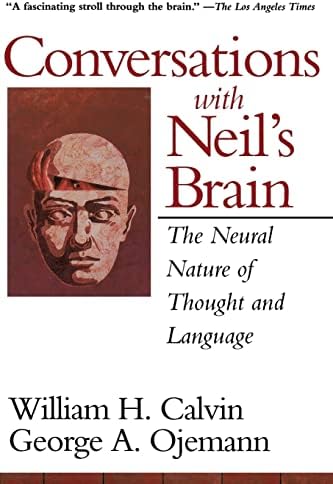
Conversations With Neil's Brain: The Neural Nature Of Thought And Language
Purchase options and add-ons
- Print length358 pages
- LanguageEnglish
- Publication dateApril 25, 1995
- Dimensions6 x 0.85 x 9 inches
- ISBN-100201483378
- ISBN-13978-0201483376
Editorial Reviews
From the Author
About the Author
William H. Calvin, Ph.D., a neurophysiologist at the University of Washington, is the author of The Throwing Madonna and The River that Flows Uphill.
George A. Ojemann, M.D., a neurosurgeon at the University of Washington, collaborated with Dr. Calvin on their earlier book, Inside the Brain.
Product details
- Publisher : Basic Books
- Publication date : April 25, 1995
- Edition : First Paperback Edition
- Language : English
- Print length : 358 pages
- ISBN-10 : 0201483378
- ISBN-13 : 978-0201483376
- Item Weight : 1.15 pounds
- Dimensions : 6 x 0.85 x 9 inches
- Best Sellers Rank: #2,201,357 in Books (See Top 100 in Books)
- #1,644 in Neuroscience (Books)
- #1,874 in Medical Neuropsychology
- #2,577 in Popular Neuropsychology
- Customer Reviews:
About the author

William H. Calvin, Ph.D., is a professor emeritus at the University of Washington School of Medicine, and President of the CO2 Foundation. His most recent book is "EXTREME WEATHER and what to do about it." He is the author of "Global Fever: How to Treat Climate Change" (University of Chicago Press 2008, see Global-Fever.org) and 15 earlier books for general readers. He studies brain circuitry, ape-to-human evolution, climate change, and civilization's vulnerability to abrupt shocks.
You probably share the author’s frustration that fifty years of climate warnings have been ineffective—and, even if they were working, that the proposed climate actions are now unlikely to be quick enough. He has been trying to reframe how scientists talk to the public about the climate problem—and about how to back ourselves out of its danger zone. Considering how the extreme weather disruptions might play out, we may only have twenty years to finish a CO2 cleanup. Even if the most ambitious of cleanup proposals were implemented on the fastest possible schedule, it would still be eight years before the cooling began.
Here he emphasizes the 2000-2012 surges in extreme weather and then the need for a big, fast, and secure drawdown of the 50% excess of atmospheric CO2. There are 120 color illustrations, mostly scientific ones adapted for general readers.
As a medical school professor, he brings to the climate discussion the perspective of those who teach physicians how to think about risk, good-enough evidence, diagnosis, prognosis, and the proposed treatment, where side-effects must be folded into the big picture explained to the patient. Nothing like that process happens for the climate threat.
A climate version of this medical mindset could supplement the usual emphasis on root causes of climate change. In the reframing, one can talk about surges in extreme weather where the numbers are far bigger than those fractional degrees of further overheating (for the top five types: 100x, 24x, 8x, 4x, and 3.6 times the 20th-century baselines for severity or annual numbers--and sustained). They are also what makes it urgent to quickly draw down the excess CO2 before our ability to respond is compromised.
He wrote the first big cover story on climate instability, “The Great Climate Flip-flop,” for The Atlantic in 1998. His book Global Fever was published by the University of Chicago Press in 2008. In his 16 books, translated into 17 languages, he has woven cutting-edge science about complex subjects into a meaningful narrative for general readers and policymakers.
Dr. Calvin is a professor emeritus at the University of Washington (Ph.D. in Physiology & Biophysics, from a physics background) who has been following abrupt climate change closely since 1983. That’s because he works on how evolution managed to enlarge the human brain three-fold during the Pleistocene. Climate change usually speeds up evolution; in search of an augmenting feedback loop, he needed to understand that interaction in close detail. After 2003, he was following global warming per se.
Our situation is not hopeless, he says, as those exaggerated reader-grabbing headlines are starting to suggest. Doing something big should bring hope during the minimum 10-15 years it will take to begin reducing extreme weather. Our situation may be bad, but it is not too late.
There are effective actions we can still take to repel the extreme weather invasion, if we only get our act together in a hurry. Like war, it is risky and uncertain. But properly focused actions can greatly improve our chances. The trip to Hell is not a sure thing.
His climate talk in Beijing at the Great Hall of the People is available in streaming video as are other lectures at NASA and Rice University.
Related products with free delivery on eligible orders
Customer reviews
Customer Reviews, including Product Star Ratings help customers to learn more about the product and decide whether it is the right product for them.
To calculate the overall star rating and percentage breakdown by star, we don’t use a simple average. Instead, our system considers things like how recent a review is and if the reviewer bought the item on Amazon. It also analyzed reviews to verify trustworthiness.
Learn more how customer reviews work on Amazon