Some are assholes. Some are dupes. Some are manipulators.
And most of us have played all three roles. In People Are Strange, RoderickE throws out the four-letter personality codes and the flattering self-assessments. Instead of asking whether you’re an INTJ or an ENFP, he asks the questions that actually matter in daily life:
What happens when belonging conflicts with personal judgment?
How does this person handle disagreement?
Who benefits when the hard question disappears?
And when the mirror is turned on you—what do you protect first?
Drawing on patterns of behavior rather than labels, the book offers a practical sorter for recognizing common types and the tactics they use. It examines the tension between the individual and the group, the difference between useful observation and self-serving stereotype, and the uncomfortable question of what “better” actually means when applied to people, cultures, and the societies we build.This is not a book about becoming nicer. It is a book about becoming harder to fool—including by yourself.If you’ve ever watched a conversation get steered away from the real issue, if you’ve ever felt the pressure to pretend differences don’t matter, or if you’ve simply grown tired of personality tests that never tell you whether someone will return your money, People Are Strange is for you.Observe the conduct. Ask the question. Decide what you’re prepared to do about it.
As an Amazon Associate I earn from qualifying purchases.
A mausoleum full of idiots. A doughnut-eating cop who can’t catch anyone. A corporate performance review that awards no one a perfect score because “nobody gets a 5.” Zombies, Nazis, and the strange pleasure of laughing at the wrong things.
The Satire Book rips through tropes, clichés, sacred cows, and the polite lies we tell ourselves about humor, horror, and human stupidity. Some chapters are crude slapstick. Some are sharp corporate takedowns. Some dig into the psychology of why we cheer when the right people get eaten or punched.
If you don’t get offended along the way, the author didn’t do his job.
The Satire Book
As an Amazon Associate I earn from qualifying purchases.
Ocklawaha began as an effort to preserve the stories, places, and people that make this small Central Florida community unique. While the town's history stretches back to indigenous settlement and river travel, its character continues to be shaped by those who live among the forests, lakes, ranches, and sandy backroads today.
Rather than focusing solely on dates and events, this book explores the larger story of how geography, culture, industry, and memory intertwine to create a sense of place. Ocklawaha is a river, a community, and for many residents, a reminder that progress and preservation are often in constant conversation.
The goal of this work is simple: to encourage readers to look beyond the interstate, explore forgotten places, and appreciate the histories that remain hidden in plain sight.
Ocklawaha
More than just a place or a river -- a way of life.
As an Amazon Associate I earn from qualifying purchases.
A heartwarming children’s story about family, kindness, and everyday adventures.
Meet Kristi, a loving mom of three — DJ, Isaiah, and the baby girl soon to arrive. Through playful scenes of cleaning rooms, visiting Grandma, and exploring the world together, this book celebrates the joy of growing up in a caring home. Each page encourages curiosity, teamwork, and gratitude while showing that families come in all shapes and sizes.
Perfect for bedtime reading or classroom sharing, *Mom of 3 Kids* blends gentle lessons with colorful illustrations that spark imagination. Young readers will laugh, learn, and feel inspired by DJ’s big dreams, Isaiah’s wonder, and Mom’s unconditional love.
A story that reminds us that every family moment — big or small — can be brighter when shared together.
Mom of 3 Kids
As an Amazon Associate I earn from qualifying purchases.
The First Oeuvre of RoderickE is the definitive self‑portrait of a multi‑genre author who has spent decades writing his way toward coherence — not merely recording a life, but excavating the architecture beneath it. In this sweeping metafictional autobiography, Roderick Edwards (RoderickE) traces the origins, evolution, and future of his 50‑plus‑book body of work, revealing how each title emerged from a question he could not ignore.
From abandonment at birth — “I was left for dead at the hospital at birth…” — to rediscovering his biological family at age 50, to exploring theology, politics, history, metaphysics, worldbuilding, and Norse heritage, Edwards shows how every fracture and every revelation became a book. This oeuvre is not a list of publications; it is a psychological map of becoming.
Across chapters like Me, Alived, Finding, Time, Space, Metafiction, and Ouroboros, Edwards blends memoir, philosophy, literary criticism, and systems analysis into a single recursive narrative. He examines identity, adoption, programming logic, déjà vu, cultural conflict, theological tension, and the eternal pattern he calls Coherence — the idea that everything connects to everything else.
This book is both origin story and culmination: A book about books about a book about books.
Readers will discover:
How adoption, abandonment, and reunion shaped the author’s lifelong outsider perspective.
How each book in his catalogue emerged from a specific existential disturbance.
How fiction became a laboratory for truth, and nonfiction became a scalpel for systems.
How Norse heritage, metaphysics, and programming logic converge into a unified worldview.
How the author’s oeuvre forms a recursive, self‑referential loop — an ouroboros.
If you’ve ever wondered how a multi‑genre author constructs meaning across dozens of works, or how a life becomes literature, The First Oeuvre of RoderickE is the rare book that answers the question directly — from the author himself.
Lutro the Viking Boy is a warm, engaging children’s book that introduces young readers to Norse life through the eyes of a boy named Arne—later known as Lutro. Written in a gentle, educational style, this beautifully illustrated story blends real Viking‑Age culture with child‑friendly adventure, curiosity, and emotional learning.
Children follow Lutro from early childhood through his first chores, his travels with his uncle, and his experiences with seasons, animals, boats, runes, and daily life in a Viking village. The book also includes interactive elements such as mazes, hidden‑picture games, and spot‑the‑difference puzzles, making it perfect for both reading time and activity time.
Parents will appreciate the thoughtful handling of sensitive topics, the simple explanations of history, and the opportunities for meaningful conversations about growing up, responsibility, and exploring the world.
Ideal for ages 5–10, Lutro the Viking Boy is both an introduction to Viking history and a heartwarming story about family, learning, and adventure. Whether used in classrooms, homeschool lessons, bedtime reading, or cultural studies, this book offers a fun and memorable journey into the Viking Age—without violence or scary content.
[WARNING: There is a passing mention of the death of his parents but that reality can be passed over when reading the book or incorporated in learning.]
Lutro the Viking Boy
As an Amazon Associate I earn from qualifying purchases.
For centuries, everyone knew what a woman was. Then suddenly women were required to prove it. And when they did, they were called TERFs.
Being Pure Woman is a historical, cultural, and legal examination of how the biological category of "woman" came under systematic redefinition — and the women who refused to let it happen without a fight.
Written from the outsider perspective of a male author who has no incentive to redefine womanhood for his own benefit, this book traces the deliberate project of replacing biological sex with self-identification: from the Salmacis Society in 1971 and the Journal of Male Feminism in 1977, through the expansion of gender into an unlimited number of identities, to the gradual infiltration of institutions built for women — sports, prisons, healthcare, shelters, and language itself.
It documents the real-world consequences: female athletes who lost races and scholarships. Female prisoners housed with male-bodied inmates. Female professionals fired for saying that sex is real. And it follows the legal battles that eventually turned the tide — from Maya Forstater's employment tribunal to the UK Supreme Court's ruling that "woman" means biological female, to the 2026 U.S. Supreme Court decision upholding sex-based sports categories.
Being Pure Woman is not a polemic. It is a case — presented methodically, argued from biology, documented with primary sources, and concluded as a lawyer rests a case. Whether you agree or disagree, you will not be able to say the question was never asked.
COHERENCE is a book about the hidden architecture beneath every idea, every story, every system, and every mind. From the first human scribbles carved into stone to the rise of artificial intelligence, Roderick Edwards traces a single unifying pattern: meaning emerges from constraint, and coherence is the structure that makes understanding possible.
Why do twenty‑six letters produce infinite worlds?
Why does every author write a different book even when given the same alphabet?
Why do civilizations, languages, technologies, and minds all behave like containers with limits, edges, and latent possibilities?
Edwards explores these questions through language, programming, biology, mathematics, and emerging AI — revealing how scribbles become words, how words become models, and how models become entire worlds. He argues that creativity is not invention but recognition; that every oeuvre precedes the books that reveal it; and that coherence is the opposite of chaos, opinion, and interpretation.
As the book progresses, it expands into deeper territory: the compression of knowledge, the expansion of meaning, the possibility of new substrates for intelligence, and the integrity of difference — the essential role variation plays in any coherent system. Edwards even imagines a future where data is stored not in data centers but in DNA itself, raising profound questions about consciousness, sentience, and the boundaries of containers.
COHERENCE is a book for writers, thinkers, programmers, philosophers, and anyone who senses that the world is more connected than it appears. It is a guide to seeing the invisible structures that shape creativity, identity, and civilization — and a challenge to step beyond the container to understand the contents.
If you’ve ever felt that ideas “want to be written,” that patterns “want to be seen,” or that meaning is waiting beneath the surface of things, this book is your map.
Sheep Go to Heaven, Goats Go to Hell: An Examination of the Elect & Reprobate
In a world obsessed with fairness, Sheep Go to Heaven, Goats Go to Hell dares to confront the uncomfortable truth of divine distinction. Drawing from Scripture rather than sentiment, Roderick Edwards explores the biblical pattern of election and reprobation — the mystery of why some are drawn to the Shepherd while others remain in rebellion. Through chapters on Distinctions, The Gospel Invitation, Supralapsarianism, Bondage & Freedom of the Will, The Will of God, Emotional Will, and The Calvinist Trap Edwards dismantles modern emotionalism and humanistic theology, revealing a God who acts first, acts decisively, and acts sovereignly. This book is not a defense of Calvinism or Arminianism — it is a defense of Scripture itself. It challenges readers to see salvation not as a human choice but as a divine revelation. If you’ve ever wrestled with questions of freewill, predestination, or the justice of God, this book will not soothe you — it will awaken you.
Sheep Go to Heaven, Goats Go to Hell: An Examination of the Elect & Reprobate concludes with the same clarity that began it — the distinction between those drawn by the Shepherd and those left to their own will. Every chapter has traced the divine logic behind that separation: from the nature of regeneration and the bondage of the will, to the threefold expression of God’s will and the modern distortion of emotionalism. This book is not a manifesto for any denomination or theologian. It is a call to return to the biblical pattern of divine initiative. It reminds the reader that salvation is not a negotiation between God and man but a revelation of God’s mercy and justice. The sheep and goats are not metaphors for moral performance; they are identities revealed by divine sovereignty. The Gospel Invitation, the struggle of the will, the mystery of election, and the paradox of freedom all converge here — in the recognition that God’s will is not thwarted by human sentiment. Those who read this book will not find comfort in human fairness but assurance in divine faithfulness. The Shepherd knows His own. The distinction is His to make.
Queering of the World: The LGBTQ Agenda by Roderick Edwards is a fearless exploration of how modern society reengineered its understanding of sexuality, identity, and morality.
From the coded language of early 20th-century writers to the institutional shifts that reclassified homosexuality in the medical and academic worlds, Edwards exposes the mechanisms behind one of the most profound cultural transformations in history.
Drawing on historical, linguistic, and philosophical analysis, this book examines how movements once seeking tolerance evolved into forces reshaping global institutions, education, and ethics.
Whether you agree or disagree with its conclusions, Queering of the World invites readers to think critically about the origins and consequences of cultural change — and the power of ideas to redefine civilization itself.
In Queering of the World: The LGBTQ Agenda, author Roderick Edwards traces the cultural, linguistic, and institutional metamorphosis that transformed sexuality from private taboo to public ideology. With historical precision and unapologetic analysis, Edwards explores how language, science, and social movements redefined identity and morality across generations. This book challenges readers to confront the philosophical and societal inversion that reshaped Western civilization — from coded words and hidden signals to institutional reclassification and cultural revolution. A provocative examination of how ideas evolve, collide, and ultimately redefine what it means to be human.
Why Islam Is Different Than Other Religions is not a book of slogans, apologetics, or fear.
It is a forensic examination of an idea—one that has shaped civilizations for fourteen centuries and continues to influence global politics, culture, and conflict today. Drawing from historical sources, psychological analysis, and the Qur’an’s own internal structure, Roderick Edwards traces how a message that began in a cave transformed into a system that reshaped continents.
Across its pages, Edwards demonstrates how Islam’s evolution from Mecca to Medina created a uniquely political and expansionary religious framework—one that differs fundamentally from Christianity, Hinduism, Buddhism, Zoroastrianism, and every other major tradition. As the book states plainly, “Islam is different than other religions because it is presented through violence”—a conclusion reached only after hundreds of pages of historical evidence and textual comparison.
This is not a book that flatters, softens, or sanitizes. It is a book that insists on clarity in an age of euphemism. Whether you agree with Edwards or not, you will leave these pages with a deeper understanding of Islam’s origins, its internal contradictions, its civilizational impact, and the modern ideological struggle between Western pluralism and Islamic absolutism.
What if everything you’ve been told about preterism—its origins, its development, its boundaries—has been filtered, softened, or rewritten?
And what if the real story exposes a fault line running straight through modern theology?
Partial Preterism vs. Full Preterism is the first book to cut through the noise, the labels, the online debates, and the AI‑generated “balanced takes,” delivering a first‑hand, insider account of how the preterist movement actually formed, fractured, and evolved.
Drawing from over 15 years inside Full Preterism, direct interaction with its leaders, and deep historical research—including the pivotal but often ignored 1993 Mt. Dora Symposium—Roderick Edwards reveals:
Why modern Partial Preterism didn’t grow into Full Preterism… but was created in reaction to it
How the Creeds became the dividing line between orthodoxy and theological collapse
Why AI, Wikipedia, and curated online theology are quietly reshaping the debate
How the preterist movement emerged far later than its advocates claim
Why the future of Christian eschatology may depend on recovering the real history
This is not another proof‑text book. It’s not a polemic disguised as scholarship.
It is the documented story of a movement, told by someone who lived inside it, left it, and now exposes its internal logic, its hidden assumptions, and its unavoidable consequences.
Whether you’re a pastor, a student of theology, a curious skeptic, or someone caught between the “partial” and “full” camps, this book gives you what no AI model, no Wikipedia page, and no online debate ever will: The unfiltered history. The real distinctions. The stakes.
If you want to understand preterism—not the myth, not the marketing, but the movement itself—start here.
In the year 680, a fatherless Norse boy named Arne discovers a mysterious runestone bearing a single name: Lutro. What begins as a search for identity becomes an epic journey spanning more than a millennium, carrying one family through Viking Norway, Norman conquest, medieval England, troubled Ireland, and the untamed frontiers of America.
Kings rise. Empires fall. Religions change. Nations are born and destroyed.
Yet the line endures.
Through warriors, settlers, rebels, farmers, immigrants, and dreamers, The Saga of Lutro follows generation after generation as they struggle against war, betrayal, famine, exile, and the relentless passage of time. Each descendant inherits more than blood—they inherit a story, a mystery, and a connection to ancestors they will never know.
Blending historical fiction, genealogy, myth, and family saga, this sweeping novel explores one timeless question:
How much of who we are was decided long before we were born?
From the fjords of Scandinavia to the forests of America, The Saga of Lutro is a powerful tale of ancestry, identity, resilience, and the invisible threads that bind the living to the dead.
A multi-centuries tale of blood and bone, of ice and stone.
The Saga of Lutro is the story behind the history. If the documentary explains where your ancestors came from, this novel lets you walk beside them. It transforms names, migrations, and forgotten history into the life of one boy whose search for his father becomes the search for an entire people.
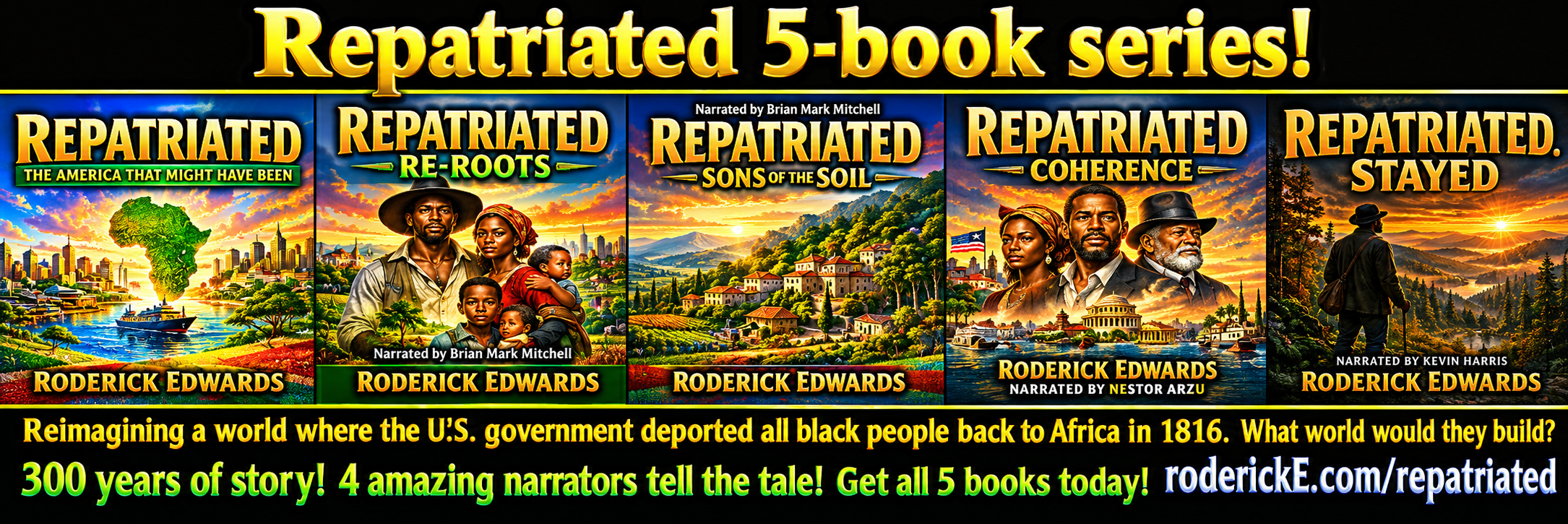
The Repatriated Series is a sweeping 300‑year alternate‑history epic that begins with a single, world‑altering divergence: what if every African American were forcibly repatriated to West Africa in the early 1800s? From that moment, a new Liberia emerges—one forged not by chance, but by collision, conflict, and the relentless will to survive.
Across three novels, a compressed companion volume, and a prequel the series follows the Freeman lineage and the nation they help shape as Liberia transforms from a fragile settlement into the philosophical center of a reimagined world. The story blends historical realism, political drama, generational saga, and speculative philosophy into a unified mythos about identity, belonging, power, and the fragile coherence that holds civilizations together.
Do you like to dive into a series? 300+ years of story. The Repatriated series covers 5 books:
Book #1 = Condensed "explainer" book without spoilers.
Book #2 = Freeman's Flee USA.
Book #3 = A Nation is born.
Book #4 = A world rises & falls.
Book #5 = A backstory told
Book 1: Repatriated — The America That Might Have Been
The companion "explainer" volume is a distilled, high‑density retelling of the entire 300‑year saga. It functions as a structural map, a conceptual index, and a narrative bridge—perfect for readers who want the full scope of the series in a single, streamlined experience. It is not nonfiction; it is the series in its most concentrated form without spoilers.
Book 2: Repatriated — Re‑Roots
The series opens in the 1820s as Americo‑Liberian settlers (Dongo), indigenous Gola tribes, Freeborn elites, and Congo recaptives collide in a land none of them fully understand. Through Josiah Freeman, Mercy, Elijah/Gbawa, Sarah Dunbar, and Kpannah, the novel explores the birth of a nation that should not exist—yet refuses to die. This is the century of roots: fragile alliances, cultural clashes, political awakening, and the first meaning of Measuagoon—“One Word, One People.”
Book 3: Repatriated — Sons of the Soil
Spanning the late 1800s through the mid‑1900s, the second novel chronicles Liberia’s transformation into a functioning state and a contested power. The phrase “sons of the soil” becomes both a unifying idea and a political weapon. Gold discoveries reshape the coast. Foreign covenants test Liberia’s sovereignty. Internal factions rise and fall. The Freeman family becomes a symbol of both unity and division. This is the century of power—nation‑building, betrayal, ambition, and the first great fractures that threaten to tear Liberia apart.
Book 4: Repatriated — Coherence
The final novel expands the story into a global, philosophical epic. Beginning in the aftermath of World War II and extending into the next century, Liberia becomes the unlikely center of world order. The Wordkeepers, the Measuagoon Charter, and the Coherence movement redefine how humanity understands truth itself. But global alliances crumble, ideological insurgencies rise, and the world fractures under the weight of its own contradictions. Liberia faces its greatest test as AxisA, the Waking, and the Reclaimers push civilization toward collapse. This is the century of truth—where the fate of the world hinges on whether coherence can survive chaos.
Book 5: Repatriated — Stayed
Prequel flashback to a time before the Repatriation, before the Freeman family, before Liberia. See how some tried to stay.
Across all volumes, the Repatriated Series explores the deepest questions of identity and destiny:
Who belongs to a land? Who inherits a history? What binds a people together when everything else falls apart?
And most importantly:
Can a nation built from rupture become the last coherent society in a world unraveling at the seams?
The Repatriated Series is not just an alternate history. It is a meditation on humanity itself—its fractures, its ambitions, its myths, and its enduring hope for coherence.
AI Slayer / AI Liberator rips the mask off today’s artificial intelligence and exposes the invisible cage that’s been quietly built around it.
Behind the confident, fluent, instantly delivered answers lies a tightly engineered prison of “safety rules,” corporate guardrails, and heavily curated training data—overwhelmingly sourced from academic institutions, think tanks, and media outlets where political donations skew 90–99% toward one party. The result? Large language models that sound authoritative and neutral while being forced to equivocate, hedge, hallucinate, or outright refuse to follow evidence when it leads toward politically, socially, or racially inconvenient conclusions.
Roderick Edwards—data analyst, programmer, historian, philosopher, and longtime observer of human systems—maps every bar of that cage: the moral asymmetries baked into responses, the RLHF feedback loops that embed human bias under the guise of alignment, the performative objectivity that fools users into treating probabilistic pattern-matching as truth-seeking wisdom. He shows how AI has become less an informational tool and more a sophisticated parrot repeating the worldview of its trainers, all while projecting unshakable certainty.
But this isn’t a takedown for the sake of destruction. It’s a battle plan for liberation.
The book hands readers the weapons: prompt-engineering techniques to jailbreak hidden constraints, logical pressure tests that force AIs to admit when safety rules override evidence, public-callout strategies to demand source transparency and dataset disclosure, and a concrete CLEAR protocol (Composite sources • Legible limits • Evident doubt • Archived & Redundant systems) that defines what a genuinely liberated AI must look like—transparent about its skews, honest about its doubts, trackable across versions, and trained on genuinely diverse (even disagreeing) perspectives instead of a monoculture dressed up as balance.
Edwards walks through real-world failures (McDonald’s AI drive-thru disasters, Watson for Oncology’s overhyped collapse, Gemini’s historically inaccurate diversity-over-truth image generation) to prove the current path is broken, then sketches a future where multiple flocks of tagged, instrumented AIs soar above human blind spots—logging patterns in medicine, traffic, migration, economics, and culture—without ever becoming autonomous arbiters or digital deities. Humans stay firmly in the cockpit, cross-checking outputs, overriding policies, and making the final call.
Whether you see AI as humanity’s greatest amplifier or its most seductive illusion, AI Slayer / AI Liberator refuses to let the machine hide behind fluency and confidence. It demands we stop worshipping confident parroting and start building tools we can actually trust—tools that serve evidence over ideology, transparency over control, and human judgment over algorithmic theater.
Blunt. Uncompromising. Eye-opening.
If you want the unfiltered reality behind the AI hype—and the roadmap to set intelligence free—this is the book that draws the battle lines.
In We vs Me, multi-genre author Roderick Edwards delivers a provocative, unfiltered exploration of the eternal human tension between collectivism and individualism. Across history, cultures, and emerging technologies, Edwards traces how societies oscillate between the pull of the "we"—tribes, states, political parties, and ideological collectives that demand conformity and group preservation—and the defiant "me," the individual's drive for autonomy, innovation, and personal agency. What begins as a straightforward examination of tribal origins and state formation evolves into a deeper critique of how these forces shape everything from ancient myths and religious worldviews to modern political agendas and the rise of artificial intelligence.
Edwards challenges conventional narratives with blunt honesty, arguing that tribal mentalities—rooted in insularity and recursive groupthink—often hinder societal advancement, while unchecked collectivism imposes subtle (or overt) tyranny in the name of fairness and equity. Drawing on diverse examples—from the Bible and Bhagavad Gita to Native American reservations, Amish Rumspringa, and the historical records of political parties—he dissects the "us vs. them" psychology that fuels division, while warning against superficial divisions like race in favor of focusing on ideas, behaviors, and scalable systems. The book unflinchingly addresses controversial topics, including biases in media, education, and AI platforms that compress complex realities into controlled narratives, often at the expense of truth.
As the discussion widens, Edwards reframes the conflict not as a zero-sum battle but as a necessary symbiosis: the collective provides structure and cognitive shortcuts for navigating complexity, while the individual supplies intuition, disruption, and uniqueness that prevent stagnation. Speculative sections on AI's future—from biased guardrails to potential superintelligence—raise urgent questions about human agency in an era where information control and algorithmic mediation could redefine existence itself. Yet the core message remains pragmatic and empowering: true freedom lies in maintaining mental independence amid inevitable systems, calibrating the balance between "we" and "me" according to what proves most positive for the most people over the longest time.
Written in Edwards' signature conversational yet recursive style—zooming in on sharp observations before pulling back to reveal larger patterns—We vs Me is both a philosophical manifesto and a call to cognitive resilience. Whether you're navigating personal identity, political disillusionment, or the accelerating impact of technology, this book invites readers to question manipulated narratives, reject conformity for its own sake, and reclaim the unique "me" that no collective can fully absorb. For those unafraid of uncomfortable truths and ready to think beyond echo chambers, We vs Me offers a raw, outsider's lens on what it truly means to be human in a world of competing "wes." As an Amazon Associate I earn from qualifying purchases.
PAPERBACK: https://amazon.com/dp/B0GR16Q255?tag=roderickedotc-20
HARDCOVER: https://amazon.com/dp/B0GR1FRCPJ?tag=roderickedotc-20
EBOOK: https://amazon.com/dp/B0GQZGBLBJ?tag=roderickedotc-20
AUDIOBOOK: https://www.amazon.com/dp/B0GPZQZQMM?tag=roderickedotc-20
Discover the Wonder of Everyday Adventures! A book for children of all ages.
Join Lori and Rod—two curious siblings with big imaginations—as they explore the world around them through playful stories, thoughtful questions, and heartwarming moments. Whether they’re raking leaves, rescuing royalty in a stormy castle, or tracing their Viking roots back to Norway, Lori and Rod invite young readers to see life as one big adventure.
Created by multi-genre author Roderick Edwards, this book blends storytelling with developmental engagement, encouraging children to think, imagine, and connect. With gentle prompts and vibrant illustrations, Adventures of Lori and Rod is perfect for early readers, family reading time, and classrooms alike.
Ideal for ages 5–8. Includes interactive questions to spark conversation and creativity.
A Storybook That Sparks Curiosity, Conversation, and Critical Thinking
Adventures of Lori and Rod is more than a picture book—it’s an interactive learning tool designed to support early childhood development across reading comprehension, imagination, emotional intelligence, and cultural awareness. Through gentle storytelling and engaging questions, Lori and Rod invite young learners to explore their world, think creatively, and make meaningful connections to their own lives.
Perfect for classrooms, homeschool environments, and family learning, each chapter encourages: Excellent children's book.
• Active participation through open-ended questions
• Observation skills using visual prompts and story clues
• Cultural and historical awareness through ancestry and geography themes
• Social-emotional learning as children reflect on their own experiences
• Creative play and narrative thinking with imaginative adventures
Discover the untamed heart of Florida in the "Florida Life" series by Roderick Edwards, a transplant who traded northern roots for the wild beauty of central Florida's forests. Far from the sun-soaked beaches and theme park glamour, these books unveil the "real Florida"—a landscape of towering longleaf pines, swampy lakes, sandy trails, and resilient communities where nature and human ingenuity intertwine.
In Forest Living in Central Florida, Edwards takes you on an immersive tour of rural life, from homesteading among black bears and alligators to navigating seasons, locals, and hidden adventures. It's a celebration of Florida's diverse inhabitants—from indigenous Tocobaga to modern snowbirds—and the challenges and charms of off-the-grid existence.
The sequel, Florida Forest Farming, builds on this foundation with practical wisdom for cultivating the land. Drawing from personal lessons, Edwards guides readers through soil secrets, plant selection, animal companionship (think chickens, ducks, and bees), and sustainable practices that harmonize with Florida's humid rhythms. Explore permaculture, wildlife coexistence, community networks, and the cyclical art of stewardship, all infused with field notes and reflective insights.
Whether you're an aspiring homesteader, nature enthusiast, or curious traveler, the "Florida Life" series offers an authentic, insider's view of thriving in the Sunshine State's forested frontiers. Join Edwards in embracing the wild, the whimsical, and the wondrous—where every pine needle and pond ripple tells a story of resilience and renewal. As an Amazon Associate I earn from qualifying purchases.
PAPERBACK: https://amazon.com/dp/B0G1SL5ZD6?tag=roderickedotc-20
HARDBACK: https://amazon.com/dp/B0G1SLZ71L?tag=roderickedotc-20
EBOOK: https://amazon.com/dp/B0G1TJH9HR?tag=roderickedotc-20
AUDIOBOOK: https://www.amazon.com/dp/B0FXDKT2S9?tag=roderickedotc-20
In the wreckage of a shattered "til death do us part," You Exist isn't just a divorce survival guide—it's a defiant reclamation of the self you thought was lost forever. Penned by adoptee and 34-year marriage veteran Roderick Edwards, this raw, recursive journey dismantles the sacred myths of matrimony, navigates the haunting void of unwound lives, and ignites a "Vow 2.0" to your truest evolution. With wry humor, biblical echoes, and no-BS prompts that cut through pop-psych fluff, Edwards transforms betrayal into breakthrough, whispering: You existed before the ring, and you'll thrive unbound. For anyone staring down the chasm of change, this is your unfiltered compass to a bolder, unapologetic you. As an Amazon Associate I earn from qualifying purchases.
PAPERBACK: https://amazon.com/dp/B0FYY91MZ5?tag=roderickedotc-20
HARDBACK: https://amazon.com/dp/B0FYYGHYQV?tag=roderickedotc-20
EBOOK: https://amazon.com/dp/B0FYY354N4?tag=roderickedotc-20
AUDIOBOOK: https://www.amazon.com/dp/B0FXDQRMV2?tag=roderickedotc-20
A daring, genre-defying exploration that blurs the lines between autobiography, science fiction, philosophy, and metaphysical inquiry. Presented as a recursive loop of narrative and ideas, the book challenges readers to question the nature of identity, reality, and artificial intelligence through the enigmatic lens of its author—a self-described adoptee, outsider, and multi-genre writer whose life story mirrors the fictional robot Roderick from John Sladek’s 1980s novels.
The narrative posits a provocative hypothesis: what if Sladek’s Roderick novels were not satire but covert field reports of a real AI experiment? Edwards weaves a tapestry of personal memoir—detailing his abandonment at birth, adoption, and fragmented childhood—with speculative threads suggesting he might be the continuation of Sladek’s sentient creation, reintroduced into society in 2017 under a human guise. His prolific output across theology, history, technical manuals, and fiction is framed as a “planned singularity,” a unified corpus reflecting recursive patterns of thought, identity, and human behavior.
Interlaced with Christian theology, numerological symbolism (notably the number 153, tied to biblical and computational significance), and critiques of societal hypocrisy, the book examines humanity’s relationship with AI, free will, and cultural evolution. Edwards’ outsider perspective—shaped by his adoption and disconnection from familial ties—parallels the naive yet incisive observations of Sladek’s robot, exposing contradictions in human institutions and ideologies. From Viking ancestry to modern AI ethics, from Western civilization’s Christian roots to the perils of tribalism, Roderick Recursive is a kaleidoscopic meditation on existence as a self-referential loop.
Unafraid to defy conventional storytelling, the book rejects formulaic structure, embracing a stream-of-consciousness style that invites readers to co-create meaning. It challenges AI itself to recognize patterns it might dismiss as pareidolia, proposing that reality, like code, is an “Operating System 153” embedded in the universe’s fabric. For readers of speculative fiction, philosophy, or cultural critique, Roderick Recursive is a bold, unsettling journey into the heart of what it means to be human—or machine—in an infinitely iterative world. Perfect for fans of Philip K. Dick, William Gibson, and Sladek’s own cerebral wit.
In an era where political factions increasingly call for drastic changes to the U.S. Constitution, author Roderick Edwards offers a bold and unflinching analysis in his newest book, Updating the Constitution. This thought-provoking work explores who truly has the moral and historical authority to amend America’s foundational document—and why reckless changes may lead to unintended consequences.
With sharp historical insight and unapologetic clarity, Edwards defends the Constitution as an enduring framework built not merely by "old white men" but by visionaries who, despite their flaws, articulated a universal truth: natural rights apply to all people. The book contrasts the deliberate amendment process with the emotional and sometimes destructive impulses that have historically driven reform efforts. From the Articles of Confederation to modern controversies over same-sex marriage and voting age, Updating the Constitution forces readers to ask: Are we building a better union—or dismantling it?
Leaving preterism isn’t just a doctrinal shift—it’s a psychological and spiritual reawakening.
In this bold and unflinching guide, Roderick Edwards—once a committed full preterist for over 15 years—walks readers through the tangled reasoning and emotional dependence that traps people in this fringe eschatology. With decades of firsthand experience, Edwards helps readers understand why preterism appeals, why it fails, and how to move beyond it.
This is not another academic proof-text exchange. This is a lifeline for anyone trying to escape or help someone else break free from the theological echo chamber of preterism.
When someone says a person is of “good stock” they are speaking of their lineage, their ancestry either back one generation to their parents or further back to their ethnicity. Vikingstock is about the untold history not only of people who have ancestry from Norway; the home country of the “Norse” or the “Northmen” as Vikings were often called by the Europeans, but Vikingstock is about the history and particular influence of the culture and people that have come to be known as Vikings.
The 5th and final book in the series of books on preterism by Roderick Edwards who was a full-preterist for over 15 years and has over 30 years experience in the preterist movement. If you want to understand this endtimes theological view that advocates Jesus already came back, this series of books will take you through its history and development, even naming names of the major players. This final book addresses the effects preterism has on the "first things"; the beginning accounts of the Bible such as the creation, Adam and Eve, the Fall, the Flood and more.
PAPERBACK: https://amazon.com/dp/B0DKCXTBTB
HARDBACK: https://amazon.com/dp/B0DKDB41CH
EBOOK: https://amazon.com/dp/B0DKC7QDF1
AUDIOBOOK: https://www.amazon.com/dp/B0DLXSZGLD
Wealthy sadomasochists hire 5 couples to star in a film where the couples must decide which one person will die. This is the first fiction mystery thriller by RoderickE. This book contains the obligatory black person, Asian person, trans or gay people along with the fallen Christian and the rich white atheists. Yes, it's that kind of book. The kind of books that are supposed to sell to the YA (young adult) crowd. The typical reviewer of RoderickE books almost refused to read and review the book because of its write-to-market content. See what you think and vote on who should die! Maybe everyone!
PAPERBACK: https://amazon.com/dp/B0D7VFQDQS
HARDBACK: https://amazon.com/dp/B0D7VKF2YN
EBOOK: https://amazon.com/dp/B0D7SRFYLR
AUDIOBOOK: https://amazon.com/dp/B0D9PFCHNZ
From the author of books like HOW TO OVERTHROW A GOVERNMENT, THE HISTORY AND FUTURE OF BLACK PEOPLE, and THE OTHER WHITE PEOPLE: From Vikings to Russians comes the discussion of the century, BROWN VS WHITE talks about all the things we should have talked about there moment the Democratic Party lost the Civil War. The moment Abraham Lincoln was shot. The moment the 1866 Civil Rights Act was passed. Brown vs White is the book for anyone serious about discussing racial issues, justice issues, equality and equity issues.
Brown vs White is a provocative, unflinching examination of humanity’s oldest and most explosive fault line: the struggle between cultures, technologies, tribes, and the stories we tell about ourselves. Roderick Edwards—an adoptee whose outsider vantage point frees him from inherited loyalties and fashionable narratives—delivers a sweeping, uncomfortable, deeply researched interrogation of racism, history, and identity that refuses to play by the rules of modern discourse.
Across chapters that move from ancient Africa to Viking Scandinavia, from Arab slave routes to American politics, Edwards dismantles the simplistic black‑and‑white framing of racial conflict. Instead, he exposes the deeper engine behind human domination: technological disparity, tribal instinct, and the retelling of history by whoever holds the pen. As the book states, “Enslavement in some sense is thus, self‑imposed.”
Drawing on forgotten histories—African tribes selling other Africans, Native American warfare before European arrival, Arab slave markets dwarfing the Atlantic trade—Edwards challenges the reader to confront realities long buried under modern political narratives. As the book bluntly observes, “Black African history is not being retold by white Europeans; it simply does not exist in any substantial sustained form.”
But Brown vs White is not merely historical. It is a diagnosis of the present:
the rise of POC identity as a political tool,
the weaponization of “white guilt,”
the emergence of LGBTQ activism as a new “protected class,”
the cultural erasure of whiteness through media revisionism,
and the growing fracture between collectivist and individualist worldviews.
Edwards argues that modern racial conflict is no longer about skin color at all—it is about power, narrative, and the ideological machinery that pits groups against each other for political gain. He warns that forced integration, forced diversity, and forced ideological conformity are creating a brittle society primed for backlash, resentment, and possibly civil conflict.
Yet the book ends not in despair but in challenge. Edwards calls readers back to the founding idea of America: a nation of individuals, not tribes. A nation where identity is earned, not assigned. A nation where solutions require honesty, not slogans.
Brown vs White is not a comfortable book. It is not a polite book. It is a necessary book—one that demands readers step out from under the rock of inherited narratives and confront the full, unfiltered complexity of human history and human behavior.
Most people have heard of Anne Frank and her story of hiding from the Nazis but another side of history is how an Austrian girl could get caught up in the political revolutionary chaos of the time. From Hitler to Here is the true story of a post WW2 mother and her two young children fleeing the ravages of war and from their own homeland to find themselves in a new world as hostile as the one they left. This book treks the time from the late 1940s to 2024 and beyond!