
Abstract
The impact of real name versus anonymity on social media represents a contentious issue. This study leverages a natural experiment in China and uses social media data from financial markets to investigate the impact of mandatory real-name identification on the informativeness of social media. We find a decrease in the informativeness of social media after the mandatory real-name identification. At the user level, our tests show that mandatory real-name identification primarily diminishes the informativeness of postings generated by high-follower users, who wield considerable influence in the capital market. Moreover, after the mandatory real-name identification, the percentage of postings with valuable information decreased and the language style became more ambiguous and lacked opinions. These findings align with the idea that the consequences of mandatory real-name identification predominantly arise from an increased perception of regulatory risk among users. Overall, this study contributes significantly to the comprehension of how anonymity influences the informativeness of social media.
Introduction
The question of whether social media should mandate real-name identification or allow anonymity constitutes a contentious issue. Anonymity, on the one hand, fosters freedom of expression, facilitating the generation of the wisdom of crowds—a significant factor behind social media’s informativeness(Chen, De, Hu, and Hwang 2014; Bartov, Faurel, and Mohanram 2018). Conversely, anonymity can induce a surge of misinformation and noise, thereby undermining the informativeness of the platform (Sabherwal, Sarkar, and Zhang 2011; Kogan, Moskowitz, and Niessner 2019; Jia, Redigolo, Shu, and Zhao 2020; Cai, McLean, Zhang, and Zhao 2022). Despite the substantial and contentious influence of real-name versus anonymous identities on the informativeness of social media, a dearth of empirical evidence exists in the existing literature on this issue.
Real-name identification includes both front-end and back-end identification. Front-end real-name identification implies a context where users’ identification information is accessible to all relevant entities, including the government, social media platforms, and other social media users. Conversely, Back-end real-name identification is one where only the government and social media platforms have the authority to obtain users’ identification details. Dyer and Kim (2021) examine the economic consequences of social media users voluntarily disclosing personal information (front-end real-name) on social media and find that users with front-end real-name identification tend to post content with higher informational value. Unlike previous studies, this paper focuses on the impact of mandatory back-end real-name identification (where users are required to disclose their real identity to the government while still being allowed to use nickname on the front-end) on the informativeness of social media.
In this paper, we use the implementation of China’s Cybersecurity Law as a research setting. China introduced The Cybersecurity Law on November 7, 2016, which subsequently came into effect on June 1, 2017. This legislation mandates that social media users must provide verifiable identity information before posting content on social media platforms. Although platforms are responsible for collecting this real-name data, the government maintains the right to access it. Consequently, every social media posting can be traced back to its original poster—an actual identifiable individual—following the introduction of this law. Additionally, this regulation necessitates only that users submit their identity details to social media platforms while still allowing them to engage in interactions using pseudonyms.
We focus on the Chinese market for the following reasons: First, the impact of mandatory back-end real-name identification on social media is primarily driven by government actions. Due to China’s unique political system, the Chinese government can use back-end real-name identification to regulate and scrutinize the content posted by social media users, with the ability to trace user information back to real individuals. Therefore, the Chinese market provides a unique institutional setting for studying the effects of back-end mandatory real-name identification. Second, China’s Cybersecurity Law provides a quasi-natural experimental setting. It stipulates that social media users must provide verifiable identity information before posting content on social media platforms. While the platforms are responsible for collecting this real-name data, the government still has access to this data. As a result, after the enactment of this law, every social media post can be traced back to the original poster—a real and identifiable individual. Moreover, the regulation only requires users to submit their identity information to the social media platform, while still allowing users to interact under nicknames.
The research setting of this paper presents the following advantages: firstly, in most instances, the choice between real-name and anonymous identification is generally established at the inception of social media platforms, making it challenging to observe compulsory transitions between the two. Our setting provides a rare opportunity to observe the mandatory transition from anonymity to real-name identification, enabling us to investigate the consequences of the real-name identification. Secondly, for anonymous social media platforms, although users can voluntarily elect to use real names, the group of users choosing to use their real names may inherently differ from those maintaining anonymity, potentially leading to endogeneity issues. In our setting, the real-name identification is mandatorily required, thereby effectively mitigating endogeneity concerns.
Mandatory real-name identification may exert two fundamentally different impacts on the informativeness of social media. On one hand, in an anonymous setting, users can freely express their perspectives on the development of firms on social media, thereby creating collective intelligence that contributes to the informativeness of social media (Chen, De, Hu, and Hwang 2014; Bartov, Faurel, and Mohanram 2018). However, personal opinions voiced by users pose a significant challenge to validate in advance. If users misestimate firms’ future performance, and these predictions materially influence the market, these users could be exposed to regulatory risks for disseminating inaccurate information. After the mandatory real-name identification, regulatory agencies gain greater efficacy in penalizing social media users, leading to a sharp increase in perceived regulatory risks among users.. Meanwhile, under this mandatory real-name identification, social media users can potentially become subjects of corporate litigation, consequently heightening their perceived litigation risks. These reduces the users’ willingness to express personal views, thereby diminishing the informativeness of social media. We refer to this impact of mandatory real-name identification as the chilling hypothesis.
On the other hand, research indicates the prevalence of disinformation and noise in social media (Sabherwal, Sarkar, and Zhang 2011; Kogan, Moskowitz, and Niessner 2019; Jia, Redigolo, Shu, and Zhao 2020; Cai, McLean, Zhang, and Zhao 2022). By enabling the connection between online activity and actual identities, the mandatory real-name identification could potentially reduce regulatory costs, deter users from spreading false information, and thus enhance social media’s informativeness. We refer to this impact of mandatory real-name identification as the disciplining hypothesis.
Prior to our examination, it remains uncertain which effect of mandatory real-name identification will dominate. Thus, the impact of mandatory real-name identification on the informativeness of social media is an empirical question.
To examine the impact of mandatory real-name identification on the informativeness of social media, we initially investigate if the sentiment of social media immediately preceding earnings announcements can predict the firm’s quarterly unexpected earnings. Then we gauge the shift in this predictive capacity pre and post mandatory real-name identification. In this study, we select East Money Guba (Guba) as the social media platform of interest. Guba is recognized as the earliest established, user-oriented, and most influential social media platform in China, specifically designed to serve retail investors (Huang, Qiu, and Wu 2016; Wang, Wong, and Zhang 2019; Ang, Hsu, Tang, and Wu 2021). Our analysis comprises a sample that represents 29,978 firm-quarters from 2,802 firms, collected during the period from 2015 to 2018. Our research findings corroborate that the sentiment of postings immediately before earnings announcements display predictive validity for unexpected earnings, aligning with the findings in Bartov, Faurel, and Mohanram (2018).
Based on the implementation of mandatory real-name identification, we segregate the sample period into three distinct intervals: the pre-announcement of mandatory real-name identification; the transitional phase after the announcement of the mandatory real-name identification, but before its implementation; and the post-implementation phase of mandatory real-name identification. During the transitional phase, we notice a marginal decrease in the predictive capability of social media postings with respect to unexpected earnings compared to the pre-announcement phase, though the regression coefficient is statistically insignificant. Following the implementation of the mandatory real-name identification, the capacity of social media postings’ sentiment to predict unexpected earnings significantly declines. A trend analysis conducted at semi-annual intervals reveals that the predictive capability of social media postings remains constant prior to the implementation of mandatory real-name identification, but began to decline after its implementation. These findings suggest that mandatory real-name identification reduces the informativeness of social media, thereby lending supporting to the chilling hypothesis.
To further validate the mechanism, that is, the decline in the informativeness of social media following mandatory real-name identification is due to an increase in perceived regulatory risk among users, we conduct three tests at the user level. First, we use a generative AI-based large language model to classify social media users into front-end anonymous users and front-end real-name users, based on their usernames and profile descriptions. Theoretically, front-end real-name users voluntarily disclose their identity information prior to the implementation of the real-name policy, and therefore should not be affected by the policy itself. This group thus serves as an ideal control group in our empirical analysis. Consistent with this expectation, our findings show that the mandatory real-name identification affects only front-end anonymous users by reducing the informativeness of their posts, while it has no significant effect on front-end real-name users.
Secondly, users who disseminate information potentially influential to the market are more likely to attract regulatory scrutiny. For such users, the risk of expressing their opinions after the mandatory real-name identification is relatively high. We divide the samples into three groups based on the number of followers: one encompassing users with no followers; another with followers numbering between one and ten; and the third constituting users with more than ten followers. As users have more followers, the impact of their postings on capital markets also becomes stronger. We compare the changes in the predictive power of the postings’ sentiment between different groups and find that the mandatory real-name identification primarily reduces the informativeness of postings made by users in the third group—those with more than ten followers.
Thirdly, we employ text analysis methods to examine the impact of mandatory real-name identification on the content of postings. We find that following mandatory real-name identification, high-follower users have reduced their discussions related to firm earnings and predictions about future firm performance. Stylistically, they appear to have decreased their use of definite statements and are less inclined to express personal views. These findings imply that the implementation of the mandatory real-name identification has increased perceived regulatory risk among users and weakened their willingness to post valuable information on social media.
Furthermore, we examine the impact of mandatory real-name identification on the informativeness of social media using a series of capital market indicators. Under the assumption of market efficiency, if social media possesses valuable information, it should also prompt a response in the capital market. Our empirical tests reveal that social media postings trigger changes in the firm’s cumulative abnormal returns, trading volume, and bid-ask spread, indicating that social media postings possess valuable information before earnings announcements. However, following mandatory real-name identification, the aforementioned influence of social media on capital markets significantly weakens, further confirming that mandatory real-name identification diminishes the informativeness of social media.
Both social media and traditional media are important information providers and disseminators to the capital market. Utilizing traditional media as a control group, our research reveals that social media’s sentiment and traditional media’s sentiment could effectively predict firms’ unexpected earnings, indicating the presence of valuable information in both social media and traditional media. However, only the informativeness of social media exhibits a significant decrease after mandatory real-name identification. This finding further confirms that the observed changes in the informativeness of social media are indeed driven by mandatory real-name identification.
Overall, our findings make three important contributions. First, this paper adds to the body of research on the informativeness of social media. As a novel channel for information provision and dissemination, the impact of social media on the capital market has garnered increasing attention. Prior research indicates that social media can offer incremental valuable information to the capital market (Antweiler and Frank 2004; Chen, De, Hu, and Hwang 2014; Bartov, Faurel, and Mohanram 2018). Unlike prior studies, our work primarily centers on the anonymity aspect of social media, examining the effects of mandatory real-name identification on the informativeness of social media.
Secondly, This paper is the first to study the impact of back-end real-name identification on social media. Dyer and Kim (2021) pioneered research into the consequences of front-end real-name identification versus anonymous identity recognition on social media. Using data from Seeking Alpha, they examined how investors respond differently to posts made under real-name versus anonymous identities. Our study complements Dyer and Kim’s (2021) work in several ways. First, compared to Dyer and Kim (2021), our paper primarily focuses on the perspective of government regulation, assessing the impact of mandatory real-name identification enforced by the government on social media. Second, our paper emphasizes the effect on information quality, whereas Dyer and Kim (2021) primarily focus on investors’ reactions to posted information. Third, while Dyer and Kim (2021) investigate front-end real-name identification, our research concentrates specifically on back-end real-name identification.
Lastly, we expand the studies related to social media regulation. To reduce misinformation and improve the environment within social media platforms, governments worldwide have sought to strengthen social media regulation. Among the controversial regulatory approaches, the mandatory real-name identification has garnered significant attention and sparked extensive discussions. Nonetheless, there is limited research investigating the consequence of the mandatory real-name identification. Our paper aims to bridge this gap.
Admittedly, our study is confined to one country—China—because the research setting and data for back-end real-name identification on social media are unique under Chinese law. Due to the distinct institutional, economic, and corporate governance systems in China, which often differ from those in Western economies, we do not assume that the behavior of all social media users can be generalized to other countries. However, our study aims to offer insights for broader social media and capital market research in three ways. First, our findings are consistent with the existing literature, which shows that social media has informational value in emerging markets (Ang, Hsu, Tang, and Wu, 2021), aligning with research conclusions from capital markets like the United States (Antweiler and Frank, 2004; Chen, De, Hu, and Hwang, 2014). This suggests that social media may serve a universal informational function across different markets. Second, although there are differences in social media regulatory policies across countries, the economic incentives and constraints faced by social media users when posting information are universal: increased costs and risks reduce users’ incentives to share valuable information. Research in other markets, including the U.S., shows that social media users’ willingness to post valuable information depends on a cost-benefit trade-off. For example, economic returns (Chen, De, Hu, and Hwang 2014), social returns (Antweiler and Frank 2004; Sprenger, Tumasjan, Sandner, and Welpe 2014), and psychological returns (Toubia and Stephen 2013). This indicates that real-name identification may influence users’ willingness to provide valuable information by increasing the cost of posting, and this mechanism can be applied across markets. Finally, the issue of real-name versus anonymous identities on social media is a global concern. Although we conduct our study using the Chinese setting, we do not believe that research on real-name and anonymous identities in social media is unique to China. An increasing number of countries are discussing the issue of real-name and anonymous policies on social media. For example, at the 2025 World Economic Forum (WEF) in Davos, Spanish Prime Minister Pedro Sánchez called for all social media platforms to end anonymous systems and require all user accounts to be linked to the European Digital Identity Wallet. South Korea implemented mandatory real-name authentication in 2007, although it was ruled unconstitutional and abolished in 2012. Nevertheless, this policy attempt demonstrates that real-name identification has a global practical basis. Additionally, both China and Germany currently use real-name identification on the internet. Therefore, although the research setting is based on the Chinese market, the impact mechanisms of real-name identification explored in this paper have external relevance and can offer valuable insights for understanding social media governance and its interaction with capital markets globally.
Background and hypothesis
Background
China introduced The Cybersecurity Law on November 7, 2016, which subsequently came into effect on June 1, 2017. China’s Cybersecurity Law stipulates that when network operators provide users with information publication and instant messaging services, they shall require users to provide identity information. If a user fails to provide identity information, network operators shall not provide relevant services.
Social media users validate their identities via their mobile phone numbers. It is mandated for users to bind their mobile phone numbers with their social media accounts. The Chinese government requires mobile users to provide their personal IDs to the telecommunications service provider during the registration of a mobile SIM card. This authentication is accompanied by an audit verification process that employs a facial recognition system to match individuals with their provided IDs. Once verified, personal information such as ID number, name, and other details are linked to the mobile number.
The mandatory real-name identification is the third-generation internet access mode following IP addresses and domain names. Its purpose is to unify online and real-world identities. Prior to the establishment of the mandatory real-name identification, the anonymity of the internet prevented the linkage of individual online identities with their real-world counterparts. If a person commits a crime online, the conventional method for tracking that person is identifying the geographic location of servers based on the suspect’s IP address. The cost of this method is high due to challenges such as the shared usage of network devices by multiple users. Therefore, the implementation of the mandatory real-name identification can reduce the cost of identifying online crime suspects. However, the implementation of this reform also raises concerns related to freedom of speech and privacy protection.
As an online financial interactive community, Guba actively implements the mandatory real-name identification. Since June 1, 2017, Guba has required that only users who have completed real-name authentication can log in. Guba requires users to use their real identity information when registering, while allowing them to choose their own nicknames. Non-authenticated website users are unable to post or forward messages and can only browse information. Although Guba collects and retains users’ real-name information, it will share this information with the government upon request.
Hypotheses
We argue that the effect of real-name identification on the predictive power of social media sentiment primarily arises from users’ behavioral responses to enhanced government surveillance. Under a back-end real-name system, although users may continue to post under anonymous screen names, their real identities are linked to their accounts in the background. Both government authorities and platform operators can trace social media activity back to individuals. The implementation of real-name identification sends a clear signal to users: “We are watching you”, which can significantly alter user behavior.
Chilling hypothesis
The chilling hypothesis suggests that users’ willingness to freely express opinions is closely tied to their perception of anonymity on social media. Within anonymous settings, users are empowered to freely articulate their perspectives regarding the development of firms. Consequently, social media platforms such as Guba often contain a substantial amount of information indicative of future corporate value. However, a problem with information indicative of future corporate value is that it is difficult to verify its authenticity in advance.
Before the mandatory real-name identification, social media users did not have to worry about their postings being mistakenly labeled as fake information, because the risk of punishment was relatively low. However, after mandatory real-name identification, the probability of being penalized significantly increased. Meanwhile, the mandatory real-name identification, social media users can become the object of corporate litigation, resulting in an increase in litigation risks. To mitigate potential risks, social media users might curtail their information sharing about a firm’s prospects on social media, thereby leading to a decline in the informativeness of social media postings. Importantly, the chilling effect does not imply that all users stop posting. Rather, it suggests that those with contrarian or insightful views—particularly on sensitive or forward-looking matters—may self-censor due to concerns about being misperceived as spreading misinformation. As such, it is not misinformation itself, but the regulatory uncertainty around it, that reduces users’ willingness to contribute valuable content. This undermines the diversity and richness of social media information and weakens the wisdom-of-crowds effect.
The mismatch between the benefits of sharing useful information and the costs of regulatory punishment may also be a significant factor leading to a decrease in social media users’ willingness to provide valuable information. Although the benefit of sharing useful information on social media is relatively limited, the cost was also relatively low before the mandatory real-name identification. The low benefit matched the low cost, which led many users to express their views on social media. However, after mandatory real-name identification, the benefit of sharing useful information on social media remains unchanged, while the cost has significantly increased, leading to users’ reluctance to share valuable information on social media. Under a back-end real-name system, increased government surveillance and monitoring make users identifiable. This identifiability reduces users’ willingness to express personal views, which in turn diminishes the informational content of social media and leads to a chilling effect. Based on the above analysis, we propose the following hypotheses:
Hypothesis 1a: Mandatory real-name identification diminishes the informativeness of social media.
Disciplining hypothesis
Mandatory real-name identification also increases the risk of regulatory punishment for social media users who post fake information. Before the implementation of real-name registration, regulatory authorities face significant challenges in locating social media users who spread fake information. However, after the implementation of mandatory real-name identification, the information of each social media user becomes linked to their real-world personal information. With access to real-world personal information, regulatory agencies can swiftly identify social media users who spread fake information in the real world. Thus, real-name registration significantly increases the risk of regulatory punishment for social media users who post fake information, thereby reducing their motivation to disseminate fake information in advance and improving the informativeness of social media. In this framework, misinformation is treated as a core problem to be corrected, and real-name identification serves as a disciplinary tool to enhance the quality and trustworthiness of content. Based on the above analysis, this paper proposes the following hypothesis:
Hypothesis 1b: Mandatory real-name identification improves the informativeness of social media.
The predictive power of social media content stems from the aggregation of diverse, freely expressed user opinions—a manifestation of the “wisdom of crowds”. If users become more cautious or silent due to regulatory pressure under real-name identification—especially when it comes to market-sensitive or negative information—the resulting information becomes incomplete or biased toward conservatism, ultimately weakening the ability of aggregate sentiment indicators to predict fundamentals. Thus, we argue that the chilling effect does not imply that all users stop posting, but rather that the expression of high-quality or heterogeneous information is suppressed, thereby undermining the environment for effective information aggregation. In contrast, a discipline effect should enhance predictive power by reducing misleading or noisy content.
Research design
Data and sample
We use Guba as the social media site for our research question. Guba was launched in 2006 and is the earliest and most influential professional stock exchange forum in China (Huang, Qiu, and Wu 2016; Wang, Wong, and Zhang 2019; Ang, Hsu, Tang, and Wu 2021). Within Guba, each listed firm has a sub-board, allowing investors to easily access relevant content by entering the securities code. Furthermore, Guba, as a specialized stock forum, guarantees minimal intrusion of information unrelated to the listed firms. As of the end of 2020, Guba had more than 7 million registered users with posting records, and the total number of postings exceeded 270 million. We use a web crawler program in Python to automatically acquire the text data of the Guba, including firm identities, poster identities, posting content, and time stamps. The detailed process of the text data of the Guba is shown in Appendix C.
In addition, this study employs a sample of companies listed on China’s A-share market from 2015 to 2018 (2 years before and after the event). We sourced financial data from the China Stock Market and Accounting Research Database (CSMAR). The traditional media data comes from Datago, the financial technology firm primarily focused on providing Chinese text data analytics. We exclude firms in the financial industry because these firms are regulated, and their financial statements are not comparable to those of non-financial firms. In China, the dates of first-quarter earnings announcements and annual earnings disclosures can be proximate or even overlap. To ensure that the social media postings could corresponds with subsequent earnings announcements clearly, we exclude observations where the interval between the disclosure of the first-quarter earnings announcements and annual earnings announcements is less than 10 days. The final sample includes 29,978 firm-year-quarter observations across 2,802 firms.
Empirical model
To test our hypotheses, we estimate the following model:
where i, q denotes firm and year-quarter, respectively. The dependent variable SUE is the firm’s standardized unexpected earnings. Following the existing literature (Bernard and Thomas 1989; Tetlock, Saar-tsechansky, and Macskassy 2008), we compute each firm’s SUE using the seasonal random walk with trend model for each firm’s earnings:
where Eq is earnings in quarter q, and the trend and volatility of unexpected earnings (UE) are equal to the mean (µUE) and standard deviation (σUE) of the firm’s previous 20 quarters of unexpected earnings data, respectively.
We are interested in the independent variable SM_Senti[10,-2]×Transition and SM_Senti[10,-2]×Post. SM_Senti[-10,-2] denotes the social media sentiment of the firm during the preannouncement period defined as the 9 day window ending 2 days prior to the earnings announcements date[-10,-2]. We follow Antweiler and Frank (2004), who compute social media sentiment as the difference between the number of positive postings and negative postings, divided by one plus the sum of positive and negative postings. We calculate the postings’ sentiment using a machine learning algorithm, as detailed in Appendix C. Transition is an indicator variable equal to 1 for samples after the announcement of the mandatory real-name identification, but before its implementation, and 0 otherwise. Post is an indicator variable equal to 1 for samples after the implementation of the mandatory real-name identification, and 0 otherwise. The specific time interval division is presented in Fig. 1.
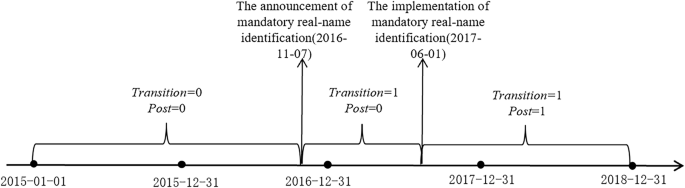
This figure presents the process of mandatory real-name identification.
To isolate the effect of mandatory real-name identification on the informativeness of social media, we follow previous studies (Chen, De, Hu, and Hwang 2014; Bartov, Faurel, and Mohanram 2018) and construct the following control variables: SUE from the previous quarter (LSUE), cumulative abnormal returns from 10 days before to 2 days before the release of quarterly financial reports (CAR[-10,-2]), the log of total assets (Size), leverage (Lev), market-to-book ratio (MB), an indicator variable for past quarterly loss (Loss), and institutional investor ownership (Inst). We winsorize all continuous variables at the 1% and 99% level. All variables are defined in Appendix A. To control for unobservable firm-level invariant characteristics and time trends, we include firm and year-quarter fixed effects. We cluster standard errors by firm.
We emphasize that quasi-natural experimental designs serve as powerful tools for causal inference in economics, finance, and accounting research, particularly when randomized experiments are not feasible. However, the validity and reliability of such designs hinge critically on the soundness of the design and the ability to control for potential biases. When issues such as endogeneity and selection bias are appropriately addressed, quasi-natural experiments can yield highly informative causal insights. Conversely, if key assumptions—such as the parallel trends assumption—are violated, or if there are uncontrolled systematic differences between the treatment and control groups, the resulting estimates may be biased and the conclusions potentially invalid. Therefore, when applying quasi-natural experimental designs, researchers must carefully assess their suitability and robustness in light of the institutional context, sample characteristics, and data structure.
Summary statistics
Figure 2 reports the user composition of Guba from 2015 to 2018. Figure 2a shows the proportion of users with different numbers of followers. We can see that the number of users with 0 followers is over 70%, the number of users with between 0 and 10 followers is 20%, and the number of users with >10 followers is 5%. This result indicates that the distribution of social media users exhibits a pronounced long-tail feature. Figure 2b presents the proportion of postings from users with different numbers of followers. This figure reveals that slightly over 20% of postings originate from users with zero followers, while ~30% of postings are from users who have between one and ten followers. Moreover, users with >10 followers originate 45% of postings. As shown in Fig. 2b, Guba users with a significant number of followers primarily populate its postings.

This figure presents the composition of users in Guba from 2015 to 2018. Figure 2a presents the proportion of users with different numbers of followers, while Fig. 2b presents the proportion of postings from users with different followers.
Table 1 reports the distribution of postings in Guba by year and industry from 2015 to 2018, where Panel A shows the distribution of postings by year and Panel B shows the distribution of postings by industry. Panel A illustrates that the total number of social media postings fluctuates across different years, yet the average sentiment of social media consistently remains negative. Simultaneously, the average number of postings per firm in 2017 and 2018 is lower than that in 2015 and 2016. Panel B reveals some disparities in the number of social media postings and the sentiment of these postings among firms in different industries.
Table 2 presents summary statistics. Panel A shows the results of descriptive statistics for the main variables. The mean SUE is 0.102 and the standard deviation is 0.954, which indicates that the overall unexpected earnings are positive. The mean value of SM_Senti[-10,-2] is -0.137 and the median value is -0.142, which represents the general negative sentiment of the postings on Guba during the 9 day window ending 2 days prior to earnings announcements [-10, -2]. In addition, the mean LSUE is 0.104. The mean CAR[-10,-2] is 0.041 with a standard deviation of 5.479, which indicates that there is a difference in cumulative abnormal returns between firms. The mean Size is 23.065 with a standard deviation of 1.021, which reveals that the sample encompasses a wide range of firms of all sizes. The mean value of Lev is 0.433. The mean MB is 2.432, indicating that the sample includes many growth and intangible-intensive firms. The mean Loss is 0.133, showing that 13.3% of the sample exists with loss in the previous quarter. The mean Inst is 0.062, indicating that the mean firm has 6.2% of its shares held by institutional investors.
Empirical results
Main results
Table 3 reports the impact of mandatory real-name identification on informativeness of social media. To illustrate the robustness of the estimation results, we stepwise add control variables to model (1). Columns (1) and (2) do not include fixed effects, while columns (3) and (4) control for firm and time fixed effects. To illustrate the baseline results, we take the estimation results accounting for all control variables in column (4) as an example. We find that the coefficient of SM_Senti[-10,-2]×Transition is -0.1363 and t-value is -1.36. Although the coefficient is negative, it is not statistically significant. The coefficient of SM_Senti[-10,-2]×Post is -0.1527 and t-value is -2.71, which is significant at 1% level. The regression results indicate that in the transition period of the mandatory real-name identification, social media postings show a slight decrease in the ability to predict unexpected earnings, although the regression coefficients are statistically not significant. However, after the implementation of mandatory real-name identification, social media postings show a significant decrease in the ability to predict unexpected earnings, suggesting that the mandatory real-name identification significantly reduces informativeness of social media. At the same time, the effect is strongly economically significant. By comparing SM_Senti[-10,-2] with SM_Senti[-10,-2]×Post, we observe that after the mandatory real-name identification, the predictive capacity of social media sentiment for firms’ unexpected earnings decreases by ~69%(0.1527/0.2224×100%). Taken together, we find that mandatory real-name identification has a significant negative impact on the informativeness of social media, supporting our research hypothesis 1a and indicates that mandatory real-name identification has a chilling effect. To address potential concerns regarding the interpretability of the interaction terms, we re-estimate the model by relaxing the year-quarter fixed effects and instead including Transition and Post explicitly as separate regressors, along with their interaction terms with SM_Senti. Unreported results indicate that the coefficient on SM_Senti[-10,-2]×Post remains significantly negative, consistent with the baseline findings.
Trend test
We conduct trend tests to show the trend of change in mandatory real-name identification. We construct the interaction term between the dummy variables Before3-After3 and the variable SM_Senti[-10,-2] based on model (1). Before3, Before2 and Before1 are dummy variables indicating whether the second half of 2015, the first half of 2016 and the second half of 2016, respectively. After1, After2 and After3 are dummy variables indicating the second half of 2017, the first half of 2018 and the second half of 2018, respectively. The results in Table 4 show that the coefficients of the variables SM_Senti[-10,-2]×Before3, SM_Senti[-10,-2]×Before2, SM_Senti[-10,-2]×Before1 are insignificant, indicating that before mandatory real-name identification, the informativeness of the social media is not affected. This finding provides further evidence for our findings.
User-level analysis
In our previous analysis, we observe that the mandatory real-name identification diminishes the informativeness of social media at the overall level. Now, we shift our research focus to the user level and explore the differential impact of mandatory real-name identification on different user groups.
Since mandatory real-name identification primarily targets anonymous users, an intuitive assumption is that for those users who voluntarily disclose their real identity on social media, the mandatory real-name identification should not have a significant impact on their behavior. However, due to the large number of social media users, manually identifying which users have voluntarily disclosed their real identity presents a significant challenge in practice. The development of generative artificial intelligence has provided assistance for our research.
We employ GLM-4, the latest generation large language model developed by Zhipu AI, to classify users on the East Money Guba.
For classification, we use users’ nicknames and profile information as inputs and prompt the model with the following instruction: “Assume you are an expert in corporate finance. You will be provided with a user’s nickname and profile information from a financial forum. Please determine whether the user discloses any identifying information (e.g., real name, employer) in either field. If so, set NE = 1; otherwise, NE = 0.” To ensure reliability, we initially classify 10,000 users using the LLM and then manually validate the classification results. Upon confirming the model’s accuracy, we proceed to classify all users into front-end anonymous and front-end real-name categories. Appendix B presents illustrative examples of front-end real-name users. As shown in Appendix B, the LLM-based classification demonstrates a reasonable level of reliability in distinguishing real-name users.
We classify social media users and construct the sentiment of front-end anonymous users (SM_Senti[-10,-2]_Anonymous), and the sentiment of front-end real-name users (SM_Senti[-10,-2]_Real_name). The empirical results are shown in Table 5. In column (1) of Table 5, we focus on the change in the informativeness of posts made by anonymous users before and after the event. The coefficient of SM_Senti[-10,-2]_Anonymous×Post is significantly negative, indicating that the perceived regulatory penalty risk for anonymous users indeed increases, causing them to be more cautious when posting information, thereby reducing the predictive ability of their posts regarding future unexpected earnings. In column (2) of Table 5, we observe the change in the informativeness of posts made by front-end real-name users before the event, but we do not find any significant results. Similarly, in column (3), we include both SM_Senti[-10,-2]_Anonymous×Post and SM_Senti[-10,-2]_Real_name×Post in the model. We find that the coefficient of SM_Senti[-10,-2]_Anonymous×Post is negative and significantly significant at the 1% level, while the coefficient of SM_Senti[-10,-2]_Real_name×Post is not significant. The regression results indicate that, after the enforcement of mandatory real-name identification, the ability of front-end anonymous users’ sentiment to predict unexpected earnings significantly decreases, while the ability of front-end real-name users’ sentiment to predict unexpected earnings remains unaffected. In our research, mandatory back-end real-name identification primarily affects the sentiment of front-end anonymous users. Therefore, this result further supports the conclusion of our study, namely that mandatory back-end real-name identification negatively impacts the informativeness of social media.
In addition to classifying user groups based on real-name versus anonymous status, we also categorize them according to the number of followers. Pan, Xu and Xu (2023) contend that high-follower users possess greater influence, and they are more likely to be subject to regulatory monitoring. Consequently, high-follower social media users may face higher risks when expressing their opinions after the mandatory real-name identification. Thus, we anticipate that the chilling hypothesis would be more evident among users with a substantial number of followers.
To investigate this aspect, we categorize social media users into no follower users (number of followers equal to 0), low follower users (number of followers >0 and less than or equal to 10), and high follower users (number of followers >10). Subsequently, we split SM_Senti[-10,-2] into SM_Senti[-10,-2]_Nonfollwers, SM_Senti[-10,-2]_Lowfollwers, SM_Senti[-10,-2]_Highfollwers, which measure no follower users’ social media sentiment, low follower users’ social media sentiment, and high follower users’ social media sentiment, respectively. Panel A of Table 6 reports the changes in the informativeness of postings across different user categories. We find that the coefficient of the variable SM_Senti[-10,-2]_Highfollwers×Post is significantly negative. This result shows that the reducing effect of mandatory real-name identification on the informativeness of social media is mainly generated by influential users. This result validates our mechanism, suggesting that the decrease in informativeness of social media after the mandatory real-name identification stems from increased awareness among users of the associated posting risks.
The change in the content of postings
Text content in social media is becoming more accessible. Therefore, we used text analysis methods to investigate the impact of mandatory real-name identification on the posting content for different users. Specifically, we use three measures to capture changes in the content of postings: proportion of predictive postings, proportion of definite statement postings, and proportion of postings expressing personal opinions. We present the specific definitions of these three indicators are presented in Appendix A. We expect that after mandatory real-name identification, if social media users can perceive increased risk in posting on social media, they will make fewer predictions about firms’ future performance; and they will use fewer definite statements in their expression and show a decreased propensity to use the first-person perspective to express their personal opinions.
The empirical results are reported in Table 7. Specifically, column (1) presents the results using the proportion of predictive posts as the dependent variable, column (2) uses the proportion of certain postings, and column (3) uses the proportion of postings expressing personal opinions. Across all three columns, the coefficient on Post is negative and statistically significant at the 1% level. These findings indicate that, following the implementation of mandatory real-name registration on the back end, social media users are less likely to post content that predicts firms’ future performance, make definite statements, or express personal views. Taken together, these content-based findings provide additional support for our main conclusion.
The impact on the capital market
We further investigate the impact of mandatory real-name identification on the informativeness of social media from the perspective of the capital market. Under the assumption of market efficiency, if social media do possess valuable information, they should prompt a response in the capital market. Firstly, existing research has found that social media facilitate the aggregation of individual opinions and improve price efficiency through the wisdom of crowds (Chen, De, Hu, and Hwang 2014; Bartov, Faurel, and Mohanram 2018; Tang 2018). After the implementation of mandatory real-name identification, we expect users decreasing the amount of valuable information they post on social media. Consequently, information related to earnings will no longer be rapidly incorporated into stock prices. As a result, we would observe a decline in market reactions to the sentiment of social media postings.
Secondly, earnings information not only elicits a market response in terms of stock price, but also causes fluctuations in trading volume (Kim and Verrecchia 1991; Bamber, Barron, and Stober 1997). Therefore, after the implementation of mandatory real-name identification, we can expect a decrease in the volatility of stock trading volume, caused by the number of social media postings.
Thirdly, Blankespoor, Miller and White (2014) find that social media reduces information asymmetry among investors. If the implementation of the mandatory real-name identification reduces the informativeness of social media, we would expect to observe a further increase in the asymmetry of information between institutional and retail investors. As a result, we would also anticipate a weakening of the negative correlation between bid-ask spread and the number of social media postings.
Table 8 reports the impact of mandatory real-name identification on the capital market. In column (1), the dependent variable is Cumulative Abnormal Returns (CAR[-10,-2]). The coefficient for SM_Senti[-10,-2] is 11.3392, and the coefficient for SM_Senti[-10,-2]×Post is -2.9373. Both coefficients are significant at the 1% level. In column (2), the dependent variable is Trading Volume (Volume[-10,-2]). The coefficient for SM_Atten[-10,-2] is 2.5426, and the coefficient for SM_Atten[-10,-2]×Post is -0.8218. Both coefficients are significant at the 1% level. In column (3), the dependent variable is bid-ask spread (Spread[-10,-2]). The coefficient for SM_Atten[-10,-2] is -0.0118, and the coefficient for SM_Atten[-10,-2]×Post is 0.0052. Both coefficients are significant at the 1% level. The results indicate that social media postings before earnings announcements lead to changes in a firm’s cumulative abnormal returns, trading volume, and bid-ask spread, suggesting that social media postings contain valuable information before earnings announcements. However, after the implementation of mandatory real-name identification, the impact of social media on the capital market has significantly weakened.
Social media vs. traditional media
Social media and traditional media are both important information providers and disseminators in the capital market (Blankespoor, Miller and White 2014; Drake, Guest, and Twedt 2014; Blankespoor, deHaan, and Marinovic 2020; Xu 2023). The mandatory real-name identification is primarily directed at social media and theoretically and practically has no effect on traditional media. Therefore, we use traditional media as a control group to further validate whether the observed changes in the informativeness of social media are indeed attributable to the mandatory real-name identification. Following You, Zhang, and Zhang (2018), we select eight largest nation-wide business newspapers in China as traditional media, including: China Securities Journal, Securities Daily, Securities Times, Shanghai Securities News, China Business Journal, First Financial Daily, The Economic Observer, and 21st Century Business Herald. The computation of the traditional media sentiment(TM_Senti[-10,-2]) mirrors that of social media. We calculate it as the difference between positive and negative media coverage, divided by one plus the sum of positive and negative media coverage.
The empirical results are presented in Table 9. From column (3) of Table 9, we observe that the coefficients of SM_Senti[-10,-2] and TM_Senti[-10,-2] are 0.2156 and 0.0272, respectively, both significant at the 1% and 10% levels. Meanwhile, the coefficient of SM_Senti[-10,-2]×Post is -0.1543, significant at the 1% level, while the coefficient of TM_Senti[-10,-2]×Post is 0.0299, which is not significant. The findings indicate that both social media sentiment and traditional media sentiment can effectively predict a firm’s unexpected earnings, suggesting that they both contain valuable information. However, after mandatory real-name identification, only the predictive ability of social media has significantly decreased, while that of traditional media remains unchanged. Overall, by contrasting social media and traditional media, we see that the observed changes in social media’s information content are indeed driven by mandatory real-name identification, further supporting the conclusions of this study.
Cross-sectional analysis
Based on the preceding analysis, after the implementation of mandatory real-name identification, social media users become more cautious when posting information in order to avoid unnecessary regulatory risks, which in turn reduces their motivation to disseminate fake information in advance and improving the informativeness of social media. Moreover, when investors focus on firms with different ownership types or those operating in regions with varying legal environments, the perceived risk of regulatory penalties may differ. Based on this reasoning, we conduct a cross-sectional analysis. We classify firms according to their ownership type into four categories: central state-owned enterprises (Central SOEs), local state-owned enterprises (Local SOEs), private enterprises, and others. Central SOEs are defined as firms ultimately controlled by the State-owned Assets Supervision and Administration Commission (SASAC) of the State Council or other central government agencies. Local SOEs refer to firms controlled by local governments or local SASACs. Private enterprises are primarily privately held firms, while the “others” category includes foreign-invested firms and those that cannot be clearly classified.
The empirical results are presented in Panel A of Table 10. In column (1), the coefficient on SM_Senti[-10,-2]×Post is negative and statistically significant at the 5% level. In columns (2)- columns(4), the coefficients on SM_Senti[-10,-2]×Post are statistically insignificant. These findings suggest that the negative effect of mandatory back-end real-name identification on the informativeness of social media is concentrated among Central SOEs, and is not significant for Local SOEs, Private Enterprises, or others. One possible explanation is that mandatory back-end real-name identification increases individual users’ visibility on social media, making them more susceptible to government oversight. Central SOEs are linked to the State Council and other central government agencies, which possess broader jurisdiction and fewer constraints in cross-regional internet regulation. As a result, following the implementation of mandatory real-name identification, social media users may perceive higher regulatory risk when posting about central SOEs, which reduces their willingness to share value-relevant information related to these firms. These findings provide further support for the hypothesis of this study.
In addition, we also classify firms based on their market capitalization and the legal environment of their registered location. Market capitalization is used to measure the size of the firm, while legal environment is proxied by the number of licensed lawyers per million residents. Firms with larger market capitalization tend to have greater nationwide influence and access to more government resources. Similarly, firms located in regions with stronger legal environments have greater access to legal resources and are more capable of pursuing litigation against social media users. Therefore, we expect that after the implementation of mandatory back-end real-name identification, social media users perceive higher regulatory and litigation risks when posting about firms with larger market capitalization or those operating in regions with stronger legal institutions. The empirical results are presented in Panel B of Table 10. In column (1), the coefficient on SM_Senti[-10,-2]×Post is negative and statistically significant at the 1% level. In column (2), the coefficient is statistically insignificant. In column (3), the coefficient is negative and significant at the 1% level, while in column (4), it remains insignificant. These results indicate that the negative effect of mandatory back-end real-name identification on the informativeness of social media is concentrated among firms with large market capitalization and those located in regions with stronger legal environments. This finding is consistent with our expectations and provides further support for the hypothesis of our paper.
Additional sensitivity tests
We further perform several additional analyses to check the robustness of our results. Firstly, we modify the calculation of the variables. We adjust the calculation window of variable SM_Senti from [-10,-2] to [-5,-2]. The empirical results are presented in column (1) of Table 11, where the coefficient of SM_Senti[-5,-2] is 0.1378 with a t-value of 4.28, which is significant at the 1% level, and the coefficient of SM_Senti[-5,-2]×Post is -0.1183 with a t-value of -2.71, which is significant at the 1% level. The results suggest that our findings remain robust when using alternative measures of social media sentiment.
Secondly, we change the calculation of the dependent variable. In the main results, we calculate unexpected earnings using the seasonal random walk with trend model. In this section, we use standardized analysts’ forecast errors (SAFE) as an alternative measure of firms’ unexpected earnings to ensure robustness. We do not use the analyst forecast model in the main results because of the absence of analyst forecast data for quarterly earnings in China. Therefore, the use of the analyst forecast model is limited to calculating the unexpected earnings for annual earnings announcements. We present the calculation of SAFE as follows:
Where EPS is the firm’s actual EPS, AFEPS is the mean of stock analysts’ forecasts of EPS for the 60 days before the earnings announcements, and we add 0.5 to the denominator to avoid a denominator of zero. The empirical results appear in column (2) of Table 11, where the coefficient of SM_Senti[-5,-2] is 0.0335 with a t-value of 2.46, which is significant at the 5% level, and the coefficient of SM_Senti[-5,-2]×Post is -0.0348 with a t-value of -1.81, which is significant at the 10% level. These results show that we obtain consistent research conclusions from the test of change dependent variable.
Thirdly, we change the period of sample. We adjust sample period from 2 years before and after the mandatory real-name identification (2015−2018) in the baseline results to 1 year before and after the mandatory real-name identification (2016 to 2017). We show the empirical results in column (3) of Table 11, where the coefficient of SM_Senti[-10,-2] is 0.1980 with a t-value of 3.26, which is significant at the 1% level, and the coefficient of SM_Senti[-10,-2]×Post is -0.2133 with a t-value of -2.23, which is significant at the 5% level. These results show that the findings of this paper still hold after changing sample period.
Fourthly, since SUE is computed based on the firm’s previous 20 quarters of unexpected earnings data, the calculation of post-event SUE inherently incorporates data from before the event date. Although this introduces a bias against finding significant results, we conduct a robustness test using UE (unexpected earnings) as an alternative to SUE. The empirical results are reported in column (4) of Table 11. The coefficient on SM_Senti[-10,-2]×Post remains significantly negative. These findings indicate that our main conclusions hold when using the alternative measure. Therefore, the results are not driven by any timing-related bias arising from the construction of SUE using prior 20 quarters of firm earnings data.
Finally, To ensure that our empirical results are not driven by a small subset of users, we randomly divide social media users into 1,000 subsets and iteratively remove one subset at a time. We then re-estimate the baseline regression model 1000 times. The distribution of the estimated coefficients is presented in Fig. 3. The results show that after randomly deleting user groups, the t-statistics of the coefficient on SM_Senti[-10,-2]×Post range from -2.96 to -2.61. As shown in Fig. 3, the baseline results remain robust following the random exclusion of users. These findings suggest that our results are not driven by outliers or specific individuals, further confirming the robustness of our conclusions. Taken together, these sensitivity analyses bolster the robustness of our conclusions.

Figure 3 reports the distribution of results after randomly excluding subsets of users. To ensure that our empirical results are not driven by a small subset of users, we randomly divide social media users into 1000 subsets and iteratively remove one subset at a time. We then re-estimate the baseline regression model 1000 times.
Conclusion
Social media has assumed an increasingly important role in shaping the capital market information environment (Antweiler and Frank 2004; Chen, De, Hu, and Hwang 2014). We examine the impact of mandatory real-name identification on social media informativeness. Using the implementation of China’s Cybersecurity as the research setting and data from Guba, we find that after the mandatory real-name identification, the predictive ability of social media postings’ sentiment on firms’ unexpected earnings decreases.
Further research finds that the impact of mandatory real-name identification is mainly observed in users with high followers. Our textual analysis finds that users discuss less information related to the firms’ earnings, make fewer predictions about firms’ future performance, make fewer definite statements, and express fewer opinions from a first-person perspective, which suggests that mandatory real-name identifications increase users’ perception of risk and weaken their willingness to post valuable information on social media.
Based on these findings, this paper contributes to the comprehension of how anonymity influences the informativeness of social media. While the vast majority of social media platforms allow users to remain anonymous, anonymity has also led to an influx of misinformation and noise in social media. Consequently, there has been growing skepticism regarding the anonymity characteristic of social media. Leveraging China’s mandatory real-name identifications policy as a research setting, we reveal that mandatory real-name identifications do not enhance the informativeness of social media. Instead, it might diminish users’ propensity to freely express their opinions, thereby reducing the informativeness of social media. Our findings suggest the pivotal role that anonymity plays in shaping the informativeness of social media.
We acknowledge certain limitations in our study. First, although the institutional environment in China provides a unique research setting for our study, its distinctive political and economic systems may limit the extent to which our findings can be directly applied to other economies (Lennox and Wu, 2022; Cheng, Hail, and Yu, 2022). Second, the effects of back-end anonymity may be limited. Our study finds that the impact of back-end anonymity primarily applies to the Chinese setting, where government monitoring and enforcement mechanisms are present. Whether the effect of back-end anonymity differs in developed capital markets, and whether the motivations of social media users change, requires rigorous examination when appropriate research settings arise in developed capital markets. This remains a topic for future research.
Data availability
No datasets were generated or analysed during the current study.
References
Ang JS, Hsu C, Tang D, Wu C (2021) The role of social media in corporate governance. Account Rev. 96:1–32
Antweiler W, Frank MZ (2004) Is all that talk just noise? The information content of Internet stock message boards. J Financ. 59:1259–1294
Bamber LS, Barron OE, Stober TL (1997) Trading volume and different aspects of disagreement coincident with earnings announcements. Account Rev. 72:575–597
Bartov E, Faurel L, Mohanram PS (2018) Can Twitter help predict firm-level earnings and stock returns? Account Rev. 93:25–57
Bernard VL, Thomas JK (1989) Post-earnings-announcement drift: delayed price response or risk premium? J Account Res. 27:1–36
Blankespoor E, deHaan E, Marinovic I (2020) Disclosure processing costs, investors’ information choice, and equity market outcomes: a review. J Account Econ. 70:101344
Blankespoor E, Miller GS, White HD (2014) The role of dissemination in market liquidity: evidence from firms’ use of Twitter™. Account Rev. 89:79–112
Cai G, McLean RD, Zhang T & Zhao M (2022) Social media and short sellers. https://papers.ssrn.com/sol3/papers.cfm?abstract_id=3907480 Accessed 21 Aug 2021
Chen H, De P, Hu Y, Hwang BH (2014) Wisdom of crowds: the value of stock opinions transmitted through social media. Rev Financ Stud. 27:1367–1403
Cheng Q, Hail L, Yu G (2022) The past, present, and future of China-related accounting research. J Account Econ. 74:101544
Drake MS, Guest NM, Twedt BJ (2014) The media and mispricing: the role of the business press in the pricing of accounting information. Account Rev. 89:1673–1701
Dyer T, Kim E (2021) Anonymous equity research. J Account Res. 59:575–611
Huang Y, Qiu H, Wu Z (2016) Local bias in investor attention: evidence from China’s Internet stock message boards. J Empir Financ. 38:338–354
Jia W, Redigolo G, Shu S, Zhao J (2020) Can social media distort price discovery? Evidence from merger rumors. J Account Econ. 70:101334
Kim O, Verrecchia R (1991) Trading volume and price reactions to public announcements. J Account Res. 29:302–321
Kogan S, Moskowitz TJ & Niessner M (2019) Fake news: evidence from financial markets. https://marriott.byu.edu/upload/event/event_566/_doc/KoganMoskowitzNiessner_2018.pdf Aug 2018
Lennox C, Wu JS (2022) A review of China-related accounting research in the past 25 years. J Account Econ. 74:101539
Pan J, Xu X & Xu Y (2023) Disguised repression: targeting opponents with non-political crimes to undermine dissent. J Curr Chin Aff. https://doi.org/10.1177/18681026251380610
Sabherwal S, Sarkar SK, Zhang Y (2011) Do internet stock message boards influence trading? Evidence from heavily discussed stocks with no fundamental news. J Bus Financ Account. 38:1209–1237
Sprenger TO, Tumasjan A, Sandner PG, Welpe IM (2014) Tweets and trades: the information content of stock microblogs. Eur Financ Manag. 20:926–957
Tang VW (2018) Wisdom of crowds: Cross‐sectional variation in the informativeness of third‐party‐generated product information on Twitter. J Account Res. 56:989–1034
Tetlock PC, Saar‐tsechansky M, Macskassy S (2008) More than words: quantifying language to measure firms’ fundamentals. J Financ. 63:1437–1467
Toubia O, Stephen AT (2013) Intrinsic vs. image-related utility in social media: why do people contribute content to Twitter? Mark Sci. 32:368–392
Wang E, Wong TJ & Zhang T (2019) Do Chinese social media delineate the optimistic bias of traditional media?. https://mitsloan.mit.edu Accessed May 2019
Xu N (2023) Information coordination: does preannouncement media coverage improve earnings expectations? Contemp Account Res. 40:1136–1175
You J, Zhang B, Zhang L (2018) Who captures the power of the pen? Rev Financ Stud. 31:43–96
Acknowledgements
This research was supported by the National Natural Science Foundation of China (72402078), the Humanities and Social Sciences Youth Foundation, Ministry of Education (24YJC790240), the National Natural Science Foundation of China (Grant No. 72172083) and the Shanghai Municipal Education Commission (Grant No. 2025AIYB062).
Author information
Authors and Affiliations
Contributions
XL: data curation, review, supervision, and editing. XZ: conceptualization, writing—original draft, methodology.
Corresponding author
Ethics declarations
Competing interests
The authors declare no competing interests.
Ethical approval
This study does not involve human participants or their data so no informed consent and other forms of ethical approve is needed.
Informed consent
No informed consent was needed for this paper. This article does not contain any studies with human participants performed by any of the authors.
Additional information
Publisher’s note Springer Nature remains neutral with regard to jurisdictional claims in published maps and institutional affiliations.
Supplementary information
Rights and permissions
Open Access This article is licensed under a Creative Commons Attribution-NonCommercial-NoDerivatives 4.0 International License, which permits any non-commercial use, sharing, distribution and reproduction in any medium or format, as long as you give appropriate credit to the original author(s) and the source, provide a link to the Creative Commons licence, and indicate if you modified the licensed material. You do not have permission under this licence to share adapted material derived from this article or parts of it. The images or other third party material in this article are included in the article’s Creative Commons licence, unless indicated otherwise in a credit line to the material. If material is not included in the article’s Creative Commons licence and your intended use is not permitted by statutory regulation or exceeds the permitted use, you will need to obtain permission directly from the copyright holder. To view a copy of this licence, visit http://creativecommons.org/licenses/by-nc-nd/4.0/.
About this article

Cite this article
Lyu, X., Zhao, X. Does mandatory real-name identification improve the informativeness of social media? Evidence from a Quasi-natural experiment in China. Humanit Soc Sci Commun 12, 1835 (2025). https://doi.org/10.1057/s41599-025-06116-9
Received:
Accepted:
Published:
Version of record:
DOI: https://doi.org/10.1057/s41599-025-06116-9
