


Abstract
Mining causes intense socio-environmental impacts and threatens Indigenous peoples in Brazil, exposing them to violence, contagious diseases, mercury contamination, and loss of livelihoods. Recent collaborative efforts by society achieved positive advances against mining in Indigenous Lands (ILs). Notably, the National Mining Agency (ANM) has revoked thousands of mining requests that encroached upon ILs for decades, marking a historic but underpublicized milestone. However, in recent months, the National Congress has approved a series of counter-attacks against Indigenous rights. Despite these advancements, it is imperative for society to sustain pressure in combating illegal mining in ILs and the ongoing attacks by ruralist and mining groups, who have a long history of undermining Indigenous rights.

Original content from this work may be used under the terms of the Creative Commons Attribution 4.0 license. Any further distribution of this work must maintain attribution to the author(s) and the title of the work, journal citation and DOI.
1. Introduction
Mining is an activity that causes intense socio-environmental impacts, such as soil and water contamination, forest degradation, and biodiversity decline. These impacts are aggravated when the mining takes place in indigenous lands (ILs), because the mining activity exposes the people living there to rural violence, contagious diseases, mercury contamination, and loss of livelihood (Le Tourneau 2015, Horowitz et al 2018).
ILs in the Brazilian Amazon, covering more than 1160 000 km2, play a crucial role in the preservation of human ethnocultural heritage, the regulation of the climate and the hydrological cycle, the prevention of deforestation, and the conservation of biodiversity (Begotti and Peres 2020). The potential negative effects of the mining bill (Projeto de Lei—PL 191/2020) proposed by the Bolsonaro government, which would open the Brazilian ILs to mineral exploration, have been extensively reported in the media since its proposal in 2020. Environmental defenders breathed a sigh of relief upon the appointment of President [Luiz Inácio] Lula [da Silva] at the start of this year, and several positive developments have taken place for the protection of ILs against mining, among which the recent (and not yet widely publicized) removal of all mining requests in ILs. Yet, societal pressure needs to be maintained to fight illegal mining and the counterstrikes of the ruralist and miner groups.
2. History
Historically, the focus of mining in the Brazilian Amazon has been on industrial mining for several minerals, on the one hand, and on artisanal mining for alluvial gold, on the other hand. While in the past, artisanal gold mining was configured as a small-scale activity, it now covers large areas and involves the use of machinery. For both types of mining forest is cleared so that the topsoil can be removed to form a mining pit, and both are consequently responsible for socio-environmental impacts. Although mining in ILs is not allowed, the first official requests for mining in indigenous territories made to Brazil’s National Mining Agency (ANM) date back to 1971 and have accumulated over the years (Ferreira et al 2014, Rorato et al 2020). The number of new mining requests inside Amazonian ILs increased sharply after the appointment of Bolsonaro’s government, from 22 in 2018 to 72 in 2019. Until February 2020, around 2760 mining requests (industrial and artisanal) overlapped with ILs in the Brazilian Legal Amazon, covering a total area of about 176.900 km2 (Rorato et al 2020).
3. Recent positive developments
Fulfilling a campaign promise and the appeal of Brazil’s indigenous peoples, President Lula, directly after his appointment, installed the unprecedented Ministry of Indigenous Peoples. Next, on 31 March 2023, he sent a formal request to withdraw PL 191/2020 from processing by the National Congress, which was approved by 29 May 3 . And, at the end of April, Lula homologated six new ILs, the first ones since 2016.
Furthermore, the combined efforts of indigenous organizations, scientists, journalists, environmentalists, and the Public Prosecutor’s Office brought about a series of three positive developments. First of all, scientists, e.g. Rorato et al (2020), Siqueira-Gay et al (2020), and Villén-Pérez et al (2022), while analyzing mining requests in ILs, raised awareness of the tenacious procedures of ANM. The ANM accepts the receival of all mining requests, including those that overlap in whole or in part with ILs. Mining in ILs is not allowed by law, and the ANM will not approve them until it will be allowed, but their system maintains such processes as ‘active’ (Rorato et al 2020). This comes with two problems: (1) the database is open for everyone to see, i.e. also for illegal miners, who may use it as a treasure map, and (2) because approval of mining requests happens on a ‘first-come-first-serve’ basis, the system incentivizes companies to put in requests in ILs, awaiting the moment that mining there may be allowed. After intense pressure from the media, some mining companies, apparently concerned about their reputation, started withdrawing their mining requests in ILs in 2021. Large withdrawals took place in recent months, (record holder in requests). Yet, the companies maintained requests in areas directly around ILs, disregarding the negative impacts that mineral exploration in the surroundings can have on indigenous communities (Sonter et al 2017, Horowitz et al 2018).
Secondly, in October 2022, the Public Prosecutor’s Office of the State of Pará obliged the ANM to remove all mining requests overlapping ILs in the circumscription area of the Judiciary Subsection of Altamira/Pará from their database. This forthright action was based on the unconstitutionality of the existence of these requests since mining activity in ILs is not legally permitted and only constitutes negative pressure on these territories and on the indigenous populations that reside there. Several mining requests in ILs in the South and West of Pará that were in the ANM database when we did our last analysis in 2020 are therefore not in the database anymore in November 2022 (figure 1), for example in the ILs Menkragnoti, Kayabi, Apyterewa, Munduruku, Baú, and others, mainly for gold mining.
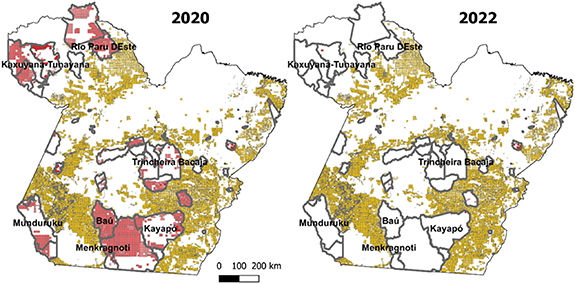
Figure 1. All mining requests in Pará state as found in the ANM database in February 2020 (left) and November 2022 (right). Mining requests inside ILs in red and outside in yellow.
Download figure:
Standard image High-resolution imageFinally, in this year, the ANM realized the toxicity of the mining request system, triggered by the serious humanitarian crisis evidenced in January of this year in Yanomami IL and by a decision of the Federal Public Prosecutor’s Office in 2015. This decision recommended that the General Director of the National Department of Mineral Production (DNPM), now replaced by the ANM, rejects requests and declares the nullity of mining processes incident on ILs. Thus, as of very recently, practically all mining requests in all Amazonian ILs have been removed (figure 2). This has not been widely publicized yet. When we asked about removing mining requests inside ILs via email, the ANM stated that ‘we inform you that the work is being carried out nationwide, promoting analyses and cleaning up the database after the events reported about mining in Yanomami IL’. According to Rorato et al (2022), the removal of requests within ILs implies a reduction in the vulnerability of these territories and indigenous populations to mining. However, the vast number of mining requests remaining around the ILs still causes a high exposure of indigenous communities and their territories to mining.
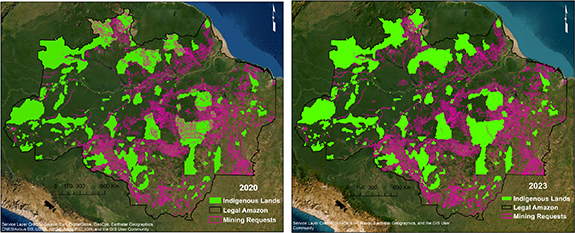
Figure 2. Areas requested for mining in the ANM database in the whole Legal Amazon by February 2020 (left) and June 2023 (right).
Download figure:
Standard image High-resolution image4. Recent counterstrikes
In response to the positive developments for ILs described above, a series of counterstrikes against the rights of indigenous peoples has been orchestrated by part of the National Congress in recent months. First (in the week of May 22), the transfer of the function of demarcating ILs from the Ministry of Indigenous Peoples to the Ministry of Justice. Second (on 30 May), the approval of the ‘anti-indigenous package’, PL 490/2007, by 283 votes in favor and 155 against. The PL 490/2007 facilitates the opening up of ILs for economic purposes and activities such as mining and provides the definition of the thesis ‘Marco Temporal’ which establishes that indigenous peoples only have the right to occupy the lands they occupied or were already in dispute on 5 October 1988, the promulgation date of the Federal Constitution.
The Marco Temporal thesis has been assessed as unconstitutional by several jurists in the country, since it disregards the original right of indigenous peoples over the lands they traditionally occupied before 1988. In addition, PL 490/2007 establishes several changes in the demarcation process of new ILs, such as the transfer of the prerogative of homologation from the President of the Republic to the National Congress. It also provides for the possibility of deregulation of ILs that have already been demarcated if ‘alteration of the community’s cultural traits’ is proven. In September 2023, the Federal Supreme Court of Brazil judged the Marco Temporal thesis to be unconstitutional. At the same time, PL 490/2007 (previously approved by the National Congress) was also approved by the Federal Senate, as PL 2.903/2023. Now, PL 2.903/2023 must be evaluated by the President of Brazil, who will have the power to veto it. However, the president’s veto can be overturned by the National Congress and the PL can come into force. The Indigenous Peoples of Brazil repudiate the Marco Temporal thesis as well as the PL 2.903/2023 that establishes it. Its approval would be one of the biggest setbacks in the rights of indigenous peoples since the enactment of the 1988 Constitution.
5. Conclusion
In relation to illegal mining, a continuous and spatially uniform law enforcement is required to prevent the waterbed effect (when fighting miners somewhere, they pop up elsewhere); the unhinged miners have not been hinged yet. In addition, gold trading laws need to be strengthened to ensure accountability for the illegal gold trade in the Amazon, i.e. the gold production chain needs to be regulated, traceable, and inspected. Organized society, through public opinion, needs to continue putting pressure on banks and large mining companies that buy illegal gold from ILs. The serious humanitarian crisis experienced by the Yanomami people now (and 30 years ago) is an emblematic example of the direct consequences of illegal mining within indigenous territories.
Regarding legal mining in the Amazon, it is essential to bury the bills PL 191/2020 and PL 490/2007 (now called PL 2.903/2023), since the negative impacts of mining on indigenous populations and their territories are clear (Rorato et al 2020, Siqueira-Gay et al 2020, Villén-Pérez et al 2022). The mere existence of mining requests in ILs generates legal uncertainty for indigenous people by transforming their lands into mining reserves, stimulates lobbying, and exerts political influence on possible regulation of mining in ILs. The recent removal of practically all mining requests inside ILs by the ANM is a historic achievement, and it is crucial to ensure that requests in ILs are not allowed again in the future.
Finally, it is necessary to consider the creation of buffer zones around the ILs and restrict the development of illegal activities with a high negative potential for the environment and for the indigenous communities. There are several cases of indigenous populations contaminated by mercury from mining around their territories (Vega et al 2018). There is no more room for this type of predatory activity with drastic socio-environmental impacts in Brazil.
Acknowledgments
Part of the study reported here was performed by six students of the MSc in Geographical Information Management and Applications (GIMA): Roche Bhola, Jasper Enhus, Sybren Huisman, Joost Noordam, Finn Peranović, and Nick Peters. We are thankful to them. We would also like to thank the editor and an anonymous reviewer for their feedback.
Data availability statement
No new data were created or analysed in this study.


