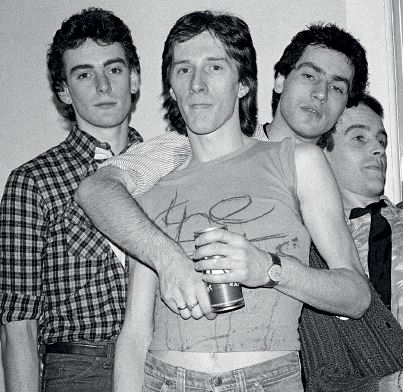
The Babys are the British band that briefly vied with US chart-topping AOR acts like Boston, Journey, Styx and Toto, and competed with other UK contenders such as 10cc and Sad Café. Fronted by Lancastrian singer/bassist John Waite and, during their heyday, the home to future Journey/Styx men Jonathan Cain and Ricky Phillips, The Babys were formed by androgynous glam keyboardist/guitarist Michael John Siddons-Corby, aka Mike Corby. Alongside singer Waite, drummer Tony Brock and guitarist Wally Stocker, they signed to Chrysalis in July 1976 for the then-biggest ever recording contract for a new band – $1m. No pressure, then. Still, Corby had reportedly jammed with Jimmy Page and, on meeting producer/manager and Andrew Loog Oldham associate Adrian Millar in September 1974, signed up to form a new quartet that could vie with the big boys.
Among those auditioned were Mandrake Paddle Steamer bassist Paul Riordan, who promptly walked, drummer Lucas Fox, who followed suit for the nascent Motörhead, and singer/guitarist Gordon Hawtin (aka Gordon Rondelle), who recommended an acquaintance, ex-Graf Spee/Chalk Farm’s John Waite. Schooled in jazz-rock with the band England, he’d relocated to Cleveland, Ohio, to play bass with The Boys. Tipped off that Corby was after a bassist, he returned to London in 1975 and met Corby and Hawtin in a Haverstock Hill pub, where he was welcomed into the fold. Next, Millar recruited Spontaneous Combustion/Strider drummer, Tony Brock, while Hawtin’s departure allowed Waite – at Millar’s behest – to become lead vocalist. Brock brought in Dream Police/Longdancer keyboardist Matthew Irving, though he left for Manfred Mann’s Earth Band before rehearsals began in London’s Tooley Street. The core players demoed 10 tracks, including Waite’s first two writing efforts, I Wear Your Ring and You’ll Get Yours (issued in 2006, and akin to Slade’s glam-rock). Jokingly, they dubbed themselves The Babys, reflecting the mix of personalities that already had been through the revolving door. Corby himself threw in the towel early in 1976, before returning and by then, ex-Joy/Pegasus guitarist Walter ‘Wally’ Stocker had been recruited. Combining Free’s Paul Kossoff’s minimalist approach with an electric doubler effect, he created the stratified guitar lines integral to The Babys’ signature sound.
The classic line-up was in place and penned some impressive tunes, filmed for a novel demo video – New York Dolls-esque mascara, rouge and hair de rigueur, directed by TV’s Supersonic show helm, Mike Mansfield. Ranging from The Raspberries-esque power-pop to Bad Company-like hard rock, their eponymous debut was recorded in Canada with Alice Cooper producer, Bob Ezrin. The band felt the result was overproduced, but it was issued in January 1977. It failed to make the US Top 100, despite the kinetic, Trevor Rabin-esque single, If You’ve Got The Time, which made No 88.
Among the 10-tracker’s other AOR cuts were the phased-drum opener, Looking For Love, the scintillating, radio-friendly Rodeo (think period UFO), and the hurtling, Bad Company-esque Read My Stars. Much of the remainder were soft-rock ballads, such as the reflective, piano-led Over And Over (featuring a lead vocal by Brock), though a cover of The Paris Sisters’ 1961 hit, I Love How You Love Me, was Slik-like glam, and closer, the Mini-Korg-framed Dying Man, could’ve come from the Barclay James Harvest songbook. A UK tour with The Damned, therefore, was hardly the wisest move, but Chrysalis engineered positive US music press coverage and they took up residence in true Rock Of Ages fashion in Hollywood. At that point, the label ditched Millar for Neil Young manager, Elliot Roberts, determined to recoup their investment and break the States.
As well as shows early in 1977, the band were ushered into Los Angeles’ Record Plant to work alongside Led Zeppelin/The Who/Bad Company producer, Ron Nevison. Over three months, they cut the 10-song rockers’n’ballads Broken Heart, marked out by its stylised colour-tint artwork, based on Corby’s concept of them as characters from A Clockwork Orange. Appearing in September, it was blessed with a grander sound thanks to Nevison’s orchestration, plus female backing vocals, the Bad Company-like And If You Could See Me Fly nestling with burnished electro-acoustic opener, Wrong Or Right, the ecstatic title track, pleading Rescue Me and sweeping, melodramatic closer, A Piece Of The Action (penned by ex-Marmalade’s Mike Japp). The heartfelt lament, The Golden Mile, and another Brock vocal, the US No 53, Silver Dreams, stand out, alongside rock standard, the US No 13 (and UK No 45), Isn’t It Time? A driving-anthem hardy perennial fashioned by Brian Wilson co-writer, ex-KGB’s Ray Kennedy, it had been rejected by The Temptations but remains an infectious soul-rocker, boasting gospel backing and surging strings. It swept the album to US No 34 and topped the charts in Australia. Bonza!
With A-league status apparently within grasp, Chrysalis re-teamed the band with Nevison, but there was disagreement on whether to focus on rockers or ballads. Consequently, Head First was recorded in a pressure-cooker environment with the Record Plant 24-track mobile at Hidden Valley Ranch, Malibu. Corby envisaged crafting a work of art, while Waite was fashioning more country-oriented material (evidenced by outtakes Restless Heart and World In A Bottle). With the pair barely speaking, they spent $300,000 in six weeks, wrangling in John Sinclair on synths, bassist Jack Conrad, pianist Kevin Kelly and mandolinist Robb Lawrence. Their combined efforts were rejected by Chrysalis in August 1978, with an irate Corby being shown the door, while Millar suggested Waite go solo, which he dismissed. Some two weeks later, the remaining trio returned to the studio in a do-or-die effort to revamp Head First, its release delayed to January 1979. They re-recorded it in stripped-back form, Corby’s contributions relegated to keys, while they added a swaggering opener, Love Don’t Prove I’m Right, plus the visceral, gospel-backed Ray Kennedy co-write, Every Time I Think Of You, which hit US No 13, catalysing the album to their US chart apogee, No 22. Job done.
Head First 2.0 contained trademark light and shade AOR corkers and polished, lighters-aloft ballads, including 1.0 numbers like the more acoustic You and Frampton-esque whimsy of California. In contrast, there was the glam-leaning title track, Corby’s insistent Run To Mexico and Brock’s Please Don’t Leave Me, while Japp provided quirky co-write I Was One, and Billy Nicholls’ White Lightning recounted an LSD trip, which explains the risible lyrics. The album stalled at US No 77, though auditions for new members led to the recruitment in November ’78 of two Americans: Bearsville-signed keyboardist/ guitarist/singer, Jonathan Cain, and Nasty Habit bassist, Ricky Phillips, thereby allowing Waite to focus more on his vocals.
Desiring a new approach, look and sound, the quintet set about crafting the nine-song Union Jacks, overturning the driving eight-note bass/Hammond of old for more synth parps and electric percussion. They supported Alice Cooper early in 1979, moulding a new repertoire on the road, demoing on four-track recorder before returning to Los Angeles’ Sound City to work with Fleetwood Mac producer, Keith Olsen. His stamp can be heard on the likes of the ballad, Love Is Just A Mystery, while there are US new wave fingerprints all over the US No 72, Midnight Rendezvous, and Jesus Are You There? The Foreigner-esque True Love, True Confession failed to make an impact on the singles charts, but a last-minute Waite revamp of a company-provided tune, retitled Back On My Feet Again, made US No 33 and became a favourite of Queen’s Brian May, no less. It helped the album – unleashed in January 1980 – to US No 42, while an opening slot for Journey offered the chance of winning over a mass audience. Yet Chrysalis pulled the band off the road in order to make another studio set, bewildering Waite et al.
Back at Sound City with Olsen, the band felt pressured to deliver once more, while Cain apparently had an eye on a potential berth in Journey’s fluid ranks. Over six weeks, they fashioned the aptly-titled 10-song On The Edge, which emerged in October 1980 to make US No 71, its energetic AOR opener, Turn And Walk Away, peaking at No 42. The melancholic Darker Side Of Town spoke of the atmosphere within the ranks and, while there were trademark tunes to please fans, such as Postcard and Gonna Be Somebody, ongoing rowing between the three Englishmen reached a peak. During the following tour, when Waite had to be carried off-stage in December during a show in Cincinnati, having injured his knee, the writing was on the wall. Appearing, in Spinal Tap fashion, on crutches at Akron, Ohio, they had to cut the set short and head to hospital. It proved The Babys’ last performance in their pomp, the remainder of the tour cancelled before disbandment early in 1981. Cain joined Journey, and an Anthology appeared later that year, Stocker and Brock’s attempts to keep the band going stillborn. Each went their separate ways, though Waite would reconvene with Cain and Phillips in the supergroup, Bad English, in 1988, following his own solo success. Aside from collections such as 2001’s Valentine Babys and Live In America, however, that seemed it for The Babys. Until 2012, when Stocker and Brock decided to give it a go one more time, resulting in a new line-up and studio set, more US touring and, in 2017, the Timeless: Anthology II, out via PledgeMusic, with subscribers offered VIP gig experiences, signed drum-heads/sticks, album artwork, handwritten lyrics, guitars, and home gigs.
RC caught up with Tony Brock and asked him how easy it was writing The Babys songs again?
“When we split, Wally and I tried to keep it going and went to my studio. We wrote 20 songs over six months and asked John Waite if he wanted to come back, because he could’ve done his solo stuff in The Babys. But he wanted to be by himself, so we didn’t push him. Then I went to Washington to play with Rod Stewart.
I didn’t have a copy of the songs Wally and I wrote, but he did. In 2012, he played the tape to me – songs like I’ll Have Some Of That. Our new guitarist, Joey (Sykes, ex-Meredith Brooks), is also a good writer, so we did new ones, such as I’ll See You There – a great mix of old and new. I’ve got tapes from when I was a teenager, too, living round the corner from Greg Lake in Poole. We became friends, and Greg was my first producer in Spontaneous Combustion, in 1972. Then I went to The Babys, with a Bonham-esque sound. I’d love to play with John Paul Jones, who was writing seven-eight bar mellotron for Kashmir. A few people have taken credit for that, but I know different. My mum tried to teach me piano. She played church organ, and I sang in the choir. But I just wanted to play rock’n’roll, so she got me a drum kit, doing two jobs to pay for it. I remember dad saying, ‘Can you turn that down?’ I’d say, ‘No, dad. It’s a drum kit!’ He’d say, ‘Put some towels over it.’ No!”
Tell us about the formation of The Babys.
Our manager, Adrian Millar, was hounding me when I was in Strider, in 1974. He asked me for months to join this new band, so when Strider broke up, I played with Mick Corby and John Waite. We auditioned for a guitarist and got Wally Stocker. He was a huge fan of Paul Kossoff, and The Babys’ sound mostly came from Wally and myself. The four of us made a three-song demo video, and we were the first band to get a major deal with one. A load of record companies wanted to sign us, so we didn’t have to showcase. We signed to Chrysalis, which was fantastic. Typically, the day after we signed, Rod called to say that Kenney Jones had left and, “I need you in the band”. I said, “oh, God, I’ve just signed a deal”. But Chrysalis did a great job for us in the early days, putting our picture on buses and billboards in the US. We were on our way. Within 18 months, we’d recorded our first album.
Was there much pressure to get the second album out quickly?
Yes. Ron Nevison brought in cello and timpani, which we were unaccustomed to. He finished the painting that was in our mind, adding all the colours. He took us to The Record Plant and we got that big drum sound by playing in a hallway, with three or four kit microphones, instead of the usual 14. It evolved smoothly, adding strings and the vocals of The Babettes – rock’n’soul.
How did Jonathan Cain and Ricky Phillips’ recruitment affect the band’s dynamic?
It changed it a lot. John Waite and I played in that Bad Company style. But Ricky, like he does in Styx, was more of an eighth-note guy, which suits Americans. That changed the angle of the band, as did having Jonathan on keyboards. It’s amazing the difference, how musicians are brought up in the US and Britain. In the UK, you just play… But it became easier for John, as he was just singing, and with the keyboards, we could play strings on stage, so we sounded more like the records. As a five-piece, though, it altered the chemistry – they didn’t get the silly British jokes then!
What about the break-up?
John went off to do his thing, and I linked up with Rod (as did Stocker; before working with Air Supply, Humble Pie and Elton John). I was with Rod for 12 years and played with Jeff Beck, Tina Turner, Elton John, Roy Orbison. With Rod, we shared a dressing-room – he was one of the boys. We had the biggest laugh, putting chickens and sheep in his bedroom. He was jumping up and down like a little girl once the chickens started flapping! Then I went to Australia to produce Jimmy Barnes, who was the first person that AC/DC asked to fill in (before Axl Rose). Then Keith Urban, before he went country. When he hit in the States I was like, what?! Then I started writing songs for US TV, like Flipper and Baywatch. I’d love to write soundtracks, as I sang a couple of songs and played piano with The Babys, and I’ve done 20-minute demos for TV pilots. I’ve just moved to Atlanta, where they make a lot of TV and films, and I’m building a new studio. I’ve just written a song with Joe Bonamassa, and I’m going to produce the next The Babys album here. People can Pledge and come and record, so it’ll be fun.
RC asked singer John Bisaha (ex-The Nameless) whether there had been a full consensus on the new collection’s contents?
“Yes. It’s all the hits and a few new songs. We play two hours live, so it was just a case of recording the set. I joined in 2013, having done a lot of songwriting, as had Joey (fellow new recruit, alongside keyboardist Francesco Saglietti). When we got together for I’ll Have Some Of That (issued in June 2014), we wrote a couple of songs, and we’ve been writing on and off ever since.”
Were you a fan of The Babys?
Yeah, from the age of 17. I was in a covers band in California and the guitarist wanted to do their songs. When he put on Broken Heart, I was smitten. We did Midnight Rendezvous and Head First, and I’ve got boxes of cassettes from the 70s. I started singing at three and, from seven, I’d spend a couple of days each summer playing piano at our neighbour, Karen Carpenter’s. She said, “You’ve got a future with your voice.”
How did you join The Babys?
My friend, Michael Hanson (ex-Glass Tiger), was in a band with me till 1992. He heard that they were getting back together and called. I said, “Get me that audition!” I went to Tony’s studio nine times over three months. Then I was accepted. I sing 90 per cent of what John sang. He doesn’t want to do it, but if he did, he could have the job back in a heartbeat. And Tony and Wally will be in the UK for the first time in 40 years when we’re at Southampton in 2018 for a rock cruise to Spain.
Is there anything else that hasn’t gone into the PledgeMusic campaign so far that may come out?
I have a lot of videos from the last five years, and the Holy Grail is the original quarter-inch demo tape that got The Babys their deal. We’ve talked about unleashing that…