
Abstract
The opioid epidemic greatly impacts adolescents, especially those with low perceived risk of harm—an important predictor of misuse initiation. Here, to address this, we developed and evaluated PlaySmart, a videogame targeting perceived risk, in a two-arm parallel superiority unblinded randomized controlled trial with a placebo comparator. We randomized 532 participants (mean age 16.6 years; 47% female) to PlaySmart (n = 269) or control games (n = 263). Eligible students—16–19 years old, no prior opioid misuse and ‘high-risk’ based on substance use or mental health screens—agreed to 60-min gameplay sessions, and provided assent and parental consent if under 18 years old. Participants played during supervised after-school sessions (1 or 2 times per week for approximately 6 weeks) at 15 Connecticut high schools. Self-reported data were collected at baseline, 6 weeks and 3 months (21 October 2021 to 27 February 2024). Follow-up rates were high (231/266 (87%) PlaySmart and 234/261 (90%) control). The primary outcome was perceived risk of harm of opioid misuse at 3 months. The secondary outcomes were self-efficacy, intentions, knowledge and attitudes (positive and negative expectancies). At 3 months, 29% of PlaySmart versus 23% of control participants reported ‘great risk’ with no statistically significant difference between groups (95% CI, –2% to 14%; P = 0.14). Self-efficacy, intentions and positive expectancies did not differ. PlaySmart participants demonstrated knowledge gains from baseline to 3 months (2.1 (95% CI, 1.4–2.7) versus 0.1 (95% CI, –0.6–0.7); P < 0.001), and negative expectancies gains at 6 weeks (2.3 (95% CI, 1.4–3.1) versus 0.2 (95% CI, –0.7–1.1); P = 0.001). Further research is needed to enhance PlaySmart, maximizing its impact on scalable opioid misuse prevention.
ClinicalTrials.gov registration: NCT04941950.
Main
An estimated 108,000 drug overdose deaths occurred in the United States during 2023, at a rate of approximately 300 deaths per day1. Initiation of opioid misuse (non-medical use of prescription opioids/prescription opioid misuse and/or heroin use) often occurs in adolescence and young adulthood. Recent data indicate that although illicit drug use among youth is decreasing, fatal overdose risk among adolescents has increased2. In 2021, opioid toxicity accounted for over 10% of deaths in 15–19-year-olds3. In 2023, 12% (1.9 million) of US high-school students reported lifetime prescription opioid misuse, and 4% (624,000) reported misuse in the past 30 days, increasing the risk for overdose4. Given the prevalence and lethality of opioid misuse in young people, creating evidence-based scalable solutions is critical. A potential target for impacting adolescent opioid misuse is their perceived risk of harm from opioid misuse.
Adolescents’ perceived risk of harm from opioid misuse is strikingly low and varies across prescription opioids and heroin. According to the most recent ‘Monitoring the Future’ (MTF) study, a nationally representative survey of American high-school students, only 28% of 10th graders perceived that trying a prescription opioid once or twice posed a great risk of harm, and only 34% of 12th graders perceived that trying any opioid other than heroin posed a great risk of harm5,6. Only 66% of 10th graders and 60% of 12th graders saw trying heroin as highly risky. There is an inverse relationship between perceived risk of harm from drug use and actual drug use7. According to a foundational paper, perceived risk of harm influences adolescent drug use by shaping attitudes and expectancies, and behavioural intentions across multiple behavioural theories, including the ‘theory of planned behaviour’, the ‘health belief model’ and ‘social cognitive theory’8.
Low perceived harmfulness being strongly associated with a high risk of misuse has been demonstrated with the non-medical use of prescription drugs6,9,10,11,12 and heroin13. Individuals with low versus those with high perceived harmfulness were almost ten times more likely to use prescription opioids non-medically10. A similar association exists with heroin use13. Therefore, heightening perceived harmfulness from opioids could be a meaningful intervention to reduce the initiation of opioid misuse.
Given the magnitude of this problem among adolescents, developing and implementing effective, engaging strategies to prevent opioid misuse initiation is critical. Although there are interventions that target adolescent substance use, including opioids14, that are used in schools15, implementation remains challenging. School-based prevention programmes declined from 75% in 2011 to 65% in 201916, reflecting barriers such as limited funding, insufficient staff training, low implementation fidelity, stigma, curriculum overload and lack of leadership support17,18,19. A recent review on opioid-specific programmes noted concerns around generalizability, reach and scale15. Digital interventions may help address these limitations20.
To that end, we developed an evidence-based digital intervention in the form of a videogame, PlaySmart, for adolescents aged 16–19 years, targeting perceived risk of harm from opioid misuse as a proximal outcome underlying the intervention’s impact on the more distal outcome of opioid misuse initiation. Videogames as interventions meet adolescents ‘where they are’. Over 85% of adolescents play videogames21. ‘Serious games’, defined as games with a primary purpose other than entertainment22, promote health and are effective at prevention23,24,25,26,27,28. They facilitate opportunities for repetitive interactions to acquire new skills that can transfer to real-life situations with consistent fidelity, placing minimal demands on personnel/resources, and facilitating sustainable distribution29,30,31,32,33,34. Digital interventions including serious games have been developed for the prevention of adolescent alcohol, tobacco and cannabis use, but there remains a notable gap in ones focused on opioid misuse prevention20,35,36,37,38. To our knowledge, only formative efforts such as MedSMA℞T39, focused on opioid safety, and our PlaySmart videogame intervention described here specifically target adolescent opioid misuse prevention.
As part of the National Institute on Drug Abuse (NIDA) Helping to End Addiction Long-term (HEAL) prevention initiative40, building on established theoretical constructs and extensive experience in serious videogames23,24,25,41,42,43, and employing a user-centric approach engaging adolescents in the design/development process, we built PlaySmart, a videogame focused on opioid misuse prevention in adolescents aged 16–19 years44. This age group was chosen in part because the HEAL initiative specifically included it in the lower range of their target age group, and because 45% of youth with prescription opioid misuse report initiation between the ages of 16 and 18 years45.
Through a two-arm parallel superiority randomized controlled trial, we evaluated the impact of PlaySmart, compared to a placebo comparator, on key outcomes related to opioid misuse, with the primary outcome being perceived risk of harm from opioid misuse46. Our hypotheses were that the PlaySmart group would demonstrate an increased perceived great risk of harm at 3 months, and for secondary outcomes, PlaySmart participants would demonstrate, in relation to opioid misuse, increased self-efficacy, decreased intentions, increased knowledge and attitudes measured both by decreased positive expectancies and increased negative expectancies.
Results
Participants
Between 21 October 2021, and 27 February 2024, 533 participants were recruited from 15 Connecticut high schools. Of the 1,062 unique individuals screened, 839 met all inclusion criteria and 533 enroled: of these, 269 were randomly assigned to the PlaySmart intervention and 264 to the control condition. One control participant was withdrawn by the principal investigator due to an incomplete parent/guardian consent form, a protocol deviation that was reported to the Institutional Review Board (IRB), resulting in a sample size of 532 (Fig. 1).
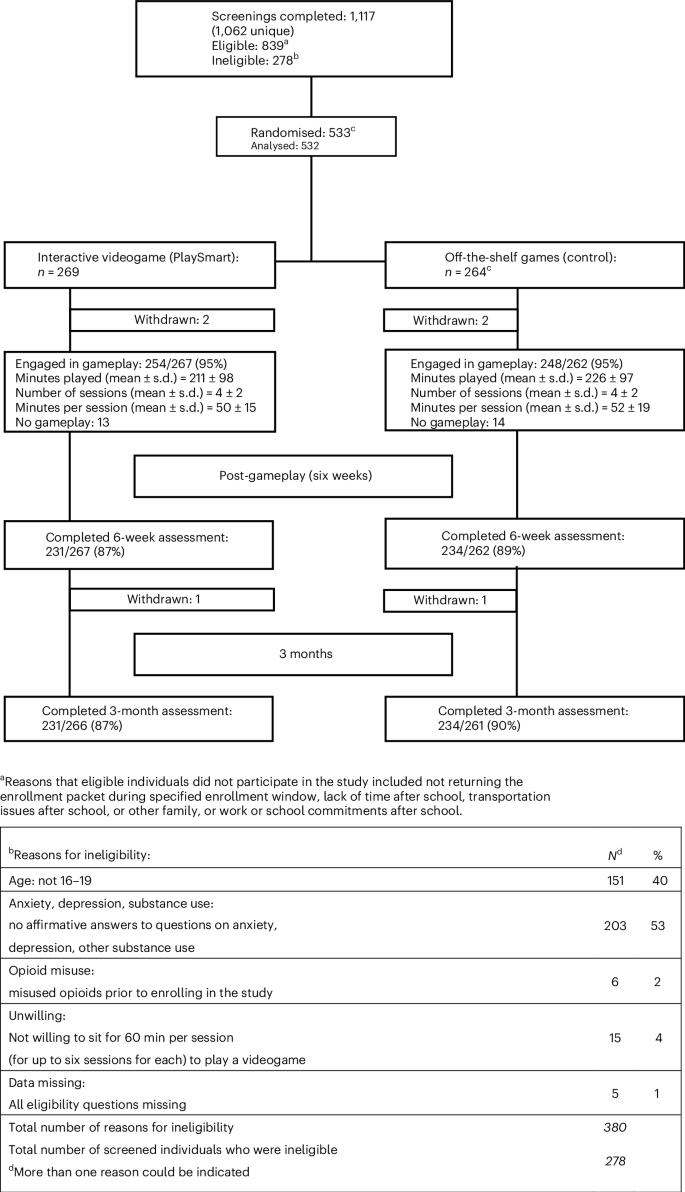
Flow of participants through screening, randomization, allocation, gameplay and follow-up assessments for the PlaySmart (intervention) and control arms. aReasons that eligible individuals did not participate in the study included not returning the enrolment packet during the specified enrolment window, lack of time after school, transportation issues after school, or other family, work or school commitments after school. bReasons for ineligibility (N, %) (note that more than one reason could be indicated) were as follows. Age: not 16–19 (151, 40%). Anxiety, depression, substance use: no affirmative answers to questions on anxiety; depression, other substance use (203, 53%). Opioid misuse: misused opioids prior to enroling in the study (6, 2%). Unwilling: not willing to sit for 60 min per session (for up to six sessions for each) to play a videogame (15, 4%). Data missing: all eligibility questions missing (5, 1%). Total number of reasons for ineligibility: 380. Total number of screened individuals who were ineligible: 278. cOne participant randomized to control was subsequently withdrawn due to a missing parental consent form. dMore than one reason could be indicated.
The baseline characteristics were similar across groups (Table 1). Participants (mean age 16.6 years) were 47% female and racially/ethnically diverse (45% Black, 34% White, 38% Hispanic).
Forty-five percent (238/532) of participants had mild to severe symptoms of anxiety47, with 86% (456/532) reporting at least one anxiety symptom, and 61% (322/532) of participants had mild to severe symptoms of depression48, with 93% (494/531) reporting at least one depression symptom. Participants reported lifetime alcohol or marijuana use (33% (175/532) and 19% (102/532)), respectively. The percentage of participants from each school ranged from 1% to 17%, with a similar number of participants in each arm at each school (Extended Data Table 1).
Primary outcome
At baseline, 16% (43/269) of the PlaySmart group and 17% (46/263) of the control group reported ‘great risk of harm’ from opioid misuse (Fig. 2). At the primary endpoint of 3 months, the outcome of perceived great risk of harm was not significantly different between groups. At 3 months (post randomization), 29% (66/231) of the PlaySmart group versus 23% (53/234) of the control group reported ‘great risk of harm’ (difference = 6%, 95% CI, –2–14%; P = 0.14). Among participants assessed at both baseline and 3 months (N = 465), 16% (36/231) of the PlaySmart group shifted from ‘no great risk of harm’ at baseline to ‘great risk of harm’ at 3 months, compared to 13% (31/234) in the control group (95% CI, –4–9%; P = 0.47). At 6 weeks post randomization (end of gameplay), 26% (59/230) of the PlaySmart group versus 18% (42/233) of the control group reported ‘great risk of harm’ from opioid misuse (95% CI, 0–15%; P = 0.047). Among participants assessed at both baseline and 6 weeks (N = 463), 14% (33/230) of the PlaySmart group shifted from ‘no great risk of harm’ at baseline to ‘great risk of harm’ at 6 weeks, compared to 7% (16/233) in the control group (95% CI, 2–13%; P = 0.009). Additional logistic regression mixed models using perceived ‘great risk of harm’ as the outcome demonstrated the following findings. The unadjusted model (model 1), models adjusted for sex and grade (model 2), and model additionally adjusted for the clustering of participants within schools (model 3) did not yield statistically significant findings (Extended Data Table 2A). The model (model 1) adjusted for sex, grade, baseline risk (‘great risk of harm’ versus ‘no great risk of harm’), and clustering of participants within schools suggested statistically significant differences in odds of ‘great risk of harm’ at 6 weeks (adjusted odds ratio (aOR) 1.96; 95% CI, 1.1–3.5; P = 0.02) but not at 3 months (aOR 1.56; 95% CI, 0.91–2.7; P = 0.11) (Extended Data Table 2B).
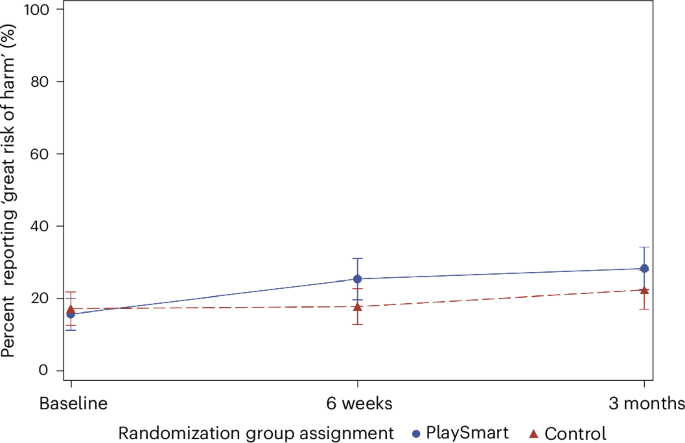
Percent reporting ‘great risk of harm’ on an eight-item perception of risk of harm measure over time per group. Percentages and 95% CIs answering ‘great risk of harm’ from opioids presented for PlaySmart (blue circles and solid line) and control (red triangles and dashed line) at baseline, 6 weeks and 3 months. The numbers contributing data for PlaySmart were 269, 230 and 231 at baseline, 6 weeks and 3 months and for control were 263, 233 and 234.
Finally, because risk perception differs between heroin and prescription opioids, we also separately analysed the questions related to each substance49 (Extended Data Table 3).
Secondary outcomes
For secondary outcomes (Figs. 3 and 4), there were no differences in self-efficacy to refuse opioids between groups (Fig. 3a). At 6 weeks, mean scores were as follows: PlaySmart = 9.1 (95% CI, 8.8–9.3); control = 9.1 (95% CI, 8.9–9.4; P value of difference = 0.95); change from baseline to 6 weeks: PlaySmart = −0.01 (95% CI, −0.3–0.2); control = −0.2 (95% CI, −0.5–0.0; P = 0.39). At 3 months, mean scores were as follows: PlaySmart = 9.1 (95% CI, 8.9–9.3); control = 9.3 (95% CI, 9.0–9.5; P = 0.33); change from baseline to 3 months: PlaySmart = 0.0 (95% CI, −0.3–0.2); control = 0.0 (95% CI, −0.3–0.2; P = 0.98).
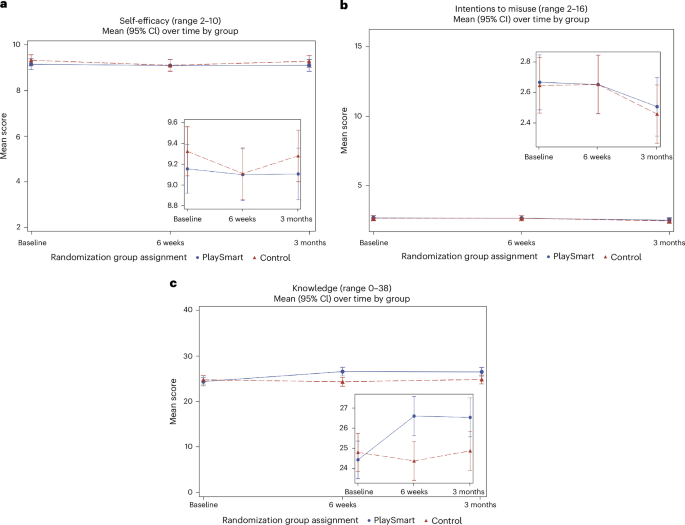
a, Mean self-efficacy scores (range 2–10) over time by group. b, Mean intentions to misuse opioids (range 2–16) over time by group. c, Mean knowledge scores (range 0–38) over time by group. Mean scores and 95% CIs presented for PlaySmart (blue circles and solid lines) and control (red triangles and dashed lines) at baseline, 6 weeks and 3 months. Scores were generated using a linear mixed model with fixed effects for randomization group, time, interaction of randomization group and time, and random participant. The range of each instrument is noted in each panel. The numbers contributing data for the self-efficacy outcome for PlaySmart were 268, 231 and 231 and for control were 263, 233 and 234 at baseline, 6 weeks and 3 months, respectively. The numbers contributing data for the intentions to misuse outcome for PlaySmart were 268, 230 and 231 and for control were 263, 233 and 234 at baseline, 6 weeks and 3 months, respectively. The numbers contributing data for the knowledge outcome for PlaySmart were 269, 231 and 231 and for control were 263, 234 and 234 at baseline, 6 weeks and 3 months, respectively.

Attitudes—positive expectancies (range 0–32) means (95% Cls) over time by group (top) and negative expectancies (range 0–28) means (95% Cls) over time by group (bottom). Mean scores and 95% CIs are presented for PlaySmart (blue circles and solid lines) and control (red triangles and dashed lines) at baseline, 6 weeks and 3 months. Scores were generated using a linear mixed model with fixed effects for randomization group, time, interaction of randomization group and time, and random participant. The numbers contributing data for each attitude outcome for PlaySmart were 269, 229 and 230 and for control were 259, 233 and 233 at baseline, 6 weeks and 3 months, respectively.
There were no differences in intentions to misuse opioids between the PlaySmart and control groups (Fig. 3b). At 6 weeks, the mean scores were as follows: PlaySmart = 2.7 (95% CI, 2.5–2.8); control = 2.7 (95% CI, 2.5–2.8; P = 1.00); change from baseline to 6 weeks: PlaySmart = 0.0 (95% CI, −0.2–0.2); control = 0.0 (95% CI, −0.2–0.2; P = 0.89). At 3 months, the mean scores were as follows: PlaySmart = 2.5 (95% CI, 2.3–2.7); control = 2.5 (95% CI, 2.3–2.6; P = 0.73); change from baseline to 3 months: PlaySmart = −0.02 (95% CI, −0.4–0.1); control = −0.2 (95% CI, −0.4–0.0; P = 0.86).
For knowledge about opioids and misuse, the mean scores were similar between groups at baseline (Fig. 3c). At 6 weeks, the PlaySmart group demonstrated a significantly (P = 0.002) higher mean knowledge score (26.2; 95% CI, 25.6–27.5) compared to the control group (24.4; 95% CI, 23.4–25.3). The change from baseline to 6 weeks was significantly (P < 0.001) greater in the PlaySmart (2.2; 95% CI, 1.5–2.8) than in the control group (−0.4; 95% CI, −1.1–0.2). At 3 months, the PlaySmart group maintained a significantly higher mean knowledge score (26.5; 95% CI, 25.6–27.5) compared to the control group (24.9; 95% CI, 23.9–25.8; P = 0.02). The change from baseline to 3 months remained significantly greater for the PlaySmart (2.1; 95% CI: 1.4–2.7) compared to the control group (0.1; 95% CI, −0.6–0.7; P < 0.001).
For the attitudes measure (Fig. 4), for the positive expectancies questions (the goal is to reduce scores), at 6 weeks, the mean scores were as follows, with PlaySmart (10.2; 95% CI, 9.3–11.0) and control (10.3; 95% CI, 9.5–11.2; P = 0.80) being comparable, showing similar changes from baseline to 6 weeks: PlaySmart (−0.2; 95% CI, −1.0–0.7) and control (−0.6; 95% CI, −1.4–0.2; P = 0.49). At 3 months, the PlaySmart group exhibited a lower mean score (9.7; 95% CI, 8.8–10.5) compared to the control group (10.6; 95% CI, 9.7–11.4; P = 0.15), with similar changes from baseline to 3 months: PlaySmart (−0.7; 95% CI, −1.5–0.2) and control (−0.3; 95% CI, −1.2–0.5; P = 0.59).
For the negative expectancies questions in the attitudes measure (the goal is to increase scores), at 6 weeks, the mean scores were comparable: PlaySmart (18.8; 95% CI, 17.8–19.7) and control (17.8; 95% CI, 16.9–18.8; P = 0.18). The change from baseline to 6 weeks was significantly (P = 0.001) greater in the PlaySmart group (2.3; 95% CI, 1.4–3.1) than in the control group (0.2; 95% CI, −0.7–1.1). At 3 months, mean scores were similar between the two groups, PlaySmart (18.7; 95% CI, 17.7–19.7) and control (18.8; 95% CI, 17.9–19.8; P = 0.85), with similar changes from baseline to 3 months: PlaySmart (2.2; 95% CI, 1.3–3.1) and control (1.2; 95% CI, 0.3–2.1; P = 0.11).
Initiation of opioids was minimal, with no difference between the groups in prescription opioid misuse (PlaySmart, 5%; control, 2%; P = 0.12 at 6 weeks; PlaySmart, 1%; control, 1%; P = 0.66 at 3 months) or heroin use (PlaySmart, 0.4%; control, 0%; P = 0.31 at 6 weeks; PlaySmart, 0%; control, 0.4%; P = 0.32 at 3 months) (Extended Data Table 4).
There were no substantial differences between per-protocol unadjusted models, models including random school cluster, or models adjusted for the randomization variables (Extended Data Table 5).
Gameplay experience
The PlaySmart group played an average of 211.1 min (50.4 min per session), and the control group played 226 min (52.4 min per session) out of the target 300 min of gameplay time, as established during pilot testing. Following gameplay, 84% (227/269) of those who played the PlaySmart game answered questions related to their gameplay experience. They answered agree/strongly agree to the following: the game helped them learn important things (93%, 210/227), they found the game easy to understand (86%, 196/227), they enjoyed the game (79%, 178/226), they were not frustrated by the game (75%, 170/227), and they felt in control of the game (73%, 165/227).
Harms
There were two mild adverse events reported, one at baseline and one at 6 weeks. Both events, described as discomfort during gameplay and discomfort from prolonged exposure to the intervention, were deemed possibly related to the study.
Data completeness
Completeness of assessments was ≥85%, with 87% (464/532; 231 PlaySmart, 233 control) of participants completing the primary outcome assessment for perceived risk of harm from opioids at 3 months. This represents a 13% loss, well below the design parameter used for sample size and power estimation, set at 16%, with an appropriate sample size inflation accounting for this loss. Notably, several strategies contributed to our strong study retention rates, including consistent research staff at each school who built trusting relationships, regular reminders to participants at each contact point, and active school support in locating students and providing flexible scheduling.
Discussion
This randomized controlled trial describes the impact of the videogame PlaySmart on participants’ perceived risk of harm from opioid misuse. The PlaySmart group did not show a significant difference in perceived risk of harm at the primary outcome timepoint of 3 months. Although there was a significant increase in perceived risk of harm from opioid misuse at the 6-week assessment (immediately following gameplay), this was not sustained at 3 months. The PlaySmart participants exhibited significant improvements in knowledge and negative expectancies about opioid misuse compared to the control group, but not self-efficacy, intentions or positive expectancies. Youth who played PlaySmart also reported high levels of satisfaction with the game, underscoring its potential as an engaging prevention tool.
Although participants in neither group reported meaningful levels of initiation of opioid misuse by the 3-month timepoint, and, as such, we were not yet able to detect a between-groups difference or demonstrate the relationship between perceived risk of harm and actual use, our study’s goal of examining perceived risk does align with research emphasizing the role of perceived risk of harm as a potential predictor of substance misuse in adolescents. We chose to target perceived risk of harm from opioid misuse because national data on adolescents, and our study data, reveal persistently low risk perceptions for both prescription opioids and heroin. In addition, research continues to demonstrate that lower perceived risk among adolescents is significantly associated with increased likelihood of actual misuse, underscoring the need for interventions that effectively shift these perceptions50,51. There are, however, few studies that examine interventions targeting perceived risk of harm19. A non-experimental pre–post study by Fuentes and colleagues52 found that, immediately post-intervention, perceptions of use being ‘very dangerous’ (a proxy for ‘great risk of harm’) increased by 16% for smoking one cigarette (23.9% to 39.9%), 16.2% for alcohol (43.8% to 60%) and 9% for marijuana (57% to 66%). Although opioids were not assessed in ref. 52, the findings for marijuana are directionally consistent with the 6-week findings in the current study—26% of PlaySmart versus 18% of controls endorsing great risk of harm from opioid misuse (8% difference). This underscores the importance of new interventions targeting accurate risk perception in mitigating substance use, including opioid misuse. We anticipate being better able to demonstrate this relationship with longer-term outcomes at our 6- and 12-month timepoints.
Our study also adds to the literature about the impact of game-based learning and the value of digital interventions for reach and scale. For example, the observed increase in opioid-related knowledge and attitudes among PlaySmart participants is consistent with our previous research and that of others on the efficacy of serious games in enhancing health-related outcomes in domains such as substance use, sexual health and mental health23,24,25,42,53,54. The incorporation of behaviour change theories and user-centred design in PlaySmart probably contributed to its effectiveness, highlighting the importance of integrating evidence-based frameworks into videogame intervention development44.
In addition, a digital intervention such as PlaySmart potentially mitigates some of the substantial implementation barriers. For example, a recent study evaluating a school-based harm reduction programme for high-school students, Safety First, reported an impact on knowledge and decision-making skills55. However, they also concluded that, although the curriculum showed important improvements, it required educator training and coaching to implement, potentially limiting broad-scale reach. Similarly, studies of effective adolescent substance prevention programmes such as LifeSkills Training and the Strengthening Family Program, which require consistent structural oversight, have demonstrated that classroom-level factors can significantly impact engagement and retention56, and translation to a virtual platform can help mitigate these barriers57. Most studies do not specify actual hours of engagement, but our study was able to document that, on average, our participants played PlaySmart for three-and-a-half hours, providing evidence of student-level engagement. Therefore, videogames like PlaySmart may offer unique advantages beyond impact, including engagement, consistent delivery and fidelity, and scalability.
Several limitations to our study must also be discussed. The sample was drawn from one US state (Connecticut), so generalizability to other populations may be limited, though it is important to note that our sample was sociodemographically diverse and from high schools in different regions of the state. Although our questions on actual substance use do ask about experience with fentanyl, the questions we used for perceived risk of harm from opioids were drawn from the MTF Study49, which did not include fentanyl. Future studies should include an assessment of perceived risk of harm from fentanyl specifically, given its emerged prevalence. In addition, our measures were collected by self-report. Although this may introduce social desirability bias, we optimized our methods through strategies we used in previous trials collecting sensitive data from young people, ensuring privacy and confidentiality, with the goal of enhancing disclosure and reducing bias24,25. Although data on both sex and gender were collected, we did not examine potential differences in intervention effects by gender due to small subgroup sizes and the scope of the current analyses.
Furthermore, the current study reports short-term outcomes, and 6- and 12-month data are forthcoming. National data indicate that if an adolescent has not started opioid misuse by age 16 years, the estimated average age of initiation would probably be around 18–19 years, so we may be able to capture the impact of the PlaySmart intervention at 12 months follow-up in some participants58. Given the strong established inverse relationship between perceived risk of harm from opioid misuse and actual misuse, this further bolsters the value of this measure as a proxy when actual misuse may be delayed.
Our current findings did not demonstrate a statistically significant increase in perceived risk of harm in the PlaySmart group at 3 months. Notably, the baseline proportion of perceived risk of harm from opioids in our cohort was lower than the one used in our power calculations (17% versus 32%). The higher estimate was based on single-item data from the 2018 MTF survey49, but our primary outcome required endorsement of ‘great risk’ across all eight opioid-related items, yielding a more conservative parameter estimate. Accordingly, the discrepancy in baseline rate probably reflects differences in how the outcome was operationalized (for example, single-item measures versus composite), potentially limiting our power to detect the hypothesized effect, and is now noted as a limitation. Importantly, a significant change was seen at 6 weeks, but was not sustained. This finding may highlight the need for a booster at a timepoint between gameplay and 3 months. Although PlaySmart did significantly improve knowledge, we know that knowledge is necessary but not sufficient for behaviour change. Behaviour change is a complex, multistep process, and although we aimed to target a number of key behavioural antecedents, such as findings in the broader substance-misuse literature, impacting all these outcomes was challenging59.
Further work is needed to refine the design of PlaySmart to achieve stronger and more durable effects on risk perception. These efforts might include incorporating into the game adaptive features such as personalized feedback, booster sessions and storyline extensions to reinforce key prevention messages and counter the decline in impact observed at 3 months. We will also examine how expanded narratives and contextually relevant storylines influence outcomes to optimize the long-term impact of PlaySmart on opioid misuse prevention. Collectively, these potential avenues for the further enhancement and design of PlaySmart will help to identify the most promising strategies to strengthen the intervention’s durability and real-world application.
Our conclusions are thus tempered to reflect the preliminary nature of the findings, and a next step is to examine the longer-term outcomes (for example, at 6 and 12 months) to more fully assess the programme’s potential impact before recommending broader dissemination. There is a continued opioid crisis in the United States and an urgent need for engaging, scalable and effective interventions targeting opioid misuse prevention in adolescents20. We hypothesize that the combination of the increase in knowledge and negative expectancies around opioid misuse, as key behavioural antecedents, in conjunction with future efforts to bolster risk perception, holds the promise of substantially impacting opioid-misuse risk perceptions and behaviours in adolescents.
Methods
Study design, settings and participants
Through a two-arm parallel superiority randomized controlled trial using a placebo comparator, we evaluated the efficacy of the original videogame PlaySmart44. This study was approved by the Yale IRB (protocol #2000030553) and registered on ClinicalTrials.gov (NCT04941950). The trial protocol and statistical analysis plan can be accessed at www.clinicaltrials.gov. High schools were eligible if they were in Connecticut. Students were eligible if they (1) were aged 16–19 years (grades 9–12); (2) attended high school (preferably enroled in the school’s school-based health centre); (3) reported no prior opioid misuse; (4) were considered to be ‘high-risk’ based on at least one of the following baseline criteria: (a) past 30-day use of cigarettes, e-cigarettes/Juul, alcohol, marijuana (including synthetics), amphetamines, cocaine, benzodiazepines, ecstasy, bath salts or other non-opioid prescription or illicit drugs OR (b) a score of ≥1 on the modified Patient Health Questionnaire-2 (PHQ-2) depression screener OR (c) a score of ≥1 on the modified Generalized Anxiety Disorder-2 (GAD-2) anxiety screener; (5) were willing to participate in 60-min gameplay sessions; and (6) provided assent and parental/guardian consent if under 18 years of age.
Participants self-reported both sex (male/female) and gender at baseline. For the present analyses, sex was included as a covariate given the study design, but gender was not included in the analysis due to small subgroup size. Additionally, race and ethnicity were self-reported to describe the sample and assess generalizability, but they were not used in primary analyses.
Participants played their assigned games (PlaySmart or control) on research-provided iPads during supervised, after-school sessions (1 or 2 times per week for approximately 6 weeks; ~60 min per session). Research assistants recorded session start and end times to monitor attendance and exposure. There was no required minimum dosage or content completion. Additional study procedures and methods have been published previously46. The full study protocol is available in Supplement Information 1.
Randomization
Randomization, block sizes 2 and 4, was stratified by sex and grade (9/10th and 11/12th) and was operationalized through REDCap P11. The randomization scheme was generated by the senior biostatistician (T.C.K.) and implemented by a separate research study team responsible for the online randomization platform and data entry system.
Research staff accessed the system after participants were screened, consented and completed baseline assessments to enter stratification data and receive randomization assignments.
The study team remained blinded to outcomes until after database lock and statistical reports were prepared.
Interventions
PlaySmart is a theory-driven, narrative Web-mobile videogame composed of up to 6 h of unique gameplay. Within the game, players navigate decisions related to peer pressure, stress and substance use, particularly opioids, while also addressing co-occurring risk factors such as mental health challenges and other substance misuse. In addition to the six main storylines, PlaySmart also features six integrated minigames that reinforce core prevention skills such as refusal skills, decision-making skills and coping strategies (Supplementary Fig. 1)46.
Participants randomized to the experimental group accessed PlaySmart through a secure login portal (https://user.p2p-games.org/login) using a unique, randomly generated username and password created via the study’s administrative site (https://admin.p2p-games.org/login). Each participant used a research-provided iPad and the same assigned iPad and login credentials across all sessions so that their progress could be saved.
Participants assigned to the control condition had access to nine videogames that contained no relevant content (for example, The Sims, Can You Escape), serving as the attention/time control.
Outcomes
Where adapted measures were used, a Cronbach’s alpha60 was generated to ensure the reliability of the questions (Extended Data Table 6). Baseline sociodemographic and clinical characteristics were collected. All measures and specific questions are described elsewhere46, but only a subset is included in the current article. Perceived risk of harm from opioid misuse was the primary outcome and was assessed with eight questions taken from the US-based Monitoring The Future survey49. In the assessment, the first five of the eight questions address heroin use and the last three questions prescription opioid misuse (Supplementary Information 1). Primary and secondary outcomes were assessed at all three timepoints, as per the protocol.
Secondary outcomes included self-efficacy, intentions, knowledge and attitudes (positive and negative expectancies). Participants’ self-efficacy to refuse opioids was assessed with a revised subscale from the Drug Use Resistance Self-Efficacy (DURSE) scale61 (two items, maximum score = 10). Higher scores indicated higher self-efficacy around not misusing opioids. Intentions to misuse opioids were assessed with a modified scale from a substance-use intentions study62 (four items, maximum score = 16). Lower scores reflected lower intentions to misuse opioids. We assessed knowledge with a 30-item scale that included 27 true/false questions and three questions allowing participants to select all that applied. This scale was a composite of instruments from two risk behaviour studies63,64. Correct answers for the 27 true/false questions were given one point; any answer left blank was given a score of 0. For the three multiple-choice questions, each correct answer was given one point (combined maximum score of 27 true/false questions and three multiple-choice questions = 38). Higher knowledge scores were consistent with more accurate knowledge. Participants’ attitudes were assessed using a revised scale65 (15 items), with the first eight questions representing positive expectancies of using opioids (maximum score = 32) and the last seven representing negative expectancies of using opioids (maximum score = 28). Initiation of opioid misuse was assessed with a dichotomous (yes/no) measure of lifetime use66,67,68.
Participants who played PlaySmart answered six questions about their gameplay experience.
Harms
Harms were pre-specified as any adverse events related to trial participation, including physical discomfort (for example, eyestrain, headache), emotional distress (for example, frustration, discomfort with game content) or any other negative effects reported by participants or study staff during gameplay or assessments. Adverse events were collected systematically at each gameplay session and follow-up assessment timepoint and reported to the Data Safety Monitoring Board and the IRB as appropriate. The risks associated with receiving the intervention were considered minimal.
Data collection and management
REDCap P11 was used for data collection, management and monitoring, and is further described elsewhere46.
Statistical analyses
We followed the ‘intention to treat’ principle in the analyses of the outcomes. Baseline characteristics are reported using mean and standard deviation for continuous variables or N and percentages for binary or categorical variables. All analyses were generated using SAS software version 9.4 (SAS Institute). Statistical significance was set to 0.05, two-sided, as appropriate.
The primary hypothesis was that, at 3 months, there would be a higher proportion of PlaySmart than control participants who perceived a great risk of harm from misuse of prescription opioids and/or use of heroin. This was tested by comparing the responses to the eight questions on perceived risk of harm with those participants who reported ‘great risk of harm’ for all of the eight questions, being included in the ‘great risk of harm’ group. Otherwise, they were included in the ‘no great risk of harm’ group. χ2 tests were used to compare the proportions of participants in each study arm who achieved the outcome at 3 months (post randomization) and 6 weeks (post-gameplay completion). The difference in proportion (and 95% CIs) of study participants in the two arms was also calculated at each timepoint.
Supplemental primary outcome analyses were performed with a mixed model with log link. Fixed effects for randomization group, time, interaction of treatment group by time, and random participant effect were included in all models. Unadjusted and adjusted (for grade and sex) were used to compare the two study groups using ORs and 95% CIs. Additional adjusted models with random intercepts for participant and participant clustered within school were also included to investigate if there was any effect of school on the primary outcome. A final supplemental model compared the change in odds of answering great risk of harm to all eight questions (scoring 32 on the Perception of Harm Scale) from baseline to 6 weeks or to 3 months for PlaySmart versus control. This model included fixed effects for randomization group, time, interaction of group and time, adjusted for baseline (binary risk score of 32 or less than 32), grade and sex, with random intercepts for participant and participant clustered within school.
The two study groups were also compared using χ2 tests of the proportions who perceived a ‘great risk of harm’ when examining two subsets of questions from the perceived risk of harm questions: five questions addressing heroin use and three questions addressing prescription opioid misuse.
For each secondary outcome, scores were compared between the two groups using least squared means using a mixed-effects model, with random participant ID, fixed effect for time, randomization group, and interaction of time and randomization group, using all data at all timepoints. Mixed-model repeated measures analysis allows for valid inferences under the assumption that data are missing at random and makes use of all available data without the need for imputation. Scores for self-efficacy to refuse opioids were summed and ranged from 2 to 10, with higher score indicating greater self-efficacy. Scores for intentions to misuse opioids were summed and ranged from 2 to 16, with higher score indicating greater intentions. Knowledge scores were summed and ranged from 0 to 38. The knowledge score and its changes (since baseline) at 6 weeks and 3 months were compared between the two study arms. Attitudes towards misuse were categorized into positive and negative expectancies. Mixed-model repeated measures analysis for the secondary outcomes provided valid estimates under the assumption of data missing at random and used all available data without requiring imputation. Given this approach and the observed attrition pattern, additional sensitivity analyses or imputation were not conducted.
Additional models for the secondary outcomes are provided. Unadjusted models with random intercepts for participant and participant clustered within school were also included to investigate whether there was any effect of school on outcome. Additional models adjusted for the randomization stratification of grade and sex are also included.
Reported initiation of prescription opioids and/or heroin was compared between the two groups at each timepoint using χ2 and difference in proportions (and 95% CIs).
Sample size and power
Based on estimates from drug use prevention interventions69,70,71, and using data from a study examining the impact of an intervention on perceptions of harm of drug use72, the study was powered to detect a 15% absolute difference between the PlaySmart group and the control groups in perceived risk of harm from opioid misuse at 3 months. The assumption was that, at baseline, ~32% of participants would report a ‘great risk of harm’ of opioid misuse49. Therefore, a sample size of 454 participants would be required with 90% power (P ≤ 0.05) (Power Analysis Statistical Software (PASS); 2008), inflated to 532 participants (266 in each arm) to account for 16% loss at 3 months based on data from another randomized trial25.
Reporting summary
Further information on research design is available in the Nature Portfolio Reporting Summary linked to this article.
Data availability
This study, part of the NIDA HEAL Prevention Cooperative, will deposit de-identified individual-level participant data in NIDA’s National Addiction & HIV Data Archive Program (NAHDAP), maintained by NIDA. Data will become available upon publication and will remain archived indefinitely. Access is restricted to protect participant confidentiality and will be granted to qualified researchers upon approval of a research proposal that includes specific aims and an analysis plan. Approval is contingent on execution of a data use agreement, which outlines permissible uses and restrictions, including prohibitions against redistribution or re-identification of participants. Requests for access should be submitted via the NAHDAP request system. Requests are typically reviewed and responded to within 4–6 weeks.
Code availability
No custom code was developed or used in the analysis of this study. The videogame PlaySmart is publicly accessible via its distribution website, Playbl (https://playbl.com). Readers interested in access must submit a request through the website. Use of PlaySmart is governed by Playbl’s standard Terms of Use and users must comply with Playbl’s Acceptable Use Policy, Privacy Policy, and, where applicable, laws protecting minors. The underlying source code of the game is not being shared or made publicly available due to licensing and intellectual-property restrictions.
References
Ahmad, F., Rossen, L. & Sutton, P. Provisional Drug Overdose Death Counts (National Center for Health Statistics, 2021).
Tanz, L. J. Drug overdose deaths among persons aged 10–19 years—United States, July 2019–December 2021. MMWR 71, 1576–1582 (2022).
Gomes, T. et al. Trends in opioid toxicity–related deaths in the US before and after the start of the COVID-19 pandemic, 2011-2021. JAMA Netw. Open 6, e2322303 (2023).
Youth Risk Behavior Survey Data Summary & Trends Report: 2011–2021 (Centers for Disease Control and Prevention National Center for HIV, Viral Hepatitis, STD, and TB Prevention Division of Adolescent and School Health, 2023).
Miech, R. A., Johnston, L. D., Patrick, M. E., O’Malley, P. M. & Bachman, J. G. Monitoring the Future National Survey Results on Drug Use, 1975–2023: Overview and Detailed Results for Secondary School Students (Institute for Social Research, 2024).
Kapadia, S. N. & Bao, Y. Prescription painkiller misuse and the perceived risk of harm from using heroin. Addict. Behav. 93, 141–145 (2019).
Bachman, J. G., Johnston, L. D., O'Malley, P. M. & Humphrey, R. H. Explaining the recent decline in marijuana use: differentiating the effects of perceived risks, disapproval, and general lifestyle factors. J. Health Soc. Behav. 29, 92–112 (1988).
Petraitis, J., Flay, B. R. & Miller, T. Q. Reviewing theories of adolescent substance use: organizing pieces in the puzzle. Psychol. Bull. 117, 67–86 (1995).
Collins, D., Abadi, M. H., Johnson, K., Shamblen, S. & Thompson, K. Non-medical use of prescription drugs among youth in an Appalachian population: prevalence, predictors, and implications for prevention. J. Drug Educ. 41, 309–326 (2011).
Arria, A. M., Caldeira, K. M., Vincent, K. B., O’Grady, K. E. & Wish, E. D. Perceived harmfulness predicts nonmedical use of prescription drugs among college students: interactions with sensation-seeking. Prev. Sci. 9, 191–201 (2008).
Ford, J. A. & Rigg, K. K. Racial/ethnic differences in factors that place adolescents at risk for prescription opioid misuse. Prev. Sci. 16, 633–641 (2015).
Voepel-Lewis, T. et al. Deliberative prescription opioid misuse among adolescents and emerging adults: opportunities for targeted interventions. J. Adolesc. Health 63, 594–600 (2018).
Votaw, V. R., Wittenauer, J., Connery, H. S., Weiss, R. D. & McHugh, R. K. Perceived risk of heroin use among nonmedical prescription opioid users. Addict. Behav. 65, 218–223 (2017).
Schwartz, C. et al. Preventing problematic opioid use for young people. Q. J. Child Ment. Health 18, 1–18 (2024).
Hua-Nguyen, C. et al. Effectiveness of educational interventions in United States schools to prevent opioid-related harms: a systematic review. Addict. Behav. 163, 108268 (2025).
Lu, W. et al. Youth participation in substance use prevention: a national profile. Prev. Med. 185, 108050 (2024).
Hallfors, D. & Van Dorn, R. A. Strengthening the role of two key institutions in the prevention of adolescent substance abuse. J. Adolesc. Health 30, 17–28 (2002).
Mihalic, S. F., Fagan, A. A. & Argamaso, S. Implementing the LifeSkills Training drug prevention program: factors related to implementation fidelity. Implement. Sci. 3, 5 (2008).
Liu, X.-Q., Guo, Y.-X. & Wang, X. Delivering substance use prevention interventions for adolescents in educational settings: a scoping review. World J. Psychiatry 13, 409–422 (2023).
Monarque, M., Sabetti, J. & Ferrari, M. Digital interventions for substance use disorders in young people: rapid review. Subst. Abuse Treat. Prev. Policy 18, 13 (2023).
Teens, Social Media and Technology (Pew Research Center, 2023).
Abt, C. Serious Games (Viking Press, 1970).
Hieftje, K. D., Fernandes, C.-S. F., Lin, I.-H. & Fiellin, L. E. Effectiveness of a web-based tobacco product use prevention videogame intervention on young adolescents' beliefs and knowledge. Subst. Abus. 42, 47–53 (2021).
Pendergrass Boomer, T., Larkin, K., Duncan, L. R., Fernandes, C.-S. F. & Fiellin, L. E. A serious video game targeting HIV testing and counseling: a randomized controlled trial. J. Adolesc. Health 74, 252–259 (2024).
Fiellin, L. E. et al. Video game intervention for sexual risk reduction in minority adolescents: randomized controlled trial. J. Med. Internet Res. 19, e314 (2017).
Mohan, D. et al. Efficacy of educational video game versus traditional educational apps at improving physician decision making in trauma triage: randomized controlled trial. Brit. Med. J. 359, j5416 (2017).
Lukhele, B. W. et al. Efficacy of mobile serious games in increasing HIV risk perception in Swaziland: a randomized control trial (SGprev Trial) research protocol. JMIR Res. Protoc. 5, e224 (2016).
Aster, A. et al. Development and evaluation of an emergency department serious game for undergraduate medical students. BMC Med. Educ. 24, 1061 (2024).
Peng, W. Design and evaluation of a computer game to promote a healthy diet for young adults. Health Commun. 24, 115–127 (2009).
Kato, P. M., Cole, S. W., Bradlyn, A. S. & Pollock, B. H. A video game improves behavioral outcomes in adolescents and young adults with cancer: a randomized trial. Pediatrics 122, e305–e317 (2008).
Merry, S. N. et al. The effectiveness of SPARX, a computerised self-help intervention for adolescents seeking help for depression: randomised controlled non-inferiority trial. Brit. Med. J. 344, e2598 (2012).
Abd-Alrazaq, A. et al. The effectiveness of serious games in alleviating anxiety: systematic review and meta-analysis. JMIR Serious Games 10, e29137 (2022).
Townsend, C. et al. The effectiveness of gaming interventions for depression and anxiety in young people: systematic review and meta-analysis. BJPsych Open 8, e25 (2022).
Ruiz, M. et al. Winning the game against depression: a systematic review of video games for the treatment of depressive disorders. Curr. Psychiatry Rep. 24, 23–35 (2022).
Aneni, K. et al. A systematic review and meta-analysis evaluating the efficacy of stand-alone digital interventions to prevent substance use among adolescents. Curr. Addict. Rep. 10, 378–395 (2023).
Andrew, L. et al. Serious games for health promotion in adolescents—a systematic scoping review. Educ. Inform. Technol. 28, 5519–5550 (2023).
Johansson, M., Romero, D., Jakobson, M., Heinemans, N. & Lindner, P. Digital interventions targeting excessive substance use and substance use disorders: a comprehensive and systematic scoping review and bibliometric analysis. Front. Psychiatry 15, 1233888 (2024).
Martínez-Miranda, J. & Espinosa-Curiel, I. E. Serious games supporting the prevention and treatment of alcohol and drug consumption in youth: scoping review. JMIR Serious Games 10, e39086 (2022).
Abraham, O., Rosenberger, C., Tierney, K. & Birstler, J. Investigating the use of a serious game to improve opioid safety awareness among adolescents: quantitative study. JMIR Serious Games 9, e33975 (2021).
Ridenour, T. A. et al. Introduction to helping to end addiction long-term prevention cooperative: overview and strategies. Prev. Sci. 24, 1–7 (2023).
Fernandes, C. S. F. et al. A pilot randomized controlled trial to evaluate a cognitive behavioral videogame intervention: empowerED. Games Health J. 12, 42–52 (2023).
Pentz, M. A. et al. A videogame intervention for tobacco product use prevention in adolescents. Addict. Behav. 91, 188–192 (2019).
Pendergrass, T., Hieftje, K., Duncan, L. & Fiellin, L. Videogame intervention to encourage HIV testing and counseling among adolescents. Mhealth 6, 26 (2020).
Aneni, K. et al. A video game intervention to prevent opioid misuse among older adolescents: development and preimplementation study. JMIR Serious Games 11, e46912 (2023).
Yule, A. M., Lyons, R. M. & Wilens, T. E. Opioid use disorders in adolescents—updates in assessment and management. Curr. Pediatr. Rep. 6, 99–106 (2018).
Pendergrass Boomer, T. M. et al. A digital health game to prevent opioid misuse and promote mental health in adolescents in school-based health settings: protocol for the PlaySmart game randomized controlled trial. PLoS ONE 18, e0291298 (2023).
Williams, N. The GAD-7 questionnaire. Occup. Med. 64, 224 (2014).
Kroenke, K. et al. The PHQ-8 as a measure of current depression in the general population. J. Affect. Disord. 114, 163–173 (2009).
Miech, R. A. et al. Monitoring the Future National Survey Results on Drug Use, 1975–2022: Secondary School Students. Monitoring the Future Monograph Series (Institute for Social Research, 2018).
Levy, N. S., Mauro, P. M., Mauro, C. M., Segura, L. E. & Martins, S. S. Joint perceptions of the risk and availability of cannabis in the United States, 2002-2018. Drug Alcohol Depend. 226, 108873 (2021).
Debnam, K. J., Saha, S. & Bradshaw, C. P. Synthetic and other drug use among high school students: The role of perceived prevalence, access, and harms. Subst. Use Misuse 53, 2069–2076 (2018).
Fuentes, P. M. et al. Effectiveness of a mobile app to increase risk perception of tobacco, alcohol, and marijuana use in Mexican high school students: quantitative study. JMIR Mhealth Uhealth 11, e37873 (2023).
Maheu-Cadotte, M.-A. et al. Effectiveness of serious games and impact of design elements on engagement and educational outcomes in healthcare professionals and students: a systematic review and meta-analysis protocol. BMJ Open 8, e019871 (2018).
Tori, A. A., Tori, R. & dos Santos Nunes, F. D. L. Serious game design in health education: a systematic review. IEEE Trans. Learn. Technol. 15, 827–846 (2022).
Fischer, N. R. School-based harm reduction with adolescents: a pilot study. Subst. Abuse Treat. Prev. Policy 17, 79 (2022).
Combs, K. M. et al. Influence of classroom-level factors on implementation fidelity during scale-up of evidence-based interventions. Prev. Sci. 23, 969–981 (2022).
Weybright, E. H., Hampilos, K., Pascoe, K. M., Cooper, B. R. & Grinstead, C. Adaptation and evaluation of Strengthening Families program for parents and youth 10–14 for delivery in a virtual format: an application of FRAME. Glob. Implement. Res. Appl. 5, 141–152 (2025).
Warren, L. K., Adams, J. & Bobashev, G. Trends in opioid misuse among individuals aged 12 to 21 years in the US. JAMA Netw. Open 6, e2316276 (2023).
Tinner, L. et al. Individual-, family- and school-based interventions to prevent multiple risk behaviours relating to alcohol, tobacco and drug use in young people aged 8–25 years: a systematic review and meta-analysis. BMC Public Health 22, 1111 (2022).
Cronbach, L. J. Coefficient alpha and the internal structure of tests. Psychometrika 16, 297–334 (1951).
Carpenter, C. M. & Howard, D. Development of a drug use resistance self-efficacy (DURSE) scale. Am. J. Health Behav. 33, 147–157 (2009).
Skenderian, J. J., Siegel, J. T., Crano, W. D., Alvaro, E. E. & Lac, A. Expectancy change and adolescents' intentions to use marijuana. Psychol. Addict. Behav. 22, 563–569 (2008).
Kelly, J. A., Lawrence, J. S. S., Hood, H. V. & Brasfield, T. L. An objective test of AIDS risk behavior knowledge: scale development, validation, and norms. J. Behav. Ther. Exp. Psychiatry 20, 227–234 (1989).
Jemmott, L. S., McCaffree, K. A. & Jemmott, J. B. Making a difference: an abstinence-based approach to HIV/STD and teen pregnancy prevention: curriculum manual (Select Media, Inc., 2003).
Callas, P. W., Flynn, B. S. & Worden, J. K. Potentially modifiable psychosocial factors associated with alcohol use during early adolescence. Addict. Behav. 29, 1503–1515 (2004).
Saha, T. D. et al. Analyses related to the development of DSM-5 criteria for substance use related disorders: 1. Toward amphetamine, cocaine and prescription drug use disorder continua using Item Response Theory. Drug Alcohol Depend. 122, 38–46 (2012).
Saunders, J. B. Substance use and addictive disorders in DSM-5 and ICD 10 and the draft ICD 11. Curr. Opin. Psychiatry 30, 227–237 (2017).
High School Youth Risk Behavior Survey Data (Centers for Disease Control and Prevention, 2019).
Faggiano, F., Minozzi, S., Versino, E. & Buscemi, D. Universal School-Based Prevention for Illicit Drug Use (Cochrane Database of Systematic Reviews, 2014).
Robertson, E. B., David, S. & Rao, S. A. A Research-Based Guide for Parents, Educators, and Community Leaders (NIH, 2003).
Preventing Prescription Drug Misuse: Data Resources–CAPT Decision-Support Tools: Preventing Prescription Drug Misuse: Understanding Who Is at Risk (Substance Abuse and Mental Health Services Administration (SAMHSA), 2016).
Lennox, R. D. & Cecchini, M. A. The NARCONON™ drug education curriculum for high school students: a non-randomized, controlled prevention trial. Subst. Abuse Treat. Prev. Policy 3, 8 (2008).
Acknowledgements
We thank our youth participants for participating in this study. This work would not have been possible without them. Additionally, we are grateful for our invaluable school and school-based health centre partners. We also thank J. Anziano, F. Giannattasio, A. Metcalf, K. Su, L. Bonilla, S. Bellete and T. Anderson for their tremendous efforts in recruitment, data collection and guidance of study participants. Finally, we acknowledge our game design and development partners, B. Sawyer and the team at Schell Games. This study was funded by the National Institutes of Health’s Helping to End Addiction Long-term (HEAL) Initiative (grant 4UH3DA050251-03). All authors (T.B., L.H., K.L., T.C.K., K.M. and L.E.F.) received funding for this project through grant 4UH3DA050251-03. The funding body played no role in the study’s design, data collection or manuscript writing.
Author information
Authors and Affiliations
Contributions
L.E.F. and T.B. designed the trial, and L.E.F. received funding for the study. K.L., T.B. and L.E.F. designed the assessments for the study. T.B. and L.H. conducted the study. K.M. and T.C.K. analysed the results. T.B. and L.E.F. wrote the first draft of the manuscript. T.B., L.E.F., L.H., K.L., T.C.K. and K.M. critically proofread the manuscript and provided valuable inputs for adjustment. All authors contributed to the final version of the manuscript.
Corresponding author
Ethics declarations
Competing interests
L.E.F., a co-author on this manuscript and principal investigator on this NIH-funded study, is also a cofounder and equity holder of a spin-out company from the play2PREVENT Lab called Playbl that focuses on the marketing and distribution of our videogame interventions. This relationship is extensively managed by L.E.F. and Yale University and L.E.F. and Dartmouth College. This management, which is closely followed, includes L.E.F. (1) not being involved in any interactions with study participants including the selection, enrolment or consenting of participants, or determination of participant eligibility and (2) not participating in data collection and maintaining an independent data analysis team (Yale Center for Analytical Studies, YCAS). The other authors declare no competing interests.
Peer review
Peer review information
Nature Health thanks Yuhua Bao, Jennifer Hellier, Michelle Torok and the other, anonymous, reviewer(s) for their contribution to the peer review of this work. Primary Handling Editor: Lorenzo Righetto, in collaboration with the Nature Health team.
Additional information
Publisher’s note Springer Nature remains neutral with regard to jurisdictional claims in published maps and institutional affiliations.
Extended data
Supplementary information
Supplementary Information (download PDF )
IRB-approved protocol.
Supplementary Fig. 1 (download PDF )
PlaySmart logic model.
Rights and permissions
Open Access This article is licensed under a Creative Commons Attribution-NonCommercial-NoDerivatives 4.0 International License, which permits any non-commercial use, sharing, distribution and reproduction in any medium or format, as long as you give appropriate credit to the original author(s) and the source, provide a link to the Creative Commons licence, and indicate if you modified the licensed material. You do not have permission under this licence to share adapted material derived from this article or parts of it. The images or other third party material in this article are included in the article’s Creative Commons licence, unless indicated otherwise in a credit line to the material. If material is not included in the article’s Creative Commons licence and your intended use is not permitted by statutory regulation or exceeds the permitted use, you will need to obtain permission directly from the copyright holder. To view a copy of this licence, visit http://creativecommons.org/licenses/by-nc-nd/4.0/.
About this article

Cite this article
Boomer, T., Hoerner, L., Larkin, K. et al. A videogame for perceived risk of harm from opioid misuse in adolescents: a randomized controlled trial. Nat. Health 1, 78–89 (2026). https://doi.org/10.1038/s44360-025-00010-z
Received:
Accepted:
Published:
Version of record:
Issue date:
DOI: https://doi.org/10.1038/s44360-025-00010-z

