A selection of neuroscience-related images

Defining the electrical synapse

  • Alberto E. Pereda
  • Adam C. Miller
Review Article

Advertisement

    • Image

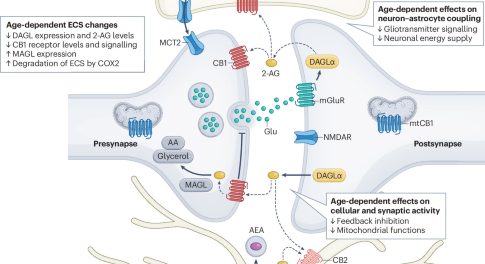
      Age-related changes in endocannabinoid system (ECS) activity might contribute to the decline in cognitive function observed during ageing. In this review, Andreas Zimmer discusses how evidence from genetic and pharmacological studies in mice and humans indicate that relevant cognitive functions may change as a result of changing ECS activity.

      • Andreas Zimmer
      Review Article
    • Image

      The skeleton is innervated by neurons that convey sensory information to the CNS and release neuroregulatory peptides to influence the bone microenvironment. James and colleagues describe the mechanisms underlying sensorineural regulation of skeletal bone, the contributions of nerve–bone coupling to bone growth and repair, and the disruption of this axis in various skeletal pathologies.

      • Zhao Li
      • Manyu Zhu
      • Aaron W. James
      Review Article
    • Image

      The capacity to self-evaluate and control one’s own cognitive performance, known as metacognition, underpins adaptive learning, social behaviours and self-belief. Stephen Fleming outlines our current understanding of the neural basis of metacognition, its contributions to self-regulation and social communication, and the consequences of its dysfunction in clinical conditions.

      • Stephen M. Fleming
      Review Article
    • Image

      Recent years have witnessed major advances in our understanding of the distinct functional and computational roles of the ventral hippocampus (vHPC). Mazen Kheirbek and colleagues examine the state-dependent representation of behaviourally salient information by the vHPC and discuss how its anatomy and circuit connectivity support affective and motivational behaviours.

      • Jeremy S. Biane
      • Julian Wagner-Carena
      • Mazen A. Kheirbek
      Review Article
    • Image

      The mechanisms underlying electrical transmission are often viewed as relatively simple compared with those mediating chemical transmission, yet electrical synapses exhibit dynamic changes in structure and strength. In this Review, Alberto Pereda and Adam Miller examine the structural and molecular bases and complexities of electrical transmission.

      • Alberto E. Pereda
      • Adam C. Miller
      Review Article
  • A distinct neuropeptide Y2 receptor-expressing neuronal subtype is identified in the brainstem nucleus ambiguus that selectively projects to cardiac ganglia and regulates heart rate and the mammalian diving reflex.

    • Sian Lewis
    Research Highlight
  • A new study in mice reveals that bile acid homeostasis in the liver is regulated by neurons from the paraventricular hypothalamic nucleus.

    • Darran Yates
    Research Highlight
  • In this Tools of the Trade article, Peter Kalugin discusses the development of multiplexed optical recording of sensors on a micro-endoscope (MORSE) to track combinatorial hormone, neurotransmitter, and neuromodulator signals on the spatial and temporal scale of neural activity.

    • Peter N. Kalugin
    Tools of the Trade
  • Transplantation of human cortical organoids into ‘apallial’ mice facilitates their integration and provides opportunities to study human cortical development and disease.

    • Katherine Whalley
    Research Highlight
  • Human brain organoids cultured for more than 5 years reproduce endogenous programmes of postnatal brain maturation and track the passage of time in culture.

    • Katherine Whalley
    Research Highlight
  • Human brain activity under psilocybin contains latent temporal structure that improves alignment with ongoing context and covaries with the subjective quality of the psychedelic experience.

    • Jake Rogers
    Research Highlight

Nature Careers

Science jobs

Advertisement