The Robot Report

  • Home
  • News
  • Technologies
    • Batteries / Power Supplies
    • Cameras / Imaging / Vision
    • Controllers
    • End Effectors
    • Microprocessors / SoCs
    • Motion Control
    • Sensors
    • Soft Robotics
    • Software / Simulation
  • Development
    • Artificial Intelligence
    • Human Robot Interaction / Haptics
    • Mobility / Navigation
    • Research
  • Robots
    • AGVs
    • AMRs
    • Consumer
    • Collaborative Robots
    • Drones
    • Humanoids
    • Industrial
    • Self-Driving Vehicles
    • Unmanned Maritime Systems
  • Business
    • Financial
      • Investments
      • Mergers & Acquisitions
      • Earnings
    • Markets
      • Agriculture
      • Healthcare
      • Logistics
      • Manufacturing
      • Mining
      • Security
    • RBR50
      • RBR50 Winners 2025
      • RBR50 Winners 2024
      • RBR50 Winners 2023
      • RBR50 Winners 2022
      • RBR50 Winners 2021
  • Resources
    • Automated Warehouse Research Reports
    • Digital Issues
    • eBooks
    • Publications
      • Automated Warehouse
      • Collaborative Robotics Trends
    • Search Robotics Database
    • Videos
    • Webinars / Digital Events
  • Events
    • RoboBusiness
    • Robotics Summit & Expo
    • DeviceTalks
    • R&D 100
    • Robotics Weeks
  • Podcast
    • Episodes
  • Advertise
  • Subscribe

Lotus leaf-inspired sensors can detect minor pressure changes

By Brianna Wessling | August 19, 2023

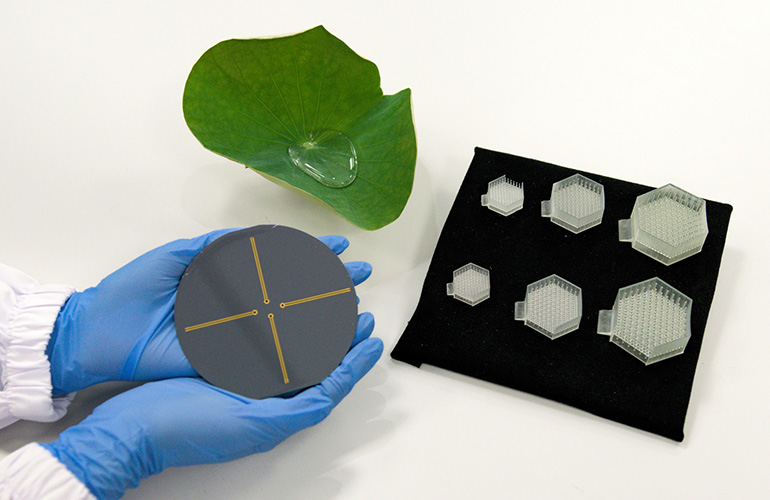
eAir sensors.

eAir sensors, the gold strips on the circular panel, mimic the lotus leaf effect, a phenomenon where water droplets roll of the leaf’s surface. | Source: NUS

Researchers at the National University of Singapore (NUS) have developed eAir, an aero-elastic pressure sensor inspired by lotus leaf’s water-repelling structures. eAir sensors offer increased precision and reliability for medical applications over traditional sensors. 

Conventional pressure sensors often struggle with accuracy and consistency. They can return varying results when the same pressure is applied repeatedly or overlook subtle changes in pressure. Additionally, they’re typically made from stiff and mechanically inflexible materials. 

The NUS research team wanted to address these drawbacks in pressure sensing and drew inspiration from a natural phenomenon called the lotus leaf effect, where water droplets easily roll off the surface of lotus leaves. This happens because of the lotus leaves’ minuscule, water-repelling structures. 

The team mimicked the lotus leaf effect by reimagining the water-repelling capabilities of the lotus leaf as a pressure-sensing tool. The eAir sensor has an air spring design, in which the sensor houses a trapped layer of air. This air forms an air-liquid interface upon contact with the sensor’s liquid. 

Aso, as external pressure increases, the air layer compresses. A surface treatment enables frictionless movement of the interface within the sensor, which triggers a change in electrical signals that accurately reflect the exerted pressure. 

“The sensor, akin to a miniature ‘capacity meter’, can detect minute pressure changes — mirroring the sensitivity of a lotus leaf to the extremely light touch of a water droplet,” Benjamin Tee, lead researcher and an associate professor from the NUS College of Design and Engineering and NUS Institute for Health Innovation & Technology, said.

eAir devices can be made a few millimeters in size, which is comparable to the size of existing pressure sensors. This technology could potentially be used to perform laparoscopic surgeries by enabling tactile feedback for surgeons, which results in more precise manipulation of patient tissues. 

“When surgeons perform minimally-invasive surgery such as laparoscopic or robotic surgery, we can control the jaws of the graspers, but we are unable to feel what the end-effectors are grasping. Hence, surgeons have to rely on our sense of sight and years of experience to make a judgment call about critical information that our sense of touch could otherwise provide,” Dr. Kaan Hung Leng, a consultant for the Department of General Surgery at the National University Hospital, Ng Teng Fong General Hospital and NUS Yong Loo Lin School of Medicine, said.

This device could also be used to improve patient experiences when it comes to managing brain-related conditions, ranging from severe headaches to potential brain damage. For example, it could offer a less invasive means of monitoring intracranial pressure (ICP), an important health metric for people with neurological conditions. 

The team’s findings were recently published in the journal Nature Materials. The NUS team is laying the groundwork for collaborations with key players in the medical field and has also filed a patent for the eAir sensor technology in Singapore. 

About The Author

Image
Brianna Wessling

Brianna Wessling is an Associate Editor, Robotics, WTWH Media. She joined WTWH Media in November 2021, after graduating from the University of Kansas with degrees in Journalism and English. She covers a wide range of robotics topics, but specializes in women in robotics, robotics in healthcare, and space robotics.

She can be reached at [email protected]

Tell Us What You Think! Cancel reply

This site uses Akismet to reduce spam. Learn how your comment data is processed.

Related Articles Read More >

Boston Dynamics' Atlas humanoid robot doing a cartwheel.
Will ‘boring’ robots win in the real world? Why robotic form should follow workflow
two race cars come through the famous corkscrew turn at Laguna Seca raceway.
IAC completes autonomous racing event at Laguna Seca
two robot arms at the RAI uncap a soda bottle and pour into a glass.
SoftBank agrees to acquire Robotics and AI Institute
STCs focus on building sustained partnerships across universities, industry, and government and accelerating the use of new ideas and technologies for scientific discovery.
NSF to invest $90M into three new technology centers, including one focused on robotics

RBR50 Innovation Awards

“2026”
“rr
EXPAND YOUR KNOWLEDGE AND STAY CONNECTED
Get the latest info on technologies, tools and strategies for Robotics Professionals.

Latest Episode of The Robot Report Podcast

Automated Warehouse Research Reports

Sponsored Content

  • Vecna Robotics makes its systems in the U.S. and is not directly affected by the FCC restriction. Webinar to discuss how the FCC robotics ruling affects automation buyers
  • Image Unleash AI Innovation: The Power of NVIDIA RTX PRO 6000 Blackwell Workstation Edition Fueled by PNY-Supplied GPUs
  • Image Daimon Robotics building the infrastructure layer for tactile intelligence 
  • ADI discusses the race to physical AI in a new report. ADI explains the race to make AI physical
  • The ADI cleanroom in Beaverton, Ore. How ADI is helping robotics startups scale
More Sponsored Content >
The Robot Report
  • Automated Warehouse
  • RoboBusiness
  • Robotics Summit & Expo
  • About The Robot Report
  • Subscribe
  • Contact Us

Copyright © 2026 Arrowfly LLC. All Rights Reserved. The material on this site may not be reproduced, distributed, transmitted, cached or otherwise used, except with the prior written permission of Arrowfly
Privacy Policy | Advertising | About Us

Search The Robot Report

  • Home
  • News
  • Technologies
    • Batteries / Power Supplies
    • Cameras / Imaging / Vision
    • Controllers
    • End Effectors
    • Microprocessors / SoCs
    • Motion Control
    • Sensors
    • Soft Robotics
    • Software / Simulation
  • Development
    • Artificial Intelligence
    • Human Robot Interaction / Haptics
    • Mobility / Navigation
    • Research
  • Robots
    • AGVs
    • AMRs
    • Consumer
    • Collaborative Robots
    • Drones
    • Humanoids
    • Industrial
    • Self-Driving Vehicles
    • Unmanned Maritime Systems
  • Business
    • Financial
      • Investments
      • Mergers & Acquisitions
      • Earnings
    • Markets
      • Agriculture
      • Healthcare
      • Logistics
      • Manufacturing
      • Mining
      • Security
    • RBR50
      • RBR50 Winners 2025
      • RBR50 Winners 2024
      • RBR50 Winners 2023
      • RBR50 Winners 2022
      • RBR50 Winners 2021
  • Resources
    • Automated Warehouse Research Reports
    • Digital Issues
    • eBooks
    • Publications
      • Automated Warehouse
      • Collaborative Robotics Trends
    • Search Robotics Database
    • Videos
    • Webinars / Digital Events
  • Events
    • RoboBusiness
    • Robotics Summit & Expo
    • DeviceTalks
    • R&D 100
    • Robotics Weeks
  • Podcast
    • Episodes
  • Advertise
  • Subscribe