
Buy New
-61%
$31.97$31.97
$5.84 delivery Saturday, October 10
Ships from: Bibliomonster Books Sold by: Bibliomonster Books
Used - Very Good
$22.69$22.69
FREE delivery October 19 - November 2
Ships from: BetterWorldBooksUK Sold by: BetterWorldBooksUK
Download the free Kindle app and start reading Kindle books instantly on your smartphone, tablet, or computer - no Kindle device required.
Read instantly on your browser with Kindle for Web.
Using your mobile phone camera - scan the code below and download the Kindle app.

Follow the authors
OK
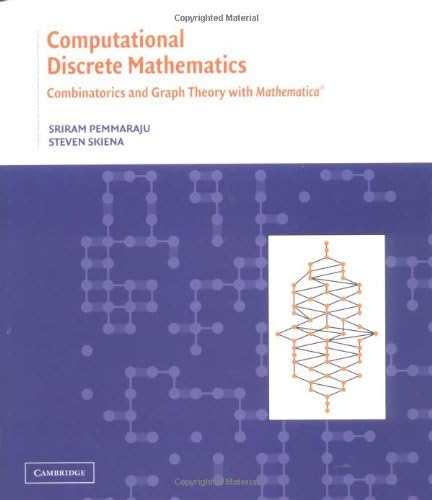
Computational Discrete Mathematics: Combinatorics and Graph Theory with Mathematica ®
Purchase options and add-ons
- ISBN-100521806860
- ISBN-13978-0521806862
- EditionFirst Edition
- PublisherCambridge University Press
- Publication dateDecember 8, 2003
- LanguageEnglish
- Dimensions8.5 x 1.25 x 9.5 inches
- Print length494 pages
Similar items that may deliver to you quickly
- Discrete Calculus: Applied Analysis on Graphs for Computational SciencePaperbackFREE Shipping by AmazonGet it as soon as Monday, Oct 5
- Handbook of Discrete and Combinatorial Mathematics: Discrete Mathematics and its ApplicationsHardcoverFREE Shipping by AmazonGet it as soon as Tuesday, Oct 6Only 1 left in stock (more on the way).
- Discrete Algebraic Methods: Arithmetic, Cryptography, Automata and Groups (De Gruyter Textbook)Perfect PaperbackFREE Shipping on orders over $35 shipped by AmazonGet it as soon as Monday, Oct 5Only 2 left in stock - order soon.
- Graphs, Algorithms, and Optimization (Discrete Mathematics and Its Applications)PaperbackFREE Shipping by AmazonGet it as soon as Monday, Oct 5
- Graph Theory (Discrete Mathematics and Its Applications)PaperbackFREE Shipping by AmazonGet it as soon as Monday, Oct 5
- Combinatorics (Discrete Mathematics and Its Applications)PaperbackFREE Shipping by AmazonGet it as soon as Monday, Oct 5
Editorial Reviews
Review
Book Description
About the Author
Product details
- Publisher : Cambridge University Press
- Publication date : December 8, 2003
- Edition : First Edition
- Language : English
- Print length : 494 pages
- ISBN-10 : 0521806860
- ISBN-13 : 978-0521806862
- Item Weight : 2.65 pounds
- Dimensions : 8.5 x 1.25 x 9.5 inches
- Best Sellers Rank: #4,340,409 in Books (See Top 100 in Books)
- #318 in Graph Theory (Books)
- #554 in Combinatorics (Books)
- #719 in Discrete Mathematics (Books)
- Customer Reviews:
About the authors

Steven S. Skiena is Distinguished Teaching Professor of Computer Science at Stony Brook University. He is the author of six well-regarded books: The Algorithm Design Manual (2020), The Data Science Design Manual (2017), Who's Bigger (2013), Calculated Bets: Computers, Gambling, and Mathematical Modeling to Win (2001), Programming Challenges (with Miguel Revilla, 2003) and Computational Discrete Mathematics (with Sriram Pemmaraju, 2003).

Discover more of the author’s books, see similar authors, read book recommendations and more.
Related products with free delivery on eligible orders
Customer reviews
Customer Reviews, including Product Star Ratings help customers to learn more about the product and decide whether it is the right product for them.
To calculate the overall star rating and percentage breakdown by star, we don’t use a simple average. Instead, our system considers things like how recent a review is and if the reviewer bought the item on Amazon. It also analyzed reviews to verify trustworthiness.
Learn more how customers reviews work on AmazonTop reviews from the United States
- 5 out of 5 stars
An Excellent Manual Describing a Great Mathematica Resource
Reviewed in the United States on November 18, 2011Although the description of how to use the product is not yet set-up for Mathematica 8, the book is an excellent reference text for Combinatorica and a good introduction to discrete Maths -- especially Graph theory. I would recommend it to people who want to use or incorporate these capabilities into their own work.
2 people found this helpfulSending feedback...Sending feedback...HelpfulThank you for your feedback.Sorry, we failed to record your vote. Please try againThanks, we'll investigate in the next few days.Sorry, We failed to report this review. Please try againWe'll check if this review meets our community guidelinesOpens in a new tab. If it doesn't, we'll remove it.
CancelReport - 3 out of 5 stars
Way too specialized to be a stand alone discrete math text
Reviewed in the United States on November 17, 2009I think the best parts of this book was the illustration overleafs for each chapter. There are some pretty cool images created using Combinatorica and Mathematica. I got this book to help me with my Discrete math course and with that in mind it wasn't as helpful as I thought it would be. I think the reason is that it's really a book about Combinatorica and how to use it with Mathematica and how the latest version is faster and how the functions were written. So in order to use it effectively you have to already be quite familiar with discrete math and graph theory to use this. There are plenty of examples to try and play with though if you can get them to run. I used Mathematica 7 and I would get a lot of obsolete command warnings or errors when trying to run the examples from the book. The book website says they have an updated version of Combinatorica but I didn't try that. Also, there are some exercises but no answers provided for any of them. There is also a complete listing of all the Combinatorica in the book but no clear indication if it's now included with the latest version of Mathematica which would be helpful. I don't see how this book could be used as a primary text for a discrete math course unless you had an excellent instructor to add all the material the book is missing and to walk you though putting the example in the book to best use. It makes more sense as a laboratory type book. This book will appeal most to those that use Mathematica with discrete math and find the documentation lacking or want to find out how the Combinatorica functions were programmed. Will also appeal to the more visual people like myself. I figured visualizing the different discrete math structures would help me solve my discrete math problems but the effort getting it to work in mathematica negates the extra time spent. If you are using it just to supplement a discrete math course as I did you probably won't benefit as much.
I must admit it was kind fun seeing Mathematica choke up on trying to spit out a 20x20 gridgraph! Never seen it do that before on my quadcore pc.
15 people found this helpfulSending feedback...Sending feedback...HelpfulThank you for your feedback.Sorry, we failed to record your vote. Please try againThanks, we'll investigate in the next few days.Sorry, We failed to report this review. Please try againWe'll check if this review meets our community guidelinesOpens in a new tab. If it doesn't, we'll remove it.
CancelReport
Amazon Customer1 out of 5 starsDoes not get past frustrating.
Reviewed in the United States on June 25, 2011This is a giant frustrating experience. A high percentage of the examples do not work in current versions of Mathematica (7 and 8). Particularly in the very, very beginning of the book when the reader is just trying to get anything to work, there is pitiful effort to update the user experience by both Wolfram and Combinatorica.com. The only problem, THIS is all that there is. Your only guide to Combinatorica on Mathematica. Amazon needs to add a ZERO STAR choice. Perhaps even negative stars. So here it is 'one star' for lack of effort. No bona fide updates on the websites.
Shame on Wolfram. Shame on Pemmaraju and Skiena.
The problems that I see are as follows.
1) The dictionary problem. To understand Table, See Sum and Products. To understand Sum and Products, See Iterator Notation. To understand Iterator Notation, See Repetitive Operators 'Do Loops'.
2) Mathematica makes heavy use of parametric overloading. Sometimes it works with one parameter. Sometimes 2 parameters. Sometimes 3 parameters. Sometimes 4. So the examples that you see make use of many different syntax structures but this is only cryptically explained.
3) You would buy 'Computational Discrete Mathematics' to do combinatorics. Duh. But before you can understand the syntax in the book, you need to know these sections in Mathematica: "Some General Notations and Conventions", "Sums and Products", "Making Tables of Values", "Repetitive Operators 'Do Loops', "Symbolic Calculations", "Iterator Notation" and "Mathematics and Algorithms". Otherwise you just go in circles. Cut and paste code. Break the code. Have no clue. Cut and paste more code.
4) A lot of the code as mentioned was written for versions long ago.
5) If you experience trouble because of the previous 4 reasons, but you need to do combinatorics, then you will find this book helpful - A beginners guide to Mathematica by David M. McMahon, Daniel M. Topa. You can read it on Google Books and still understand a lot of it even though select pages are omitted.
6) To invoke the Combinatorica Package
Do not use <<DiscreteMath `Combinatorica`
Do not use << Combinatorica`
Do not use Needs["Combinatorica`"]
DO USE `Combinatorica
At least this will get you started.
Below this point is my original rant. But you should understand my point already.
Be aware that once you are in `Combinatorica you will break other functionality of Mathematica. I will document some of these soon.
Next Google 'mathematica compatibility guide' find the updates for DiscreteMath and Graphics. Note the changes that affect many commands in (Pemmaraju/Skiena, 2006).
Next Google 'Mathematica 8 Documentation'. Save this link because you will need to come back often.
Next Google 'combinatorica package tutorial'. A lot of what you want to do has new commands. The only way that I can figure out what to do is to Google each command. In particular, do not use ShowGraph. Instead Google 'mathematica 8 butterfly graph' and you will see something like below. (But you may have to close you Mathematica program. And then reopen Mathematica and paste in the code.) It is random. The Google query pattern is Mathematica 8 + Noun of the thing you want to create. Many/most of the Method Commands used in the book have changed.
This worked for me.
{ButterflyGraph[1], ButterflyGraph[2]}
Table[ButterflyGraph[2, b, PlotLabel -> Row[{"base", b}, "-"]], {b, 2,
3}]
It actually works. So page 10 In(26) would be {ButterflyGraph[3]}
But this is just one of the patterns. In other places it will be different. In closing, this scenario would be bad for an open source product. I think we are all paying for Mathematica and paying for "Computational Discrete Mathematics", so (in my mind) this irritated rant has some justification. I don't think I should have to waste days of my time. I'm not getting paid. So why aren't the people who are getting paid not taking any ownership for their products?
27 people found this helpfulSending feedback...Sending feedback...HelpfulThank you for your feedback.Sorry, we failed to record your vote. Please try againThanks, we'll investigate in the next few days.Sorry, We failed to report this review. Please try againWe'll check if this review meets our community guidelinesOpens in a new tab. If it doesn't, we'll remove it.
CancelReport- 5 out of 5 stars
useful for who want to learn discrete mathematics with mathematica of Wolfram research software
Reviewed in the United States on February 20, 2010though the program created more than 6 years ago, it's useful reference for learning discrete mathematics with mathematica software
2 people found this helpfulSending feedback...Sending feedback...HelpfulThank you for your feedback.Sorry, we failed to record your vote. Please try againThanks, we'll investigate in the next few days.Sorry, We failed to report this review. Please try againWe'll check if this review meets our community guidelinesOpens in a new tab. If it doesn't, we'll remove it.
CancelReport - 1 out of 5 stars
This is really outdated for the latest versions of Mathematica
Reviewed in the United States on January 21, 2012When this book was originally published I am sure it was useful, but with Mathematica 7 or 8 this book is almost worthless.
There are a few neat examples, but probably not worth buying this book. There are better books on the subject, though not targeted for Mathematica.
I would first look at the documentation for Mathematica at the wolfram website, the documenation of Combinatorics is probably just as good as this book.
12 people found this helpfulSending feedback...Sending feedback...HelpfulThank you for your feedback.Sorry, we failed to record your vote. Please try againThanks, we'll investigate in the next few days.Sorry, We failed to report this review. Please try againWe'll check if this review meets our community guidelinesOpens in a new tab. If it doesn't, we'll remove it.
CancelReport