Customers who viewed this item also viewed
Download the free Kindle app and start reading Kindle books instantly on your smartphone, tablet, or computer - no Kindle device required.
Read instantly on your browser with Kindle for Web.
Using your mobile phone camera - scan the code below and download the Kindle app.
Follow the authors
OK
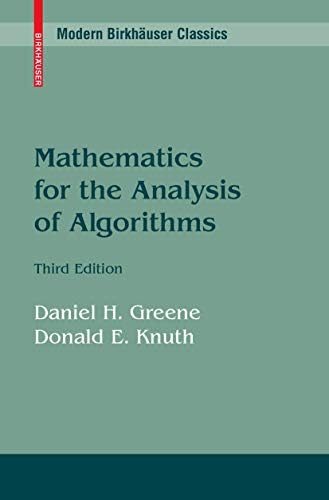
Mathematics for the Analysis of Algorithms (Progress in Computer Science and Applied Logic)
This monograph collects some fundamental mathematical techniques that are required for the analysis of algorithms. It builds on the fundamentals of combinatorial analysis and complex variable theory to present many of the major paradigms used in the precise analysis of algorithms, emphasizing the more difficult notions. The authors cover recurrence relations, operator methods, and asymptotic analysis in a format that is concise enough for easy reference yet detailed enough for those with little background with the material.
- ISBN-100817635157
- ISBN-13978-0817635152
- EditionSubsequent
- PublisherBirkhauser
- Publication dateJanuary 1, 1990
- LanguageEnglish
- Dimensions6 x 0.75 x 9.25 inches
- Print length132 pages
Customers who viewed this item also viewed
- Art of Computer Programming, The, Volumes 1-4B, Boxed SetHardcoverFREE Shipping by AmazonGet it as soon as Monday, Oct 5
Editorial Reviews
Review
“This is a short cookbook of methods for analyzing the run time of computer algorithms, aimed at computer scientists … . a very erudite book, full of interesting things for both mathematicians and computer scientists … .” (Allen Stenger, MAA Reviews, September, 2015)
“Mathematics for the Analysis of Algorithms covers a variety of topics in a relatively small amount of pages. Despite its briefness, most of the topics are clearly and fully explained using detailed examples for better understanding. As such, the book is suitable for use as study material, as well as a good reference guide…The reviewer recommends this book to anyone interested in advanced theory of algorithms and the mathematics behind it, either as an exposition to the topic or as reference material in future work.” ―SIGACT NEWS
"This book collects some fundamental mathematical techniques which are required for the analysis of algorithms... This book arose from handouts for an advanced course on the analysis of algorithms at Standard University, and the appendices list lectures, homework assignments and problems for the midterm and the final exams with their solutions. In summary, this book is a very valuable collection of mathematical techniques for the analysis of algorithms and accompanies, as well as complements, the second author's series The Art of Computer Programming
." ―Mathematical Reviews"The book covers the important mathematical tools used in computer science, especially in the exact analysis of algorithms. A wide range of topics are covered, from the binomial theorem to the saddle point method and Laplace's techniques for asymptotic analysis...The book is very well written. The style and the mathematical exposition make the book pleasant to read...It covers many of the major paradigms used in the analysis of algorithms in its one hundred plus pages." ―SIAM Review
"The book presents a welcome selection and careful exposition of material that can be (and is) covered in a single course...In this reviewer's opinion, this would be an interesting text to use with a group of advanced students well-grounded in undergraduate mathematics and computer science, and would produce a valuable course for the participating students." ― Computing Reviews
"The reader has probably heard of the expression 'good things come in small packages.' The validity of that maxim is no more in evidence than in the work under review, which is nothing less than a mathematical wellspring among the otherwise parched world of theoretical algorithm analysis. In only 76 pages (not counting the bibliography and amazing appendices), the authors cover four important topics in algorithm analysis, all from a rudimentary, but highly original,
point of view: Binomial Identities, Recurrence Relations, Operator Methods, and Asymptotic Analysis. Each of these topics is critical to understanding the modern analysis of algorithms, primarily from the speed of execution perspective... In summary, the book under review should not be underestimated in its powerful use of mathematics for the analysis of algorithms arising from computer science considerations." ―Timothy Hall, Process Quality Improvement Consulting"The analysis of algorthms is possible on mathematical and on computer scientific ways. This [book] is a mathematical look at this topic. It is based on an advanced course in computer science at Stanford University... The Appendices contain further difficult problems for applying the methods of this outstanding, full-of-thoughts book." ―P.L. Erdos (Periodica Mathematica Hungarica)
From the Back Cover
A quantitative study of the efficiency of computer methods requires an in-depth understanding of both mathematics and computer science. This monograph, derived from an advanced computer science course at Stanford University, builds on the fundamentals of combinatorial analysis and complex variable theory to present many of the major paradigms used in the precise analysis of algorithms, emphasizing the more difficult notions. The authors cover recurrence relations, operator methods, and asymptotic analysis in a format that is terse enough for easy reference yet detailed enough for those with little background. Approximately half the book is devoted to original problems and solutions from examinations given at Stanford.
"...a very valuable collection of mathematical techniques for the analysis of algorithms..." ― Mathematical Reviews
"The book covers the important mathematical tools used in computer science, especially in the exact analysis of algorithms. A wide range of topics are covered, from the binomial theorem to the saddle point method and Laplace’s techniques for asymptotic analysis...The book is very well written. The style and the mathematical exposition make the book pleasant to read...It covers many of the major paradigms used in the analysis of algorithms in its one hundred plus pages." ― SIAM Review
"The book presents a welcome selection a
nd careful exposition of material that can be (and is) covered in a single course...In this reviewer’s opinion, this would be an interesting text to use with a group of advanced students well-grounded in undergraduate mathematics and computer science, and would produce a valuable course for the participating students." ― Computing ReviewsProduct details
- Publisher : Birkhauser
- Publication date : January 1, 1990
- Edition : Subsequent
- Language : English
- Print length : 132 pages
- ISBN-10 : 0817635157
- ISBN-13 : 978-0817635152
- Item Weight : 12 ounces
- Dimensions : 6 x 0.75 x 9.25 inches
- Best Sellers Rank: #4,773,219 in Books (See Top 100 in Books)
- #708 in Number Systems (Books)
- #730 in Computer Algorithms
- #860 in Counting & Numeration
- Customer Reviews:
About the authors

Donald E. Knuth was born on January 10, 1938 in Milwaukee, Wisconsin. He studied mathematics as an undergraduate at Case Institute of Technology, where he also wrote software at the Computing Center. The Case faculty took the unprecedented step of awarding him a Master's degree together with the B.S. he received in 1960. After graduate studies at California Institute of Technology, he received a Ph.D. in Mathematics in 1963 and then remained on the mathematics faculty. Throughout this period he continued to be involved with software development, serving as consultant to Burroughs Corporation from 1960-1968 and as editor of Programming Languages for ACM publications from 1964-1967.
He joined Stanford University as Professor of Computer Science in 1968, and was appointed to Stanford's first endowed chair in computer science nine years later. As a university professor he introduced a variety of new courses into the curriculum, notably Data Structures and Concrete Mathematics. In 1993 he became Professor Emeritus of The Art of Computer Programming. He has supervised the dissertations of 28 students.
Knuth began in 1962 to prepare textbooks about programming techniques, and this work evolved into a projected seven-volume series entitled The Art of Computer Programming. Volumes 1-3 first appeared in 1968, 1969, and 1973. Having revised these three in 1997, he is now working full time on the remaining volumes. Volume 4A appeared at the beginning of 2011. More than one million copies have already been printed, including translations into ten languages.
He took ten years off from that project to work on digital typography, developing the TeX system for document preparation and the METAFONT system for alphabet design. Noteworthy by-products of those activities were the WEB and CWEB languages for structured documentation, and the accompanying methodology of Literate Programming. TeX is now used to produce most of the world's scientific literature in physics and mathematics.
His research papers have been instrumental in establishing several subareas of computer science and software engineering: LR(k) parsing; attribute grammars; the Knuth-Bendix algorithm for axiomatic reasoning; empirical studies of user programs and profiles; analysis of algorithms. In general, his works have been directed towards the search for a proper balance between theory and practice.
Professor Knuth received the ACM Turing Award in 1974 and became a Fellow of the British Computer Society in 1980, an Honorary Member of the IEEE in 1982. He is a member of the American Academy of Arts and Sciences, the National Academy of Sciences, and the National Academy of Engineering; he is also a foreign associate of l'Academie des Sciences (Paris), Det Norske Videnskaps-Akademi (Oslo), Bayerische Akademie der Wissenschaften (Munich), the Royal Society (London), and Rossiiskaya Akademia Nauk (Moscow). He holds five patents and has published approximately 160 papers in addition to his 28 books. He received the Medal of Science from President Carter in 1979, the American Mathematical Society's Steele Prize for expository writing in 1986, the New York Academy of Sciences Award in 1987, the J.D. Warnier Prize for software methodology in 1989, the Adelskøld Medal from the Swedish Academy of Sciences in 1994, the Harvey Prize from the Technion in 1995, and the Kyoto Prize for advanced technology in 1996. He was a charter recipient of the IEEE Computer Pioneer Award in 1982, after having received the IEEE Computer Society's W. Wallace McDowell Award in 1980; he received the IEEE's John von Neumann Medal in 1995. He holds honorary doctorates from Oxford University, the University of Paris, St. Petersburg University, and more than a dozen colleges and universities in America.
Professor Knuth lives on the Stanford campus with his wife, Jill. They have two children, John and Jennifer. Music is his main avocation.


Discover more of the author’s books, see similar authors, read book recommendations and more.
Related products with free delivery on eligible orders
Customer reviews
- 5 star4 star3 star2 star1 star3 star64%24%0%0%12%0%
- 5 star4 star3 star2 star1 star2 star64%24%0%0%12%0%
Customer Reviews, including Product Star Ratings help customers to learn more about the product and decide whether it is the right product for them.
To calculate the overall star rating and percentage breakdown by star, we don’t use a simple average. Instead, our system considers things like how recent a review is and if the reviewer bought the item on Amazon. It also analyzed reviews to verify trustworthiness.
Learn more how customers reviews work on Amazon