
Buy New
-23%
$49.93$49.93
FREE delivery Monday, October 5
Ships from: Amazon.com Sold by: Amazon.com
Used - Very Good
$15.45$15.45
FREE delivery Monday, October 5 on orders shipped by Amazon over $35

Ships from: Amazon Sold by: Collect Musings
Download the free Kindle app and start reading Kindle books instantly on your smartphone, tablet, or computer - no Kindle device required.
Read instantly on your browser with Kindle for Web.
Using your mobile phone camera - scan the code below and download the Kindle app.

Follow the author
OK
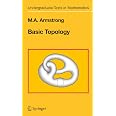
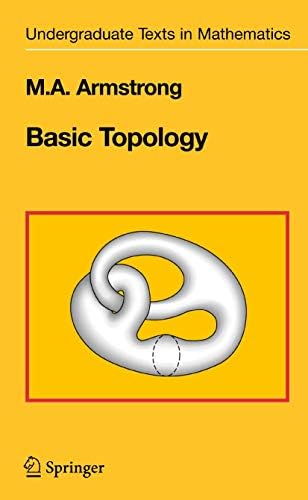
Basic Topology (Undergraduate Texts in Mathematics)
Purchase options and add-ons
- ISBN-100387908390
- ISBN-13978-0387908397
- EditionFirst Edition
- PublisherSpringer
- Publication dateJuly 5, 1983
- LanguageEnglish
- Dimensions6.33 x 0.74 x 9.56 inches
- Print length263 pages
Frequently bought together

Customers who viewed this item also viewed
- Introduction to Topology: Third Edition (Dover Books on Mathematics)PaperbackFREE Shipping on orders over $35 shipped by AmazonGet it as soon as Monday, Oct 5
- Topology (Undergraduate Texts in Mathematics)PaperbackFREE Shipping by AmazonGet it as soon as Monday, Oct 5
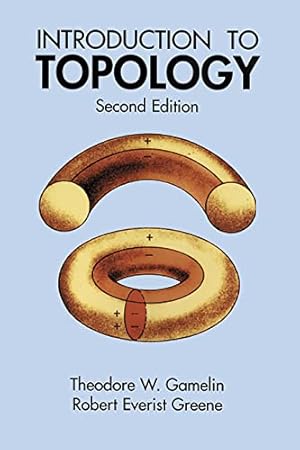
- Introduction to Topology: Second Edition (Dover Books on Mathematics)Theodore W. GamelinPaperbackFREE Shipping on orders over $35 shipped by AmazonGet it as soon as Monday, Oct 5
- An Introduction to the Theory of NumbersHardcoverFREE Shipping by AmazonGet it as soon as Friday, Oct 9Only 3 left in stock - order soon.
- Basic MathematicsPaperbackFREE Shipping on orders over $35 shipped by AmazonGet it as soon as Monday, Oct 5Only 3 left in stock - order soon.
Customers also bought or read
- Introduction to Topology: Second Edition (Dover Books on Mathematics)
Paperback$9.69$9.69Delivery Mon, Oct 5 - Fourier Analysis: An Introduction (Princeton Lectures in Analysis, Volume 1)
Hardcover$60.95$60.95FREE delivery Oct 21 - Nov 1 - Introduction to Topology: Third Edition (Dover Books on Mathematics)
Paperback$16.18$16.18Delivery Mon, Oct 5 - Essential Topology (Springer Undergraduate Mathematics Series)
Paperback$37.28$37.28FREE delivery Mon, Oct 5 - Topology and Geometry (Graduate Texts in Mathematics, 139)
Hardcover$42.92$42.92FREE delivery Mon, Oct 5 - Calculus On Manifolds: A Modern Approach To Classical Theorems Of Advanced Calculus
Paperback$46.74$46.74FREE delivery Oct 6 - 8 - Introduction to Topological Manifolds (Graduate Texts in Mathematics, 202)
Hardcover$39.12$39.12FREE delivery Mon, Oct 5 - Algebra: Chapter 0 (Graduate Studies in Mathematics, 104)
Paperback$89.00$89.00FREE delivery Mon, Oct 5 - Introduction to Metric and Topological Spaces (Oxford Mathematics)
Paperback$60.00$60.00FREE delivery Mon, Oct 5 - An Introduction to Algebraic Topology (Graduate Texts in Mathematics, 119)
Hardcover$43.35$43.35FREE delivery Mon, Oct 5 - Ordinary Differential Equations: An Elementary Textbook for Students of Mathematics, Engineering, and the Sciences (Dover Books on Mathematics)
Paperback$30.38$30.38Delivery Mon, Oct 5 - Differential Geometry of Curves and Surfaces: Revised and Updated Second Edition (Dover Books on Mathematics)
Paperback$28.52$28.52FREE delivery Oct 9 - 15 - Character Theory of Finite Groups (Dover Books on Mathematics)
Paperback$11.09$11.09Delivery Mon, Oct 5 - A Book of Abstract Algebra: Second Edition (Dover Books on Mathematics)
Paperback$25.16$25.16Delivery Mon, Oct 5
Editorial Reviews
Review
Product details
- Publisher : Springer
- Publication date : July 5, 1983
- Edition : First Edition
- Language : English
- Print length : 263 pages
- ISBN-10 : 0387908390
- ISBN-13 : 978-0387908397
- Item Weight : 1.2 pounds
- Dimensions : 6.33 x 0.74 x 9.56 inches
- Part of series : Undergraduate Texts in Mathematics
- Best Sellers Rank: #981,767 in Books (See Top 100 in Books)
- #129 in Topology (Books)
- #321 in Geometry
- Customer Reviews:
About the author

Discover more of the author’s books, see similar authors, read book recommendations and more.
Customer reviews
Customer Reviews, including Product Star Ratings help customers to learn more about the product and decide whether it is the right product for them.
To calculate the overall star rating and percentage breakdown by star, we don’t use a simple average. Instead, our system considers things like how recent a review is and if the reviewer bought the item on Amazon. It also analyzed reviews to verify trustworthiness.
Learn more how customers reviews work on AmazonTop reviews from the United States
- 5 out of 5 stars
A Great Intro To Topology
Reviewed in the United States on July 3, 2019Topology is sort of a weird subject in that it has so many sub-fields (e.g.; algebraic topology, geometric topology) and has application to so many diverse subjects (try to find a field in mathematics that doesn't, at some point, appeal to topology...I'll wait).
I like this book as an in depth intro to a field with...well, a lot of depth. I find topology to be a field of mathematics with an extremely dense vocabulary, and I think Armstrong does a good job of helping the reader become comfortable with wielding that vocabulary and the mathematics behind it. I wouldn't call this book a great intro to any specific sub-field of topology, though I feel it definitely skews more towards the algebraic side of topology. But as an intro to the general umbrella term of "topology", you'd be hard-pressed to find a better book (IMO).
Also: this book is old enough where you can find solution manuals (for free!) online to help you check your work (but no cheating!).
4 people found this helpfulSending feedback...Sending feedback...HelpfulThank you for your feedback.Sorry, we failed to record your vote. Please try againThanks, we'll investigate in the next few days.Sorry, We failed to report this review. Please try againWe'll check if this review meets our community guidelinesOpens in a new tab. If it doesn't, we'll remove it.
CancelReport - 2 out of 5 stars
Your Average topology student will be frustrated...
Reviewed in the United States on February 24, 2006This text is very very difficult to read for people like me, your average topology student. A difficult subject to grasp, the layout of this book simply does not help organize the material. I have purchased several other books, that while they don't make topology easy, at least make it digestable. Pass on this book and go with Munkres.
12 people found this helpfulSending feedback...Sending feedback...HelpfulThank you for your feedback.Sorry, we failed to record your vote. Please try againThanks, we'll investigate in the next few days.Sorry, We failed to report this review. Please try againWe'll check if this review meets our community guidelinesOpens in a new tab. If it doesn't, we'll remove it.
CancelReport - 5 out of 5 stars
Excellent text, for self-study or course
Reviewed in the United States on March 9, 2015I just love this book. I happened to click on this page only to get the reference correct so I could cite it properly, and was shocked to see some negative reviews: I was sure it would get nothing but 5s!
So I am writing this only to counterbalance those negative reviews, with which I disagree completely, and to reinforce the positive ones, which I agree with in all respects and will therefore not repeat.
I came upon this book when, as a researcher with a good analysis and dynamics background, I wanted to learn more topology myself, and also
wanted a text to teach from. I was put off by the standard Algebraic Topology texts, which to me were too algebraic and abstract, and this was strongly recommended to me by a grad student in Kleinian groups just finishing his doctorate, as being beautifully written while providing more contact with the geometry. It was the perfect answer, and I only wish I'd encountered it earlier!
In fact I've taught from it twice, once an undergrad course and once a grad course, and would very happily do so again. It is very carefully and beautifully written, and I don't recall finding any mistakes.
The book, and the exercises, appear informal and hence simple, but this is deceptive: both are quite deep. For self-study this is an excellent choice, and if you have the time, you can really read the book and study it thoroughly from page one.
I did most of the exercises myself (and assigned many for the students) and found them meaningful, challenging but doable- at just the right level.
The book starts in Ch 1 with some already interesting topology and in Ch 2,3, 4 gives a review of the point-set topology, all the while developing the reader's geometric intuition in preparation for what is to come. This part will be useful and fascinating even for those who think they know it all already.
My only complaint is I would wish for a second volume which would go deeper into homology theory, while referring to say combinatorial group theory and knot theory as applications and examples. But then again, there are many excellent texts to choose from once one has this under one's belt!
4 people found this helpfulSending feedback...Sending feedback...HelpfulThank you for your feedback.Sorry, we failed to record your vote. Please try againThanks, we'll investigate in the next few days.Sorry, We failed to report this review. Please try againWe'll check if this review meets our community guidelinesOpens in a new tab. If it doesn't, we'll remove it.
CancelReport - 3 out of 5 stars
An acceptable text
Reviewed in the United States on September 18, 2005I would recommend reading with a highlighter and marking up a lot of the text because many definitions, points of interest, etc... are not set apart from regular text and it can be difficult locating the information you want/need to know on a particular page because of this. I have already highlighted a good deal of the book so that I can flip through the pages quickly and locate what I need.
There are plenty of exercises in the book of easy to medium difficulty, but certainly not many that I would call "hard."
The text is easy to read even if it is not organized as well as Munkres book. I don't think this is a book anyone would regret getting for learning topology for the first time, but as the title clearly indicates, this is not a book for people taking a second course in topology.
10 people found this helpfulSending feedback...Sending feedback...HelpfulThank you for your feedback.Sorry, we failed to record your vote. Please try againThanks, we'll investigate in the next few days.Sorry, We failed to report this review. Please try againWe'll check if this review meets our community guidelinesOpens in a new tab. If it doesn't, we'll remove it.
CancelReport - 4 out of 5 stars
Valuable, and generally pleasant, introduction to topology
Reviewed in the United States on May 19, 2011I can see how this book has left very few people happy. To generalize broadly, one often finds two types of reviewers of math books on Amazon: those who find the text too difficult, and denounce it; and those who implicitly denounce the first group by means of vigorous support of the book in question. Typically this latter group goes on to write reviews of books *supported* by the first group in which they denounce the excessive "hand-holding," the pandering to the reader's "intuition," and the general attempts to make the material accessible.
This book, however, manages to both require a non-trivial amount of effort and sophistication from the reader (thus alienating the first group), all while also appealing to intuition and giving large numbers of examples (thus alienating the second).
The following example should make the author's approach clear. On several occasions, Armstrong gives a non-standard definition of an idea. This is usually a definition that is more intuitive (to the beginner), but which is harder to use to complete proofs. This non-standard definition is followed by the standard definition, and the equivalence of both formulations is established. This is the case with connectedness, for instance. First, connectedness is defined by appealing to the idea that a space "should be one piece," leading to the formulation that whenever a connected topological space is decomposed into two subsets, the intersection of the closure of one of these sets with the other set is always nonempty. Soon thereafter, the standard formulation (the formulation which one almost always uses to actually write proofs) is introduced and established as equivalent, namely that a connected topological space is one in which the only sets that are both open and closed are the entire space itself and the empty set.
It is true that this approach makes for a bad reference book. It is also certainly not the most elegant and streamlined presentation. But the book is clearly not meant to be a reference or to be a showcase of exceptional concision and elegance. It is meant to be a book to learn from. Adding to this, the chapters are all full of examples, many of them quite interesting.
I will concede that the writing and layout can be irritating at times. In particular, as has been pointed out many times before, the author does not isolate and highlight all definitions and corollaries. So this adds to the difficulty of using the book as a reference, and it even makes it somewhat unpleasant to read as a learning text at times. But to say that the author does not define things is simply wrong. (In the first chapter the author sketches an overview of the material contained in the text, and it consequently does not contain many formal definitions or proofs. By and large, however, all subsequent chapters are independent of this chapter. So if you are truly scandalized by someone attempting to give a loose overview of the subject, you are entirely free to skip this chapter and refer to it as necessary (which will be infrequently).)
All and all, I thought this was a good first topology text. You are always given good examples to chew on while you are sorting out the technicalities. The problems are also generally good. While many are fairly straightforward, I have found that they are almost all at least thought provoking, and some develop new material entirely. And there are more than a handful of difficult ones.
Finally, it should be emphasized that one can realistically be introduced to the rudiments of wide range of topics in a single semester: general topology, identification spaces, topological groups, the fundamental group, triangulations (including Seifert-Van Kampen), and simplicial homology. (To be clear, the book contains more than that, but I am only outlining what could be done in about 13 weeks.) Moreover, unlike some texts which are only meant to give the flavor of a subject to undergraduates, I have found that the foundations set by this books were substantial enough to build on.
33 people found this helpfulSending feedback...Sending feedback...HelpfulThank you for your feedback.Sorry, we failed to record your vote. Please try againThanks, we'll investigate in the next few days.Sorry, We failed to report this review. Please try againWe'll check if this review meets our community guidelinesOpens in a new tab. If it doesn't, we'll remove it.
CancelReport - 5 out of 5 stars
Insightful and fun introduction
Reviewed in the United States on April 24, 2002I'm surprised that several previous reviewers have given this book low ratings. This book is far superior to the standard introductions.
As someone who has studied topology for several years now, I have found that the greatest failing of many introductory texts is the inability to give a real 'feel' for the subject. By 'feel' I mean not only familiarity with the necessary tools and ways of thought needed to progress to higher levels of understanding but also experience with the kinds of problems that plague(excite?) topologists on a daily basis.
Several texts proceed in the logical progression from point set topology to algebraic topology. Munkres is among the best of this style. But the logical order is not always pedagogically best, especially in topology. To start one's topology career by spending one or more semesters on point set topology is utterly ridiculous, given that such point set subtleties are to a large degree not used to study the beginnings of geometric or algebraic topology. This is how these texts fail to give students the 'feel' for topology; the student has no idea what it is that most topologists do, and in fact will not get a good idea until much later.
Armstrong tries (and succeeds for the most part) in grounding concepts in real applications, the way the tools are actually used by research mathematicians. Perhaps this is part of why it may be confusing to the novice; introducing topological groups and group actions on spaces right after the section on quotient spaces may appear a bit much, but those concepts are a big part of *why* quotient spaces are so important! Incidentally, the material on quotient spaces is the most complete I've ever seen in an introductory book; Armstrong covers cones and also gluing/attaching maps.
The book is certainly fun. Imagine learning about space-filling curves right after the section on continuous functions. Armstrong keeps things spiced up throughout the book. He also goes at some length into triangulations, simplicial approximation, and simplicial homology. Then he *applies* this stuff to get results like Borsuk-Ulam, Lefschetz fixed-pt thm, and of course dimension invariance. Throw in less standard material like Seifert surfaces, and you have quite an interesting mix.
The exercises can be quite varied and hard, but are designed to give the reader a realistic view of the difficulties of the subject. The reader will get considerable insight from them, and loads of fun too. I say this, because as someone who already knows the stuff, I find more than a few of the problems enjoyable even now.
Having wrote all that, I should add that I did *not* learn out of this book! But I wish greatly that I had! I would have known sooner whether topology was the right subject for me to pursue and had some 'lead time' to absorb some very fundamental concepts early on. If you pass over this book, be warned that you are shorting yourself in the long run.
56 people found this helpfulSending feedback...Sending feedback...HelpfulThank you for your feedback.Sorry, we failed to record your vote. Please try againThanks, we'll investigate in the next few days.Sorry, We failed to report this review. Please try againWe'll check if this review meets our community guidelinesOpens in a new tab. If it doesn't, we'll remove it.
CancelReport - 2 out of 5 stars
Two Stars
Reviewed in the United States on July 5, 2018I hate Armstrong's explanations. He is so wordy and talks in circles.
2 people found this helpfulSending feedback...Sending feedback...HelpfulThank you for your feedback.Sorry, we failed to record your vote. Please try againThanks, we'll investigate in the next few days.Sorry, We failed to report this review. Please try againWe'll check if this review meets our community guidelinesOpens in a new tab. If it doesn't, we'll remove it.
CancelReport - 5 out of 5 stars
Very good and cheap
Reviewed in the United States on September 3, 2018I could buy almost new book by cheap price.
Thanks!
Sending feedback...Sending feedback...HelpfulThank you for your feedback.Sorry, we failed to record your vote. Please try againThanks, we'll investigate in the next few days.Sorry, We failed to report this review. Please try againWe'll check if this review meets our community guidelinesOpens in a new tab. If it doesn't, we'll remove it.
CancelReport
Top reviews from other countries
M.G. Solis5 out of 5 starsTopology is Necessary.
Reviewed in Mexico on November 4, 2017Really nice book, if you are a Undergraduate with some basic knowledge of real Analysis, this book will suit you just fine.
Sending feedback...Thanks, we'll investigate in the next few days.Sorry, We failed to report this review. Please try againWe'll check if this review meets our community guidelinesOpens in a new tab. If it doesn't, we'll remove it.
CancelReport
Linda Sutherland4 out of 5 starsGood for algebraic topology
Reviewed in the United Kingdom on January 9, 2022This book could be used as a first course in topology. However, the empasis is on algebraic topology, and it is a bit light on general topology. (You may or may not regard that as a problem, depending on where in mathematics your future interests will lie.) To redress the balance, it might be best to read it alongside Janich & Levy's excellent book.
The text and proofs are reasonably clear, but in a book at this level a little more hand-holding would have helped in places. The basic concepts of algebraic topology are not difficult to visualise intuitively, but the mathematical machinery needed to work with them is quite heavy, and it is easy to get lost in the details.
Because the emphasis is on algebraic topology, a first course in algebra is an essential prerequisite for this book, though you won't need much more than basic group theory.
Sending feedback...Thanks, we'll investigate in the next few days.Sorry, We failed to report this review. Please try againWe'll check if this review meets our community guidelinesOpens in a new tab. If it doesn't, we'll remove it.
CancelReport
Abhishek Roy4 out of 5 starsGood.
Reviewed in India on July 31, 2018Very good book for algebraic topology.
Sending feedback...Thanks, we'll investigate in the next few days.Sorry, We failed to report this review. Please try againWe'll check if this review meets our community guidelinesOpens in a new tab. If it doesn't, we'll remove it.
CancelReport
frank3 out of 5 starsGood value.
Reviewed in the United Kingdom on June 8, 2024Very fairly priced second-hand book. My rating would have been higher had it been , as pictured , the Springer edition.
Sending feedback...Thanks, we'll investigate in the next few days.Sorry, We failed to report this review. Please try againWe'll check if this review meets our community guidelinesOpens in a new tab. If it doesn't, we'll remove it.
CancelReport


![Calculus Study Cards: Calculus Review Prep and Practice Test Questions for High School Students [Full Color Cards]](https://m.media-amazon.com/images/I/411W1SNrb9L._AC_SR100,100_QL65_.jpg)