Gary Helmling, Software Engineer
@gario
HBaseCon 2015 - May 7
Reusable Data Access Patterns
Agenda
• A brief look at data storage challenges
• How these challenges have influenced our work at Cask
• Exploration of Datasets and how they help
• Review of some common data access patterns and how Datasets apply
• A look underneath at the tech that makes it work
Data Storage Challenges
• Many HBase apps tend to solve similar problems with common needs
• Developers rebuild these solutions on their own, sometimes repeated for each app
• Effective schema (row key) design is hard
• byte[] conversions, no real native types
• No composite keys
• Some efforts - Orderly library and HBase types (HBASE-8089) - but nothing complete
Data Storage Challenges
• Easy to wind up with many similar, but slightly different implementations
Cask Data Application Platform
• CDAP is a scale-out application platform for Hadoop and HBase
• Enables easy scaling of application components
• Combines real-time and batch data processing
• Abstracts data storage details with Datasets
• Built from experience by Hadoop and HBase users and contributors
• CDAP and the components it builds on are open source (Apache License v2.0):
• Tephra, a scalable transaction engine for HBase and Hadoop
• Apache Twill, makes writing distributed apps on YARN as simple as running threads
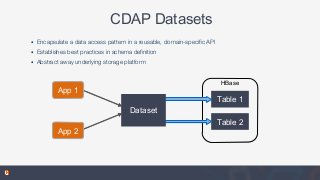
• Encapsulate a data access pattern in a reusable, domain-specific API
• Establishes best practices in schema definition
• Abstract away underlying storage platform
HBase
CDAP Datasets
Table 1
Table 2
Dataset
App 2
App 1
How CDAP Datasets Help
• Reusable as data storage templates
• Easy sharing of stored data:
• Between applications
• Batch and real-time processing
• Integrated testing
• Extensible to create your own solutions
• Leverage common services to ease development:
• Transactions
• Readless increments
Reusing Datasets
• CDAP integrates lifecycle management
• Centralized metadata provides key configuration
• Transparent integration with other systems
• Hive metastore
• Map Reduce Input/OutputFormats
• Spark RDDs
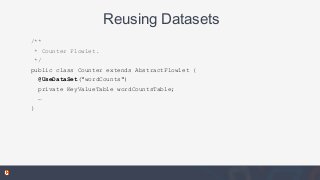
Reusing Datasets
/**
* Counter Flowlet.
*/
public class Counter extends AbstractFlowlet {
@UseDataSet("wordCounts")
private KeyValueTable wordCountsTable;
…
}
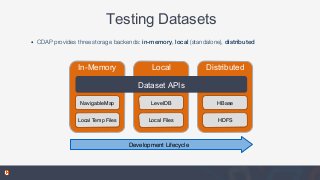
Testing Datasets
• CDAP provides three storage backends: in-memory, local (standalone), distributed
In-Memory
NavigableMap
Local Temp Files
Local
LevelDB
Local Files
Distributed
HBase
HDFS
Dataset APIs
Development Lifecycle
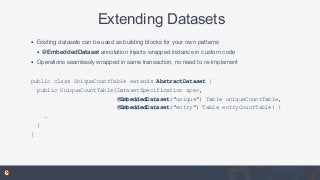
Extending Datasets
• Existing datasets can be used as building blocks for your own patterns
• @EmbeddedDataset annotation injects wrapped instance in custom code
• Operations seamlessly wrapped in same transaction, no need to re-implement
public class UniqueCountTable extends AbstractDataset {
public UniqueCountTable(DatasetSpecification spec,
@EmbeddedDataset("unique") Table uniqueCountTable,
@EmbeddedDataset("entry") Table entryCountTable) {
…
}
}
HBase Data Patterns & Datasets
• Secondary Indexes
• Object-mapping
• Timeseries
• Data cube
Secondary Indexing
• Example use case: Entity storage - store customer records indexed by location
• HBase sorts data by row key
• Retrieving by a secondary value means storing a reference in another table
• Two types: global and local
• Global: efficient reads, but updates can be inconsistent
• Local: updates can be made consistent, but reads require contacting all servers
• IndexedTable Dataset performs global indexing
• Uses two tables: data table, index table
• Uses global transactions to keep updates consistent
Object-Mapping
• Example use case: Entity storage - easily store User instances for user profiles
• Easy serialization / deserialization of Java objects (think Hibernate)
• Maps property fields to HBase columns
• No defined schemas in HBase
• Accessing data by other means requires knowledge of object structure
• ObjectMappedTable Dataset: automatically persists object properties as columns in HBase
• Metadata managed by CDAP
• Stores the object's schema
• Automatically registers a table definition in Hive metastore with the same schema
Timeseries Data
• Example use case: any data organized around a time dimension
• System metrics
• Stock ticker data
• Sensor data - smart meters
• Constructing keys to avoid hotspotting and support efficient retrieval can be tricky
• TimeseriesTable Dataset: for each data key, stores a set of (timestamp, value) records
• Each stored value may have a set of tags used to filter results
• Each row represents a time bucket, individual values in that bucket stored as columns
• When reading data, projects entries back into a simple Iterator for easy consumption
Data Cube
• Example use case: Retail product sales reports, web analytics
• Stores “fact” entries, with aggregated values along configured combinations of the “fact”
dimensions
• Pre-aggregation necessary for efficient retrieval
• HBase increments can be costly in write-heavy workload
• Querying requires knowledge of pre-aggregation structure
• Reconfiguration can be difficult
• Need metadata around configuration
• Cube Dataset: uses readless increments for efficient aggregation
• Transactions keep pre-aggregations consistent
• Dataset framework manages metadata
Transactions
• Provided by Tephra (http://tephra.io), an open-source, distributed, scalable transaction engine
designed for HBase and Hadoop
• Each transaction assigned a time-based, globally unique transaction ID
• Transaction =
• Write Pointer: Timestamp for HBase writes
• Read pointer: Upper bound timestamp for reads
• Excludes: List of timestamps to exclude from reads
• HBase cell versions provide MVCC for Snapshot Isolation
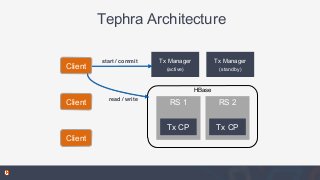
Tephra Architecture
Tx Manager
(active)
Tx Manager
(standby)
HBase
RS 1
start / commit
Client
Client
Client
read / write
RS 2
Tx CP Tx CP
Transactional Writes
• Client sets write pointer (transaction ID) as timestamp on all writes
• Maintains set of change coordinates (row-level or column-level granularity depending on needs)
• On commit, client sends change set to Transaction Manager
• If any overlap with change sets of commits since transaction start, returns failure
• On commit failure, attempts to rollback any persisted changes
• Deletes use special markers instead of HBase deletes
• HBase deletes cannot be rolled back
Transactional Reads
• TransactionAwareHTable client sets the transaction state as an attribute on all read operations
• Get, Scan
• Transaction Processor RegionObserver translates transaction state into request properties
• max versions
• time range
• TransactionVisibilityFilter - excludes cells from:
• Invalid transactions (failed but not cleaned up)
• In-progress transactions
• “Delete” markers
• TTL’d cells
Increment Performance
• HBase increments perform read-modify-write cycle
• Happens server-side, but read operation still incurs overhead
• Read cost is unnecessary if we don't care about return value
• Not a great fit for write-heavy workloads
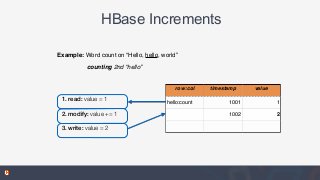
HBase Increments
row:col timestamp value
hello:count 1001 1
1002 2
Example: Word count on “Hello, hello, world”
counting 2nd “hello”
1. read: value = 1
2. modify: value += 1
3. write: value = 2
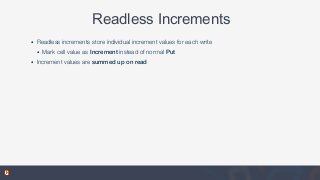
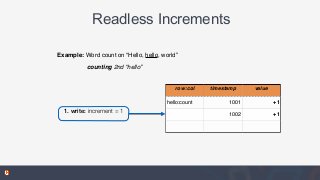
Readless Increments
• Readless increments store individual increment values for each write
• Mark cell value as Increment instead of normal Put
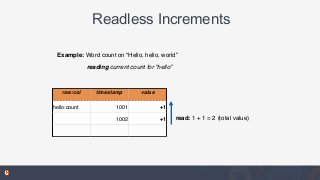
• Increment values are summed up on read
Readless Increments
row:col timestamp value
hello:count 1001 +1
1002 +1
1. write: increment = 1
Example: Word count on “Hello, hello, world”
counting 2nd “hello”
Readless Increments
row:col timestamp value
hello:count 1001 +1
1002 +1
Example: Word count on “Hello, hello, world”
reading current count for “hello”
read: 1 + 1 = 2 (total value)
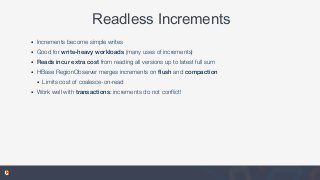
Readless Increments
• Increments become simple writes
• Good for write-heavy workloads (many uses of increments)
• Reads incur extra cost from reading all versions up to latest full sum
• HBase RegionObserver merges increments on flush and compaction
• Limits cost of coalesce-on-read
• Work well with transactions: increments do not conflict!
Want to Learn More?
Open-source (Apache License v2)
Website:
http://cdap.io
Mailing List:
cdap-user@googlegroups.com
cdap-dev@googlegroups.com
Open-source (Apache License v2)
Website:
http://tephra.io
Mailing List:
tephra-user@googlegroups.com
tephra-dev@googlegroups.com
QUESTIONS?
Want to work on these and other challenges?
http://cask.co/careers/

HBaseCon 2015: Reusable Data Access Patterns with CDAP Datasets

  • 1.
    Gary Helmling, SoftwareEngineer @gario HBaseCon 2015 - May 7 Reusable Data Access Patterns
  • 2.
    Agenda • A brieflook at data storage challenges • How these challenges have influenced our work at Cask • Exploration of Datasets and how they help • Review of some common data access patterns and how Datasets apply • A look underneath at the tech that makes it work
  • 3.
    Data Storage Challenges •Many HBase apps tend to solve similar problems with common needs • Developers rebuild these solutions on their own, sometimes repeated for each app • Effective schema (row key) design is hard • byte[] conversions, no real native types • No composite keys • Some efforts - Orderly library and HBase types (HBASE-8089) - but nothing complete
  • 4.
    Data Storage Challenges •Easy to wind up with many similar, but slightly different implementations
  • 5.
    Cask Data ApplicationPlatform • CDAP is a scale-out application platform for Hadoop and HBase • Enables easy scaling of application components • Combines real-time and batch data processing • Abstracts data storage details with Datasets • Built from experience by Hadoop and HBase users and contributors • CDAP and the components it builds on are open source (Apache License v2.0): • Tephra, a scalable transaction engine for HBase and Hadoop • Apache Twill, makes writing distributed apps on YARN as simple as running threads
  • 6.
    • Encapsulate adata access pattern in a reusable, domain-specific API • Establishes best practices in schema definition • Abstract away underlying storage platform HBase CDAP Datasets Table 1 Table 2 Dataset App 2 App 1
  • 7.
    How CDAP DatasetsHelp • Reusable as data storage templates • Easy sharing of stored data: • Between applications • Batch and real-time processing • Integrated testing • Extensible to create your own solutions • Leverage common services to ease development: • Transactions • Readless increments
  • 8.
    Reusing Datasets • CDAPintegrates lifecycle management • Centralized metadata provides key configuration • Transparent integration with other systems • Hive metastore • Map Reduce Input/OutputFormats • Spark RDDs
  • 9.
    Reusing Datasets /** * CounterFlowlet. */ public class Counter extends AbstractFlowlet { @UseDataSet("wordCounts") private KeyValueTable wordCountsTable; … }
  • 10.
    Testing Datasets • CDAPprovides three storage backends: in-memory, local (standalone), distributed In-Memory NavigableMap Local Temp Files Local LevelDB Local Files Distributed HBase HDFS Dataset APIs Development Lifecycle
  • 11.
    Extending Datasets • Existingdatasets can be used as building blocks for your own patterns • @EmbeddedDataset annotation injects wrapped instance in custom code • Operations seamlessly wrapped in same transaction, no need to re-implement public class UniqueCountTable extends AbstractDataset { public UniqueCountTable(DatasetSpecification spec, @EmbeddedDataset("unique") Table uniqueCountTable, @EmbeddedDataset("entry") Table entryCountTable) { … } }
  • 12.
    HBase Data Patterns& Datasets • Secondary Indexes • Object-mapping • Timeseries • Data cube
  • 13.
    Secondary Indexing • Exampleuse case: Entity storage - store customer records indexed by location • HBase sorts data by row key • Retrieving by a secondary value means storing a reference in another table • Two types: global and local • Global: efficient reads, but updates can be inconsistent • Local: updates can be made consistent, but reads require contacting all servers • IndexedTable Dataset performs global indexing • Uses two tables: data table, index table • Uses global transactions to keep updates consistent
  • 14.
    Object-Mapping • Example usecase: Entity storage - easily store User instances for user profiles • Easy serialization / deserialization of Java objects (think Hibernate) • Maps property fields to HBase columns • No defined schemas in HBase • Accessing data by other means requires knowledge of object structure • ObjectMappedTable Dataset: automatically persists object properties as columns in HBase • Metadata managed by CDAP • Stores the object's schema • Automatically registers a table definition in Hive metastore with the same schema
  • 15.
    Timeseries Data • Exampleuse case: any data organized around a time dimension • System metrics • Stock ticker data • Sensor data - smart meters • Constructing keys to avoid hotspotting and support efficient retrieval can be tricky • TimeseriesTable Dataset: for each data key, stores a set of (timestamp, value) records • Each stored value may have a set of tags used to filter results • Each row represents a time bucket, individual values in that bucket stored as columns • When reading data, projects entries back into a simple Iterator for easy consumption
  • 16.
    Data Cube • Exampleuse case: Retail product sales reports, web analytics • Stores “fact” entries, with aggregated values along configured combinations of the “fact” dimensions • Pre-aggregation necessary for efficient retrieval • HBase increments can be costly in write-heavy workload • Querying requires knowledge of pre-aggregation structure • Reconfiguration can be difficult • Need metadata around configuration • Cube Dataset: uses readless increments for efficient aggregation • Transactions keep pre-aggregations consistent • Dataset framework manages metadata
  • 17.
    Transactions • Provided byTephra (http://tephra.io), an open-source, distributed, scalable transaction engine designed for HBase and Hadoop • Each transaction assigned a time-based, globally unique transaction ID • Transaction = • Write Pointer: Timestamp for HBase writes • Read pointer: Upper bound timestamp for reads • Excludes: List of timestamps to exclude from reads • HBase cell versions provide MVCC for Snapshot Isolation
  • 18.
    Tephra Architecture Tx Manager (active) TxManager (standby) HBase RS 1 start / commit Client Client Client read / write RS 2 Tx CP Tx CP
  • 19.
    Transactional Writes • Clientsets write pointer (transaction ID) as timestamp on all writes • Maintains set of change coordinates (row-level or column-level granularity depending on needs) • On commit, client sends change set to Transaction Manager • If any overlap with change sets of commits since transaction start, returns failure • On commit failure, attempts to rollback any persisted changes • Deletes use special markers instead of HBase deletes • HBase deletes cannot be rolled back
  • 20.
    Transactional Reads • TransactionAwareHTableclient sets the transaction state as an attribute on all read operations • Get, Scan • Transaction Processor RegionObserver translates transaction state into request properties • max versions • time range • TransactionVisibilityFilter - excludes cells from: • Invalid transactions (failed but not cleaned up) • In-progress transactions • “Delete” markers • TTL’d cells
  • 21.
    Increment Performance • HBaseincrements perform read-modify-write cycle • Happens server-side, but read operation still incurs overhead • Read cost is unnecessary if we don't care about return value • Not a great fit for write-heavy workloads
  • 22.
    HBase Increments row:col timestampvalue hello:count 1001 1 1002 2 Example: Word count on “Hello, hello, world” counting 2nd “hello” 1. read: value = 1 2. modify: value += 1 3. write: value = 2
  • 23.
    Readless Increments • Readlessincrements store individual increment values for each write • Mark cell value as Increment instead of normal Put • Increment values are summed up on read
  • 24.
    Readless Increments row:col timestampvalue hello:count 1001 +1 1002 +1 1. write: increment = 1 Example: Word count on “Hello, hello, world” counting 2nd “hello”
  • 25.
    Readless Increments row:col timestampvalue hello:count 1001 +1 1002 +1 Example: Word count on “Hello, hello, world” reading current count for “hello” read: 1 + 1 = 2 (total value)
  • 26.
    Readless Increments • Incrementsbecome simple writes • Good for write-heavy workloads (many uses of increments) • Reads incur extra cost from reading all versions up to latest full sum • HBase RegionObserver merges increments on flush and compaction • Limits cost of coalesce-on-read • Work well with transactions: increments do not conflict!
  • 27.
    Want to LearnMore? Open-source (Apache License v2) Website: http://cdap.io Mailing List: cdap-user@googlegroups.com cdap-dev@googlegroups.com Open-source (Apache License v2) Website: http://tephra.io Mailing List: tephra-user@googlegroups.com tephra-dev@googlegroups.com
  • 28.
    QUESTIONS? Want to workon these and other challenges? http://cask.co/careers/