Near Real Time Indexing
for ebay Search
Swati Agarwal & Raj Tanneru
AGENDA
• Overview
• Indexing pipeline
• Performance Enhancements
• Search Data Acquisition
• Challenges in Data Acquisition
• Q&A
OVERVIEW
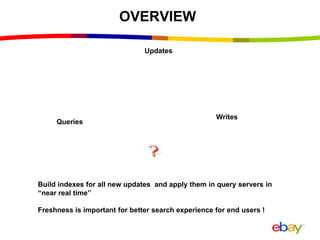
Writes
Build indexes for all new updates and apply them in query servers in
“near real time”
Freshness is important for better search experience for end users !
Updates
Queries
DESIGN GOALS
• Reduce average time taken to propagate user updates
• Handle large update volume
• Reduce variability in performance
• Allow horizontal scaling
• Support distributed search servers
• Improved monitoring
WHY HBASE ?
• Scalable – supports storing large volumes of data
• Feature rich -- efficient scans and key based lookups
• No schema
• Support for versioning
• Data consistency
• Good support from open-source community
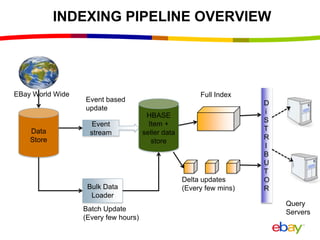
INDEXING PIPELINE OVERVIEW
Data
Store
HBASE
Item +
seller data
store
Event
stream
Bulk Data
Loader
D
i
S
T
R
I
B
U
T
O
R
Query
Servers
Delta updates
(Every few mins)
Full IndexEBay World Wide
Event based
update
Batch Update
(Every few hours)
HIGH LEVEL APPROACH
• Building a full index takes hours due to data-set size
• # of items changed every minute are much less
• Identify updates in time window t1 – t2 (Timerange scan)
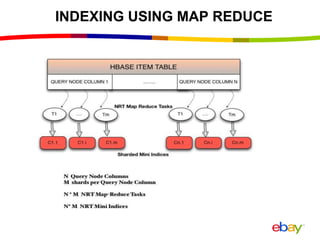
• Build a ‘mini index’ only on last X minutes of changes using Map-Reduce
• Mini indices are copied and consumed in near real time by query servers
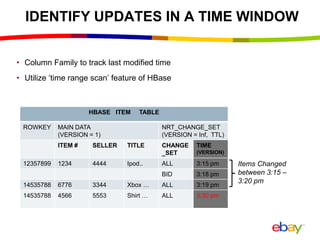
IDENTIFY UPDATES IN A TIME WINDOW
• Column Family to track last modified time
• Utilize ‘time range scan’ feature of HBase
HBASE ITEM TABLE
ROWKEY MAIN DATA
(VERSION = 1)
NRT_CHANGE_SET
(VERSION = Inf, TTL)
ITEM # SELLER TITLE CHANGE
_SET
TIME
(VERSION)
12357899 1234 4444 Ipod.. ALL 3:15 pm
BID 3:18 pm
14535788 6776 3344 Xbox … ALL 3:19 pm
14535788 4566 5553 Shirt … ALL 3:30 pm
Items Changed
between 3:15 –
3:20 pm
INDEXING USING MAP REDUCE
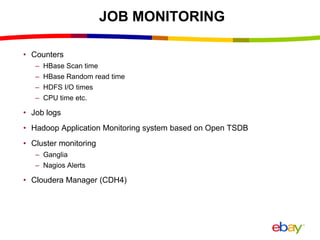
JOB MONITORING
• Counters
– HBase Scan time
– HBase Random read time
– HDFS I/O times
– CPU time etc.
• Job logs
• Hadoop Application Monitoring system based on Open TSDB
• Cluster monitoring
– Ganglia
– Nagios Alerts
• Cloudera Manager (CDH4)
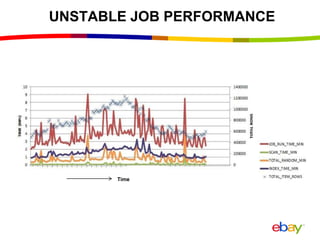
UNSTABLE JOB PERFORMANCE
Time
PERFORMANCE DIAGNOSIS
• Slow HBase
– Excessive flush
– Too many HFiles
– Major compaction at peak traffic hours
• Bad nodes in the cluster
– Machine restarts
– Slow disk
– Data node / Region server / task tracker not running on same machine
• Slow HDFS
– HBase RPC timeouts
– HDFS I/O timeout or slowness
• Job Scheduler
– Even with highest priority for NRT jobs preemption time is in the order of minutes
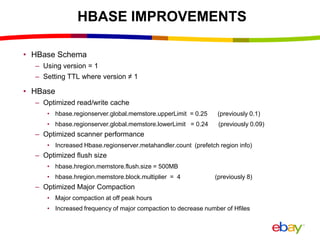
HBASE IMPROVEMENTS
• HBase Schema
– Using version = 1
– Setting TTL where version ≠ 1
• HBase
– Optimized read/write cache
• hbase.regionserver.global.memstore.upperLimit = 0.25 (previously 0.1)
• hbase.regionserver.global.memstore.lowerLimit = 0.24 (previously 0.09)
– Optimized scanner performance
• Increased Hbase.regionserver.metahandler.count (prefetch region info)
– Optimized flush size
• hbase.hregion.memstore.flush.size = 500MB
• hbase.hregion.memstore.block.multiplier = 4 (previously 8)
– Optimized Major Compaction
• Major compaction at off peak hours
• Increased frequency of major compaction to decrease number of Hfiles
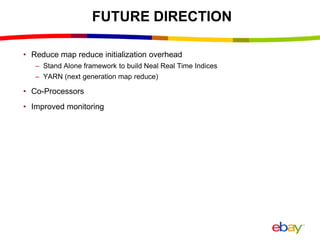
FUTURE DIRECTION
• Reduce map reduce initialization overhead
– Stand Alone framework to build Neal Real Time Indices
– YARN (next generation map reduce)
• Co-Processors
• Improved monitoring
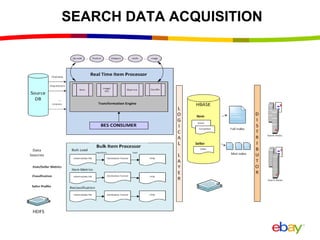
SEARCH DATA ACQUISITION
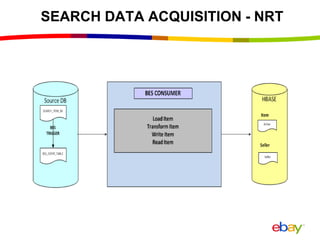
SEARCH DATA ACQUISITION - NRT
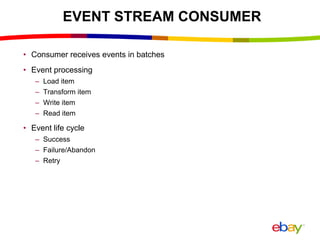
EVENT STREAM CONSUMER
• Consumer receives events in batches
• Event processing
– Load item
– Transform item
– Write item
– Read item
• Event life cycle
– Success
– Failure/Abandon
– Retry
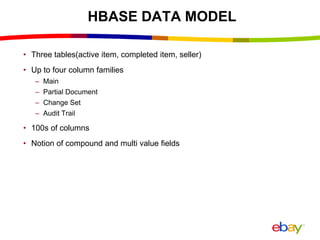
HBASE DATA MODEL
• Three tables(active item, completed item, seller)
• Up to four column families
– Main
– Partial Document
– Change Set
– Audit Trail
• 100s of columns
• Notion of compound and multi value fields
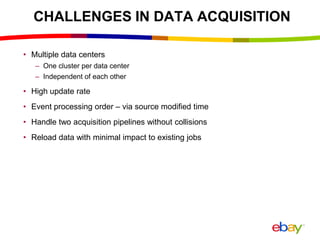
CHALLENGES IN DATA ACQUISITION
• Multiple data centers
– One cluster per data center
– Independent of each other
• High update rate
• Event processing order – via source modified time
• Handle two acquisition pipelines without collisions
• Reload data with minimal impact to existing jobs
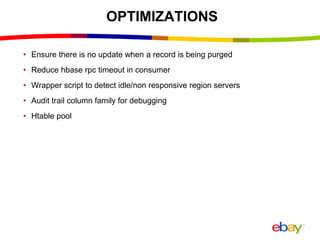
OPTIMIZATIONS
• Ensure there is no update when a record is being purged
• Reduce hbase rpc timeout in consumer
• Wrapper script to detect idle/non responsive region servers
• Audit trail column family for debugging
• Htable pool
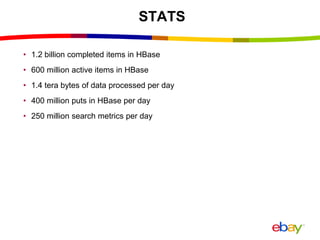
STATS
• 1.2 billion completed items in HBase
• 600 million active items in HBase
• 1.4 tera bytes of data processed per day
• 400 million puts in HBase per day
• 250 million search metrics per day
Thank you
Questions??

HBaseCon 2013: Near Real Time Indexing for eBay Search

  • 1.
    Near Real TimeIndexing for ebay Search Swati Agarwal & Raj Tanneru
  • 2.
    AGENDA • Overview • Indexingpipeline • Performance Enhancements • Search Data Acquisition • Challenges in Data Acquisition • Q&A
  • 3.
    OVERVIEW Writes Build indexes forall new updates and apply them in query servers in “near real time” Freshness is important for better search experience for end users ! Updates Queries
  • 4.
    DESIGN GOALS • Reduceaverage time taken to propagate user updates • Handle large update volume • Reduce variability in performance • Allow horizontal scaling • Support distributed search servers • Improved monitoring
  • 5.
    WHY HBASE ? •Scalable – supports storing large volumes of data • Feature rich -- efficient scans and key based lookups • No schema • Support for versioning • Data consistency • Good support from open-source community
  • 6.
    INDEXING PIPELINE OVERVIEW Data Store HBASE Item+ seller data store Event stream Bulk Data Loader D i S T R I B U T O R Query Servers Delta updates (Every few mins) Full IndexEBay World Wide Event based update Batch Update (Every few hours)
  • 7.
    HIGH LEVEL APPROACH •Building a full index takes hours due to data-set size • # of items changed every minute are much less • Identify updates in time window t1 – t2 (Timerange scan) • Build a ‘mini index’ only on last X minutes of changes using Map-Reduce • Mini indices are copied and consumed in near real time by query servers
  • 8.
    IDENTIFY UPDATES INA TIME WINDOW • Column Family to track last modified time • Utilize ‘time range scan’ feature of HBase HBASE ITEM TABLE ROWKEY MAIN DATA (VERSION = 1) NRT_CHANGE_SET (VERSION = Inf, TTL) ITEM # SELLER TITLE CHANGE _SET TIME (VERSION) 12357899 1234 4444 Ipod.. ALL 3:15 pm BID 3:18 pm 14535788 6776 3344 Xbox … ALL 3:19 pm 14535788 4566 5553 Shirt … ALL 3:30 pm Items Changed between 3:15 – 3:20 pm
  • 9.
  • 10.
    JOB MONITORING • Counters –HBase Scan time – HBase Random read time – HDFS I/O times – CPU time etc. • Job logs • Hadoop Application Monitoring system based on Open TSDB • Cluster monitoring – Ganglia – Nagios Alerts • Cloudera Manager (CDH4)
  • 11.
  • 12.
    PERFORMANCE DIAGNOSIS • SlowHBase – Excessive flush – Too many HFiles – Major compaction at peak traffic hours • Bad nodes in the cluster – Machine restarts – Slow disk – Data node / Region server / task tracker not running on same machine • Slow HDFS – HBase RPC timeouts – HDFS I/O timeout or slowness • Job Scheduler – Even with highest priority for NRT jobs preemption time is in the order of minutes
  • 13.
    HBASE IMPROVEMENTS • HBaseSchema – Using version = 1 – Setting TTL where version ≠ 1 • HBase – Optimized read/write cache • hbase.regionserver.global.memstore.upperLimit = 0.25 (previously 0.1) • hbase.regionserver.global.memstore.lowerLimit = 0.24 (previously 0.09) – Optimized scanner performance • Increased Hbase.regionserver.metahandler.count (prefetch region info) – Optimized flush size • hbase.hregion.memstore.flush.size = 500MB • hbase.hregion.memstore.block.multiplier = 4 (previously 8) – Optimized Major Compaction • Major compaction at off peak hours • Increased frequency of major compaction to decrease number of Hfiles
  • 14.
    FUTURE DIRECTION • Reducemap reduce initialization overhead – Stand Alone framework to build Neal Real Time Indices – YARN (next generation map reduce) • Co-Processors • Improved monitoring
  • 15.
  • 16.
  • 17.
    EVENT STREAM CONSUMER •Consumer receives events in batches • Event processing – Load item – Transform item – Write item – Read item • Event life cycle – Success – Failure/Abandon – Retry
  • 18.
    HBASE DATA MODEL •Three tables(active item, completed item, seller) • Up to four column families – Main – Partial Document – Change Set – Audit Trail • 100s of columns • Notion of compound and multi value fields
  • 19.
    CHALLENGES IN DATAACQUISITION • Multiple data centers – One cluster per data center – Independent of each other • High update rate • Event processing order – via source modified time • Handle two acquisition pipelines without collisions • Reload data with minimal impact to existing jobs
  • 20.
    OPTIMIZATIONS • Ensure thereis no update when a record is being purged • Reduce hbase rpc timeout in consumer • Wrapper script to detect idle/non responsive region servers • Audit trail column family for debugging • Htable pool
  • 21.
    STATS • 1.2 billioncompleted items in HBase • 600 million active items in HBase • 1.4 tera bytes of data processed per day • 400 million puts in HBase per day • 250 million search metrics per day
  • 22.

Editor's Notes

  • #4 Site activity is continuous but bulk indexes are built infrequentlyTakes over 6 hours to build full index
  • #5 to reflect user updates in indexes