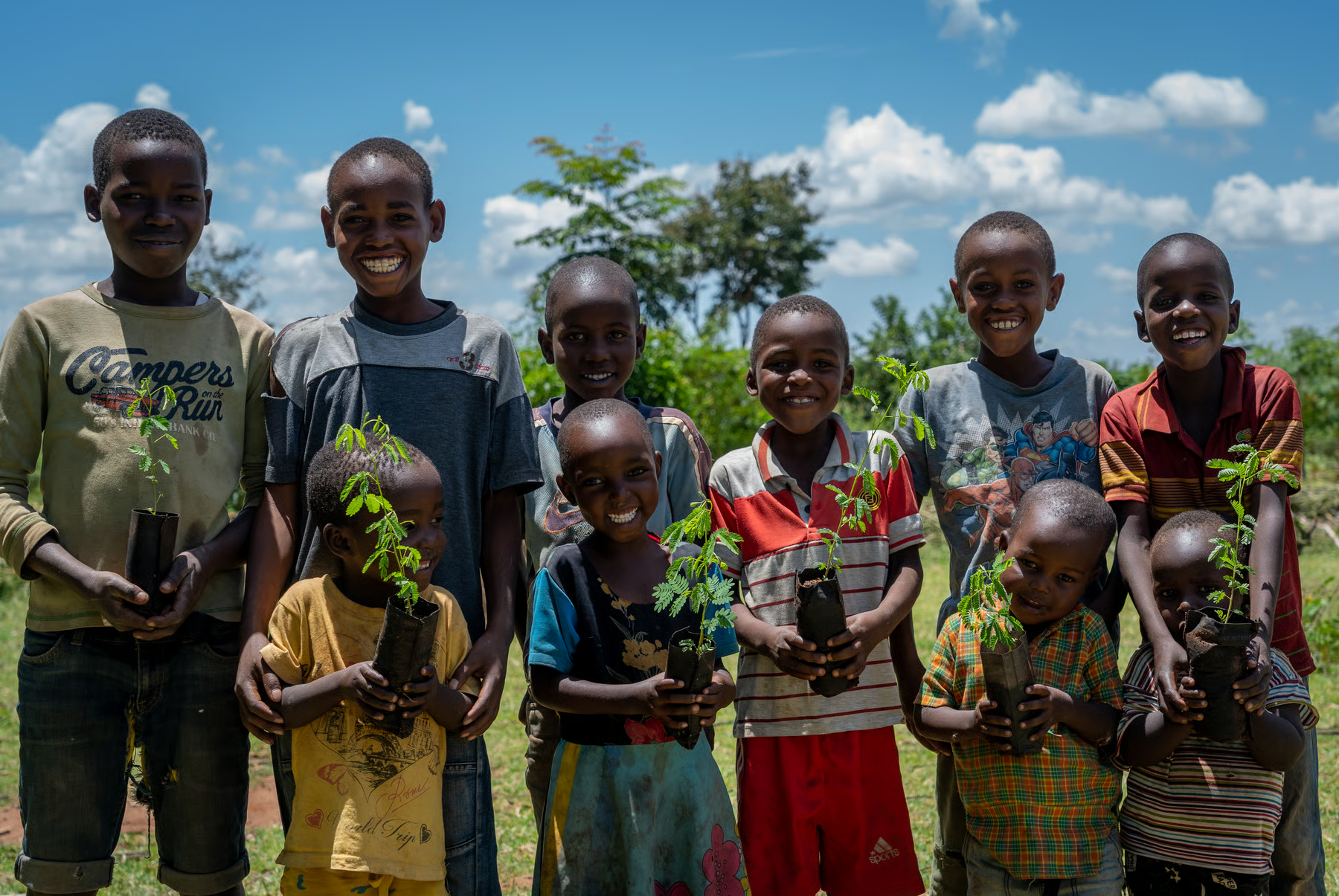
One Print, One Tree
For every print order placed with Canva, we plant a tree – it’s a simple idea with a big impact.
Our impact so far
13.4 million
trees planted
13,500
people benefited
10,901
hectares of land under planned restoration
275+
plant species across 13 countries

How it works
- Your order gets a tree. Every time you print with Canva, your order will unlock a tree to be planted at one of our designated restoration sites in either Malawi, Tanzania, or the Philippines.
- Your tree finds a home. We work with the Forest Landscape Restoration organization, Reduce. Reuse. Grow. to find the perfect planting site for your tree to create biodiversity and wildlife restoration.
- Your tree is planted. Our on-the-ground NGO planting partners employ local community members and farmers to plant your contributed tree, bringing back vitality to the land that they call home.

Why plant trees?
Canva is on a mission to do the most good that we can. Planting trees empowers communities that are vulnerable to climate change to restore vitality to degraded lands that were once flourishing and become more resilient to weather events such as prolonged droughts and floods. Canva also recognizes the importance of biodiversity and wants to ensure we help protect, conserve, and expand habitat for species that are at risk of becoming endangered or extinct. There is also a clear link between nature and many indigenous cultures, so restoring land also restores and preserves unique cultures.
We know that planting trees doesn’t solve all climate-related problems, find out more about what Canva is doing here(opens in a new tab or window).

What are we planting?
We primarily plant native species to restore essential, threatened ecosystems. There are also a small number of instances in which non-native fruit or timber trees are integrated for the production of food or energy resources for locals.
To foster plant diversity, we’ve planted over 275 different native tree species. Some of these tree species are listed as endangered, including the Afrocarpus Usambarensis tree and the Podocarpus Usambarensis tree from our sites in Tanzania, and the Dipterocarpus Grandiflorus tree and the Pterocarpus indicus at our site in the Philippines.

How are we protecting endangered species?
One Print, One Tree plants also protect endangered species by saving their habitats.
This is the focal point of our tree planting site in the Philippines, which is supporting local communities to find habitats for endangered species such as the Philippine Eagle and Philippine Crocodile.

Saving the Philippines Eagle
We’ve partnered with the Philippine Eagle Foundation to protect the endangered Philippines Eagle. We’re committed to ensuring its survival, the biodiversity it represents, and the sustainable use of our forest resources for future generations to enjoy.
The Philippine Eagle — the national bird of the Philippines — is one of the rarest eagles in the world. It is a giant bird of prey that’s listed as critically endangered by the International Union for Conservation of Nature (IUCN), with an estimated number of only 400 pairs left in the wild. The Eagles are threatened daily by human activities — the forest is their only home.
Unfortunately, illegal logging and irresponsible use of resources have resulted in the disappearance of their forest habitat, with at least one Philippine eagle being killed every year. As more of our forest is lost, Philippine Eagles go farther from their usual hunting grounds in search of prey to hunt. This rare and majestic bird species can be found nowhere else but in the Philippines. Losing the species to extinction would also mean that the world is losing a precious biological heritage.
Meet the Communities
The Philippines
Once nearly completely covered with forest, the Philippines has dwindled to less than 20% of its original coverage. To help address this, Canva Print has partnered with the Philippine Eagle Foundation to establish Project ReGAIN. Based in the Davao region, the project is working with the Indigenous Obu Manuvu tribe to restore their ancestral domain and to combat biodiversity loss in the area’s diminishing ancient forests.
Here’s how Canva Print is making a difference in this region:
- Trees committed: 3 million trees
- Site size: 1,200 hectares
- Species: 60+ tree species
- Benefitting: Approximately 6,000 locals
Tanzania
In partnership with the Tanzania Forest Service and local NGOs, Canva Print is involved in the Project FOREST initiative.
The project aims to restore forests, enhance water sources, and promote sustainable practices in Tanzania’s Usambara Mountains, a critical hotspot for global biodiversity. The planting methodologies involve establishing community tree nurseries, implementing afforestation programs with local species, and diversifying livelihoods through climate-resilient agriculture.
Here’s a snapshot of the impact this initiative is having in Tanzania:
- Trees committed: 6,490,000
- Site size: 4,026 hectares
- Species: 23 native tree species
- Employing: Approximately 1,000 locals
Malawi
Malawi's Dzalanyama Forest Reserve is facing a significant threat of deforestation. This is due to the production of illegal charcoal, a primary energy source for around 90% of Malawi citizens. While more electric infrastructure is a long-term goal, our work in Malawi focuses on addressing the dual challenge of conserving the forest while meeting charcoal demands. The project envisions long-term environmental and local livelihood benefits by educating communities and implementing sustainable planting and management strategies.
Here’s the impact this project is having in Malawi:
- Trees committed: 1,500,000 trees
- Site size: 890 hectares
- Species: 6 tree species
- Employing: Approximately 250 people

Dr. Jayson Ibañez
Director for Operations, Philippine Eagle Foundation
Frequently Asked Questions
Our locations span Malawi, Tanzania and the Philippines. These sites were chosen because they allow us to maximize the environmental benefit we deliver while also driving positive impacts to the residents of the regions in which we plant.
The Philippines is very near and dear to Canva as it is home to our second largest staff presence, and is an immensely beautiful landscape that was once nearly entirely covered by forest. That coverage is at less than 20% today and we want to help restore it.
In Malawi, we also do considerable work with GiveDirectly(opens in a new tab or window) and want to help transform the living standards within that nation. It’s a big lift, and we can only do so much, but we are going to try and help as much as we can to prove that one company can make a difference.
In Tanzania, the Usambara Mountains are a biodiversity hotspot, that provides many downstream benefits to nearly 1 million people. Forest coverage has dwindled to less than half of what it once was and we want to help restore coverage and the stable benefits that the forest provides before it gets worse.
No, we are not physically planting trees ourselves. We have partnered with Reduce. Reuse. Grow. Inc. (RRG), a Sustainability-as-a-Service business that operates Forest Landscape Restoration (FLR) programs to help offset impacts from print, consumer packaged goods, and technology industries.
RRG manages the tree-planting process on our behalf. By working in these countries, not only does Canva contribute to the fight against climate change by planting carbon-sequestering forests, but we also deliver ecological and social benefits to the local populations contributing to many of the United Nations Sustainable Development Goals.
The focus of One Print, One Tree is on restoring natural landscapes and as a result, the large majority of trees we plant are native species appropriate for the site. Any use of non-native trees is done for the purposes of agroforestry for food production or to serve as a timber resource for energy.
This is dependent on the region in which we are planting.
Our projects in the Philippines, Tanzania, and Malawi each have their own nurseries which have been established to support the planting projects developed by One Print, One Tree. Seeds are sourced via local seed banks and wildling collection systems that either employ locals or offers a regular marketplace for the provision of seedlings.
All of Canva’s seedlings are grown at restoration partner-specific, local nurseries to ensure quality, germination rates, and reliable tracking.
It depends, but there is oversight by government authorities, like the Departments of Forestry for each nation, along with Indigenous leadership, or local councils. The beneficiaries of the trees are the local communities that depend on the forest for essential resources. One exception is when agroforestry trees are planted on land owned by local farmers. In such cases, the farmers own the trees along with the proceeds from the trees.
In the Philippines, Project ReGAIN is planted on lands that are the ancestral domain of the Obu Manuvu tribe and involves multiple clans. The land is also a known nesting site for the Philippines Eagle which is the national bird of the Philippines and is critically endangered. The eagle is a symbol of the health of the forests in the Philippines, the preservation of their bird and the expansion of their habitat is crucial for the conservation movement in the Philippines.
In Tanzania, the trees are being planted on forest reserves that were devastated by past wildfires and then overgrown with invasive ferns that have restricted the natural regeneration of native forests. The land is controlled by local village council authorities and the Tanzania Forest Service, including the Baga Village Council Authority, the Mgwashi Village Council Authority, the Mkussu Forest Reserve, and the Bumbuli District Forest.
In Malawi, the trees are planted in the Dzalanyama Forest Reserve. This project varies from our normal project as the goal is to create trees for the purpose of legal and sustainable charcoal production. This plantation is being put in place to provide a supply of legal charcoal, and to reduce the amount of illegal deforestation taking place in the old-growth Dzalanyama Forest Reserve (DFR). The DFR serves as an essential water catchment for the Lilongwe River and many of the region's citizens. The dwindling forest coverage of the DFR jeopardizes the reliability of the region's water supply so it must be protected.
RRG has a network of NGO restoration partners that employ people from the local communities in which these projects are being implemented.
In the Philippines, we are implementing a “rainforestation” model. This promotes the restoration and expansion of forests by planting native tree seedlings along with agroforestry seedlings, protecting forests and their biodiversity. At the same time, it provides an additional source of income for farmers who practice it. In this project, rainforestation farming is done by growing native tree seedlings in a nursery, while agroforestry seedlings that are ready for planting will be bought from farmers. Philippines Eagle Foundation staff assist farmers with the collection and growing of wildlings and the planting of agricultural crops, such as cash crops, short-term crops, and long-term crops, in restoration farms will also be monitored.
In Tanzania, our model involves designing and establishing community tree nurseries and includes an afforestation program for locally adapted fruit and forest trees. The program focuses on sustainable nursery management, tree planting, and harvesting, which improves ecosystem health and provides employment. Additionally, the project promotes climate-resilient livelihoods by enhancing agricultural practices, improving water governance, and building community capacity for climate adaptation.
In Malawi, our framework involves the coordinated afforestation of 750 hectares in the Katete Eucalyptus Plantation managed by an NGO, but with direct oversight from the Department of Forestry. There will also be an additional 140 hectares in seven surrounding communities, that will be managed by Village Natural Resource Management Committees (VNRMCs) that are focusing on sustainable fuel wood and raw material production for legal and sustainable charcoal production, which is part of a broader strategy of Malawian government to transition to more sustainable livelihoods for its citizens. The VNRMCs will identify areas within their regions, raise their own seedlings with the support of the Dzalanyama Conservation Catchment Trust, and manage these resources under contractual arrangements.
This approach not only generates income and improves livelihoods for involved communities but also fosters sustainable forest resource management through education and collaboration, ensuring continued legal and sustainable charcoal production.
As soon as possible, but usually within 18 months of your order. We have to allow time for seedlings to be established in a nursery. Following this, seasonality and rainfall levels are factors that determine when trees will go into the ground.
We make every effort to ensure the forest we plant becomes permanent and sustainable. For our work in the Philippines and Tanzania, our restoration partners work carefully with all levels of government to secure written agreements designating the restoration sites as protected in perpetuity and we do not plant in logging areas.
In the case of our work in Malawi, we’re planting trees for legal and sustainable charcoal production, in order to counter illegal charcoal production in the region. These practices contribute to preserving the old growth forest.
A percentage of seedling mortality is inevitable, but ongoing maintenance and monitoring are essential to project success, especially in the initial years after planting. Weeding is very important to ensure seedlings have the space to establish themselves and outcompete invasive grasses, shrubs, and ferns. Even with weeding, some trees will die, but if this occurs we will replant trees that die within the first 1-2 years of initial planting to help ensure a canopy is established.
Luckily, many of the trees in the Philippines, and Tanzania, are fast-growing and can establish a small canopy in as little as three years. The slower-growing big trees, like the Shorea Contora (White Lauan), will eventually push through and establish themselves as the giants among their peers, eventually serving as mother trees and perpetuating natural regeneration beyond our lifetimes.
As of March of 2025, we’ve planted 10.7 million trees. This number is constantly evolving as the Canva community places more print orders and we commit to planting more trees to restore degraded landscapes.
No. We source paper from sustainable sources, separate from our reforestation projects.
