Documentation used to support the product. Today, it’s fundamental to the product experience, especially as AI becomes the primary way people learn, search, and decide. For many users, documentation is the first (and sometimes only) way they evaluate, adopt, and successfully use what you’ve built. As the use of AI has grown, documentation has also … continue reading
When OpenAI announced its persistent memory feature for ChatGPT in early 2025, it was presented as a convenience. Users could now have the model remember prior context, preferences, and facts, making interactions smoother and more personal. On the surface, it was a feature update. But at a deeper level, it hinted at a shift that … continue reading

Over the past two years, the pace of innovation for AI code assistance has been nothing short of astounding. We’ve moved from “enhanced autocomplete” systems to ecosystems of AI agents capable of completing complex tasks and cranking out prodigious amounts of code. At the same time, developers are being asked to build, test, and deploy … continue reading

The market keeps saying “SaaS is dead.” That’s probably true, but it’s also incomplete. What’s actually dying is the idea that value lives inside a vendor-controlled black box. The next era is about utilities: unlimited coding capacity and unlimited analytical capability. And if those two utilities are real, then the vendor model has to change. … continue reading

Once, when ChatGPT went down for a few hours, a member of our software team asked the team lead, “How urgent is this task? ChatGPT isn’t working — maybe I’ll do it tomorrow?” You can probably imagine the team lead’s reaction. To put it mildly, he wasn’t thrilled. Today, according to a Stanford HAI report, … continue reading

CDK Global processes approximately $540 billion annually in automotive commerce. When the company decided to open its integrations through Modern APIs, the challenge wasn’t technical. It was figuring out which of the hundreds of possible data endpoints would actually drive adoption among dealership software integrators. Over three years, the program shipped more than 80 APIs … continue reading
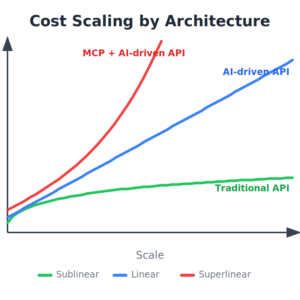
An enterprise builds an AI-powered contract review API that costs $1.58 per document to process: loading the contract, running five extraction passes through an LLM, flagging risks, and generating a summary. The unit economics are reasonable, and the API works well when called by internal applications. Then the team exposes this API via MCP for … continue reading

AI has moved from experimentation to executive mandate. Across industries, competitive pressure and rising user expectations are encouraging leaders to embed AI into core workflows, increase automation, improve efficiency and accelerate delivery. Competitive pressure drives innovation, and technology leaders and practitioners are finding new ways to meet rising demands. Enter: agentic AI systems that can … continue reading

Companies planning to build a cross-platform app will eventually face a critical decision of a front-end technology for building the solution’s user interface. In many cases, this decision comes down to choosing between React Native and Flutter, two very popular cross-platform front-end frameworks, and the dilemma of choosing between them can be challenging to solve. … continue reading

In the long arc of technology, Artificial General Intelligence may be looming somewhere beyond the horizon—faint, inevitable, and over-discussed. But in the enterprise—where risk is institutionalized and change moves at human speed—we are not ready to hand the keys to the machines. Not yet. For the next five years, the winning hand will not be … continue reading

Once upon a time, the largest pain point facing most enterprise software developers was writing and testing code. Thanks to the generative and agentic AI capabilities that have become widespread over the past few years, however, the coding part of development work has become substantially easier. But here’s an equally pressing challenge for software developers … continue reading

Modern DevOps pipelines are extraordinarily fast. Teams can spin up infrastructure instantly and automate builds and deployments. Yet despite these speed gains in tooling, many organizations still face slow, unpredictable, and painful release processes. It isn’t the CI system that holds releases back. It isn’t a lack of automation skills or test cases. It’s something … continue reading
In our DevOps-driven world of CI/CD pipelines and rapid deployments, it’s easy to assume that automation and now AI have made manual testing obsolete. But the reality is different. Manual testers still play a critical role in quality assurance, providing the kind of human insight and context-aware validation that automated tests can’t replicate. The challenge? … continue reading

Picture this: You’re testing a new AI-powered code review feature. You submit the same pull request twice and get two different sets of suggestions. Both seem reasonable. Both catch legitimate issues. But they’re different. Your instinct as a QA professional screams “file a bug!” But wait—is this a bug, or is this just how AI … continue reading