



The Becoming series started in 2019. We wanted to hear from women in different walks of life and how they were approaching creativity, career goals, and more–mostly the WHY and HOW beneath it all. It’s been amazing to conduct these interviews and get a “behind the scenes” look at so many inspirational women like today’s, Sarah Simon. You can see them all here.
Sarah Simon (@themintgardener) is a best-selling author, artist, and educator who delights in helping others discover the everyday magic of watercolor. As the creator of the #1 best-selling Watercolor Workbook series, she makes painting feel joyful, approachable, and wonderfully human for artists of all levels.
Through books, classes, workshops, and art retreats around the world, Sarah champions creativity, mindfulness, and a slower way of living. She’s happiest with dirt under her nails and paint scattered across her desk, tending gardens, sketchbooks, and ideas——choosing beauty, joy, and connection over the dishes and laundry, every time.
What do you consider yourself?
Artist, Author & Educator
You have a FEW new books out. Tell us about it and what prompted you to write it.
I want watercolor, and art in general, to feel as approachable as possible. I love the idea of removing obstacles and preparing a clear path to finding joy in creating for everyone who feels like gentle nudge and desire.
So often, sourcing the right materials or finding a tutorial that truly inspires you can feel more daunting than the act of painting itself. I wanted to change that. My books were born out of a simple desire: to make it easy to begin.
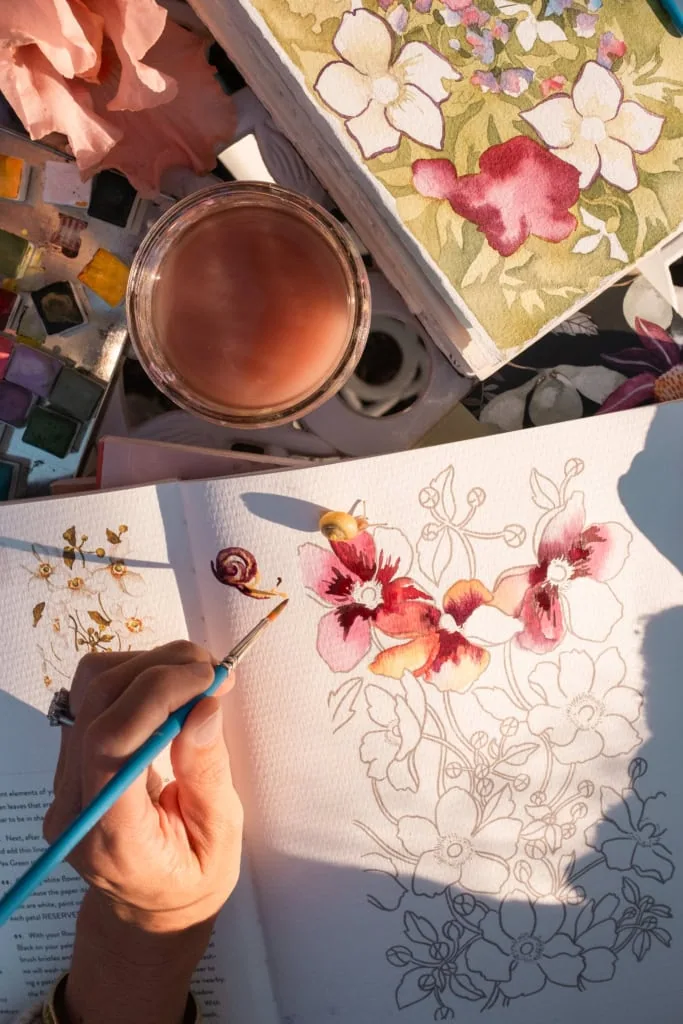
Over the years, I’ve created a few different pathways into watercolor, depending on how someone loves to learn. One is my online Flower Painting Club, where artists can join at the tier and commitment level that feels joyful and doable. The other is my books — especially my internationally bestselling Watercolor Workbook series. These workbooks are printed with my pre-drawn linework directly onto premium, wood-free watercolor paper bound right into the book. There’s no transferring, no tracing, no fuss. You simply open the page and begin painting.
The books and my tutorials truly go hand in hand. Many readers begin with a workbook and then join me online to expand their skills — and others discover the workbooks after painting alongside me digitally. They inform one another, creating a full, layered learning experience. And then they come on my art retreats! But you read more about that later…
Last year, I released Watercolor Notepad, which was a natural and exciting progression. Paper is the most important supply when it comes to watercolor, and one of the most common questions I receive is, “What paper should I use?” This notepad is the exact same high-quality paper used in my Watercolor Workbook series, now offered as a standalone pad for artists who want an affordable, reliable surface to experiment, practice, and play. It’s sturdy, wood-free, and designed to let paint truly dance. Creating it felt like answering a question my community had been asking for years.
And my most recent release, published March 10, 2026, is Flower Fairies — a magical water-reveal book that feels especially close to my heart.
As a little girl, I poured over Cicely Mary Barker’s Flower Fairies (first published in 1923) reading favorite poems, deciding which fairy felt most like me, and claiming my own special flower alongside my sisters. Those books felt like pure enchantment. Getting to create Flower Fairies, filled with seek-and-find surprises, counting elements, and hidden illustrations revealed with a swipe of a magical water brush, feels like the sweetest full-circle dream. Little-girl Sarah would be absolutely beaming to know she’d one day be part of something so whimsical and fantastical.
While it’s designed for the young flower-lovers in your life, I’ve been delighted to discover it truly charms all ages. It’s a no-mess travel companion, a whimsical fairy-party activity, and a gentle early learning tool meant to be explored together. There’s something so satisfying about watching the hidden colors bloom onto the page with a simple swish of water.
At the heart of all of my books is the same hope: that when someone sits down with one of them, the barriers feel lowered. The paper is ready. The lines are there. The colors are waiting. All that’s left is the quiet joy of watching paint meet the page.
What is your educational background and how has it shaped or changed your current career?
I have always been creative and I have always enjoyed creating with my hands – whether it’s drawing or weeding in the garden. It’s when I feel the most like ME. Growing up, I always loved creating—drawing, painting, sketching. Even more, I had no problem thinking of myself as an artist.
Then I became an “adult,” with very “important” grown-up responsibilities and concerns. I headed to college to pursue a practical “dollars and cents” degree, one that would guarantee a career after graduation. There was logic in this: I would be able to pay my bills and survive on my own in the world—a world that measured success in financial terms. Although I dabbled with artistic side jobs as I worked my way through school (my favorite was one where I soldered kaleidoscopes), I mostly stuffed my creative urges down deep inside and worked my way along a safer path. I graduated with a degree in economics and had some fantastic adventures as a young adult. I traveled, began a successful career at a Seattle tech firm, and was “doing well.”
And then one day, I broke my foot.
Confession: I tripped while wearing flip-flops. The most frustrating part of having a broken foot was having to slow down and sit still—definitely not my style. It was during this time that my best friend, Lauren (who had an art degree) insisted that I take advantage of this forced period of rest. “You have to sit still, so you will paint!” she cheered.
Suddenly, I was face-to-face with my resistance and forced to examine the real reason why I fought my artistic urges. Now that I had no reasonable excuses left, why shouldn’t I paint? The truth was that I was afraid. I felt more like an imposter than an artist. What could I say or contribute that hadn’t been said or done before? What if what I created wasn’t good enough—for me? For everyone else?
Lauren simply wouldn’t listen to my excuses. She drove me to the art store and piled supplies in the cart as I crutched along behind her. She added a big tube of white paint, “An artist always needs a good white” she said. I gulped and confessed that I didn’t know what to paint—I didn’t even know what my style was. She suggested that I paint something for my fiancé, Colin, because at least I knew what he liked.
Colin and I often traveled together and visiting art museums was one of our favorite things to do. We loved to wander through rooms of incredible art, soaking up the atmosphere, standing in awe of the Greats—van Gogh, Picasso, John Singer Sargent, or Rembrandt. I knew that one of Colin’s favorite paintings was “The Great Wave” by Katsushika Hokusai, the Japanese woodblock master and legend. I thought perhaps I could embark on my new painting journey like many before me, by copying a master and hopefully learning a few things in the process.
I dove in, bolstered by Lauren’s belief in me, spending every Saturday on a secret “mystery project.” I didn’t tell anyone that I was painting, just in case it was a total failure. The unveiling happened on Christmas Eve at Colin’s grandparents’ home. Both of our families were there. My heart was beating out of my chest. Colin opened the framed canvas and exclaimed, “Oh my gosh—I love Hokusai! It has all the texture of a real painting—where did you buy this?”
I proudly told him that I painted it; my journey back to art had begun.
What inspired you to become an artist?
I kept painting, mostly experimenting with acrylics. Others saw the joy that painting gave me, and I received a few commissions from family and friends. I was learning and growing as an artist. Then, my first daughter was born. My days were full of sweet smiles and tiny fingers and toes, but my time was not my own. Painting was on the back burner; I told myself that I would turn back to art when life slowed down a bit. And then we were blessed with a second daughter. I was completely swallowed up in motherhood and all that is entailed in caring for a family and home. I collapsed into bed each night. I never found time for myself.
My husband saw my exhaustion—and he recognized my restlessness. He reminded me that my happiest days were those I spent painting. Cue the excuses—and I had plenty of them. How could I justify spending money on a craft? How could I spend time painting when I didn’t even get enough sleep? Where would I find time between laundry, dishes, diapers? But Colin didn’t let me off the hook that easily, thank goodness. Again, he reminded me that I was happiest when I was creating.
I began @TheMintGardener—an Etsy shop and Instagram account—in 2014. My name, TheMintGardener, has a funny story behind it. My favorite thing to do in the garden was to throw seeds in the general direction of dirt, and then see what came up in a few months. Mint was a favorite of mine because it was vibrantly successful. It flourished wherever it landed: in shade or sun, with little need for water and no need for fertilizing. Being a “Mint Gardener” was a bit of a laugh between my husband and I, since it didn’t take much in the way of my effort to make a successful Mint bed. I felt more confident sharing plants and flowers…and maybe one day I would post some of my art pieces. Maybe.
So, I began slowly, sharing simple posts about our garden. It was a way for me to tap into the outside world, a place where I could be Sarah—not someone’s wife or mother. As time passed, I received encouragement from so many family members and friends. They believed in me—that I was indeed an artist, both in my garden and with my brush.
It’s hard to express in words the joy that I have experienced because I chose to paint and share my art. And I still feel vulnerable, with flickering feelings of fear when I share a new post or do a show or pop-up shop. But still, I show up, because my goodness, feeling uncomfortable is well worth the reward of sharing what I love to do.
How do you make social connections in the creative realm?
“To be interesting, be interested.” — Dale Carnegie
This quote perfectly captures how I approach connection in the creative world.
When I meet other creatives — whether in person or online — I lead with curiosity. I genuinely want to know what moves them, what they’re wrestling with, what keeps them up late making. I love asking questions, digging deeper, and encouraging those brave enough to bring their inner longings into outer form.
Creativity is vulnerable work. So instead of “networking,” I try to participate. I comment thoughtfully. I respond. I share what truly moved me about someone’s piece. I stay interested.
There’s something sacred about paying attention — about having your art antennae quietly attuned to beauty. When an image takes my breath away, I say so. When someone’s work stirs something in me, I tell them. That honest interest becomes the beginning of connection.
And like any practice, it’s built through consistency. The same way daily drawing builds skill, daily encouragement builds community. A kind message. A shared resource. A simple “I see you.”
Over time, those small moments turn into real friendships — rooted not in comparison, but in shared wonder.
What artists and creatives do you look up to, both historical and present?
There are so many! Truly, my art book stacks feel like old friends at this point. But off the top of my head, the first names that come to mind are Vincent van Gogh, John Singer Sargent, William Morris, and Glynn Boyd Harte.
Each of them inspires me in different ways. Van Gogh for his devotion to color and movement and his brushstrokes: they feel like emotional boldness, both tender and fearless. Sargent for his fluid confidence, especially in watercolor. I love the way his brush seems to dance and never overwork, yet land exactly where it should. William Morris for his reverence for nature, and the handmade, and the idea that beauty belongs in everyday life. And Glynn Boyd Harte for his lyrical linework and romantic sensibility. I especially love how he depicts the subjects of food and water…I always want to see more of his work!
My art library is a beauty bath for my eyes. I’ll often pull books down just to sit and soak, especially on mornings when I can move slowly with a big mug of milky tea. I love studying colors, noticing textures, and tracing compositions with my gaze. It’s all about beauty steeping. I want those influences to settle quietly into my bones.
Recently, I discovered that John Singer Sargent often used white gouache in his watercolors. I felt like I had stumbled upon a treasure trove of wisdom, and oddly, it gave me permission to continue combining these mediums like I love to do. There’s something so thrilling about realizing that even masters layered, experimented, adjusted. Sargent ‘broke the rules’ and added gouache to watercolor! It reminds me that technique can be both refined and playful, and that following the nudge to try something different, even if the general art community frowns upon it, can be liberating and absolutely beautiful.
Looking at the work of artists I admire makes me feel like I’m invited to the party. It’s a reminder that I can be a part of a long, ongoing conversation about beauty, color, and paying attention. And that feels like such a gift.
What sparked your interest in design and sharing on the Internet?
The time finally arrived to share my artwork with the wider world. Up until 2014, I had been only sharing pictures of my plants. I knew I needed to share my art too. The day began early, around five in the morning. I had just fed my two-month old daughter and she was snoozing contentedly. Instead of rolling back into bed, I sat in the living room at my great-grandmother’s writing desk. I watched the sun rise, captivated by the soft morning light as the breeze shook the leaves of the trees. Inspired, I painted a few monochromatic green leaves. Suddenly, I felt that someone needed to hold the plant I had just painted. In those quiet hours, my character “Florence” was born. She came to life, embracing leafy eucalyptus boughs in a large vase, her face hidden by the greenery. I loved the contrast of the watercolor plant with the simple, ink lines of her body. Next, I drew Florence holding one of our chickens. I knew I had to share her, but I still remember the vulnerability I felt as I hit “post,” sharing a piece I cared about with an audience for the first time.
Sharing your art with other people is vulnerable. On social media, or just with a close friend over coffee. A work of art comes from your own two hands. As you share it—or even think about sharing it—your heart beats faster and a negative voice may whisper in your ear, telling you all the reasons you are silly and unworthy to share your creation.
But I truly believe this: sharing your work is good for you. Even when you are scared, even when you are giddy with excitement. These emotions show you, that you are alive. I often think that the creation of art is most like a deep sense of longing. A feeling that needs to be communicated – but in its own unique language. Our spoken language often falls short of the notes, colors, saturations and swoops that a filled paintbrush can say, joyously rioting across the blank page. The liminal spaces we gleefully enter as we suddenly wake up from that delicious flow state and realize – something just happened and it felt like magic.
But if you never share your discoveries, your expressions of the truest you…you miss out on others reflecting their feelings back to you, and the creative process growing into something even bigger than yourself. I would love to encourage you here. Be bold. Be brave. Step through your feelings of vulnerability to the other side. Embrace the process, play with paint, trust the artist inside that has original suggestions. And when you do choose to share, the community that surrounds you and the joy you feel is so much stronger than the vulnerability or fear of sharing ever was.
What are three words to describe your style?
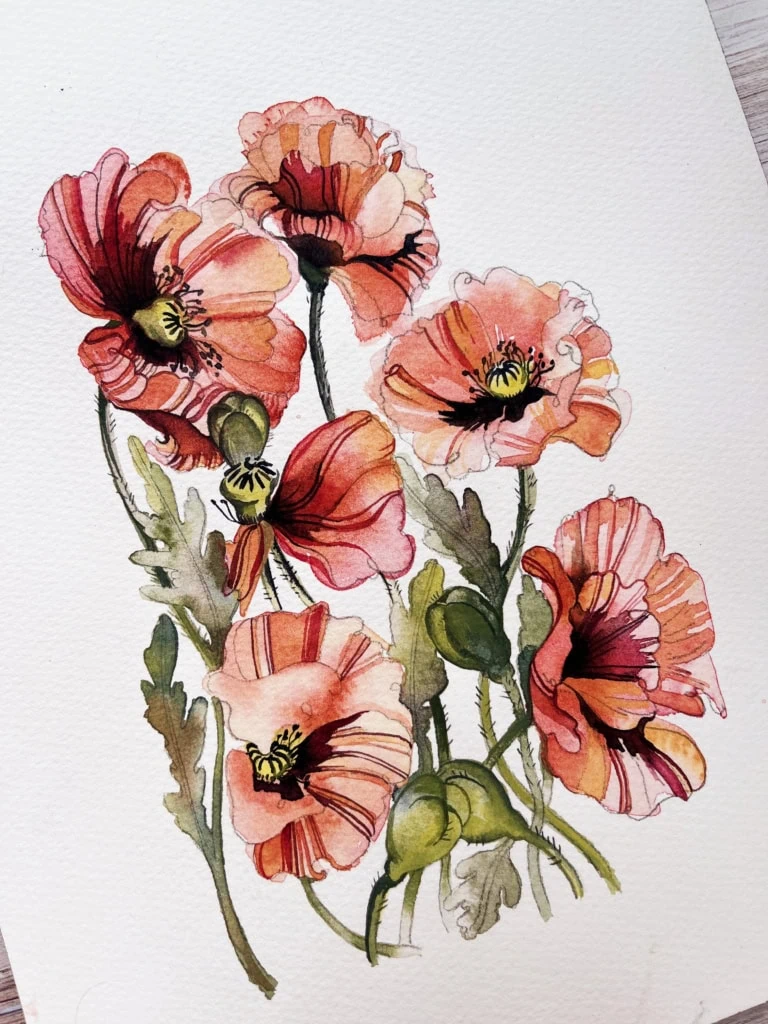
Botanical. Whimsical. Gentle-but-confident.
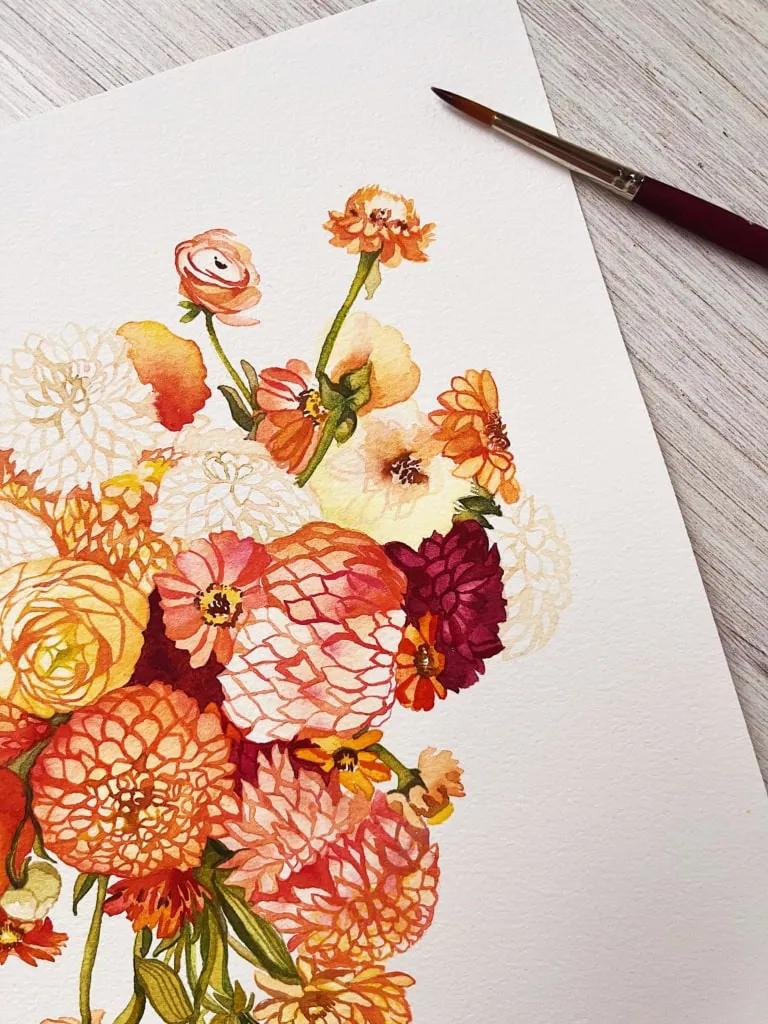
My work carries a light, storybook quality — as if it belongs in a secret garden or tucked inside a beloved heirloom book. There’s a quiet sense of wonder woven through it. I want it to feel beautiful and enchanted, but never overly precious.
There’s a softness in the way I try to observe the world. I want my lines to feel attentive, never rushed — to hold a quiet affection for the subject. I’m not just trying to depict something; I want to honor it.
Rooted in real gardens, real growth, and careful observation, my art is grounded even in its whimsy. And above all, I never want it to feel intimidating. My hope is that it feels like an open invitation — that you’ll pick up your paintbrush or pen and join me.
What is one project that you are especially proud of and why?
I’m especially proud of and always excited for our yearly “A Creative Way Art Retreats.”
A Creative Way Retreats are truly something special: immersive, soul‑nourishing creative getaways designed for artists of all levels to slow down, reconnect with wonder, and make meaningful art in beautiful places. Whether we’re gathered in the peaceful light of a French chateau in the Loire Valley or at a thoughtfully curated domestic retreat in Seattle, Washington or outside of Charleston, South Carolina, every retreat is crafted to inspire deep creative flow, joyful connection, and unforgettable memories.
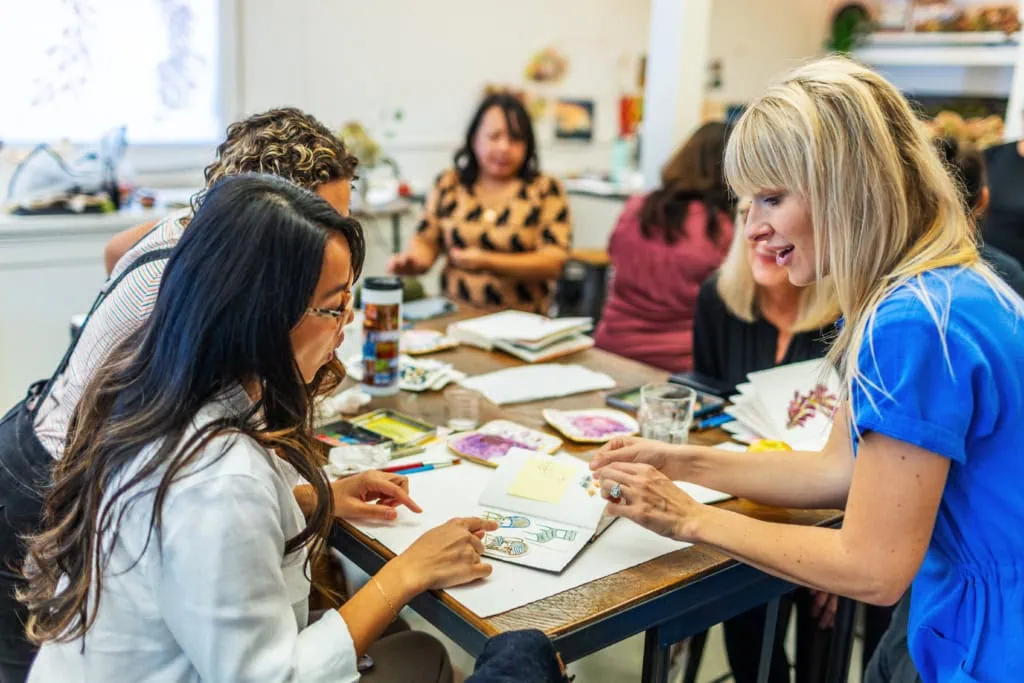
These retreats are more than art workshops; they are intentional creative experiences. Over the course of several days you’ll paint, sketch, and explore together in a supportive community, with expert guidance and ample space to develop your skills, refine your artistic voice, and most importantly, fall in love with the act of creating again. There’s time for structured learning, gentle exploration, and moments of quiet inspiration in environments that naturally awaken curiosity and wonder.
What makes A Creative Way extra magical is how thoughtfully everything is prepared. I am so intentional with the selection of high‑quality art supplies, curated just for you, all meals are shared around table conversations that grow into friendships (and I LOVE good food, so we always have a positively incredible chef feeding you!) and even little excursions to soak in the place we are spending our days in. It all becomes part of the creative rhythm. For many attendees, the retreat becomes a turning point in their art practice, and for some, their lives: a place where confidence grows, inspiration blooms, and creative habits take root.
I’m so proud to be able to host these retreats because they are exactly the kind of creative experiences I wish someone had invited me into earlier in my journey. They remove obstacles: the intimidation, the isolation, the fear of not “being good enough,” and replace them with encouragement, connection, and abundant creative possibility. I love witnessing artists show up curious and leave confident with new skills, new friends, and a deeper sense of creative belonging. I’m proud because these retreats honor creativity as a joyful, communal, life‑giving practice — a fresh and abundant way of seeing the world, together.
2026 Art Retreats
(Spring offerings are sold out, but here are links to Fall 2026, and if you are interested in joining us for an international trip, you can visit themintgardener.com/links)
Art Retreat Seattle FALL Oct 15-18
Art Retreat Flowertown FALL Nov 5-8
You can find The Mint Gardener:
On her website
On Instagram @themintgardener
Comments