
From time to time, the title of a newly announced TV series strikes the internet’s funny bone. 30 Rock fans immediately clocked TLC’s reality dating show MILF Manor as a real-life manifestation of Jack Donaghy’s shameless hit MILF Island. On the other end of the prestige spectrum, The Young Pope—paired with promo shots of its star, Jude Law, smoking cigarettes in frilly papal vestments—became a meme long before anyone had actually watched it. Well, now we’ve got The Miniature Wife, whose key art simply screams that the title is no metaphor.
The show is ridiculous, to be sure. But it’s also surprisingly good. (I’d say it’s more Young Pope than MILF Manor if it wasn’t so different from either show as to defy substantive comparison.) Starring and executive produced by Elizabeth Banks and Matthew Macfadyen, Peacock’s sci-fi dramedy takes its premise not from a cynical suit who fell asleep watching Honey, I Shrunk the Kids but from a deadpan, surrealistic short story by Manuel Gonzales. And in a 10-episode season that premieres on April 9, creators Jennifer Ames and Steve Turner (Goliath, Ash vs Evil Dead) shade that spare source material into an entertaining, remarkably insightful portrait of marriage, family, and the skewed narratives people create for themselves about both.
Such an unusual mix of B-movie wackiness and emotional realism requires versatile leads with complex chemistry, and in Banks and Macfadyen it has some of the best around. He’s pivoted from Pride & Prejudice dreamboat to TV’s most nuanced portrayer of ambitious little weasels, in Succession and then Death by Lightning. Her work as a director (Cocaine Bear) and producer (Bottoms) sometimes overshadows her estimable talents in front of the camera, where she excels at the intersection of comedy and drama. When we meet their characters, Lindy and Les Littlejohn (yes, we’re going all-in on the mini theme), the spouses are deep in couples therapy and poised to recommit to their troubled 20-year marriage. Lindy, an author who teaches in lieu of writing a follow-up to a Pulitzer-winning debut novel that is roughly as old as her college-aged daughter (Sofia Rosinsky), is owning her “accountability issues.” A scientist who leads his own agrotech company, Les cops to having “narcissistic tendencies.” Over a romantic dinner, he reveals that he’s about to lock down the funding to finish his dream project within the next year. And then he’ll be ready to step back from work and devote himself to their life together.
Advertisement
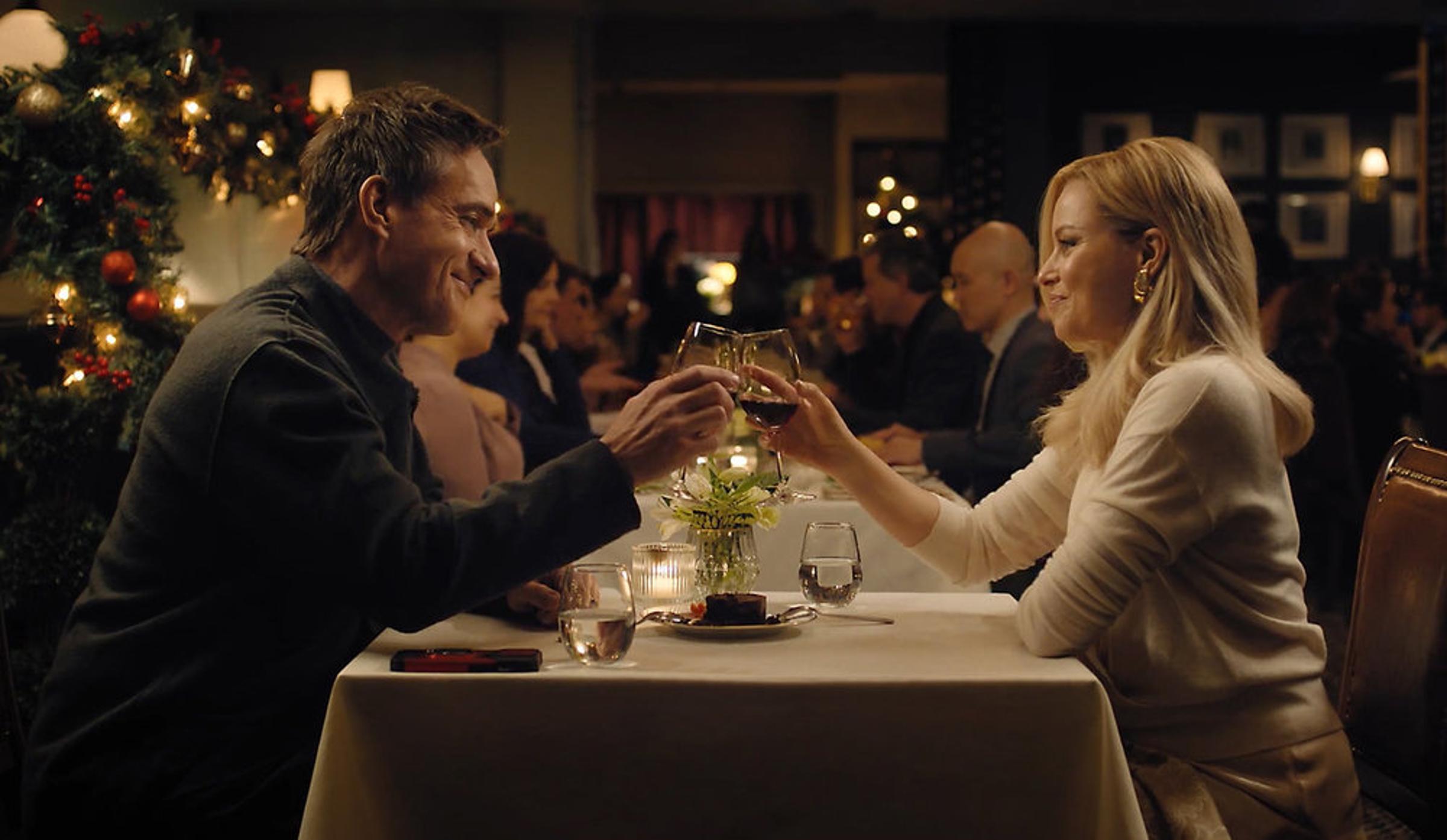
Matthew Macfadyen and Elizabeth Banks in The Miniature Wife Peacock
Les’ project is pretty absurd. He has concocted a potion that shrinks objects such as ears of corn to a fraction of their original size, ostensibly making agriculture more sustainable by allowing farmers to grow more crops in smaller spaces. He just needs a final infusion of cash, from a fratty tech bro played by Ronny Chieng, to support the development of a formula that will make the micro produce big again. After Chieng’s Hilton hears a drunk, bitter Lindy complain about her husband’s workaholic tendencies, Les gets it. The catch is that he has to grind through the upcoming holiday season to meet Hilton’s deadline. So much for the vow renewal and getaway with old friends that Lindy had been planning. She’s furious. They squabble. In the confusion, she gets doused with his solution and shrinks to six inches. Voila: the miniature wife.
Advertisement
At first, the conceit seems as stupid as you’d think. The show’s vaguely uncanny, intermittently convincing visual effects show us Banks nestled in the palm of Macfadyen’s hand, sipping a tiny cup of coffee while reclining inside a coffee cup, using pins as swords to fight insects that are nearly as big as she is. A few of these moments are legitimately funny; most are just silly. But they work as scaffolding for unexpectedly sophisticated character studies. The Littlejohns have a dollhouse that is a scale model of their mansion, furnished with objects Les has shrunk. As he scrambles to refine his enlarging formula—he can restore an ear of corn to its original size, but a few seconds later it explodes—he tries to make Lindy comfortable by miniaturizing her clothes and setting up itty-bitty movie nights. He also locks her inside the dollhouse, leaving giant-to-her Post-It notes explaining that it’s for her safety. (The couple does have a rather aggressive cat.)
Advertisement
Can you see the metaphor starting to take shape? Happily, there’s more to it than a simplistic feminist parable of a powerful man imprisoning his helpless wife in a monument to his genius and her domesticity. Flashbacks revisit the lengthy stretch when Lindy was the superstar of their marriage, a best-selling author who nabbed one of the literary world’s highest honors on her first try: a funny-sad novel that lightly fictionalized her relationship with her frosty mother (Linda Emond). Meanwhile, Les, whose supposedly normal family Lindy idealized, was nursing the failure of a GMO tomato project. As the years passed, he maintained total faith in his outlandish ideas; she increasingly viewed her success as a fluke. Their moody daughter, Lulu, grew up idolizing her dad and resenting her mom, even though she obviously has more in common with Lindy. The amalgam of zany premise and insight into how the characters’ interpretations of past familial relationships sabotage the ones they’re trying to repair in the present yields a show much stronger than either half of the concept would’ve been alone.
Advertisement

From left: O-T Fagbenle, Zoe Lister-Jones, Matthew Macfadyen, and Ronny Chieng in The Miniature Wife Rafy—Peacock
The Miniature Wife doesn’t escape every pitfall of the contemporary streaming series, but its pluses go a long way towards mitigating its minuses. If 10 episodes of at least 40 minutes apiece is an excessive amount of time to devote to this farce, it helps that the dialogue is witty and the performances charming, and that there are always new thematic layers to uncover. (Viewers who tune in to new episodes weekly, instead of bingeing the season like I did, might not even notice the plot dragging.) The expansion of Gonzales’ story, from which the show derives many of its most inspired surreal details, leaves room for secondary characters that may not need individual plotlines but earn them through sheer enjoyability. Lulu has more dimensions than the typical angsty TV teen. As Lindy’s loyal friend and long-suffering literary agent, Fleabag’s Sian Clifford treats us to the spectacle of a dry, no-nonsense Brit gradually losing it. O-T Fagbenle, who has brought delightful oddness to underwritten characters in Presumed Innocent and All’s Fair, is a riot as a cheesy employee of Les’ with whom Lindy has been conducting an emotional affair—as is Zoe Lister-Jones, playing Hilton's affectless, dominatrix-like deputy. By the end of the season, I was ready for 10 more episodes.
Advertisement
Marriage is as popular a topic for television now as it has ever been. All too often, though, it appears in forms that lend themselves to predictability and caricature. There’s at least one evil spouse in every domestic thriller—usually the man. An effective rom-com makes you fall in love with both halves of the central couple, and rarely reserves much time for life beyond the altar. The surface weirdness of The Miniature Wife frees it up to defy genre conventions. It has to have a unique angle on the long arc of romantic partnerships. Otherwise, it would just be a joke.
