


 Report an issue with this product or seller
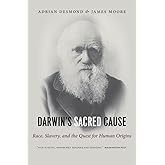















The thoughts and thought processes of Charles Darwin can only be appreciated and evaluated within the social and intellectual context of his own era. That at least is the starting premise of "Darwin's Sacred Cause" by Adrian Desmond and James Moore. This stimulating study is not a biography of Darwin per se; the authors have already published one, titled simply "Darwin." Instead, this is a detailed investigation of the ideas and opinions concerning the origins of humanity that were current in Darwin's lifetime and the decades previous, and the implications of those ideas for the formulation and publication of Darwin's hypotheses about what we now call `evolution.'
The `Sacred Cause' to which Darwin was dedicated was the abolition of slavery. Desmond and Moore assert that Darwin was born into a family and milieu passionately committed to abolition, originally on the profoundly religious grounds of the unity of all humankind as descendents of Adam and Eve. The great abolitionist families of 18th and 19th Century England are worth reading about in their own right -- Josiah Wedgwood and his descendents, the Wilberforces, the Clarksons, Harriet Martineau, etc. They are insightfully treated in the fine study "Bury the Chains" by Adam Hochschild. Darwin's allegiance to this humanitarian cause was unshakable and surely lent emotional urgency to his efforts to `prove' that all human were of the same species and the same descent, and therefore entitled to equal human rights.
For the enlightenment of any flat-earthers and creationists who might stumble over this book in the darkness of their caves, let me explain that "evolution" was not an idea first expounded by Charles Darwin. Usually called "transmutation" in the 18th and early 19th Centuries, evolution was well established as a notion before Charles Darwin was born. It was observable, undeniable, barnyard knowledge available to all breeders of animals and plants. Polite society held that the definition of a "species" could be built on the question of interbreeding; hybrids of two species - obviously something that did occur - would be sterile, and thus if two breeds of cattle or two races of humans could produce fertile offspring, then they must be of a single species. Darwin's hypothesis was that transmutation could occur, over long times and in specific circumstances, by the accumulation of small variations until the descendents of a single original species could no longer interbreed. His language for this was "descent with modification." The daring corollary of this hypothesis was that all living organisms must have descended, over vast periods of geological time, from a single original life form. For this to have occurred, Darwin theorized two agents of change: 1. the Malthusian pressure of "survival of the fittest", and 2. sexual selection. Darwin of course knew nothing about genetics, about random genetic drift or mutation, etc. Nobody did, back then.
The hot button issue in the 1840s and 1850s wasn't `evolution', however. It was the theological/political/economic issue of the equality of races, aka "what to do with those pesky dark-skinned savages". Three choices? Exterminate them; enslave them; treat them as brothers. The constituencies for the first two choices far outnumbered the third. Political and social rivalries between England and America were also significant in the debate, since England had committed itself to abolition while the USA, however divided against itself, sustained and defended the peculiar instution of slavery.
The `educated' scientific community of Darwin's lifetime was aligned in two camps on the issue of human origins: the monogenecists and the polygenecists, the former maintaining the `conservative' Biblically-sanctioned idea of a single origin for all humans, and the latter amassing volumes of scholarly `evidence' that the human races were distinct species with distinct origins in different regions of the planet. The majority opinion was that species were immutable, that each geographic region of the planet was a `homeland' for a whole suite of species, including species of humans. Such ideas were most authoritatively expressed by Louis Agassiz, the `super star' of American science. Of course, Darwin was the staunchest of monogenecists, even after he had shed all his religious convictions. And of course, the concomitants of polygenecism were mightily appealing to slave owners, to the Lords of the Loom in New England as much as to the Lords of the Lash in Dixie, to the aristocracies of birth and money everywhere, to all who felt comfortable with their own racial superiority in a hierarchy established by nature itself. The core of Desmond and Moore's research in this book is the careful re-examination of the debate between these two camps.
Polygenicism, by the way, is not totally laid to rest even today. There are archaelogists and anthropologists of repute in China who aspire to show that modern humanity did NOT emerge from Africa, but rather that `races' of H. erectus evolved concurrently in several regions, one being Asia, into races of H. sapiens, which then perhaps overlapped and interbred. There are also `wishful thinkers' who jealously guard the notion that H. neanderthalis (highly regarded now that its beetle-browed stupidity has been displaced by the measurements of its larger cranium than ours) must have contributed some gentic uniqueness to European stock. And you might try reading the reviews of the infamous "The Bell Curve" here on ammy, to ascertain that nostalgia for a hierarchy of racial superiorities isn't extinct.
Perhaps I've already used too many words to summarize the matter of this hugely meaningful social history. "Darwin's Sacred Cause" is the most thought-provoking book of social history I've read in recent years. It's a book I wish I'd written myself, or even had the scholarly tools to write. Though the cause was (and is) sacred, Desmond and Moore do NOT make a saint of Charles Darwin. They depict his hesitations, his dependencies on the esteem of his peers, his clinging to respectability and allegiance to his own social class, his compromises, his limits. The Darwin they depict is a man who had to earn his own greatness by hard work and painful decisions, a Darwin less to worship and more to admire.
I'm surprised to find so few reviews of this enormously important book here on the product page. The two negative reviews, in fact, make significant points, though I think they miss the central point. Desmond and Moore do take an irritating tone of over-certainty at times, especially in their introduction. They do not, however, ignore Darwin's grudging acknowledgement that his Malthusian survival theory might be a two-edged sword, that it might justify the hateful "social Darwinism" of the succeeding decades. The drama of this detailed, conscientiously academic study is to be found in the way Darwin persisted and demolished, yes, demolished, the basis for racism forevermore.

FREE delivery April 30 - May 6

FREE delivery April 30 - May 6

FREE delivery May 1 - 5
FREE delivery May 1 - 5

Download the free Kindle app and start reading Kindle books instantly on your smartphone, tablet, or computer - no Kindle device required.
Read instantly on your browser with Kindle for Web.
Using your mobile phone camera - scan the code below and download the Kindle app.

Follow the author
Get new release updates & improved recommendations
Something went wrong. Please try your request again later.
Frequently bought together
This item: Darwin's Sacred Cause
$18.63
Get it Apr 30 - May 6
Only 1 left in stock - order soon.
+
$31.59
Get it as soon as Thursday, May 7
Sold by ifbookstore and ships from Amazon Fulfillment.Total price: $00
To see our price, add these items to your cart.
Choose items to buy together.
Customers who viewed this item also viewed
Page 1 of 1 Start over
- Darwin's Sacred Cause: Race, Slavery and the Quest for Human OriginsPaperbackFREE Shipping on orders over $35 shipped by AmazonGet it as soon as Tuesday, Apr 28
About the author

Products related to this item
Page 1 of 1Start over
Customers say
Customers praise the book's deep research and well-documented historical approach. They find the content excellent, with one customer highlighting how it explores Darwin's family influence on his attitudes and beliefs.
AI Generated from the text of customer reviews
Select to learn more
11 customers mention research, 10 positive, 1 negative
An excellent, well researched, well written book on the environment Darwin was in as he worked out the details he covers in his book Origin of...Read more
Excellent historical information on Darwin's early life and family influence on his attitudes and beliefs.Read more
...One may or may not agree with the authors' theories, but the book is deeply researched and magnificently well written, and recommended reading for...Read more
Novel insight that makes perfect sense but underappreciated about this father of evolutionary understandingRead more
8 customers mention content, 7 positive, 1 negative
Quality book that arrived in a timely way and in an as-advertised condition. Thanks.Read more
...Desmond and Moore's books are among the most delightful and well-documented historical works, and, in this case, also very significant....Read more
...is deeply researched and magnificently well written, and recommended reading for anybody interested in the evolution of thought and knowledge.Read more
An excellent, well researched, well written book on the environment Darwin was in as he worked out the details he covers in his book Origin of...Read more
Top reviews from the United States
There was a problem filtering reviews. Please reload the page.

Top reviews from other countries
- SeedsowerReviewed in the United Kingdom on May 17, 2017
Interested in Darwin? Then read this!
Format: HardcoverVerified Purchase -
LiuReviewed in France on December 21, 2012
Très fourni mais peu convainquant
Format: HardcoverVerified Purchase