


The popular Ultralytics YOLO11 AI model was compromised in a supply chain attack to deploy cryptominers on devices running versions 8.3.41 and 8.3.42 from the Python Package Index (PyPI)
Ultralytics is a software development company specializing in computer vision and artificial intelligence (AI), specifically in object detection and image processing.
It's best known for its "YOLO" (You Only Look Once) advanced object detection model, which can quickly and accurately detect and identify objects in video streams in real time.

Ultralytics tools are open-source and are used by numerous projects spanning a wide range of industries and applications.
The library has been starred 33,600 times and forked 6,500 times on GitHub, and it has had over 260,000 downloads over the past 24 hours from PyPI alone.
Ultralytics YOLO11 compromised
Yesterday, Ultralytics 8.3.41 and 8.3.42 were released to PyPi, and users who installed the compromised versions directly or as a dependency discovered that a cryptominer was deployed. For Google Colab accounts, owners got flagged and banned due to "abusive activity."
Ultralytics is a dependency of both SwarmUI and ComfyUI, who both confirmed that fresh installs of their libraries would have led to the installation of the miner.
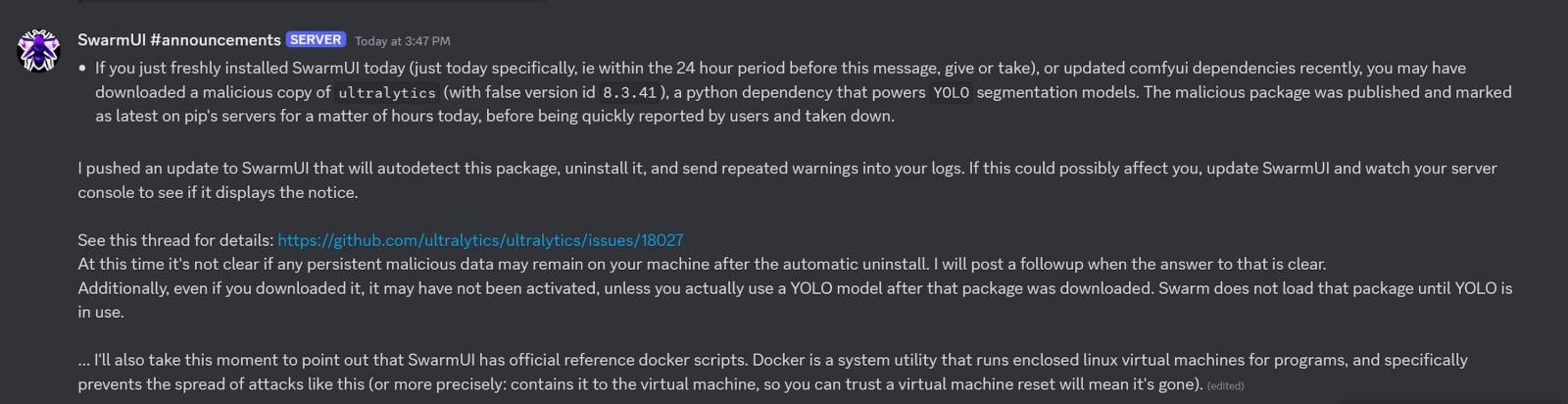
When installed, the compromised library installs and launches an XMRig Miner at '/tmp/ultralytics_runner' to connect to a minin pool at "connect.consrensys[.]com:8080".

Source: Floresce
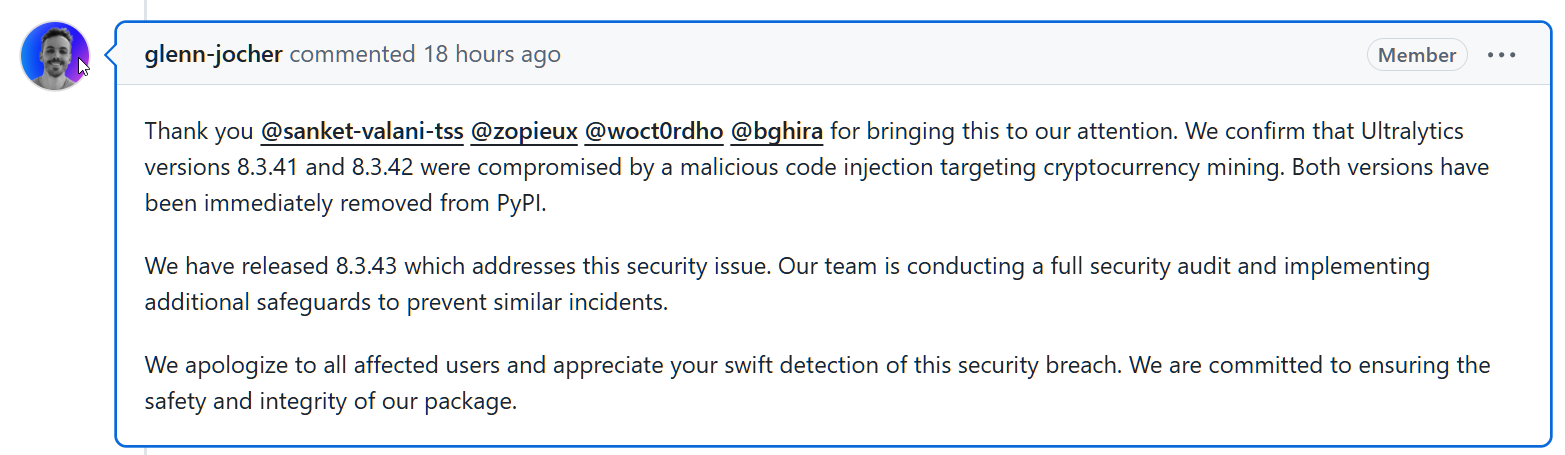
Ultralytics founder and CEO Glenn Jocher confirmed that the issue only impacts those two compromised versions, which have already been pulled and replaced with a clean 8.3.43 version.
"We confirm that Ultralytics versions 8.3.41 and 8.3.42 were compromised by a malicious code injection targeting cryptocurrency mining. Both versions have been immediately removed from PyPI," Jocher posted to GitHub.
"We have released 8.3.43 which addresses this security issue. Our team is conducting a full security audit and implementing additional safeguards to prevent similar incidents."
Source: BleepingComputer
The developers are currently investigating the root cause, and potential vulnerabilities in the Ultralytics build environment to determine how it was breached.
However, Jocher commented that the compromise appears to originate from two malicious PRs [1, 2]with code injection in the branch names submitted by a user in Hong Kong.
Whether the malicious code solely performed crypto mining or compromised private user data remains unclear, and the community is still awaiting a formal advisory regarding the breach that will provide clarifications on all details.
Out of an abundance of caution, those who downloaded a malicious version of Ultralytics should perform a full system scan.
BleepingComputer has contacted Ultralytics to comment on the situation and learn more about how the supply chain compromise was achieved, but we are still awaiting a response.
Update 12/8: There are user reports of new trojanized releases on PyPI, so the attack appears to continue through new package versions 8.3.45 and 8.3.46.

99% of What Mythos Found Is Still Unpatched.
AI chained four zero-days into one exploit that bypassed both renderer and OS sandboxes. A wave of new exploits is coming.
At the Autonomous Validation Summit (May 12 & 14), see how autonomous, context-rich validation finds what's exploitable, proves controls hold, and closes the remediation loop.
Claim Your Spot











Comments
Wannabetech1 - 1 year ago
"which can quickly and accurately detect and identify objects in video streams in real time."
Huh wonder who would have a use for that?
kristiana - 1 year ago
<p>""which can quickly and accurately detect and identify objects in video streams in real time." Huh wonder who would have a use for that?" Real-time object detection in video streams is invaluable for various industries. For example, in security and surveillance, it enables rapid identification of suspicious activities or individuals, enhancing response times for law enforcement.</p>
Wannabetech1 - 1 year ago
I guess my "smartassness" didn't come through. In any case you made my case though I was thinking government surveillance and not retail which just makes it worse.