- Content Strategy
Building a content strategy: How-tos, templates, and tips

Jump to:
What is a content strategy?
A content strategy is a high-level internal document that outlines how an enterprise will plan, create, distribute, manage, and govern audience-targeted content to help achieve its business goals. The content should be valuable, relevant, and consistent to attract, engage, and retain the ideal customer.
Content is an integral part of marketing(opens in a new tab or window), with 90% of organizations relying on it to market their products and services. However, it’s surprising to discover that only 70% take the time to create a content strategy(opens in a new tab or window). For those that do have a documented content strategy plan, only 29% of marketers(opens in a new tab or window) believe it’s extremely effective, while 58% say it’s moderately effective.


Who creates the content strategy?
Building a content strategy typically falls on the content strategist. However, they can't work alone. The content strategist collaborates closely with senior leaders and members of other teams, including, but not limited to, sales, product development, and design. This way, content creation is aligned with the company’s greater objectives while considering different perspectives.
How did content strategy planning come about?
Though companies were already using content marketing by the early 1990s, the term “content strategy” was first mentioned in 1997 by information designers(opens in a new tab or window) such as Ann Rockley. US digital agencies followed suit by creating content strategy job posts the succeeding year.
In 2002, Rockley and Charles Cooper released a book called Managing Enterprise Content: A Unified Content Strategy (Voices That Matter). It described a unified concept strategy as “a repeatable method of identifying all content requirements up front, creating consistently structured content for reuse, managing that content in a definitive source, and assembling content on-demand to meet customer needs.”
By 2009, content strategy had gained popularity with the rise of multi-channel publishing and content marketing conferences. It also spawned frameworks such as the content strategy quad and HHH model. Created by Kristina Halvorson and Melissa Rach in 2009, the content strategy quad(opens in a new tab or window) framework focused on substance, structure, workflow, and governance, with core strategy at the center of the circle. In 2014, Google developed the triangle-shaped HHH model for YouTube users. Following this structure, people are encouraged to post a mix of Hero (high impact), Hub (regular and consistent), and Hygiene/Help (sought-after) video content.
Why do you need a content strategy?
No matter how large or small your enterprise is, having a well-defined roadmap significantly increases the odds of achieving your business objective. It’s important to spend ample time, funds, research, and resources on creating your content strategy because:
It guarantees your content supports your overall goals
Think of a content strategy as a packing list for your journey toward achieving your marketing goals—whether that means increasing sales revenue or building brand love. What essentials do you take with you, and what can you leave behind?
At the same time, a well-thought-out content strategy ensures that your content resonates with your existing and target audiences.
It keeps everyone aligned across your organization
Not only does a content strategy get you internal stakeholder buy-in, but it also helps your marketing and sales teams stay aligned on what content to create. HR can offer support to meet employee requirements (through training and hiring people), while the comms team can easily track progress and share milestones.
It streamlines content generation and distribution while optimizing your assets
You can pinpoint which teams to assign, when to outsource, and which content to prioritize. In turn, you can lower your marketing costs and avoid needlessly expensive ventures with less-than-ideal ROI.
It strengthens brand credibility and online visibility
Consistently releasing relevant and valuable content for your audience is a great way of establishing yourself as an industry leader.
It helps you monitor and analyze your content
By having routine checks in place, you can develop a more refined marketing strategy.
What a content strategy is and isn’t
Though these terms may seem similar at first glance, there are differences that make each concept as indispensable as the other. Understanding their nuances is crucial for crafting a comprehensive and effective strategy that delivers measurable results.
Content strategy vs content marketing
A content strategy ensures the right content is crafted for your ideal target while being aligned with your business goal. Content marketing executes the strategic plan through different tactics.
Content strategy vs content plan vs content calendar
Even if these three concepts work hand in hand, a content strategy’s primary purpose differs from that of a content plan and a content calendar. By definition, the content strategy is a high-level outline that sets the overall goal and direction. It answers “what” and “why.”
The content plan, however, shows the content types, topics to cover, and distribution platforms to use. Answering the questions “how” and “when,” a content plan clearly indicates specific tactics and timelines.
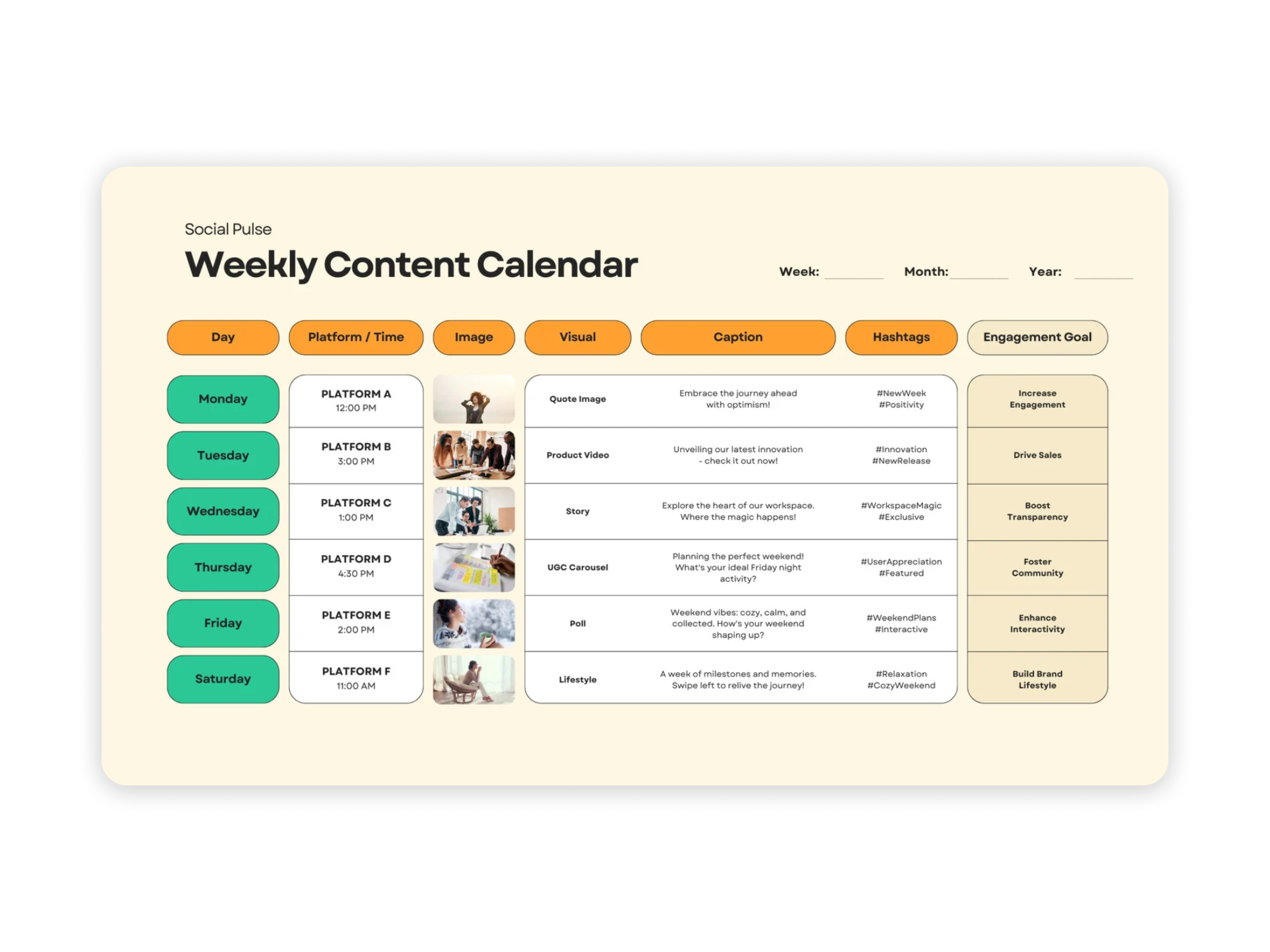
The content calendar provides a detailed schedule from creation to posting. This includes the subject, type, creator, approver, status, as well as the publish date, time, and channel.
What to include in a content strategy?
A content strategy can be tailored to achieve an organization’s desired results, but its core components remain constant across the board. Whether you’re building a social media or search engine optimization (SEO) content strategy, the following components must be included in your document.
Your goal, considered your North Star, assists everyone in staying on the right path. You don’t need to look far to determine what it is. Refer to your business plan to identify your long-term purpose.
According to the Content Marketing Institute(opens in a new tab or window) (CMI), creating brand awareness was the number one goal of surveyed marketers. Other common goals include building credibility and trust, generating demand/leads, nurturing subscribers/audiences/leads, and generating sales/revenue.

Also known as buyer persona or customer persona, the audience persona is a semi-fictional character that embodies your target market. This in-depth profile of your ideal customer is carefully formed through interviews, surveys, social media insights, and research conducted on online forums and social media groups related to your product or industry. It includes demographic information (age, sex, location, race, education level, employment, and income level), interests, pain points, and content preferences.
A content audit is a comprehensive evaluation of all your existing published material. Each piece of content is analyzed for its quality, accuracy, consistency, performance, and relevance to the target audience, often using portfolio-based frameworks like the BCG Matrix(opens in a new tab or window) to compare assets and prioritize effort. This systematic process also helps identify areas of improvement and gaps in the content strategy, such as improving SEO ranking or optimizing user experience on your website.
For new businesses, performing a competitive analysis can give you an idea of your market, trends, and key players. For long-time enterprises, running a competitive analysis can reveal how your rivals attract new customers and promote their products.
In your analysis, identify direct and indirect competitors. Mention each competitor’s target audiences, brand voice, themes and topics, distribution channels, marketing strategy, content formats, and audience engagement.
Develop a set of standards that’ll guarantee content quality and brand consistency from ideation to distribution. For internal teams, start with the basics, such as brand guidelines(opens in a new tab or window), which include your brand kit, messaging, voice(opens in a new tab or window), and tone. Marketing and content teams will benefit from having a style guide(opens in a new tab or window) that can be shared with external parties such as freelancers. Additionally, content samples, templates, and best practices will paint a clearer picture of what’s expected from both internal teams and third-party contributors.
For example, Docusign(opens in a new tab or window)’s creative team once struggled to provide visual content for its 6,000 global employees. However, by making a standardized Brand Kit(opens in a new tab or window), Brand Templates, and Brand Controls in Canva, their team unlocked over 500 hours of design capacity and experienced a 50% increase in sales engagement.
Create a visual guide to help implement your content strategy. This streamlined process doesn’t need to be as detailed as your content plan. However, it must provide information on the teams’ roles and responsibilities and the steps to take chronologically.
This structured workflow will benefit your teams at any stage of the collaboration process and will also prove helpful when onboarding new employees and freelancers.
Also known as key performance indicators (KPIs), measurements of success are essential in evaluating and tracking your content’s progress. Depending on your goal, choose the relevant metrics (measurable data points in context) to help you gain actionable insights and make informed decisions.
A website may aim to build brand awareness with an increase in traffic, conversion rate, and retention rate as its metrics. For a social media account that aims to build community engagement, their content may be measured by the likes, shares, saves, and comments they receive on their posts.
How to create a content strategy
It’s impossible to create a content strategy in one sitting. It’d take, in all likelihood, weeks or even months because of the amount of information you need to compile and scrutinize. But, once you come up with a well-developed content strategy, you can support it with a marketing plan that has a greater chance of making an impact.
Follow these nine steps to make a compelling content strategy, whether you’re building an ecommerce website or focusing on B2B marketing.

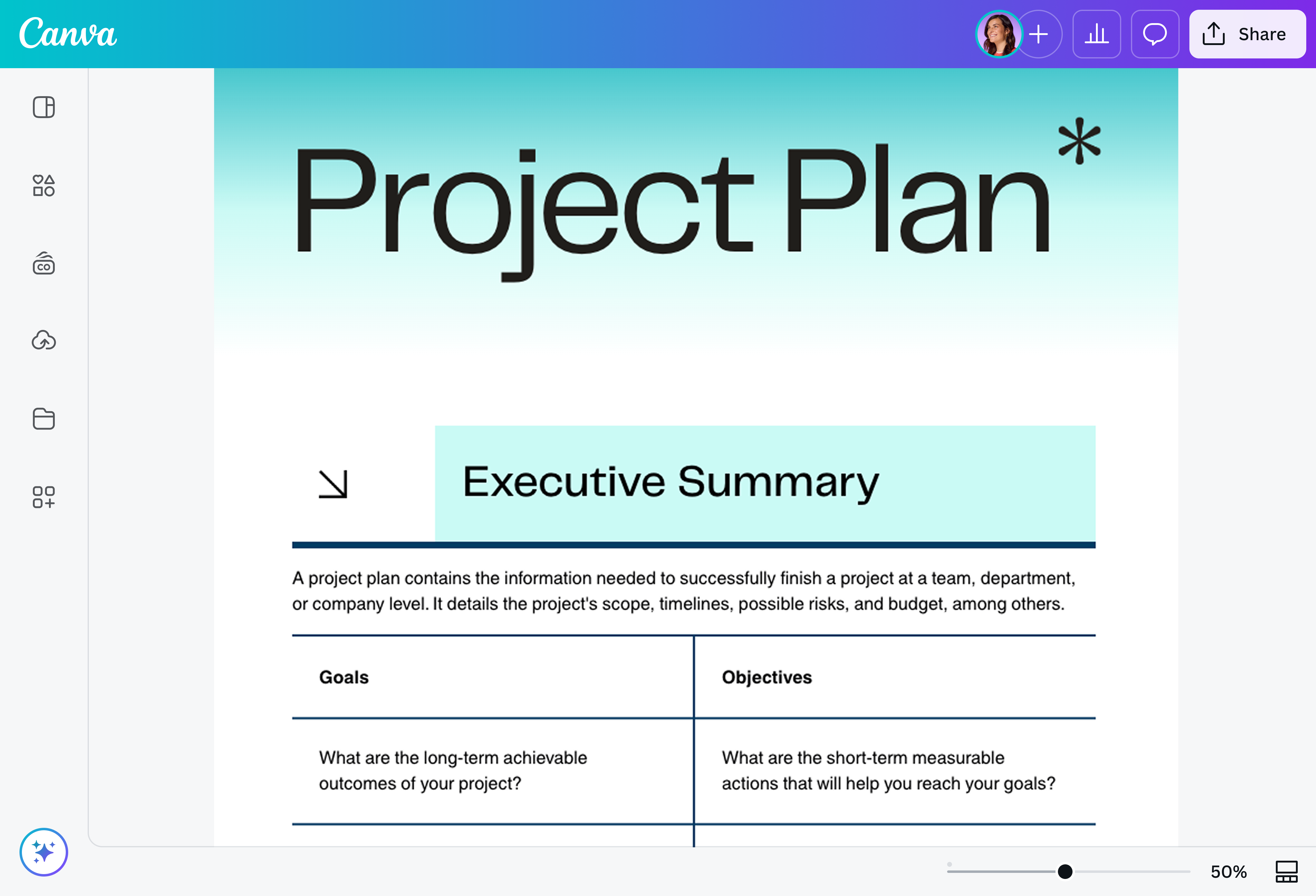
To create your content strategy, edit a safe and secure Canva Doc(opens in a new tab or window) or start a file from scratch. Share your visual document by inviting different people and teams through email or a quick link. With just a click, grant varying access controls(opens in a new tab or window) (view, comment, or edit) or change a team member’s role. Keep communication flowing by assigning tasks, tagging others, and leaving comments.

Refer to your enterprise’s primary objective. Raising brand awareness, boosting engagement, generating leads, and increasing sales revenue are some examples you can mention in your content strategy goals.
When identifying your goals, ask these questions:
- What are our short-term and long-term goals?
- Why do we need to invest in content?
- What do we want our content to achieve?
Do ample research to create your audience persona. Conduct a content audit and check if it aligns with your customer persona. Study the competition to learn how you can capture their market.
When building your audience persona, answer the questions:
- Who is our content for?
- Which of their problems are we addressing?
- Will we target multiple personas? If yes, how do we create content for each persona?
When conducting a content audit, make an inventory of your assets in the content management system (CMS), on social media, or both. Assess the quality, relevance, and performance of every piece of content posted. Find out:
- Which content formats, topics, and channels do our audiences like best and least?
- What are our strengths, weaknesses, and areas for improvement?
- Should we produce new content types or post on untapped channels?
When performing a competitive analysis, get ideas from your rivals’ existing campaigns and discover how they interact with their audiences. Explore areas where they fall short and pick up potential topics and themes that you can execute better.
Assess the following characteristics when surveying your competitive landscape:
- Your competitors’ products and services
- Your competitors’ strengths and weaknesses
- Overlaps between your target audiences
- Audience opinions
- Brand strategies used by your competitors
- Your competitors’ market share
- Your competitors’ current market position
Host a brainstorming meeting(opens in a new tab or window) to come up with content ideas and strategies, then refine and rank them. Make collaborations fun using real-time cursors, sticky notes, and timers on Canva Whiteboards(opens in a new tab or window).
During the brainstorming session, ask your attendees:
- Which medium (written, image, audio, and/or video) do we use for our content?
- Do we produce short-form and/or long-form content?
- Do we focus on discovery platforms (e.g., YouTube and Instagram) or relationship platforms (e.g., Twitch and Discord)?
Explore Canva’s media gallery for content inspiration, or drag and drop inspiring content saved on your device. From free assets to social media-friendly posts, common content marketing strategy examples include:
- Blog posts
- Case studies
- eBooks
- Influencer partnerships
- Infographics
- Interactive content
- Newsletters
- Photos
- Podcasts
- Templates
- User-generated content
- Videos
- White papers
Follow OMD Agency’s(opens in a new tab or window) lead and maximize Canva’s visual suite to produce high-quality marketing materials such as infographics, social media posts, newsletters, and thought leadership documents. If you’ve got a content design idea but can’t find the right peg, try Magic Design(opens in a new tab or window). Type in a prompt to generate a customized sample. You can even upload your own materials to stay on brand.
Decide on the best communication channels by reviewing your audience persona and top-performing posts.
Your content strategy must contain a guide to help marketing, sales, and other teams create consistent, high-quality, and reusable content. Remember to include the content design, brand kit, messaging, voice, tone, and style guide. When developing your guidelines, answer to following:
- How will we communicate with our audience persona?
- What value will our content provide to our target market?
- How do we make sure the content aligns with our goals and standards?
Incorporate editable Brand Templates(opens in a new tab or window) in your content strategy. Templates speed up the design process, allowing anyone, even those without design experience, to quickly produce on-brand content.
To devise a realistic and feasible process, map out how your teams will craft valuable, relevant, and consistent content while factoring in the needed resources—namely, budget, time, and people.
From writing and designing content to publishing and monitoring posts, assign roles and responsibilities for each step to improve accountability. Ask your team:
- How will we manage our content’s creation, publication, and distribution? Which teams are involved in the process?
- Do we have ample resources to produce, publish, and share content?
- How much time do we need to create quality content? How long are our turnaround times?
- When and how do we outsource content?
Decide when and how often you’ll publish content and how you’ll market it. Combine tried and tested approaches with novel, out-of-the-box strategies to engage your target market. Determine:
- Which channel is our audience persona most active on? What time are they active?
- Do we promote content on different platforms at various times?
- Should we collaborate with experts, influencers, or other websites to market our content?
- What value can we offer that’ll urge our audience to make the move?
- Although blogging(opens in a new tab or window) produces 67% more leads in a month than those without blogs, it pays to promote your brand’s latest blog post on social media. In fact, 89% of marketers use organic posts(opens in a new tab or window) to distribute their content. Paid ads and sponsored content can also amplify your reach.
Once everyone has given their input, confirm your content strategy is good to go by answering these questions:
- Does my strategy deliver content that my target audience will find valuable?
- Does my content address the current issues of my target audience?
- How can we consistently deliver our content over time?
Using your shareable Canva Doc, disseminate the information quickly so internal stakeholders can update their processes. Similarly, the content strategy will help your sales team develop a clear action plan to implement across target verticals.
Track and monitor your content to determine the strategy’s effectiveness. Use the appropriate KPIs based on your goal and gather data from other teams. For example, check if your sales dramatically increased after publishing blog posts on a new product or running a social media campaign focused on a particular service.
Regularly revise your content strategy. To cut down on prep time, make a copy of your existing document for the next meeting and save your new notes in it. Share the updated file with all the teams. Upload it to your integrated apps(opens in a new tab or window). Or present(opens in a new tab or window) it instantly—all without leaving Canva.
Get inspired with content strategy templates
Craft the right content marketing strategy, no matter which digital platform you post on or what blog type you produce. Use any of our professionally designed document examples to bring your content strategy to life. Complement your text with branded elements and rich visuals that get the message across. Update the Canva Doc simultaneously with team members from anywhere in the world and on any device.
Start building a content strategy by modifying these templates.


All you need in a content strategy maker
Go beyond the boring word processor. Create a content strategy using our free, intuitive online document creator equipped with amazing AI tools and collaborative features. Elevate your document with stunning graphics and branded content that you can easily drag, drop, and edit. Win stakeholders’ support with a compelling content strategy made on Canva Docs.

Great on any device
With responsive Docs, create, view, and edit your doc on any device. Perfect for when you're on the go.

Visual library for visual Docs
Seamlessly add visuals like graphs, tables, images, videos, graphics, and more, all available within your doc.

Manage all your content in one place
Design high-quality creative content for any format. Sort, share, and scale content with ease.

Scale your brand
Set brand guidelines across your organization. Limit fonts, colors, and content to keep designs on brand.

Visually supercharge your work
Elevate your business documents. Create Docs, Whiteboards, Presentations, Websites, Videos,Social Media posts, and more.

Work smarter with Magic Studio AI
All the power of AI, at your fingertips. Generate assets, copy drafts, and designs with AI-powered tools within Canva.

Power up with apps
Make your organization’s workflows more efficient with hundreds of apps and integrations, or customize your own.

Stay safe and in control
Keep your confidential content safe with built-in security measures, user and AI controls, and usage reporting features.
Content strategy best practices
Building an effective content strategy takes a lot of time and continuous effort. From changing audience needs to emerging technologies, many factors come into play that may affect the success of your ongoing strategic plan.
To increase the chances of having a successful content strategy, here are some best practices to follow:
Schedule regular content strategy reviews
It won’t be easy to gauge the results of your strategic plan overnight, so give it at least three to six months before running an analysis. That way, you stay competitive and have enough data to measure your content performance. Additionally, conducting annual market research to expand your audience is advisable.
Conduct keyword research
Regularly search for and identify relevant search terms related to your product or service, then find ways to incorporate them into your content. This marketing strategy creates opportunities to rank well in search engines for content that your target audience is looking for. This can potentially lead to higher conversion rates and organic traffic.
Build content pillars
Also called content buckets or content categories, content pillars are key themes and topics that your brand will regularly discuss. For blogs and websites, content pillars will help you develop connected posts or pages that’ll establish your authority. For social media, content pillars will help you form a consistent brand voice and online presence. Choose three to five core content pillars, then check to see if they’re broad enough to generate various engaging content.
Create content for different stages of the buyer journey
You want to be with your target market every step of the way, from initial awareness (Top-of-Funnel) to consideration (Middle-of-Funnel) to decision-making (Bottom-of-Funnel). Produce different forms of content that will pique their curiosity and hold their attention. Provide them with relevant content that solves their pain points. Develop content that persuades audiences to support your product or service.
Also, don’t be afraid to repurpose existing high-ranking content into different formats. Since it performed well, there’s a greater chance your target market will engage with it in other formats. For example, transform a successful blog post into an in-depth YouTube video. Promote it by developing shorter, digestible TikTok, Instagram, and LinkedIn clips.
Content strategy FAQs
An important buyer persona(opens in a new tab or window) trait for long-term content strategy is knowing their information consumption habits. This includes their preferred content types (such as videos, blog posts, or podcasts), where they access the information (from brand websites or social media), and how often they actively seek information related to your industry. Knowing these habits can determine how you create and distribute tailored content and keep them engaged over time.
Other important buyer persona traits to consider are their pain points and challenges, goals and aspirations, and decision-making process.
SEO content strategy is an approach focused on creating website content to rank higher on the search engine results page (SERP). It involves researching what keywords people are looking for and identifying search trends. With these insights, you can create valuable, relevant, and discoverable content for your website.
The three Cs of content strategy are curation, context, and conversion. Curation involves creating original content that’s relevant to your target market, while also knowing how to find and share valuable content from other sources. Context is about taking that content and packaging in a way that’s relevant to your brand and your audience’s wants and needs. Conversion means providing your customers with an easy way to contact you and avail of your product or services—and that means having clear, engaging calls to action in your content.
Was this page helpful?
Produce winning content through a well-planned strategy