- Inside AI Vision NYC: The questions that will define the AI era
Inside AI Vision NYC: The questions that will define the AI era
We took AI Vision global, and New York delivered. One night, eight sessions, and an unplanned theme that emerged from every single speaker: the teams that will lead in the AI era aren't the ones with the best tools. They're the ones asking better questions.
When we hosted the first AI Vision in Sydney last year, we had a feeling something special was about to happen – we just didn't know how big it would get. We knew that bringing builders, founders, academics and enterprise leaders into the same room to talk honestly about AI would spark something real, but the response blew us away: over a thousand people, incredible conversations, and enough momentum to take it global.
And if you’re thinking global, why not start in New York City?
The energy in the room last week matched the city perfectly: sharp, forward-leaning, and a little restless energy. We heard from technologists, investors, designers, and operators across every industry. And while we didn't plan for a theme to emerge, one did. Pretty much every person on stage (in their own way) said the same thing: AI isn't about productivity or efficiency. It's about helping you ask better questions.
Here's what that looked like across a night of genuinely honest conversation.
The real risk of AI is not thinking carefully enough
Dr. Sandra Peter from the University of Sydney opened the night without holding back. We're in what she calls a decade of disorientation – possibly the most disorienting of our careers, but also the most impactful.

The tension she laid out is one every organization is quietly facing. AI saves time and boosts productivity – the data is clear on that – but offloading thinking to AI also decreases brain activity, and research shows that effect persists after you stop using the tools. Senior talent gets amplified; junior talent risks being left behind. As one global creative agency head told her: his senior people were getting sharper, while his junior team was getting worse.
Her challenge to the room: figure out what should be imagined by humans and what should be delegated to machines. Make mistakes, admit them, and use this moment to fix things along the way.
Your AI product is working when people stop calling it an AI product
Why do some AI tools get embedded in daily work while others stall after the demo? The panel agreed: it's rarely the model. It's the design.
Jenny Wen from Anthropic put it plainly: usable AI lives beyond the demo. It's the thing people reach for every day because it makes them genuinely more capable. The real design challenge is showing people the right use cases at the right moment, meeting them where they are, not where you wish they were.

The panel landed on a theme that cuts across every industry: trust is the real barrier to adoption, not technology. People need to see how an AI tool is reaching its output, and without that transparency they simply won't engage with it, no matter how capable it is. On top of that, once they’ve engaged, the real measure of success isn't usage metrics but the moment people stop thinking of something as an AI product; it's just become how work gets done.
Don’t automate what you’re doing today – redesign it
Ashley Kramer from OpenAI was direct: getting from pilot to production is still genuinely hard, and most organizations are making it harder by automating broken processes instead of fixing them. ChatGPT has 900 million weekly active users, growing faster than any technology in history, but access isn't transformation.
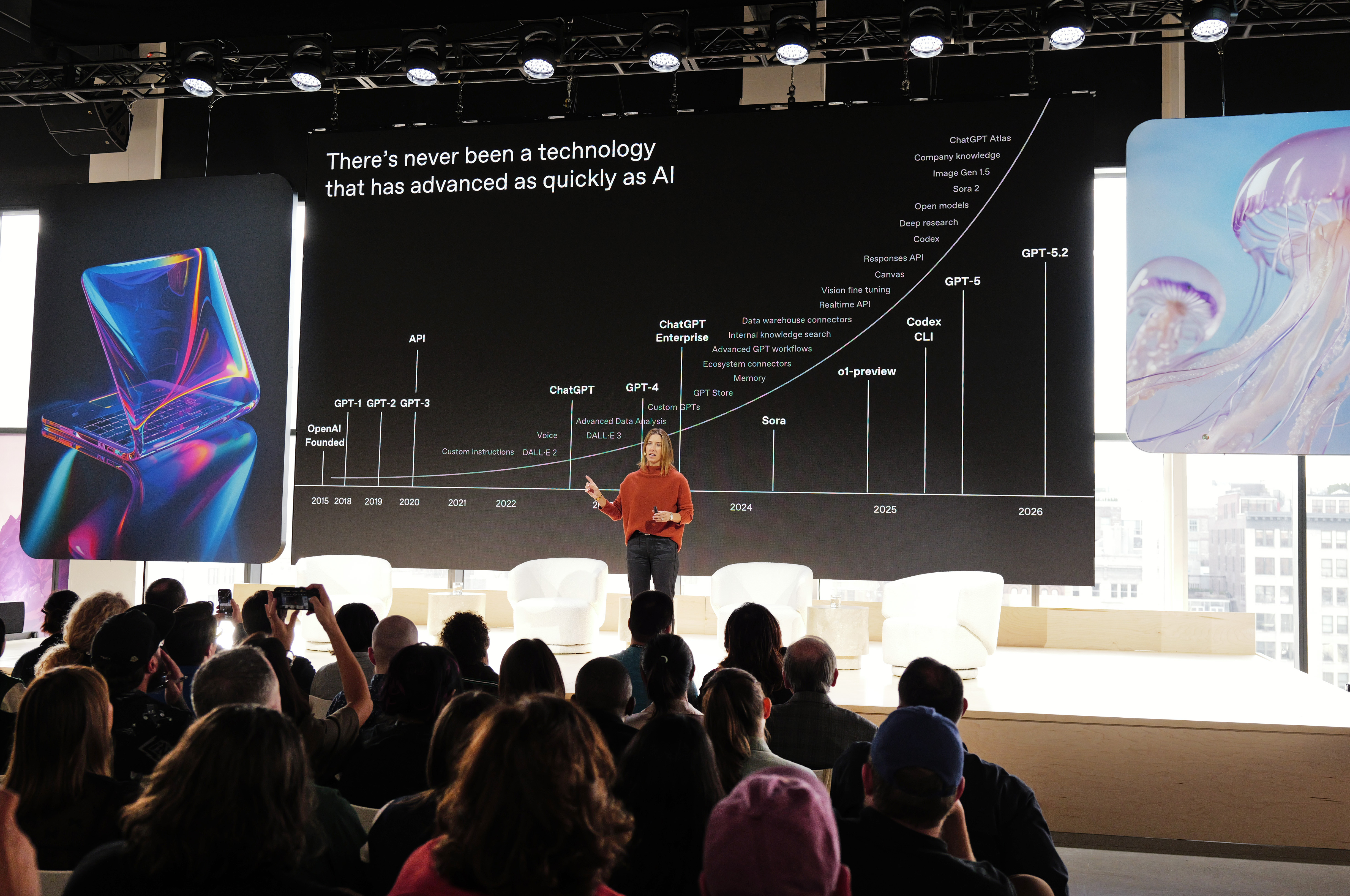
Her framework: people, process, product. Empower people from the bottom up, not just the top down. Redesign workflows rather than replicating them. Then reimagine the end-to-end experience. BBVA did this across 120,000 employees and now saves each person more than three hours a week. Datadog's AI code review agent caught 22% of errors humans missed. The common thread: they started small, measured what worked, and scaled deliberately.
Give your whole organization the keys, not just the tech team
One of the most practical conversations of the night centered on how organizations actually scale AI beyond the early adopters. The second-half panel – featuring Ash Ashutosh from Pinecone, Dr. Rong Yan from HeyGen, Lamees Butt from Riser, moderated by Stephanie Mehta from Fast Company and Inc. – cut through a lot of noise quickly.
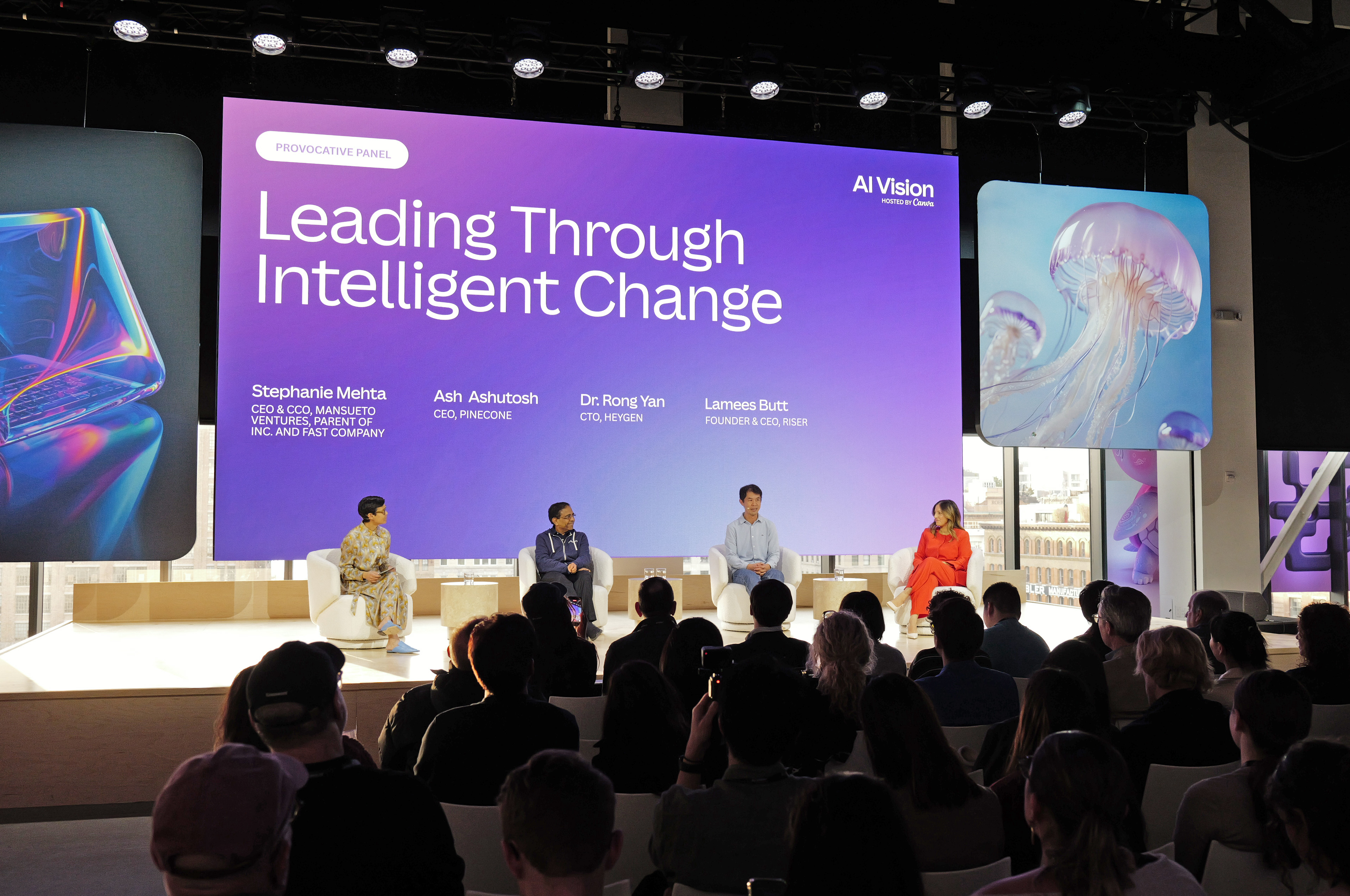
The panel's view was clear: the companies pulling ahead are the ones who've built a solid data foundation and then handed creative freedom to the people who understand their work best. At Pinecone, that looks like a finance team member building her own billing agent, designed around how she knows the job should actually run.
Rong reframed what good talent looks like in this environment too. The boundaries between engineering, product, and design are blurring, and what organisations need now are builders – people with the judgment and breadth to decide what ships, not just execute on someone else's brief.
Lamees pushed the framing even further: AI has made it cheaper than ever to build a business, and she thinks we're entering a new era of ownership, where the next generation of great companies comes from people who see a real problem and back themselves to solve it.
In the age of AI, the “what if” question is your most powerful tool
Alejandro Matamala Ortiz from Runway led with a reframe that struck a real chord. Eight years ago, his team asked one question: what if anyone in the world could become a filmmaker? It sounded naive. But that question – not the technology, not the product – turned out to be the most important thing they ever asked.

His point: every category-defining moment in history follows the same structure. Same tools, different question. Méliès used the same camera as the Lumiere brothers and invented narrative cinema. Fleming looked closer at the petri dish everyone else threw away. The trap he sees now is teams using the most powerful creative technology in history to make the same things, just faster. That's not the ceiling.
The teams that will win are the ones asking questions nobody else has thought to ask yet.
Once it works, it stops being AI – it’s just software
Benedict Evans closed the night by doing what he does best, fitting fifty years of tech history into fifteen minutes to ask where AI actually sits in the long arc of platform transitions. His read is that this is as significant a shift as the move from PCs to smartphones, with the big four tech platforms collectively spending over $650 billion on AI infrastructure this year alone. And yet for all that capital, most general-purpose models are, for practical purposes, commodities — impressive, expensive ones, but commodities nonetheless — and nobody has yet worked out where the real value will settle.

His best analogy: the automatic elevator. When Otis invented it, lift attendants were still a commonplace sight. Today, nobody steps into a lift and thinks about automation. It's just a lift. Once technology truly works, it disappears into the background. In ten years, that's probably what this looks like too.
His closing thought was characteristically grounding: a lot of what exists in generative AI right now won't work, and history tells us that's simply how platform shifts unfold. The internet in 1997 looked nothing like what it became. The job is to keep experimenting, keep building, and keep asking what the new thing is actually for.
The future belongs to the curious
Every conversation at AI Vision NYC pointed to the same place: the people shaping this era aren't waiting for certainty. They're building before the answers exist, and asking questions nobody thought to ask yet. That's the energy we want to keep bringing to AI Vision as we take it further around the world.
We'll see you at the next one.
Watch the sessions
Stay ahead with insights from the Canva Newsroom. Get the latest on visual communication, AI-powered workflows, and the ideas shaping how teams create and collaborate – straight to your inbox.
Sign up