- Employer Branding Strategy
Employer branding strategy: What it is and how to create one
Jump to:
What is an employer branding strategy?
Did you know that 92% of workers would consider changing jobs(opens in a new tab or window) for a company with a stellar reputation? This highlights the power of employer perception and the urgent need for organizations to actively manage their reputation as an employer. That’s where an employer branding strategy comes in.
The Chartered Institute of Personnel and Development defines an employer brand(opens in a new tab or window) as “a set of attributes and qualities, often intangible, that makes an organization distinctive, promises a particular kind of employment experience, and appeals to those people who will thrive and perform best in its culture”.
Put simply, an employer branding strategyis the deliberate, tactical management of an organization’s employer image. It answers the essential question, “Why should people choose to work and stay in your organization?”
Difference between branding and branding strategy
Branding refers to how people see and identify with your organization, product, or service. But in the context of human resources (HR) and recruitment, branding pertains to what people think and feel about your company as a workplace. It is usually shaped by your culture, values, employee stories, and lived experiences.
On the other hand, a branding strategy is the roadmap you create to intentionally influence and shape that employer reputation over time. Grounded in your business values and goals, this long-term plan is built through the stories you tell, the culture you build, and the way people experience your workplace day to day.
Why is employer branding important?
Organizations worldwide recognize the value of building an employer branding strategy. A report by The Conference Board reveals that 78% of companies invest in employer branding(opens in a new tab or window). Small organizations typically spend less than $500,000 annually, while larger enterprises are willing to allocate more than $1 million per year. Why? Because the returns go beyond recruitment.
The benefits of an employer branding plan include:
Attraction of top talent
A strong employer brand significantly increases your ability to attract high-quality candidates. In fact, many companies invest in employer branding specifically to attract top talent. A LinkedIn meta-study reinforces this finding, revealing that organizations with a great employer brand receive 50% more qualified applicants(opens in a new tab or window) on average.
Greater hiring efficiency and reduced recruitment costs
An effective employer brand makes it easier and faster to recruit. Companies with strong employer brands enjoy up to a 50% reduction in cost-per-hire(opens in a new tab or window) and hire new employees one to two times faster than those with weaker reputations. Because top talent actively seeks them out, these organizations also spend less on job ads and external recruitment agencies.
Improved employee retention and lower turnover
When employees feel a sense of belonging at your company, they tend to stay longer. This improved retention not only preserves team morale but also reduces the high costs associated with turnover. According to the Society for Human Resource Management, replacing an employee can cost an organization between six months to a full year of that employee’s salary(opens in a new tab or window)—or even more, depending on the role.
Higher quality of hires and better performance outcomes
Applicants who resonate with your mission and culture are more likely to become highly engaged employees. They tend to learn their role faster, adapt quickly, and deliver stronger results.
Stronger employee engagement and internal advocacy
When your employees feel valued, they’re more motivated to do their best work(opens in a new tab or window). Higher engagement often results in greater productivity, better customer service, and increased innovation. The best part? Engaged employees naturally become your brand ambassadors. They share positive experiences and recommend the company to others through word of mouth.
Enhanced corporate reputation and business impact
When an organization has a strong employer brand, it can elevate the company’s public image. This reputation often influences how internal and external stakeholders perceive the business. Multiple studies have shown that companies listed as great places to work tend to outperform peers in trust, loyalty, and even financial returns.
Key components of a strong employer branding strategy
A strong employer branding strategy consists of several interconnected elements brought together across departments such as HR, marketing, internal communications, and senior management. The result is an authentic, compelling, and consistent narrative about what it’s like to work at the organization.
Here are the elements typically included in an effective employer branding strategy:
The cornerstone of any employer brand, the employee value proposition or EVP, represents the unique set of benefits and opportunities that an organization offers to its employees. Answering the question “what makes it worthwhile for someone to work here?,” the EVP outlines both the tangible and intangible rewards they can expect. Tangible benefits might include wellness programs, retirement plans, or paid time off. Meanwhile, intangible benefits could be career development opportunities and healthy work-life balance.
Take Salesforce, for instance. With an EVP deeply rooted in the Ohana (family) culture, the company emphasizes collaboration, diversity, inclusion, personal growth, and well-being(opens in a new tab or window).
Acting as the connective tissue with the organization, internal comms(opens in a new tab or window) reinforces your EVP from the inside out. It’s responsible for translating your core values into tangible actions and everyday behaviors. Moreover, it builds trust and alignment by connecting leadership messaging to the lived experiences of employees. Internal comms also amplifies employee engagement through recognition, feedback, and two-way dialogue.
Beyond internal comms, your employer brand strategy comes to life through external storytelling. This involves consistently sharing authentic content that highlights your company culture, employee success stories, and how your organization cares for and invests in its people. In fact, job seekers trust employees three times more than the company itself to provide an accurate picture of workplace culture.
How do you make your messaging more relatable and credible? Feature employee-led content that is supported by a consistent brand style guide(opens in a new tab or window) and pre-approved templates.
It’s common for candidates to visit a company’s website and social media accounts to learn about a prospective employer. Channels such as your career page, social platforms, job postings, campus recruiting events, and PR activities can be used strategically to share your employer brand content and reinforce key messaging.
This covers the full journey, from recruitment to onboarding to day-to-day work to the exit process. When your EVP is consistently reflected across these stages and communication is respectful, it increases the likelihood of brand advocacy—even from candidates who weren’t hired or employees who have moved on.
Employer branding strategy examples
Employer branding strategies vary significantly by industry, company size, and workforce composition. Each sector faces its own talent challenges and must draw on unique strengths to attract and retain the right people.
The following real-life examples show how effective employer branding can be tailored to different organizational contexts—and why thoughtful positioning makes a difference.
In the tech and IT sector, many companies focus on innovation, learning, flexibility, and impact. Google builds their brand around these traits, offering employees an opportunity to work on cutting-edge projects in open, playful office spaces. Employee well-being is also a priority, reflected in perks like healthy meals, wellness facilities, and internal learning programs.
Google’s LinkedIn page(opens in a new tab or window) reinforces its culture and values through employee stories and “day in the life” videos, giving potential candidates an authentic glimpse into life at the company.
Starbucks
Starbucks refers to its employees as “partners”, which reflects the company’s emphasis on shared values and mutual respect. Beyond the title, the coffee chain offers meaningful benefits such as tuition reimbursement, free online college programs, and comprehensive health coverage that includes mental health support. These programs not only support employee well-being but also contribute to stronger engagement and retention, particularly in an industry known for a high turnover rate.
DocuSign
Recognized as a “Best Place to Work(opens in a new tab or window)”, DocuSign’s employer brand centers on trust, innovation, and empowerment. Its brand identity is consistently communicated across channels, and is supported by strong employee advocacy. Furthermore, the company is a champion of diversity and inclusion, and fosters an environment where all employees feel empowered to be their most authentic selves. All of this ultimately results in happier teams, better performance, and stronger employer branding.
Download The Visual Economy report
Explore how visual communication – boosted by AI and innovative technologies – is enhancing productivity, creativity, brand awareness, and employee culture.
- Learn why visual communication is a competitive edge
- See how teams use visuals to improve speed and clarity
- Explore the impact of visuals on brand perception and results
- Get practical insights from global marketing and comms leaders
How to develop an employer branding strategy
Developing an effective employer branding strategy requires a future-focused mindset, cross-functional collaboration, and a commitment to authenticity. Whether you’re starting from scratch or refining what’s already in place, it’s important to keep your employer brand genuine, intentional, and impactful at every step.
For most organizations, the first step in strengthening an employer branding strategy is to conduct internal and external perception audits.
Internally, this can be done through a mix of anonymous surveys, focus group discussions, and one-on-one interviews. Gauge your employees’ engagement, what they value about working there, and what issues they experience. In addition, find out whether they would recommend the company to friends as a place to work.
Externally, review your current brand assets and communication channels: company website, career pages, recruitment hubs, and social media accounts. Analyze competitor employer brands to identify critical talent needs and gaps. You can also assess how your organization is viewed on employer review sites such as Glassdoor, Indeed, and Vault.
Conducting a thorough brand perception audit can provide you with a reality check that anchors your employer branding strategy in facts rather than assumptions. Even better, the audit reveals alignment or misalignment with your EVP.
Brainstorm(opens in a new tab or window) with HR, marketing, leadership, and employee representatives to identify three to five key attributes that define your employment experience. These might include compensation, culture, development, or purpose. Your EVP should answer:
- Why should someone work here?
- What can they expect in return for their contributions?
Once you’ve defined or refined your EVP pillars, validate them with target talent segments, new hires, and current employees. Gather feedback by asking questions like:
- Does this EVP resonate with you?
- Does it describe our company accurately?
Define your target audiences and key messages. Build a multi-channel communication plan with various themes and formats that showcase your EVP. Develop a social media strategy for employer branding that neatly ties with your business goals.
Tell your story to the talent market through authentic, consistent, and impactful content. Develop creative assets that humanize your brand and make your organization a more compelling place to work, from behind-the-scenes visuals and “day-in-the-life” videos to engaging captions and thoughtfully written job postings.
Encourage employees to share their own experiences with the organization through organic social media posts or testimonials. Even simply sharing job openings with their networks can help amplify your reach. However, note that this step only works if your employees are genuinely happy or proud to work for the company.
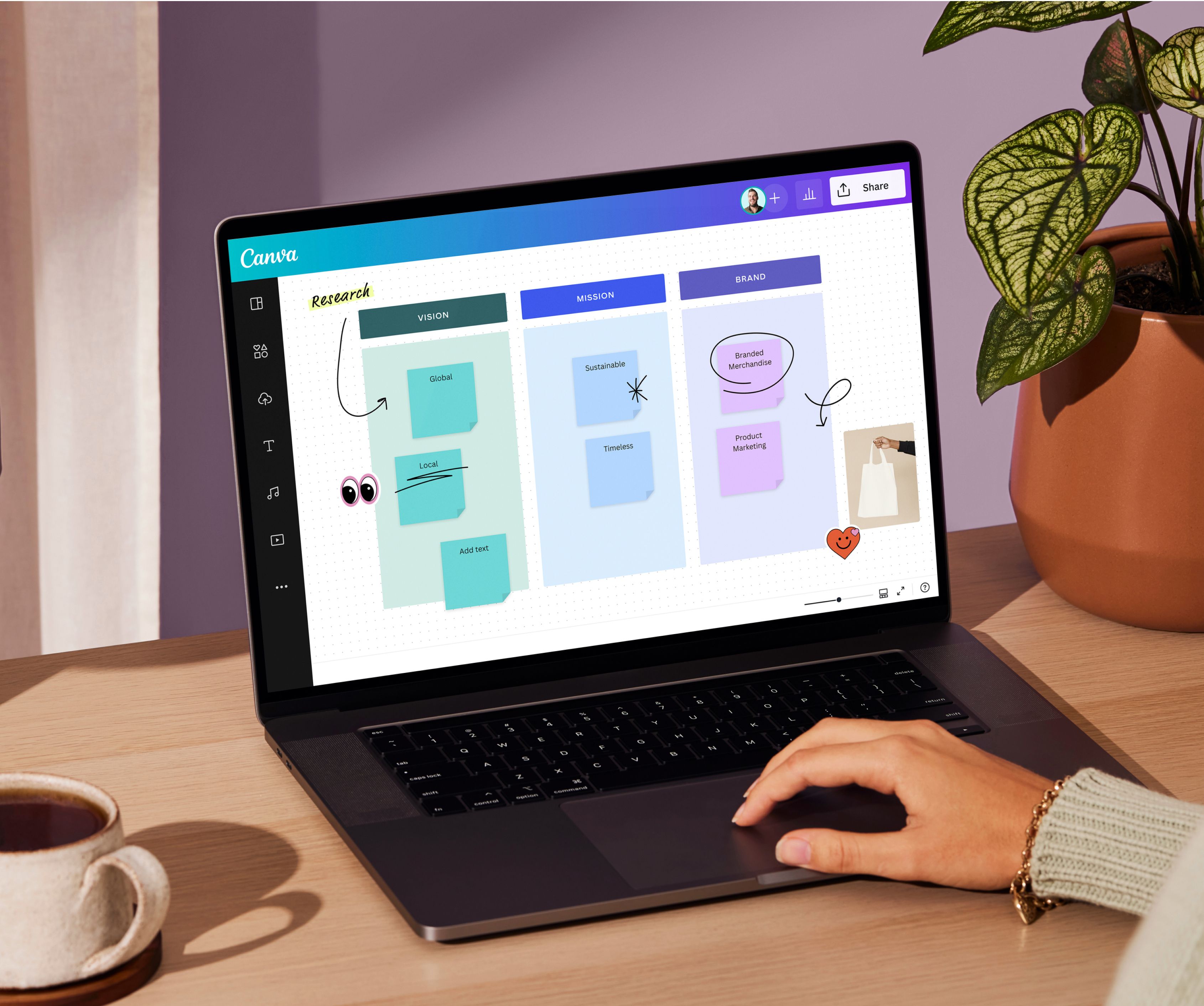
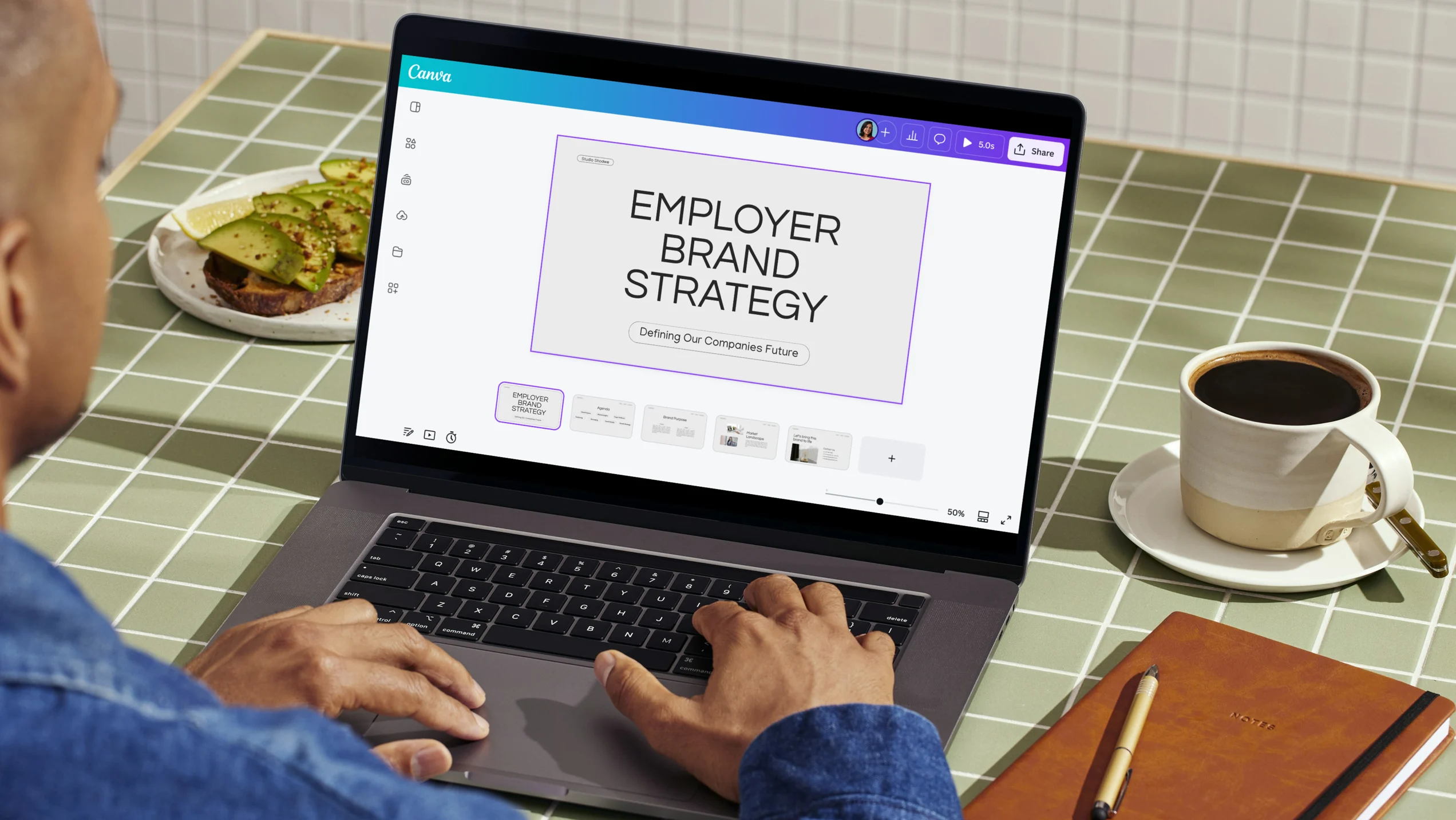
Online tools such as Canva Docs and Whiteboards(opens in a new tab or window) streamline the process of building on-brand engagement materials. Collaborate in real time with multiple teams to create employer branding assets including social media content calendars, hiring manager toolkits, and onboarding playbooks. Visual collaboration helps guarantee messaging consistency and accelerates alignment across HR, marketing(opens in a new tab or window), and internal comms departments.
FedEx utilized Canva Enterprise(opens in a new tab or window) to maintain brand consistency at scale(opens in a new tab or window). Their global teams managed to reduce brand review times by 77% and publish hundreds of branded designs in a month.
How to execute and optimize employer branding strategy
The work doesn’t stop when you’re done developing your employer branding strategy. The process moves to continuous execution, iteration, and long-term maintenance—helping sustain and improve your strategies while maintaining your relevance in a changing talent market.
- Optimize your employer branding plan by:
- Deploying your employer brand internally and externally across key channels
- Training internal stakeholders (e.g., hiring managers and recruiters) on how to communicate the brand effectively
- Monitoring performance through key performance indicators such as application rates, time-to-hire, employee engagement, and retention rates
- Gathering ongoing feedback from employees, candidates, and public platforms
- Refining your messaging or EVP over time based on new insights
- Aligning departments through regular check-ins and collaborative planning sessions
- Celebrating your milestones internally (by thanking employees) and externally (by posting announcements)
Tools and software to support your strategy
Various tools and software can be used hand in hand to fortify your employer branding strategy. The breakdown below shows the purpose, features, and use cases of the most common tools and software.
- Canva: Asset creation, brand consistency, and team collaboration (ex. EVP one-pagers, branded job posts, and campaign planning boards)
- LinkedIn: Employer branding, recruitment marketing, and employee advocacy (ex. targeted ads, company updates, and employee stories)
- Glassdoor/Indeed: Employer reputation monitoring and review response (ex. employee reviews and assessment of candidate perception)
- Sprout Social: Social media scheduling and analytics (ex. employer brand content calendar and engagement measurement)
- Culture Amp: Employee feedback and engagement tracking (ex. pulse surveys and internal brand alignment audits)
Employer branding strategy best practices
With a compelling EVP and an authentic culture, you’re off to a promising employer branding strategy. That foundation becomes even more effective when it’s brought to life through consistent storytelling, strong design, and intentional execution. Follow these best practices to build and sustain your own employer branding strategy.
Maintain authenticity and transparency
As an employer, it’s your responsibility to accurately reflect your culture. If your messaging promotes work-life balance but employees are regularly working overtime, that disconnect can quickly damage your credibility and deter future candidates.
Additionally, addressing issues head-on helps improve public perception. For example, proactively responding to negative reviews on employee review platforms shows that your organization is committed to change. A Glassdoor study(opens in a new tab or window) found that 62% of candidates reported an improved perception of a company when employers responded to reviews.
Promote inclusive and diverse storytelling
In recent years, Diversity, Equity, Inclusion (DEI) along with Environmental, Social, Governance (ESG) considerations have become core pillars of effective employer branding strategies. A strong DEI focus fosters an inclusive culture where all employees feel valued, respected, and given equitable opportunities to grow.
Younger talent, in particular, seek employers whose values align with their own and demonstrate a genuine commitment to positive social and environmental impact.
As a result, many companies now integrate DEI and ESG into their company narrative. For example, Unilever weaves sustainability and social responsibility(opens in a new tab or window) into its global employer branding messages. Meanwhile, Patagonia’s is deeply rooted in environmental activism and ethical business practices(opens in a new tab or window). This values-driven approach helps attract like-minded candidates who want their work to align with a greater purpose.
Use branded templates to ensure consistency
Reduce room for error by using enterprise-approved brand kits(opens in a new tab or window) and reusable templates when promoting your organization. Regardless of your company size, Canva offers customizable templates to help you build and optimize a consistent employer branding strategy.
Show what it’s truly like to work at your organization
Not just a “nice-to-have”, an employer branding strategy is now an essential part of shaping how your company is perceived. When introspection, communication, and integrity come together across teams, the result is a powerful employer brand that attracts high-quality, top-performing talent. Engaging and retaining these people drives lasting success—and that’s the goal of every organization.
Was this page helpful?
Visuals are your biggest business advantage