Customers who viewed this item also viewed
These promotions will be applied to this item:
Some promotions may be combined; others are not eligible to be combined with other offers. For details, please see the Terms & Conditions associated with these promotions.
Your Memberships & Subscriptions
Download the free Kindle app and start reading Kindle books instantly on your smartphone, tablet, or computer - no Kindle device required.
Read instantly on your browser with Kindle for Web.
Using your mobile phone camera - scan the code below and download the Kindle app.
Follow the authors
OK
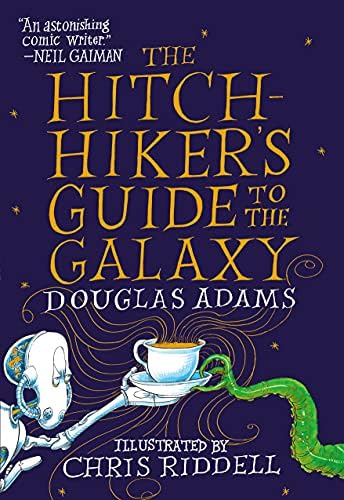
The Hitchhiker's Guide to the Galaxy: The Illustrated Edition Kindle Edition
Seconds before the Earth is demolished to make way for a galactic freeway, Arthur Dent is plucked off the planet by his friend Ford Prefect, a researcher for the revised edition of The Hitchhiker’s Guide to the Galaxy who, for the last fifteen years, has been posing as an out-of-work actor.
Together this dynamic pair begin a journey through space aided by quotes from The Hitchhiker’s Guide (“A towel is about the most massively useful thing an interstellar hitchhiker can have”) and a galaxy-full of fellow travelers: Zaphod Beeblebrox—the two-headed, three-armed ex-hippie and totally out-to-lunch president of the galaxy; Trillian, Zaphod’s girlfriend (formally Tricia McMillan), whom Arthur tried to pick up at a cocktail party once upon a time zone; Marvin, a paranoid, brilliant, and chronically depressed robot; Veet Voojagig, a former graduate student who is obsessed with the disappearance of all the ballpoint pens he bought over the years.
Where are these pens? Why are we born? Why do we die? Why do we spend so much time between wearing digital watches? For all the answers stick your thumb to the stars. And don't forget to bring a towel!
Praise for The Hitchhiker’s Guide to the Galaxy
“A whimsical oddyssey . . . Characters frolic through the galaxy with infectious joy.”—Publishers Weekly
“Irresistable!”—The Boston Globe
- Reading age11+ years, from customers
- LanguageEnglish
- PublisherDel Rey
- Publication dateDecember 18, 2007
- ISBN-109780307417138
- ISBN-13978-0307417138
Shop this series
See full series- Kindle Price:$27.97-By placing your order, you're purchasing a license to the content and you agree to the Kindle Store Terms of Use.
- Kindle Price:$57.94-By placing your order, you're purchasing a license to the content and you agree to the Kindle Store Terms of Use.
Shop this series
This option includes 3 books.
This option includes 5 books.
This option includes 6 books.
Why can't I get these titles?
Under regulatory requirements, teens need a parent or guardian to buy or borrow titles. Ask your parent or guardian to acquire these titles for this account from their device. These books will appear in your Kindle library once they do.
Customers who viewed this item also viewed
Customers also bought or read
- There Is No Antimemetics Division: A Novel#1 Best SellerCosmic & Eldritch Horror
Kindle Edition$13.99$13.99 - The Remains of the Day: Winner of the Nobel Prize in Literature (Vintage International)
Kindle Edition$12.99$12.99 - Dungeon Crawler Carl: Dungeon Crawler Carl Book 1#1 Best SellerContemporary Fantasy

Kindle Edition$4.99$4.99
Editorial Reviews
Amazon.com Review
Review
“Irresistible!”—The Boston Globe
“With droll wit, a keen eye for detail and heavy doses of insight . . . Adams makes us laugh until we cry.”—The San Diego Union-Tribune
“One of the greatest achievements in comedy. A work of staggering genius.”—David Walliams
“Really entertaining and fun.”—Michael Palin
“Fizzing with ideas . . . brilliant.”—Charlie Brooker
“Weird and wonderful.”—Eoin Colfer
“It changed my whole life. It’s literally out of this world.”—Tom Baker
From the Inside Flap
--The Boston Globe
Seconds before the Earth is demolished to make way for a galactic freeway, Arthur Dent is plucked off the planet by his friend Ford Prefect, a researcher for the revised edition of The Hitchhiker's Guide to the Galaxy who, for the last fifteen years, has been posing as an out-of-work actor.
Together this dynamic pair begin a journey through space aided by quotes from The Hitchhiker's Guide ("A towel is about the most massively useful thing an interstellar hitchhiker can have") and a galaxy-full of fellow travelers: Zaphod Beeblebrox--the two-headed, three-armed ex-hippie and totally out-to-lunch president of the galaxy; Trillian, Zaphod's girlfriend (formally Tricia McMillan), whom Arthur tried to pick up at a cocktail party once upon a time zone; Marvin, a paranoid, brilliant, and chronically depressed robot; Veet Voojagig, a former graduate student who is obsessed with the disappearance of all the ballpoint pens he bought over the years.
Where are these pens? Why are we born? Why do we die? Why do we spend so much time between wearing digital watches? For all the answers stick your thumb to the stars. And don't forget to bring a towel!
"[A] WHIMSICAL ODYSSEY...Characters frolic through the galaxy with infectious joy."
--Publishers Weekly
From the Back Cover
--The Boston Globe
Seconds before the Earth is demolished to make way for a galactic freeway, Arthur Dent is plucked off the planet by his friend Ford Prefect, a researcher for the revised edition of The Hitchhiker's Guide to the Galaxy who, for the last fifteen years, has been posing as an out-of-work actor.
Together this dynamic pair begin a journey through space aided by quotes from The Hitchhiker's Guide ("A towel is about the most massively useful thing an interstellar hitchhiker can have") and a galaxy-full of fellow travelers: Zaphod Beeblebrox--the two-headed, three-armed ex-hippie and totally out-to-lunch president of the galaxy; Trillian, Zaphod's girlfriend (formally Tricia McMillan), whom Arthur tried to pick up at a cocktail party once upon a time zone; Marvin, a paranoid, brilliant, and chronically depressed robot; Veet Voojagig, a former graduate student who is obsessed with the disappearance of all the ballpoint pens he bought over the years.
Where are these pens? Why are we born? Why do we die? Why do we spend so much time between wearing digital watches? For all the answers stick your thumb to the stars. And don't forget to bring a towel!
"[A] WHIMSICAL ODYSSEY...Characters frolic through the galaxy with infectious joy."
--Publishers Weekly
About the Author
Chris Riddell, the 2015–2017 UK Children’s Laureate, is an accomplished artist and the political cartoonist for the Observer. He has enjoyed great acclaim for his books for children. He has won a number of major prizes, including the 2001, 2004, and 2016 CILIP Kate Greenaway Medals. His book Goth Girl and the Ghost of a Mouse won the Costa Children’s Book Award 2014. Riddell has been honored with an OBE in recognition of his illustration and charity work. He lives in Brighton with his family.
Excerpt. © Reprinted by permission. All rights reserved.
The house stood on a slight rise just on the edge of the village. It stood on its own and looked out over a broad spread of West Country farmland. Not a remarkable house by any means—it was about thirty years old, squattish, squarish, made of brick, and had four windows set in the front of a size and proportion which more or less exactly failed to please the eye.
The only person for whom the house was in any way special was Arthur Dent, and that was only because it happened to be the one he lived in. He had lived in it for about three years, ever since he had moved out of London because it made him nervous and irritable. He was about thirty as well, tall, dark-haired and never quite at ease with himself. The thing that used to worry him most was the fact that people always used to ask him what he was looking so worried about. He worked in local radio which he always used to tell his friends was a lot more interesting than they probably thought. It was, too—most of his friends worked in advertising.
On Wednesday night it had rained very heavily, the lane was wet and muddy, but the Thursday morning sun was bright and clear as it shone on Arthur Dent’s house for what was to be the last time.
It hadn’t properly registered yet with Arthur that the council wanted to knock it down and build a bypass instead.
At eight o’clock on Thursday morning Arthur didn’t feel very good. He woke up blearily, got up, wandered blearily round his room, opened a window, saw a bulldozer, found his slippers, and stomped off to the bathroom to wash.
Toothpaste on the brush—so. Scrub.
Shaving mirror—pointing at the ceiling. He adjusted it. For a moment it reflected a second bulldozer through the bathroom window. Properly adjusted, it reflected Arthur Dent’s bristles. He shaved them off, washed, dried and stomped off to the kitchen to find something pleasant to put in his mouth.
Kettle, plug, fridge, milk, coffee. Yawn.
The word bulldozer wandered through his mind for a moment in search of something to connect with.
The bulldozer outside the kitchen window was quite a big one.
He stared at it.
'Yellow,' he thought, and stomped off back to his bedroom to get dressed.
Passing the bathroom he stopped to drink a large glass of water, and another. He began to suspect that he was hung over. Why was he hung over? Had he been drinking the night before? He supposed that he must have been. He caught a glint in the shaving mirror. “Yellow,” he thought, and stomped on to the bedroom.
He stood and thought. The pub, he thought. Oh dear, the pub. He vaguely remembered being angry, angry about something that seemed important. He’d been telling people about it, telling people about it at great length, he rather suspected: his clearest visual recollection was of glazed looks on other people’s faces. Something about a new bypass he’d just found out about. It had been in the pipeline for months only no one seemed to have known about it. Ridiculous. He took a swig of water. It would sort itself out, he’ d decided, no one wanted a bypass, the council didn’t have a leg to stand on. It would sort itself out.
God, what a terrible hangover it had earned him though. He looked at himself in the wardrobe mirror. He stuck out his tongue. 'Yellow,' he thought. The word yellow wandered through his mind in search of something to connect with.
Fifteen seconds later he was out of the house and lying in front of a big yellow bulldozer that was advancing up his garden path.
Mr. L. Prosser was, as they say, only human. In other words he was a carbon-based bipedal life form descended from an ape. More specifically he was forty, fat and shabby and worked for the local council. Curiously enough, though he didn’t know it, he was also a direct male-line descendant of Genghis Khan, though intervening generations and racial mixing had so juggled his genes that he had no discernible Mongoloid characteristics, and the only vestiges left in Mr. L. Prosser of his mighty ancestry were a pronounced stoutness about the tum and a predilection for little fur hats.
He was by no means a great warrior; in fact he was a nervous, worried man. Today he was particularly nervous and worried because something had gone seriously wrong with his job, which was to see that Arthur Dent’s house got cleared out of the way before the day was out.
“Come off it, Mr. Dent,” he said, “you can’t win, you know. You can’t lie in front of the bulldozer indefinitely.” He tried to make his eyes blaze fiercely but they just wouldn’t do it.
Arthur lay in the mud and squelched at him.
“I’m game,” he said, “we’ll see who rusts first.”
“I’m afraid you’re going to have to accept it,” said Mr. Prosser, gripping his fur hat and rolling it round the top of his head; “this bypass has got to be built and it’s going to be built!”
“First I’ve heard of it,” said Arthur, “why’s it got to be built?”
Mr. Prosser shook his finger at him for a bit, then stopped and put it away again.
“What do you mean, why’s it got to be built?” he said. “It’s a bypass. You’ve got to build bypasses.”
Bypasses are devices that allow some people to dash from point A to point B very fast while other people dash from point B to point A very fast. People living at point C, being a point directly in between, are often given to wonder what’s so great about point A that so many people from point B are so keen to get there, and what’s so great about point B that so many people from point A are so keen to get there. They often wish that people would just once and for all work out where the hell they wanted to be.
Mr. Prosser wanted to be at point D. Point D wasn’t anywhere in particular, it was just any convenient point a very long way from points A, B and C. He would have a nice little cottage at point D, with axes over the door, and spend a pleasant amount of time at point E, which would be the nearest pub to point D. His wife of course wanted climbing roses, but he wanted axes. He didn’t know why—he just liked axes. He flushed hotly under the derisive grins of the bulldozer drivers.
He shifted his weight from foot to foot, but it was equally uncomfortable on each. Obviously somebody had been appallingly incompetent and he hoped to God it wasn’t him.
Mr. Prosser said, “You were quite entitled to make any suggestions or protests at the appropriate time, you know.”
“Appropriate time?” hooted Arthur. “Appropriate time? The first I knew about it was when a workman arrived at my home yesterday. I asked him if he’d come to clean the windows and he said no, he’d come to demolish the house. He didn’t tell me straight away of course. Oh no. First he wiped a couple of windows and charged me a fiver. Then he told me.”
“But Mr. Dent, the plans have been available in the local planning office for the last nine months.”
“Oh yes, well, as soon as I heard I went straight round to see them, yesterday afternoon. You hadn’t exactly gone out of your way to call attention to them, had you? I mean, like actually telling anybody or anything.”
“But the plans were on display . . .”
“On display? I eventually had to go down to the cellar to find them.”
“That’s the display department.”
“With a flashlight.”
“Ah, well, the lights had probably gone.”
“So had the stairs.”
“But look, you found the notice, didn’t you?”
“Yes,” said Arthur, “yes I did. It was on display in the bottom of a locked filing cabinet stuck in a disused lavatory with a sign on the door saying ‘Beware of the Leopard.’”
A cloud passed overhead. It cast a shadow over Arthur Dent as he lay propped up on his elbow in the cold mud. It cast a shadow over Arthur Dent’s house. Mr. Prosser frowned at it.
“It’s not as if it’ s a particularly nice house,” he said.
“I’m sorry, but I happen to like it.”
“You’ ll like the bypass.”
“Oh, shut up,” said Arthur Dent. “Shut up and go away, and take your bloody bypass with you. You haven’t got a leg to stand on and you know it.”
Mr. Prosser’s mouth opened and closed a couple of times while his mind was for a moment filled with inexplicable but terribly attractive visions of Arthur Dent’ s house being consumed with fire and Arthur himself running screaming from the blazing ruin with at least three hefty spears protruding from his back. Mr. Prosser was often bothered with visions like these and they made him feel very nervous. He stuttered for a moment and then pulled himself together.
“Mr. Dent,” he said.
“Hello? Yes?” said Arthur.
“Some factual information for you. Have you any idea how much damage that bulldozer would suffer if I just let it roll straight over you?”
Product details
- ASIN : B000XUBC2C
- Publisher : Del Rey
- Accessibility : Learn more
- Publication date : December 18, 2007
- Edition : Reissue
- Language : English
- File size : 46.3 MB
- Screen Reader : Supported
- Enhanced typesetting : Enabled
- X-Ray : Enabled
- Word Wise : Enabled
- Print length : 208 pages
- ISBN-10 : 9780307417138
- ISBN-13 : 978-0307417138
- Page Flip : Enabled
- Book 1 of 6 : Hitchhiker's Guide to the Galaxy
- Reading age : 11+ years, from customers
- Best Sellers Rank: #16,373 in Kindle Store (See Top 100 in Kindle Store)
- #34 in Time Travel Science Fiction (Kindle Store)
- #37 in Science Fiction Adventures
- #74 in General Humorous Fiction
- Customer Reviews:
About the authors

Douglas Adams (1952-2001) was the much-loved author of the Hitchhiker’s Guides, all of which have sold more than 15 million copies worldwide.

Discover more of the author’s books, see similar authors, read book recommendations and more.
Related products with free delivery on eligible orders
Customer reviews
Customer Reviews, including Product Star Ratings help customers to learn more about the product and decide whether it is the right product for them.
To calculate the overall star rating and percentage breakdown by star, we don’t use a simple average. Instead, our system considers things like how recent a review is and if the reviewer bought the item on Amazon. It also analyzed reviews to verify trustworthiness.
Learn more how customers reviews work on AmazonCustomers say
Generated from the text of customer reviewsSelect to learn more
Reviews with images
Great read for anyone
Top reviews from the United States
There was a problem filtering reviews. Please reload the page.
- Reviewed in the United States on May 5, 2017Format: Mass Market PaperbackVerified PurchaseDouglas Adams’ bestselling book The Hitchhiker’s Guide to the Galaxy published in 1979 is witty, occasionally complex, and accessible to the average reader. The protagonist, Arthur Dent, is a befuddled Englishman and his friend, Ford Prefect, is a hitchhiking alien doing research for the latest edition of The Hitchhiker’s Guide to the Galaxy. The two narrowly escape destruction with the rest of planet Earth when Ford catches wind of its impending demolition by intergalactic civil servants and beams them to the nearest accessible spaceship--the Vogon demolition fleet’s mothership. Inside, they encounter murdered mattresses, ruthless bureaucrats, and torture by poetry. They are soon ejected into space and twenty-nine seconds later (one second short of death), the president of the universe and his girlfriend rescue them in their recently stolen state-of-the-art spaceship, The Heart of Gold. In the remaining pages, Adams prioritizes unpacking the absurdity of bureaucracy, politics, and religion over a strong plot and whimsically manipulates grammar and rhetoric to inspire in the reader a sense of his disregard for the possibility of any sense or meaning to life.
Entries peppered throughout the book from the “real” The Hitchhiker’s Guide inform the reader of non-essential historical, cultural, and always humorous tidbits about the universe and its inhabitants. For example, the popular drink the Pan Galactic Gargle Blaster makes the drinker feel like their brain is being “smashed out by a slice of lemon wrapped round a large gold brick” (Ch 2). Ford hopes to update the electronic guide with how one can see the wonders of the universe for 30 Altarian dollars a day, but due to being stuck on Earth for 15 years his signature contribution remains his description of Earth as “mostly harmless”. Arthur Dent is more the butt of every joke than the hero of the story and simply plays the role of baffled human encountering the unknown. The president, Zaphod Beeblebrox, who happens to be Ford’s cousin, has two heads, three arms, and the ego of a true politician. He steals almost everyone’s thunder, but that’s probably because, while only six people know it, he’s succeeding phenomenally at his presidential mandate of distracting everyone’s attention away from power instead of wielding it. Zaphod is accompanied by his human girlfriend, Trillian, who acts as the token female character in the typically male-dominated sci-fi tale. Smart and sexy, she is mostly disregarded by her boyfriend while dutifully following him into every folly. Marvin is a pet robot of sorts with a serious depression problem which proves to have tremendous utility.
On account of the Heart of Gold’s Infinite Improbability Drive, the serendipitous crew encounters and escapes from a series of unthinkable situations, the most notable being the discovery of the fabled planet of Magrathea. Believed to now be dead, it supposedly designed and constructed luxury planets at the behest of ultra-wealthy clients until closing up shop with the collapse of the intergalactic economy some ten million years ago. At this point in the book a loosely coherent plot begins to emerge. After narrowly evading the planet’s automatic defense missiles, the crew land the Heart of Gold on the surface and Zaphod leads the bunch on a hunt for the unfathomable riches he is certain must be hidden there... somewhere. Instead, he comes to a shocking realization about the key to his wildly successful career of misconduct, Arthur learns of the mysterious nature and fate of his late beloved Earth, Trillian loses her two pet mice, and Marvin unwittingly saves everyone’s lives just by being himself.
Adams playfully goads the reader closer and closer into agreeing that “The Universe is almost certainly being run by a bunch of maniacs” (Ch 31) by poking fun at bureaucracy and politics with amusing analogies. Much like the local bureaucrat trying to tear down Arthur’s house, the Vogons respond to Earthlings’ protests before imminent destruction by stating, “All the planning charts and demolition orders have been displayed in your local planning department in Alpha Centauri for fifty of your Earth years” (Ch 3). Zaphod Beeblebrox is the posterchild for theatrical two-faced politics. His wild antics make him the most successful president in history and he possesses two heads, and therefore two faces, one of which is more popular than the other (Ch 4).
Adams then picks apart religion and philosophy without being overtly insulting due to his use of their very own arguments. A small but exceedingly sophisticated fish proves God’s existence and is therefore the final and clinching proof of his nonexistence. God “promptly vanishes in a puff of logic” because “without faith I am nothing” (Ch 6). Philosophers protest the creation of a supercomputer they fear will put them out of a job if it is able to answer the questions of the Universe, thus they demand the “total absence of solid facts” (Ch 25). Adams’ deft criticism of these topics threatens to elicit not much more than a self-deprecating chuckle from the very people he is poking fun at.
Absurd similes and outrageous statements infuse the writing style with charming humor while occasionally reminding the reader that reality can in fact be quite ridiculous. “For a few seconds Ford seemed to ignore him, and stared fixedly into the sky like a rabbit trying to get run over by a car” (Ch 1), and, “The ships hung in the sky much the same way that bricks don’t” (Ch 3), are clearly very foolish things to say, yet confer upon the reader a precise picture of the given situation that Adams wants them to have. In a similar vein, a police ship commits suicide after hearing Marvin’s depressing view of the universe (Ch 34), letters of the alphabet can be “friendly” (Ch 1) or “unfriendly” (Ch 34), and the answer to life, the universe and everything is simply the number “42” (Ch 27). Adams makes clear to the reader exactly how seriously he takes his subject matter.
Poking fun at politics and religion and making ludicrous statements are the more obvious of Adams’ tactics to discourage the reader from taking life, or really anything, very seriously. Less obvious, but equally effective, is his manipulation of grammar and rhetoric. By rendering the familiar structure of language malleable in his expert hands, he reminds the reader at every turn that all is not as it seems. He breaks commonly accepted rules of writing by blatantly using redundant vocabulary and pairing oxymoronic words. Arthur wakes up blearily then gets up and wanders blearily around his room (Ch 1), Ford Prefect is not conspicuously tall and his features are striking but not conspicuously handsome (Ch 1), and Zaphod rides a thoroughly ridiculous form of transport, but a thoroughly beautiful one (Ch 4). The windows on Arthur’s soon to be destroyed home are “of a size and proportion which more or less exactly failed to please the eye” (Ch 1), and there is something “very slightly odd” about Ford Prefect (Ch 1). With these deviances from the norm and by slipping in a clever grammar joke here and there, “...to boldly split infinitives that no man had split before” (Ch 15), Adams taunts the grammar police and then scoffs when their powerlessness and lack of creativity are exposed. By deftly rendering malleable the familiar institution of language, Adams bring home his deeper message that societal constructs are the mere product of a human desire to invent order out of chaos.
While Adams can boast a nimble sense of humor and a clever mind, obvious plot holes emerge as the story progresses. For example, the Vogons dump Arthur and Ford millions of lightyears away from Earth but then Trillian and Zaphod pick them up in the same vector as Earth. This could be due to the fact that Adams was a legendary procrastinator who would often leave manuscripts unfinished until the last minute. His biographer, M.J. Simpson, author of Hitchhiker: A Biography of Douglas Adams says that Adams also had problems following the traditional structure of a story. He shares that, “Adams was good at writing beginnings, middles, and endings, but when he got to the middle he’d thought of another good beginning and wanted to write that instead of the ending”. Adams’ habit of making things up as he went along is uncomfortably apparent to the reader who craves consistency and resolution, especially from a book some say holds a place in the sci-fi genre. Therefore, his book might more accurately fall under the category of comic science fiction.
While he falls short of producing the next great science fiction series of our time, Adams succeeds remarkably in demonstrating how a truly inquisitive mind works. He breaks the rules of fiction writing, but rather than being his downfall, these bold deviations add to his appeal. By weaving together intelligence, humor, and slapstick, he reaches a broad audience without sacrificing his unique voice and underlying message. So much so that the reader is left almost certain that “the chances of finding out what really is going on are so absurdly remote that the only thing to do is to say hang sense of it and just keep yourself occupied” (Ch 30).
- Reviewed in the United States on March 4, 2018Format: KindleVerified PurchaseThis is a very quick read and I think anyone who has a chance should check it out. The author is incredibly imaginative and I don't know that I've ever read anything quite like it. It was fun and campy and ridiculous all the while managing to make the reader think. For example:
"For instance, on the planet Earth, man had always assumed that he was more intelligent than dolphins because he had achieved so much-the wheel, New York, wars and so on-while all the dolphins had ever done was muck about in the water having a good time. But conversely, the dolphins had always believed they were far more intelligent than man-for precisely the same reasons."
I have to say, I'm with the dolphins on this one. Though this was my favorite quote I think the author snuck a few other thought provoking questions in there about the meaning of life, the possibility of higher powers, etc.
The book itself was entertaining and funny. I only gave it four stars because I didn't feel there was every really a plot at hand (we're hitchhikers discovering information about the galaxy I suppose) but this is a seriously minor complaint.
I'd recommend this to anyone who needs a quick pick me up kind of book. This is a good one to bust a reading slump or cleanse your palate so to speak.
- Reviewed in the United States on May 10, 2017Format: KindleVerified Purchase“But the story of this terrible, stupid Thursday, the story of its extraordinary consequences, and the story of how these consequences are inextricably intertwined with this remarkable book begins very simply. It begins with a house.” The Hitchhikers Guide to the Galaxy by Douglas Adams is the first in it’s series, also made into a movie. The sheer weirdness of this book is unexplainable for one to understand without reading it. It plays with the kind of humor where everything is so random that your mind feels it is comical. Also, this book is truly not the Hitchhikers Guide to the Galaxy itself, but rather, as it explains in the exposition, a book about the Hitchhikers Guide to the Galaxy and those who are using it.
The story, at first, seems normal as a narrator tells us about a man getting his house knocked down. The reality slowly fades, as random names and phrases that the narrator uses are seeming very un-Earth like. It is present day, or around this time, and first set in London, England. Soon after, the setting turns into a fantasy, yet not impossible, world of aliens around our galaxy that we never knew. It jumps into this turn fairly quickly, and persuades you to keep reading with the constant action and suspense. Then, there are the characters. “The thing that used to worry him most was the fact that people always used to ask him what he was looking so worried about.” Our main character; Arthur Dent. Arthur is the one real character in the story that can be related to or understood by us, the human people of Earth. A stubborn, normal, fed up human that is always confused or questioning things in all the madness of the plot. Ford Prefect, Zaphod Beeblebrox, Marvin-all know what is going on in this crazy world since they are a part of it. A women named Trilian brings a mother character to the book, being human aswell but always caring and responsible during the adventure. These main characters are the protagonists, and the entirety of their journey is the antagonist. They all seem to be in search for something, but each character doesn’t really understand what it is or how to find it.
In the beginning, all Arthur cares about is his house. Shortly after, his house and everything around it aren’t his biggest problem. His home planet of Earth went through a dramatic change, from full of life to non-existent. His best pal Ford, who was secretly not from Earth himself, decided to rescue Arthur from his death. This spirals to extreme coincidences and near death-experiences as they hitchhike their way through space. They later get picked up by the president of the Universe, Zaphod Beeblebrox, and his two helpers Trillian and Marvin. They are now searching for the legendary planet of Magrathea, which was told to have been creating planets as luxury items. The ship searches, and discovers, the hidden planet, but finding the true treasures are harder than they appear. The randomness of their adventures and the narrations throughout the novel show a genius way of connecting these facts and instances into one story that captivates the reader. The erratic events somehow create a normality. It brings the reader into the story, teaches and explains all the events and ideas, and gives flashbacks so all the facts come together into one plot.
While reading this, every chapter has something that would make me laugh or force me to press forward in the book. Adams achieved his goal, finally bringing us a children’s book for adults. When explaining this to someone, it sounds like you are reading a kindergarten’s story. But when actually reading it, the elements of description and hidden pieces of the story somehow make the overall book feel more mature and more deep. I loved the sudden and random way he would explain, almost over explain, all the details in the story. Though you could say he was droning on and on, the way he does this helps the story seem more clear through the insanity. I enjoyed the comical way that Adams used to describe who people are without even the character itself knowing about it. Mr. Prosser, the man trying to knock down Arthur’s house, was shown to us as this; “Curiously enough, though he didn’t know it, he was also a direct male-line descendant of Genghis Khan..” The story later tells that the stubby male called Mr. Prosser gets very vivid, but violent, war scenes in his memory every now and then. Adams later uses this to explain Mr. Prosser’s thoughts and feeling about what he does or how he lives. Interesting ways that Adams shows his characters are far from normal, but far from normal is perfect for me and I appreciated it immensely. My favorite thing about the characters was having Arthur as the main focus. Arthur is the rock, the glue, the sanity of the entire story. I related to him myself, and he keeps you in focus during the book. Though I was thrilled with these parts of the book, sadly not every story is perfect. Compared to the roaring events of the rest of the story, the ending just didn’t meet my expectations. There just wasn’t enough action in it like the rest of the story, but I could see how a tranquil ending would wrap up all the crazy events in the book.
Adams has a very unique style, and it would seem to work with young adults who find themselves not usually enjoying reading books. It has that childish setting and overall feel, but with mature ways of writing. A younger child may enjoy the fun setting but have trouble sticking to the plot, so a more young adult would suit it better. The Hitchhiker Guide to the Galaxy is a comical, interesting book that would be great for anyone who likes science fiction or fantasies.
Top reviews from other countries
Giovanna CaivanoReviewed in Brazil on September 21, 20225.0 out of 5 stars Just couldn't stop reading it
Format: KindleVerified PurchaseI knew it was a classic and people loved it but I never felt the urge to read it. It stayed in my wishlist for years until I got bored of the types of books I was reading and wanted some fiction. I got the sample and had to buy it because I couldn't stop reading. Great book! Really sparkles our imagination!
-
Zain AlmawlaReviewed in Sweden on December 28, 20254.0 out of 5 stars Good book
Bra bok
JunzReviewed in Singapore on October 29, 20255.0 out of 5 stars Good item
Lovely item. Tq AmazonSG
Amazon CustomerReviewed in Japan on October 26, 20235.0 out of 5 stars great read
Format: KindleVerified PurchaseA masterpiece in deed. This book had me laughing by myself through every single page. The humor, the characters and all the events that happen around them keeps you engage in a universe fill with absurdity. The same kind of two absurdity one finds in our own home-planet.
fermionReviewed in France on April 17, 20245.0 out of 5 stars Makes one feel happy
It’s really clever and the funny bits appear quite out of nowhere even when we know this book has got plenty. It’s humble in a special way even when being so well put together. One small discomfort was me waiting for a plot to appear (which is not mandatory for a book of this coolness level), but it does appear and the absurdity still makes sense in a way. Looking forward to relishing the next book in the series and most probably the rest!