Showing posts with label asim. Show all posts

Tuesday, November 15, 2011

We have a cure to death right here

Image

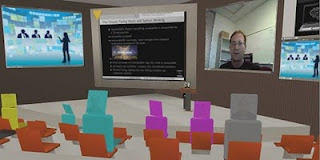
Ken Hayworth gave an interactive online talk and Q/A in teleXLR8 on How to create a Connectome Observatory of the mouse brain and beyond, on November 13 2011. See the complete report A Connectome Observatory for nanoscale brain imaging on KurzweilAI.

New technologies now permit imaging brain tissue at resolutions approaching 5x5x5nm. voxel size, down to the protein level. “This is more than sufficient resolution to determine all the connectivity and the properties of the synapses that are needed to explain the functionality of the brain circuits,” Ken said.

“In 100 years, if we have the technology to bring someone back, it won’t be in a biological body,” Ken said in a New York Times article last year. “It is these scanning techniques and mind-uploading that, I think, will bring people back. This is a taboo topic in the scientific community. But we have a cure to death right here. Why aren’t we pursuing it?”

In the Q&A, participants compared connectome preservation via the chemical brain preservation techniques proposed by Ken’s Brain Preservation Foundation to cryonics. See the full video of the talk and Q/A below.


Last year I wrote a post on Chemical brain preservation: cryonics for uploaders, also republished by the Cryonics Institute. Excerpt:

This resolution is sufficient to image the smallest brain structures which, according to current scientific knowledge, are the physical substrate of our thoughts, memories, feelings, emotional responses, hopes, dreams and identity. It is important to stress that this can be done with current technology... the information in a chemically preserved brain can be retrieved and run on a different substrate ("mind uploading"). This makes chemical brain preservation a storage technique optimized for future nanoscale scanning, and an ideal form of "cryonics for uploaders". For those who accept scanning the brain and running the information in the scan file on a different substrate as a valid form of identity preservation, chemical brain preservation seems clearly superior to cryopreservation.

After listening to Ken's talk, I am persuaded that the required brain imaging resolution can be achieved NOW with existing technology (and can only improve). So we just need to build operational pipelines for preparation, readout and storage and medical research facilities (and regulations or better absence thereof) able to preserve brains with sufficient accuracy for future readout and personality retrieval.

Ken prefers to discuss brain preservation technology as a scientific research topic instead of speculating on future availability for human patients (see his article on the Alcor Cryonics magazine and Mike Perry's reply). But in response to questions by Mike Perry and myself he said “If there was really a concerted effort to develop brain preservation technology, it would be easy to have highly reliable hospital brain preservation procedures ready to go in any hospital before the end of the decade. It is all a matter of will.”

It is difficult to escape the conclusion that we have a cure to death right here.

Sunday, October 17, 2010

teleXLR8 on Hypergrid Business as "online TED", Teleplace talk on BCI

The teleXLR8 project has been covered by Hypergrid Business, one of the best online magazines focused on professional applications of virtual reality, "as an online open TED, using modern telepresence technology for ideas worth spreading, and as a next generation, fully interactive TV network with a participative audience."

The Hypergrid Business article has the first public indications of the monthly membership fee for teleXLR8: $15, or $10 if paid annually. See this administrative note for more details.

Image

I am organizing the TransVision 2010 conference in good old brickspace, and unfortunately many people will not be able to come for the usual reasons: money and time. Of course, the conference will be open to remote participants and speakers via teleXLR8. I am persuaded that, with Teleplace, telepresence technology has achieved critical performance, usability and immersion for online-only conferences, and I believe more and more conferences will move online.

Later today (or tomorrow morning depending on where you are: Sunday October 17, 2010, at 10am PST, 1pm EST, 6pm UK, 7pm CET) Max Hodak will give a talk in Teleplace on Brain-machine interfacing: current work and future directions. In the picture above, Max lectures in Teleplace. UPDATE: This was a great talk. About 30 participants attended the talk and contributed to the discussion with very interesting questions and comments. For those who could not attend we have recorded everything (talk, Q/A and discussion) on video.

Brain-Machine Interfacing (BMI), or Brain-Computer Interfacing (BCI) is one of the emerging technologies which will start having a very big impact in the next decade of the 10s. From the abstract of Max' talk: "Fluid, two-way brain-machine interfacing represents one of the greatest challenges of modern bioengineering. It offers the potential to restore movement and speech to the locked-in, and ultimately allow us as humans to expand far beyond the biological limits we’re encased in now."

See also "teleXLR8 Project News - a telepresence community for cultural acceleration", our mini-manifesto Telepresence Education for a Smarter World on the IEET site and the interview MIND and MAN: Getting Mental with Giulio Prisco, by Natasha Vita-More, on H+ Magazine. Besides the existing Facebook Group and Linkedin Group, we have created a teleXLR8 mailing list on Google Groups. Please feel free to join the mailing list to discuss the project.

Sunday, September 19, 2010

VIDEO: Martine Rothblatt on Reconstructing Minds from Software Mindfiles, Teleplace, September 18

Martine Rothblatt gave an ASIM Expert Series talk in Teleplace on “Reconstructing Minds from Software Mindfiles” on Saturday September 18, 2010.

Image

Some questions and comments from the audience have been of a philosophical nature and related to preservation of self (whatever that is), but most of those who attended the talk were already prepared to accept that, depending on the amount of information stored and the accuracy of the reconstruction process, the upload copy may be (and feel like) a valid continuation of the original self. The talk and the discussion have been more focused on actual technologies and technical issues: How to extract enough information? How to prove that the information extracted is enough? How to quantify a critical treshold? How to make sure that nothing really important is left behind? How to reconstruct a thinking and feeling mind from a database? Martine gave a detailed presentation of the preliminary implementation of software mindfiles in her twin projects CyBeRev and LifeNaut (similar, but kept separate mainly as a fail-safe measure) and their forthcoming mobile clients and integration with social networks.

Thanks Martine for the great talk and thanks to the (about 25) participants who contributed to the discussion with very interesting questions and comments. For those who could not attend we have recorded everything (talk, Q/A and discussion) on video. Here is a direct link to a video.

Friday, September 17, 2010

REMINDER - Martine Rothblatt on Reconstructing Minds from Software Mindfiles, Teleplace, September 18, 10am PST

REMINDER - Martine Rothblatt will give an ASIM Expert Series talk in Teleplace on “Reconstructing Minds from Software Mindfiles” on Saturday September 18, 2010, at 10am PST (1pm EST, 6pm UK, 7pm CET). Those who already have Teleplace accounts for teleXLR8 can just ahow up at the talk. There are a limited number of seats available for others, please contact me if you wish to attend. You can also join the Facebook page for the event.

Image

Abstract: “I do think, however, there is a (natural) tendency to way overestimate the importance of copying our brain structure to copying our minds. I think our minds will be uploadable in good enough shape to satisfy most everyone by reconstructing them from information stored in software mindfiles such as diaries, videos, personality inventories, saved google voice conversations, chats, and chatbot conversations. The reconstruction process will be iteratively achieved with AI software designed for this purpose, dubbed mindware.“

I met Martine online earlier today to prepare the talk. She told me that, in previous presentations of software mindfiles, many questions and comments have been of a philosophical or metaphysical nature and related to preservation of self (whatever that is). But I told Martine that I believe most of those who will attend the talk tomorrow are already prepared to accept that, depending on the amount of information stored and the accuracy of the reconstruction process, the upload copy may be (and feel like) a valid continuation of the original self. I expect that the audience will prefer leaving philosophy aside and be more interested in actual technologies and technical issues: How to extract enough information? How to prove that the information extracted is enough? How to quantify a critical treshold? How to make sure that nothing really important is left behind? How to reconstruct a thinking and feeling mind from a database? See also ASIM Experts series: Reconstructing Minds from Software Mindfiles on carboncopies.org and the discussion in the article MIND and MAN: Getting Mental with Giulio Prisco on H+ Magazine. Watch also the short movie Bina48 Robot on YouTube (latest update of the video in the New York Times article).

Martine Rothblatt is an American lawyer, author, and entrepreneur. Rothblatt graduated from UCLA with a combined law and MBA degree in 1981, then began work in Washington, D.C., first in the field of communication satellite law, and eventually in life sciences projects like the Human Genome Project. She is currently the founder and CEO of United Therapeutics. In 2004, Rothblatt launched the Terasem Movement, a transhumanist school of thought focused on promoting joy, diversity, and the prospect of technological immortality via personal cyberconsciousness and geoethical nanotechnology. The purpose of the CyBeRev (cybernetic beingness revival) project of the Terasem Movement is to prevent death by preserving sufficient information about a person so that recovery remains possible by foreseeable technology.

Teleplace is one of the best 3D applications for telework, online meetings, group collaboration, and e-learning in a virtual 3D environment (v-learning). Those who already have Teleplace accounts for teleXLR8 can just ahow up at the talk. There are a limited number of seats available for others, please contact me if you wish to attend. You can also join the Facebook page for the event.

Monday, September 13, 2010

Martine Rothblatt on Reconstructing Minds from Software Mindfiles, Teleplace, September 18, 10am PST

Martine Rothblatt will give an ASIM Expert Series talk in Teleplace on “Reconstructing Minds from Software Mindfiles” on Saturday September 18, 2010, at 10am PST (1pm EST, 6pm UK, 7pm CET). Those who already have Teleplace accounts for teleXLR8 can just ahow up at the talk. There are a limited number of seats available for others, please contact me if you wish to attend. You can also join the Facebook page for the event.

Image

Abstract: “I do think, however, there is a (natural) tendency to way overestimate the importance of copying our brain structure to copying our minds. I think our minds will be uploadable in good enough shape to satisfy most everyone by reconstructing them from information stored in software mindfiles such as diaries, videos, personality inventories, saved google voice conversations, chats, and chatbot conversations. The reconstruction process will be iteratively achieved with AI software designed for this purpose, dubbed mindware.“

Martine Rothblatt is an American lawyer, author, and entrepreneur. Rothblatt graduated from UCLA with a combined law and MBA degree in 1981, then began work in Washington, D.C., first in the field of communication satellite law, and eventually in life sciences projects like the Human Genome Project. She is currently the founder and CEO of United Therapeutics. In 2004, Rothblatt launched the Terasem Movement, a transhumanist school of thought focused on promoting joy, diversity, and the prospect of technological immortality via personal cyberconsciousness and geoethical nanotechnology. The purpose of the CyBeRev (cybernetic beingness revival) project of the Terasem Movement is to prevent death by preserving sufficient information about a person so that recovery remains possible by foreseeable technology.

Teleplace is one of the best 3D applications for telework, online meetings, group collaboration, and e-learning in a virtual 3D environment (v-learning). Those who already have Teleplace accounts for teleXLR8 can just ahow up at the talk. There are a limited number of seats available for others, please contact me if you wish to attend. You can also join the Facebook page for the event.

H+ Magazine - MIND and MAN: Getting Mental with Giulio Prisco

H+ Magazine - MIND and MAN: Getting Mental with Giulio Prisco

Image

I have been interviewed by Natasha for H+ Magazine. See H+ Magazine - MIND and MAN: Getting Mental with Giulio Prisco. We talk about a bit of everything, telepresence, cyberspaces and metaverses, the transhumanist movement and the enabling role of telecom technology, life extension, mind uploading (oops sorry, substrate-independent minds), transcending biology and becoming substrate-independent minds, Randal and Suzanne's ASIM initiative (Advancing Substrate-Independent Minds, see carboncopies.org) including the online workshops and the recent mixed-reality ASIM 2010 Conference in San Francisco, moving from biological to robotic and virtual bodies, and the Teleplace -based teleXLR8 project, a “telepresence community for cultural acceleration” focused on science and technology education and outreach (with a transhumanist flavor). Perhaps we talk also of other things, the article is long.

Wednesday, August 18, 2010

ASIM 2010 Conference, Advancing Substrate-Independent Minds

Image

About 30 persons attended the ASIM 2010 Conference, Advancing Substrate-Independent Minds, satellite to the Singularity Summit 2010, San Francisco, August 16-17th. Besides the participants in San Francisco, about 25 remote participants attended online in Teleplace. The two main organizers Randal A. Koene and Suzanne Gildert appear in the image above (right screen).

The interactive live streaming of the ASIM 2010 Conference has been covered by KurzweilAI News (TOP STORY of today): Advancing Substrate-Independent Minds conference to be streamed live. I think this has been a really excellent mixed-reality event (see below).

Previously the subject of the conference had been described by KurzweilAI as: "What might brains and minds look like in the future? It can be difficult to manage and organize ideas from many highly specialized fields of expertise that must necessarily converge to answer this intriguing question. Not only must one consider the areas of brain imaging, neuroscience, and cognitive psychology, but also artificial intelligence, nanotechnology, biotechnology, computational hardware architectures, and philosophy.

In the past, the transferal of minds into computer-based systems has been rather vaguely referred to as “uploading.” However, those hoping to advance this multidisciplinary field of research prefer to use the term Advancing Substrate Independent Minds (ASIM), to emphasize a more scientific, and less science-fiction approach to creating emulations of human brains in non-biological substrates. The term ASIM captures the fact that there are several ways in which hardware and software may be used to run algorithms that mimic the human brain, and that there are many different approaches that can be used to realize this end goal. On May 22, 2010, carboncopies was born in an effort to unite the disparate areas of research contributing to ASIM...
"

Note: the term ASIM provides some plausible deniability to serious scientists, which is very useful. But I am not a serious scientist, and I think I will continue to use the good old term Mind Uploading. It is deliciously retro with a flavor of the wild, visionary, irresponsible and unPC transhumanism of the 90s. I am persuaded that future science and technology will permit achieving our wildest dreams, including mind uploading. In the meantime, the ASIM project will contribute to advancing step by step and developing enabling technologies.

The ASIM 2010 Conference featured 7 talks followed by lively discussions:

ASIM 2010 Conference, Advancing Substrate-Independent Minds, Day 1, with pictures and videos

Introduction to Advancing Substrate-Independent Minds, by Randal A. Koene
Computational complexity, by Suzanne Gildert
Advanced Tools – Synthetic biology, Nanotechnology, etc., by Mark Hamalainen
Preservation & large-scale high-resolution structural analysis, by Ken Hayworth (talk given via Teleplace)

ASIM 2010 Conference, Advancing Substrate-Independent Minds, Day 2, with pictures and videos

Fundamental Issues – Resolution & Scale, “Me” Programs, by Randal A. Koene
Actionable Approaches – ASIM Now, by Peter Passaro (talk given via Teleplace)
ASIM in Context – Ongoing Advances in neuroprosthetics, AGI, Cyber-augmentation, embodiment, VR, etc., by Monica Anderson

Remote participants in Teleplace were able to follow the talks via interactive video streaming, ask questions to the speakers, and contribute to the discussion. Two speakers (Peter Passaro on Day 2 and Ken Hayworth on Day 1) gave their talks via Teleplace. After attending both days of the conference remotely in Teleplace, I am very happy with the performance of the Teleplace system as a means to open up conferences to a global remote audience in “mixed reality”, with crisp video and audio (after properly setting up the microphones) and deep interactivity for all participants. I have participated in ASIM 2010 from the middle of nowhere in Central Europe, with a 3G phone link to the Internet and a very weak signal (in other words, my current Internet connection is VERY slow). Even with this poor connection, I have been able to participate in ASIM 2010 without any problem. There are, of course, special problems to deal with in mixed reality events. For example, in the first half of Day 2 remote participants could not hear well the on-site participants far from the microphone. In future events, we will use cordless microphones to give to on-site participants when they want to say something. In this case, the problem was solved by asking on-site participants to go to the microphone to comment and ask questions. Mixed reality via the professional and social collaboration platform Teleplace permits merging on-site and remote participants in one virtual group, and it is the best way to open up a conference to remote participants that I have seen. The 2-way video and audio link enables each participant, on-site or remote, to be seen and heard by all other participants, on-site or remote.

Thursday, August 12, 2010

Remote access via Teleplace to the ASIM 2010 Conference, San Francisco, August 16-17

Image

If you cannot be in San Francisco next Monday and Tuesday you can virtually attend in telepresence the Advancing Substrate-Independent Minds (ASIM-2010) conference, the satellite to the Singularity Summit arranged by carboncopies.org, focusing on the potential ways to realise substrate independent minds. The conference will take place on the 16th and 17th of August, in the evenings (after the Singularity Summit workshop sessions) at the Hyatt Regency Hotel in downtown San Francisco.

Those who already have a Teleplace account for teleXLR8 can just show up at the conference, others who wish to attend should contact the organizers. Note for European participants: the time is PST - the conference starts at 4am (in the middle of the night) continental EU time, 3am UK, on August 17 and 18 (the night between Mon and Tue for the first session, the night between Tue and Wed for the second session). Note for new participants: please read our Practical Teleplace Help page for new users.

This ASIM conference is the first of its kind, with previous workshops being held online. We are hoping that the enthusiasm for the topics and the discussion sessions displayed during these online events will carry over to the real life workshop. The conference has a practical, action-oriented structure that is aimed at inciting discussion rather than dissemination of points of view. Topics on day one (August 16th) and day two (August 17th) are divided into distinct categories: Day 1 - Practical and Immediately Actionable Directions. Day 2 - Fundamental and Long-term Considerations.

Several participants and speakers will be joining us remotely via Teleplace software, an increasingly useful virtual conferencing tool. The conference will also be webcast live using the same software. If any attendees have friends or colleagues who are unable to attend the real-life conference but would like to join us remotely, please contact us for information on how to set up a Teleplace account.

This formula permits full 2-way interaction between two groups of participants, those physically present at the conference, and those attending in telepresence ("mixed reality"). Through a combination of 2-way video and audio feeds, each participant in either group will be able to see and hear participants in the other group. In particular, speakers and participants attending via Teleplace will be able to give presentations, ask questions to other speakers, and participate in the discussions.

See Carboncopies–Realistic Routes to Substrate-Independent Minds on KurzweilAI: Advancing Substrate-Independent Minds 2010 (ASIM-2010) to be held after Singularity Summit. In addition to the virtual events, carboncopies is holding an official launching conference in real life: Advancing Substrate-Independent Minds (ASIM-2010) will take place at the Hyatt Regency in San Francisco on August 16 & 17, 2010, immediately after the Singularity Summit. A virtual link will also be provided for those who wish to attend remotely. Please join us in person, or through virtual presence in Teleplace on August 16 and 17, 2010, for an action-oriented event aimed at advancing substrate-independent minds. Contact us to find out more about each option. Regarding the ASIM-2010 conference, all are welcome and there is no registration fee -- although donations to offset our expenses are greatly appreciated. Please RSVP the organizers to secure your seat.

Friday, July 30, 2010

teleXLR8: ASIM 2010, Suzanne Gildert on Quantum Computing, Ben Goertzel on the Cosmist Manifesto

Next events in teleXLR8, a telepresence community for cultural acceleration:

Image

Ben Goertzel will give a talk in Teleplace on his recent book “A Cosmist Manifesto: Practical Philosophy for the Posthuman Age” on September 12, 2010, at 10am PST (1pm EST, 6pm UK, 7pm CET).

Image

Suzanne Gildert will give a talk in Teleplace on “Building large-scale quantum computers: Fundamentals, technology and applications” on September 4, 2010, at 10am PST (1pm EST, 6pm UK, 7pm CET).

We will (probably) be able to provide remote access via Teleplace to the ASIM 2010 Conference, San Francisco, August 16-17.

Teleplace is one of the best 3D applications for telework, online meetings, group collaboration, and e-learning in a virtual 3D environment (v-learning). Those who already have Teleplace accounts for teleXLR8 can just ahow up at the talks. There are a limited number of seats available for others, please contact me if you wish to attend.

Sunday, July 18, 2010

Randal A. Koene on Realistic Routes to Substrate-Independent Minds, Teleplace, July 17, 2010

Image

Randal A. Koene gave a talk in Teleplace on “Realistic Routes to Substrate-Independent Minds” on July 17, 2010. We recorded the full video of the presentation and Q/A in two versions: one from a fixed point of view, and another from the dynamic point of view of a participant who zooms on all slides to read the text better.

Full video of the presentation and Q/A (fixed point of view)
Full video of the presentation and Q/A (participant’s dynamic point of view)

This presentation has been a very comprehensive introduction to Substrate-Independent Minds and a very interesting discussion of current research, recent advances, and future possibilities. The Q/A session has been very lively, and there has been no time to ask and answer all the questions raised by the presentation. The good friends at KurzweilAI have created a discussion forum on Realistic Routes to Substrate-Independent Minds (continuation of Teleplace), where we can continue the discussion. We encourage all those who attended the live presentation in Teleplace and have other questions, as well as those who have watched the video of the presentation and Q/A, to ask questions and discuss on the KurzweilAI forum.

Realistic Routes to Substrate-Independent Minds
Randal A. Koene – carboncopies.org

Take as a given that the Church-Turing thesis applies to human thinking, that our minds are complex machines, but machines nonetheless. Let us also assume that we already understand many of the scientific, societal and even evolutionary pressures – as described in several of my previous talks – that underscore the need to augment our minds with the capabilities of machine intelligence and the adaptability to operate in computational substrates other than those of the cerebral neurophysiology. What do we know about the possible target substrates and the procedures that may achieve a transition to such substrates? Which are the primary remaining scientific challenges, and which are the engineering hurdles to be overcome? At carboncopies.org, we are taking steps to identify and formulate rational approaches to these problems. For example, on one end of the spectrum we investigate feasible and careful ways to accomplish subject-specific data acquisition and whole brain emulation, while on the other we lend support to proposals for commercially viable developments in cognitive augmentation. We actively encourage peer review through publications and events such as the workshop on Advancing Substrate Independent Minds (ASIM-2010) in San Francisco, August 16-17, 2010.

Sunday, July 4, 2010

Randal A. Koene on Realistic Routes to Substrate Independent Minds, Teleplace, July 17, 10am PST

Randal A. Koene will give a talk in Teleplace on July 17, 2010, at 10am PST (1pm EST, 6pm UK, 7pm CET).

Image

Realistic Routes to Substrate Independent Minds
Randal A. Koene – carboncopies.org

Take as a given that the Church-Turing thesis applies to human thinking, that our minds are complex machines, but machines nonetheless. Let us also assume that we already understand many of the scientific, societal and even evolutionary pressures – as described in several of my previous talks – that underscore the need to augment our minds with the capabilities of machine intelligence and the adaptability to operate in computational substrates other than those of the cerebral neurophysiology. What do we know about the possible target substrates and the procedures that may achieve a transition to such substrates? Which are the primary remaining scientific challenges, and which are the engineering hurdles to be overcome? At carboncopies.org, we are taking steps to identify and formulate rational approaches to these problems. For example, on one end of the spectrum we investigate feasible and careful ways to accomplish subject-specific data acquisition and whole brain emulation, while on the other we lend support to proposals for commercially viable developments in cognitive augmentation. We actively encourage peer review through publications and events such as the workshop on Advancing Substrate Independent Minds (ASIM-2010) in San Francisco, August 16-17, 2010.

Those who already have Teleplace accounts for teleXLR8 can just ahow up at the talk. There are a limited number of seats available for others, please contact me if you wish to attend.

Friday, June 18, 2010

ASIM2010-1 First Online Workshop on Advancing Substrate Independent Minds

The First Online Workshop on Advancing Substrate Independent Minds, ASIM2010-1, was held in Teleplace on June 5, 2010. It was a very intense workshop with 10 talks and lively discussions. See the carboncopies website for a background. All talks and discussions were recorded on video and may be available upon qualified request (see the contact info on the carboncopies website). The short video summary below is public.

Image

Description of the workshop and summary video: A brief summary of excerpts from the June 5, 2010 online workshop “Advancing Substrate Independent Minds (ASIM-2010-1)”. ASIM is driven by a community with an objective-oriented and action-oriented approach that is aimed at the development of technological means by which to achieve the transfer of cognitive processes from a human brain to an artificial substrate.

A convergence of nanotechnology, biotechnology, brain imaging, etc. promises to accelerate cutting edge developments towards processes such as whole brain emulation, mind transfer, digital personalities, gradual neuroprosthetic replacement and brain preservation.

The first public ASIM workshop will be held on August 16-17, 2010, as a satellite meeting to the Singularity Summit 2010 in San Francisco. For more information, please visit http://www.carboncopies.org/upcoming-workshops.


Comments: this was a very interesting workshop and I look forward to participating in the forthcoming workshops, online and in physical space. I hope I will attend the Singularity Summit 2010 in San Francisco and the satellite ASIM public workshop (I am not yet sure I will be able to go). After listening carefully to all the talks and asking many questions to experts, I am persuaded that:

Mind Uploading is feasible in principle. This is the only position compatible with materialism, the scientific method, and current scientific knowledge.

Achieving MU may take longer than we wish and require reformulations of current notions of self. Having worked so many years in research and engineering management I know only too well that achieving an ambitious objective very often takes more time than expected, often takes much more time than expected, and always takes more money than expected. So despite many very promising ongoing advances I remain very skeptic on the timeline. I don't think even the first MU research demonstrators will be achieved by 2050 (I am happy to see that others are more optimist, and I will be VERY happy to be proven wrong).

But, as I said, Mind Uploading is feasible in principle and it will be achieved someday.

Achieving MU will probably require a combination of all methods proposed so far, and then some.

Mind Uploading via a combination of:
- Brain preservation optimized for future scanning
- DNA or softcopy genome storage
- Bainbridge-Rothblatt personality capture (see also the Lifenaut Project recently featured in New Scientist)
may available to those of my generation. Though our natural remaining lifespan is not likely to be long enough for us to benefit of uploading technology, a combination of these methods may transport (a sufficiently detailed instance of) us to a future where Mind Uploading is an operational reality.