Thursday, October 29, 2026

ROPE, JUSTICE, AND THE LAWLESS FRONTIER.

ROPE, JUSTICE, AND THE LAWLESS FRONTIER.
Originally Appeared on A News Cafe


The Story of Shasta County’s Earliest Hangings, 1850–1859

Image
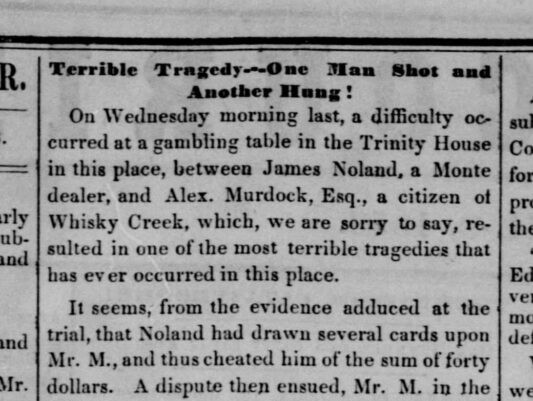
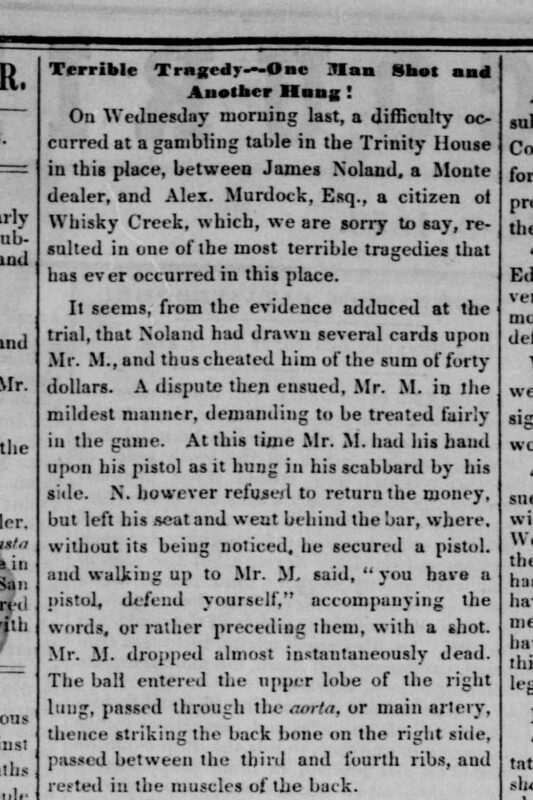
Above: “TERRIBLE TRAGEDY—ONE MAN SHOT AND ANOTHER HUNG!” The Shasta Courier reported the April 5, 1853, killing of Alex Murdock by monte dealer James Noland inside Shasta’s Trinity House. The dispute began over $40 at a gambling table and ended when Noland confronted Murdock with the words, “You have a pistol, defend yourself!” Noland was arrested by Sheriff David Corsaut, tried the following day by a citizens’ jury, and hanged that evening. Shasta Courier, April 9, 1853.

Before the gallows

In the years following the Gold Rush, Shasta County was a rough and rapidly changing corner of California. Established on February 18, 1850, the county quickly attracted miners, merchants, adventurers, and drifters seeking their fortunes in the northern Sacramento Valley and the rugged mountains beyond. Mining camps sprang up almost overnight wherever gold could be found, but where gold was discovered, trouble was never far behind.

The growing population created an immediate need for courts, sheriffs, jails, and laws. These institutions developed slowly, however, and justice sometimes depended on a combination of newly established courts, local officials, and citizens willing to take matters into their own hands. Some accused men appeared before formal courts, while others faced hastily organized citizens’ juries. The line between lawful justice and vigilantism could be difficult to distinguish.

Shasta County’s first elected sheriff was Michael Oppenheimer, but there was no proper county jail in those earliest days. According to the historical record of the Shasta County Sheriff’s Office, prisoners could be confined in a special cell at Shasta beneath the Trinity House, a hotel, saloon, and gambling establishment built by David Corsaut, who later served as sheriff.

Citizens sometimes devised their own punishments. At Horsetown, one accused thief was tied up and dunked into the cold waters of Clear Creek before being released with a warning never to return. When more serious crimes occurred, citizens sometimes organized courts, selected judges and juries, heard testimony, and rendered verdicts. And when the verdict was death, there was always the rope.

A deadly clash of cards – Easterbrook and Price

One of the earliest cases occurred on March 14, 1851, at Oak Bottom, about 10 miles from Shasta. Josiah Price and his mining partner, Easterbrook, had been drinking and playing cards with others inside a canvas tent when an argument developed. Price eventually left the tent, and Easterbrook followed.

Witness Isaac Roop testified that Easterbrook shouted, “God damn you, I intend to meet you!” Price replied, “I intend to meet you,” and a shot followed. Price called for water after being wounded, while Easterbrook fled and was captured about sixty yards away. He reportedly told his captors, “It was an accident, and I was drunk.” Roop subsequently found a recently discharged pistol.

Citizens quickly organized an ad hoc court. Jesse Dutton served as chairman and Robert W. Crenshaw as secretary. Twelve men were selected as jurors, attorneys volunteered for the defense and prosecution, witnesses testified, and Easterbrook was allowed to speak on his own behalf. He reportedly mentioned his wife and young daughter while insisting that he had not intended to kill Price.

The jury unanimously found Easterbrook guilty of first-degree murder and sentenced him to death. On March 15, approximately 24 hours after the killing, Easterbrook was hanged at Reading Springs.

Later historical records also associate a man named Pearson with Price’s killing and list both Easterbrook and Pearson as having been executed. The detailed contemporary account, however, focuses on Easterbrook and does not establish Pearson’s role. Until additional primary evidence is found that discrepancy remains unresolved. The case illustrates how quickly frontier justice could move. The killing, capture, trial, conviction, and execution unfolded in roughly a single day.

Image
Above: Shasta County, California’s second Sheriff David Corsaut (1817-1876) is pictured here. Courtesy of Shasta Historical Society.
Kit Shannon, Bates, and Tatman

Another deadly confrontation occurred in July 1852. Richard Touzalin, whose surname is also recorded as Trusdale, was passing through Shasta when he became involved in a confrontation with Kit Shannon, a native of Texas. After an initial fistfight at the California Exchange, the men encountered each other again, and Shannon attacked Touzalin with a bowie knife. Touzalin died from his wounds.

Citizens arrested Shannon and organized their own proceedings. A judge and jury were selected, Shannon was convicted, and on July 6—only two days after the confrontation—he was hanged under the authority of Sheriff David Corsaut. The case again demonstrated the uncertain boundary between citizens’ justice and the developing county government.

Later that year, Ira Tatman and Tom Bates were convicted in District Court in connection with the killing of Francis Mitchell and hanged on November 30, 1852. A later newspaper recollection, however, remembered Tatman and Bates as having killed a miner and stolen his mule and other belongings, and placed their hanging in 1851. The writer also recalled that their handcuffs had to be cut from their hands by his father, a local blacksmith who operated a shop with George McComber.

Whether the writer misremembered the year or details from separate events became intertwined remains uncertain. The discrepancy illustrates the difficulties historians face when later recollections conflict with other surviving records.

“You have a pistol, defend yourself!” – Noland and Murdock

On April 5, 1853, a quarrel inside Shasta’s Trinity House ended with a gunshot, a citizens’ trial, and one of the most dramatic executions of the town’s early history. According to the Shasta Courier, James Noland, a monte dealer, and Alex Murdock of Whiskey Creek were gambling when an argument erupted over $40. Murdock accused Noland of dealing unfairly. Although Murdock carried a pistol in his waistband, witnesses testified that he made no attempt to draw it.

Noland walked behind the bar, obtained a pistol, and returned. According to the Courier, he confronted Murdock with the words, “You have a pistol, defend yourself!” and fired. The bullet struck Murdock in the upper right portion of his body, passing through a major artery and reaching his backbone. He died almost immediately.

The newspaper reported that Noland afterward was “dancing jumping and laughing around his victim with the greatest glee” and boasting about the killing as one of his “jobs.” Noland claimed self-defense, but witnesses said Murdock had made no attempt to use his weapon. He reportedly admitted before his execution that he had not feared Murdock would shoot him.

Sheriff David Corsaut arrested Noland, but citizens organized a public meeting at the Shasta Hotel the following day. Twelve men were selected as a jury, and after hearing the testimony, they found Noland guilty and ordered him hanged at six o’clock that evening.

The execution itself went badly. According to the Courier, the rope struck against Noland’s chin rather than properly catching around his neck, and he struggled before dying. Within roughly twenty-four hours, a gambling dispute had become a killing, arrest, trial, conviction, and execution—another stark example of the speed of frontier justice.
Image


Above: “TERRIBLE TRAGEDY—ONE MAN SHOT AND ANOTHER HUNG!” The Shasta Courier reported the April 5, 1853, killing of Alex Murdock by monte dealer James Noland inside Shasta’s Trinity House. The dispute began over $40 at a gambling table and ended when Noland confronted Murdock with the words, “You have a pistol, defend yourself!” Noland was arrested by Sheriff David Corsaut, tried the following day by a citizens’ jury, and hanged that evening. Shasta Courier, April 9, 1853.
Violence against Native people

The story of Shasta County’s early justice cannot be told only through the men who appeared before courts or citizens’ juries. Newspapers also recorded instances in which Native people were killed outside the developing legal system.

In March 1853, the Shasta Courier reported that a Native man accused of taking a bag of hard bread from a wagon at Cottonwood was pursued for about a mile and a half, fired upon several times, captured, and killed the following morning by a group of white men. The next day, another Native man accused of taking beef was reportedly taken to Major Pierson B. Reading’s ranch and hanged. The newspaper stated that the hanging occurred with Reading’s permission and the approval of a Cow Creek chief. Neither man was named, and the report gives no indication that either received a formal trial.

In February 1854, the Courier reported another series of killings. White men from Johnson’s Ranch reportedly captured and hanged two Native people, another was shot the following day, and two more were hanged near Woodman’s Ranch on Cow Creek. Two of those killed were identified as Pit River Indians who had reportedly been found among the Cow Creek Indians after Numtaramin, identified as a Cow Creek chief, informed settlers of their presence.

Another report from September 1855 described the hanging of an unnamed Native man in the Dog Creek area after settlers accused him of theft. Again, no formal trial was described.

These reports preserve the perspectives and accusations of settlers and newspaper editors, not those of the Native people who were killed. Their names, testimony, and accounts were generally not recorded, and the accusations against them therefore should not be treated as established facts. These incidents were not conventional judicial executions, but acts of extrajudicial violence during a period when the developing legal system did not extend equally to everyone.

Jeptha R. Marsh and a changing legal system

Not every man sentenced to die reached the gallows. Jeptha R. March was convicted of murdering Hamilton Timmons near the mouth of Middle Creek on the Sacramento River after a dispute reportedly involving liquor. Although the men appeared to reconcile, March later entered the cabin where Timmons was eating with his partners and shot him through the heart.

Sheriff William A. Nunnally captured March at the Olive Branch House on Cottonwood Creek, and March was returned to Shasta, convicted of first-degree murder, and sentenced to hang. His attorneys appealed, arguing that one of the jurors had lived in Shasta County for only two or three weeks despite a thirty-day residency requirement. The California Supreme Court overturned the conviction and ordered a new trial.

March was later tried again in Colusa County, convicted, and once more sentenced to death. His execution was repeatedly postponed through gubernatorial intervention. On January 11, 1858, March escaped from the Colusa jail. Remarkably, an order from newly inaugurated Governor John B. Weller arrived that same evening commuting his death sentence to life imprisonment. March had escaped only hours before learning that his life had been spared.

His case stood in sharp contrast to the rapid citizens’ trials of only a few years earlier. Appeals, judicial review, stays of execution, and gubernatorial intervention had become part of the process. A death sentence was no longer necessarily the final word.
Image
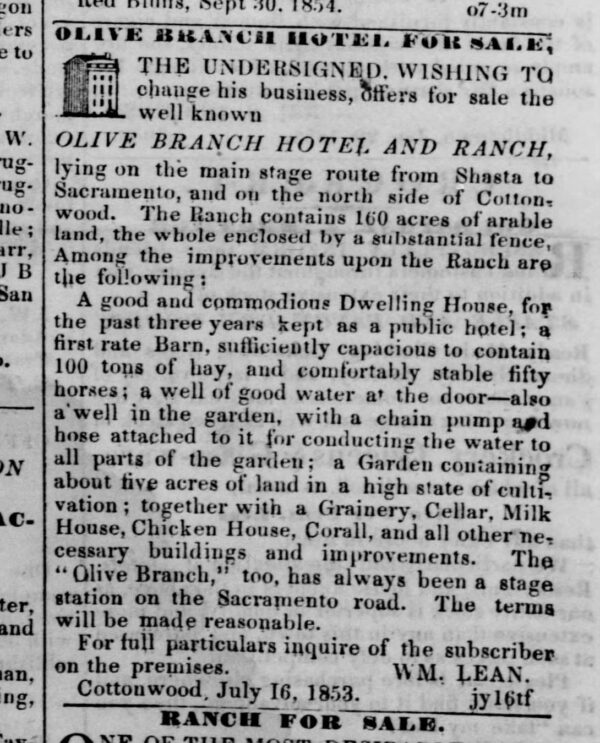
Above: THE OLIVE BRANCH HOTEL AND RANCH AT COTTONWOOD. This advertisement appeared in the Shasta Courier on January 27, 1855, although the notice itself was dated at Cottonwood on July 16, 1853. The well-known establishment served as a stage station along the main route between Shasta and Sacramento. Sheriff William A. Nunnally later captured Jeptha R. March at the Olive Branch House on Cottonwood Creek.
Alexander Higgins and the first legal hanging

According to the county’s historical record, Alexander Higgins became the subject of Shasta County’s first legal hanging after killing his traveling partner, David C. “Levi” Goodwin, with an axe at Horsetown on June 13, 1855. The killing followed an argument involving shared gold, money, and travel plans.

Higgins’ first trial encountered difficulty when a juror was found legally unqualified to serve. A second jury convicted him and sentenced him to death. Sheriff John A. Dreibelbis, who had captured Higgins, oversaw his public execution at Shasta on November 9, 1855.

Before his death, Higgins wrote a lengthy letter published in the Shasta Courier. He described his life from his birth in Longford, Ireland, through his service in the U.S. Army’s 4th Artillery during the Mexican-American War and his eventual journey to California. Much of his final statement warned against alcohol, which he described as a “soul-destroying and crime-engendering habit.”

Higgins was reportedly escorted by approximately seventy-five men to the gallows. Unlike the citizens’ executions of earlier years, his case proceeded through the formal courts, marking another stage in Shasta County’s transition toward government-administered criminal justice.

The Portuguese Flat murder – Charles Blair

On October 4, 1856, six Chinese miners living near Portuguese Flat, later known as Pollard Flat, in the Sacramento River Canyon near Slate Creek, were attacked by white men. One miner was mortally wounded with knives and died the following day. The Shasta Republican reported that the other miners resisted their attackers and drove them away, leaving behind a pistol and hat. The newspaper also reported that the miners had been robbed of $89.

Charles Blair, also identified in later records as Frances Blair, was arrested. Later accounts connected Jesse Stanley with the attack. Stanley reportedly fled toward the Pit River country and was eventually arrested, although little information survives concerning his ultimate fate. Blair was convicted of first-degree murder on December 2, 1856, and sentenced to hang at Shasta on January 16, 1857. But Blair never reached the gallows.

While confined in the Shasta County Jail, he attempted to escape and was recaptured. His attorneys petitioned Governor J. Neely Johnson for clemency, and his execution was postponed. On May 1, 1857, Johnson reduced Blair’s sentence to life imprisonment. Sheriff John A. Dreibelbis transported him to San Quentin, where he was received on May 9.

Blair’s story took another turn on May 16, 1859, when Governor John B. Weller pardoned him on the condition that he leave California and not return. A man once sentenced to die on the Shasta gallows had instead received a reduced sentence and ultimately a gubernatorial pardon.

The name of the Chinese miner who was killed has not been found in the surviving records examined so far. Although his name has been lost, his death remains an important part of the history of Portuguese Flat and Shasta County. Chinese miners played an important role in California’s Gold Rush economy while facing discrimination, unequal treatment, and violence.

A county taking shape

By the end of the 1850s, Shasta County had changed considerably from the mining frontier of the decade’s beginning. Citizens’ courts and immediate executions increasingly gave way to formal trials, judges, juries, appeals, stays of execution, gubernatorial intervention, and pardons.

The transformation was neither simple nor complete. Native people were subjected to extrajudicial violence outside the developing court system, while the murder of an unnamed Chinese miner revealed another side of the insecurity and violence of Gold Rush California. Their experiences cannot be separated from the larger history of the county.

The cases preserved from these years show a county struggling to determine what justice should mean. Some accused men faced citizens’ juries assembled almost overnight. Others stood before established courts and appealed their convictions. Some reached the gallows; others escaped it through an increasingly formal legal process.

Gold had brought thousands of people into the region. Violence tested the communities they created, and the law developed alongside them. For a brief and turbulent period, the gallows became one of the starkest symbols of authority on the northern California frontier. And beneath the gallows, Shasta County’s early history unfolded—a story of violence, justice, and a frontier slowly learning to live by the law.


RESOURCES:

1850 U.S. Census

1852 California State Census

The Pennsylvania Weekly Telegraph newspaper of Harrisburg, Pennsylvania, November 27, 1850

The Tragedy at Shasta City - The Sacramento Transcript newspaper of Sacramento, April 3, 1851

Murder and Hanging - The Richmond Daily Times newspaper of Richmond, Virginia, May 20, 1851

Life and Death in California - The Daily American Telegraph newspaper of Washington, District of Columbia, May 22, 1851

An Account - The Telegraph-Courier newspaper of Kenosha, Wisconsin - June 6, 1851

1852 California State Census

Affray at Shasta - The Sacramento Daily Union newspaper of Sacramento, July 7, 1852

Another Murder and the Murderer Hung - The New York Daily Herald newspaper of New York, August 15, 1852

Bloody Tragedies - The Boston Evening Transcript newspaper of Boston, Masschusetts, August 16, 1852

Hung - The New York Times newspaper of New York, New York - August 16, 1852

Hung - The Buffalo Post newspaper of Buffalo, New York - August 17, 1852

Bloody Tragedies - The Boston Evening Transcript of Boston, Masschusetts, August 16, 1852

Hung - The Buffalo Post newspaper of Buffalo, New York, August 17, 1852

Seventeen Days Later from California - The Alton Daily Courier newspaper of Alton, Illinois, August 25, 1852

Matters About Shasta - The Daily Alta California newspaper of San Francisco, November 1, 1852

To Be Hung - The Nevada Journal newspaper of Nevada City, November 12, 1852


Terrible Tragedy - One Man Shot and Another Hung - The Shasta Courier newspaper of Shasta, April 9, 1853

Excitement at Shasta City - A Murderer Hung - The New York Tribune newspaper of New York, New York, May 13, 1853

Shooting Affray at Shasta - The Tri-Weekly Messenger of Hannibal, Missouri, May 19, 1853

The Shasta Courier newspaper of Shasta, January 21, 1854

1860 U.S. Census

1870 U.S. Census

The Shasta Courier newspaper of Shasta, May 17, 1879

1880 U.S. Census

1900 U.S. Census

David Corsaut - The Delta Independent newspaper of Delta, Colorado, April 4, 1913

Pioneer Dead - The Daily Sentinel newspaper of Grand Junction, Colorado, March 31, 1913

History of Hangings Is Recalled in Shasta County - The Sacramento Bee newspaper of Sacramento, January 22, 1921

Lynching History - The Sacramento Bee newspaper of Sacramento, February 12, 1921

Hanging History in Shasta County - The Searchlight newspaper of Redding, March 26, 1921

Hanging History of Shasta County - The Searchlight newspaper of Redding, April 1, 1921

Early Shasta Murderers Pay on Gallows written by Rosena A. Giles - The Redding Record Searchlight newspaper of Redding, January 14, 1953

Thursday, October 22, 2026

OFT FORGOTTEN PLACES IN SHASTA COUNTY (PART III)

The history of Shasta County is often told through the stories of its most celebrated communities—Shasta, Redding, Whiskeytown, and Kennett. Yet scattered across the mountains, valleys, and canyons of the county were dozens of lesser-known settlements that briefly flourished before disappearing from the landscape. Born from the excitement of the California Gold Rush, the expansion of mining, and later the arrival of the railroad, these forgotten communities played important roles in shaping Northern California during the nineteenth and early twentieth centuries.

Some existed for only a few years, while others endured for decades before economic decline, changing transportation routes, or the construction of Shasta Dam erased them from the map. Today, many survive only in newspaper accounts, government records, survey maps, and the memories preserved by local historians.

Among the earliest mining settlements was Bulgin Gulch, also known as Bullion Gulch or Buljon Gulch, situated within the Clear Creek mining region of western Shasta County. During the 1850s the gulch attracted miners and prospectors seeking placer gold, including James Regan and G. M. Roach. The district later became the center of a legal dispute when merchant and miner Paul De Pray successfully contested Roach's mining claims before ultimately purchasing them at a sheriff's sale in August 1863. Although the settlement never established its own United States Post Office, nearby streams supplied water to its residents until mining activities dwindled around 1870 and the camp faded into history.

Farther north, the bustling mining town of Pittsburg was established in 1853 along Squaw Creek in what later became the Shasta Lake basin. At its height, the community contained dozens of homes, bakeries, blacksmith and shoemaker shops, and even a barber. The prosperity of the settlement gave rise to the Pittsburg Mining District, but like many Gold Rush communities, its fortunes proved temporary. By approximately 1862 Pittsburg had largely disappeared, and today its former location rests beneath the waters of Shasta Lake. Nearby Copper City, established in 1854, survived much longer before eventually sharing the same watery fate following construction of Shasta Dam.

Another early settlement, Clarkville, was established in 1856 on the north side of Battle Creek within the Rancho Buena de Breisgau Mexican land grant. Founded by Jeremiah Clarke, the community persisted into the late 1860s and even served as the location of the Clarkville Election Precinct. Though little remains today, its site survives on what is now Gover Ranch, offering another reminder of the county's vanished frontier communities.

High above Squaw Creek stood Circle City, a small mining settlement overlooking Bully Hill. While few physical traces remain, the community once relied upon the Winthrop Post Office and maintained close connections with neighboring mining towns including Copper City, Delamar, Sallee, and South Sallee.


Image

Bully Hill. Courtesy of Shasta Historical Society.

Travel and commerce also gave rise to settlements such as Jackass Flat, strategically located where roads from Horsetown and Briggsville converged on the route to Middletown. The town served as an important resting place for mule trains and freight packers transporting supplies into the mining districts. Its nearby pastures allowed exhausted animals to recover before continuing their journeys, making Jackass Flat an indispensable stop along one of the region's busiest transportation corridors during the Gold Rush and California’s early statehood.

Among the county's most intriguingly named communities was One Dog Town, a small mining camp that flourished briefly during the early 1850s near Clear Creek. Although little survives today, official county records from 1855 reference the settlement as a landmark when describing the boundaries of Shasta Township, confirming that it was once a recognized point on the frontier landscape. Like countless other placer mining camps, One Dog Town likely consisted of cabins, tents, stores, and saloons serving nearby miners. As gold production declined, the settlement quietly vanished, leaving behind little more than its colorful name and scattered documentary references.

Not all forgotten communities centered solely upon mining. Hogtown, located near present-day Keswick, developed as an early suburb of Shasta during the 1850s. It became widely known for its Oakland Race Track, where horse racing, mule races, jack races, foot races, gymnastics, and even cockfighting attracted large crowds. Under promoter Thomas J. Stump, Hogtown became one of the county's principal entertainment centers during the early years.

Transportation routes also sustained communities such as Welshville, a teamster station situated between South Sallee and Delamar. Named for William Welsh, whose extensive freight operations utilized teams of horses hauling supplies between Bella Vista and Bully Hill, the settlement also included a blacksmith shop operated by A. R. Schettig. Like many communities along the Squaw Creek corridor, Welshville ultimately disappeared beneath the waters of Shasta Lake.

The twentieth century brought new settlements driven less by placer mining than by railroads and industrial development. Bonita, also known as Pitt, emerged north of Kennett as an important railroad junction connecting the Sacramento Valley and Eastern Railroad with the Southern Pacific Railroad. Nearby Culp Station developed as a railroad siding north of Cottonwood during the 1920s, while neighboring Panorama briefly shared a similar purpose before both communities faded with changes in railroad operations.

One of the county's most ambitious mining boomtowns was Sallee, established in 1900 near the famed Bully Hill mines. Streets were carefully surveyed, substantial buildings quickly erected, and businesses opened in anticipation of long-term prosperity. However, legal disputes over ownership of the townsite soon engulfed the community, leading to lawsuits, injunctions, and competing land claims. Despite these challenges, nearby South Sallee and Delamar continued to grow alongside the mining industry, with local media outlets reporting new construction throughout the district during 1900. Ultimately, however, declining mining activity brought an end to these once-promising town sites.

The final chapter in this story belongs to Smith Center, a company town established in 1915 by the Shasta Dredging Company west of Gas Point. Designed to house employees working the company's dredging operations, the community consisted of seventeen homes arranged in a semicircle and relied upon the Gas Point Post Office to send and receive mail. Like so many industrial settlements, its existence was closely tied to the fortunes of a single enterprise, and once those operations ceased, the town quietly disappeared.

Today, little remains of these forgotten communities exist beyond weathered foundations, abandoned roads, submerged townsites, and scattered documentary records. Yet together they represent an essential chapter in the history of Shasta County. Their miners, merchants, railroad workers, freighters, and families helped build the economy and character of northern California long before many of today's communities existed. Although time has erased most physical evidence of their existence, the stories of these vanished settlements continue to remind us that the history of Shasta County extends far beyond the towns that survived.


RESOURCES:

From Pitt River - The Shasta Courier newspaper of Shasta, May 14, 1853

From Pitt River - The Shasta Courier newspaper of Shasta, May 21, 1853

Mining - The Shasta Courier newspaper of Shasta, April 14, 1855

The Shasta Courier newspaper of Shasta, December 29, 1855

The Shasta Courier newspaper of Shasta, October 16, 1858

Sheriffs Sale - The Shasta Courier newspaper of Shasta, August 24, 1864

New Discovery - The Shasta Courier newspaper of Shasta, June 9, 1866

The Shasta Courier newspaper of Shasta, June 16, 1866

Shasta’s Second Smelter City - The Searchlight newspaper of Redding, March 31, 1900

Bully Hill Activity - The Searchlight newspaper of Redding, April 6, 1900

The Daily Free Press newspaper of Redding, November 19, 1900

He Defended Himself With A Hatchet - The Free Press newspaper of Redding, May 7, 1904

Train To Delamar In Seven Months - The Courier-Free Press newspaper of Redding, February 18, 1907

The Governor of Hogtown is Dead - The Searchlight newspaper of Redding, June 4, 1907

Smith Center Name of Dredger Town - The Searchlight newspaper of Redding. April 27, 1915

Shasta County Has A Promising New Town - The Sacramento Daily Union newspaper of Sacramento, April 28, 1915

Power Lines to Smith Center Now Complete - The Courier-Free Press newspaper of Redding, June 8, 1915

Farewell to Thomas Family Leaving For Smith Center - The Searchlight newspaper of Redding, October 22, 1915

New Times Table Effective Sunday - The Searchlight newspaper of Redding, August 24, 1921

Southern Pacific Making Larger Yards In Redding - The Searxhlight newspaper of Redding, May 21,  1925

Shasta Development Reported Planned By Railroad; Actiin Is Not Yet Opened - The Searchlight newspaper of Redding, March 23, 1930

S.P. Will Not Move Yards From Dunsmuir and Gerber To Anderson As Reported - The Courier Free Press newspaper of Redding, April 4, 1930

The Courier-Free Press newspaper of Redding, March 25, 1930

Our Storied Landmarks – Shasta County, California, written by May H. Southern, published by Balakshin Printing Company, ©1942.

My Playhouse Was A Concord Coach, an anthology of newspaper clippings and documents relating to those who made California history during the years 1822-1888, by Mae Hélène Bacon Boggs. Published by Howell-North Press ©1942

Shasta County, California A History by Rosena Giles, published by Biobooks, ©1949.

Fun Was Hard To Come By In Pioneer Whiskeytown - The Record Searchlight newspaper of Redding, September 27, 1963

Place Names of Shasta County by Gertrude A. Steger revision by Helen Hinckley Jones, ©1966 by La Siesta Press, Glendale, California

U.S., Appointments of U.S. Postmasters, 1832-1971

Friday, October 9, 2026

Celebrating Redding’s 139th birthday, and Chauncey C. Bush Sr., ‘Father of Redding’

Celebrating Redding’s 139th birthday, and Chauncey C. Bush Sr., ‘Father of Redding’


Image

Portrait of Judge Chauncey C. Bush Sr. (1831–1907), pioneer merchant, judge, banker, and civic leader whose career linked Gold Rush-era Shasta with railroad-era Redding. Courtesy of California State Archives.


When the California and Oregon Railroad bypassed the old mining town of Shasta, its merchants faced a hard choice: remain with the community where they had built their names or gamble on an uncertain settlement rising on the Sacramento River flats. Chauncey Carroll Bush Sr. chose the gamble. His decision alone did not make Redding, but few early residents touched so many of its foundations at once—commerce, government, freight, banking, fraternal life, and civic promotion. By the time he died in 1907, the title so often attached to his name, the “Father of Redding,” reflected a lifetime spent helping a new town take shape.

Redding was established on June 15, 1872, when the California and Oregon Railroad, a division of the Central Pacific, made it the temporary end of the line at Poverty Flat, a stretch of swampy, unfarmable ground that earlier settlers had largely passed over. A persistent local myth holds that the town was named for Major Pierson B. Reading, the pioneer who settled Shasta County in 1843 under a Mexican land grant. In fact, it was named for railroad agent Benjamin Bernard Redding of Sacramento. Residents used the spelling “Reading” in the major’s honor for years, until a Superior Court ruling in 1880 upheld the railroad’s spelling and settled the matter.

Bush Sr. was born in Pittsfield, Massachusetts, on July 31, 1831. After he lost his mother in infancy, his father moved the family west to Pittsfield in Pike County, Illinois. In 1850, at eighteen, Bush Sr. joined the westward rush to California, leaving Illinois in March and reaching Hangtown—now Placerville—on August 20. He mined first near Auburn, then reached Shasta County by early 1851 and took up a claim near French Gulch.

That claim was only the beginning. Bush Sr. packed supplies by mule through rugged country, worked as a store clerk, and eventually entered business for himself. By the 1860s, C. C. Bush and Company operated a substantial wholesale and retail store on Main Street in Shasta, carrying the provisions and goods a mining district required. Bush Sr. also represented insurance companies. In September 1860, he won election as justice of the peace in Shasta Township, beginning the judicial career that made “Judge” a permanent part of his public identity.

Bush Sr.’s politics changed with a turbulent era. He was active in the Douglas Democratic organization in 1860 and ran as a Union Democratic candidate for county judge the following year. He also served as vice president of Shasta County’s Soldiers’ Relief Society, which raised aid for Union servicemen. Later records place him in county judicial service through the 1860s and into 1872, after which he studied law and entered practice.

On June 27, 1865, he married Ida Matilda Schroeder, who had arrived in Shasta as a young teenager. Their first home stood on High Street, across from Shasta’s Union Church. The house had been built in 1854 by a carpenter named Barton. A newspaper account published after it was destroyed by fire in 1904 stated that Bush Sr. had purchased the property in 1855. Chauncey and Ida had seven children: Maria Merrick Bush; William Bush; Eda Ellen Bush; Chauncey Carroll Bush Jr.; George William Bush; Jennie Brown Bush; and Harry Edward Bush. Only four survived childhood.


Image

Ida Matilda (Schroeder) Bush (1847–1925), a pioneer and the wife of Judge Chauncey Carroll Bush Sr. She shared in the civic and social life of early Shasta and Redding. Courtesy of California State Archives.


The railroad changed the direction of Bush Sr.’s life. When it chose lower ground along the Sacramento River rather than extending its line to Shasta, he tried to keep the route at the old county seat. When that effort failed, he recognized where the region’s future lay. He broke ground for a cellar on July 22, 1872—reported as the town’s first permanent improvement—and his family moved to the new settlement that summer. Lots went on sale two weeks later, on August 3; seventeen sold at an average of $108 each. By August 11, Bush Sr. had opened Redding’s first general mercantile store, even as he continued to operate his Shasta business.

The new town grew with startling speed. On September 1, 1872, the first passenger train arrived in Redding by way of Red Bluff, Cottonwood, and Anderson, drawing a large crowd to the depot. Among the passengers were Charles Litsch and Mary Jane Culverhouse, the only woman aboard. Barely three weeks later, on September 23, the U.S. Post Office Department appointed Bush Sr. Redding’s first postmaster. The post office operated from his residence at the corner of Sacramento and Market streets, on the ground later occupied by the Redding Hotel. By November 22, only three months after the first lots sold, seventy new houses had already been built.

Bush Sr. built more than a store. He partnered with George Merrick Hatch in a ranching venture near Wells Ferry and later joined Henry F. Johnson in a forwarding and commission firm at the railroad terminus. Their business handled freight between the rail line and the towns and mining districts farther north, placing them within the supply chain that served northern California and southern Oregon long before modern highways.

The young town was not gentle with its builders. A major fire in 1873 destroyed the C. C. Bush and Company store, leaving losses beyond the insurance carried. Bush Sr. rebuilt and continued. In 1879, he helped organize Redding’s first fire department, the Hook and Ladder Company, serving as its inaugural foreman. That same year, he helped organize Reading Lodge No. 254, Redding’s Masonic lodge, and became its first worshipful master. His influence extended into statewide Masonry as well; in 1883, he helped lay the cornerstone for the Garfield monument in Golden Gate Park. In Redding, the Bush name became attached to commercial property, including Bush Hall and the Bush Block, where tenants operated businesses serving the growing railroad town.

Redding was incorporated on September 5, 1887, with the official filing following on October 4. On October 10, Bush Sr. became the first president of Redding’s Board of Trustees—an office then equivalent to mayor—and served until Jerry Culverhouse succeeded him the following April. Bush Sr. was associated with the Bank of Shasta County from its early years and later served as its president and manager. He also supported moving the county seat from Shasta to Redding, a change completed on May 19, 1888, the same day Redding held its first court session.

The Bush household maintained a civic life of its own. Ida Bush and daughter Eda hosted Presbyterian gatherings and charitable events, and the family home became a familiar setting for meetings, music, and fundraising. That quieter work complemented Bush Sr.’s public and commercial achievements.

Bush Sr.’s commitment to promoting the community had begun much earlier. In 1888, he helped organize the Shasta County Board of Trade, chaired its founding meeting, and became its temporary president. The organization set out to publicize the county’s communities, resources, and opportunities to a wider audience. By the first years of the new century, Bush Sr. was still doing that work. As president of the Board of Trade in 1902, he corresponded with a prospective developer about a woolen mill. Later that year, he helped organize Redding’s reception for a touring group of San Francisco businessmen, chairing the meeting and delivering the public welcome. The effort was intended to promote the town and its prospects for investment.

His most visible late investment came in 1902, when Bush Sr. erected a brick building at 1449 Market Street beside the Bank of Shasta County to provide new post-office quarters for the federal government. Architect Matthew W. Herron designed the building, and Holt & Gregg Company of Anderson completed its brickwork. The post office opened there in 1904; the building later housed a cigar store and other businesses. Nearly a century after Bush Sr. built it, the Shasta Historical Society purchased the property in 1996, moved its archival collections there the following year, and formally opened its new home in 1998. It remains a direct, physical link between Bush Sr.’s investment in early Redding and the institution that preserves the county’s history today.

The following year, a notice signed by Bush Sr. called for bids to remodel the Bush Block on California Street. The proposed work included excavation, brickwork, carpentry, plastering, glazing, roofing, and painting—another practical sign that he was still reinvesting in Redding’s business center decades after arriving at Poverty Flat.

Image

In 1903, C. C. Bush sought bids for extensive improvements to the Bush Block, a commercial property in the original town of Redding. From the Searchlight newspaper of Redding, March 8, 1903.

His later years did not remove him from public responsibility. In 1903, the Armory Hall Building Association named Bush Sr. secretary, with his son Chauncey Carroll Bush Jr. as treasurer and his son George as manager. In 1905, he served on several Shasta County grand-jury committees inspecting public buildings, records, finances, and roads. That June, he joined Judge Edward Sweeney and George O. Perry in representing the county at a San Francisco dinner honoring the National Irrigation Committee.

That same year, Chauncey and Ida celebrated their fortieth wedding anniversary during an Order of the Eastern Star observance. Beneath a large wedding bell, they renewed their vows before family and friends, with their son George—then a justice of the peace—performing the ceremony.

Bush Sr. attended the 1907 session of the Grand Lodge of Masons in San Francisco as grand Bible bearer, his final official duty. He died in Redding on December 21, 1907, at the age of seventy-six, and the Superior Court adjourned that morning in his honor. His influence remained visible in the institutions and properties he had helped build, and in the example he set. Judge Chauncey Carroll Bush Sr. was buried in the chapel at Evergreen Cemetery in Oakland, California, alongside members of his family.

Redding’s growth rested on the work of merchants, railroad laborers, farmers, families, civic officials, and countless others whose names history remembers less often. Calling Chauncey Carroll Bush Sr. the Father of Redding should not erase any of them. It recognizes his remarkable ability to adapt, rebuild, and keep investing in the community as Shasta County’s center of gravity shifted from the old mining town to the railroad city on the Sacramento River. More than a century after his death, his story remains one of the clearest bridges between those two worlds.


Image


Judge Chauncey Carroll Bush Sr. (1831–1907) in later life. A pioneer merchant, banker, civic leader, and one of the principal builders of early Redding. Courtesy of California State Archives.


RESOURCES:


1850 U.S. Census

1860 U.S. Census

Great Register of Shasta County, 1866

1870 U.S. Census

New Town — The Shasta Courier newspaper of Shasta, June 15, 1872

Redding — The Shasta Courier newspaper of Shasta, August 3, 1872

First Train — The Shasta Courier newspaper of Shasta, September 7, 1872

Trip to Redding — The Shasta Courier newspaper of Shasta, September 28, 1872

1880 U.S. Census

History and Business Directory — Shasta County, by B. F. Frank and H. W. Chappell. Redding Independent Book and Job Printing House, Redding, California, 1881

Incorporation Prevails — The Republican Free Press newspaper of Redding, September 3, 1887

Supervisors Proceedings, May Term 1888 — The Shasta Courier newspaper of Shasta, May 19, 1888

Listing of Redding Mayors, 1887–2007

U.S., Appointments of U.S. Postmasters, 1832–1971, available on microfilm in the archives of the Shasta Historical Society

Outpost on Poverty Flats, by Charles J. Gleeson. Redding Printing Company, 1978

Redding the First Hundred Years, by Edward Petersen. North-Cal Printing & Litho., 1972

A History of Redding: The Early Years, 1872–1875, by Al M. Rocca. Renown Publishing, 2014

Association of Territorial Pioneers of California certificate presented to Chauncey Carroll Bush Sr., 1883

The Bank of Shasta County — The Free Press and Record Searchlight newspapers of Redding, 1880s–1903

Post Office to Have Handsome New Quarters Adjoining Bank of Shasta County — Weekly Searchlight newspaper of Redding, September 19, 1902

Notice to Contractors — The Searchlight newspaper of Redding, March 8, 1903

Dressed in a New Suit of Clothes — The Searchlight newspaper of Redding, March 18, 1903

Colonial Dames Exhibit Antiques — The Searchlight newspaper of Redding, February 24, 1903

Fire Wipes Out a Pioneer Home — The Searchlight newspaper of Redding, July 26, 1904

Redding Had a $75,000 Blaze — Record Searchlight newspaper of Redding, July 5, 1904

Will Meet with the Committee on Irrigation — Record Searchlight newspaper of Redding, June 9, 1905

The Bank of Shasta County, written by Mary Graham Bush, The Covered Wagon, Shasta Historical Society, 1973

Shasta Historical Society archival collections, Redding, California

Reading Lodge No. 254 and Western Star Lodge No. 2 historical records and portrait collections

Sunday, October 4, 2026

TODAY THE CITY OF REDDING TURNS 139 YEARS OLD!

Image


A sweet glimpse of the City of Redding’s beginnings! As the City of Redding celebrates its 139th birthday today, October 4th, this advertisement takes us back to 1887. Oswald Grüttner’s Bakery and Saloon (advertised as O. Grittner), at the corner of Market and Tehama streets, advertised “Nice Light Bread,” candy and confections, along with wines, liquors and cigars.

Published just four days after the city’s incorporation documents were officially filed, the advertisement offers a taste of business life in the newly incorporated City of Redding. Happy birthday, City of Redding! Celebrating 139 years and moving forward into the future.

Source: The Republican Free Press, October 8, 1887

Friday, October 2, 2026

Celebrating the City of Redding’s 139th Birthday This Sunday.

Image


A look back at the 1500 block of California Street, likely photographed during the mid-to-late 1930s. The Redding Theatre and neighboring businesses offer a glimpse of downtown Redding in an earlier era as we celebrate the city’s 139th birthday on Sunday, October 4, 2026. Photograph by Eastman’s Studio, B-622; exact date unconfirmed. Photograph courtesy of Shasta Historical Society.

Wednesday, September 30, 2026

FINDING MAUD: My Ancestor’s Grave Marker Rediscovered After 16 Years.


Filmed on location.


Last seen in 2010, my maternal great-great-great-grandmother Maud’s grave marker had disappeared beneath the soil at Redding Memorial Park. After three weeks of searching, my girlfriend Latoya and I uncovered it on September 27, 2026. Finding Maud: My Ancestor’s Grave Marker Rediscovered After 16 Years follows our search, the discovery, and the family history behind her name.

Friday, September 25, 2026

A Secret Beneath the Floorboards: The Tragic 1876 Inquest of Shasta’s Forgotten Infant.

A Secret Beneath the Floorboards: The Tragic 1876 Inquest of Shasta’s Forgotten Infant.
Originally Appeared on A News Cafe

Image

Source: Shasta State Historic Park


In May of 1876, the quiet residential streets of the historic town of Shasta were disturbed by a grim discovery that brought a deeply private tragedy into public view. Beneath the floor of a small woodhouse behind a home on Back Street, a woman's ordinary household routine led to the discovery of a female infant's remains. The discovery led to a coroner's inquest and placed several of Shasta's established citizens in the unusual position of determining what could—and could not—be concluded about the child's death.

The Discovery on Back Street

The discovery was made on May 23, 1876, at the property of local resident Jack Anderson, who lived on Back Street in Shasta. While attending to her daily household chores, Mrs. Jack Anderson entered the woodhouse at the rear of the dwelling. There, she discovered the body of a female infant concealed beneath the floor. The remains had been wrapped in several pieces of wearing apparel and lightly covered with loose earth and rubbish.

Most disturbing was a strip of muslin cloth, approximately two inches wide, that had been drawn twice around the infant's neck and tied in a hard knot. The circumstances immediately raised questions about how the child had died and why the body had been hidden beneath the floor.

The Coroner's Inquest

The discovery was reported to Shasta County Coroner William P. Hartmann, who convened an inquest on May 24, 1876. A coroner's jury was assembled from among men known in the community. Their names included August Grotefend, Adolph Dobrowsky, Julius Leiter, Emanuel Lewin, Jasper Smith, and John Stowell.

These were not anonymous men. They were established residents of a community that, although considerably diminished from its Gold Rush heyday, still retained a network of merchants, craftsmen, and other longtime citizens. Their participation illustrates how such investigations in a small nineteenth-century community could quickly become matters of public knowledge. The jury examined the infant's remains and heard the testimony presented to the coroner. The cloth around the child's neck was an unsettling piece of evidence, but the circumstances surrounding the birth and death were not sufficiently clear to establish that a criminal homicide had occurred.

A Cautious Verdict

The jury ultimately determined that the deceased was a female infant approximately one and a half months old. Their verdict stated that the child was "supposed to be stillborn." That conclusion was significant. Rather than declaring that the infant had been murdered, the jurors stopped short of finding that the child had been born alive and subsequently killed. The evidence available to them apparently did not establish that the infant had lived independently after birth.

The verdict therefore left unanswered the most disturbing questions surrounding the case. The cloth tied around the child's neck remained an ominous detail, but the jury did not convert that circumstance into a formal finding of homicide. The jurors did, however, record one additional conclusion: they believed the infant was the child of a local woman named Sarah Baxter.

What the Record Tells Us—and What It Does Not

The identification of Sarah Baxter is one of the most revealing aspects of the surviving account, but it must also be treated carefully. The inquest record, as reported, identifies her as the presumed mother; it does not by itself establish the circumstances surrounding the pregnancy, the birth, or the infant's death.

It would be tempting to assume that the hidden burial resulted from the social pressures surrounding an unmarried pregnancy or an illegitimate birth. Such pressures certainly existed in nineteenth-century California, but the surviving account does not provide enough evidence to say that this was Sarah Baxter's particular situation.

What can be established is more restrained—and in some ways more haunting. A newborn child had been concealed beneath the floor of a backyard woodhouse. The infant had been wrapped in clothing, a strip of muslin had been tied twice around her neck, and a coroner's jury was unable to determine conclusively that she had been born alive. The jury nevertheless recorded the name of the woman they believed to be her mother. Beyond that, the historical record becomes silent.

A Glimpse Behind Shasta's Public Facade

Cases such as this offer a different view of Shasta than the familiar stories of merchants, miners, freight teams, saloons, and bustling streets. Shasta had been a ramshackle mining community from the beginning. By 1876, the great Gold Rush boom had long since passed, and Shasta was a much quieter place. Yet behind the town's surviving buildings and familiar pioneer names were private lives marked by poverty, family difficulties, childbirth, death, and circumstances that rarely appeared in the official histories of the community.

The tragedy discovered on Back Street lasted only briefly in the public record. There was no celebrated criminal trial and no dramatic conviction. Instead, the story survives through the terse proceedings of a coroner's inquest—a handful of names, a concealed infant, and a verdict carefully limited to what the evidence could establish.

Today, the case of Shasta's forgotten infant is a reminder that the history of a frontier town was not made only by the men whose names appeared in business advertisements or public offices. It was also shaped by ordinary people confronting deeply personal tragedies, sometimes behind closed doors and sometimes, as in May 1876, beneath the very floorboards of their homes. The jury could determine only what the evidence allowed. The questions they could not answer remain buried with the child. No record has yet been found identifying where the infant was ultimately buried.


Resources:

Dead Infant Found - The Shasta Courier newspaper of Shasta, May 27, 1876