Skip to content
Gaming

Headshot: A visual history of first-person shooters

Doom, Halo, Goldeneye, Half-Life, Call of Duty… you may recognize a few of these.

Richard Moss – | 266
Image
But no one was complaining that the gore was repeated.
Story text

Many of us are familiar with the first-person shooter (FPS) creation myth—that it materialized fully formed in the minds of id Software founders John Carmack and John Romero shortly before they developed Wolfenstein 3D. Afterward, it was pushed forward only by id until Valve’s Half-Life came along.

But the reality behind FPS evolution is messier. Innovations came from multiple sources and often took years to catch on. Even Wolfenstein 3D had numerous predecessors within and without id. And like the genres we’ve previously explored—a list including city builders, graphic adventures, kart histories, and simulation games—there have been many high and low points throughout this long, violent, gory history.

Minus ’90s cult favorite Descent (because I personally consider it a flight combat shooter), these are the shooters that pushed the genre forward or held it back. Many of us encountered at least one that truly spoke to us, but together, these titles made it cool to shoot pixel-rendered dudes, dudettes, mutants, and weird alien creatures in the face.

Image
Faceball 2000
Image
MIDI Maze

Pre-history

In the beginning, there was Maze. Later remade for several 1980s and early ’90s machines under numerous variant titles such as Maze War, Maze Wars+, Super Maze Wars (the version I played to death on a Mac), Bus’d Out, Faceball 2000, and MIDI Maze, this first version of Maze was programmed on an Imlac PDS-4 minicomputer in 1973. It was a two-player 3D maze game coded by three high schoolers—Greg Thompson, Steve Colley, and Howard Palmer. They completed the would-be masterpiece during a work/study program at NASA’s Ames Research Center. Thompson and Infocom (the text adventure company) co-founder Dave Lebling then carried on the work at MIT the following year.

They progressively added more features, and soon Maze became what we would now call a first-person shooter. Besides shooting each other, players could peek around corners and check a map to see where they were in the maze, and opponents looked smaller or larger according to distance. Perhaps coolest of all, other people could watch the eight-player action unfold on a Sutherland LDS-1 graphics display computer—one of the earliest cases of gaming as a spectator sport.

Maze was played across a network (via a PDP-10 mainframe) within MIT and over the ARPANET—an early version of the Internet—between MIT and Stanford. Legend has it that the game got so popular it was banned from ARPANET because it chewed through too much data.

Jim Bowery’s 32-player, 3D networked, first-person perspective space shooter Spasim—a kind of forebear to space combat sims Star Wars: X-Wing and Elite—got its first release on the PLATO computer around this time as well, effectively making Maze and Spasim joint ancestors of the FPS genre. However, they weren’t the only pre-id Software games to provide real-time, first-person perspective shooting.

Image
The Colony.
Image
Gun Buster.

Pseudo-3D arcade first-person tank shooter Battlezone hit in 1980, with wireframe vector graphics that not only gave it a novel and iconic look but also let it run super fast. Battlezone got cloned on every platform known to man in the 1980s and early ’90s, but none was worthy of much note besides Spectre (1991)—a networkable Macintosh game that asked players to capture flags as quickly as possible while driving around an abstract, futuristic map blasting (or on higher levels, fleeing) enemy tanks.

The Mac also hosted another important progenitor to the FPS genre: The Colony (1988). Part horror puzzler and part shooter, The Colony was a terrible game—you could die in several different ways without warning or explanation just in the supposedly “safe” opening section (and it just got more sadistic from there). But in terms of its technical achievements, The Colony was remarkable. It presented a huge, sprawling, detailed (underground) black-and-white, mostly wireframe 3D world with real-time graphics rendering and 256 degrees of freedom in where you could look (using the mouse, no less—years before it became a genre standard). The Colony looked stunning, like a vision of the future. But its fame extended little beyond the Macintosh faithful.

No less obscure than The Colony and just as significant, Taito’s Gun Buster (1992) was the first—and one of the only—light gun games to go off rails. Rather than giving you control only over shooting, as was the norm, it gave you a joystick for forward/backward and strafing movements and mapped turning to the light gun’s aiming reticule. It had cooperative and head-to-head modes for one to four players, breakable glass in its first level, and graphics that PC shooters wouldn’t match for another few years. Sadly its distribution, and hence its impact, was sorely limited.

Image
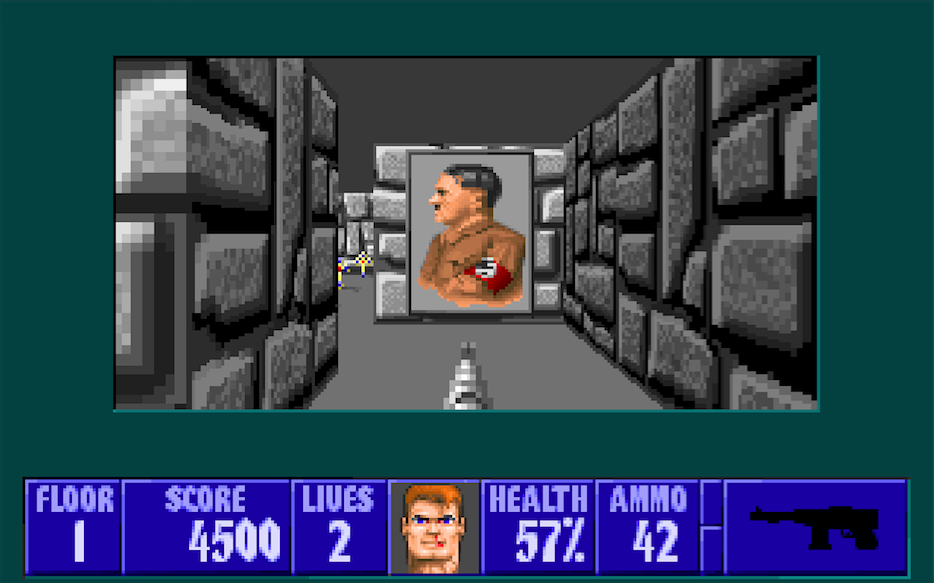
Wolfenstein

Mecha-Hitler

Coding wizard John Carmack wanted to take the ponderous first-person 3D action of flight simulators and make it fast like an arcade game. He had just one problem: home computers at the time—this is 1990—were slow. In order to make a fast-paced, 3D first-person action game, he had to take some shortcuts. His solution was to use a technique called raycasting, which involves sending invisible rays out from the player’s position in the direction they’re facing and then performing simple calculations to determine where and at what height to draw walls.

Hovertank (1991) turned out not to be the most impressive game, with ugly, solid-colored walls, a black ceiling, and gray floors coupled with repetitive shooting of uninspired enemies. Still, it was a start.

Carmack soon refined his raycasting engine and developed a mapping system to put textures on the walls—a system that he came up with after hearing about the 3D engine for in-development, first-person role-playing game Ultima Underworld. Unlike Underworld, however, Catacomb 3-D (1991) only put textures on the walls. The ceilings and floors were still just solid blocks of color. It also introduced a cartoon head that showed the health of your hero, but the game was too graphically limited (3D engine aside) to make a big impression.

That wasn’t the case with id’s next attempt, Wolfenstein 3D (1992). Here, id finally came into its own. Carmack figured out some tricks to speed up his rendering engine, while designers John Romero and Tom Hall crafted maze-like maps with loads of secret rooms, and artist Adrian Carmack (no relation to John) hand-drew the 256-color object/character sprites—a big step up visually from its earlier 16-color EGA titles.

Wolfenstein 3D‘s popularity was not merely a product of its technical achievements, though. The episodic shareware shooter ditched the fantasy stylings of Catacomb for good ol’ Nazi killing. The simple-yet-ridiculous setup of spy William “BJ” Blazkowicz deciding to singlehandedly topple the Nazi regime—and with it their secret army of undead mutants—made for easy motivation.

Word got around fast that not only was Wolfenstein 3D full of cool Easter eggs and hidden rooms, but come episode three, you could kill Hitler. Or rather Mecha-Hitler—the crazed homicidal tyrant donned a huge robot suit equipped with four chainguns and a creepy, uncanny ability to always be looking right at you. If you managed to actually kill him, he didn’t just keel over quietly; he exploded into a disgusting but oh-so-satisfying pile of blood and guts. You even got to watch his final moments again in slow motion on the game’s gory, controversial Death Cam.

This dedication to over-the-top graphic violence landed id in hot water repeatedly through the ’90s—particularly with German censors and Nintendo’s strict no-blood policy on the Super Nintendo. The game maker also felt the heat from religious groups and eventually, in the wake of the Columbine High School massacre in 1999, with the broader public. Still, this work was critical to the edgy, raw, arcade-y image that id fostered in its march to world domination. Other developers simply raced to play catch up.

Image
Ken’s Labyrinth
Image
Not so subtle hints abound.

Seven above, the rest below

For its third game, an unknown Macintosh developer called Bungie wanted to fuse dungeon exploration with the first-person shooting of Wolfenstein 3D. Pathways into Darkness (1993) offered a claustrophobic and spooky first-person adventure set in the catacombs beneath a Mayan pyramid. It strangely put the action in a separate window to your health status, inventory, and goals as well as a text-adventure-style log of messages. (You could move these windows around and resize them like in a regular application.)

Pathways was notable not only for its weird multi-window interface and for being Bungie’s first foray into the genre but also for its treatment of story as essential to the experience. Where id’s early work kept things simple—there are bad guys you should kill—Pathways into Darkness had complications. As you traveled deeper into the pyramid, you came across the dead bodies of your comrades, various treasure hunters, and the Nazis who lost their lives in terror decades earlier. Special crystals made it possible to talk to them all, to reveal the lies, deception, and no small amount of fear that tore the Nazis apart and drove them all insane. Bit by bit you could piece together the pyramid’s dangerous secret.

Bungie wasn’t the only studio trying to capitalize on Wolfenstein 3D‘s success. Epic MegaGames put out Ken’s Labyrinth at the beginning of 1993, with interactive slot machines as a gimmicky addition to stave off accusations of cloning Wolfenstein 3D, while The 3DO Company developed the spooky but hard-to-control Escape from Monster Manor, and Bethesda released a solid Terminator-themed Wolfenstein 3D clone. And friends of id at Raven Software—at the time based just down the street—licensed an updated-yet-slower version of the Wolf3D engine (now with sloped floors, texture-mapped floors and ceilings, jumping, and swimming) for its 1993 fantasy-themed shooter Shadowcaster. All of these were blown out of the water by id’s next offering.

DOS is much worse

You can blame Doom for starting the never ending trend of space marine protagonists. First released as shareware in December 1993, whereupon it spread mostly via word of mouth, id Software’s magnum opus ditched undead Nazi soldiers in favor of Martian demons. It had a story, but you could be forgiven for forgetting it—even the protagonist is remembered only as “Doomguy.”

For Doom‘s engine, id once again chose speed over features. In order to have better graphics with movement that was even faster and smoother than in Wolfenstein 3D, Carmack made floors and ceilings flat planes and walls vertical columns—all of which textures could be applied to. This meant no looking up and down or jumping and no slopes or curves in the level geometry. But that didn’t matter.

Doom was full of surprises—monsters in the elevator, pools of acid, walls that suddenly disappear (often revealing hordes of terrifying demons), variable lighting that seemed to always be hiding something in the darkness, and horrific noises that would gush out of your PC’s crappy sound card with an otherworldliness emphasized by the shortcomings of early- to mid-’90s computer audio systems. Even the difficulty levels made you think twice; medium was called “Hurt me plenty.”

Having noticed that player-made modifications to Wolfenstein 3D had lengthened the lifespan of the game, id also took pains to make Doom easy to mod. All art, sound, and level design assets were kept in WAD (“Where’s All the Data?”) files separate from the engine so that they could be replaced without any need for hacking. Between modding and local and online multiplayer, you were set for years.

Doom‘s effect was shocking and instant. Its three-dimensional speed and gore made many people queasy, but most were so thrilled by the experience they came rushing back for more. First-person shooters had come before, but none came close to Doom‘s impact. Effectively overnight, the industry changed. Everybody knew about Doom, even if they’d never played a video game in their life. No longer were 2D platformers and graphic adventure games the dominant genres in the home. Now the swift, bloody first-person shooter ruled supreme.

Image
The one that changed it all—Doom
Image
And the one many played but remains a distinct relic of an era—Duke Nukem 3D

Shake it, baby

At first lacking a term to describe this burgeoning new genre, critics and fans used a disparaging title for shooters that followed over the next few years: “Doom clones.” Many of course were little more than just that, but it wouldn’t be fair to completely gloss over the competition. Good ones include Raven Software’s Doom engine-based fantasy shooters Heretic (1994) and Hexen: Beyond Heretic (1995) as well as Rebellion’s Atari Jaguar exclusive Alien vs Predator (1994) and Amiga exclusive Alien Breed 3D (1995) by Team17 (of Worms fame).

Of all the mid-’90s Doom-alikes, 3D Realms’ Duke Nukem 3D (1996) had perhaps the greatest impact. It starred a foul-mouthed and overtly sexist brute as he traversed Los Angeles strip clubs, a film set, and other reality-grounded locations in search of babes to rescue (and have sex with) and muscle-bound mutant pig cops and alien invaders to kill. While by today’s standards it was horrifically misogynistic, players at the time adored Duke Nukem 3D‘s risqué humor, and critics praised its portrayal of near-future consumerist decadence coupled with a bold send-up of Hollywood action heroes. (You may recall that this is at the back end of the era in which Arnold Schwarzenegger, Sylvester Stallone, and Jean-Claude Van Damme were megastars.)

It wasn’t only notable for the perverse story and real-life setting, though. Duke was an actual character with a real personality. He delivered dozens of snarky one-liners and taunts throughout the game in total deadpan, some self-referential like “And I thought 10 guns was hard to carry!” or “Don’t have time to play with myself” (after seeing an arcade machine for platformer Duke Nukem II) and others drew on movies like Apocalypse Now. ”I love the smell of napalm in the morning” became “I love the smell of… burned crap in the morning.”

Duke 3D‘s environments were filled with movie references to support such lines, and it was also one of the first shooters to provide lots of non-critical interactive elements—light switches, water fountains, dancing strippers (tip one and she’d briefly open her bra), toilets, and more—most of which also had some benefit to either Duke’s health or your grasp of the sprawling non-linear levels.

Image
Marathon
Image
System Shock

Talk to the terminal, ’cause the AI ain’t listening

The very best of the apparent Doom clones turned out to be the one that fewest played. Bungie’s Marathon (1994) was a certifiable mega-hit in Macintosh terms, but it barely registered a blip on the radar of most PC gamers until Halo came along years later.

Marathon‘s two biggest contributions to the genre—apart from setting the groundwork for Bungie to eventually create Halo—were its story and its atmosphere. The story was never going to win a Pulitzer, but it had a depth and complexity rarely found in games outside of the RPG and adventure genres and heretofore absent from the FPS genre. Set 800 years in the future, the plot concerned a crash survivor’s attempt to defend a colony ship from hostile aliens. The catch was that, of the ship’s three artificial intelligence units, one got destroyed in the initial alien attack while the others were severely damaged. Worse, one of the damaged AIs had gone insane.

Dedicated players could read a novel’s worth of backstory and intrigue via the terminals in every level. Many terminals gave access to crew logs, maintenance documents, messages, manuals, and other information—all of which was presented out of order. The story was so involved, even, that fans have spent the past 20 years researching, transcribing, and interpreting the reams of terminal text across Marathon and its two sequels, Durandal and Infinity. The whole trilogy remains a fascinating exploration of a variety of deep philosophical and technical questions about self-aware, super-intelligent AIs.

The highlight of that first game in particular was the atmosphere. Where Doom was intense for its super-fast speed and plethora of flying giblets, Marathon built its intensity more like a thriller. Levels tended to be dark, with a mixture of claustrophobic winding corridors and cavernous rooms. You never knew what lurked around a corner—a room full of baddies, perhaps, or maybe a computer terminal or a cloak-wearing alien called a S’pht ready to scare the living daylights out of you. All three games were full of scary moments, but the first one’s dark and gritty atmosphere combined with S’pht surprise attacks was nightmare-inducing.

Marathon is also notable for being the first FPS since The Colony to offer mouselook—a now-standard feature that lets you control the camera freely with your mouse—as well as for having dual-wielding weapons, real-time voice chat (in multiplayer), a simple physics engine to allow different levels of gravity, official mod tools, and auto-mapping (you could actually walk around while in the map view, too).

The Marathon series’ impact was not so greatly felt as another story-heavy FPS released in 1994 (just a week before Doom II). More aptly described as a hybrid FPS/RPG with evolutionary ties closer to Ultima Underworld than Doom, Looking Glass’ System Shock didn’t sell enough to recoup costs, but its release triggered massive reverberations and long-lasting aftershocks in the games industry as its ideas and all-star team of designers fanned out into the wider games sphere—taking key roles at such major developers as Irrational, Arkane, Ion Storm, Valve, and Westwood.

System Shock and its 1999 sequel swapped the twitchy speed of Marathon and Doom for an unwieldy interface and a control system that utilized almost every key on a standard keyboard. Beyond the needlessly complicated control scheme, however, lay many ideas that became mainstays in the FPS genre—the story unraveled through audio logs that were scattered throughout the world, the omniscient AI antagonist SHODAN mocked you constantly, your character could be upgraded to unlock new skills or special powers, there were weird hacking mini-games, and the walls sometimes had story-relevant graffiti on them.

System Shock‘s greatest legacy, though, was the idea that shooters could be more than mindless shooting games. It flirted with philosophy, cybernetics, rampant AI, and the nature of humanity, and it hinted at a future in which violent games could have something meaningful to say.

Image
But no one was complaining that the gore was repeated.
Image
The new contender on the block—Quake

Super nailguns rule

That future wouldn’t arrive yet. Still driven by John Carmack’s coding genius, id Software took little apparent notice of the goings on elsewhere in the genre. Half the thrill of playing a first-person shooter at this stage of the genre’s development was marveling at the graphics, frame rate, geometry, and other technical features. And on matters of technology, nobody came close to id.

While Doom II (1994) offered mere refinements on the original Doom engine to go with its new levels, Quake (1996) debuted a whole new engine—one that the game’s expansive, cavernous, Gothic-styled environments and monsters expertly showed off. Quake was a huge technical leap for the genre. It ditched pre-rendered lighting and enemy/object sprites in favor of dynamic real-time lighting (which offered light levels that infamously varied from dark to darker) and polygonal models—a first for the genre (unless you count Descent). Gone were the boxes of old; Quake was full of curves and stairs and ramps. You could look up and admire the purple sky or down to see the ugly water and lava surface textures.

Quake also featured jumping and swimming, now at the breakneck pace that id specialized in, supported 3D accelerated graphics cards—which were at the time a new technology—and established mouselook as a genre standard.

Quake‘s technical achievements couldn’t hide the fact that it was something of an incoherent mess in design terms (although I personally forgave the eclectic mishmash of styles because it introduced nailguns and the cool Thunderbolt lightning gun). Id co-founders John Romero and John Carmack fought constantly over creative decisions with the game, and late in production its theme was changed from medieval fantasy to otherworldly sci-fi. Quake looked incredible, and it felt great to explore the nooks and crannies of its levels, but the single-player game ultimately fell short, and few people who started actually finished it.

Quake was the first shooter widely played over the Internet and in tournaments—although I should note that “widely played” is a relative term that in 1996 meant more in the area of thousands or perhaps tens of thousands worldwide than the millions it’d mean today. And there was no such thing at this time as matchmaking; you just picked a server (or rolled your own) and joined a game. Since most players had terrible dial-up connections, you could find yourself at a massive advantage if you had cable Internet or a T1 line.

The most popular mode was initially deathmatch, which involved a free-for-all battle wherein the goal was to kill more players than everyone else (if you died, you’d “respawn” a moment later with your armor and any picked-up weapons gone). The game was highly moddable, however, so many players gravitated to custom multiplayer modes like team/class-based capture the flag mod Team Fortress, the creators of which were later hired by Half-Life developer Valve.

Image
Goldeneye
Image
Extremely, extremely familiar visual for anyone in their late 20s, early 30s.
Image
Perfect Dark
Image
“Do what I say. I’ve got two weapons pointed in your general direction.”

License to kill

Game consoles at first struggled to cope with the demands of first-person shooters. The problem wasn’t graphics or processor horsepower; rather it was controls. The peak FPS was designed for playing with a keyboard, increasingly with a keyboard and mouse pairing. Console controllers just couldn’t match the precision or complexity well enough to compete.

But two games on the Nintendo 64—Goldeneye 007 and Perfect Dark—proved it was possible. Both came courtesy of British studio Rare, which was previously known for the Battletoads and Donkey Kong Country series. Goldeneye 007 released in August 1997 to low expectations but massive success. Its single-player mode made you feel like super spy James Bond and not some cheap imitation, while the multiplayer mode was so good it changed the course of both the FPS genre and console gaming at large.

The best way to play Goldeneye was with four friends clustered tightly around the TV, each staring intently at their tiny quarter of the screen (most people didn’t have the 55-inch widescreen monstrosities that dominate the TV market today; a typical TV in 1997 would have been around 20-25 inches—perhaps less—in 4:3 aspect ratio). While common, it was considered bad sport to cheat by looking at your opponent’s portion of the screen to see where they were before they appeared on your little viewing window. (A small percentage of players even combated screencheating by fashioning cardboard dividers that could be stuck along the split screen borders.)

Taking cues from the way enemies in on-rails arcade light gun shooter Virtua Cop reacted differently depending on where you shot them, Goldeneye adopted location-based damage modeling. Shoot someone in the foot and they’d hop and struggle to walk, shoot them in the head and they’d die instantly, and shoot them in the groin and they’d double over in pain. A shot to the groin became the ultimate multiplayer humiliation—outstripping even accidental suicide by remote mine, which was celebrated by an end-game Lemming Award.

Other multiplayer highlights included shooting up the toilets in the Facility map; killing rivals through floor grates; setting proximity and remote mine traps; and kills with throwing knives. Looking back on the game now, however, it’s hard to grasp how most of us managed to use the Nintendo 64 controller’s weird C buttons to control the camera and strafe left and right with the shoulder buttons plus analog stick for aiming (some discovered the dual controller option).

Rare followed up on Goldeneye with Perfect Dark, a sci-fi FPS with a female protagonist—the third game in the genre to do so, after Rise of the Triad (which let you choose between multiple male and female characters) and Jurassic Park: Trespasser (the game famous for making you look down at your character’s boobs to check your health status).

Despite being nowhere near as influential, Perfect Dark was the superior Rare shooter. It had better, more stylish and fluid graphics, smarter bad guys, and way more multiplayer options. The whole game was brimming with ideas and variety. Each difficulty level presented a different set of challenges—harder modes threw more objectives and set-pieces at you rather than the typical enemy hitpoint and population boosts.

But Perfect Dark fell victim to its own ambition and the Nintendo 64’s age. It demanded too much of the console, leading to sluggish, inconsistent frame rates. And it came out at a time when most console gamers had already turned their attention to the upcoming PlayStation 2 and GameCube systems (and a scant few, bless their hearts, were happily enjoying Sega’s short-lived Dreamcast console).

Image
Can’t skip, won’t skip.
Image
Half-Life was wildly innovative, but it generated a large share of poor knock-offs.

The silent protagonist

Upstart newcomer Valve licensed and modified the Quake engine for its little-anticipated but genre-changing debut title. Released for PC in November 1998, Half-Life introduced the world to bearded mute theoretical physicist Gordon Freeman and decommissioned military complex Black Mesa. That world seemed to flow seamlessly through underground labs and above-ground waste disposal plants and dormitories—a sense emphasized by an unskippable five-minute ride on the monorail into the heart of the complex.

You always remained in control of Dr. Freeman. There was never a moment where a pre-rendered Gordon Freeman would blast his way out of trouble while you watched, and not a word of exposition took place without you being able to behave immaturely and subversively. You could stare at the wall or hide in a corner or crouch in front of another character’s genitals (or simply run away and get on with other things) while they spoke.

The story emerged slowly through the environment and the actions—not words—of you, the aliens, the soldiers, and your colleagues. It had big action set-pieces, little skirmishes with hostile aliens and soldiers, quiet moments of explorative contemplation, and a terrifying crawl past snapping blind tentacles that hunt by sound. All of it felt incredible.

Unfortunately, Half-Life suffered from what I call the Myst effect. It was a revolutionary genre piece, but many developers failed to understand what made it great. The bad post-Half-Life shooters were packed full of linear corridors and bad scripted sequences that would bore the pants off you. The same went for most of the good ones. The maze-y, non-linear level designs of early shooters such as Doom and Marathon died with Half-Life‘s success, and the standard “you, good guy, shoot everything,” motivation nearly followed suit.

Image
Unreal Tournament
Image
Quick recap of the action in Unreal Tournament.

Rocket jumping fragfests

The first-person shooter throne wasn’t yet Valve’s, though. April 1998 release Unreal posited Epic as a contender, with stunning graphics matched by a hostile alien world, a melancholic story of paradise lost, and a cool array of unconventional weapons upgrades. A 1999 sequel, Unreal Tournament, cemented Epic’s place on the FPS grand stage with a much-loved and long-lived multiplayer mode that was surprisingly fun to play even with only AI-controlled bots for opponents.

Dynamix made a play for the crown too, with the first entry in self-professed “World’s Fastest Shooter” series Tribes (which was at this point an offshoot from the Earthsiege mech sim series). A multiplayer-only game, Starsiege: Tribes (1998) was thrilling to master. Its enormous undulating outdoor environments could be navigated in seconds instead of minutes using a physics exploit known as “skiing,” which involved continuously jumping while traveling downhill to keep your mech from encountering friction and thus gaining speed indefinitely.

Despite the loss of key designers Tom Hall and John Romero—who went on to produce the horribly overhyped, wretched Daikatana (2000) together—id still had a few tricks left. Quake II (1997) looked at times like a technicolor version of its predecessor and served as a bridge between that game and Quake III: Arena (1999). Like Unreal Tournament, Quake III put the focus on open spaces where players could go to blast each other to smithereens.

The best players in all three of these multiplayer-focused games took to getting around in… unconventional ways. I already mentioned how in Tribes you could fly across the entire map in seconds, but Quake III and Unreal Tournament had gravity-defying maneuvers of their own. You couldn’t be competitive at Quake III without mastering rocket and plasma jumps—which entailed shooting downward (with rocket launcher or plasma gun) just after jumping to propel your character upward. (There was also plasma climbing—same principle, but at a particular angle while standing next to a wall.) Similarly, every serious Unreal Tournament player had to know about impact jumping and telefragging, where if you teleported on top of someone they’d die.

All three had massive longevity and thriving competitive scenes. Even now you can still find matches online with little fuss. But times were changing, and the genre was moving in a new direction—one that was less arcade-like and more realistic. The new FPS crop came with a lower skill ceiling, and they were built around maps that were simpler.

Image
Counter-Strike
Counter-Strike

Terrorists win

Many mods had come before, and a number of those were popular—like the original Team Fortress, which was a mod of Quake, or Justin Fisher’s Aliens-themed total conversion mod of Doom, which was arguably a better game than Doom II. But no mod ever came close to the impact of Counter-Strike. It arguably transcended the game it modified (and then spun out from as a separate commercial product). Sure, Half-Life set the tone and story versus action dynamic for single-player campaigns in every first-person shooter that followed. But shooters were always about multiplayer more than solo play. Frags and stealth kills are more fun when you know you’ve got the better of a human, not a bot.

Counter-Strike was buoyed by good fortune. Its rise to fame came at the perfect coalescence of soaring Internet adoption rates, broadband affordability, Quake fatigue, the end of PC gaming’s golden age, and rising interest in competitive play. The likes of Quake III and Unreal Tournament were great and all, but it was difficult for spectators to parse what was going on. Some gamers tired of their chaotic free-for-all deathmatches ruled by whoever had the quickest reflexes and best rocket jumps.

Much as Half-Life brought a serious, more character and plot-heavy shift to the single-player FPS, Counter-Strike gave your death at the hands of a fellow human player more meaning. No longer was it just a count variable in the high score charts; now every death had a real cost. If you died, you wouldn’t just respawn a moment later. That was it until the next round. You had to wait and observe while your teammates hunted down the remaining enemy players.

Counter-Strike took over Internet cafes around the world and helped usher in dedicated LAN gaming centers. And gradually, year by year, it pushed FPS mainstays Quake and Unreal Tournament to the periphery of the genre’s amateur and professional competitive scenes. Big-money competitions in the mid-2000s gained international attention as the best players racked up hundreds of thousands of dollars in prize money and endorsements.

Image
Deus Ex
Deus Ex

Wall mines make great ladders

In 1998, System Shock developer Looking Glass headed even further from the pervading market trends with Thief: The Dark Project, a medieval-themed FPS-cum-stealth game that was marketed as a first-person sneaker. It was as big a hit as the company ever had, and its intelligent enemies—who tried to flee when injured and responded realistically to both auditory and visual cues—opened the door to a wealth of emergent design possibilities.

Many of the same ideas and philosophies made their way into Ion Storm’s Deus Ex (2000), which made stealth one of many viable strategies for surviving and thriving in its chaotic and dangerous cyberpunk future dystopia. Deus Ex wasn’t a mere shooter, although you could largely play it as a typical run-and-gun game if you felt so inclined and were willing to put your skill points into the relevant areas.

It was all about player choice. All puzzles and potential conflict situations had multiple solutions, and most environments had multiple pathways out—a point infamously proven by players who climbed into supposedly inaccessible areas by placing proximity mines (what the game calls Lightweight Attack Munitions) on the wall and using them somewhat like you would a ladder.

No game before it had felt so freeing and real, though it wasn’t all smiles and sunshine. The graphics were crap even then, and Deus Ex also holds the dubious honor of starting the tradition of disappointing first-person lockpicking and hacking interfaces.

The Chronicles of Riddick: Escape from Butcher Bay (2004) and Dishonored (2012), among a handful of other games, carried the torch forward for intelligent stealth/RPG-hybrid first-person shooters that made player-choice paramount (and the former gets extra points for not bothering with lockpicking).

And Tom Clancy’s Rainbow Six (1998) is also worth mentioning, as it and its many sequels featured their own kind of emergence through player choice. These first- or third-person tactical shooters were made in consultation with the late author Tom Clancy, and, in keeping with the style of his novels, they were not only authentic but realistic down to the fine details. This made it extremely difficult, as one shot anywhere could incapacitate you, and your fallen comrades stayed dead between missions—reducing your squad numbers.

Image
Halo, you might have heard of this one.
Image
Or Halo 2 (and 3, 4, 5, etc.)

Red vs Blue

After completing the Marathon trilogy, Bungie turned for a few years to real-time strategy with the acclaimed Myth series. Then in 1998 the studio began work on an RTS/third-person shooter hybrid called Halo, which was publicly announced in spectacular fashion on stage at the 1999 Macworld Expo (one of the rare occasions that Apple talked about games in a keynote presentation).

Microsoft soon snapped up Bungie for its burgeoning games division, and Halo was wrenched away from its Mac roots to become an Xbox exclusive (although Mac and Windows ports eventually followed two years after initial release). Mac gamers’ loss was the world’s gain. Halo: Combat Evolved transformed into an exceptional first-person shooter and got top-billing on the Xbox—it really was the only reason to buy the Microsoft console in its early days.

Halo‘s innovations were few, but its memorable stars Master Chief—now an iconic, helmet-wearing supersoldier—and Cortana—a sentient AI that lives in his neural interface—offered a great path into a story-rich world torn by aliens-versus-humans war. Like Marathon, the plot laid heavy on the idea of rampant AI and nuanced alien hostilities. (Unlike Marathon, however, the plot also got more pompous and less interesting with each sequel.)

Halo was rip-roaring fun, with accessible but deep combat that often ended in a drawn-out cat-and-mouse duel. Every game in the series has a swagger that most other shooters can’t seem to replicate, and just as the first Halo sold Xbox consoles, Halo 2 (2004) sold people on premium online service Xbox Live, and Halo 3 (2007) multiplayer defined so much of the Xbox 360’s identity.

War never changes

It’s surprising, given how overdone the military thing feels in first-person shooters, that World War II shooter Medal of Honor felt incredibly fresh and exciting when it dropped on the PlayStation in 1999. A kind of spiritual successor to box office smash Saving Private Ryan (to the point where that film’s director, Steven Spielberg, actually conceived of and wrote the game story), Medal of Honor sent you behind enemy lines in 1944 to wreak havoc in Nazi encampments and take out certain strategic objectives without getting caught or killed.

It was a far more tactical and realistic experience than the usual FPS or war game fare, with lifelike environments (relative to what the PS1 could output) and ambient sound and smart AI that had enemy soldiers and guard dogs reacting dynamically and evasively to your bravado.

Image
Medal of Honor, literally featuring Spielberg.
Image
Battlefield 1942
Image
Call of Duty: Modern Warfare
Image
They may be close replicas of one another, but there’s a reason the CoD games remain wildly popular.

Medal of Honor brought with it a string of copycats. Soldier of Fortune (2000) doubled down on the cinematic realism and violence (excessively so, for most people at the time, as you could blast limbs off and torture foes) while also switching setting to present day. America’s Army (2002) was created by the US Army as a recruiting tool masquerading as a game. Battlefield 1942 (2002) stuck with the World War II setting but went with a class-based system that added massive depth to multiplayer matches. Current market leader Call of Duty got its start here (2003), too, with its main twist on the Medal of Honor formula being to provide frontline British and Soviet campaigns as well as an American one. And Operation Flashpoint: Cold War Crisis (2001) went for a more realistic tactical battlefield simulation (the excellent Arma series by the same developer carries on this legacy today).

Battlefield soon became one of the PC’s online multiplayer mainstays. Its well-balanced class-based warfare rewarded all types of players—the run-and-gun caution-to-the-wind types, the patient snipers, the sneaky scouts, the pyromaniacs, the pilots (yes, there were plenty of vehicles), and the angels in our midst (read: medics) could all thrive in the sprawling, hilly maps and with the tiered objective systems.

The Battlefield series jumped around in time periods and play styles, with the most notable offshoot being console-only buddy story Bad Company (2008)—which was like a video game version of war comedy film Three Kings. But the best entry remains the second game, which transplanted the action into the modern day and refined all of the systems from the first Battlefield. It also introduced a commanding class that could (attempt to) direct squadmates from afar, a Battle Recorder that allowed public sharing of special moments years before most developers even thought of the option, and scalable maps that changed depending on player numbers.

While Battlefield effectively owned the PC market, Call of Duty became de facto standard for military-themed shooters on consoles. As with Battlefield, the standout entry was the one that ditched the World War II setting in favor of present day. Call of Duty 4: Modern Warfare (2007) was about as cookie-cutter as you could get in everything except for story and the addition of experience points to online multiplayer, but that didn’t matter. It swept games media’s many end-of-year awards on the way to selling seven million copies in just two months.

Modern Warfare‘s campaign made you feel. It wasn’t a story of one man singlehandedly saving the human race; both your (multiple) protagonists and their contingent of non-playable comrades seemed very much mortal characters vulnerable to the petty whims of a fate that at any moment may turn against them—as indeed it did for one protagonist. They’re all just soldiers—ordinary people with military training fighting other people’s battles—and Infinity Ward’s knack for big setpieces shined a light on how forcibly amoral their jobs can be—most notably in a disturbing, prophetic scene of destruction seen on a thermal imaging monitor.

Eight further annualized sequels have followed so far, each louder, faster, and seemingly more tone deaf than those before it. Yet still—for now at least—Call of Duty outsells almost everything that doesn’t have Grand Theft Auto or Minecraft in the title.

Image
Ah, City 17. (We all Half-Life 2)

Source

While military-themed shooters made their climb to the top of the genre’s sales, tech leaders Valve, Epic, and id Software continued their three-way battle. The Quake versus Unreal Tournament rivalry continued until the mid-2000s, whereupon both entered the realms of irrelevancy except as engines (and anyone who follows the industry now will probably know that Epic’s Unreal Engine long ago squashed idTech, while id Software as a game developer has done little of note in years beyond releasing overhyped corridor FPS-cum-racing game Rage in 2011).

Valve cemented itself as king of the FPS—and prince of the action game engines—with Half-Life 2 (2004) and its two episodic sequels (released in 2006 and 2007). Half-Life 2 remains many people’s choice for the best FPS ever for its environments—set in City 17, a post-apocalyptic dystopia crafted in the finest detail—and for its restrained approach to storytelling. Like its predecessor, you remained in total control even when other characters rambled away on long monologues. And if you were somehow unimpressed by the story and the characters, you could still delight in the joys of using the gravity gun to fling stuff around.

Image
Crysis remains awfully pretty even nine years out.
Image
Far Cry 2

The hills are alive with propagating fire

It’s amazing to think that eight years after Crytek’s Crysis (2007) came out, it’s still the metric for PC performance. The game itself, like Far Cry (2004) before it, was an unextraordinary romp through a jungle archipelago that—breathtaking, graphics card-crippling visuals aside—was notable for the cool nanosuit that could make you near-invisible and for the agency you had in completing objectives however you saw fit.

The dynamic approach to jungle firefights was better implemented in the 2008 Ubisoft-developed Far Cry sequel, which sent you to modern-day Central Africa to burn some grassy hills. Far Cry 2 put you in the midst of a bloody civil war over diamonds where morality was a sliding scale. The game let you loose with the information only that you were supposed to assassinate a gun runner called The Jackal.

The game’s smart AI, bumpy roads, misbehaving cars, amoral soldiers, self-surgery, degrading weapons, ambush convoys, crazy plotlines, and grazing wildlife all combined to make it one of the more believable and immersive open worlds we’ve yet seen. But the real highlight of Far Cry 2 was starting a fire downwind of some bad guys—accidentally or on purpose—and cackling maniacally as they fled the onrushing flames.

Image
F.E.A.R
F.E.A.R

F.E.A.R. of acronyms

First-person shooters were flirting with horror as far back as Doom, but F.E.A.R. (2005) went ahead and married FPS to the supernatural. It used all the tricks of a good psychological horror movie—moody lighting, spooky sounds, frightening bad guys, great physicality, long claustrophobic corridors, and a creepy, ghostly little girl that kept appearing unexpectedly.

Open-world survival shooters, meanwhile, could learn much from S.T.A.L.K.E.R.: Shadow of Chernobyl (2007), which put you in the very real, very ruined and abandoned Chernobyl and Pripyat region of Ukraine. S.T.A.L.K.E.R. didn’t need horror tropes to scare you; it was terrifying just to be in its threatening, bleak world, where other people were desperate, and every environment—be it an abandoned building, a bandit camp, a lonely path, a mutant-infested hillside, or whatever else—seemed to hold painful memories of the 1986 Chernobyl disaster. Most of all, S.T.A.L.K.E.R. was proof that first-person shooters can be slow and contemplative, beautiful and subtly horrific—a lesson that developers could still learn.

The likes of Fallout and Borderlands seem frivolous by comparison, but the growing influence of Eastern European developers may yet see S.T.A.L.K.E.R.’s approach replicated. The closest so far is 4A Games’ Metro series, which started in 2010 with Metro 2033. Less wild and much fiddlier than S.T.A.L.K.E.R., the Metro games nonetheless depict the post-nuclear-apocalypse with a harsh and cold bleakness—right down to the faulty gas masks and improvised bullets—that is stunning to behold—right up until you get sick of the quick-time events and annoying monsters.

Image
Mirror’s Edge: You’re not parkour unless you are parkour

Disarmed

Valve’s extraordinary Portal (2007) came as a huge surprise as an addition to the Orange Box compilation that Half-Life 2: Episode Two and Team Fortress 2 went to retail in. The gaming world was stunned and delighted by the game’s puzzling promises of cake. It was all predicated upon using a neat portal-creating gun to help your character, Chell, make her way through a sequence of challenge rooms under the watchful gaze of (actually malicious) AI system GLaDOS—the only other character in the game (unless you count the companion cube). As with all successful genre innovations, Portal birthed a new puzzle-heavy first-person subgenre. And around the same time the so-called “walking simulator” genre (which is actually an exploration genre, not a real walking sim) got its start with Half-Life 2 mod Dear Esther.

DICE’s 2008 cult hit Mirror’s Edge took shooter-fatigue FPS design in a rather different direction. At a time when parkour was still new to 3D video games, you guided courier Faith across walls and over rooftops to avoid the police and bad guys who were all after her. A distinct, minimalist art style heavy in reds and whites helped focus your fevered dash for safety, while Faith’s forward momentum forced instinctive edge-of-your-seat choices about when to slide, climb, roll, jump, or stop and fight. The shooting was ironically the worst part of the game, which thankfully you could play for the most part unarmed.

Perhaps there was a touch of Metroid Prime (2002) influence—the celebrated first-person GameCube adventure had downplayed the shooting and instead pushed exploration and fluid acrobatic platforming as the core attraction. In any case, Mirror’s Edge was a clear statement that shooters should stop worrying so much about having enough dudes to shoot in the face—the genre was always more about movement, anyway.

Image
BioShock
BioShock

Rapture

It took Irrational eight years to put out its spiritual successor to System Shock 2 (EA held the license and wasn’t interested in a sequel). After multiple story and setting changes, they eventually settled on a game that would critique Ayn Rand’s objectivist philosophy through a failed utopia called Rapture.

A breathtaking opening level in which you descended into the decaying city beneath the sea set the scene for one of the finest pieces of environmental storytelling in any video game past or present. The decision about whether to “harvest” Little Sisters for ADAM—a genetic material used to alter DNA—was sadly too binary to do justice to the dark nuance in their relationship with the horrifying Big Daddies that would protect them. But BioShock was yet another highpoint for narrative presented through architecture and character design.

A sequel followed three years later with more nuance and better consistency across the board (at the expense of fewer standout moments), then in 2013 BioShock Infinite—a prequel—squandered the difficult task of wrapping up the story. Infinite also completed the series’ unfortunate descent from role-playing/shooter hybrid to cookie-cutter FPS.

Image
Left 4 Dead (dibs on Zoey).

Whatever you do, don’t startle the Witch

Aside from the light gun arcade shooter series The House of the Dead and the occasional survival game, zombies were relatively rare when Left 4 Dead came out in 2008. It meshed four-player cooperative shooting with plenty of scares by the invisible hand of an artificial intelligence algorithm called the Director.

The Director made the game easier when you were getting creamed and harder when you were cruising, decided where bad guys and items would be placed each time you started a level, and toyed with your emotions through music and visual effects. By “you” I mean both individual players and their squad as a whole.

Like Deus Ex and Far Cry 2 before it, Left 4 Dead championed the idea of emergent, or dynamic, gameplay. It asked a simple question: you’re in a zombie movie; how are you gonna get out alive? There was no story to speak of in the game, but it was full of stories all the same—stories that emerged from playing it, as comrades died around you while attempting to revive your idiot corpse or while somebody startled the Witch and everyone lost their shit trying to escape her mad charge.

Image
Borderlands
Borderlands

Wanna hear the new dubstep song I wrote?

Fresh from successes with Half-Life expansions Opposing Force (1999) and Blue Shift (2001) as well as several Brothers in Arms WW2 shooters (the first of which was the only good one), Gearbox took a gamble with a shooter that stood out from the crowd.

Borderlands (2009) ignored the traditional hyperreal brown color palette in favor of cel-shaded graphics, shirtless dudes wearing gas masks, lots of loot, giant alien insects, mutant dog-lizards, and a heavy dose of role-playing mechanics that made it feel a bit like an MMO (even headshots were “critical hits”). Lots of things about the game didn’t work, but its cool art style and “loot and shoot” play style resonated, and it’s perhaps owing to Borderlands and its sequels’ success that other games in the genre are beginning to embrace absurdity again.

Image
Hello Destiny
Image
You can play Modern Combat 5 on your mobile devices… these graphics would’ve slayed on most consoles to date.

The present and future of the first-person shooter

The first-person shooter is in an interesting place now. Genre powerhouses Bungie and Respawn are looking to redefine the console shooter with MMO elements and larger-than-life battles—Destiny (2014) has classes, loot and level grinding, continuous content updates, and thrilling combat. Titanfall (2014) throws massive Titans into the midst of its epic mech-parkour battles. But both seem to still be filling out to meet their potential, and in the meantime new technology could easily take the FPS in totally different directions.

Virtual reality has incredible immersion but so far seems ill-suited to the genre unless you have free-roam motion-tracked movement, while mobiles and tablets are becoming a viable option with the near-console-quality power they now carry under the hood and the growing numbers of people with compatible external controllers. (And even without a gamepad, the current best iOS shooter, Modern Combat 5, is very much playable and fun.)

A shakeup would be interesting. Most of the popular shooters today that aren’t the latest annualized Call of Duty are older than two years. Tens of thousands of people are still playing Team Fortress 2 every day. Quake III: Arena maintains a healthy community in free-to-play title Quake Live, and various flavors of Battlefield—particularly Battlefield 4 (2013) and Counter-Strike: Global Offensive (2012) are the current choices among top players—retain huge followings.

The genre has never been so splintered. There are fast shooters and slow shooters, tactical ones and reflex-based ones, restrained experiences and over-the-top bombastic jumbles of exhilarating confusion, arena-based shooters and planet-scale monsters (PlanetSide 2, anyone?). A handful have decent stories, though most don’t. And while every so often another storytelling masterpiece will likely blow us all away, the genre seems set to continue exploring new ways to make moving and shooting interesting. Other genres, like the open-world RPG and the fast-growing MOBA, threaten to steal its crown, but after two decades as the dominant game type, the first-person shooter is showing no signs of letting up.

Richard Moss writes about emerging science and technology and shares untold or neglected stories about the people, ideas, cultures, histories, and communities behind video games. He also produces Ludiphilia, a podcast about play in all its forms. You can follow him on Twitter @MossRC.

266 Comments