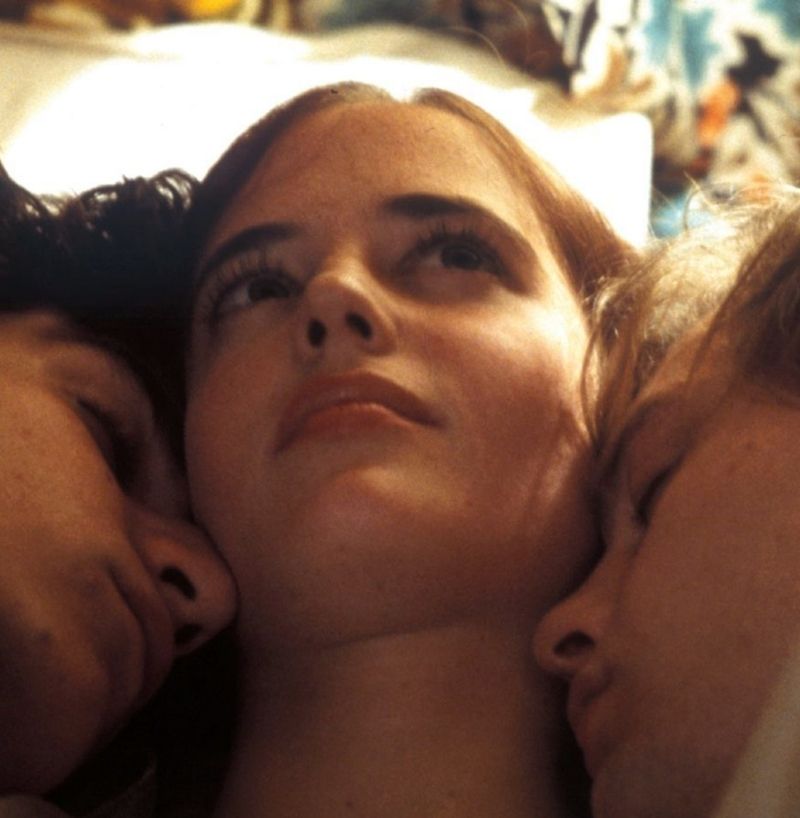
Is love linear if desire does not live in permitted places? If it intertwines, tangles, spills over and hides; if it sits in glances that must not be returned; if one person will never be enough, and two are always, always too much? It seems that, in the geometry of longing, love triangles, sharp, uneven and inevitable, have the most human shape. After all, the triangle is the simplest figure that brings instability. A couple is in balance, a triangle loses its equilibrium. It tilts, stretches, changes sides or ultimately collapses. The third point is doomed to bring unrest, because it introduces into the simplicity of the emotional surface a complexity for which there is no room. And yet it is precisely there that something deeply human is revealed.
Love triangles are never about choosing between two people. Ultimately, they are always about us: passion or peace, fantasy or reality, safety or risk. The third angle is not merely another romantic option. It is a version of life that could be lived, an externalized inner conflict. That is why it is, and has to be, tense. That is why we return to it. Not as a source of entertainment, but as a lens through which we see ourselves. At its core, the love triangle is not about love, but about the impossibility of existing within a whole and about what happens when desire is divided, thwarted or looked at honestly, like a reflection in a mirror.
At the center is the storm
Anna Karenina suffers, Gatsby’s Daisy retreats, broken, Madame Bovary dies, and we still watch Casablanca and The Graduate with a lump in our throat. In classic love triangles, the person caught between two lovers is the one who gets the worst of it. Like a hinge on a door being pulled in opposite directions, they stand still, unable to move, because guilt, indecision and need are a burden that is difficult to carry. In a triangle, one must choose, because it is impossible to have everything and unbearable to be left with nothing.
An intoxicating combination, and no less rare in today’s pop culture. That is why it is hardly surprising that we reacted so strongly to Call Me By Your Name, The Worst Person in the World and Y tu mamá también, that Nicole Kidman’s monologue from Eyes Wide Shut instantly became a cult classic, and that this year we awaited each episode of Severance with such fervor.
“He looked at me as he passed. Just a quick look. Nothing more. But I could barely move […] And I thought, if he wants me, even just for one night, I am ready to leave everything […] It was strange because, at the same time, you were dearer to me than ever. And in that moment, my love for you was both tender and sad.” As Nicole Kidman, as Alice Harford, explains to us, the poetics here lies in the tension between desire and limitation. In this dark realm, we always ask ourselves: what if we made the wrong decision? What if we lose both? What if that other life remains forever in the shadow of the one that came before? And however rational we may be by nature, the answer will certainly not be logical.
Reflection or illusion?
As they say: three is a crowd, and often that third side in this geometry is considered a threat. After all, it is the one that brings chaos. And while that may be true, sometimes the truth is more subtle and symbolic. The third is a reflection of the protagonist’s desire, a desire of which they themselves may still be unaware, or a part of the self that has been suppressed beneath the surface. From romantic comedies à la Bridget Jones, through Bertolucci’s arthouse film The Dreamers, all the way to the new A24 film The Materialists, which will define the summer of 2025 and which we have been buzzing about for months, this conflict of identity is present across all genres and media, and it plans to stay there.
Take, for example, last year’s film Challengers, directed by Luca Guadagnino, where it is clear to us that, for Tashi, Art and Patrick, all tennis is about sex, and all sex is about tennis. In this love triangle, lust plays a supporting role, while the stage belongs to ambition, control and identity. Tashi is not only an object of desire. She is the force of gravity pulling both men toward her while, at the same time, drawing out of each of them as much of the best as of the worst. Every relationship in this film coaxes a different aspect of the characters’ personalities to the surface, and the choice of partner is overshadowed by the desire to win a new version of oneself. Game, set and match.
Even more brutal is the love triangle in Elena Ferrante’s My Brilliant Friend, which at first glance may seem to encompass Lenù, Lila and Nino, but in fact consists of entirely different elements. The two friends clash over the idea of a better life and escape from the poverty in which they grew up. While Lila represents chaos, creativity and sharpness of mind, unwilling to play by the rules, Lenù is diligent, compliant and determined to reach the top through education and social approval. Although Nino is a key man in both women’s lives, their love for him could never compare to the love and envy they feel for one another.
At the same time, not all triangles are romantic, but rather reflections of power or the lack of it. The Talented Mr. Ripley brings class struggle onto the stage instead of love, obsession instead of passion.
In such a setup, what is presented is not only an emotional conflict, but also a social one: who is the one who chooses, who is the one who remains, and who will be erased from the narrative entirely?
In all three stories, the triangle is proof of the fluidity of identity. What we are with one person may not be able to survive in the presence of another. And sometimes the pain is not tied to the loss of a lover, but to the loss of that brighter, lighter and more desirable version of ourselves that we become in someone else’s eyes.
Why does the triangle endure?
In a culture that values resolution, happy endings and certainty, the love triangle is a kind of pillar of resistance. It is essentially unsolvable, because even when someone “wins”, someone else loses. Every decision made is full of regret, and the one who leaves is remembered the longest.
That lack of resolution is, in essence, what gives the love triangle its timeless character. It tells us that love is not a straight line, but a knot, that we are not always consistent, rational or composed, and that an honest depiction of love is more devastating and more tangled than the one we are given in classic media.
Still, it is dangerous to lose sight of one undeniable fact: love triangles are exciting. They lure us in and serve voyeurism and projection on a silver platter. Through film, literature, television and music, they force us, together with the characters, to discover what lies on our hearts: jealousy, vulnerability, betrayal or escape into the unknown. In real life, their appearance is far more dramatic, because it inevitably provokes and tests our understanding of morality. But if we were to say that they do not awaken some kind of empathy in us too, we would be lying. Because, after all, who among us has not at some point been divided between two things that cannot exist at the same time?
Living the triangle
Ultimately, the allure of the love triangle does not lie in scandal and anticipation, but in its ability to illuminate the rawest parts of our inner lives. It forces us to confront our own indecision, lust and contradictions. We do not return to these stories only to find out who will end up with whom. We return to them to feel the heat of possibility and the weight of decisions we could never, or dared never, make ourselves.
Love triangles remind us that longing does not follow the instructions of a script. That we are sometimes drawn to different people for completely different, incomprehensible reasons. And that love, like everything in life, means something different to each of us. Because we are made up of fractions, because we are fluid and because we will never stop searching. Perhaps the triangle is so important also because it reveals another, greater truth: that the heart is not a perfect circle. It pulls us in different directions, and the most important love stories are not about choices, but about the admission that we are capable of wanting several things at the same time, and that this desire is, in itself, a kind of poetry.