

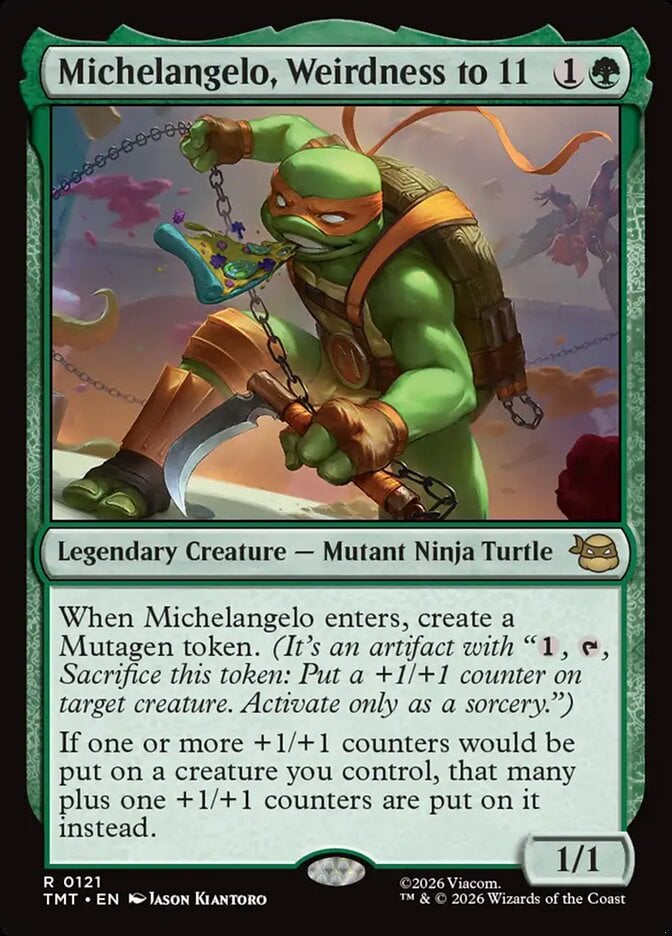
Michelangelo, Weirdness to 11 | Illustration by Jason Kiantoro
In the early 1980s, two young, aspiring comic book artists, Kevin Eastman and Peter Laird, asked the question: “If Bruce Lee was an animal, what would be the absolute dumbest animal he could be?” A few silly sketches later and the result of their efforts was the Teenage Mutant Ninja Turtles, which more than four decades later has become a beloved media franchise that spans TV shows, movies, toys, video games, and of course, comic books. At least, that’s how Kevin Eastman tells it.
Now, with the Heroes in a Half Shell joining Magic: The Gathering, let’s look at every card that you can find in Play boosters of this new expansion and judge how they’re likely to play out in a prerelease or a local draft.
As always, this is a review based on my initial impressions of the cards. Various factors like the speed of the format or the general power levels of the colors and archetypes are relatively unknown early on. Many cards will under- or overperform based on initial impressions as the format takes shape. My reviews are largely based on the card’s quality in a vacuum or the assumption that the archetype they belong in is playable.
Grading System
I use a comparative rating system on a scale of 0-10. Here’s a rough guide to what each rating means:
10: The absolute best of the best. 10s make a meaningful impact on any game, especially when you play from behind, and they’ll be extremely tough to beat.
Examples: Gloom Ripper and Trystan's Command.
8-9: Extremely good cards, usually game-winning bombs and the most efficient removal spells, though not quite good enough to be a 10/10. Could also be the mythic uncommon of the set (though these are harder to predict).
Examples: Sunderflock and Champions of the Shoal.
5-7: Important role-players. These are typically great uncommons that really drive you towards playing a particular color, like build-arounds and good removal, as well as very powerful commons. Cards like Morcant's Eyes or Silvergill Mentor.
2-4: The average Limited card. Most commons end up in this range and most of your Limited decks are made up mostly of these.
Examples: Wanderbrine Preacher and Unexpected Assistance.
1: These cards are weak and you hope never to play them in your main deck, though they’re still just about playable if you need them in a pinch.
Examples: Reluctant Dounguard and Heirloom Auntie.
0: Virtually unplayable in every scenario and you should never put these cards in your main deck. Typically cards that were designed with Constructed or Commander play in mind but are awful in Limited.
Examples: Rimefire Torque and Mornsong Aria.
Set Mechanics
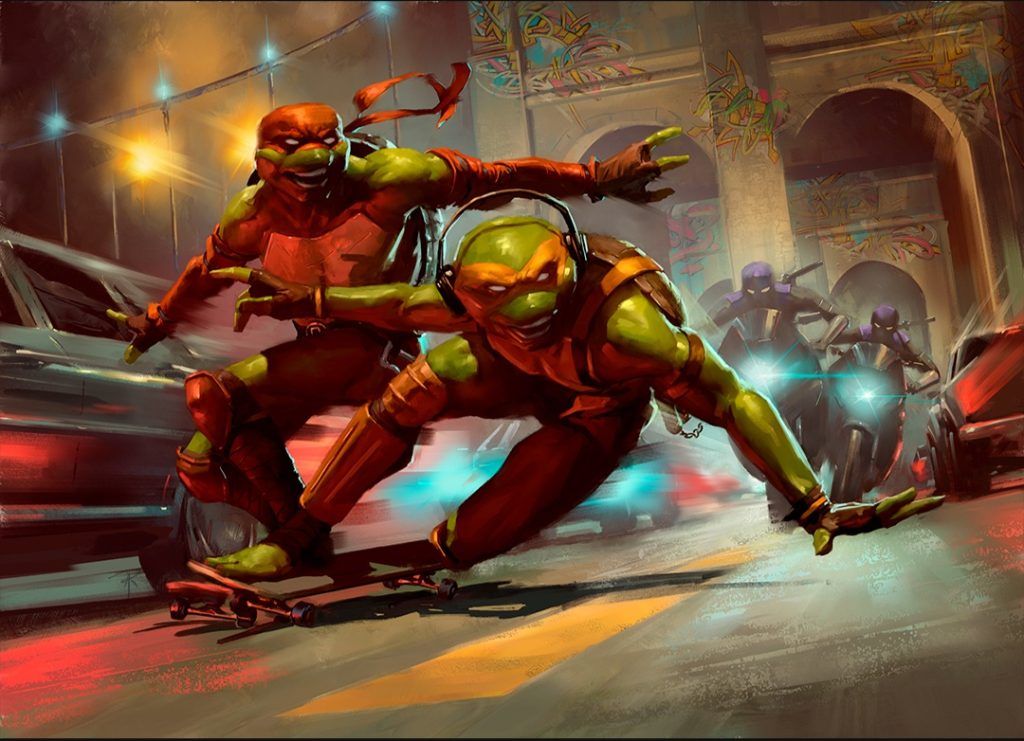
Raph & Mikey, Troublemakers | Illustration by Aaron J. Riley
TMT contains a variety of new and returning mechanics that all feel quite thematic for the ninja turtles, so let’s have a look at each of them.
Alliance
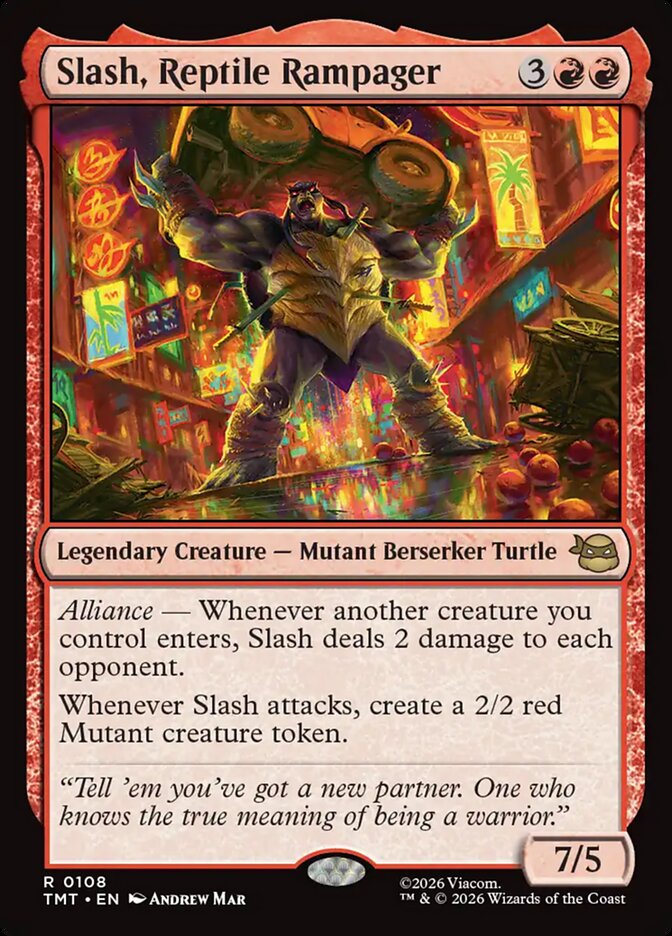
Returning from Streets of New Capenna, alliance is a very simple ability word that signifies abilities that trigger whenever another creature you control enters (often called “creaturefall”). It’s very straightforward, which is great. It makes for good, honest gameplay that rewards you for doing what you were likely to do anyway. It works very well with anything that gives you multiple creatures in one go, so keep an eye out for those as you build your deck.
Classes
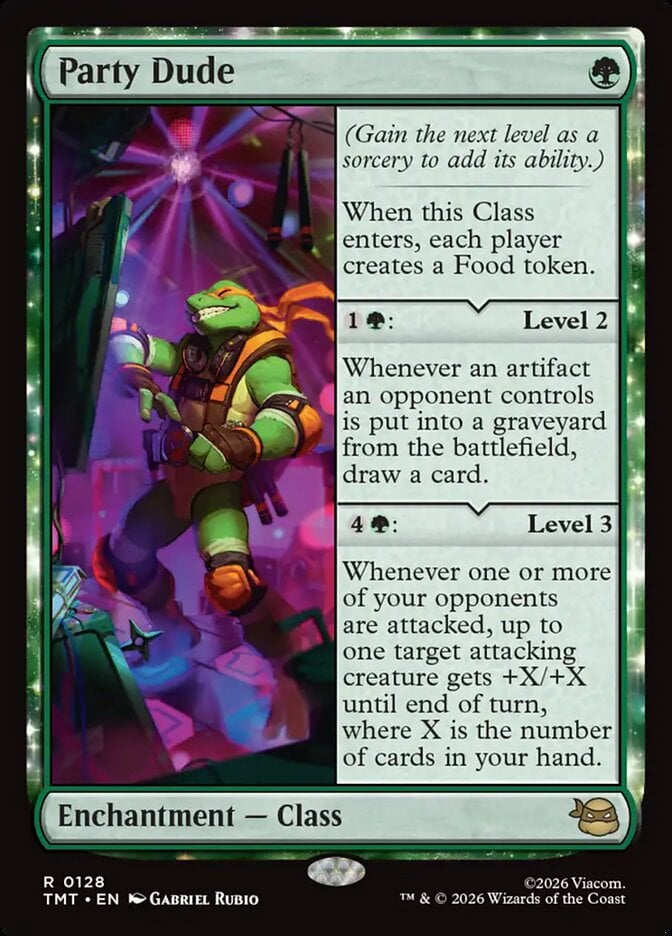
We’ve seen classes a few times before, so we’re pretty familiar with them at this point. Classes are an enchantment subtype that you can level up to improve their abilities. Each class begins at the first level and gives you access to the first ability at the top of the card. Then, at sorcery speed, you can pay the corresponding mana costs to level up the class to level 2 and then again to level 3 to gain access to their respective abilities. Notably, when you level up a class, you still keep the abilities from the previous levels, so you’re just improving them by leveling them up.
Classes are interesting, but noncreature cards in Limited need to do a lot to make the cut. We’ll have to see just how powerful each one is.
Disappear
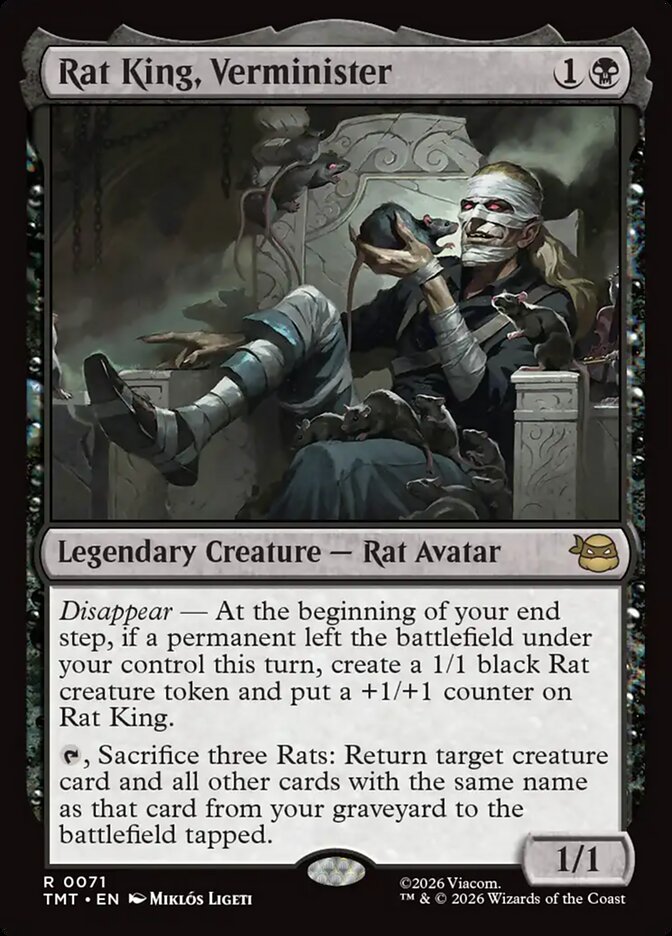
Disappear is a new ability word, though it’s very reminiscent of some older ones. Disappear just means that this ability cares in some way about a permanent having left the battlefield under your control this turn, very much like the revolt or void ability words.
Notably, these abilities won’t need to have seen that permanent leave because the game tracks that for you. If you have a creature die in combat then play something with a disappear trigger after combat, it’ll know that your creature died earlier and trigger accordingly. These abilities tend to be pretty good, but you shouldn’t consider them to be trivial; you need to enable them if you want them to trigger consistently.
Mutagen Tokens


Mutagen tokens are a new type of generic artifact token along the same lines as Treasure, Clue, Food, Blood, Map, Junk, etc., and they’re pretty simple. You can pay 1 mana and sacrifice them to put a +1/+1 counter on a creature. They’re essentially like +1/+1 counters that you can float on the board and then distribute wherever you need them. We’ll see a lot of these throughout the set, and they help with not just counter synergies but also artifact and token synergies, which this set appears to be full of.
Sneak
We’ve had ninjas in Magic before thanks to our visits to Kamigawa, so ninjas already have their own thematic mechanic. Ninjutsu is quite restrictive, however, because it can only really appear on creatures. Sneak is a remodel on the classic mechanic: Instead of an activated ability that puts your creature directly onto the battlefield, sneak is an alternate casting cost, which allows it to appear not just on creatures but on other kinds of spells, too. Otherwise, it functions very much the same, allowing you to cheat out a spell for less mana by returning your unblocked attacker to your hand.
This is the set’s key mechanic, so look to pick up cheap, evasive creatures to help enable it. Creatures with good enters the battlefield abilities are also great options to return to your hand and reuse.
The Ninja Turtles Themselves
Leonardo, Donatello, Raphael, and Michelangelo appear a lot in this set. Each of the four main ninja turtles are assigned to one of Magic’s five colors, and each appears four times in that color, once at each rarity. In addition, there’s a cycle of “techniques” with their names on them and a cycle of dual color rare team up legends that includes each possible pairing of the four turtles. That makes for eight unique cards for each of them, and more ampersands than I’ve ever needed for a set review. Also, the creature types of mutant, ninja, and turtle all have some mechanical relevance somewhere in this set.
Draft Archetypes
TMNT is a smaller set designed for Pick-Two drafts. As such, we only have five draft archetypes in the set:
- Orzhov (White/Black ): Ninjas/Sneak
- Golgari (Black/Green ): Food/Disappear
- Simic (Green/Blue ): Mutants/Mutagen
- Izzet (Blue/Red ): Artifacts
- Boros (Red/White ): Alliance (Go-Wide Aggro)
If you want an in-depth look at the archetypes and some of the major set logistics, check out our Prerelease Guide from our new YouTube channel, The Daily Upkeep:
White
Action News Crew
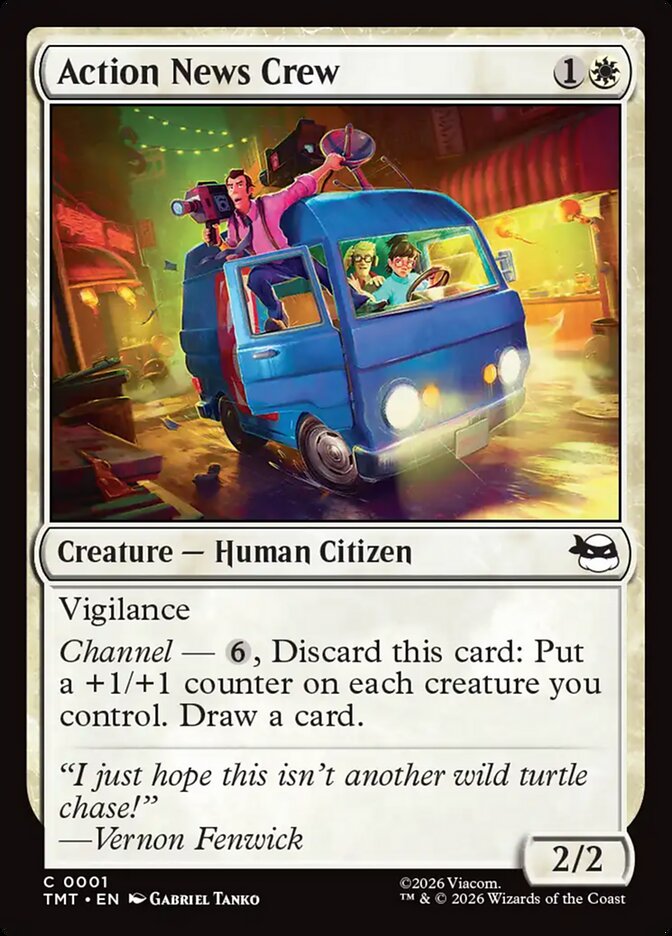
Rating: 3/10
Yes, Action News Crew is the only card in the set that has channel and it’s here because the news crew works for Channel 6. I love this card’s flavor, but it’s also a very solid common creature, especially if you can play it early and find a way to sneak it back to your hand later.
Agent Bishop, Man in Black
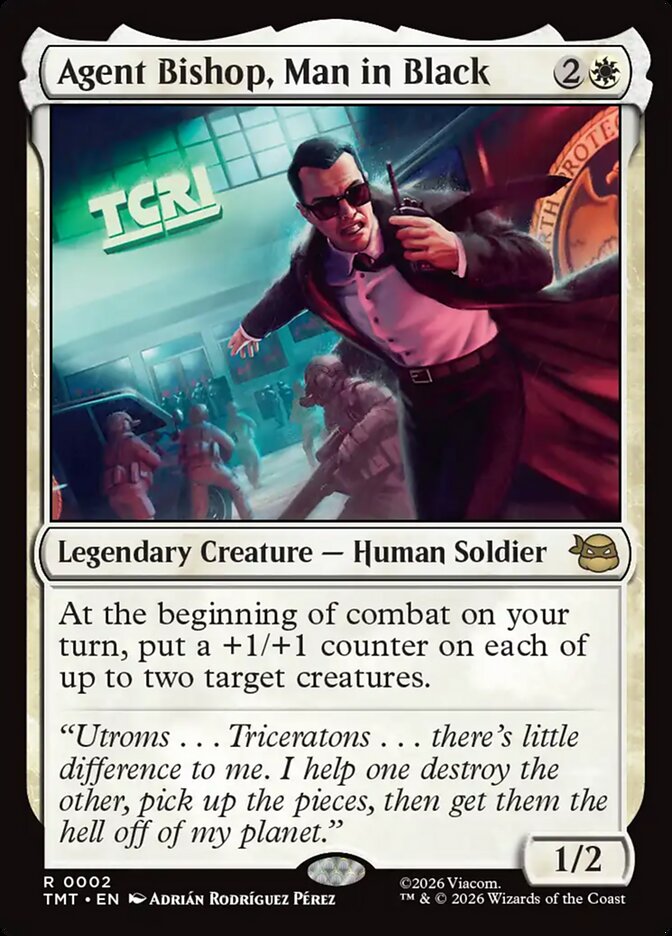
Rating: 10/10
Back in Zendikar Rising, we were introduced to Luminarch Aspirant, which was one of the best cards in the entire set. Since then, we’ve seen Halana and Alena, Partners, Siege Veteran, and Ornery Tumblewagg, just to name a few. All have been incredible bomb rares in their respective formats. I have no doubt that our newly power crept version, Agent Bishop, Man in Black, will be just as powerful, if not more so, and a likely contender for the card you most want to open.
April O’Neil, Kunoichi Trainee
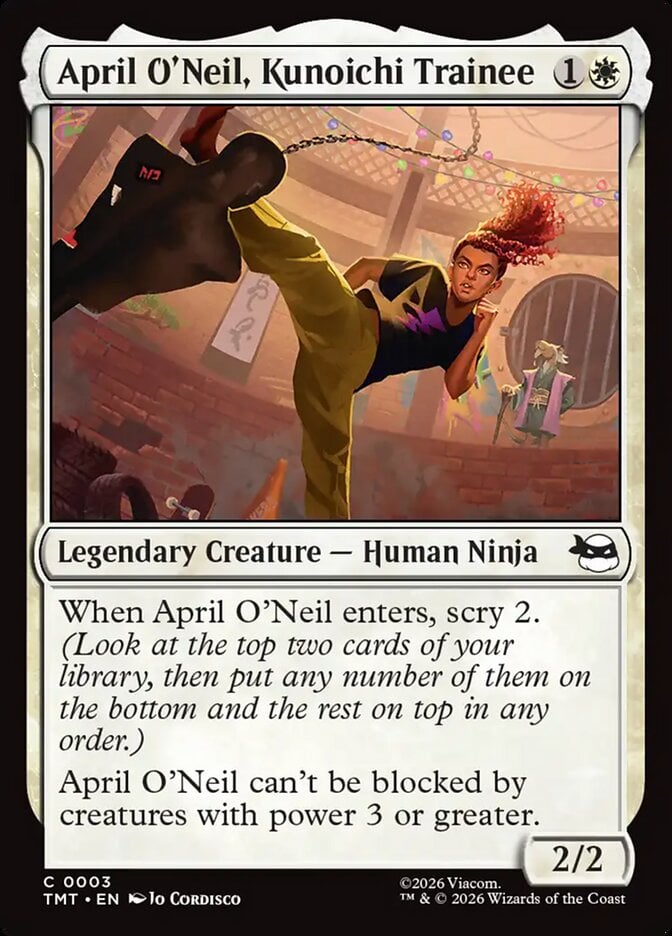
Rating: 4/10
Sneak needs two things to enable it properly: cheap, evasive creatures and good, reusable enters the battlefield triggers. April O'Neil, Kunoichi Trainee is a good little common 2-drop that can do a little bit of both, which makes it pretty valuable when drafting a ninja deck.
Dimensional Exile
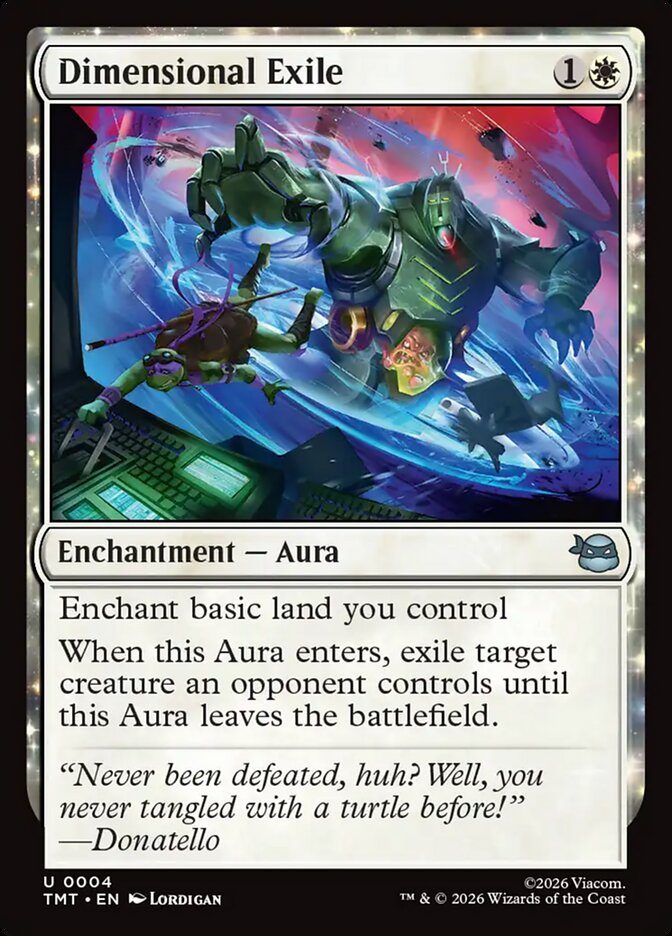
Rating: 7/10
Two mana to answer any creature is a great deal. Dimensional Exile is a premium removal spell that any white deck is happy to play.
East Wind Avatar
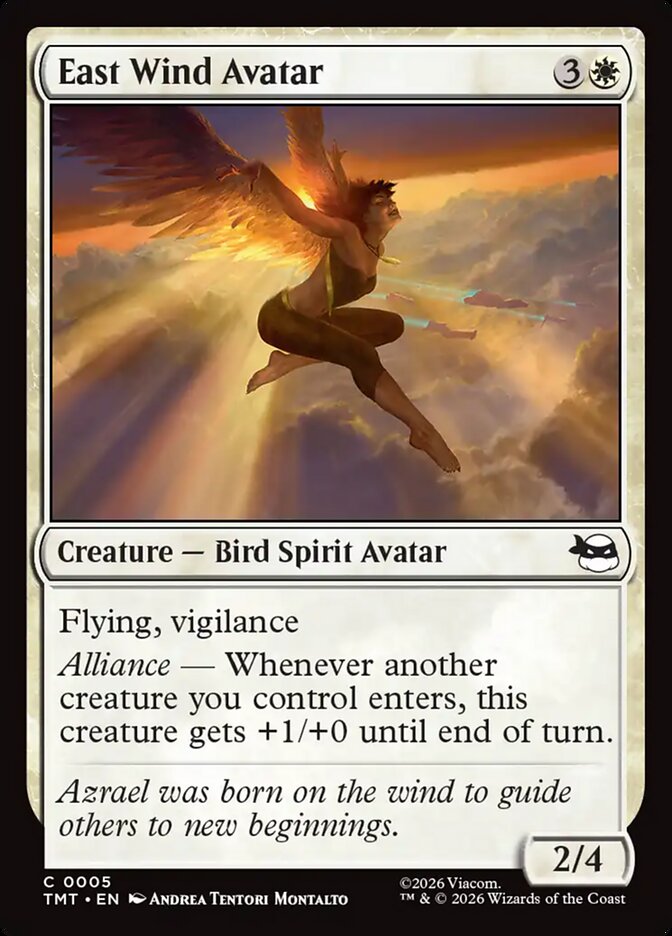
Rating: 3/10
When I reviewed Bloomburrow, I was really high on Wax-Wane Witness precisely because it was a 2/4 with flying, vigilance, and more upside for just 4 mana. I’m not making that mistake again. I think East Wind Avatar is a perfectly fine curve-filler, but we’re just long past the point in Magic’s history when oversized pseudo-vanilla creatures are exciting.
Featherbrained Filcher
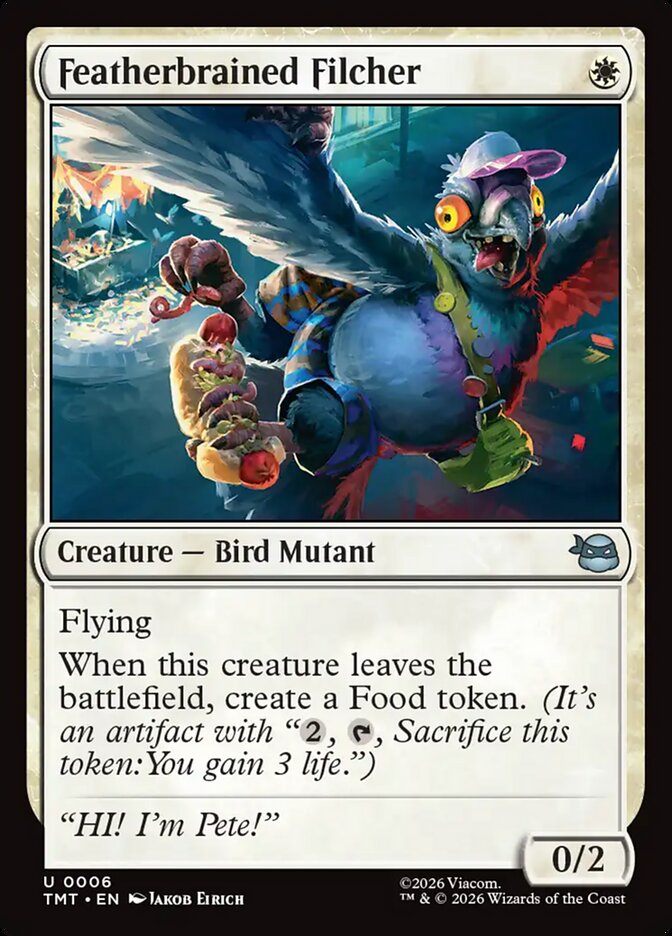
Rating: 5/10
Yay, it’s a 1-drop flier to enable sneak! Sadly, that’s about all that Featherbrained Filcher does. Having 0 power means you’re unlikely to want it anywhere else, but in sneak decks it looks incredible!
Grounded for Life
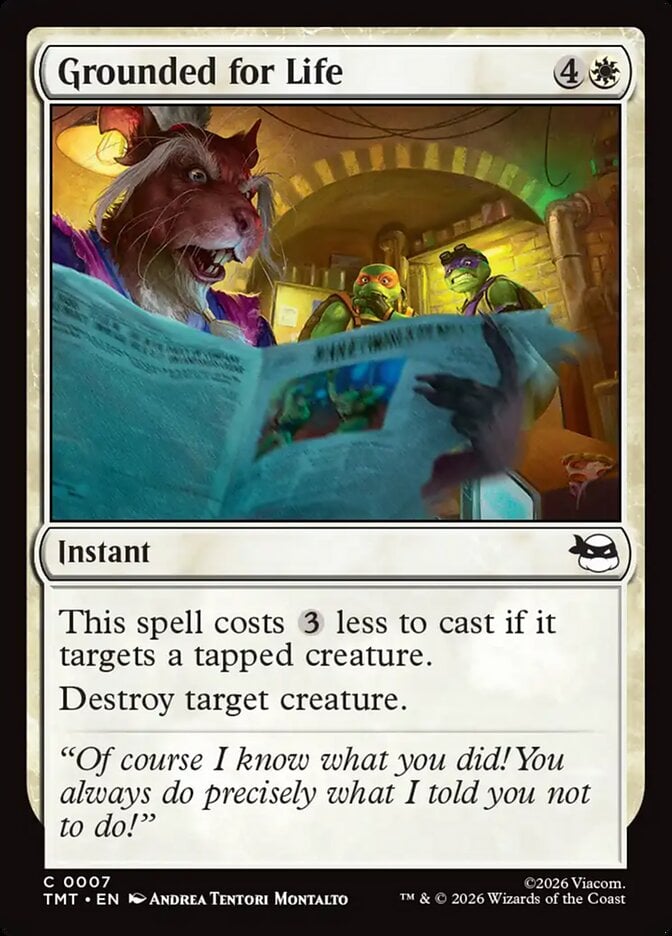
Rating: 4/10
Both of white’s archetypes are very aggressive, so a defensive removal spell like this doesn’t sound all that appealing. That said, sneak decks are probably going to be annoying, and Grounded for Life is a good answer to them, so this’ll probably be fine.
Hamato Guardian Stance
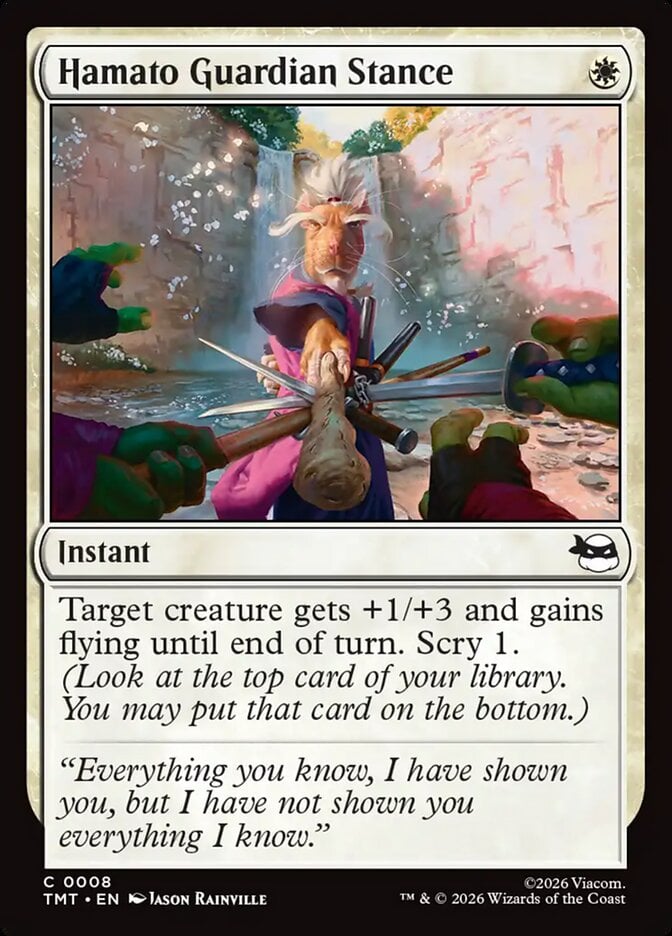
Rating: 1/10
Hamato Guardian Stance is a quintessentially mediocre combat trick. Costing 1 mana is the best thing it has going for it, but the effect is nowhere near powerful enough for most decks to really care.
High-Flying Ace
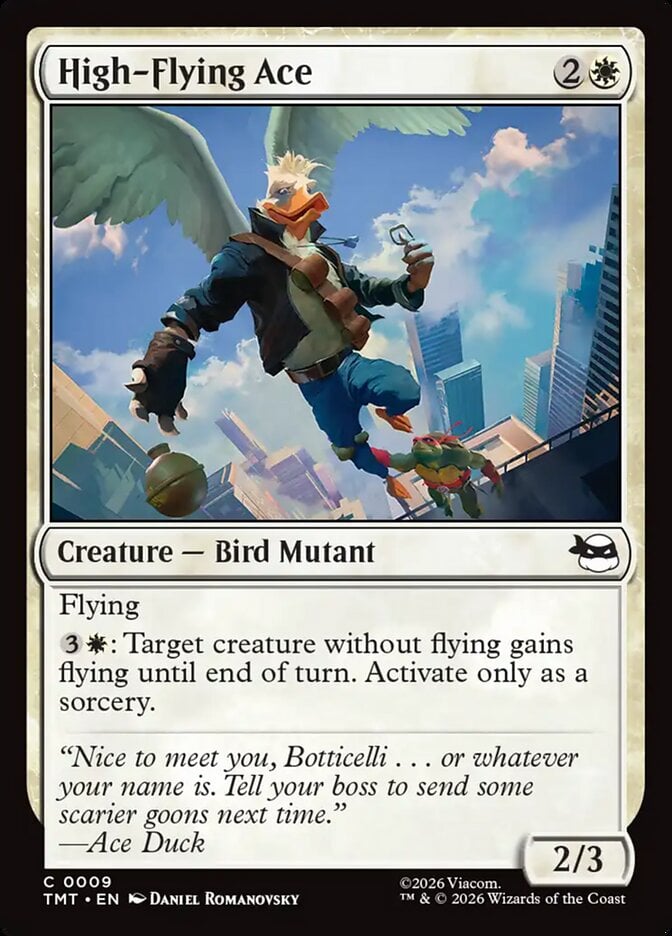
Rating: 4/10
High-Flying Ace looks like a custom-built common for the sneak deck. First and foremost, it’s a relatively cheap flier to enable sneak costs, while it’s also a pretty good size itself. But in the late game, it really pops off: You can give flying to something with a good enters ability, sneak with it, and reuse the ability. I quite like this one, and I’m sure it will be pretty decent.
Jennika, Bad Apple Big Sister
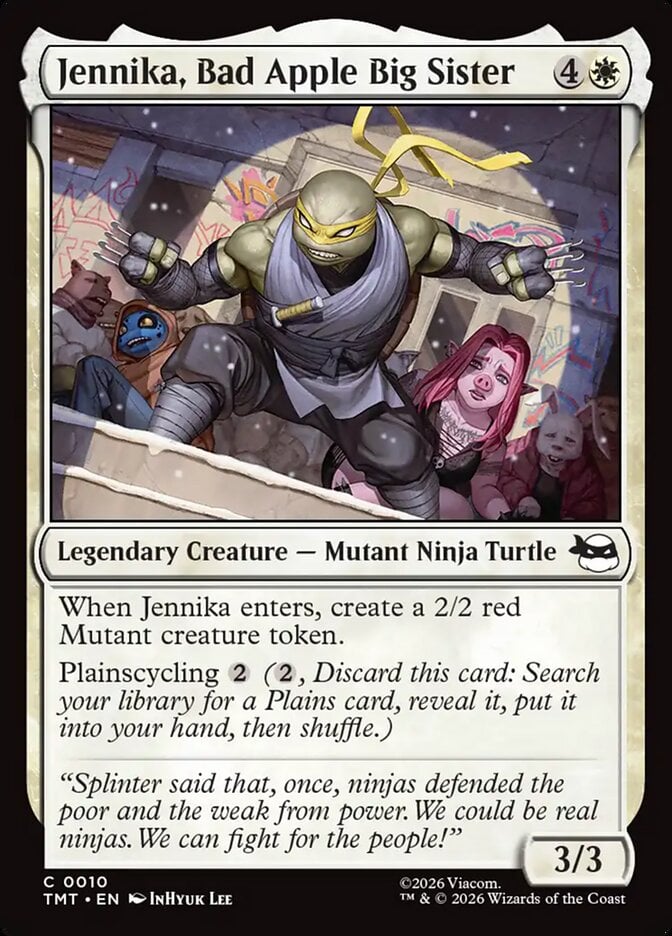
Rating: 3/10
Looks like basic landcyclers are back! Jennika, Bad Apple Big Sister might be one of the better white ones we’ve seen, too. Five mana for a 3/3 and a 2/2 is a pretty solid rate, but two bodies in one is also awesome for triggering alliance abilities. Jennika’s even really good at sneaking back to your hand. It’s not that good, but compared to many of the white landcyclers we’ve seen in the past, Jennika is quite impressive.
Koya, Death from Above
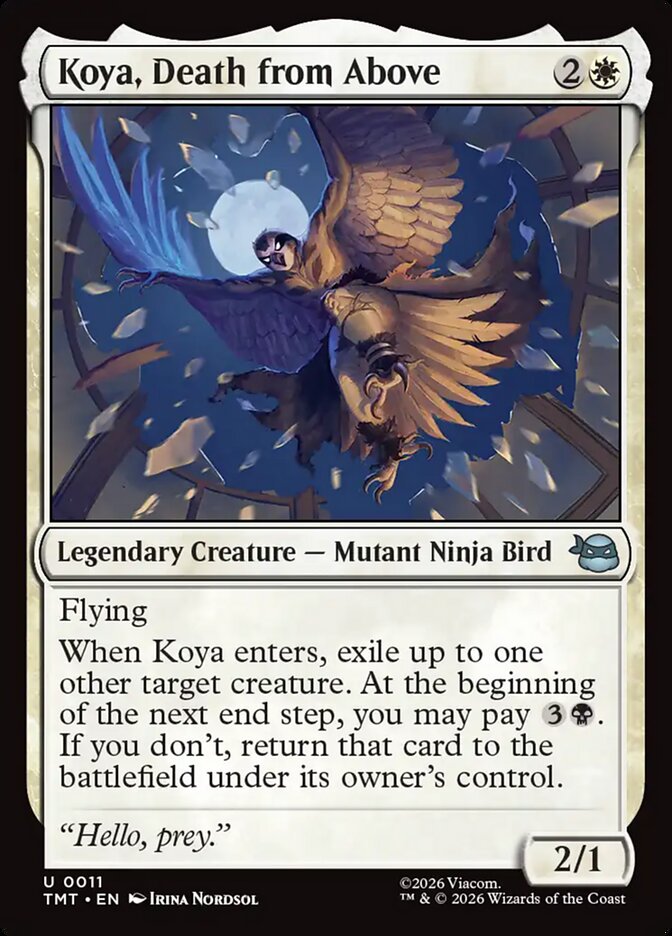
Rating: 7/10
Right away, Koya, Death from Above is essentially a smaller Flickerwisp, which is a great start, especially for the ninjas deck. But if you ever manage to get to 7 mana, Koya upgrades into a full-blown Angel of Despair, exiling any creature you need to. Sure, it costs 7 mana and requires a second color, but that’s well worth the wait, and the starting point is pretty damn good in the meantime.
The Last Ronin’s Technique
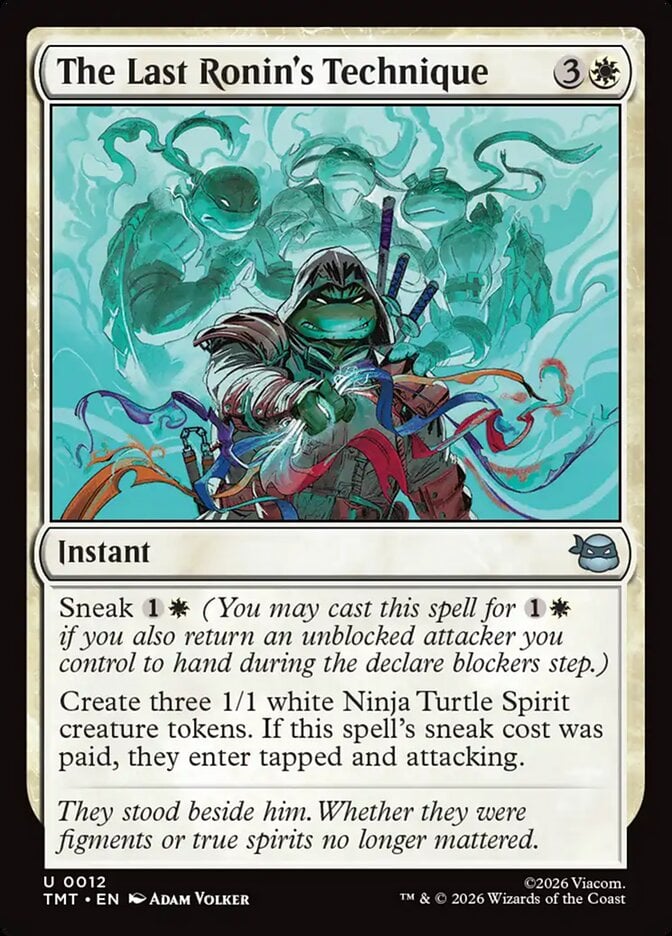
Rating: 5/10
Four mana to create three 1/1 tokens isn’t all that great, but the sneak cost on this looks enticing. Usually, you don’t want 1/1s to enter tapped and attacking, as they’re easily eaten by opposing blockers, but that’s not possible when they enter after blocks are declared. The Last Ronin's Technique looks like a good role-player for any deck built around the sneak mechanic.
Leader’s Talent
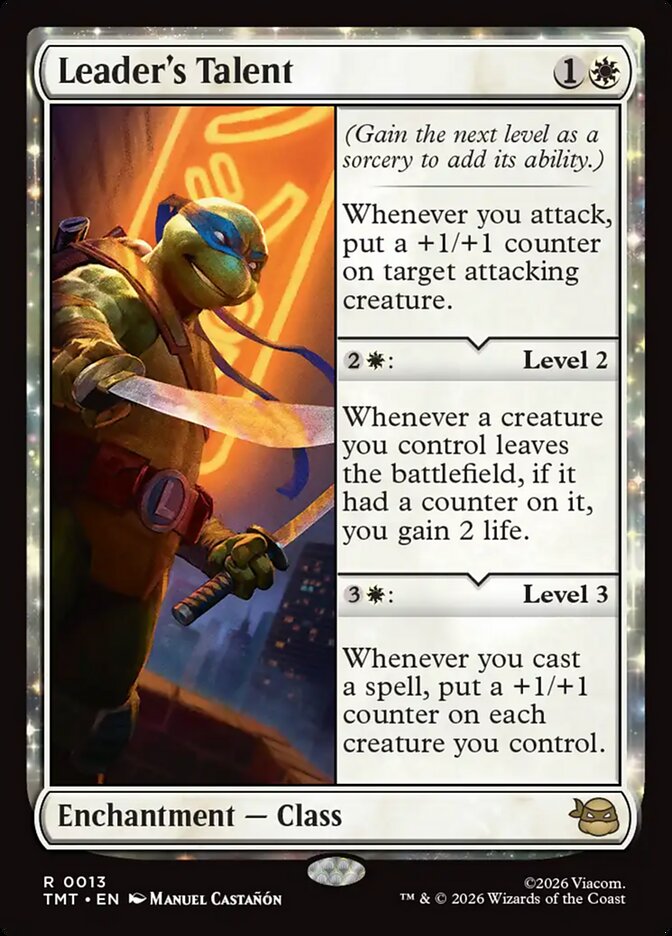
Rating: 6/10
Thankfully, you're given the best ability on Leader's Talent right away, so there’s barely any need to level it up. For 2 mana, this sits in play and can generate a free +1/+1 counter every turn, assuming that you can keep attacking. It’s reasonable to level it up from there, but the other abilities are so minimal that you probably won’t want to prioritize them over other game actions.
Leonardo, Big Brother
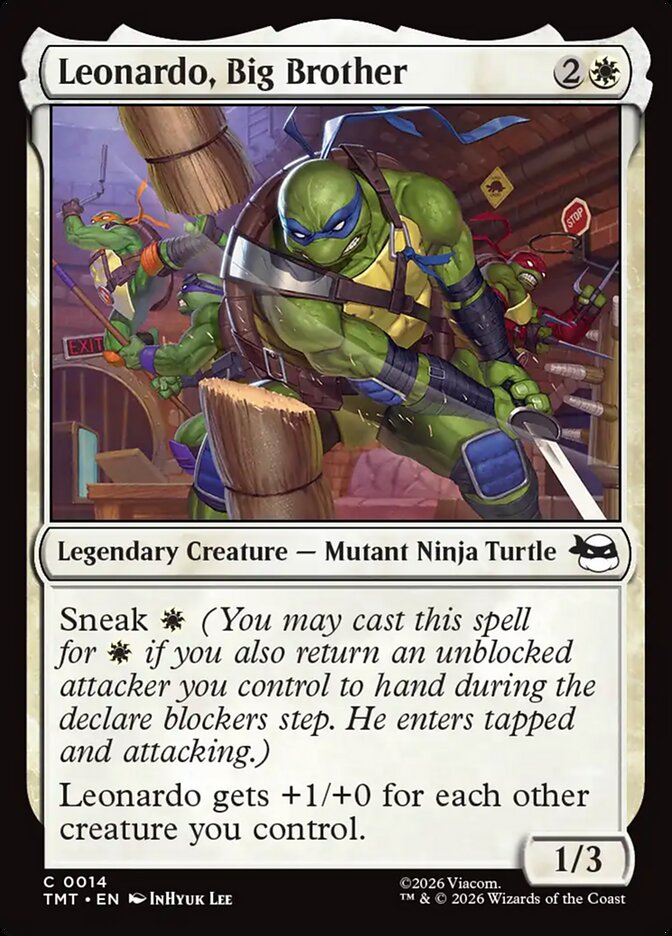
Rating: 2/10
You’d think a common Leonardo with sneak would be a pretty sweet card, but Leonardo, Big Brother looks underwhelming to me. Costing 1 mana to sneak might be interesting, though. If you have a sneak creature with an enters trigger, for example, you could sneak that creature in and then bounce it cheaply with this. Still, that’s fairly niche, and I don’t think Leonardo is worth playing all the time.
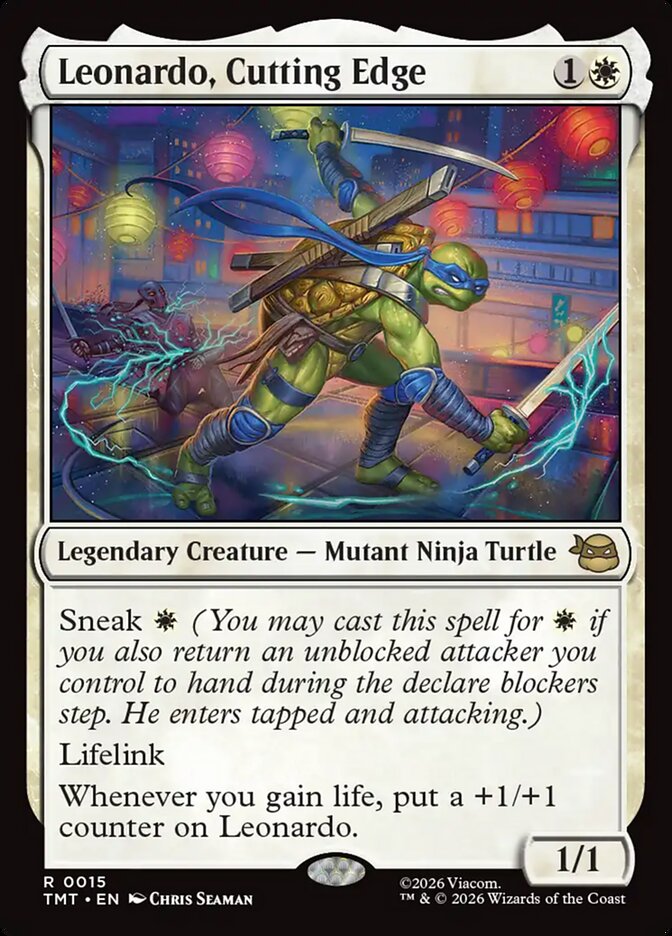
Leonardo, Cutting Edge
Rating: 7/10
Lifelink is a perfect keyword for an Ajani's Pridemate, which is precisely what we get here on Leonardo, Cutting Edge. Plus, when you sneak it in, you typically get that first bit of lifegain right off the bat. There aren’t too many more sources of lifegain throughout TMT, but even one should help you to snowball this into a huge threat that your opponent needs to deal with.
Leonardo, Leader in Blue
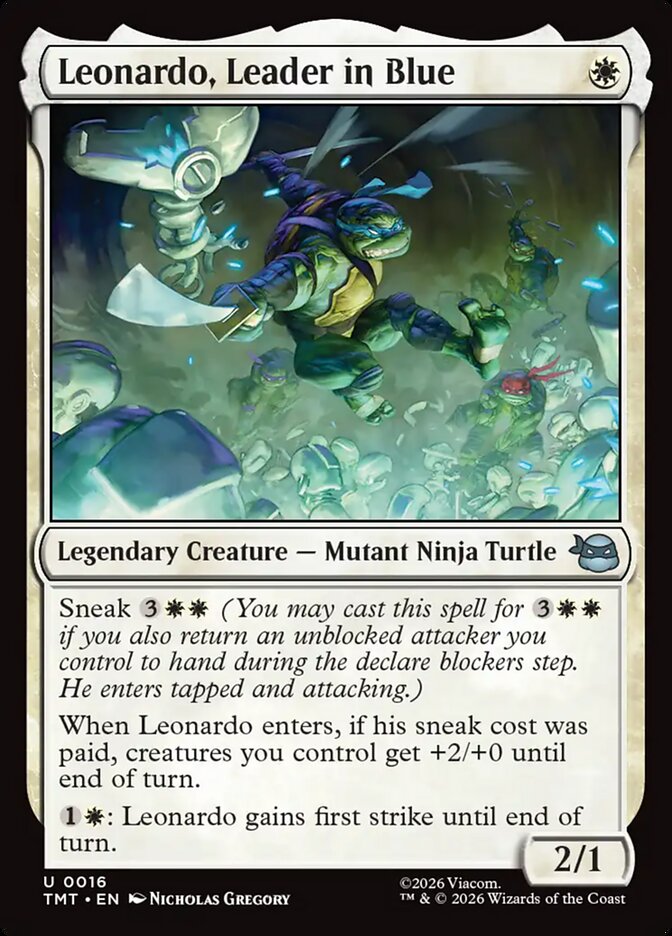
Rating: 7/10
Who needs evasion when you have the threat of activation? If you run Leonardo, Leader in Blue out on turn 1, then your opponent can’t reliably block it until they find a creature with 3 toughness, and you don’t even need to activate Leo’s ability to do that. That makes it a great enabler for some sneaky ninjas, and it’s also a pretty good one itself when you’re going wide.
Leonardo, Sewer Samurai

Rating: 9/10
I think the best comparison I can draw is with Serra Paragon, an extremely powerful card in its own right. Leonardo, Sewer Samurai doesn’t even limit you to one creature each turn, so you could feasibly cast several if the situation allows for it. I’ve run the numbers and roughly a third of the creatures in this set have a power or toughness of 1 or less, so there are a lot of potential creatures to give you value.
The funny part is that if you return any of these to your hand for a sneak cost, the finality counter won’t do anything, so you could just keep playing them over and over. This Leonardo is a really powerful card that can catch you back up in a game you’re losing if it stays in play for an extended period of time.
Leonardo’s Technique
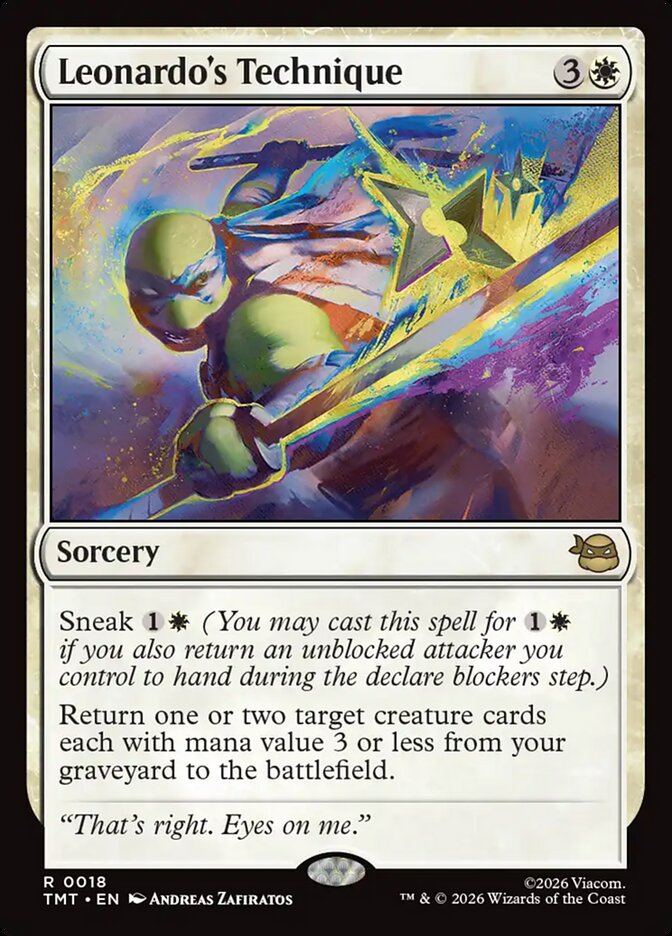
Rating: 2/10
We’ve seen cards like Helping Hand and Recommission in the past, and they’ve always been fine, but a little too situational most of the time. The task to set up a decent creature in your graveyard isn’t trivial. Leonardo's Technique is even more situational, but it gives you a greater reward if you can find the right time to cast it. I could be wrong on this one, but I think the risk of never getting to cast it outweighs the potential upside of reanimating two creatures at once.
Lita, Little Orphan Amphibian
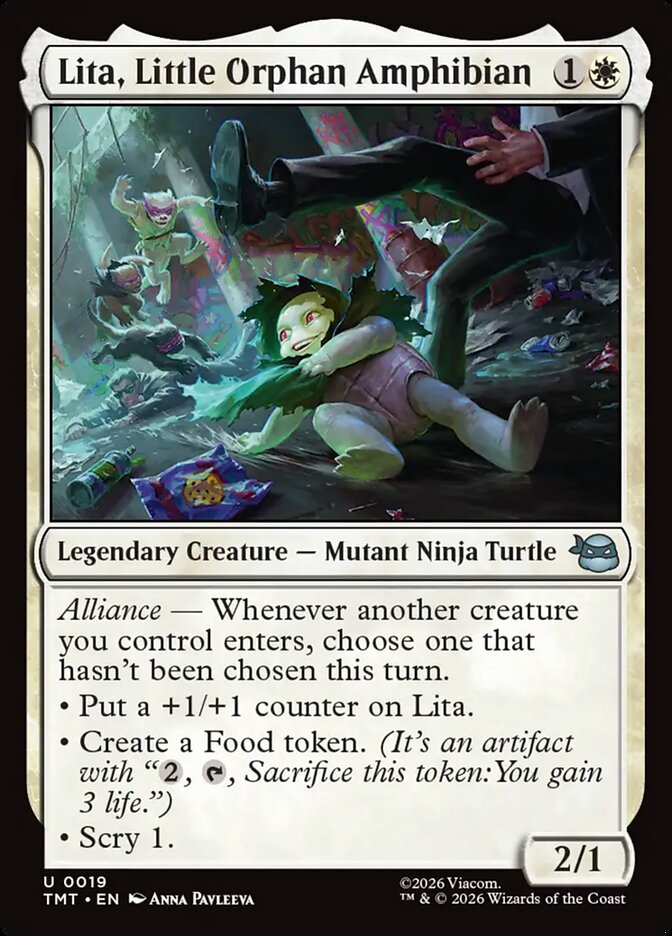
Rating: 6/10
If I’m planning to play creatures on most turns of the game, which is what every white deck in TMT Limited is going to want to do, then I can’t imagine many better 2-drops than Lita, Little Orphan Amphibian. It should trigger every turn, and you’ll typically want to add a +1/+1 counter so that it can keep pace with your opponent’s creatures, but the extra Food tokens and scrying are definitely going to help on turns when you can play multiple creatures at once.
Make Your Move
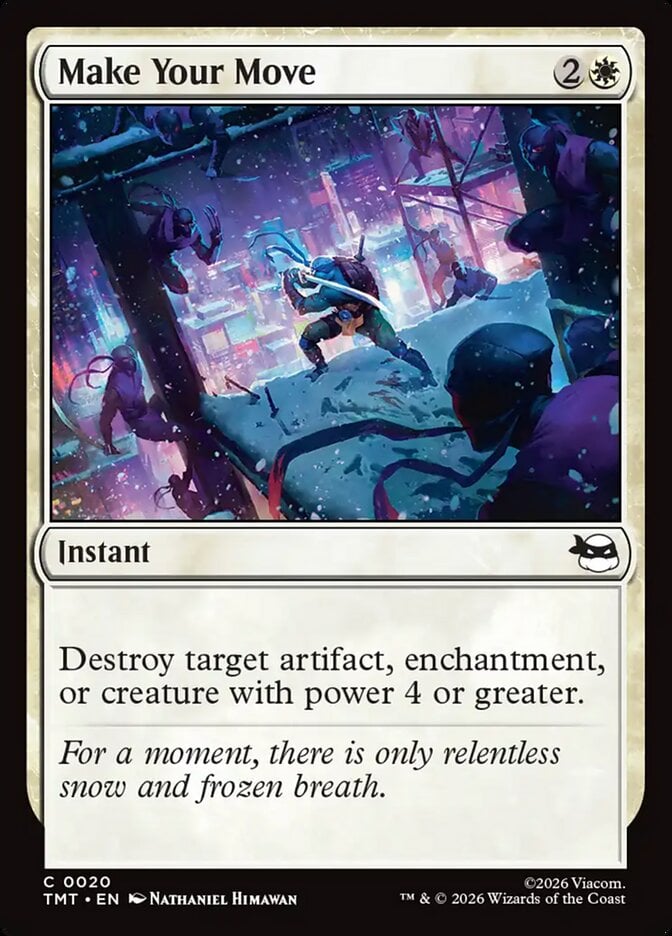
Rating: 2/10
We’ve seen Make Your Move a couple of times before, and I imagine it’ll play out the same here. It’s a good sideboard card, and it’s just flexible enough to make the main every now and again, but it’s not something you need to prioritize.
Mighty Mutanimals

Rating: 6/10
Four mana for two creatures, each with 2 power, is a good deal by itself. What pushes Mighty Mutanimals over the top is the fact that its alliance ability triggers right away, so you also get a free +1/+1 counter. From there, any future creatures you play net you extra counters, and you can use the original creature as a flicker target or something to sneak back to your hand. All of that equals a pretty sweet card for any white deck in this format.
Prehistoric Pet
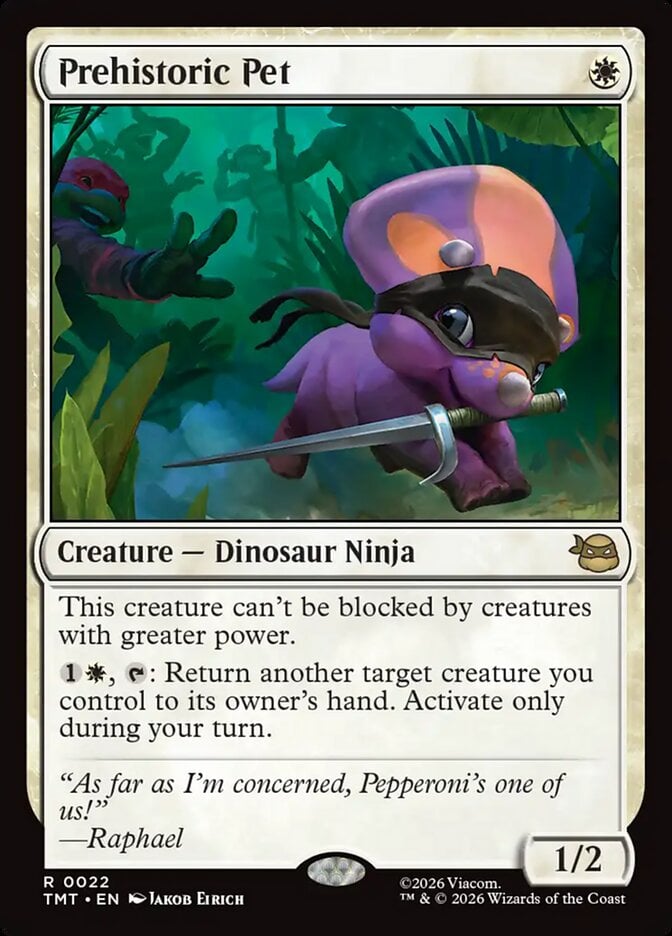
Rating: 4/10
Sneak decks are going to look for cheap, evasive creatures to enable the mechanic and Prehistoric Pet is a… reasonable way to do that. On balance, this evasion is probably worse than just having flying, but it’s still a 1-drop to get the ball rolling early. I do like the extra ability to bounce your own creatures, as getting to sneak them again helps to enable their abilities more often. I think this is a little too clunky to be a standout card, but it’s still a fine enabler when you need it.
Quintessential Katana
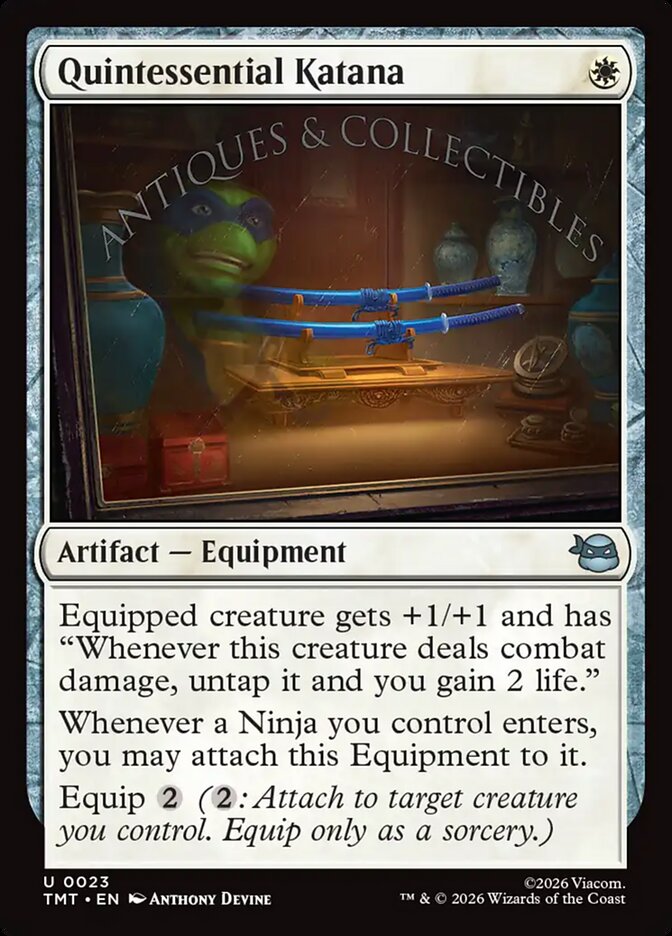
Rating: 3/10
There’s a lot to like about Quintessential Katana. It should generally equip for free most of the time, and it gives you a nice little boost each time. It also costs 1 mana, so you can usually find a way to slot it into your curve. That said, these effects don’t add up to much, and this is a card in your deck that doesn’t really affect the board, so I don’t know if you can afford to play it.
Sally Pride, Lioness Leader
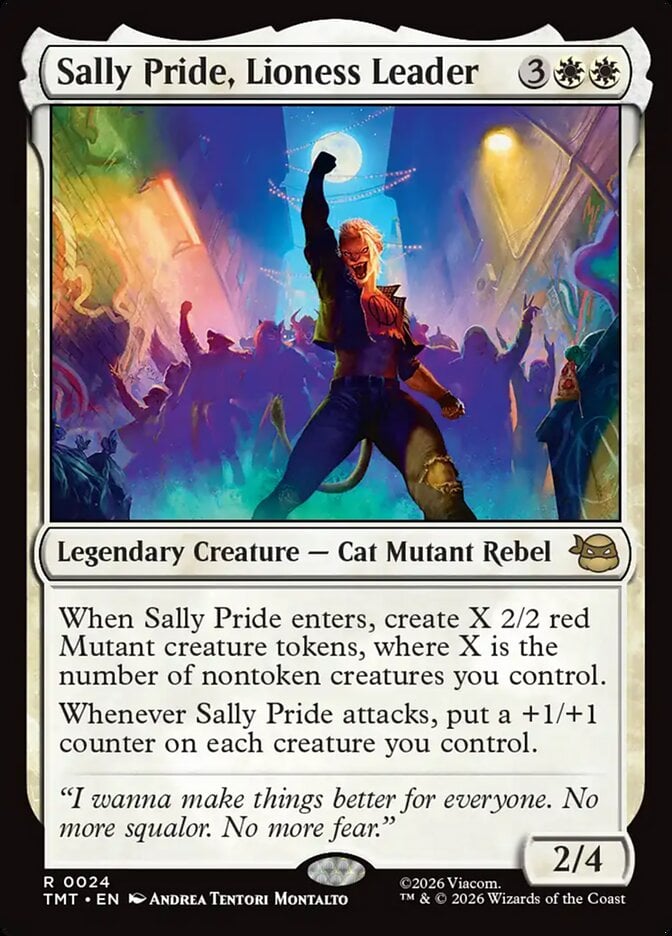
Rating: 10/10
If the top of your curve is Sally Pride, Lioness Leader, you’re going to feel pretty good about your chances in the game. Unless your creatures have been traded off, Sally makes several 2/2 tokens right away. That would be more than good enough, but this cat also buffs them whenever it gets to attack. Even in a vacuum, Sally Pride creates a single token just from seeing itself on the battlefield. Can you imagine getting to sneak it back to your hand? Sally is utterly ridiculous, and one of the best bombs in the set.
Triceraton Commander
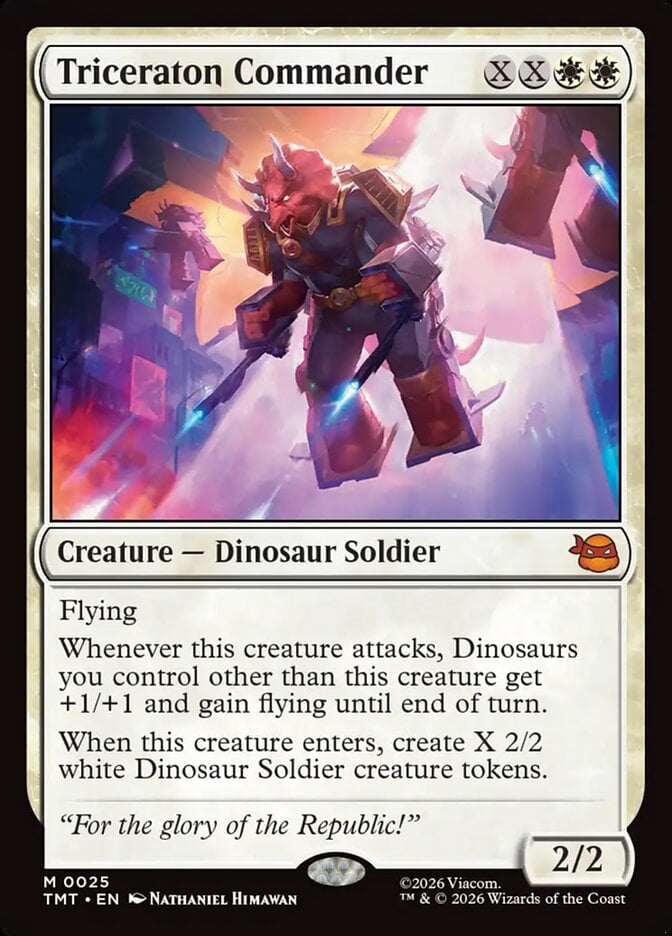
Rating: 9/10
It’s so weird seeing this card right after Sally Pride, because Sally is considerably better while being a very similar design. That’s not to say that Triceraton Commander is bad, because it’s very good, it’s just a bit odd to see them side-by-side. The sweet spot for this card is likely going to be 6 mana, creating two dinosaur tokens, then all three creatures can attack for 8 flying damage on the next turn. Even running this out for X=0 and just getting a 2/2 flier on the board might be the right play in some games, especially to enable sneak. This is flexible and very strong, which equals a good mythic rare for basically any deck.
Turncoat Kunoichi
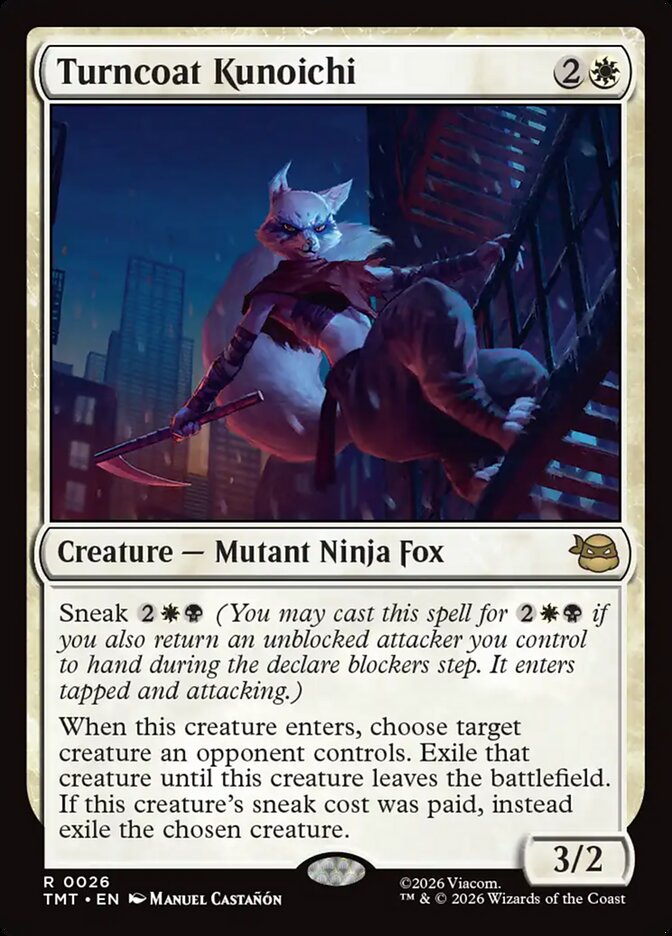
Rating: 10/10
I honestly can’t imagine a better build-around for a sneak deck. Just on her own, Turncoat Kunoichi is already a Banisher Priest, which is an excellent floor to have on your bomb rare. If you can sneak it, this fox becomes a straight up Nekrataal that exiles any creature. This requires black mana, but that doesn’t seem like much of a problem.
Oh wait, we’re not done, because creatures with strong enters the battlefield abilities are perfect choices to return to your hand when you pay a sneak cost. If you had enough mana, you could even sneak it in, exile a creature, then sneak the Kunoichi out for something else in the same combat. This is yet another absurd rare for white and probably the one I’d want to open the most.
Turtles Forever
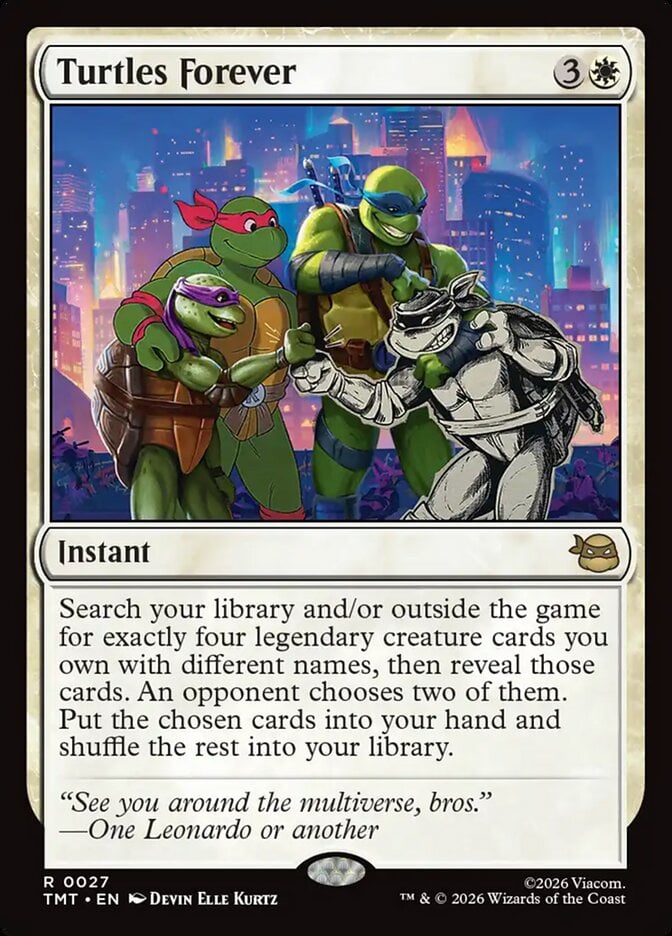
Rating: 2/10
I’d usually look at a card like this, give it a 0/10 and just move on. However, Turtles Forever looks a fair bit better than most. Assuming you have four legendary creatures to find, this always puts two nonland cards into your hand, even if they’re the worst ones that you show your opponent. I realize that a few of the things I mentioned are some significant red flags for this card, but I just think it has some potential and shouldn’t be overlooked. But it’s still not great.
Uneasy Alliance
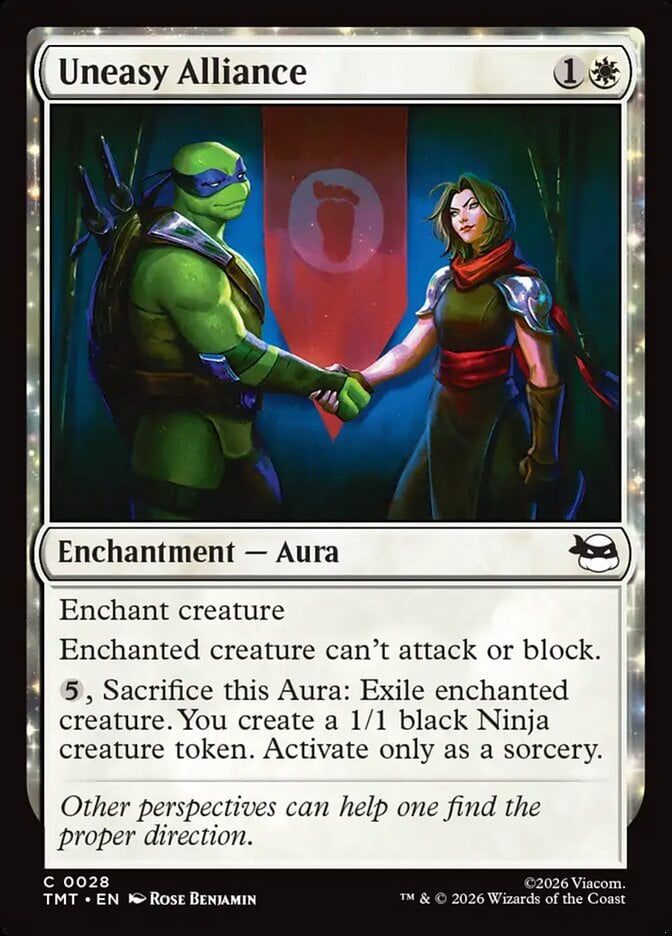
Rating: 5/10
This seems like a pretty common design nowadays, like we saw with Avatar’s Path to Redemption. Uneasy Alliance is premium removal for white and probably white’s best common.
Blue
April O’Neil, Hacktivist

Rating: 8/10
On the turn you cast April O'Neil, Hacktivist, it’ll see that you cast it and draw you one card. On future turns, you’re fairly likely to cast spells, so April continues to draw you cards just for doing nothing particularly special. It might even draw you a couple of cards at once if you ever find a way to double spell, perhaps casting a removal spell and a creature in the same turn. Regardless, the floor on April is very high: It’ll pretty much always be a 1/5 that draws a card, and it has a ton of potential to be even more than that.
April, Reporter of the Weird
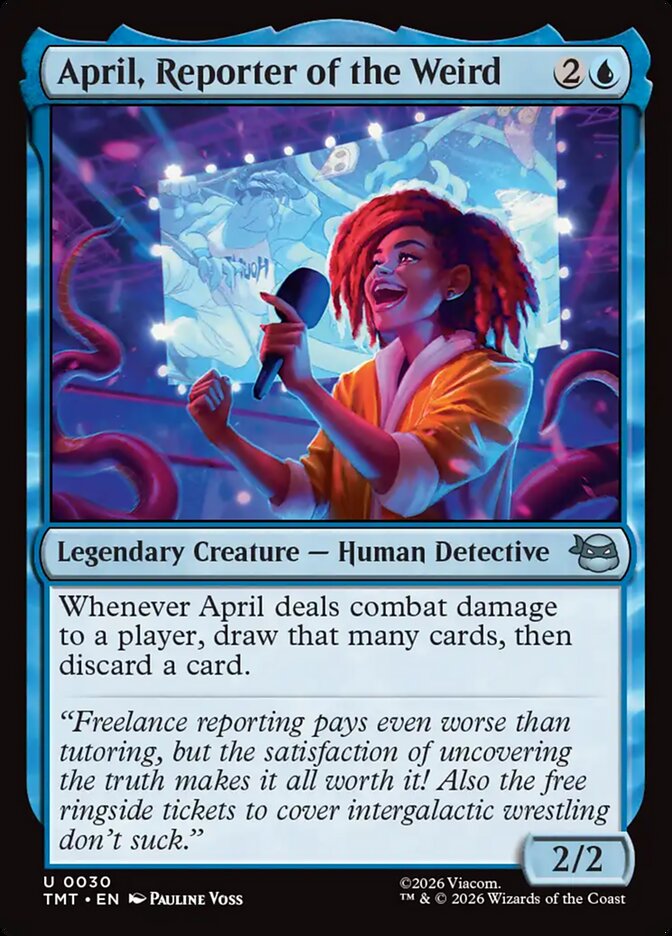
Rating: 5/10
In a typical set, April, Reporter of the Weird wouldn’t be that exciting. After all, a 2/2 isn’t going to be able to get combat damage through very often. However, if you pile enough +1/+1 counters onto this April in the Mutagen deck, not only does it become able to attack more often, but it also makes April’s ability that much more powerful. This detective will get to the point when just a single hit will draw you enough cards to close out a game, and that potential is worth something at least.
Bespoke Bō
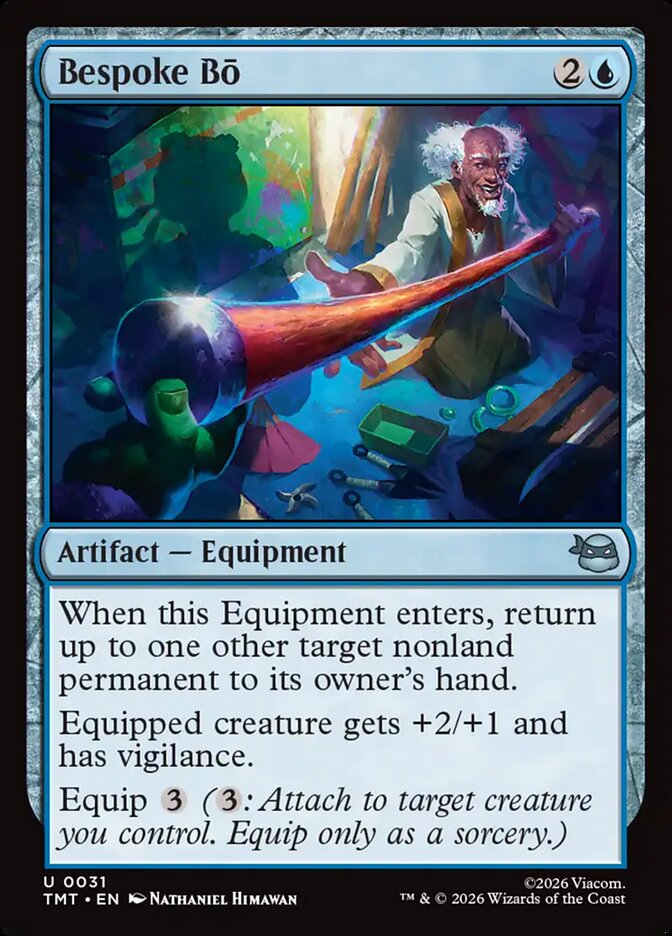
Rating: 5/10
My first instinct was to look at Bespoke Bō as this set’s Man-o'-War. I think that’s somewhat true, but a weak equipment is a much worse permanent card to have on the battlefield than a creature. Still, this is a good tempo swing, and having it on the battlefield definitely isn’t nothing, especially in an artifact deck.
Buzz Bots
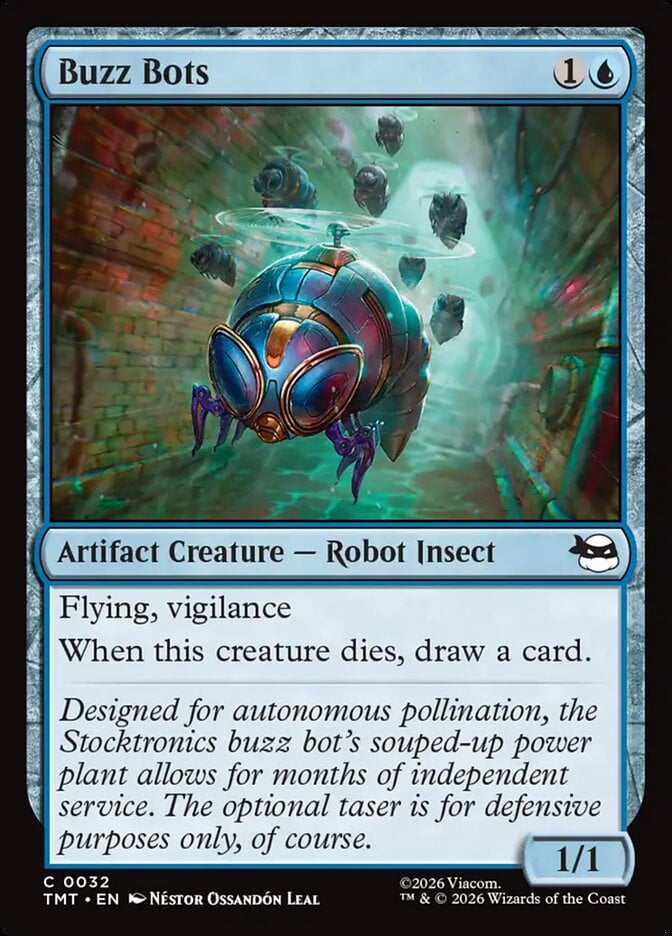
Rating: 4/10
It’d of course be better to draw the card on entering, but blue doesn’t have much sneaking to do anyway, so we can forgive Buzz Bots for just being a simple two-for-one that’s good in any deck.
Crustacean Commando
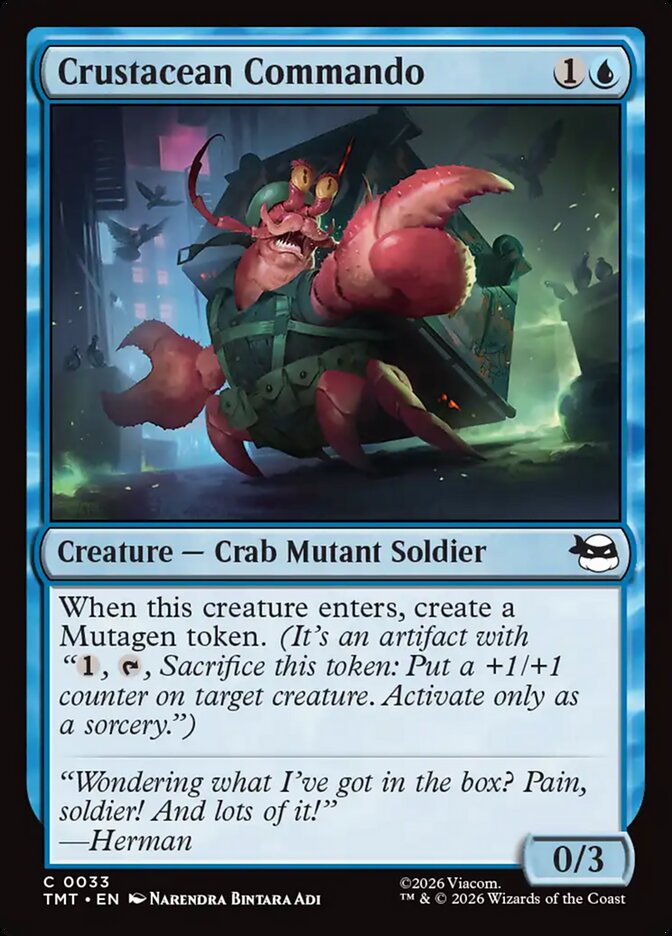
Rating: 2/10
I’d be pretty happy with most cheap creatures that create a Mutagen token when they enter, but Crustacean Commando doesn’t really do enough. It’s a fine playable if you need it, but I think we can do better most of the time.
Does Machines
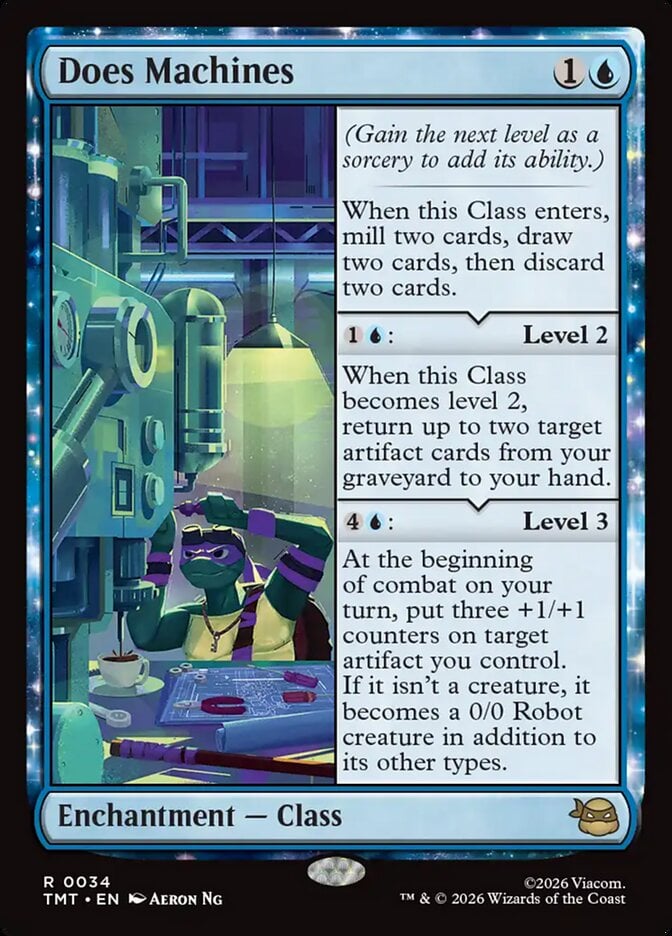
Rating: 8/10
I didn’t like Does Machines when I first read it, but it’s really growing on me. The biggest problem with the card is that the first ability is pretty weak. While it provides you with some card filtering, you end up down on cards for not much gain. However, the second and third level abilities are extremely good. Level 2 immediately gives you back the card advantage you lost from the first level, and level 3 basically just wins you the game as long as you have a few artifacts available and a little bit of time for it to grind away.
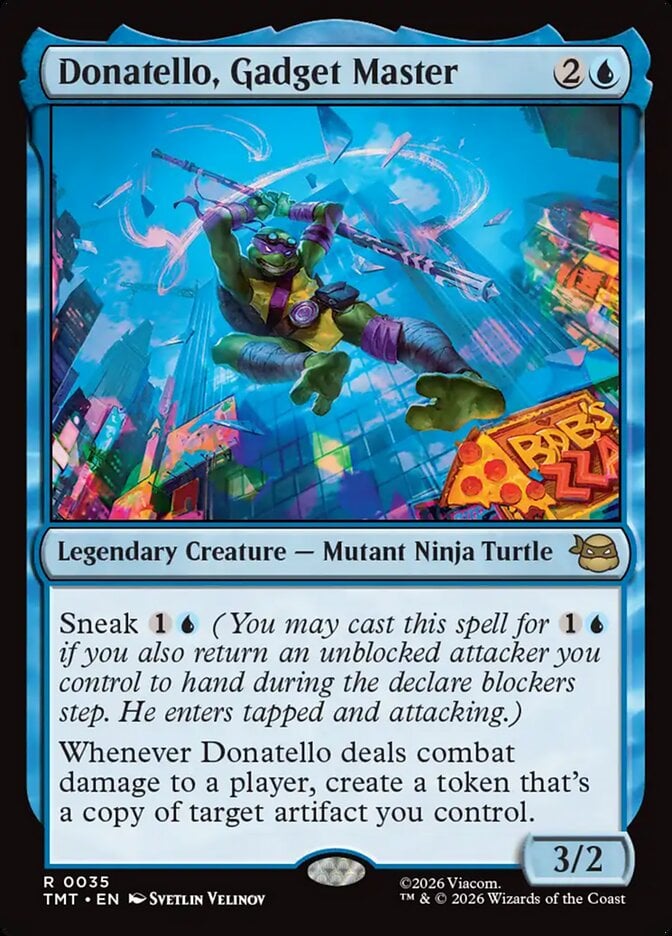
Donatello, Gadget Master
Rating: 6/10
The first card I thought of when I saw this is Mist-Syndicate Naga, but sadly, Donatello, Gadget Master is nowhere near as broken as that. Copying an artifact you control has the potential to be good, but you need a good number of targets for it before I’d feel comfortable running it. As such, this feels very much like a blue/red gold card, which pops off in a dedicated artifacts deck but falls flat elsewhere.
Donatello, Mutant Mechanic
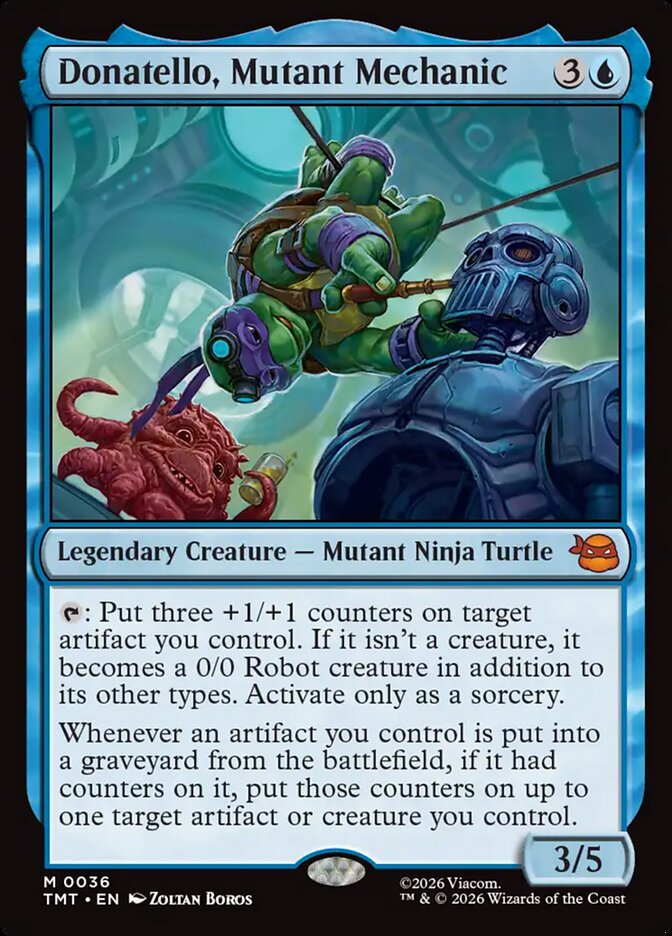
Rating: 7/10
The idea of a bomb rare that churns out a free 3/3 every turn of the game is quite compelling. Donatello, Mutant Mechanic has the potential to be exactly that, but it comes with its fair share of downsides. This turtle does nothing on the turn you play it, is limited to sorcery speed, and needs a steady stream of artifacts to keep its ability going. There’s a lot of potential here, but this Donnie might end up being a little on the slow side.
Donatello, Turtle Techie
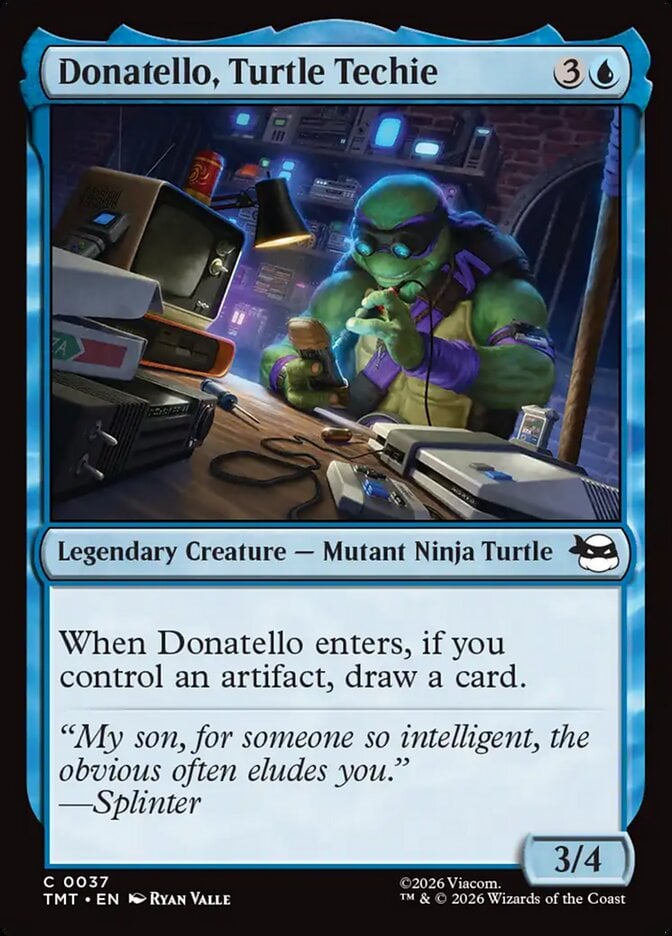
Rating: 4/10
Four mana for a 3/4 cantrip creature is an awesome rate. While Donatello, Turtle Techie is clearly good for the artifact deck, both blue archetypes will be able to use it since the Mutagen tokens also enable this Donnie.
Donatello, Way with Machines
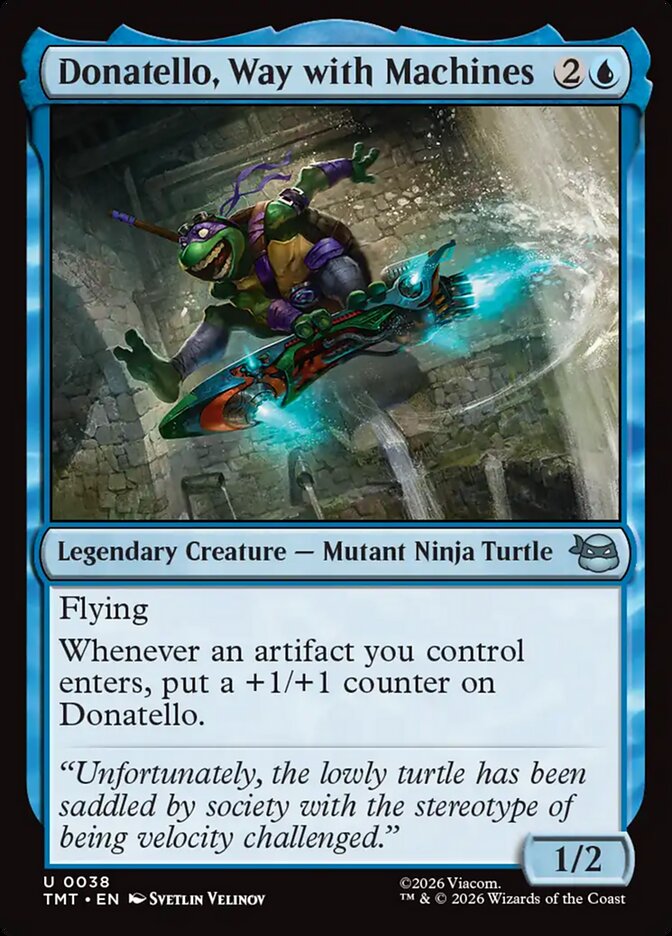
Rating: 5/10
Three mana is kind of a lot for this Donatello card, but if you can play it early, then it should grow into a huge threat very quickly, especially with the sheer number of ways this set has to make several artifacts at once. Donatello, Way with Machines is quite weak to draw in the late game, but I think that’s a fair balance against the times when you play it early and it runs away with the game.
Donatello’s Technique
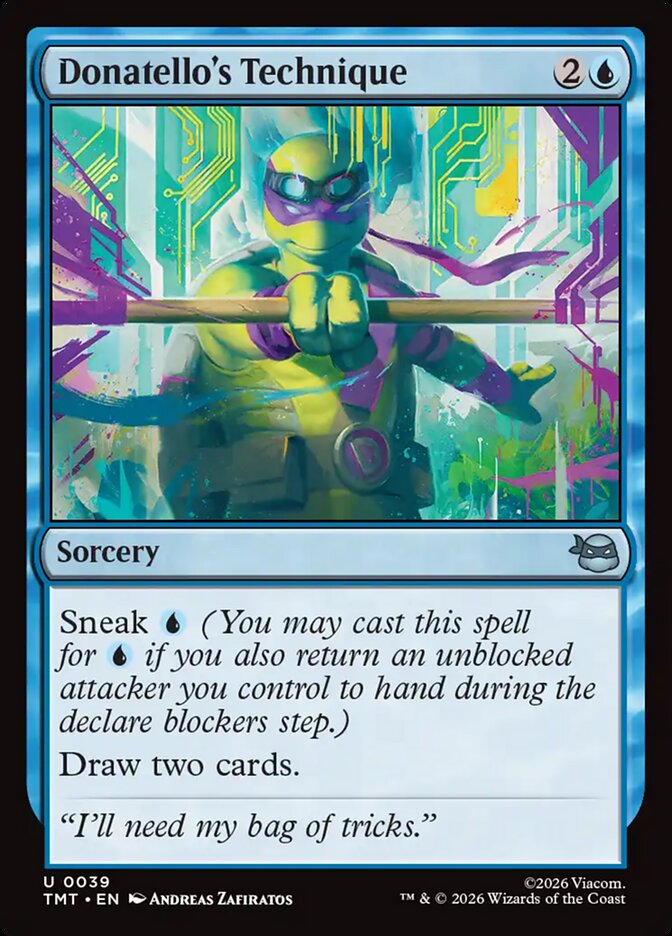
Rating: 6/10
I definitely like to see yet another Divination with a strict upside. Sneaking in Donatello's Technique for 1 mana isn’t only a cost reduction, but it’s also a potential advantage if you can pick up a useful creature that you want to recast.
Fugitive Droid
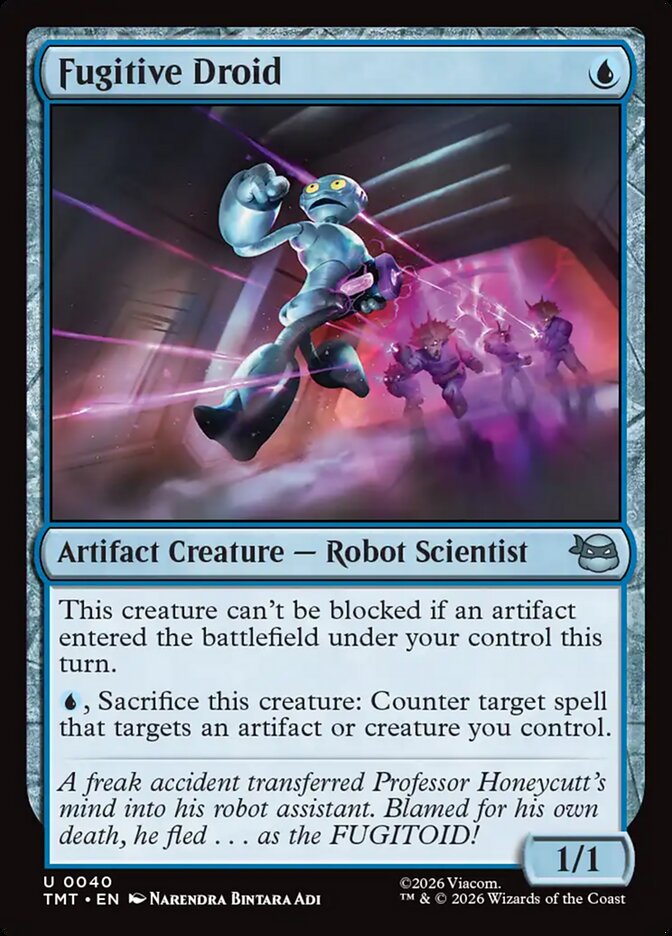
Rating: 6/10
Blue doesn’t have a lot of sneak cards, so a cheap creature like this with good evasion is a little out of place. That doesn’t mean I’m saying no to a sweet little Siren Stormtamer, and Fugitive Droid even slots perfectly in these artifact-based decks.
Kitsune, Dragon’s Daughter
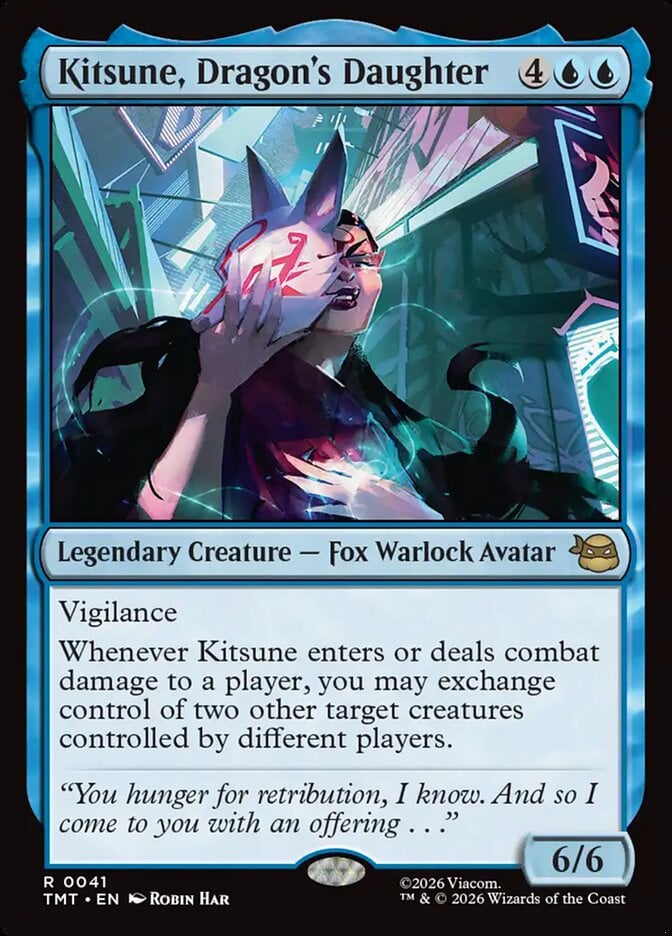
Rating: 9/10
Kitsune, Dragon's Daughter looks dangerously close to just being a 6-mana 6/6 Agent of Treachery. Yes, it’s much more situational than that, but it doesn’t seem too hard to control a creature that’s less valuable than the one that you want to steal. And unlike a spell like Switcheroo, Kitsune is always just a 6/6 vigilance, even if you don’t swap anything.
A weird downside I’ve noticed is that the quality of the creatures in TMT is quite lacking. While the set isn’t short on powerful cards, many of Teenage Mutant Ninja Turtles’ best creatures are quite small and have great enters the battlefield triggers, which Kitsune can’t utilize. Still, that’s a minor gripe about what should be a very powerful card for blue.
Kitsune’s Technique
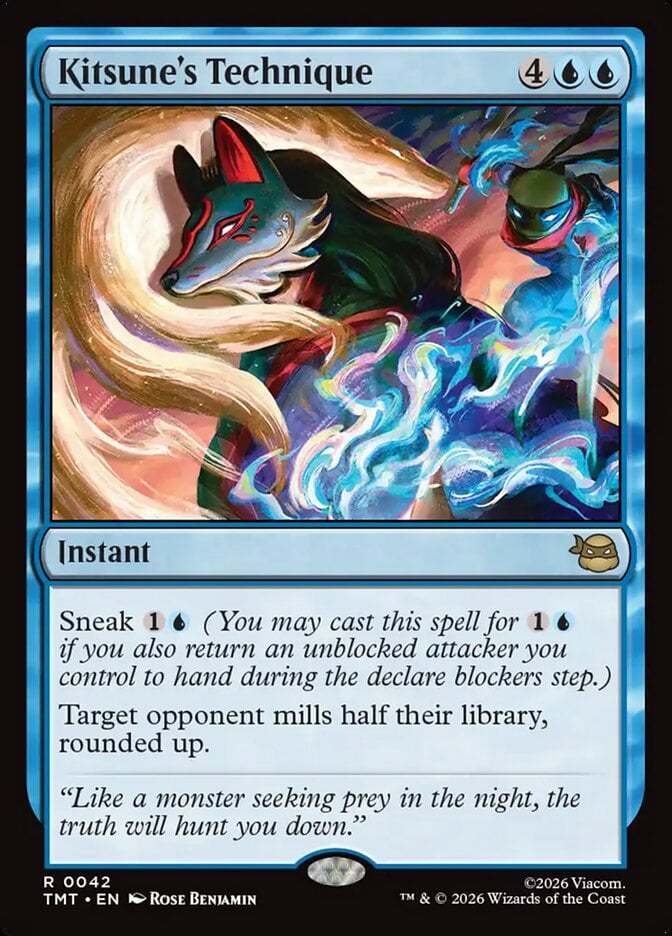
Rating: 0/10
Traumatize just isn’t a good card in Limited. Milling half of a player’s library is usually going to amount to milling them for about 10 cards, but without more mill effects to finish them off, Kitsune's Technique is basically useless.
Krang, Master Mind

Rating: 10/10
A creature that can draw as many as four cards when it enters is truly absurd. With the way that most games of Limited play out, by the time you get to cast Krang, Master Mind, you probably won’t have very many cards left in your hand, if any at all. On top of that, both blue archetypes have plenty of artifacts both to reduce Krang’s casting cost and to make it a serious threat once on the board. Even topdecking this and casting it for full price to draw a new hand sounds pretty good too. This is probably going to be one of my favorite cards in the set, and I hope I can draft a few of them.
Metalhead
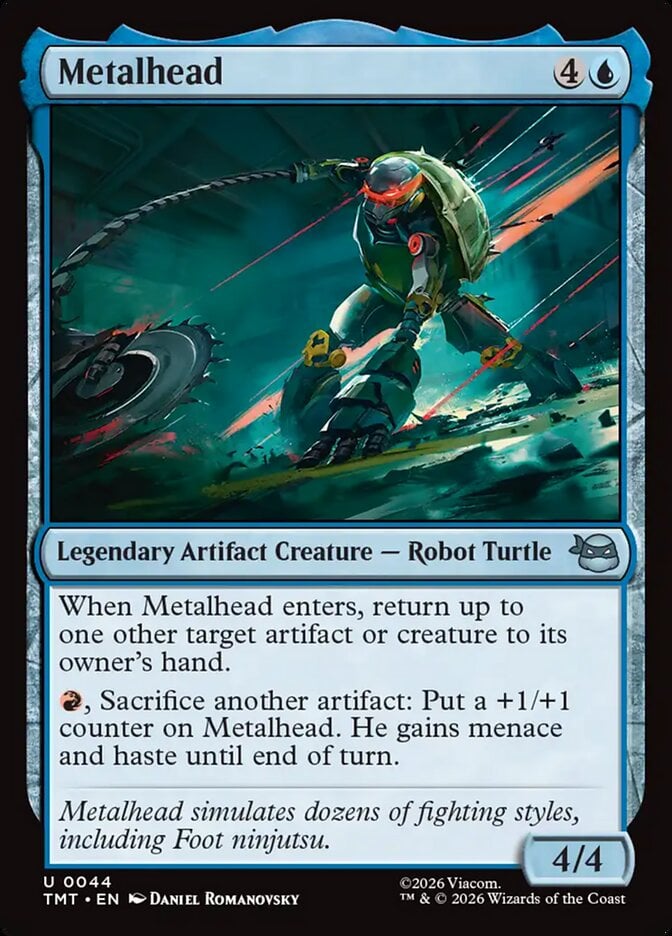
Rating: 7/10
Oh, so this is the set’s Man-o'-War. Fair enough then. For 5 mana, as opposed to the typical 3, the creature we get is so much stronger. A 4/4 with this ability isn’t bad, but for some red mana and a few throwaway artifacts we can turn Metalhead into a creature that can win the game by itself. We don't even need to activate it very often because just the threat of it is often enough to make sure it can attack unopposed.
Mind Transfer Protocol
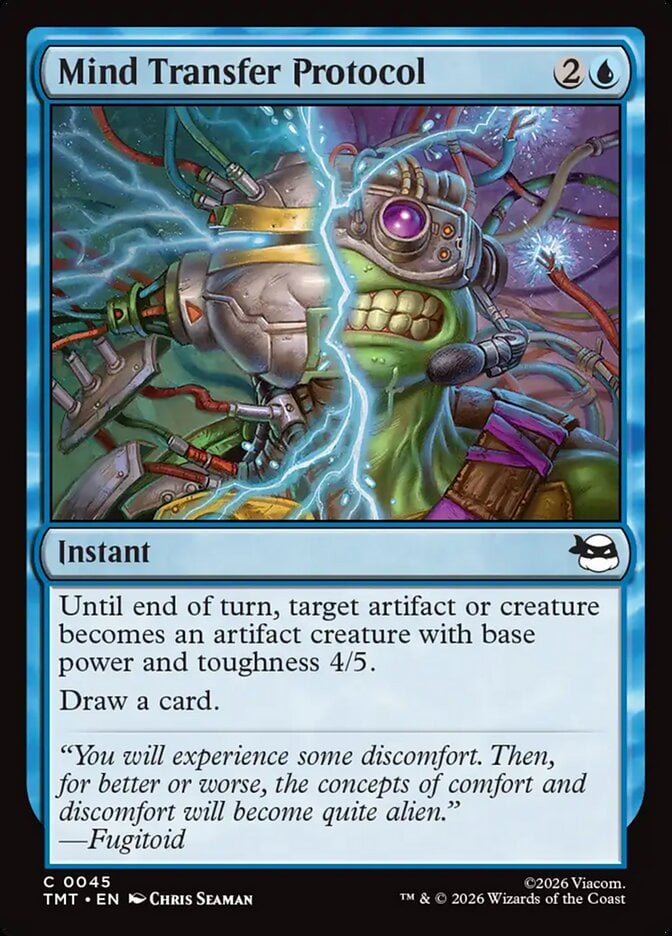
Rating: 5/10
Mind Transfer Protocol is a card we’ve seen before, in the form of Kamigawa: Neon Dynasty’s Suit Up. That card was incredible, and I don’t see why this won’t be. Not only can you use it as a two-for-one combat trick, but you can even ambush an opponent with some noncreature artifact that you have available, again giving you a sweet two-for-one swing.
Mondo Gecko
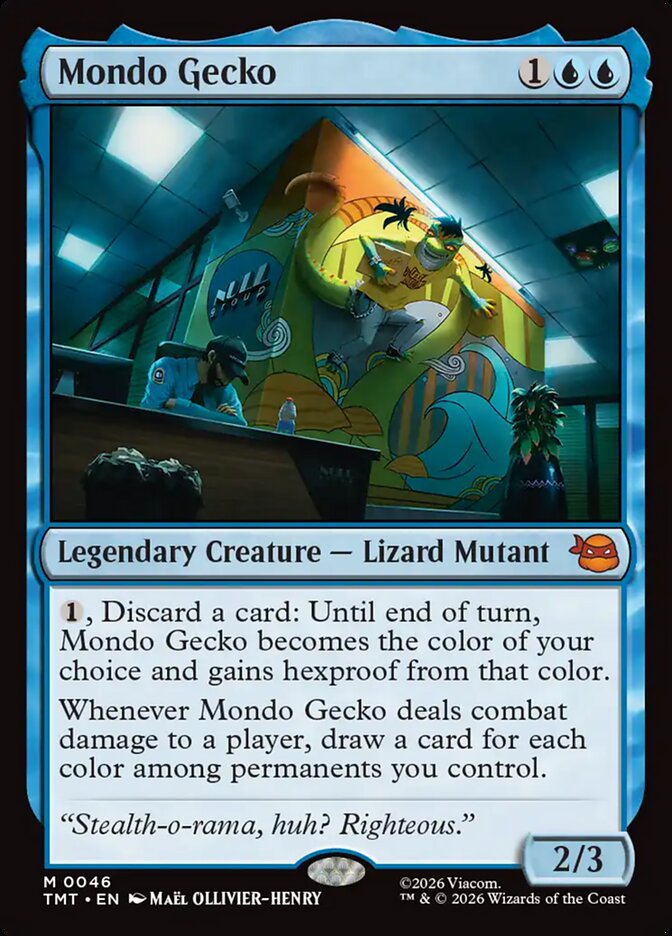
Rating: 4/10
On first inspection, I like the idea of a creature that can draw multiple cards just for dealing combat damage to your opponent. The problem is that Mondo Gecko offers you no help to accomplish that goal, which is very disappointing for a mythic rare. It can protect itself from removal, but it doesn’t get into combat very well at all. I’m not sold on this one; if it’s good, I’ll have to see it in action.
Negate
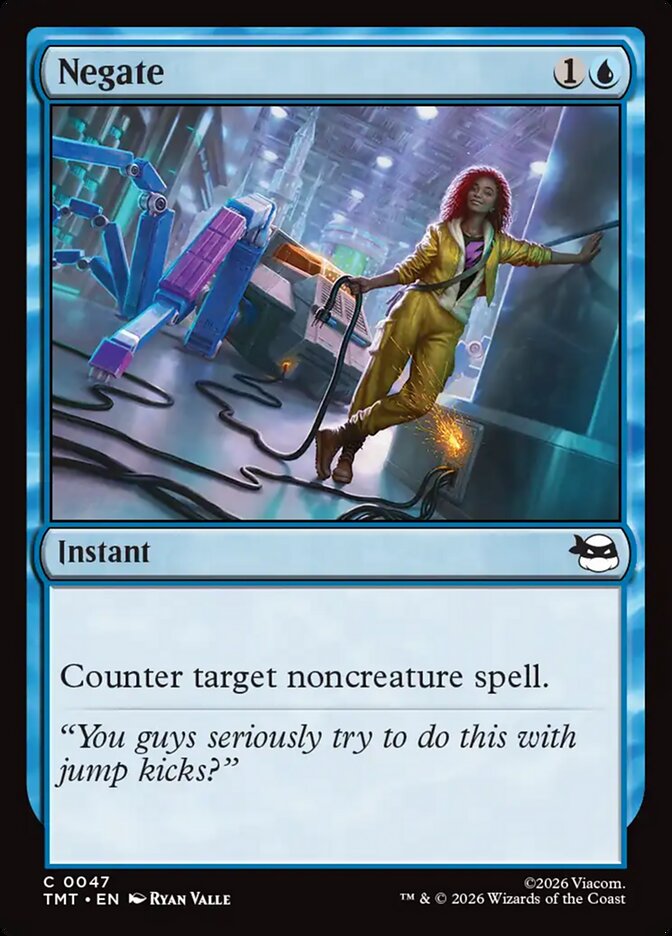
Rating: 1/10
Negate is a classic staple in Magic at this point, and it’s usually the same in every Limited format it appears in. It’s not worth a slot in your main deck, as most decks are about 20% noncreature spells or less, but it can be a great sideboard card for the right matchup.
Ooze Spill
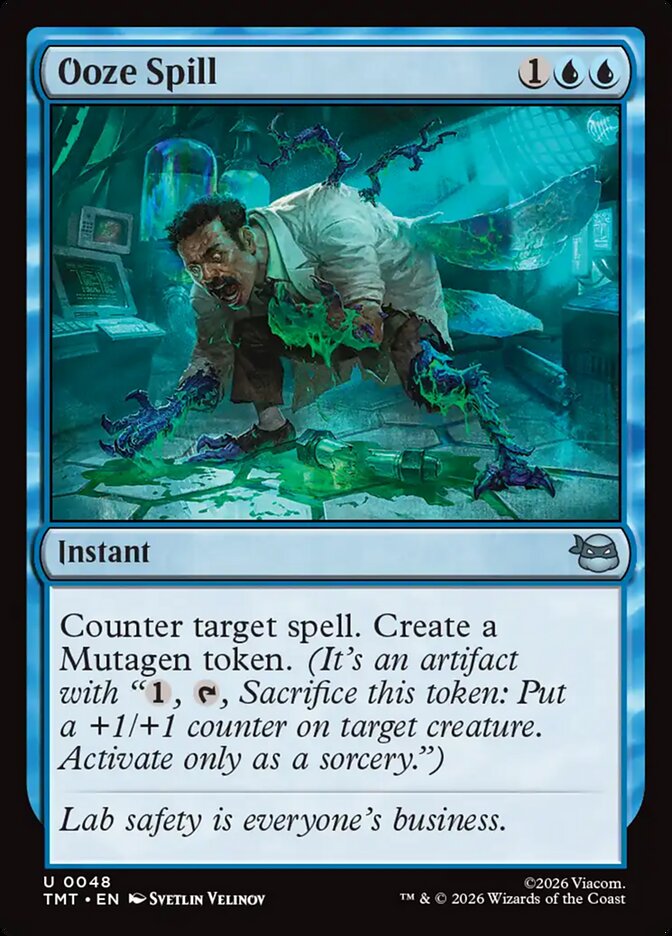
Rating: 1/10
Cancel is a mediocre card in Limited that only really works in slower-paced formats. My early impression of Teenage Mutant Ninja Turtles is that the format won’t be slow enough for a card like Ooze Spill, even with a Mutagen token to sweeten the deal.
Ray Fillet, Man Ray
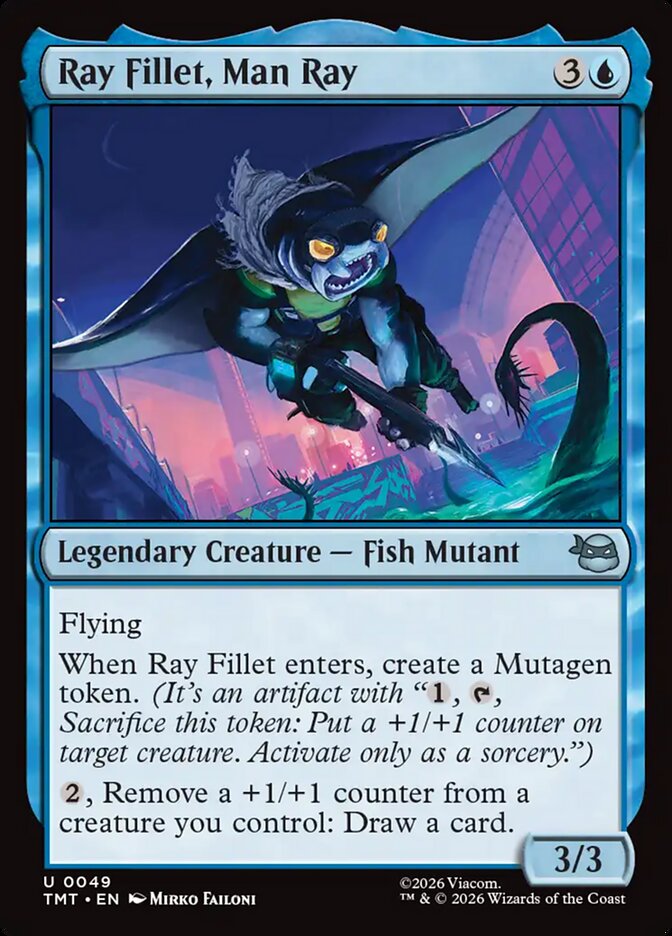
Rating: 6/10
A 4-mana 3/3 flier plus a Mutagen token is already be something I’d be interested in, but Ray Fillet, Man Ray raises the stakes here by also letting you turn your +1/+1 counters into card draw. Having Ray out is a roundabout way to get a ton of extra value from your Mutagen tokens, which is a fantastic way to help you keep up with your opponent as a game goes long.
Renet, Temporal Apprentice
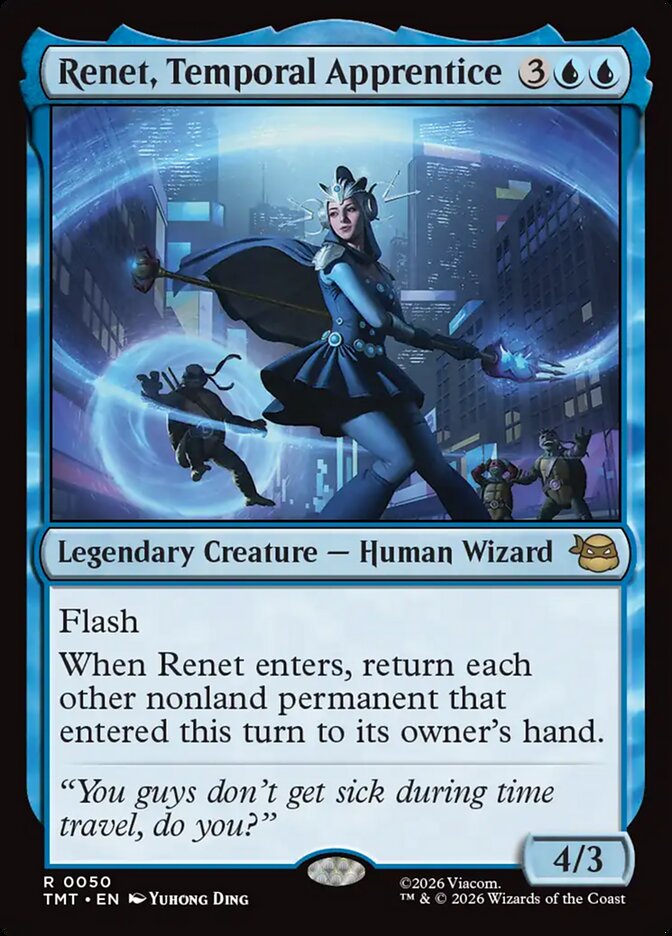
Rating: 5/10
Renet, Temporal Apprentice is an incredibly situational card, but it offers a huge tempo swing if you can time it right. The base rate is that you can leave open the mana for it, flash it in at the end of your opponent’s turn to bounce any creatures they played, and you’ll effectively Remand them. They get the enters triggers though, so unless those triggers created more things that you could bounce, the opponent is still up on the exchange.
I think the best use for Renet might be to cast it during combat either to block something that would enable a sneak play or to bounce a creature once it’s been snuck in. Either way, Renet looks pretty solid, but it requires a bit too much setup to be any better than that.
Retro-Mutation
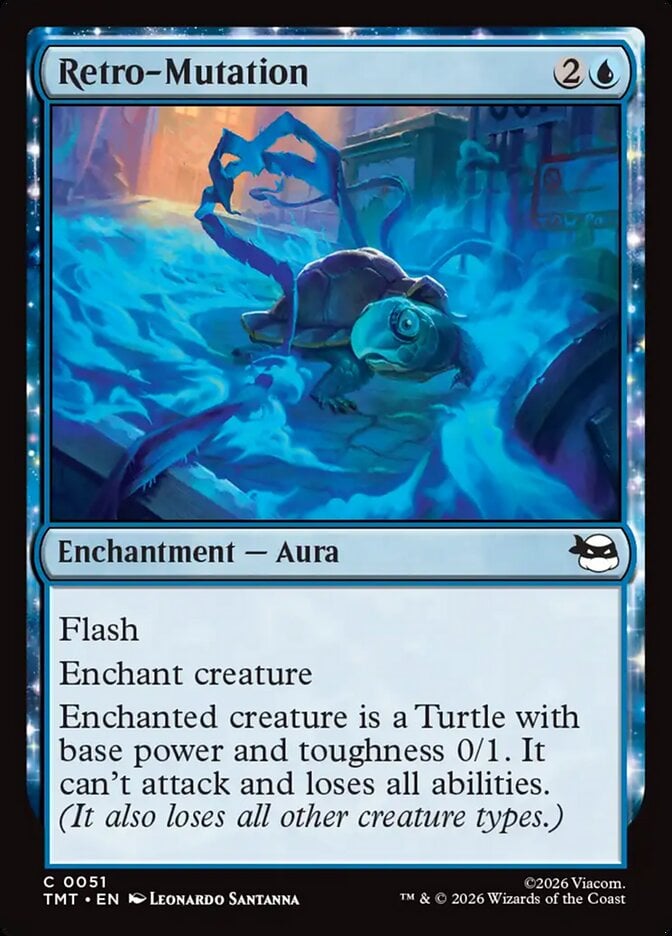
Rating: 4/10
Three mana feels a little bit expensive for this card, but shutting down an opponent’s creature almost completely does count as good removal. I particularly like that the creature can’t attack; sneak could have been a very good way for an opponent to get rid of Retro-Mutation, and that avenue has been closed off.
Return to the Sewers
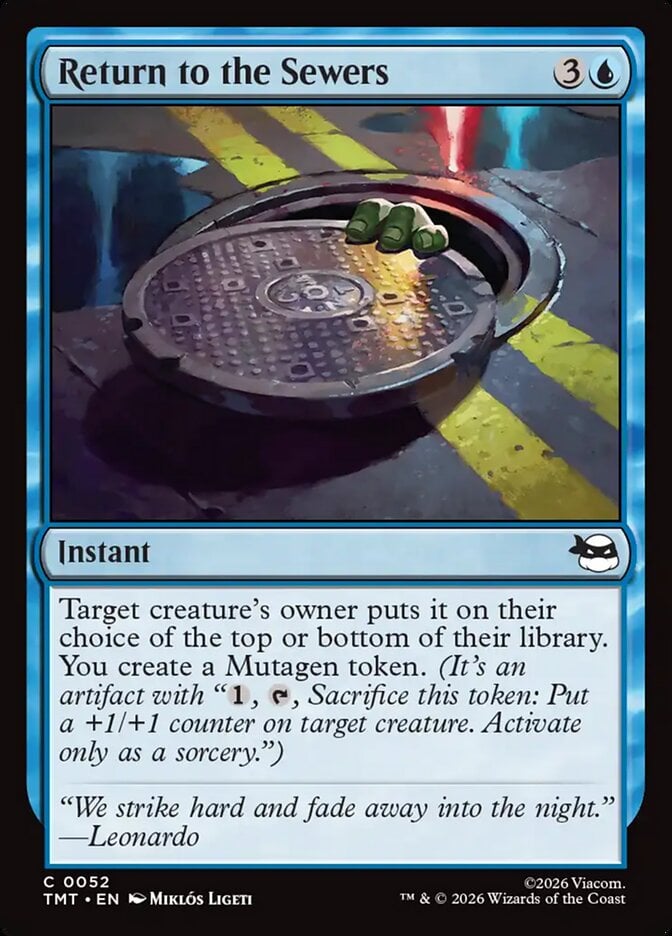
Rating: 4/10
I feel like I say this in every set review since Wizards prints a card like this in every single Draft set these days. Four mana to spin a creature to the top or bottom is just good removal for blue, and the Mutagen token that Return to the Sewers gives you is of course a nice upside.
Sewer-veillance Cam
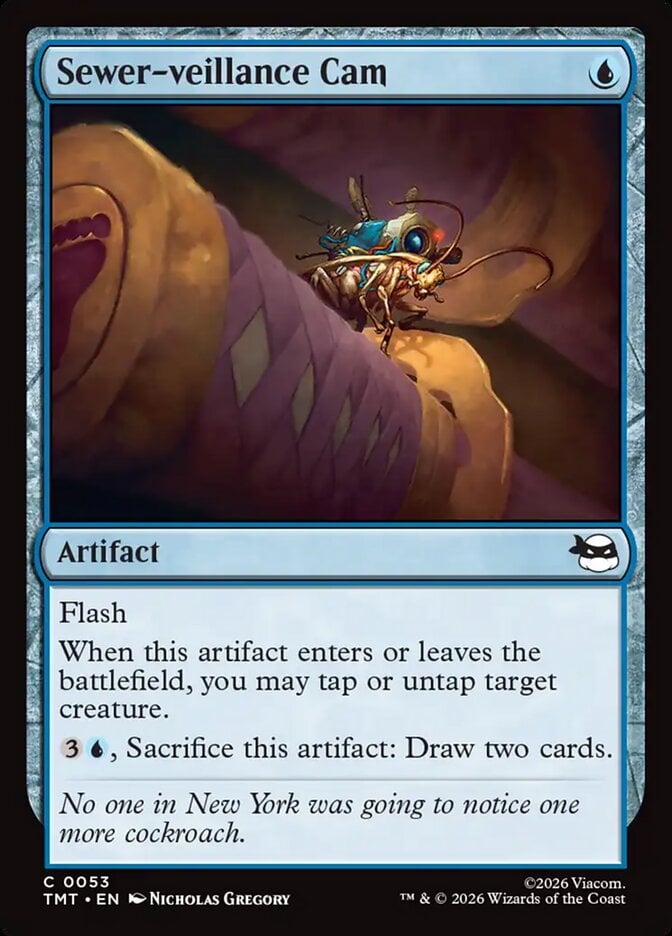
Rating: 1/10
I don’t see Sewer-veillance Cam coming together. It’s cheap, but the effect is so minimal and the cost to turn it into card draw is too high. I could imagine a very dedicated artifact deck that might want this, but it lacks efficiency.
Stockman, Mad Fly-entist
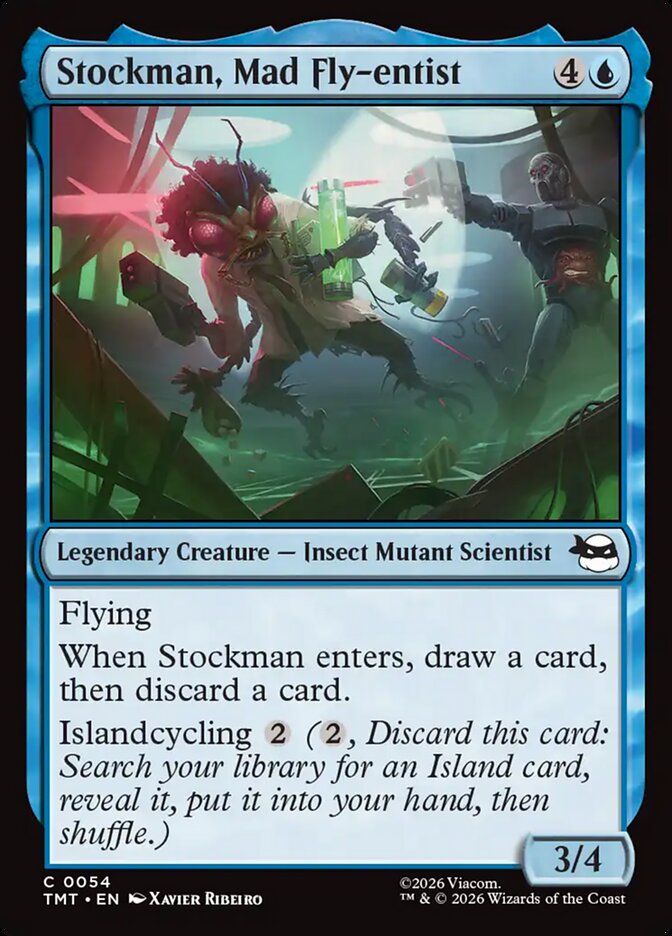
Rating: 2/10
There’s nothing particularly wrong with this blue landcycler, but it’s not all that great either. I don’t think most decks are going to want to play Stockman, Mad Fly-entist, but it’s certainly not the worst card to round out your deck.
Turtles in Time
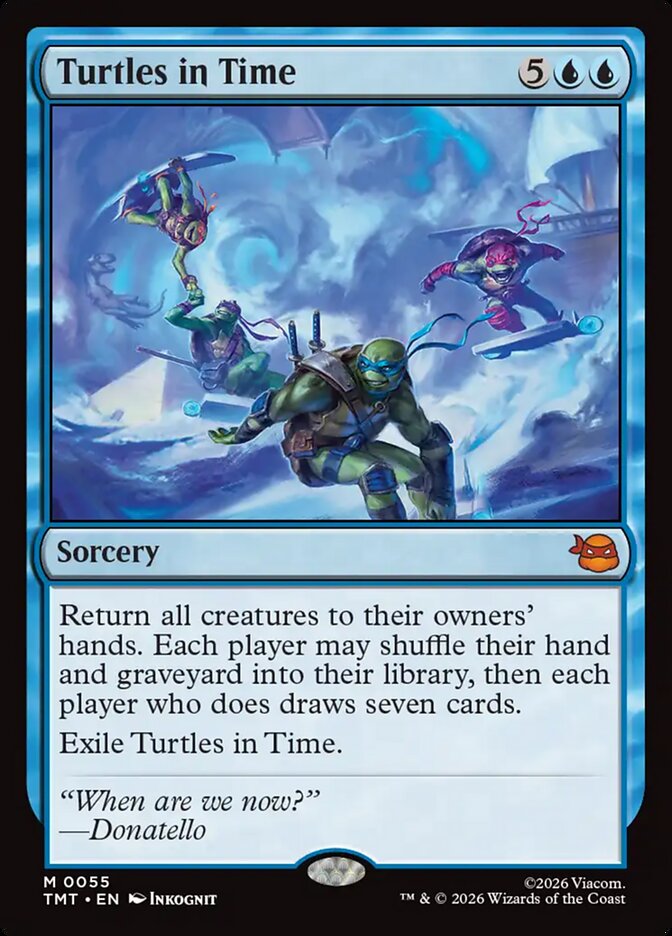
Rating: 8/10
Turtles in Time is primarily a Timetwister, but one that packs a serious punch. These kinds of effects are best when you combine them with something else to make up for the fact that they don’t affect the board in any meaningful way. This tends to mean they excel in formats like Vintage Cube but suck outside of that. This flips that script on its head by actually wiping the board before it draws you a new hand. While there’s no control archetype to draft, this looks exceptionally good if you can set it up. I’m sure it can find a home.
Utrom Scientists
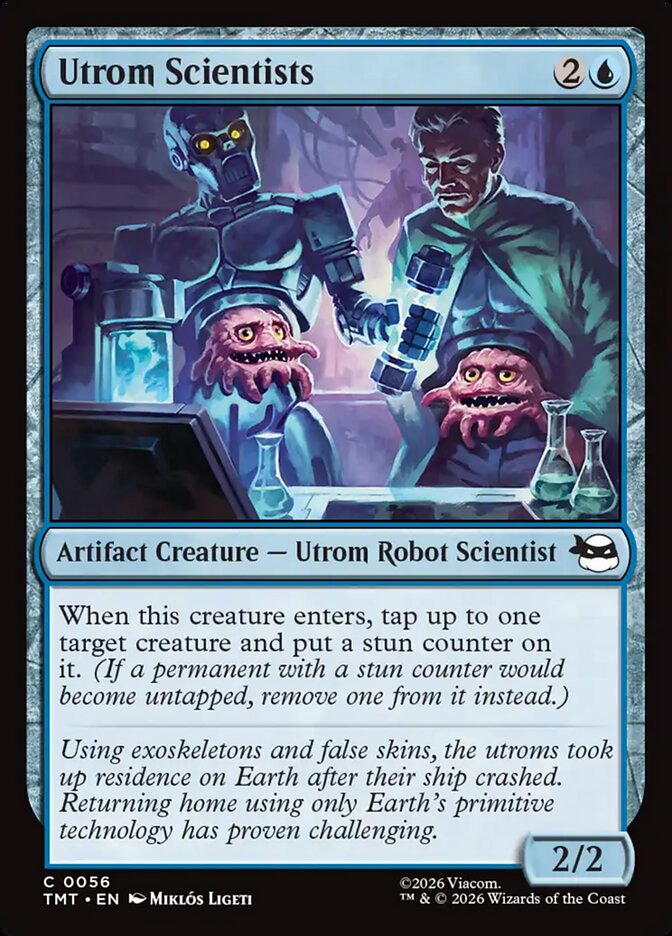
Rating: 5/10
I always love to see a Frost Lynx in a set, and Utrom Scientists is even an artifact to boot. This is a great tempo play that also advances your game plan, and it has been a seriously good card in many previous sets.
Black
Anchovy & Banana Pizza
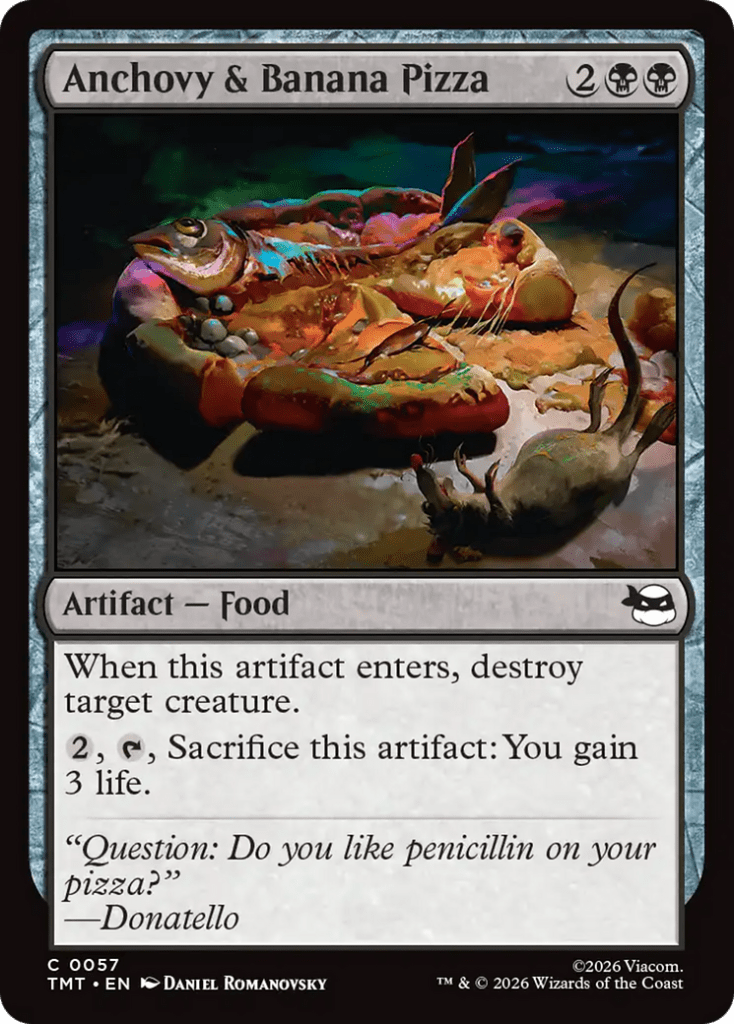
Rating: 6/10
As disgusting as an Anchovy & Banana Pizza sounds, I want to take as many of these as I can get. Being a permanent makes a removal spell like this much more valuable than if it were just a regular sorcery; all you need to do is find the synergies, which the black/green deck is especially set up to do.
Armaggon, Future Shark
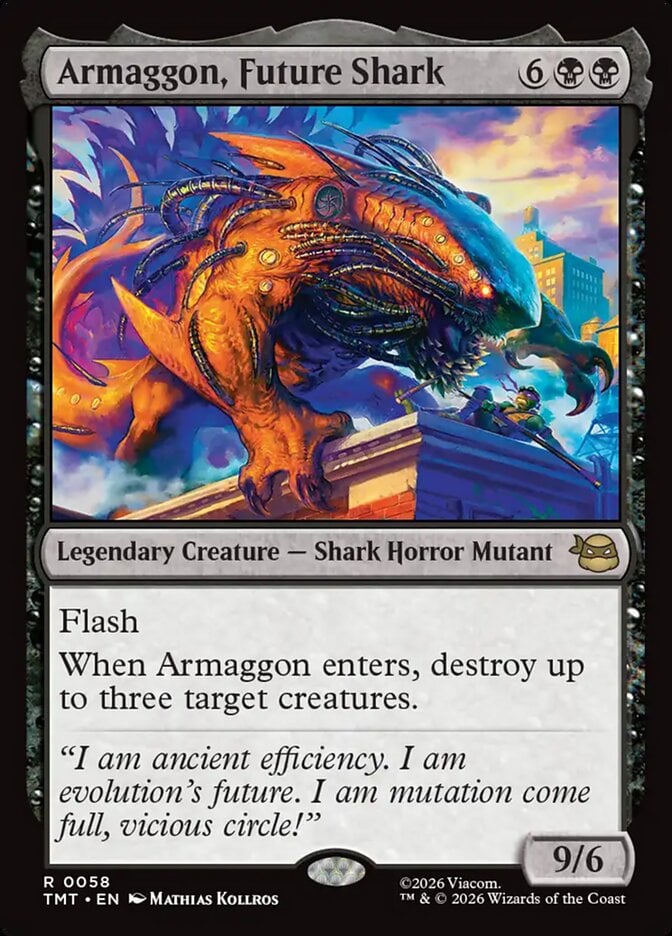
Rating: 8/10
For decades, Nekrataal and its various successors have been widely regarded as some of the most powerful cards in their respective Limited formats. So obviously, Armaggon, Future Shark is unbelievably absurd. The only problem is the pesky mana cost. Six is achievable in most games, 7 is somewhat reasonable, but 8 is pushing it. Still, Ardyn, the Usurper ended up being the best card in Final Fantasy, and as long as this format isn’t particularly fast, I’m sure Armaggon has a shot of being just as good.
Bebop, Warthog Warrior
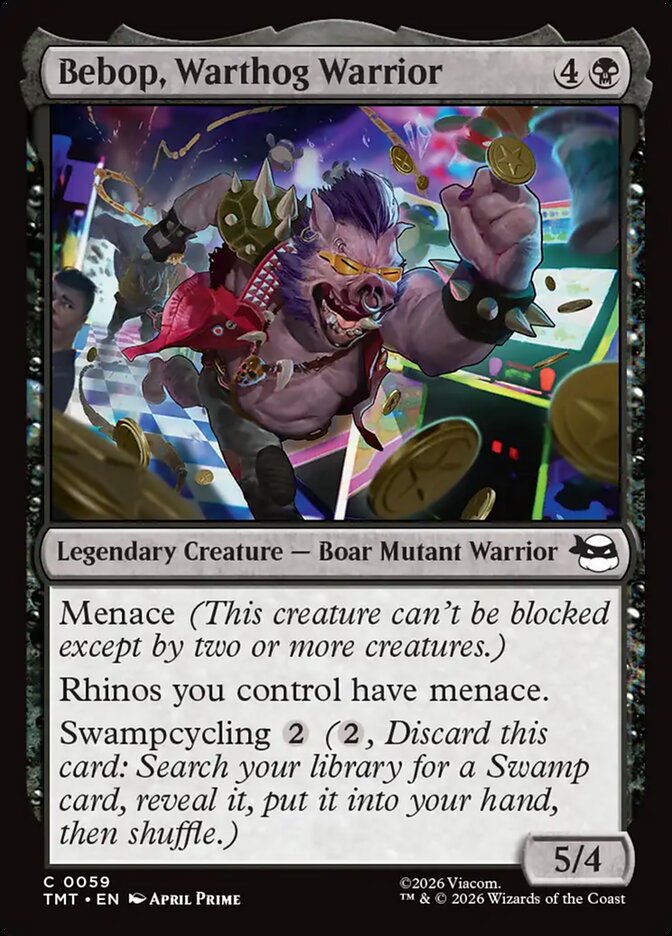
Rating: 2/10
With only three rhinos in TMT, I don’t think Bebop, Warthog Warrior is very playable. It’s basically just a 5/4 with menace, which isn’t worth a slot most of the time. It’s of course our swampcycler for the set, which has some value, but it’s rarely that important to have one. The joke of course is that if you combine this with Rocksteady, Crash Courser, they give each other their abilities and they both become unblockable, but that probably won’t come up often enough to make this good.
The Cloning of Shredder
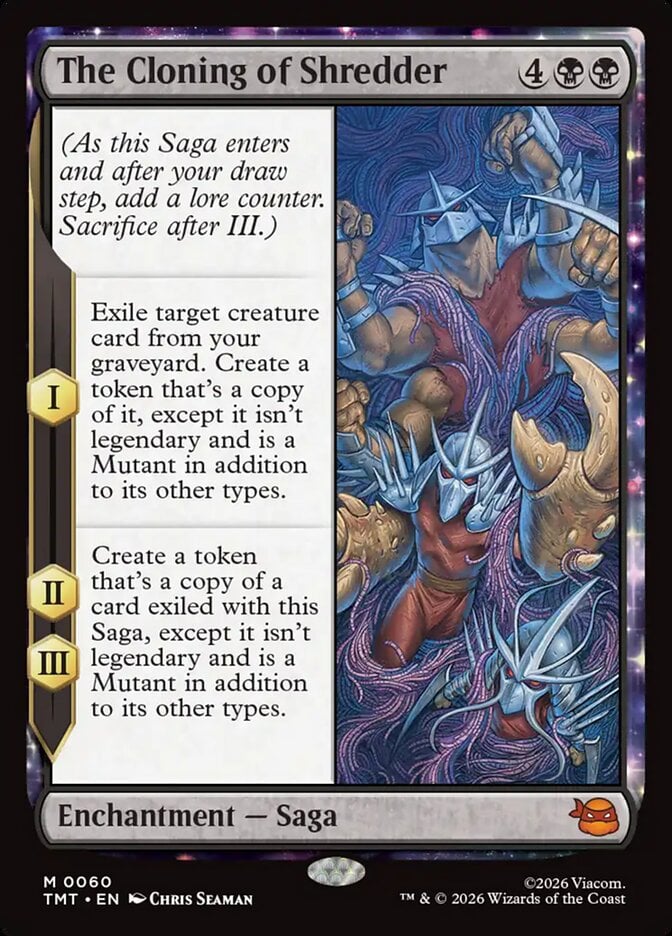
Rating: 8/10
Six mana is a little too much for a Reanimate spell, but the ability to make three copies of a creature over the next few turns sounds truly absurd. The Cloning of Shredder looks incredibly powerful to me, it just requires a little bit of set up to get going. You can of course just trade off your creatures beforehand and then exile some decent 4-drop, but I’d hope to have a way to enable this to copy something a bit more premium than that and run away with the game from there.
Death in the Family
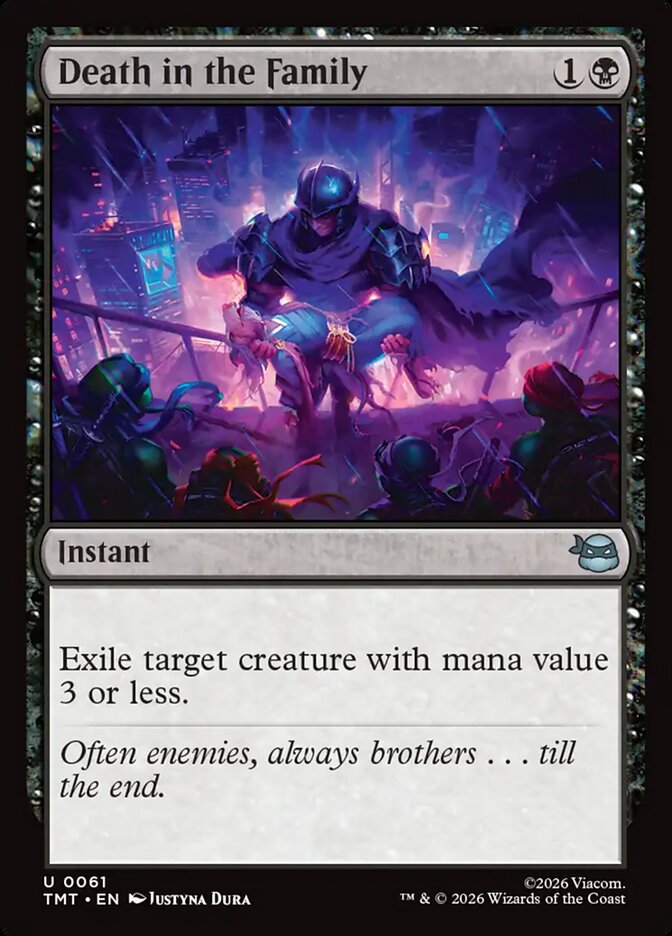
Rating: 5/10
Death in the Family is a cheap, clean answer to a lot of creatures. Even while restricting you to only smaller creatures, you can still trade up on mana by exiling a 3-drop, and being an instant makes it very flexible.
Dream Beavers
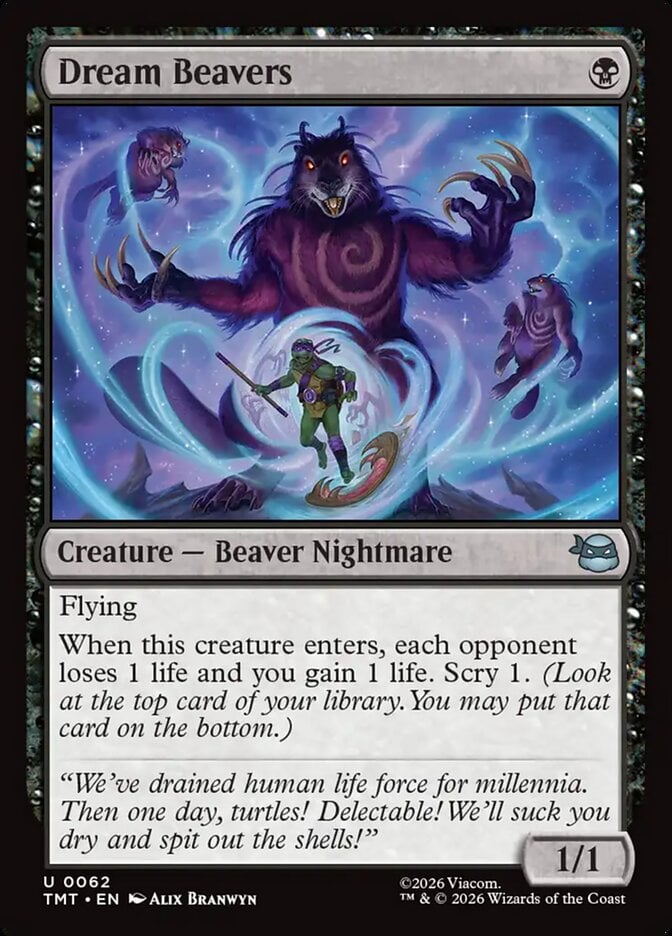
Rating: 7/10
Dream Beavers looks like the perfect custom-built creature to enable sneak costs. If you’re drafting black/white ninjas, this is a card you should prioritize extremely highly. Much like a Cauldron Familiar, you could imagine casting this several times over the course of one game, and its ability is one that gets that much better if you can keep doing it.
Foot Mystic
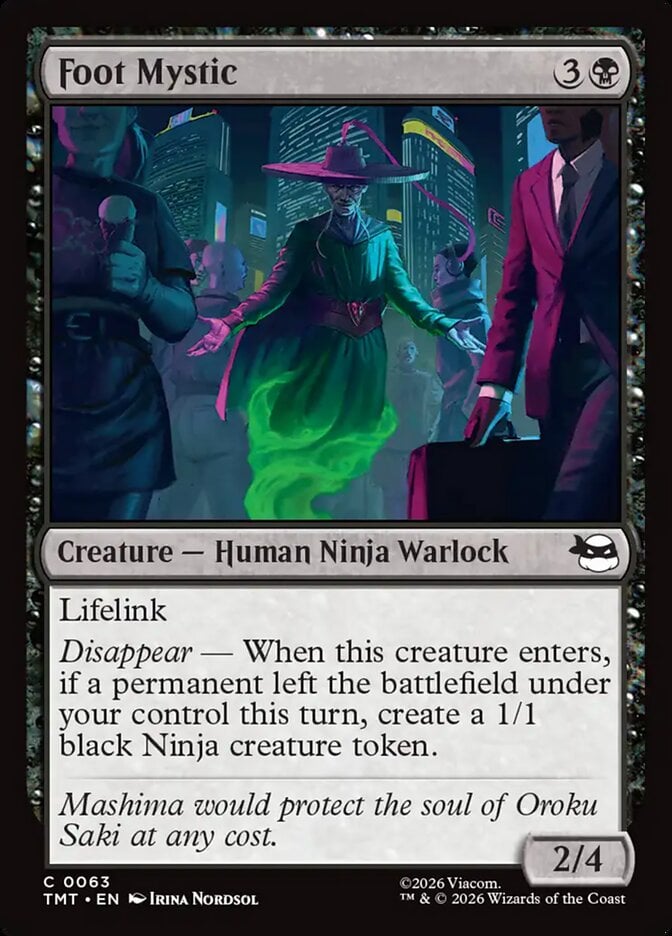
Rating: 3/10
Two bodies in one card is usually good, and this card is no exception. Foot Mystic is just a little small for the 4 mana you have to pay and requires some setup, but it should still find a good home in some ninja decks.
Insectoid Exterminator
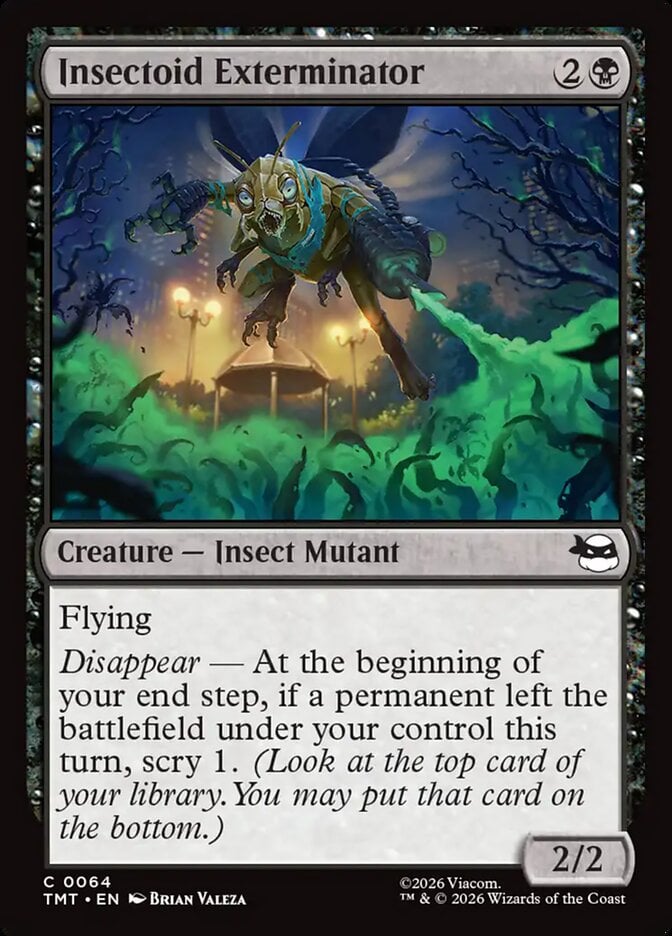
Rating: 2/10
Insectoid Exterminator is essentially just a Wind Drake. The upside of a free scry on some turns is pretty negligible, but as a flying creature, it could still see some play due to its ability to enable sneak costs.
Lord Dregg, Insect Invader
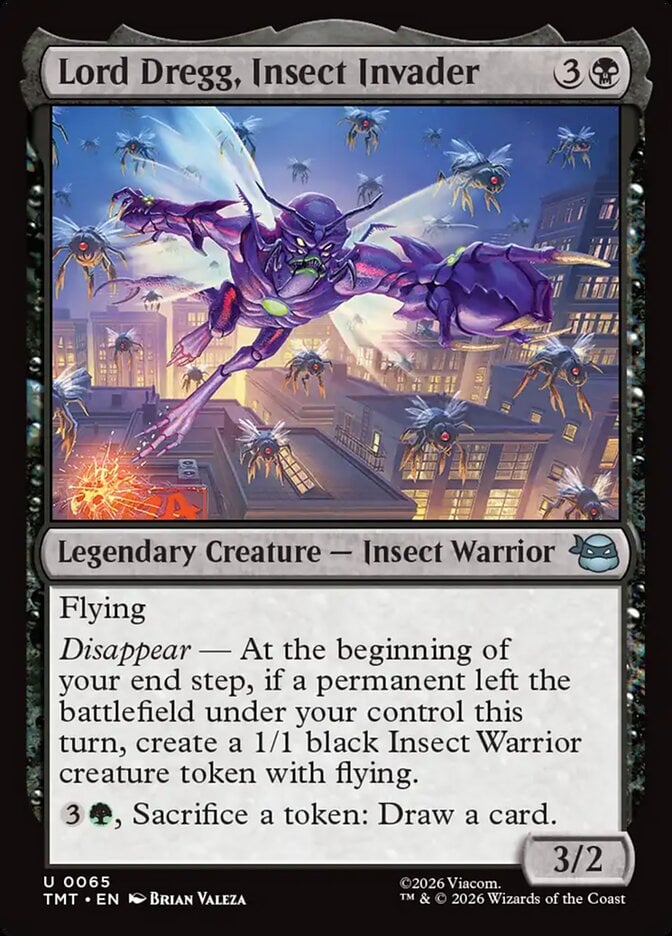
Rating: 7/10
If you can play Lord Dregg, Insect Invader on a turn when you already enabled disappear, then you get a 3/2 flier plus a 1/1 flier for just 4 mana, which is already excellent. From there, you can use sneak or other abilities, including its own, to trigger this over and over. This is an incredible card that doesn’t look too difficult to enable and churns out an army of Insect Warrior tokens.
Madame Null, Power Broker
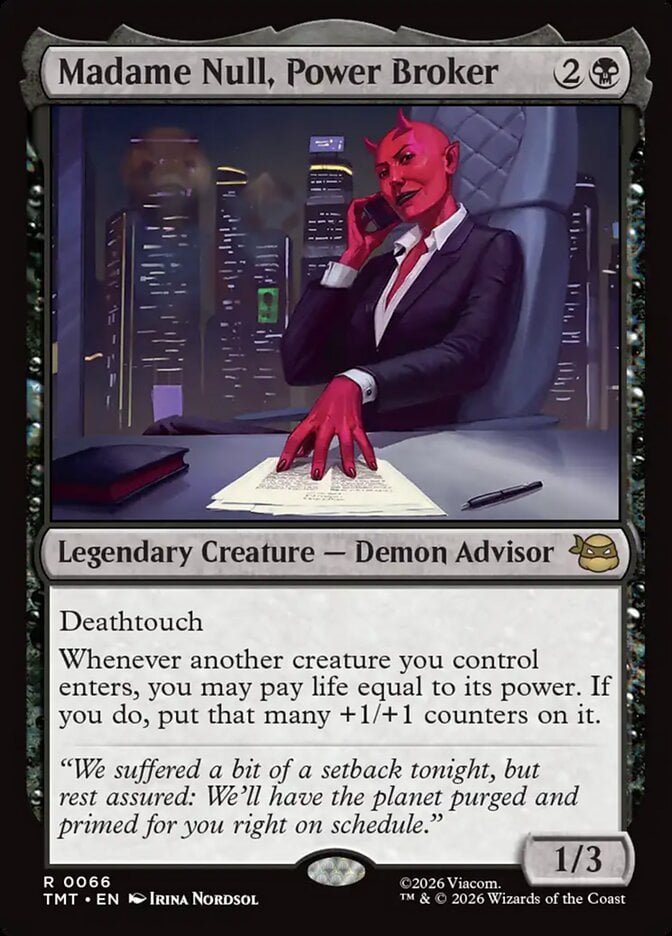
Rating: 7/10
I think the part I like the most about Madame Null, Power Broker is that its ability doesn’t cost you any mana. You can curve it perfectly into a 4-drop on turn 4 then pay some life to make it an 8/8 or something, and that seems like a pretty difficult situation for your opponent. You can’t pay life into Madame Null too many times, but it should be enough to make just a couple of very big creatures. Also, being a 1/3 with deathtouch makes this demon a great brick wall regardless.
Ninja Teen
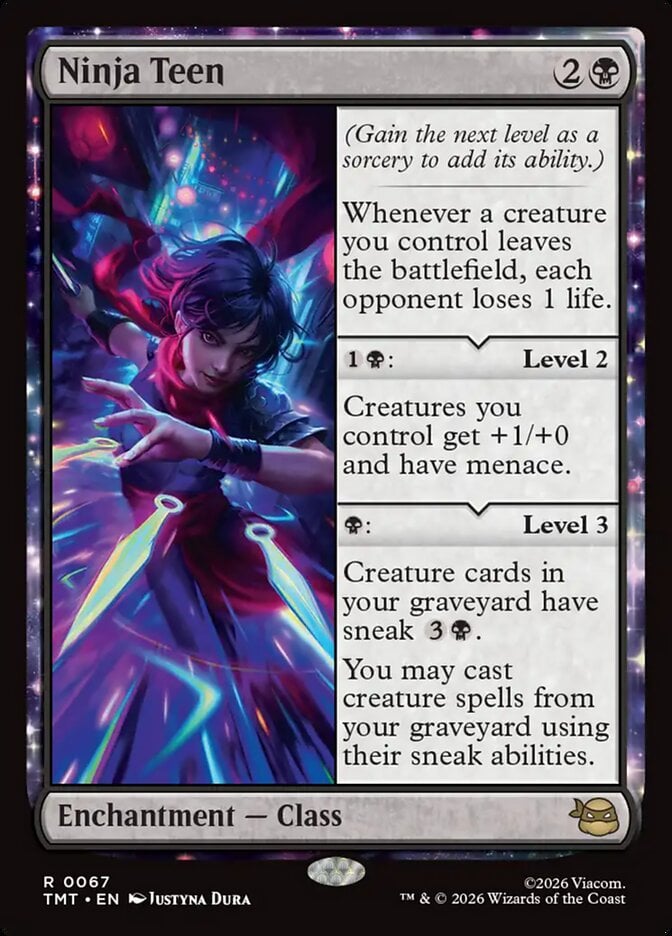
Rating: 6/10
Ninja Teen is a hard card to evaluate. It looks like a decent enough build-around for a sneak deck, but the main issue is that it doesn’t affect the board in any meaningful way. Even the level 3 ability only works if you have some creatures in the graveyard to use with it. I like the potential that this card is showing me, but I just think it might require a little too much work.
Oroku Saki, Shredder Rising
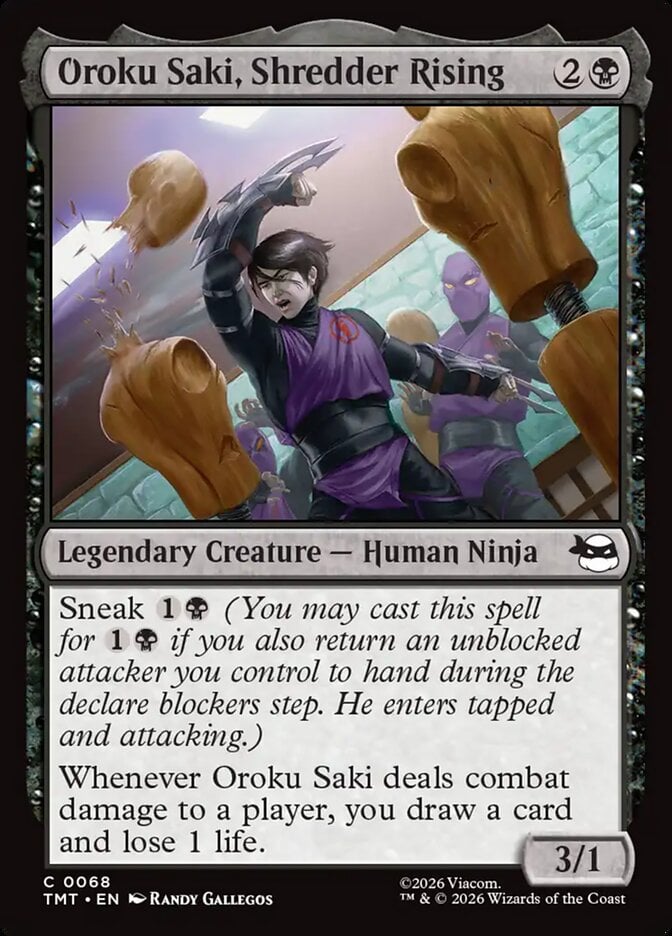
Rating: 4/10
Ninja of the Deep Hours is one of the best ninjas in Magic’s history, so whenever we revisit the theme, it’s good to see a new variant. Oroku Saki, Shredder Rising is the perfect creature to sneak in, as this guarantees it hits at least once to give you a free card back for your troubles. With 1 toughness, it’s unlikely to get another hit in, but if this ninja ever does, you’ll be laughing all the way to the bank.
Pain 101
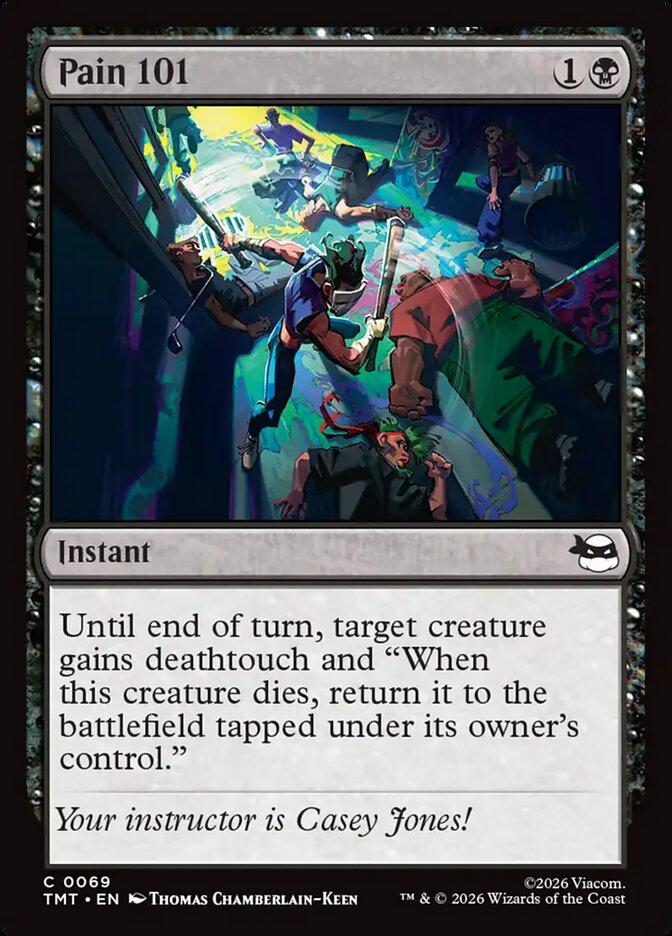
Rating: 2/10
I normally dislike cards like this, but there’s one detail that makes me a little more interested in a trick like Pain 101. There are quite a lot of good enters the battlefield triggers throughout TMT, and with it being such a small set, the chances of finding the right ones to utilize this card go way up.
Paramecia Coloniex
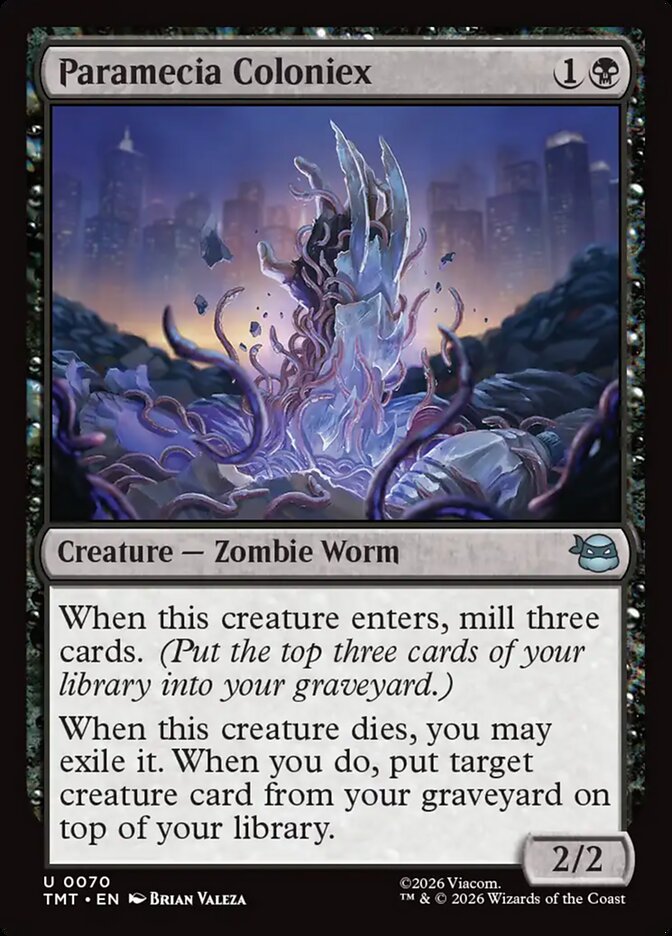
Rating: 3/10
A 2-drop that mills you for a few cards would be great in most sets, but it’s oddly out of place here. There’s no real self-mill theme and no archetype that can properly use a card like Paramecia Coloniex. On its own, it’s a fine 2-drop, but nothing spectacular given the set it’s in.
Rat King, Verminister
Rating: 8/10
It shouldn’t be too hard to find a good spot to cast Rat King, Verminister and have it trigger immediately to give you a sweet 2/2 plus a 1/1 for just 2 mana. Once you’ve done that, the rat token this avatar makes is essentially unblockable, since blocking it just triggers Rat King again to replace the token and make this guy bigger. You can probably use this to your advantage and use the rats to enable sneak costs, but even without that, Rat King looks like a sweet value engine that doesn’t need much help to be good.
Savanti Romero, Time’s Exile

Rating: 8/10
Savanti Romero, Time's Exile certainly can be a bit of a double-edged sword. However, as a wise man once said: “I don’t know why people say a double-edged sword is bad. It’s a sword. With two edges” (see the flavor text of Manabarbs).
While it's bad that its trigger can lose you a considerable amount of life and isn’t optional, this does draw you a ton of extra cards. I think trample is also key here; if your opponent could just chump block this demon each turn while you sit there losing more and more life, then it’d feel much more like a liability. So while there are going to be some games when this is going to be bad, most of the time it should be a powerhouse, and I’m willing to take the risk.
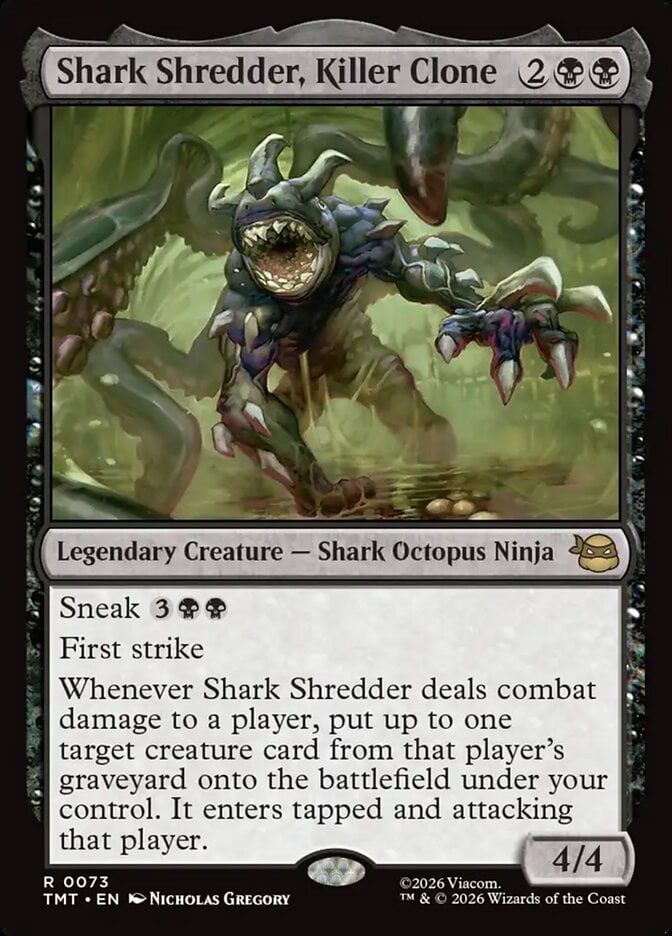
Shark Shredder, Killer Clone
Rating: 9/10
Ink-Eyes, Servant of Oni, eat your heart out! Shark Shredder, Killer Clone is such a neat design, it looks so good to play with. A 4/4 with first strike is really hard to get into combat with in the first place, so even running it out on turn 4 isn’t bad. While you do need your opponent to have creatures for you to steal, you can easily set that up just by removing them or trading them off in combat on earlier turns. It’s then just plain rude to sneak this in because it guarantees you hit your opponent with at least two creatures in that combat. This looks like it’s one of black’s better rares, and it’s especially good in what is likely to be my favorite deck to draft, so it gets extra points from me.
Shredder, Unrelenting
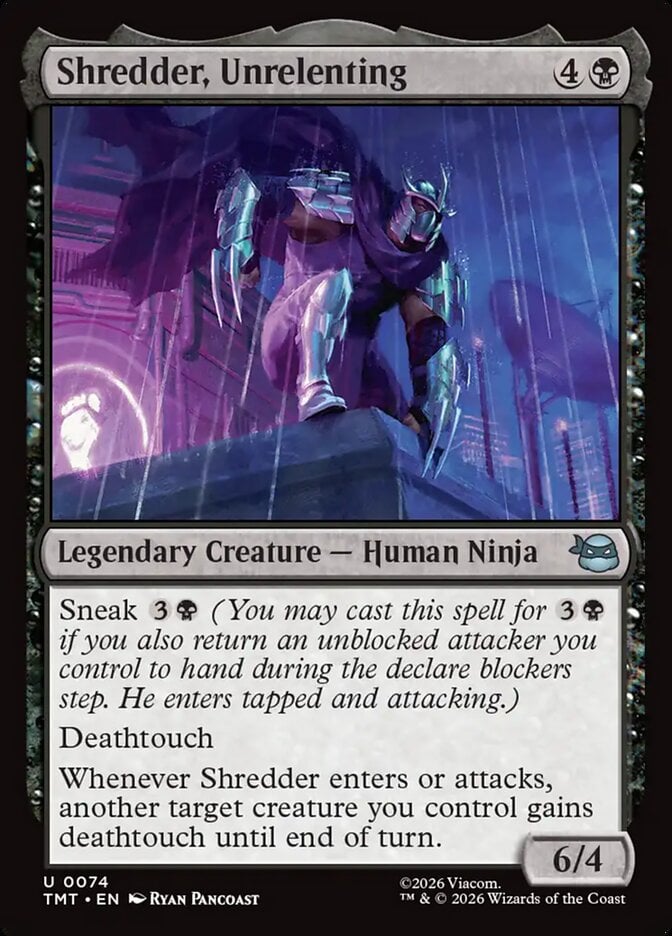
Rating: 6/10
Shredder, Unrelenting is a nasty combat trick that shouldn’t be too difficult to set up. You can make one big attack, let your opponent block, and use an unblocked attacker to sneak it in and force your opponent to trade with a creature they originally thought was a favorable block. Not only that, but you’re now hitting your opponent for 6 damage, which makes this a big swing in tempo.
Shredder’s Armor
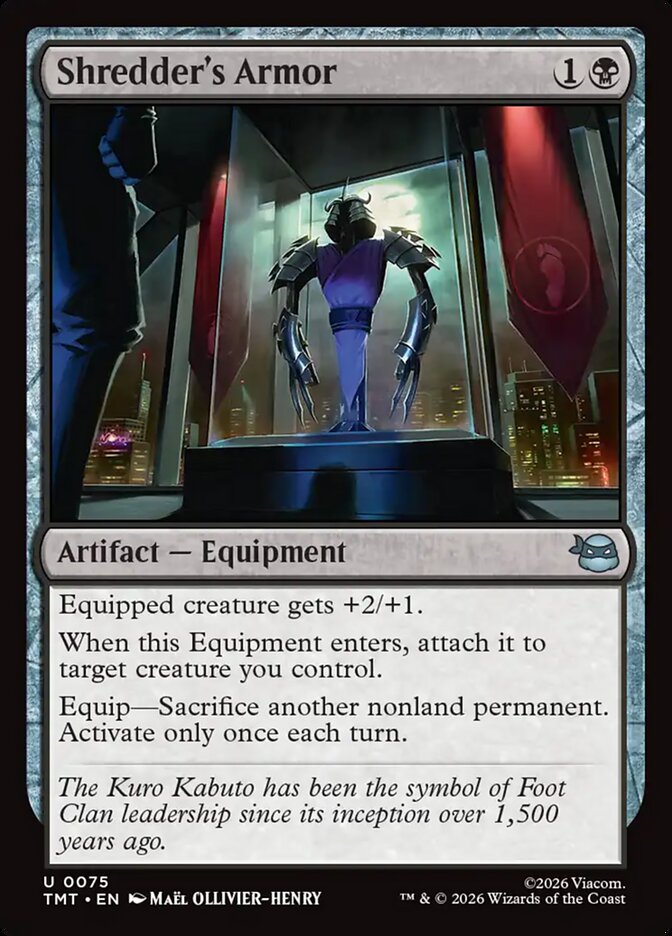
Rating: 5/10
Shredder's Armor is a nice, cheap equipment card that provides a good boost to power and toughness while not costing any mana to equip. You even get the first equip for free. What sets this apart is that it’s a free sacrifice outlet for the black/green deck, which makes it quite valuable if you have the right setup for it.
Shredder’s Revenge
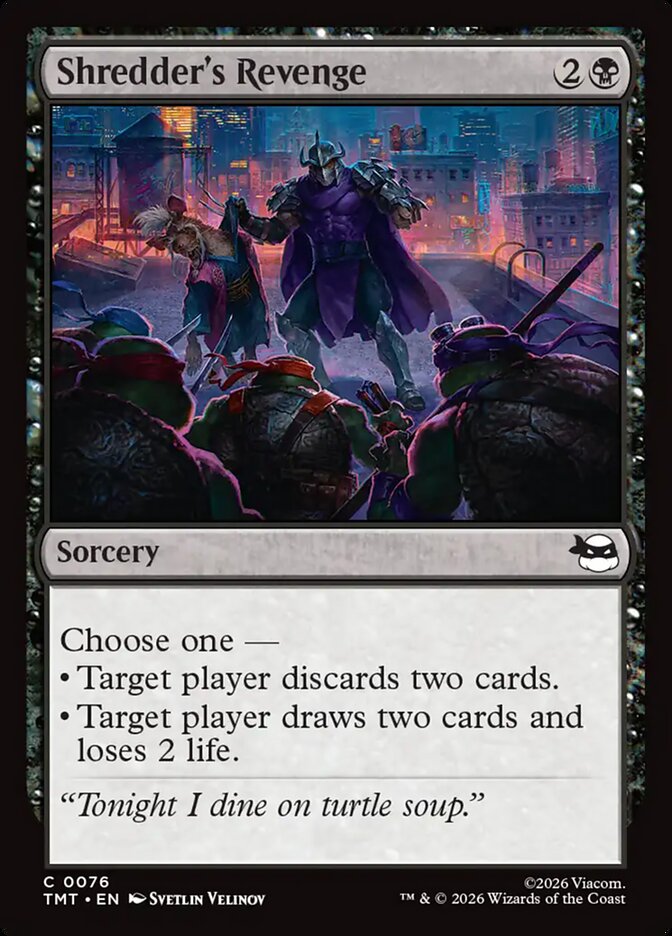
Rating: 1/10
Mind Rot has really fallen off in recent years to the point where you’re never happy to play it. As such, Shredder's Revenge is a draw spell first and foremost, which some decks are probably fine using, but none are going to be excited to run it. This is likely the last card you add to your deck, but more often than not, you won’t play it at all.
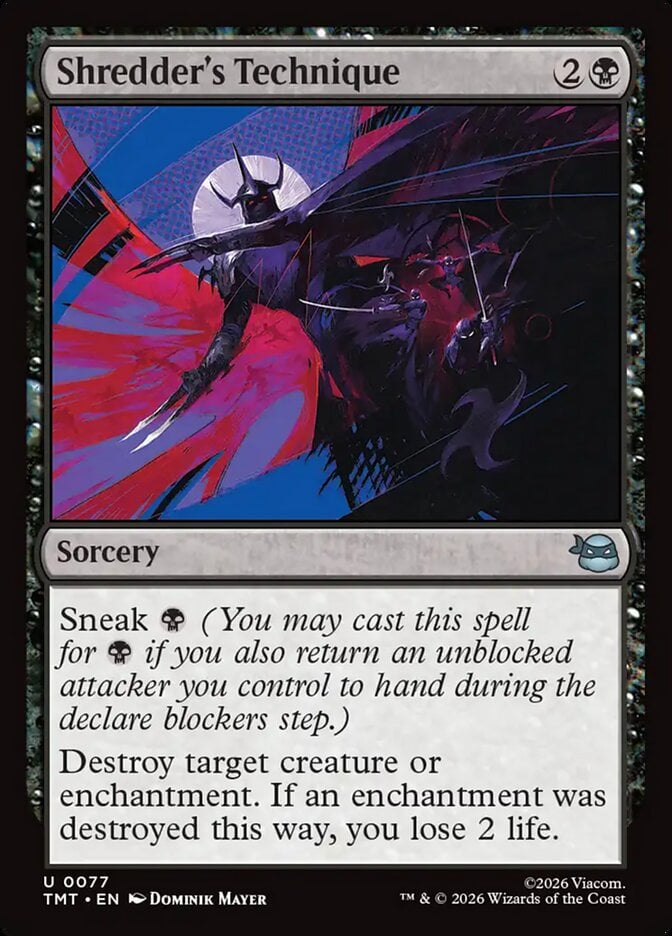
Shredder’s Technique
Rating: 6/10
Three mana for a sorcery that kills any creature or enchantment is nice, clean removal, especially in a set with so many strong enchantments to remove. The sneak ability is really interesting here though, because it still allows you to pick off a double block in combat if you have an unblocked attacker to sneak with. Still, Shredder's Technique is likely the best black removal spell in Teenage Mutant Ninja Turtles, and it also plays well into the set’s themes.
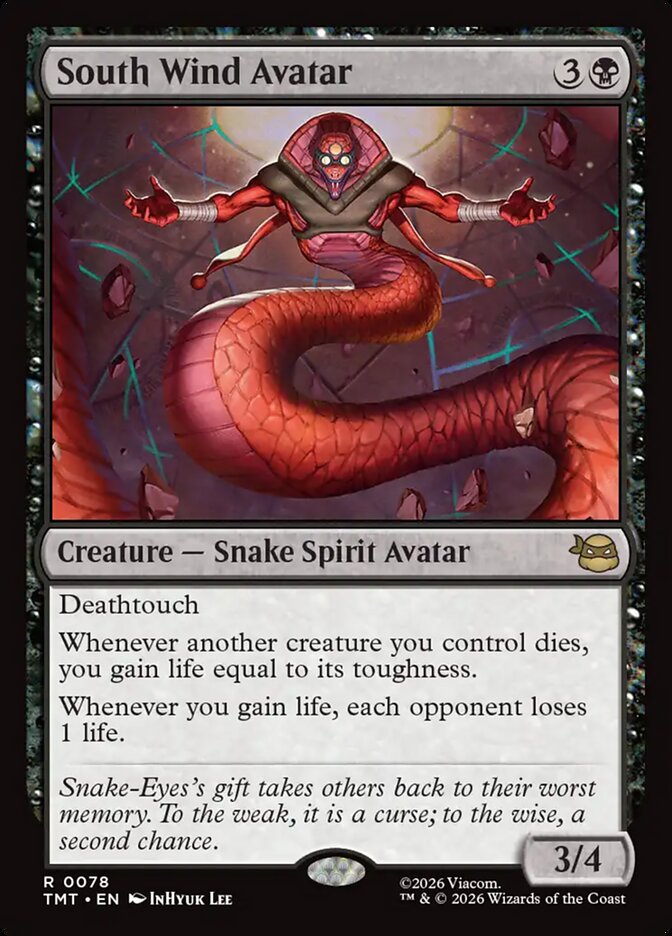
South Wind Avatar
Rating: 5/10
It doesn’t look like there’s much special about South Wind Avatar. It’s a good card based on raw stats alone, but it has very little synergy with the rest of the set. It’s a card you’ll probably always play, but it isn’t not one you’ll pick up early in a draft.
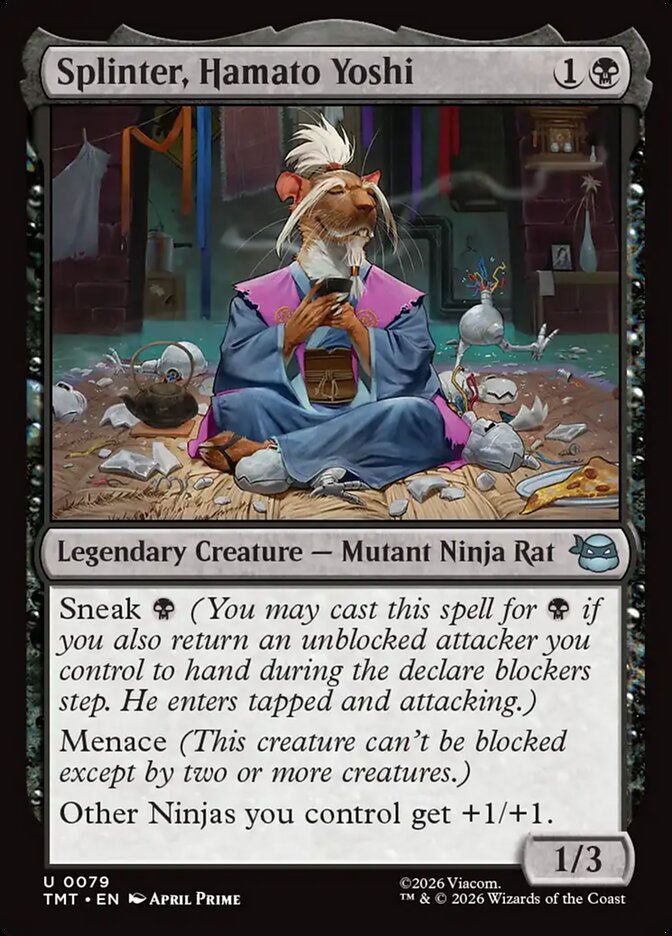
Splinter, Hamato Yoshi
Rating: 7/10
A typal lord like Splinter, Hamato Yoshi would be a welcome sight in any set with a creature type to focus on. In this set, it’s downright stupid. Sneaking Splinter in isn’t only cheap, but it's also a great combat trick in the right scenario. It’s even a good creature to enable other sneak costs given that this Splinter has menace. This is yet another great card for the ninjas deck, and I hope I get to play it a lot.
Splinter’s Technique

Rating: 1/10
Right away, Diabolic Tutor is awful in Limited. No card in your deck is so good that it would be worth casting for an additional 4 mana. Demonic Tutor is also too weak. Splinter's Technique’s one advantage is its ability to bounce a creature when you sneak it. While that’ll often be a cost, it’ll sometimes feel like an upside. If that’s the case in your deck and you also have a great card or two to go searching for, then maybe you can play this tutor.
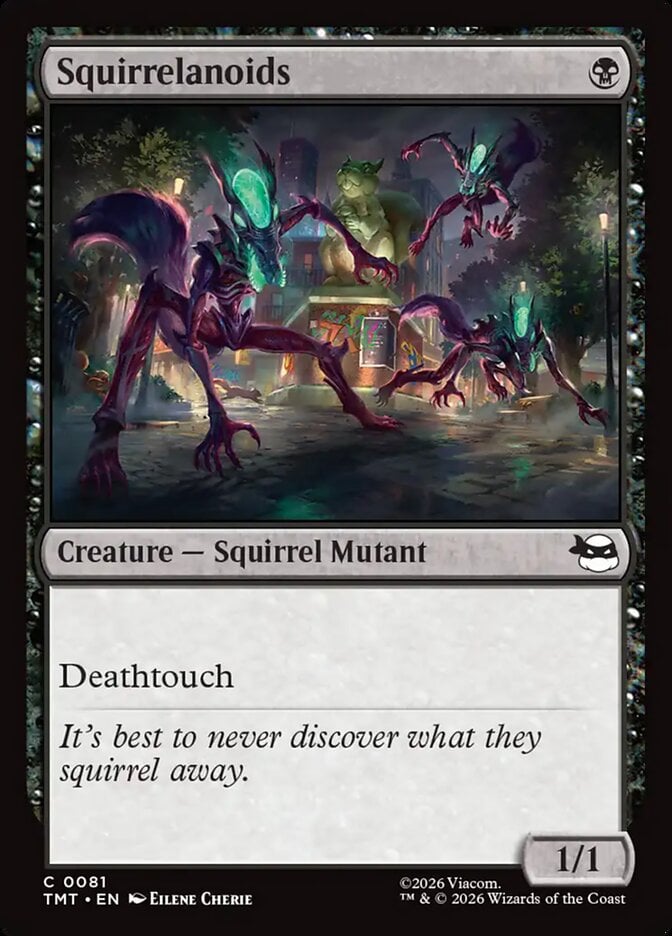
Squirrelanoids
Rating: 4/10
One mana for a 1/1 with deathtouch is pretty much always good to see. Squirrelanoids should also play out especially well in TMT, as it’s unlikely your opponent will want to block it, which you can make use of for sneak.
Stomped by the Foot
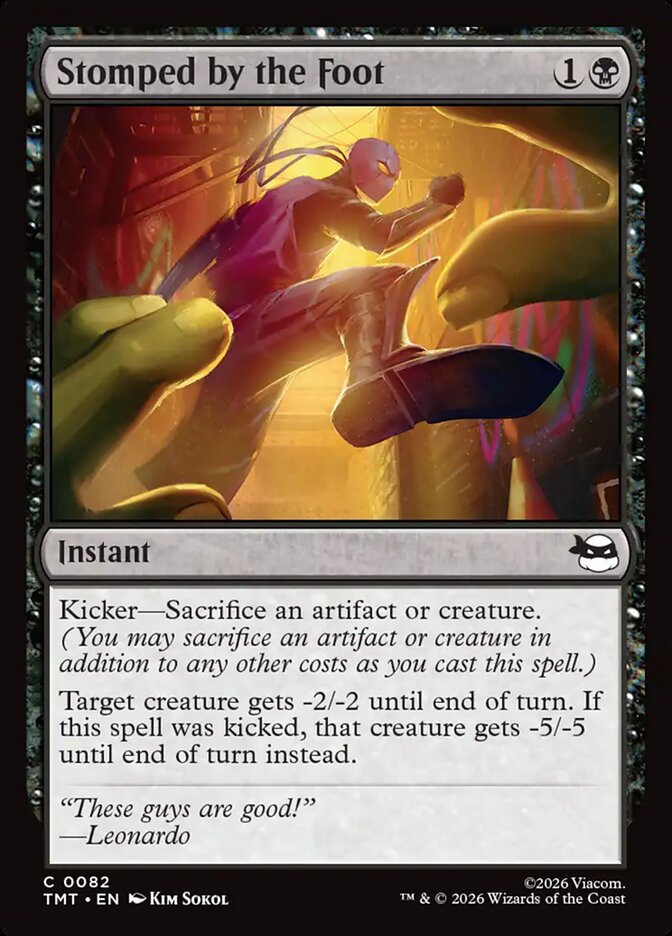
Rating: 6/10
Whether it’s Stomped by the Foot, Vicious Offering, or Vayne's Treachery, the rate on this removal spell is incredible. Just -2/-2 is good enough to take out many things in the early game and -5/-5 deals with nearly everything else once you reach the late game. This is likely to be black’s best common and possibly one of the best commons in the set.
Super Shredder

Rating: 6/10
Super Shredder looks remarkably similar to Lorwyn Eclipsed’s Moonshadow, a card which I think played very well in that format. The key differences are that Shredder triggers for anything that dies and triggers from your opponent’s permanents. It’s true that sometimes you’ll draw this too late to be that good, or you opponent will easily remove it, but it’s very difficult to deal with it once it starts to rack up counters. Menace also ensures that your opponent can’t get away with simply chump blocking it ad nauseam.
Tunnel Rats
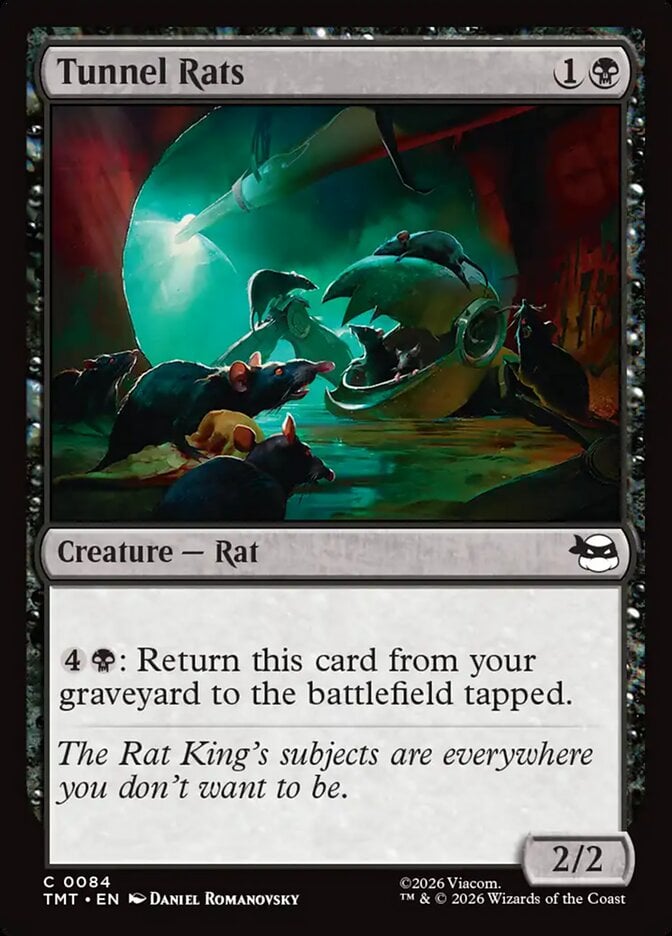
Rating: 1/10
While it sounds good to get this creature back repeatedly, 5 is so much mana that Tunnel Rats is a card you’re only likely to use once you’re already at the end of the game and you’re flooding out. Until then, it’s only a vanilla 2/2, and you can do a lot better.
Red
Bot Bashing Time
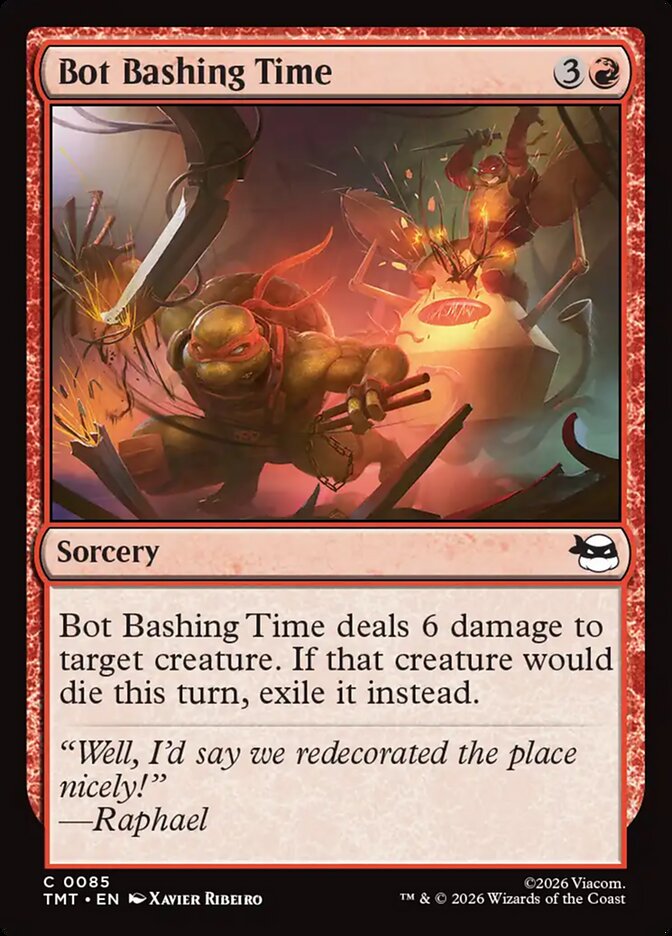
Rating: 5/10
Six damage is enough to kill most of the creatures in Teenage Mutant Ninja Turtles. In fact, there are only six creatures big enough to dodge it, which makes Bot Bashing Time a pretty solid removal spell for 4 mana.
Broadcast Takeover
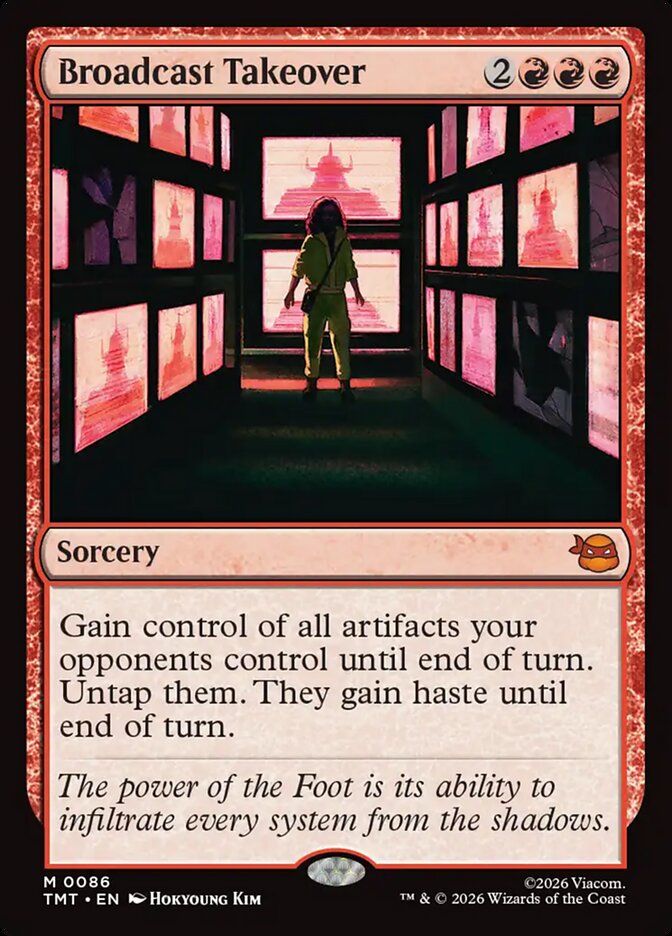
Rating: 0/10
Since Broadcast Takeover does nothing unless your opponent has artifacts in play, you should never play it in your main deck. Should you ever side it in? Probably not. Even against an artifact-themed deck, there’s bound to be plenty of creatures that you can’t steal, a fact that places this somewhere between useless and mediocre.
Casey Jones, Jury-Rig Justiciar

Rating: 5/10
First of all, a 2/1 with haste for just 2 mana is technically playable in any red deck, but it’s not particularly good. As such, we really want to have a lot of artifacts to make Casey Jones, Jury-Rig Justiciar a playable card. I don’t know how such a deck will look. I’m seeing a lot of artifact-based cards that aren’t actually artifacts themselves, so Casey will probably miss more often than you want. Still, I’d be very happy to play Casey with only a 50-70% chance to hit something good (which translates to there being roughly 5-8 artifacts in your deck), given that they’re also an aggressive creature even if you miss.
Casey Jones, Vigilante
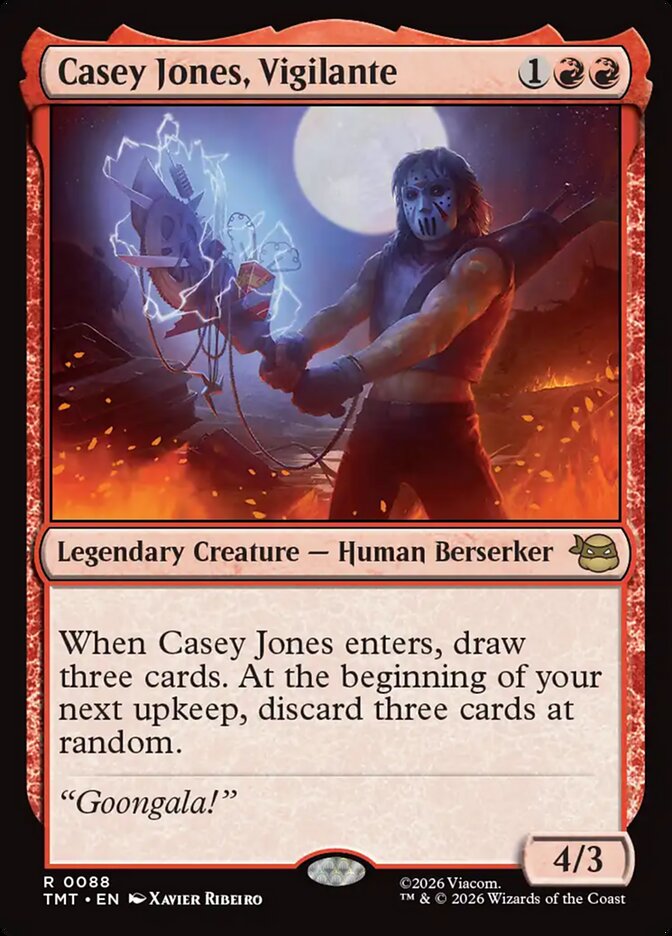
Rating: 1/10
Casey Jones, Vigilante is an interesting card that likely has some applications in other formats, but it looks incredibly bad here. Draw three cards and then discard three at random is an ability that’s bound to backfire far more often than it’ll benefit you. You can utilize it more effectively when you have no cards left in hand and plenty of mana, but playing a card that’s only good in that situation sounds like a bad idea.
Cool but Rude

Rating: 0/10
None of the abilities on Cool but Rude are particularly good in a game of Limited. It doesn’t affect the board, it doesn’t synergize with any theme in the set, and it never gives you back the card you invested in it in the first place. This looks basically unplayable to me. Avoid it at all costs.
General Traag, Heart of Stone
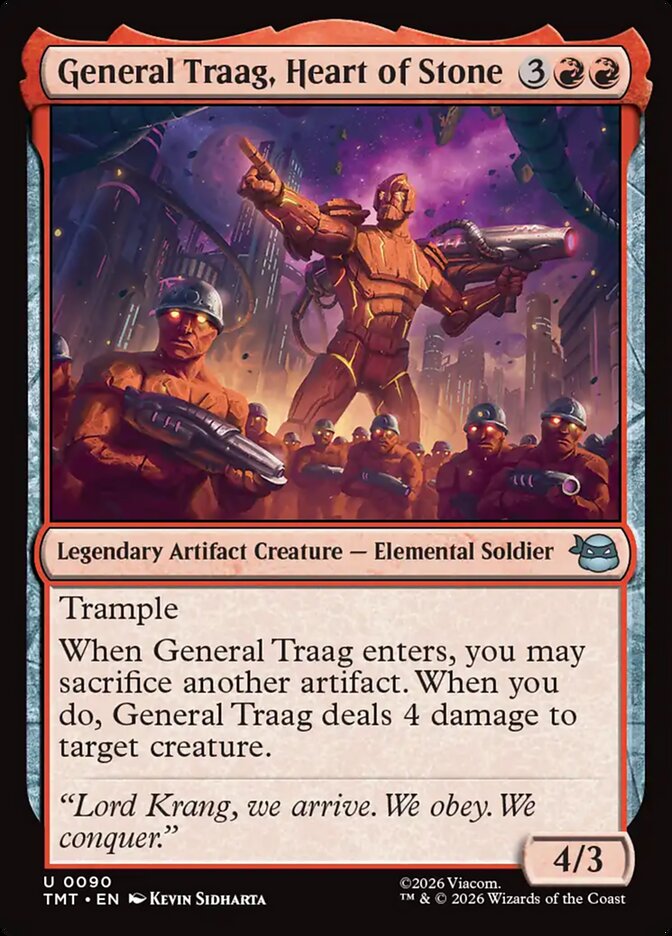
Rating: 7/10
I always keep an eye out for Flametongue Kavu variants, and this one is a real doozy. General Traag, Heart of Stone is a little more expensive than I’d like, but that shouldn’t matter as long as you have a deck with enough throwaway artifacts to fuel it. Four damage destroys most of the creatures in Teenage Mutant Ninja Turtles, so this a very powerful payoff for the artifacts deck.
Hard-Won Jitte
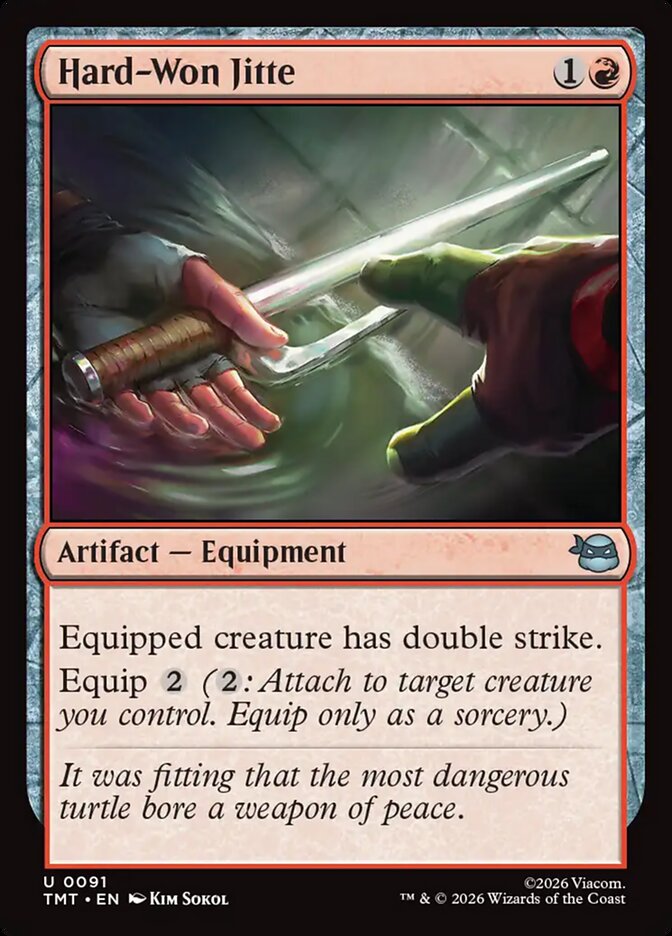
Rating: 1/10
No, I don’t think so. This is way too much mana to spend just to give something double strike. Your opponent can still chump block the creature, so you need your creature to have trample or evasion already for this to even be relevant. I don't think you should play Hard-Won Jitte at all, and I’d be surprised to see it played against me.
Improvised Arsenal
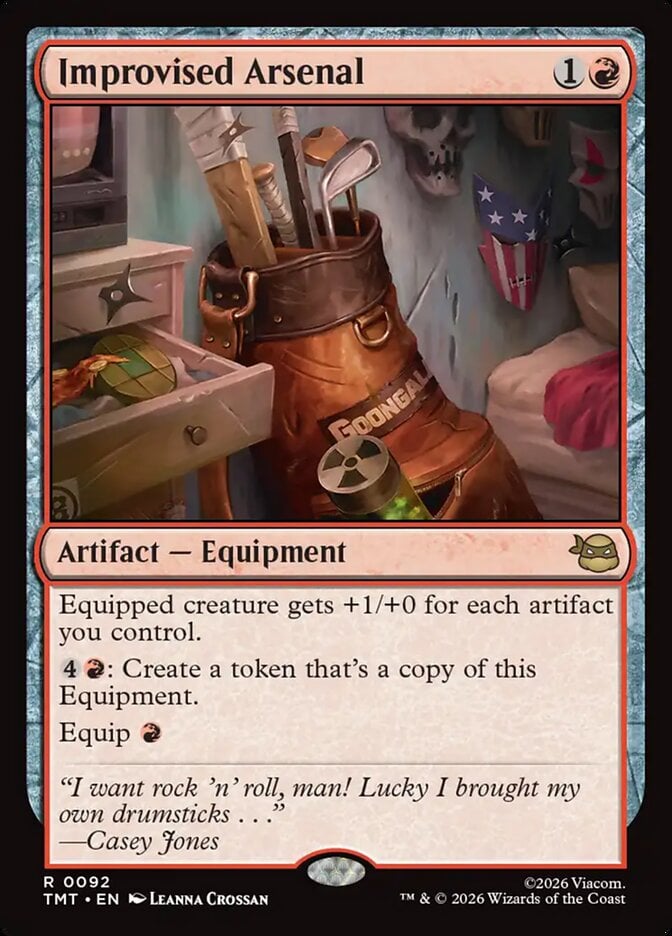
Rating: 7/10
I don’t think I ever expected to see Cranial Plating get a functional reprint, but here we are. In an aggressive artifact-based deck, Improvised Arsenal can turn literally any creature into a must-answer threat. Once you get to the late game and can churn out more copies of this, it shouldn’t take much more to close out a game.
Jennika’s Technique
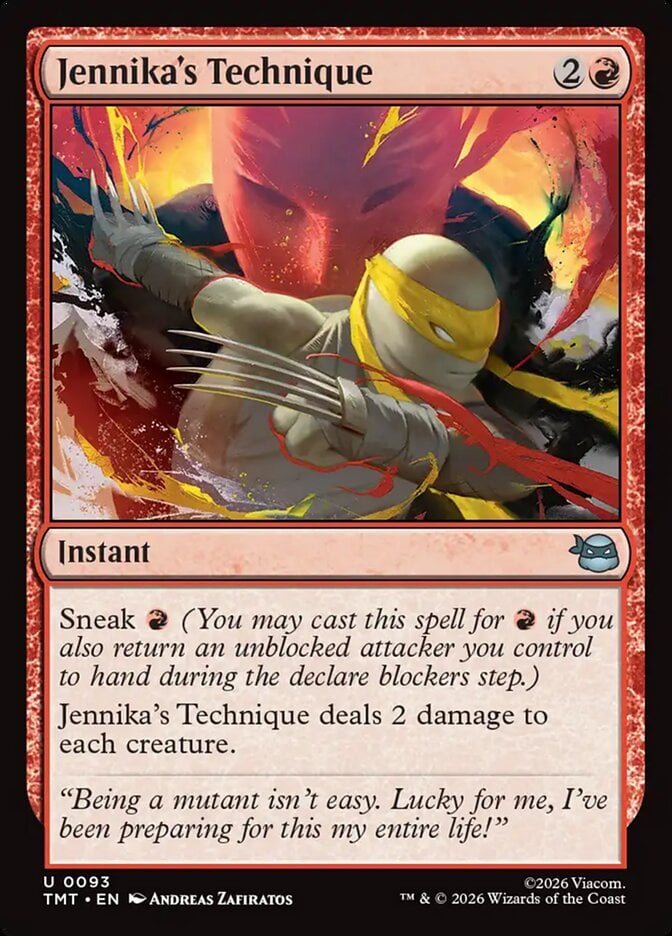
Rating: 2/10
Both of red’s archetypes are aggressive in nature with plenty of small creatures, so it’s difficult to see where a card like this fits in those decks. It’ll be hard to play Jennika's Technique in any deck with lots of creatures that it can sweep away, so this is far less of a main deck option than it might be in another format.
Manhole Missile
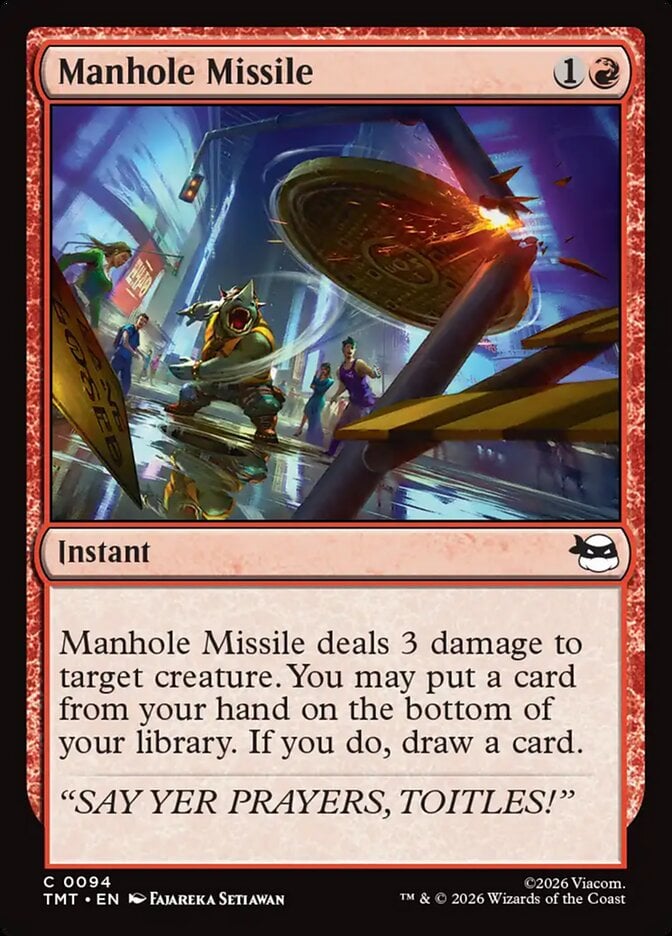
Rating: 6/10
Manhole Missile is a typical premium removal spell for red and most likely the best common in Teenage Mutant Ninja Turtles. Three damage for 2 mana is a great rate on return and the ability to swap out a card in your hand for a new one is a great bonus.
Mouser Attack!
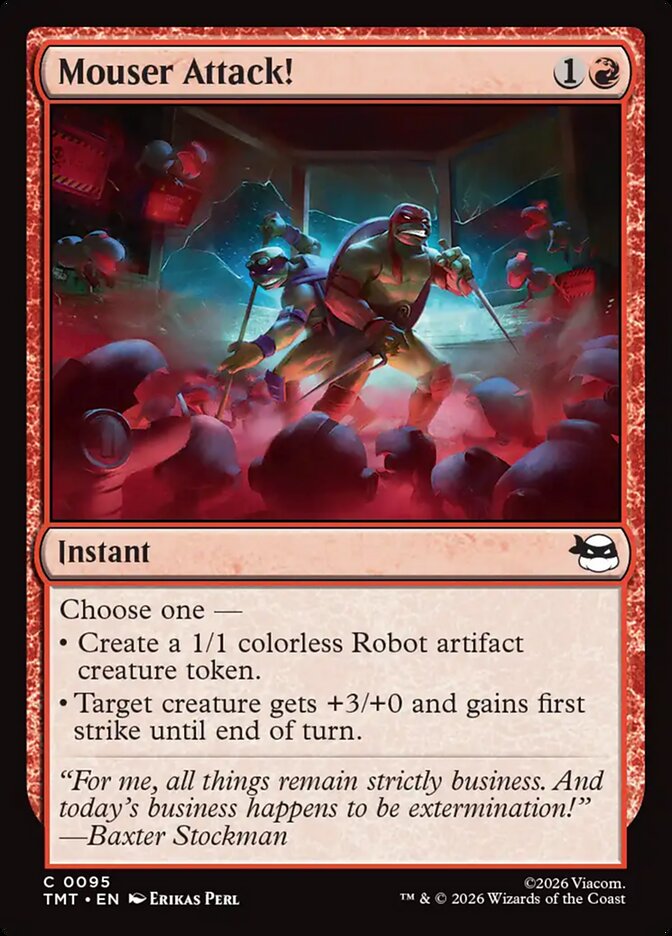
Rating: 2/10
Sure Strike is a fairly decent combat trick and Mouser Attack! is very much the same card. Creating a single 1/1 token for 2 mana is pretty bad, but doing so at instant speed might be good to trigger an alliance ability and affect combat in a different way. All of this is no substitute for hard removal spells, but it could come in handy if you’re short on those.
Mouser Foundry
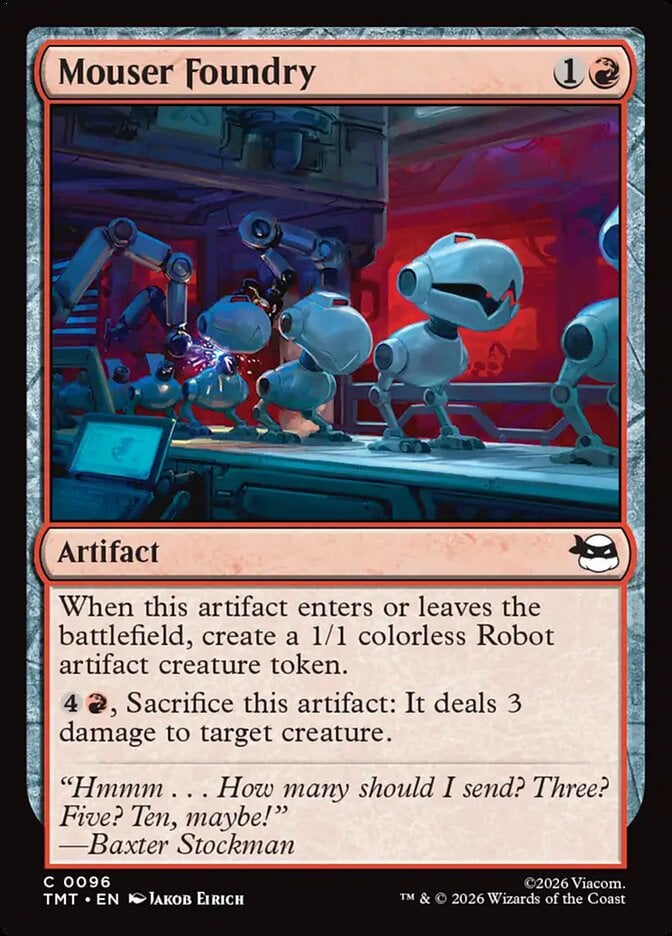
Rating: 3/10
I usually love cards like this, but waiting until I have 5 mana to sacrifice it and get the full value kinda takes the fun out of it. I’d like to find some other way to sacrifice it, but it doesn’t look like there’ll be a lot of ways to do so. Still, at the very least, Mouser Foundry is two artifacts in one card, and that’s quite valuable in itself.
Mutant Town Musicians
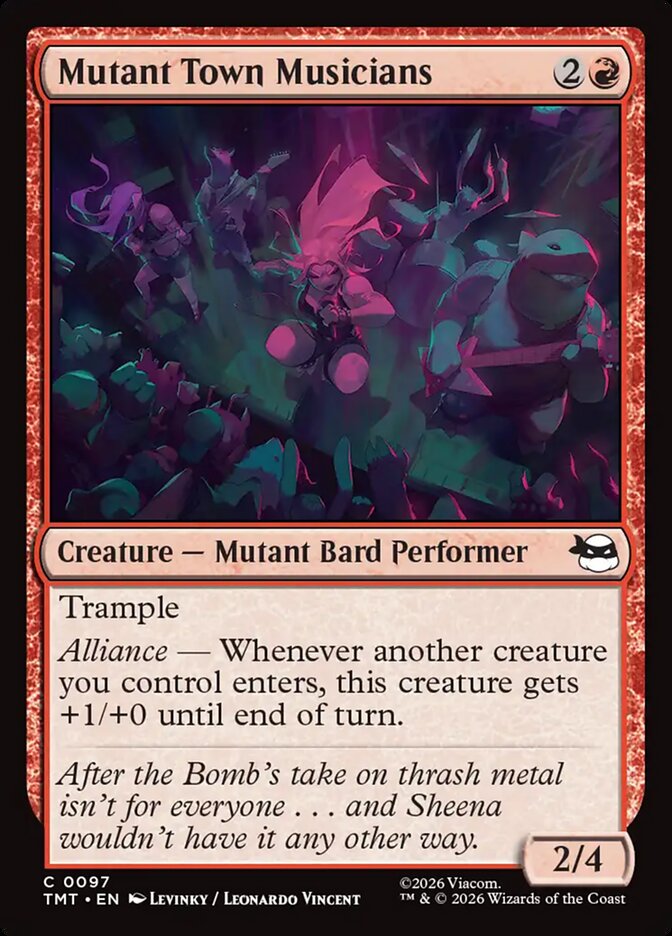
Rating: 3/10
If Mutant Town Musicians is regularly a 4/4 trampler when you attack with it, then it’d probably be pretty good. The problem is that often it won’t be that good, which severely limits its power level. In a good alliance deck, I can see this as a decent curve-filler, but it’s not the sort of card that every deck can use.
Null Group Biological Assets
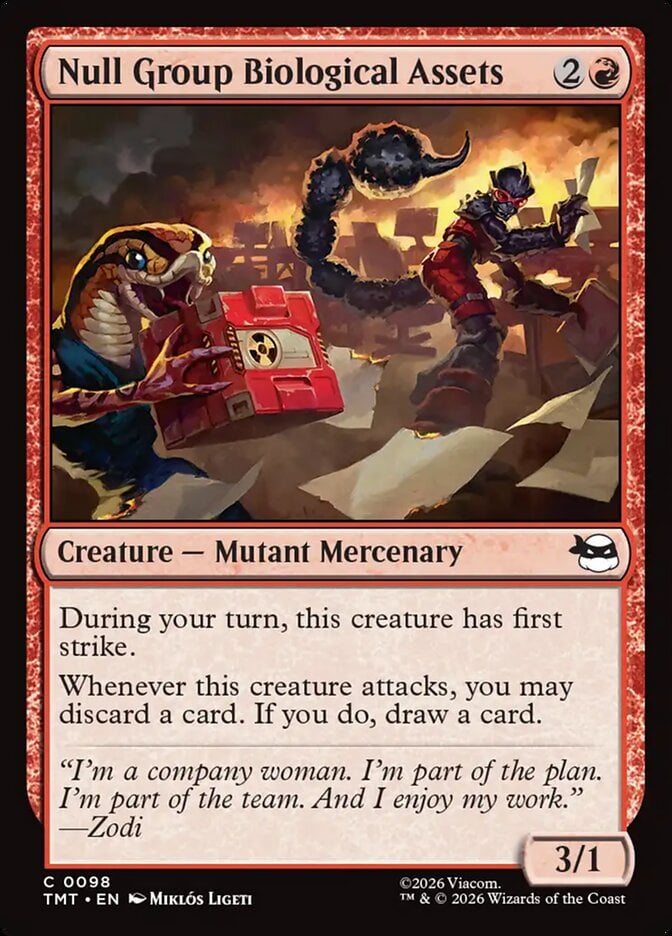
Rating: 2/10
A 3/1 with first strike can be a pretty annoying creature to deal with, but the problem I see with Null Group Biological Assets is simply that it doesn’t do anything for either of red’s archetypes. Synergy is a big part of modern Limited formats, and the fact that this doesn’t offer any is a point against it.
Old Hob, Alleycat Blues
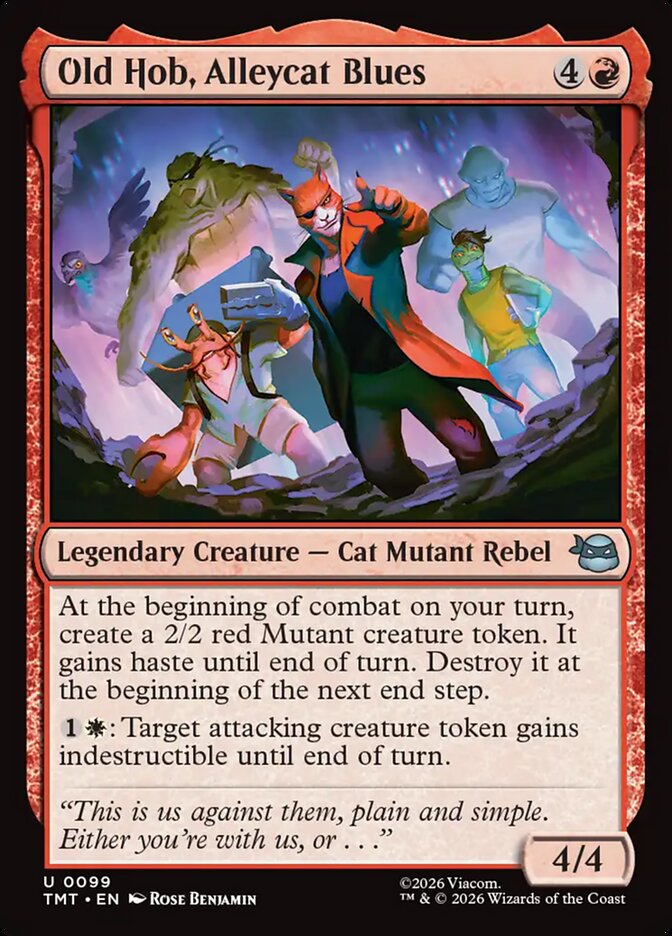
Rating: 6/10
Old Hob, Alleycat Blues is a great card to top the curve in a go-wide deck. Even if you can’t use the white ability on it, you can create a 2/2 token every turn and trigger any and all alliance abilities you might have on board. Add in the white ability and you have a card that your opponent has to answer or you’ll run away with the game.
Purple Dragon Punks
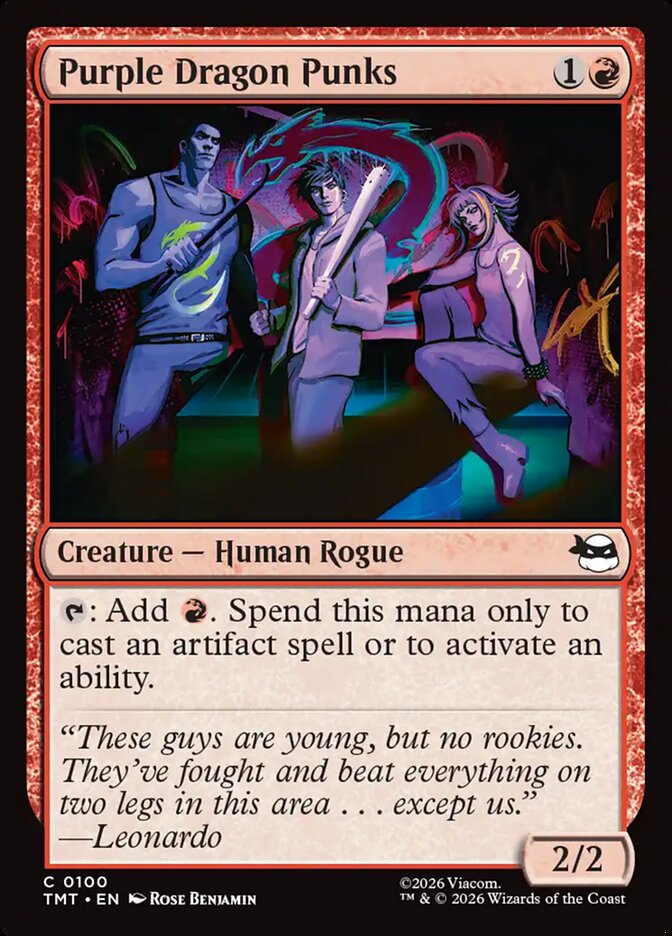
Rating: 4/10
A mana dork for the artifact deck certainly sounds like it could work. It’s a little annoying that it isn’t an artifact itself, but I’m sure that’s not enough to hold back Purple Dragon Punks. Mana dorks are good in Limited, and I’m sure this one will be, too.
Raphael, Most Attitude
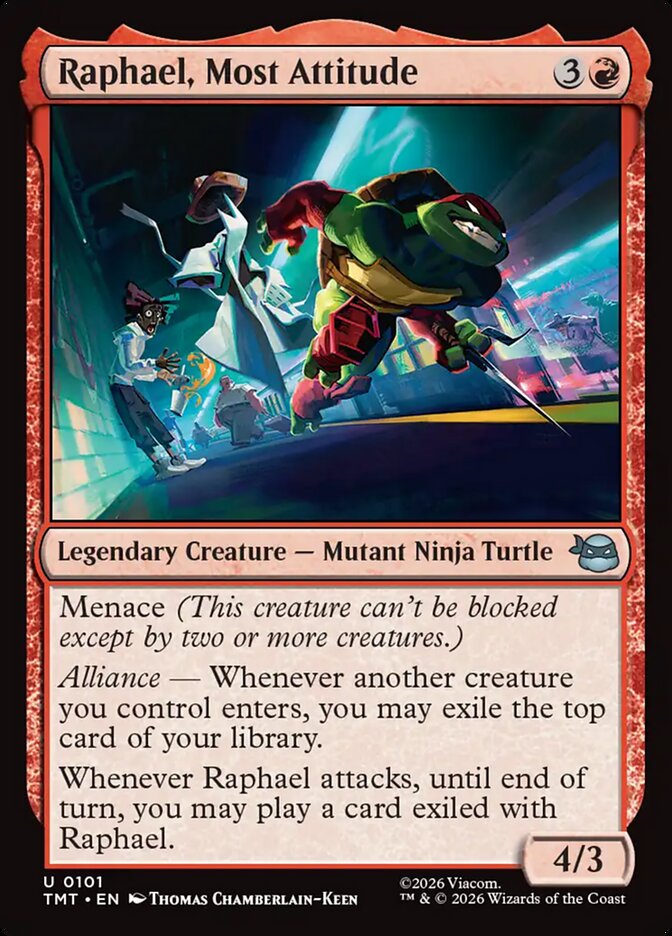
Rating: 4/10
This is a very roundabout way to let you draw an extra card or two. While that’s a very good upside to have, you have to do a lot just to get one free card out of the deal. Probably a little too much. At the end of the day, Raphael, Most Attitude is still a 4/3 with menace for 4 mana, so you don’t need much persuasion to put it in your deck.
Raphael, Ninja Destroyer
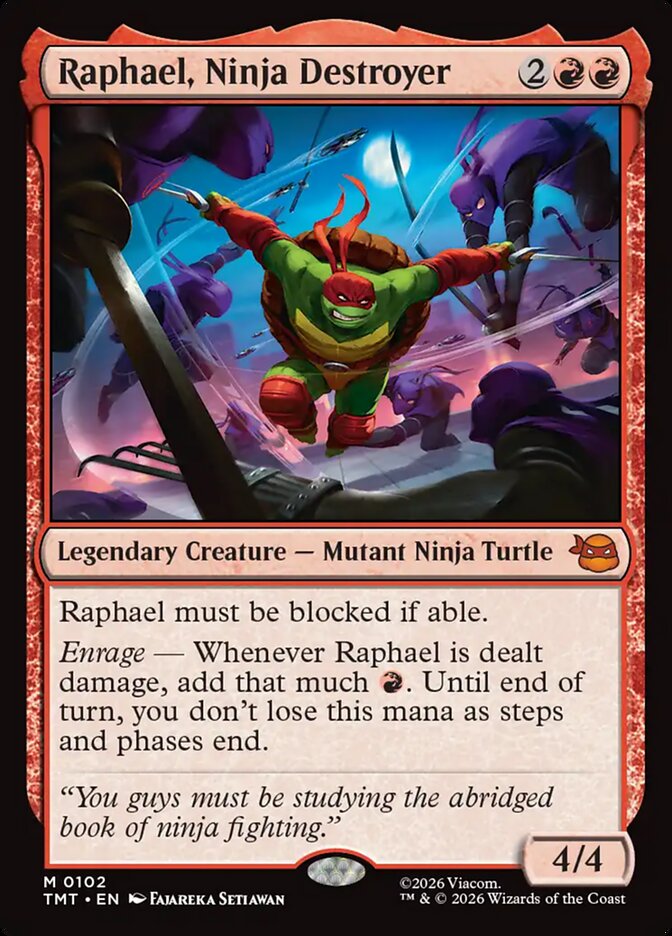
Rating: 4/10
This mythic Raphael card looks like it could have some serious combo potential, but in Limited it looks kind of mediocre. Raphael, Ninja Destroyer isn’t quite big enough for the “must be blocked if able” ability to be that much of an upside. You still won’t want to attack with it into a pair of 2/2s, or worse yet, a pair of 2/3s. The mana rebate you get for that might be able to let you cast an extra spell, but it’s hardly worth what you put into it.
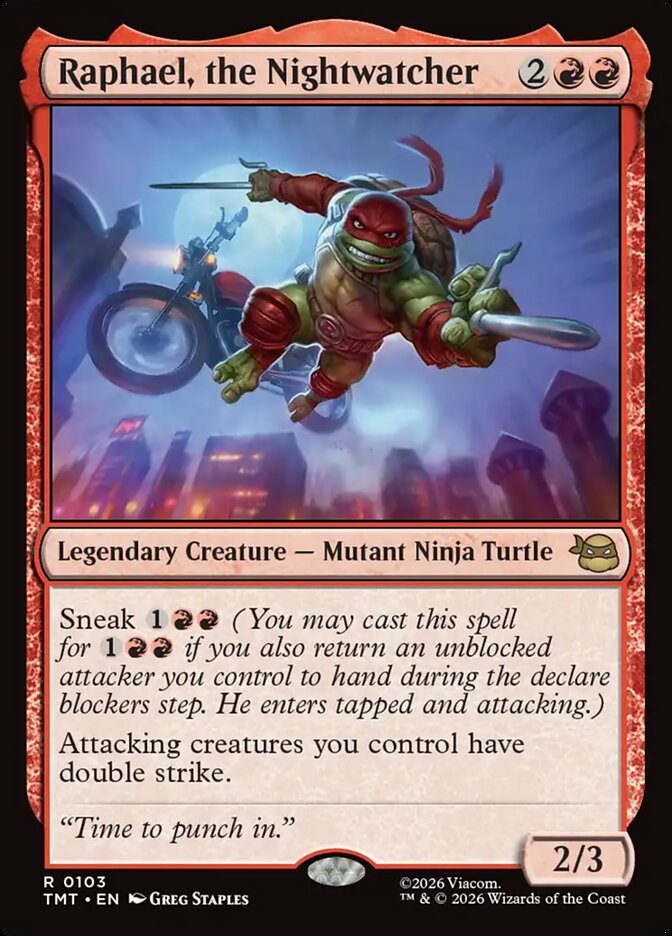
Raphael, the Nightwatcher
Rating: 6/10
Red isn’t the best color at sneaking ninjas in, but if you can sneak in Raphael, the Nightwatcher, you’ll be well rewarded. Raphael won’t just hit for a good chunk of damage by itself, but you can potentially combat trick any other creatures you’re attacking with. Or better yet, if you have other attacking creatures that haven’t been blocked, giving them all double strike can force through a lot of extra surprise damage.
Raphael, Tough Turtle
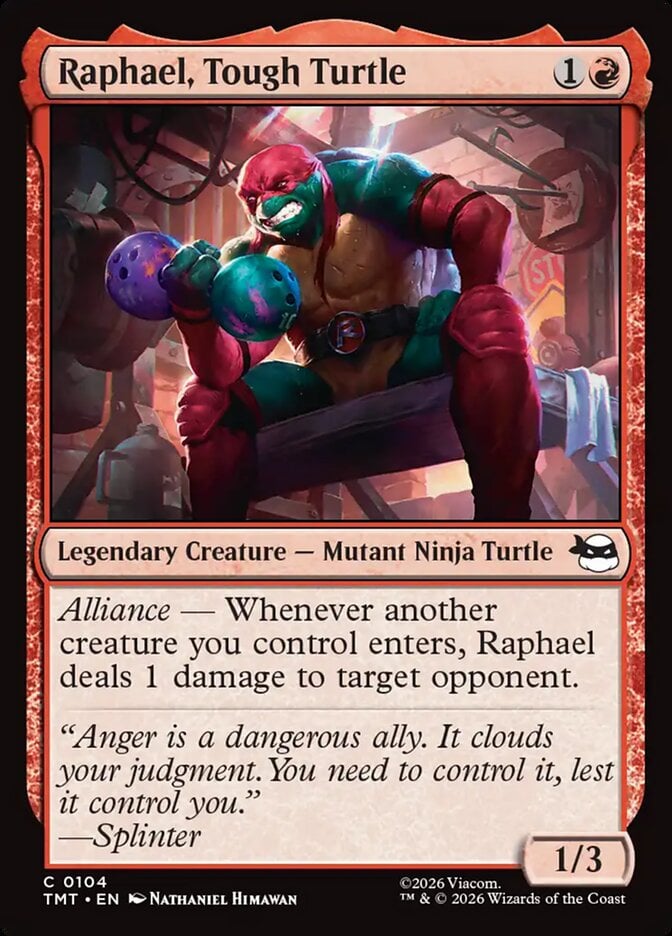
Rating: 3/10
While I’d prefer a red 2-drop to be aggressive, the extra damage pings that Raphael, Tough Turtle can rack up over time should more than make up for its unimpressive stat line. I’d happily play this in a go-wide alliance deck, but the artifact decks probably aren’t going to be as interested.
Raphael’s Technique

Rating: 1/10
It’s been a while since I’ve seen a variant of Wheel of Fortune in a Standard set. Wheel has become an incredible combo card, but there are no combo decks to draft in TMT. If you plan to use Raphael's Technique, then you need to find a spot in which your opponent has more cards to discard than you do and you should preferably have a stronger board than your opponent. In other words, you need to be in a winning position to make this playable, which doesn’t really equate to a card you actually want to play.
Ravenous Robots
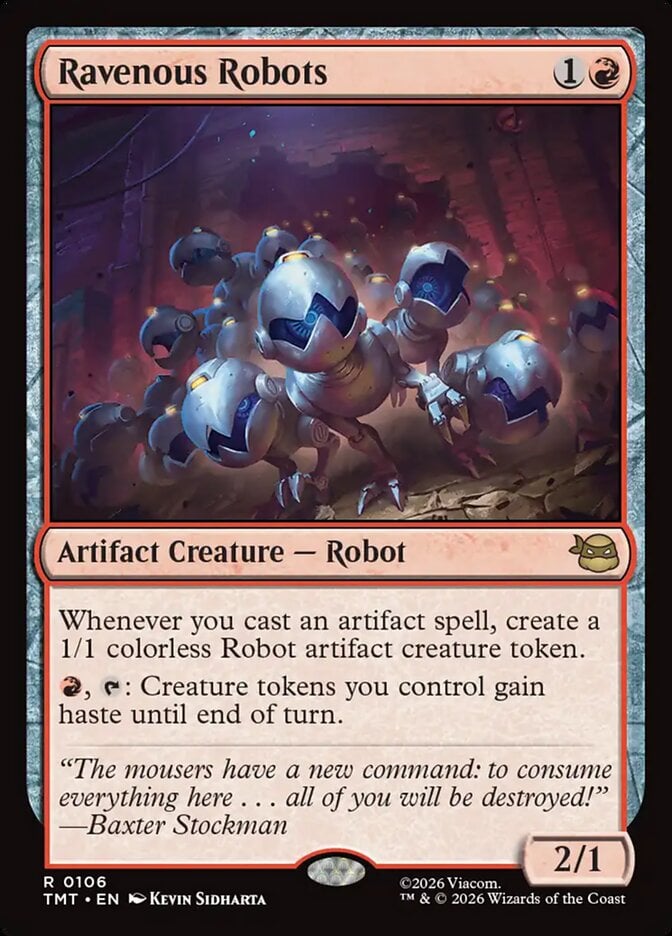
Rating: 6/10
I do love to play with Young Pyromancer. It’s going to be a little hard to trigger because the artifact decks are going to have to run a fair few nonartifacts based on the makeup of this set, but you only need to trigger Ravenous Robots once or twice to make it worth it, which should be easy enough to do.
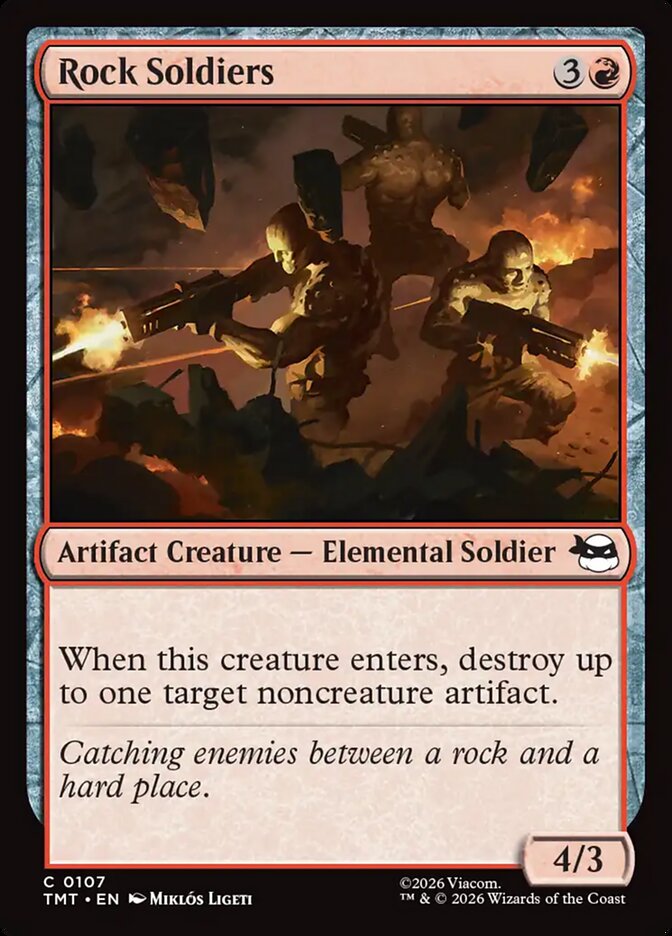
Rock Soldiers
Rating: 3/10
Assuming that you can actually destroy something useful, Rock Soldiers is a powerful common to play. Given the prevalence of Mutagen and Food tokens, you’ll probably be able to at least get something. In specific matchups, you might be able to destroy something more relevant.
Slash, Reptile Rampager
Rating: 7/10
Two damage for each creature that enters is quite a lot and adds up quickly. The only issue is that by costing 5 mana, Slash, Reptile Rampager will typically be the top of your curve, so you might not have many more creatures to play after it. Still, at least Slash then has a built-in way to create free tokens and guarantee some damage.
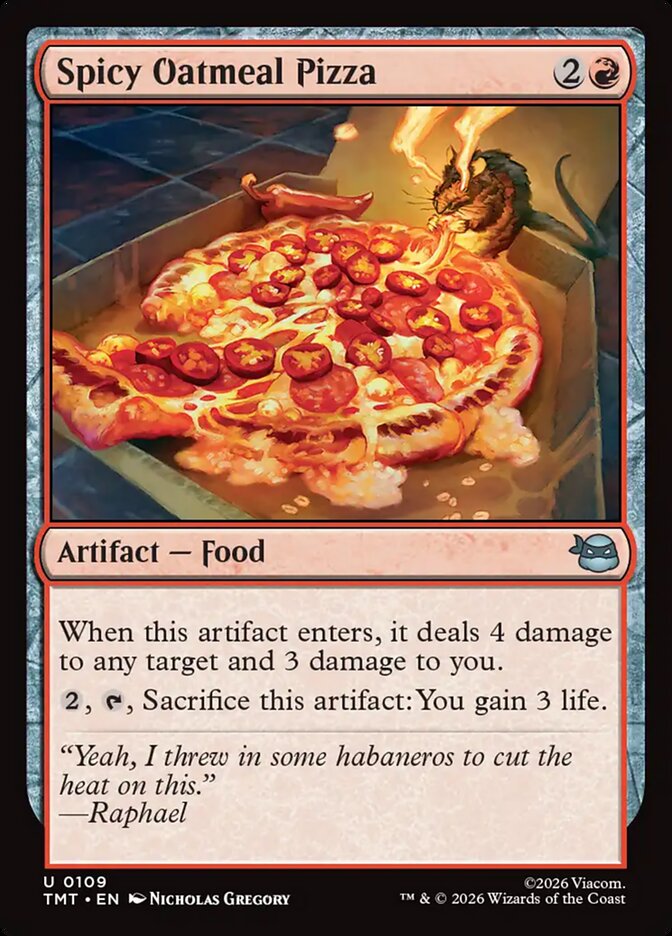
Spicy Oatmeal Pizza
Rating: 7/10
Spicy Oatmeal Pizza is an absurdly good rate for damage that you can use to kill most creatures or just finish off your opponent, and you can even mitigate the damage it deals to you by sacrificing it to gain life back. What an awesome card.
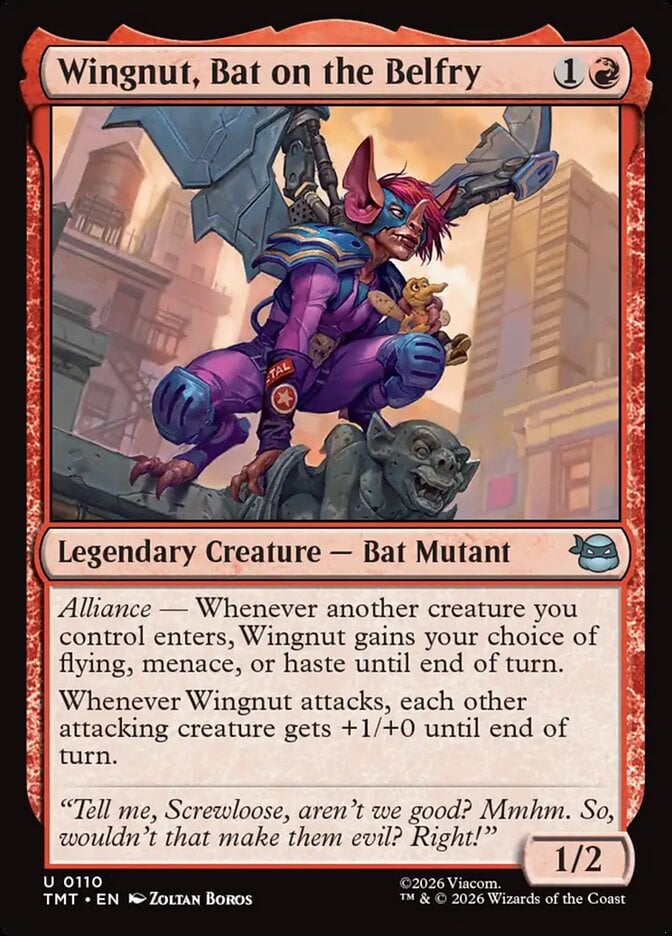
Wingnut, Bat on the Belfry
Rating: 4/10
Giving +1/+0 to your team is a good ability, but not being able to attack unless you can trigger its first ability seems a little rough. Wingnut, Bat on the Belfry can be a decent creature in the right deck, but you really need to trigger the alliance ability reliably to want it.
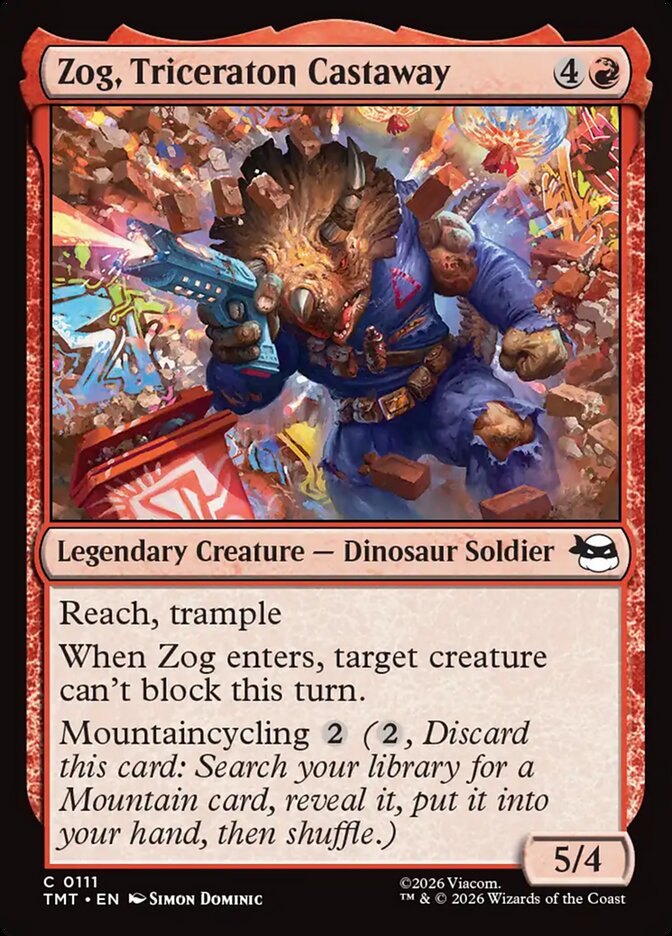
Zog, Triceraton Castaway
Rating: 3/10
Red’s landcycler looks pretty good. Zog, Triceraton Castaway is good on offense and defense, but it also has an immediate impact when you play it. It’s still a 5-drop, which not every deck will want, but it’s at least decent when you do play it.
Green
Courier of Comestibles
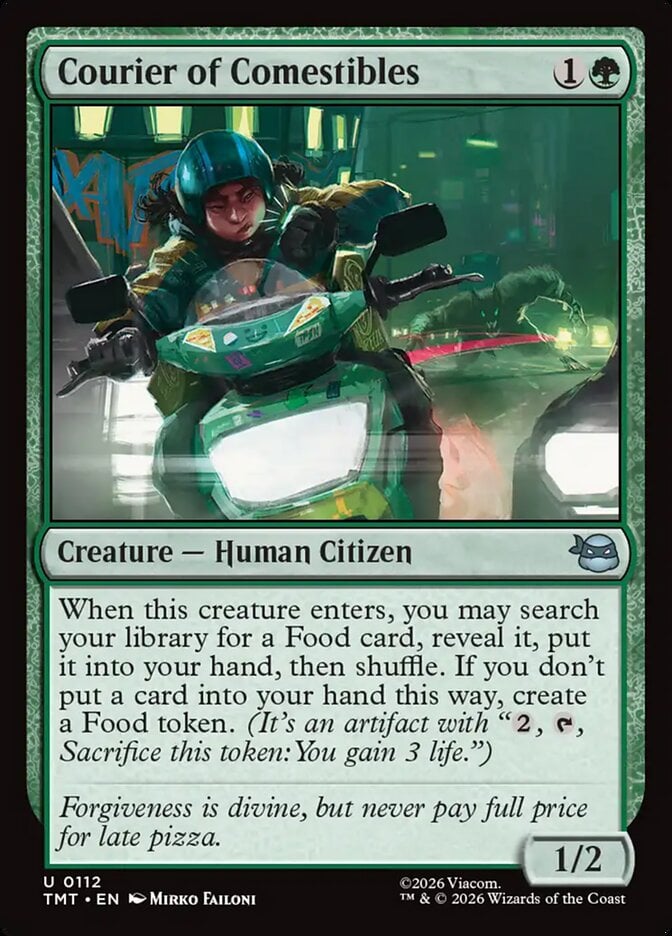
Rating: 6/10
That’s right, we have a pizza delivery guy on a Magic card! And you know what, it’s actually really good! A 1/2 plus a Food token isn’t particularly good, so we really want to search up a food card most of the time. Thankfully, there are some very good options to choose from. You clearly won’t be able to play Courier of Comestibles in every green deck, but it’ll be a great card when you have some good pizzas to fetch with its ability.
Cowabunga!
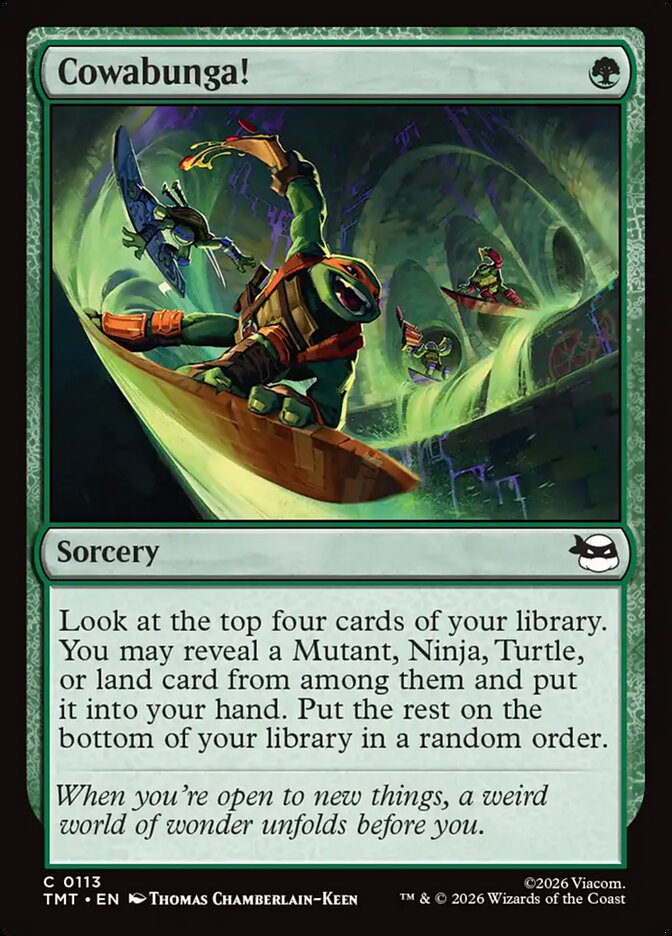
Rating: 2/10
These sorts of cards are always perfectly fine to play. Assuming you hit with this most of the time, you can always run this sorcery to make up the numbers. The issue is that a green deck rarely has any specific reasons to run a 1-mana cantrip. Still, it’s going to be pretty fun to yell Cowabunga!, throw this on the table, and find one of the ninja turtles from among your top four, so I can’t criticize it too much.
Frog Butler
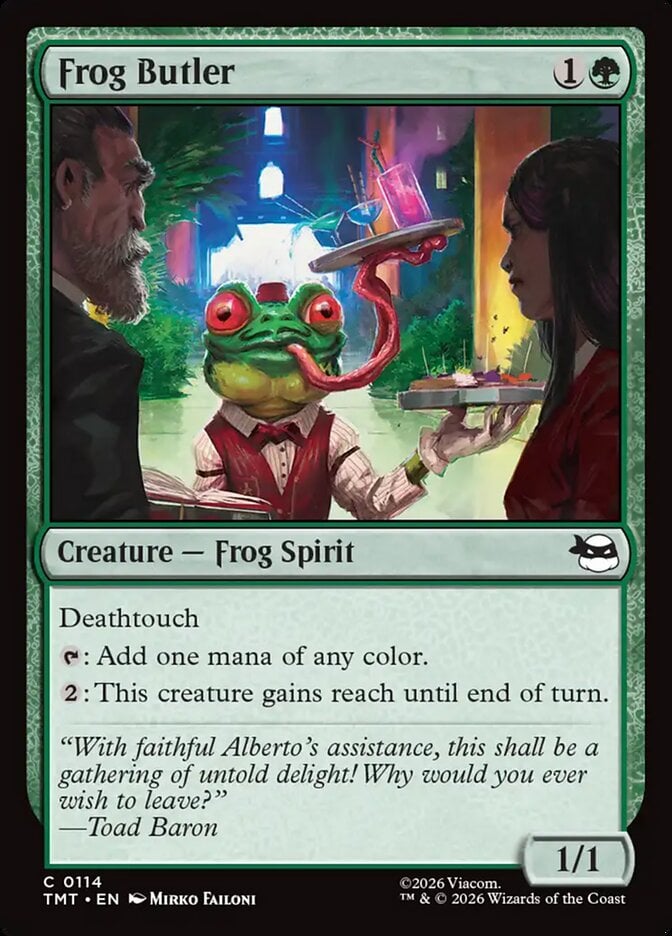
Rating: 5/10
Looks like Poison Dart Frog has gotten itself a nice job! Frog Butler has everything I like in a green common. Deathtouch lets it trade off for bigger creatures, and it accelerates your mana before doing so; both things that are great to do in Limited.
Groundchuck & Dirtbag
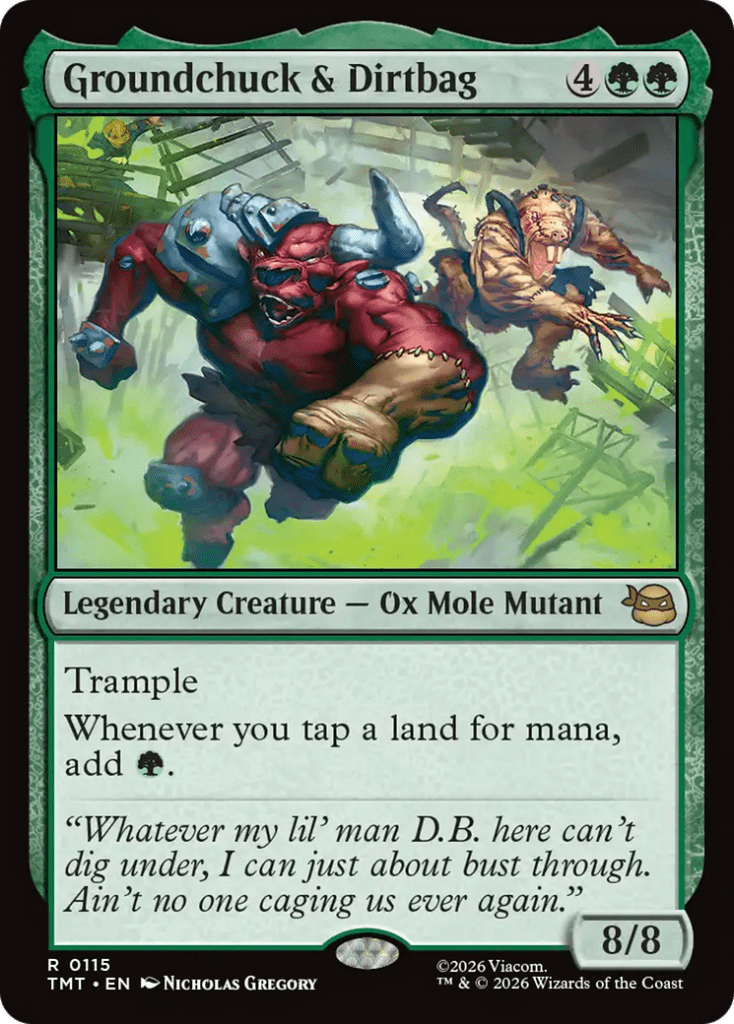
Rating: 3/10
Once you’ve cast a 6-drop creature, do you really need much more mana? In other formats sure, but in Limited this rarely comes up. Groundchuck & Dirtbag is little more than an 8/8 trampler for 6 mana, which isn’t bad, but it’s nothing to write home about.
Guac & Marshmallow Pizza
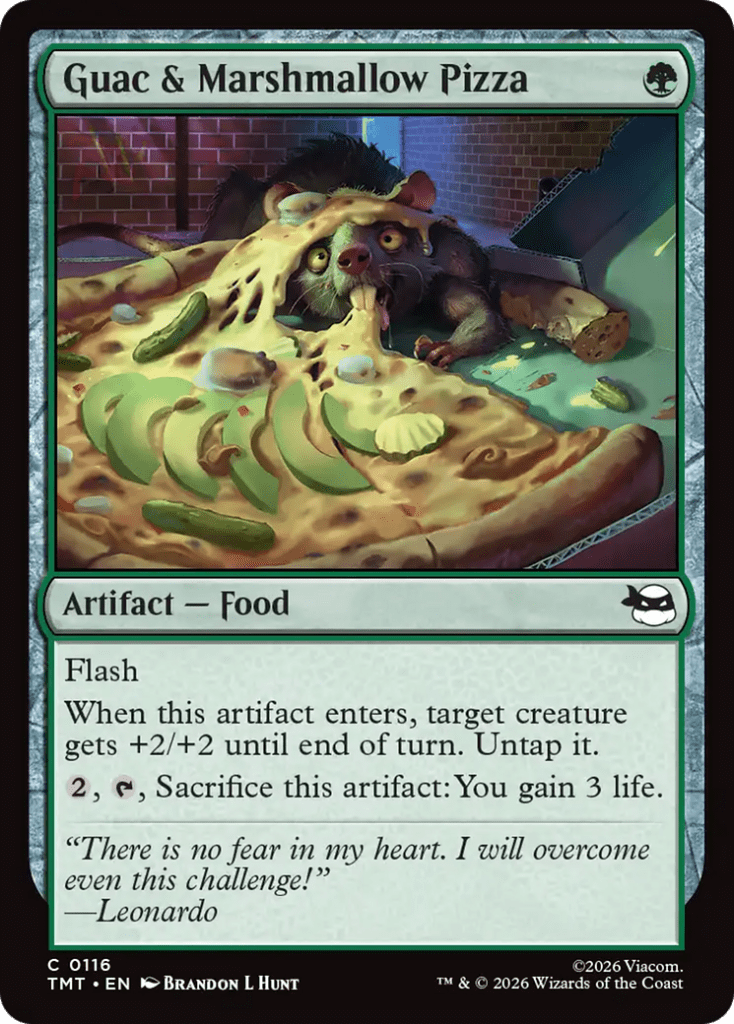
Rating: 2/10
While I appreciate there are some upsides to this being a food, the effect of giving +2/+2 for 1 mana isn’t particularly good. Guac & Marshmallow Pizza does score a few points for having that little extra going for it, but it’s still not something I’d clamor for.
Leatherhead, Swamp Stalker
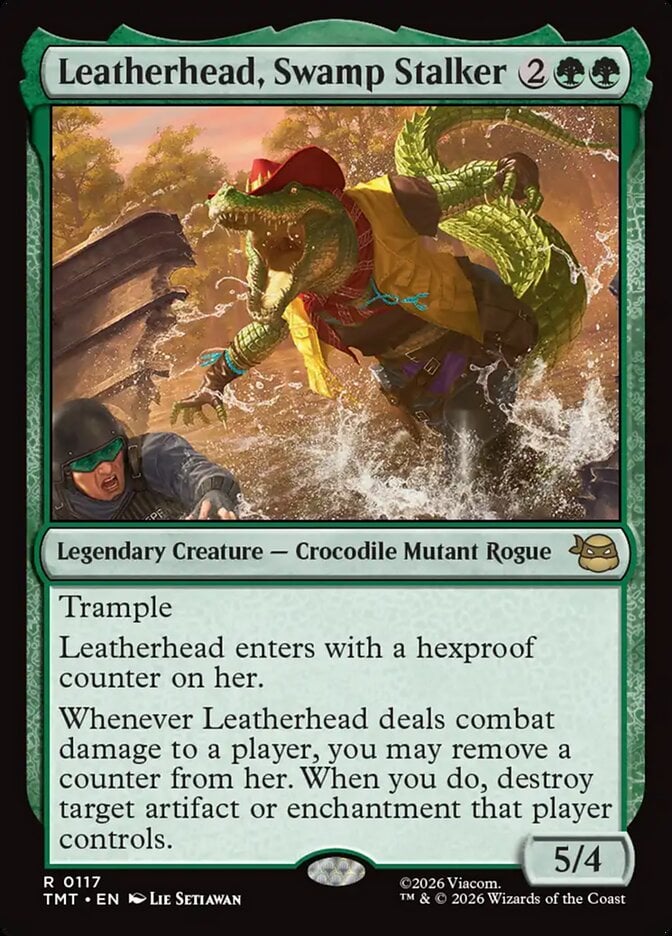
Rating: 7/10
A 5/4 with hexproof and trample is a pretty great deal for just 4 mana. There are quite a few powerful enchantments in Teenage Mutant Ninja Turtles, as well as a whole artifact theme in blue and red, so I assume that Leatherhead, Swamp Stalker’s ability to destroy these permanents in exchange for any counters you find on it will be extremely useful. You can use the hexproof counter of course, but you can also use +1/+1 counters, which will be useful if you need to destroy multiple targets.
Michelangelo, Game Master
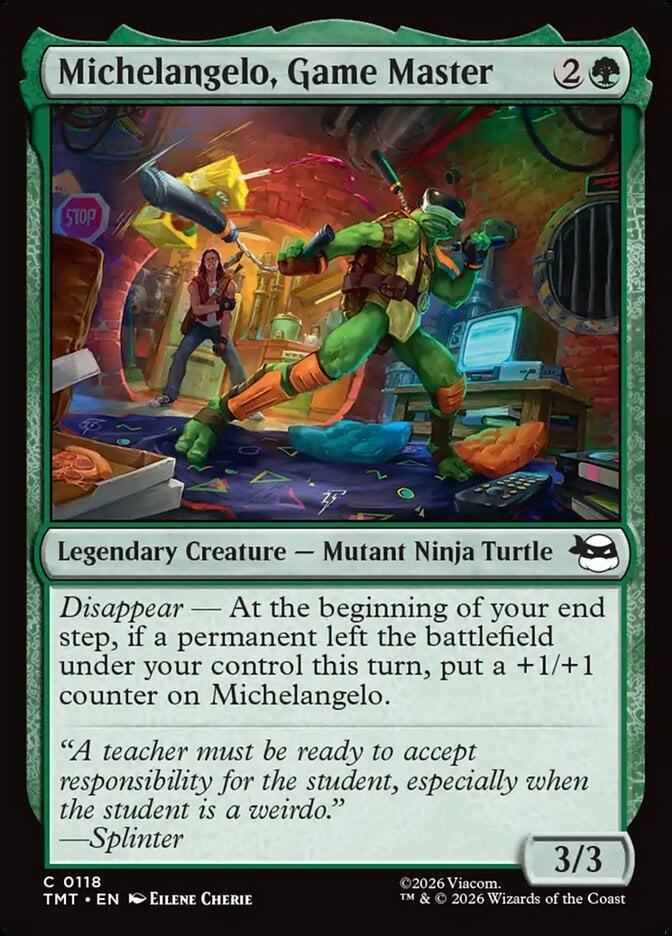
Rating: 4/10
If you simply trade off your 2-drop on turn 3, you can play Michelangelo, Game Master and turn it into a 4/4 right way. You don’t even need it to trigger much more than that, but it certainly can if you can set it up. This turtle is a decent size even when it doesn’t trigger at all, so the fact that it’s very easy to have grow bigger makes it a good card in my book.
Michelangelo, Improviser
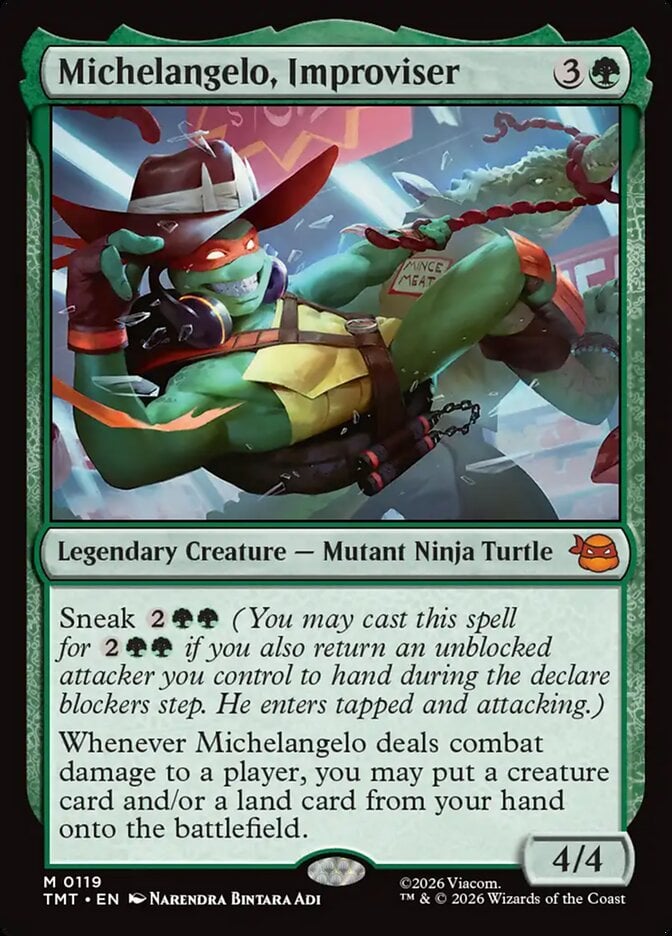
Rating: 4/10
Cards with this kind of ability have historically never been good in Limited. That said, none of them have really been 4/4s or have required a lot more work than Michelangelo, Improviser. If you can cheat something out, that’s pretty sweet, but you actually have to find an appropriate timing to do so, along with something worth putting into play. It seems to me like there’s a lot of things that have to go right here, so I’m not sold yet.
Michelangelo, Mutant BFF
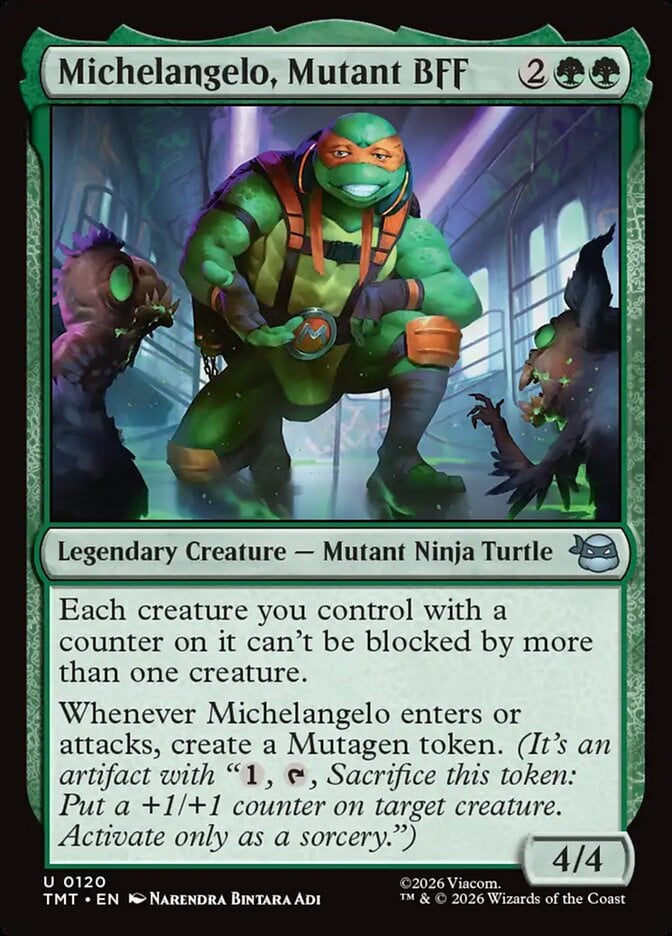
Rating: 6/10
A 4/4 plus a Mutagen token is a really good start for our uncommon Michelangelo. The evasion that it grants is especially good on bigger creatures, since the threat of a double block is usually how an opponent keeps your creatures back. As such, Michelangelo, Mutant BFF looks like a great +1/+1 build-around and a reasonable card by itself in other decks.
Michelangelo, Weirdness to 11
Rating: 8/10
Just on its own, Michelangelo, Weirdness to 11 represents a 1/1 plus two +1/+1 counters for 3 mana total, which is a good deal to start. But beyond that, this Mikey functions as a Winding Constrictor for +1/+1 counters. The snake was a very powerful card back in the day, and given the clear synergies that Mikey here has with the rest of the set, I’m sure this will be a fantastic card to take early and move into a deck that can fully utilize it.
Michelangelo’s Technique
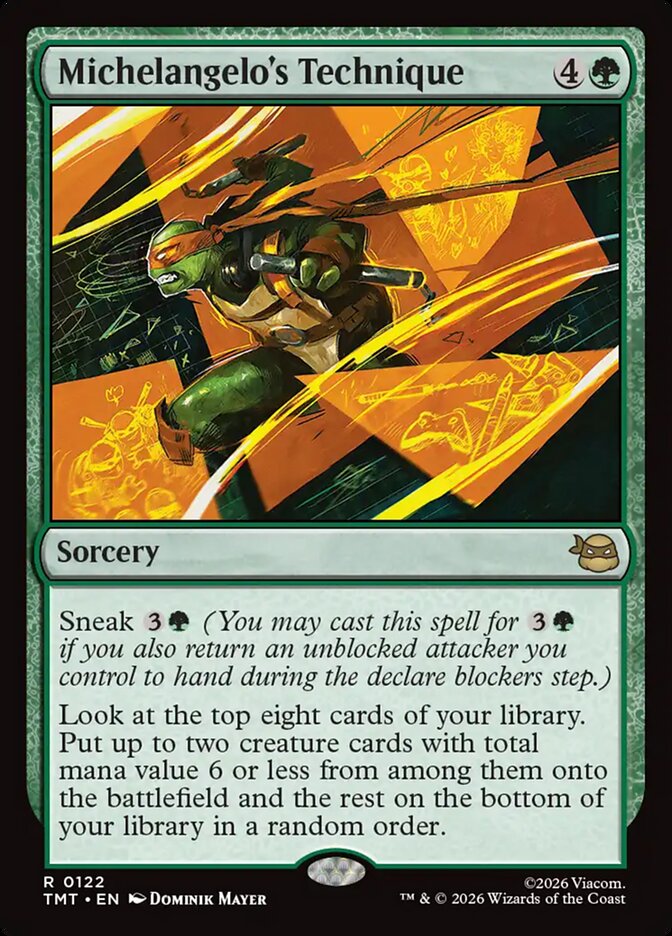
Rating: 4/10
Unlike other Collected Company variants, Michelangelo's Technique has a ton of flexibility to make sure you don’t miss quite so often. While you’d usually prefer to get two creatures out of this, you at least have the option to get one bigger one if you want. The thing is, if you’re ever getting just one creature, then this wasn’t much different from just playing the creature itself. I don’t like this a lot, but I have a feeling it’s one that I could be wrong about.
Mona Lisa, Science Geek
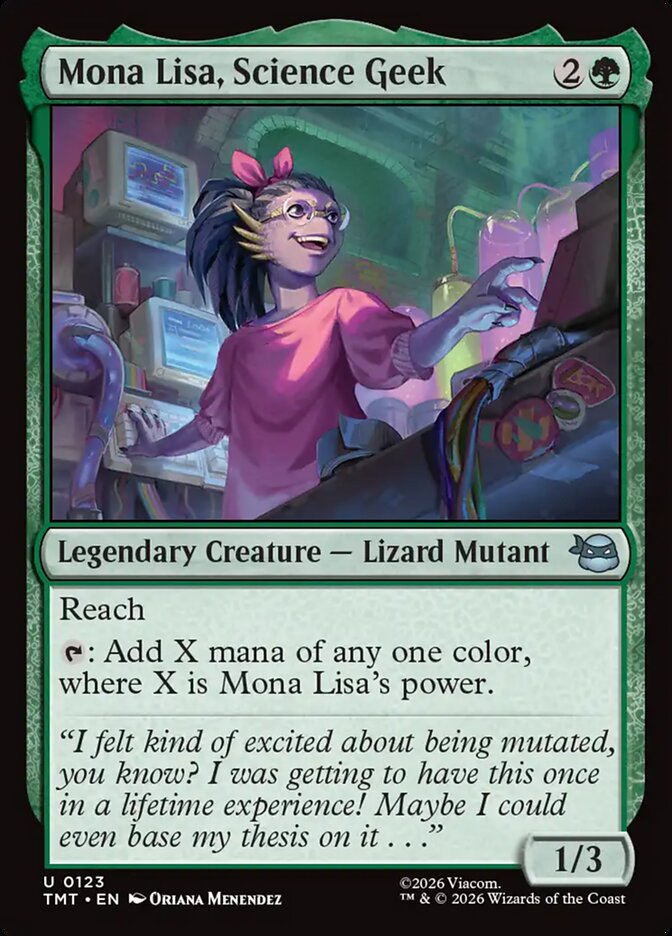
Rating: 3/10
Mona Lisa, Science Geek is little more than just a 3-drop mana dork, which isn’t too good. You’d much prefer your mana dorks to cost 2 mana. In exchange, it has the ability to tap for a lot more than just 1 mana, but you need to make it bigger somehow. The difficulty there is that you’d probably prefer to sink your +1/+1 counters into a better creature. Being a mana dork is fine, but I don’t think you have the time to get more use out of Mona Lisa than that.
Mutagen Man, Living Ooze
Rating: 7/10
Mutagen Man, Living Ooze is basically as big as you need it to be at any point in the game. Just on its own, you can dump as much mana as you want into this ooze and then crack all the Mutagens to make it bigger. Beyond that, you can probably find other ways to utilize the Mutagen tokens, like stacking them onto a creature that can attack on the same turn, or sacrificing them for value. This is a pretty incredible rare with a ton of flexibility, which is exactly what I like to see.
Mutant Chain Reaction
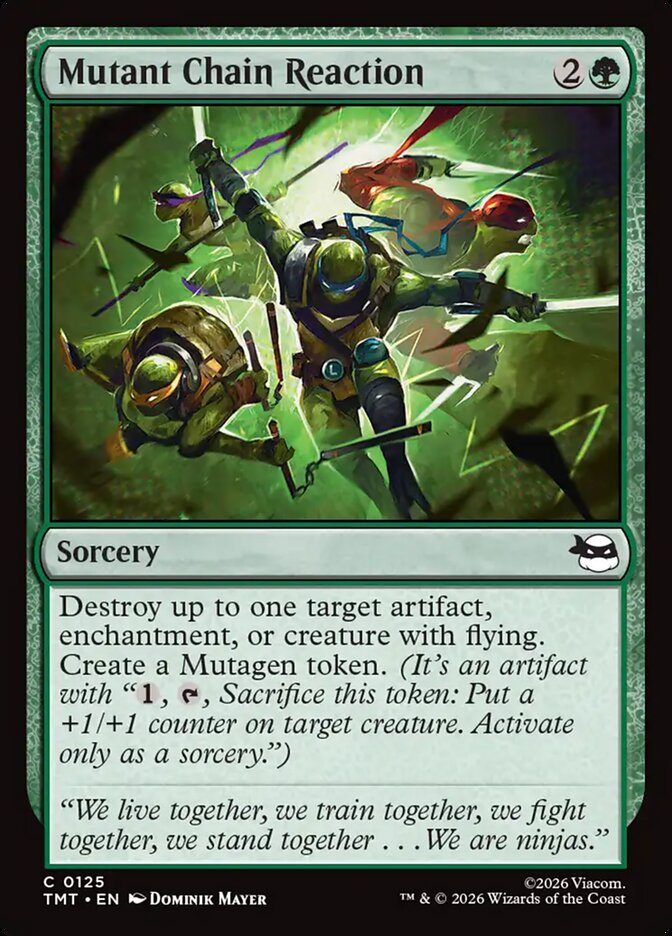
Rating: 1/10
Mutant Chain Reaction is the textbook example of a sideboard card. It’s far too narrow to run in your main deck, but out of the sideboard it can be a reasonable answer to many problematic permanents.
New Generation’s Technique
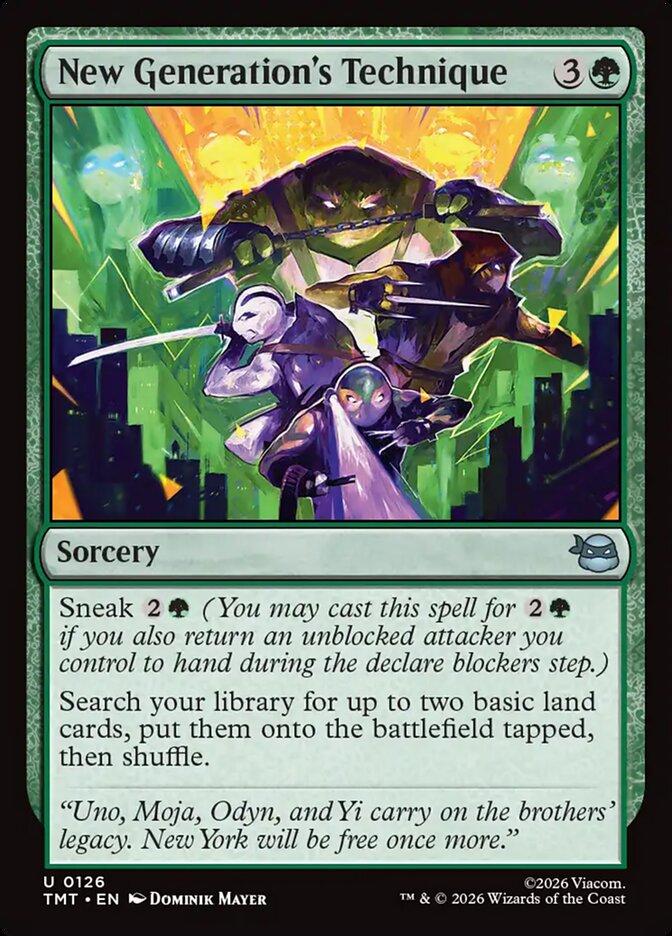
Rating: 5/10
Explosive Vegetation is already a very reasonable spell to cast, so cutting its mana cost by 1 sounds pretty great to me. If you can cast this on turn 3, you’ll get to play a 6-drop on turn 4 and get really far ahead. Even after turn 3, it’s still a good card to help to fix your colors and just guarantee you some land drops.
Novel Nunchaku
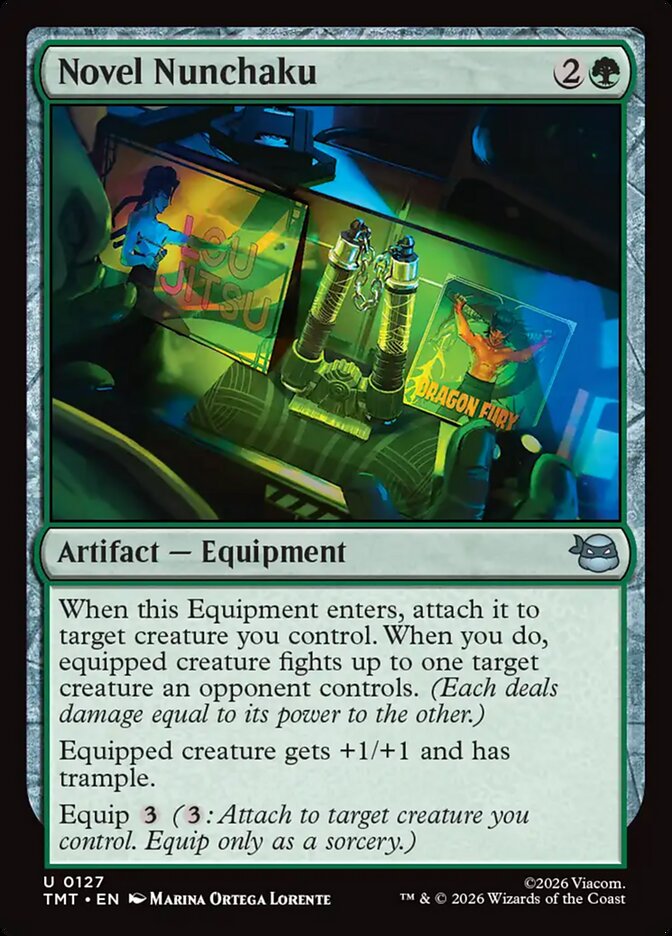
Rating: 6/10
+1/+1 and a fight is pretty good for just 3 mana. Better yet, you then get to keep the Novel Nunchaku and keep attaching it to other creatures. We just saw a very similar card in Lorwyn Eclipsed’s Pitiless Fists, and this card is much better than that.
Party Dude
Rating: 1/10
Party Dude’s first ability is incredibly bad. Symmetrical effects are pretty poor in general. If you can upgrade it to level 2, you can at least dissuade your opponent from sacrificing their Food token, but that doesn’t stop them from sacrificing it before you do that. Level 3 isn’t even that good; by the time you can afford it, you’re not likely to have any cards left in your hand. Your opponent will usually just not sacrifice their artifacts to enable your level 2 ability. Where this could be good is as a sideboard card against artifact decks, just for level 2 alone, but I don’t think it’ll be that necessary.
Primordial Pachyderm
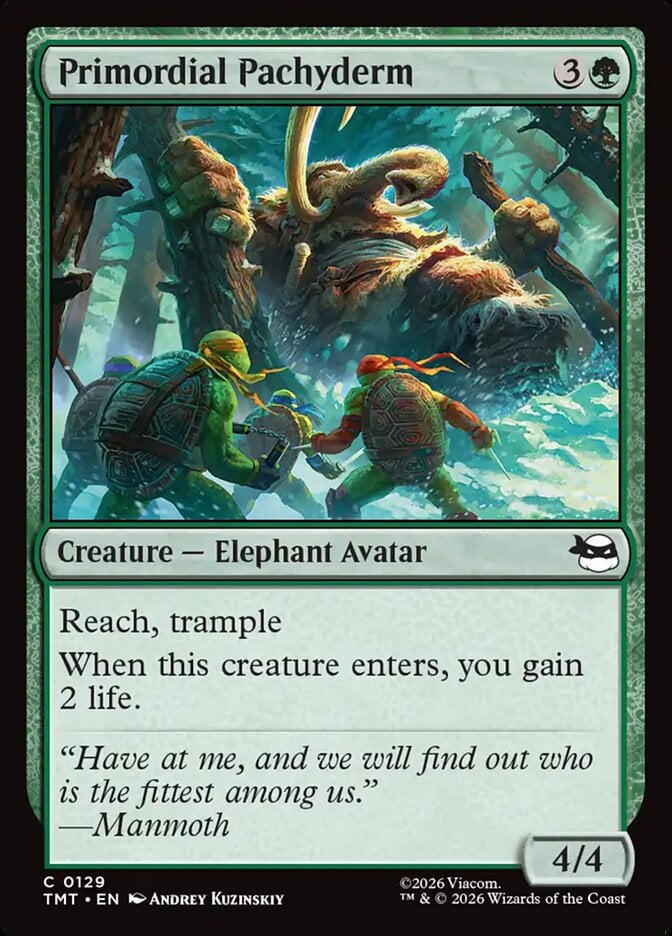
Rating: 3/10
I remember reading about Giant Spider being among the best green commons back in the days of the M10 and M12 core sets. Even more recently I gawked at the printing of Magnigoth Sentry, a strict upgrade on the existing formula. Now, we have Primordial Pachyderm, an upgrade further still. Four-drop green commons haven’t been too good as of late, but this one looks like it has enough going for it to earn a spot in most of your green decks.
Ragamuffin Raptor
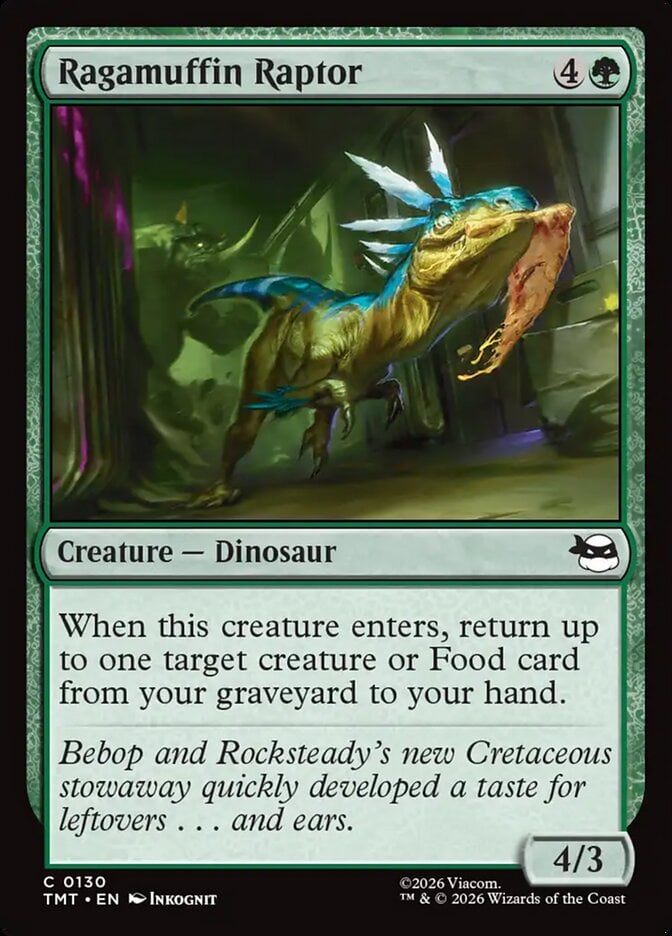
Rating: 6/10
This is one of the best common 5-drops I’ve seen for a long time. Not only is Ragamuffin Raptor just a big Gravedigger, which is already an excellent start, but given the quality of some of the pizza cards in this set, getting one of them back almost sounds just as good.
Rocksteady, Crash Courser
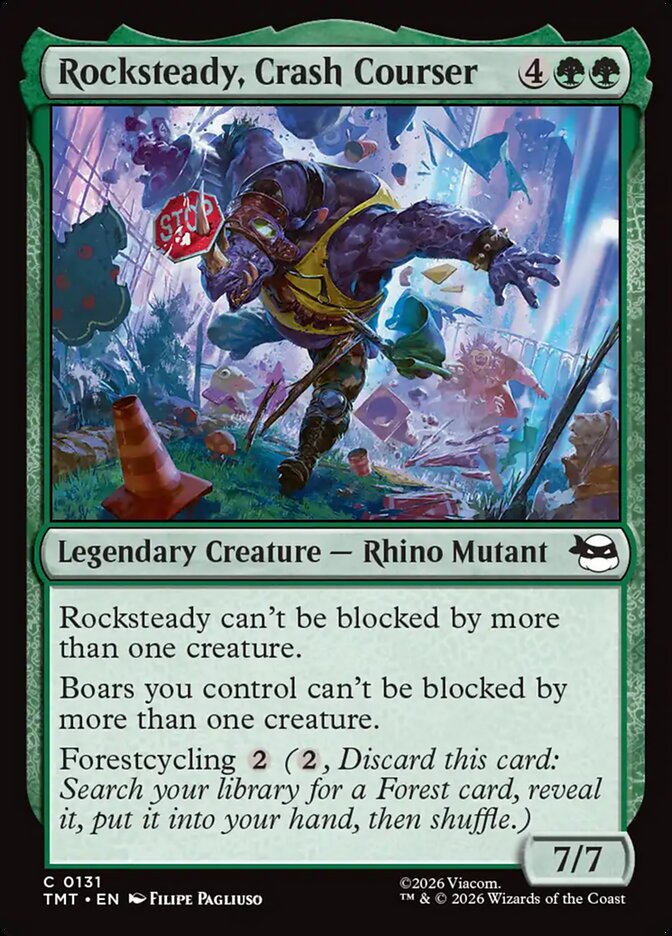
Rating: 3/10
Unlike its boar counterpart, Rocksteady, Crash Courser is actually quite decent on its own. A 7/7 that can’t be blocked by multiple creatures is kind of annoying to have to deal with, plus you can forestcycle it.
Saved by the Shell
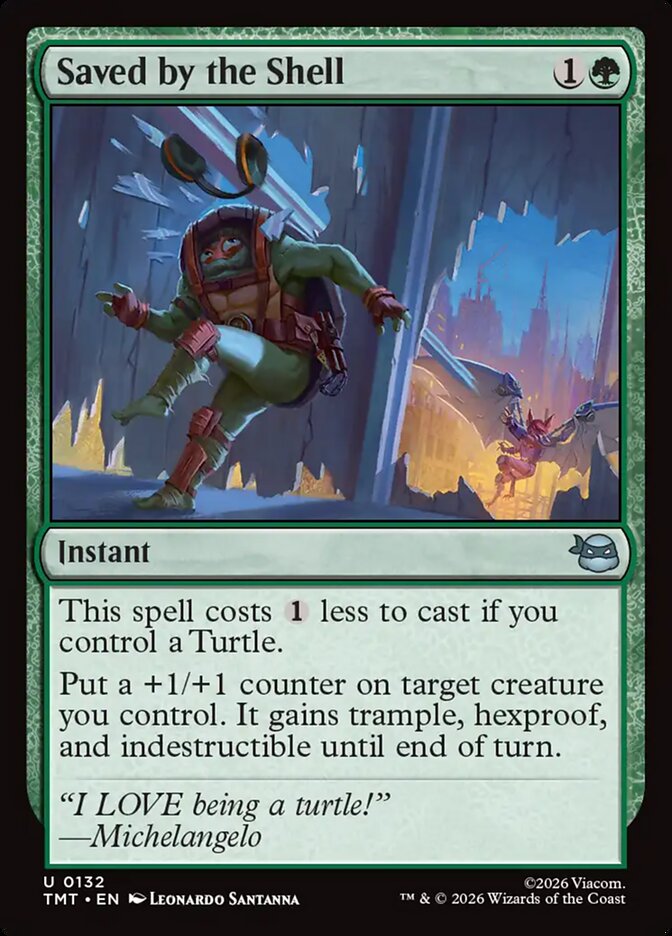
Rating: 4/10
Unlike some of the similar protection spells we’ve seen in the past, Saved by the Shell kind of does it all. Hexproof protects from most removal and indestructible protects from the rest. Plus, the +1/+1 counter combined with indestructible makes it an effective combat trick. I don’t normally like these cards, but this one literally does it all.
Tenderize
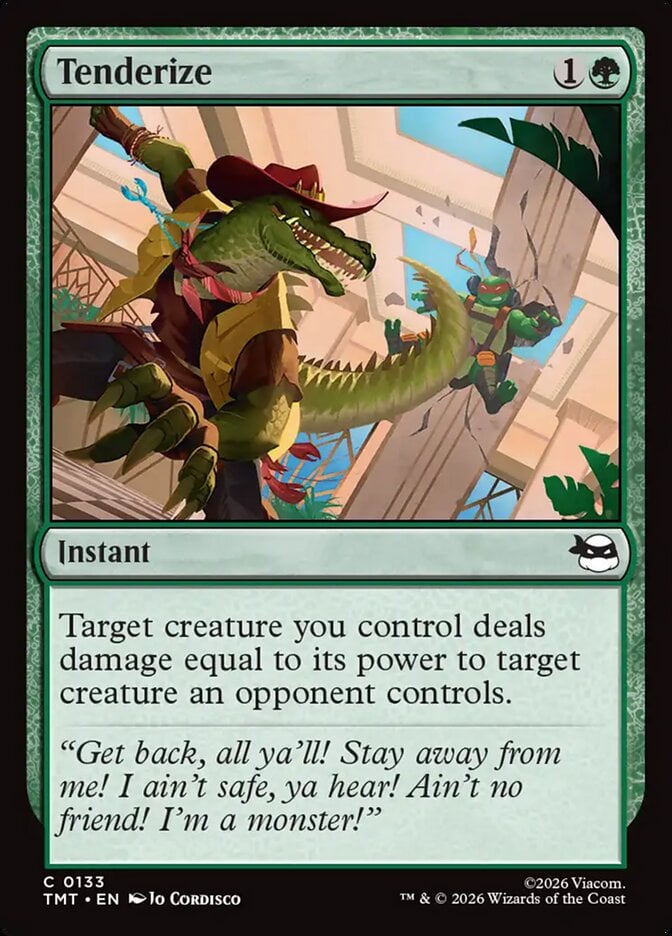
Rating: 6/10
There’s absolutely nothing wrong with a card like Tenderize. Two mana, instant, bite spell. Just good, clean removal for green, and every green deck will be happy to see it.
Transdimensional Bovine
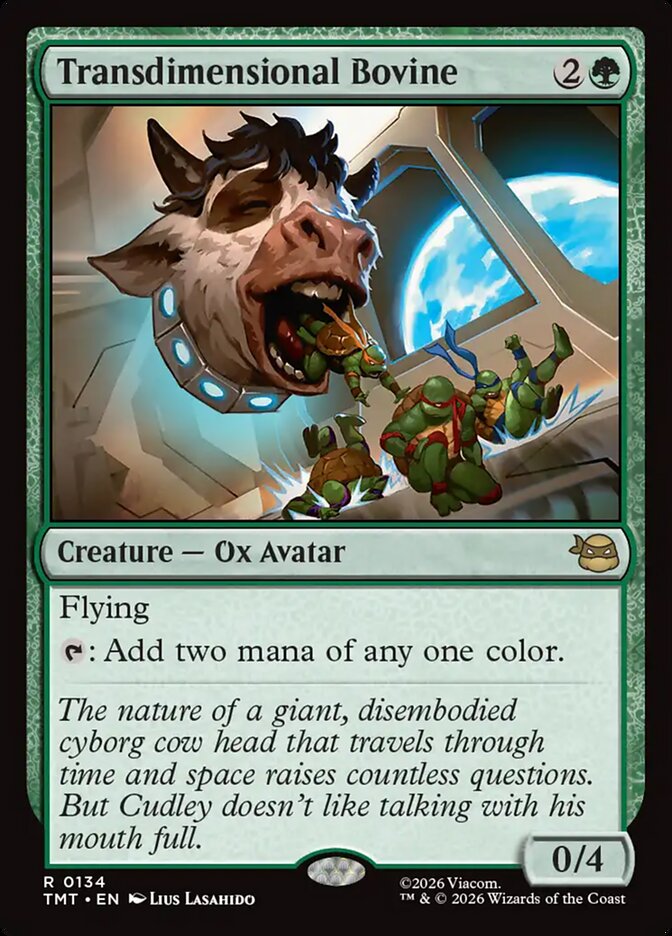
Rating: 6/10
This is one hell of a weird creature… I mean, can a Transdimensional Bovine really fly? I guess that’s a question for someone who knows the lore of TMNT. But yeah, while 3 mana is a lot for a mana dork, ramping you an extra 2 mana is really strong, plus the 4 toughness allows you to block a good amount of early aggression.
Turtle Power!
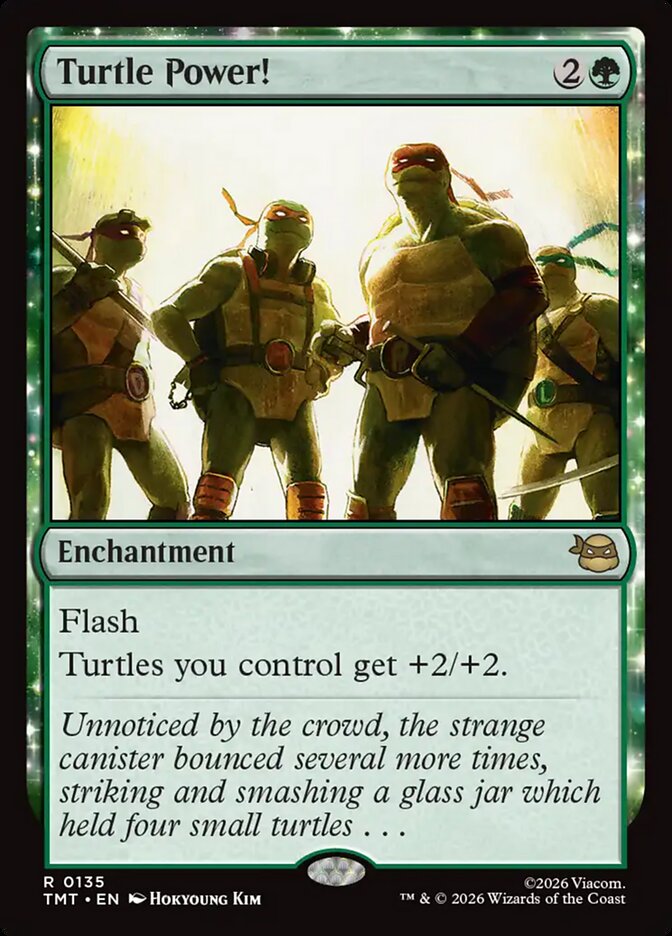
Rating: 3/10
I’d have expected Teenage Mutant Ninja Turtles to have a lot more turtles in it, but it seems that there are very few beyond the four main turtles themselves, and most of them are at higher rarities. There are also no black ones. A +2/+2 Glorious Anthem is definitely something to be excited about, but the lack of turtles makes me think that Turtle Power! won’t quite be enough to get the job done.
Venus, Torn Between Worlds
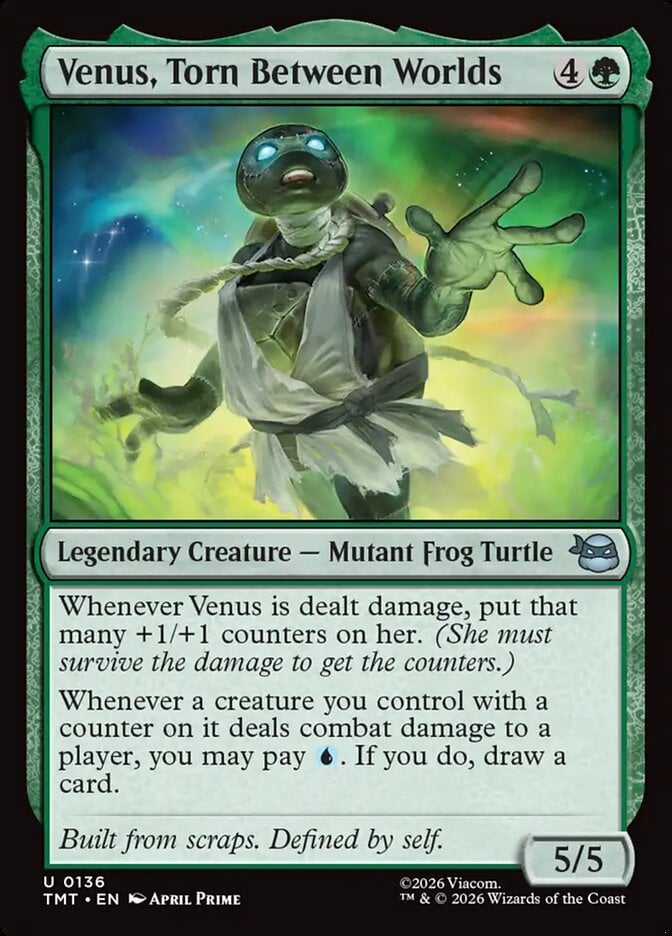
Rating: 4/10
The issue with Venus, Torn Between Worlds is that it’s just too big and expensive. You’re not likely to be able to play it on a turn when you also have spare blue mana to get a hit in with something else and draw a card. On future turns, your opponent will be more prepared for the impending onslaught. This just feels a little too situational to be a powerhouse, but there’s potential.
West Wind Avatar
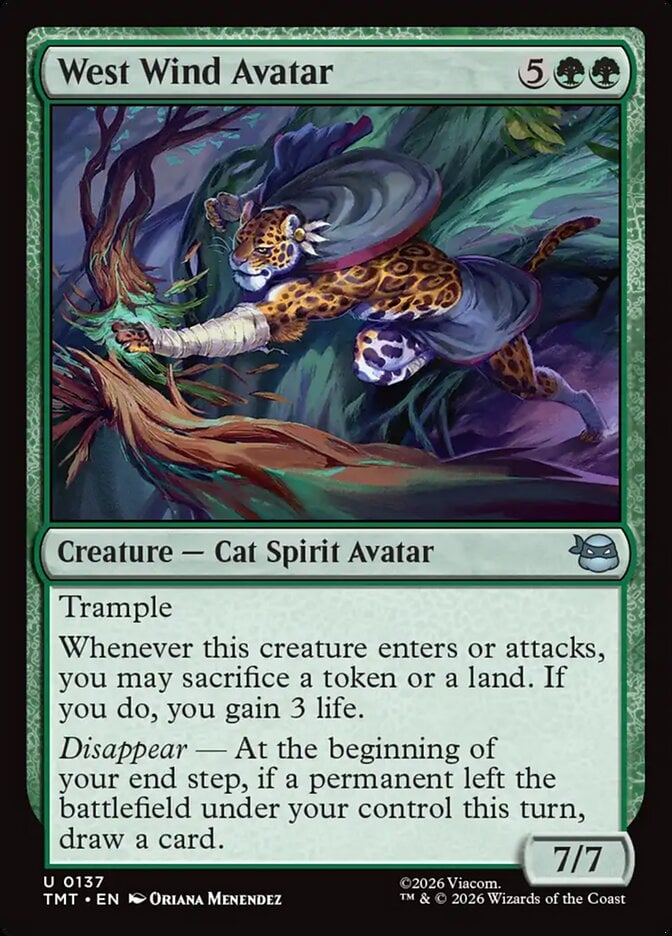
Rating: 6/10
While I appreciate that only being able to sacrifice a land or a token is quite restrictive, the reward of 3 life right away and an extra card drawn in the end step is well worth it. All that attached to a 7-mana 7/7 with trample makes West Wind Avatar my dream ramp payoff, and you could even draw extra cards if you can enable disappear on future turns!
Zoo Escapees
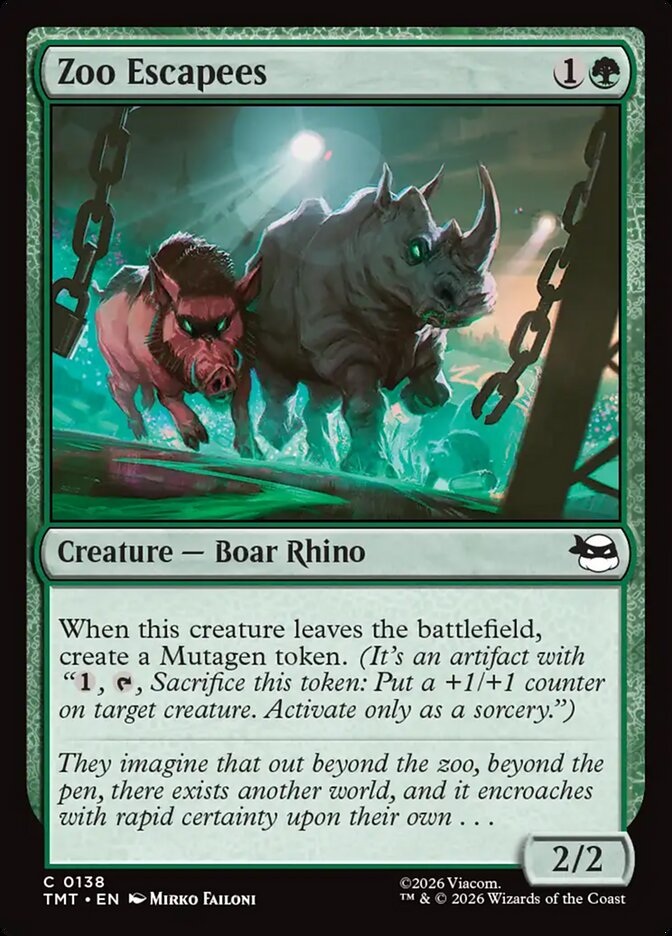
Rating: 3/10
Two-mana 2/2s with upsides are always nice to see. The Mutagen tokens look like they’ll be quite valuable, so even if you need to trade off Zoo Escapees first, you do get nicely rewarded.
Multicolored
Baxter Stockman
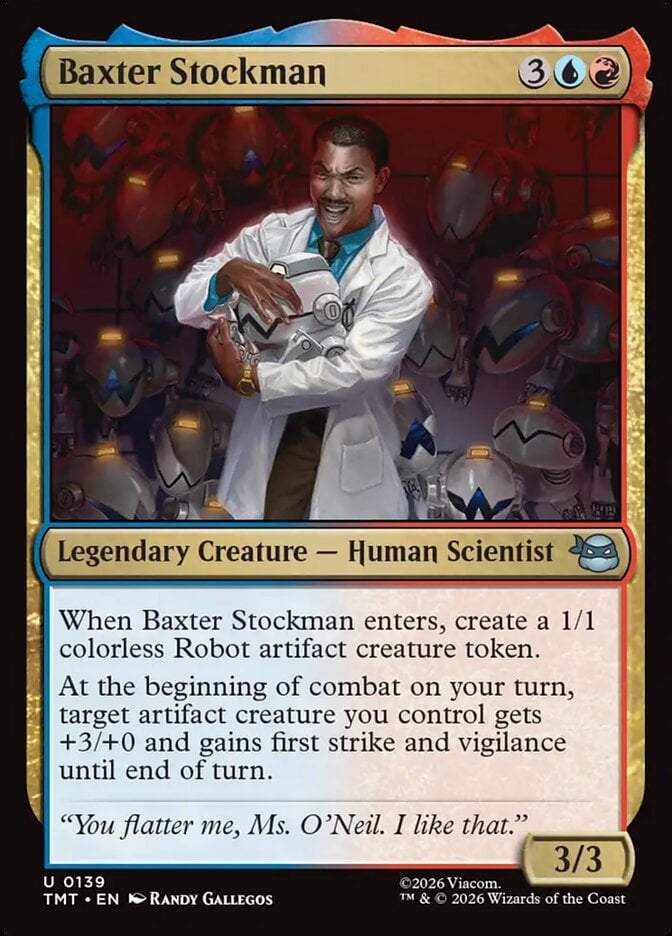
Rating: 5/10
A 3/3 plus a 1/1 would be great if it cost 3 or even 4 mana, but for 5 mana it’s not great. Baxter Stockman’s other ability can be relevant as soon as you play it, which makes it rather hard for your opponent to block your attacks each turn. It’s quite vulnerable to removal, though. A 3/3 is fairly easy to deal with, and this scientist won’t leave you too much value if that happens.
Bebop & Rocksteady

Rating: 6/10
Unlike many other similar overstatted creatures with downsides, Bebop & Rocksteady doesn’t require any kind of cost to just keep it around and do nothing. If you don’t have anything to sacrifice right away, you can comfortably wait until you do. In some decks, getting to sacrifice a permanent for no mana cost is going to be an upside that enables disappear abilities or whatever else you might find.
Brilliance Unleashed
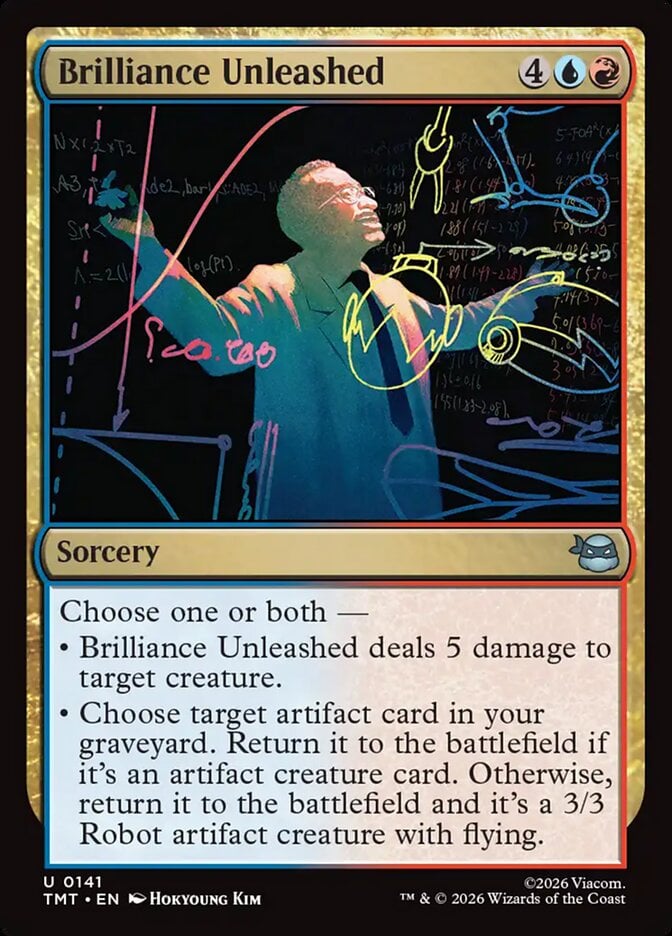
Rating: 7/10
Brilliance Unleashed does say you can “choose one or both”, but that’s just to be a little more flexible. You really want to choose both. If you do, you get an easy two-for-one swing by killing a creature and reanimating another one. Six mana is a little on the expensive side, but the power is very much there to justify the cost.
Dark Leo & Shredder
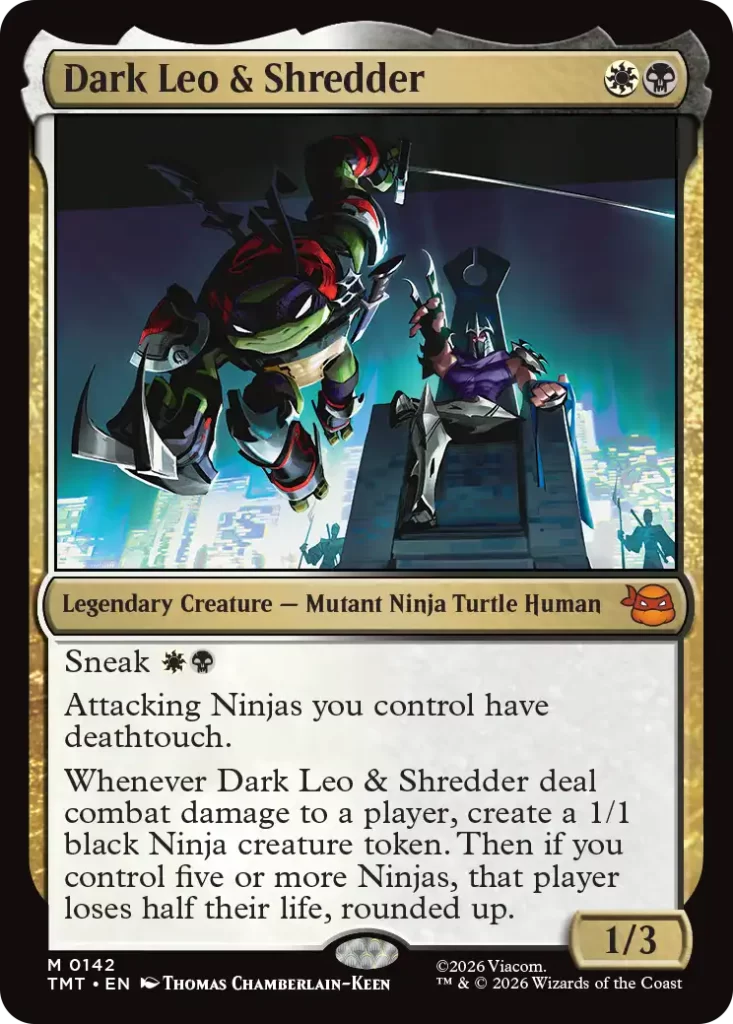
Rating: 8/10
Giving all attacking ninjas deathtouch is a nasty ability. On the turn you sneak in Dark Leo & Shredder, it could be a ridiculous combat trick, especially if your opponent took the time to line up blocks on, for example, some 1/1 ninja tokens. The deathtouch also applies to itself, so it’s incredibly difficult to want to block Dark Leo & Shredder on future turns. Get one hit in and your new 1/1 deathtouch token will easily enable future sneak abilities, too. There’s a lot to like here, and it’s nice to see this ninja deck coming together.
Don & Leo, Problem Solvers
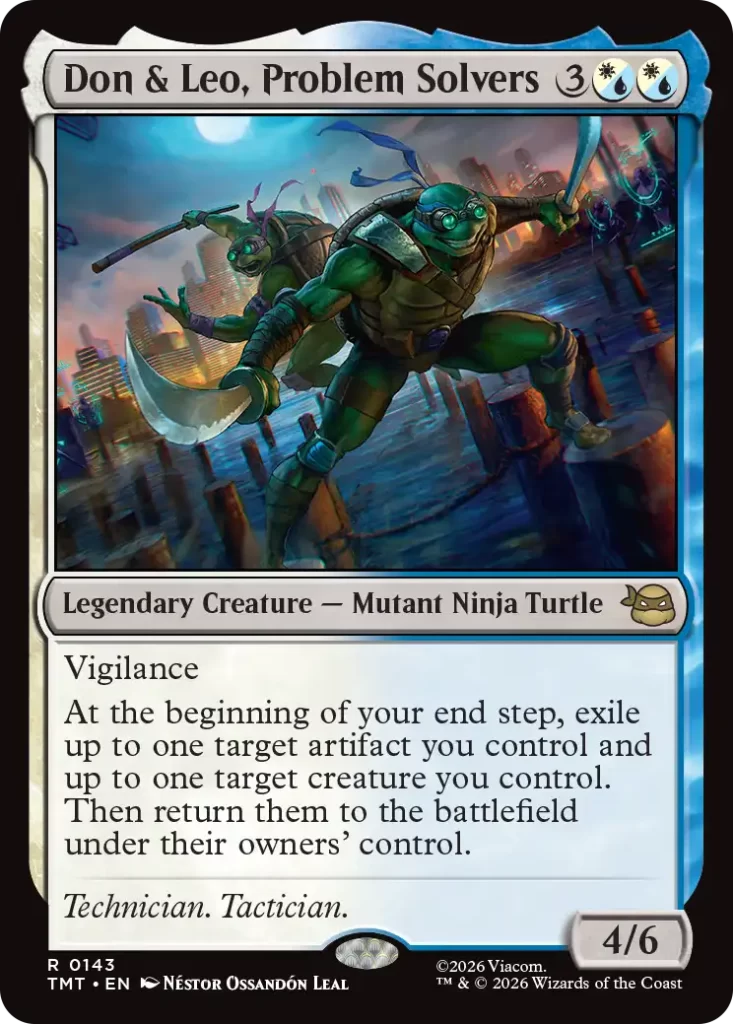
Rating: 4/10
There are some pretty great enters triggers in this set, but if you don’t have one, Don & Leo, Problem Solvers is little better than just a big vanilla creature. It deserve a second look if you have the right abilities to pair with it, but most decks won’t need this card.
Don & Raph, Hard Science
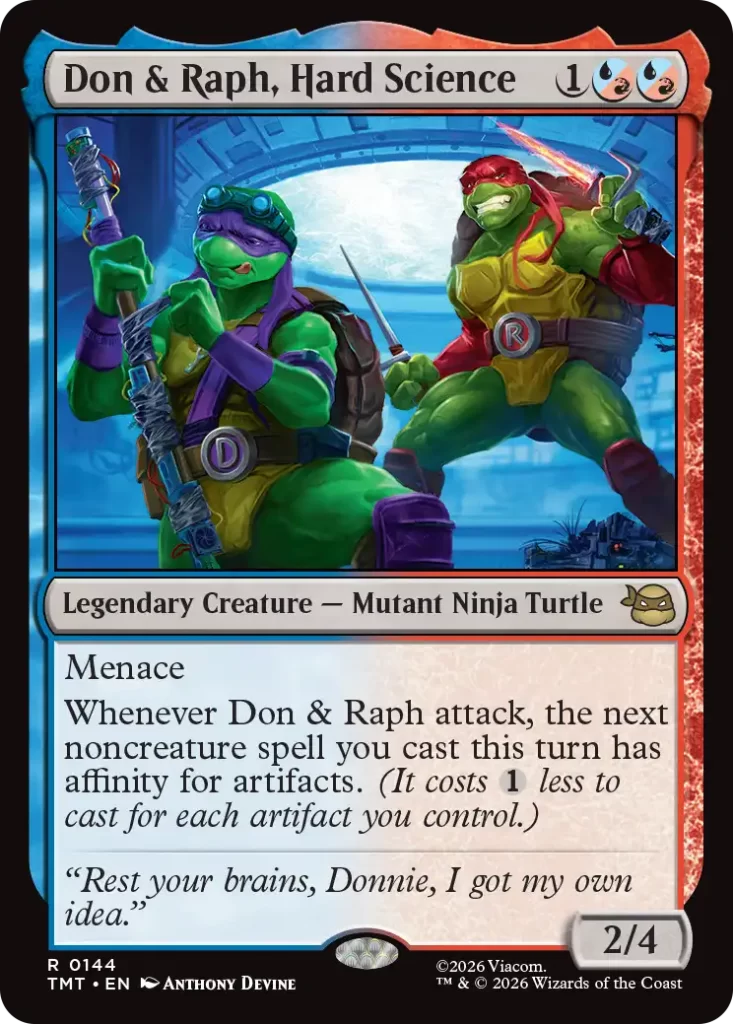
Rating: 4/10
Giving affinity for artifacts to the next spell you cast sounds incredible, but restricting it to noncreature spells really doesn’t bode well. Most decks aren’t likely to have that many noncreature spells in the first place, let alone any that really need to be discounted. Don & Raph, Hard Science is very specific, and I could definitely see it being powerful if it discounts a card like Brilliance Unleashed, but most decks aren’t going to be too bothered by this card at all.
EPF Point Squad
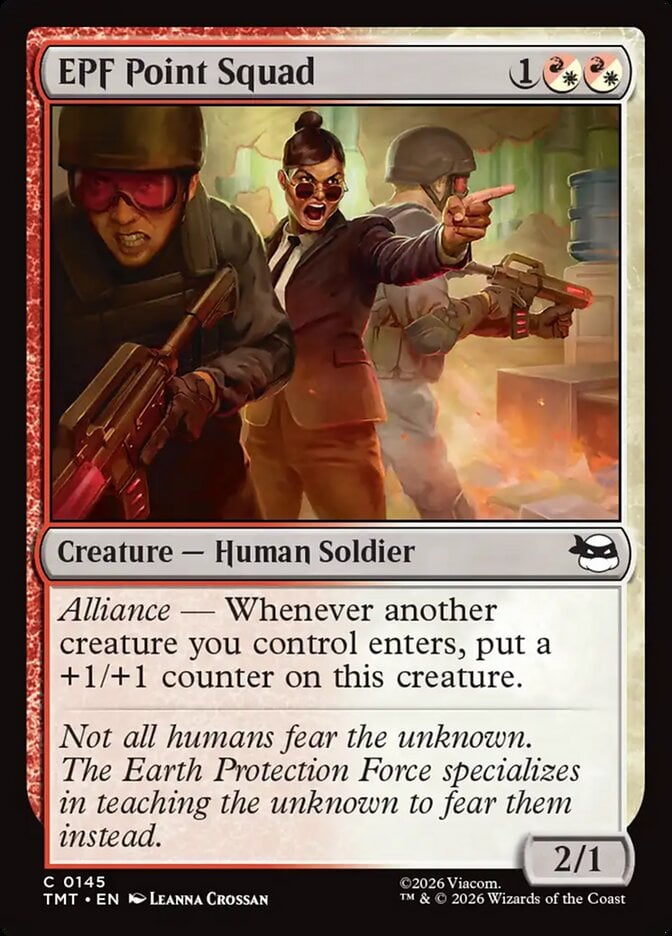
Rating: 3/10
This card kind of reminds me of Quandrix Pledgemage, which overperformed back in Strixhaven: School of Mages due to how frequently you could trigger it. EPF Point Squad isn’t anywhere near as good, but the better your alliance deck is, the better this card becomes because you’ll be able to trigger it a lot more often.
Foot Elite
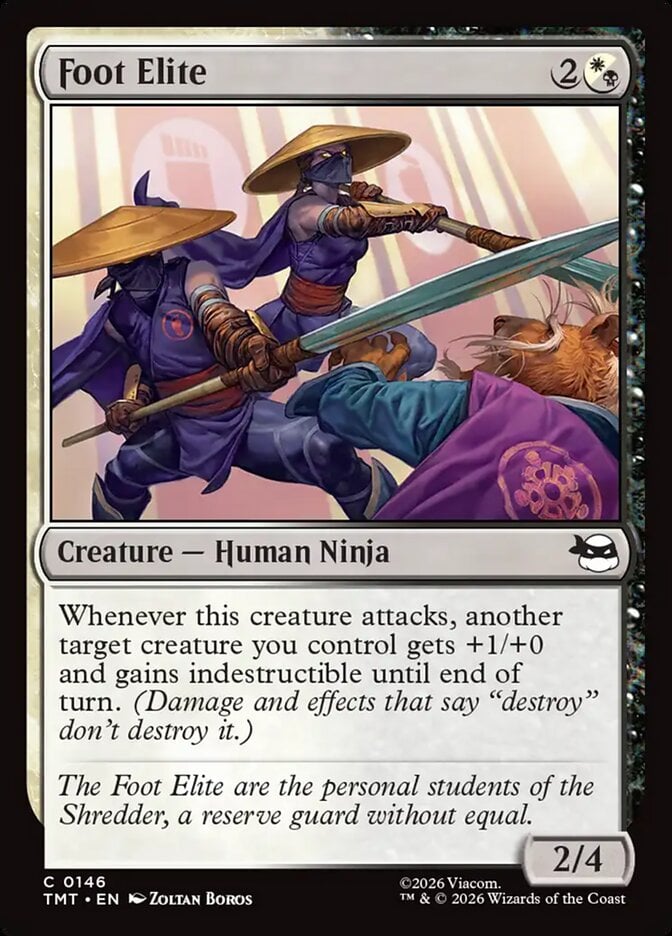
Rating: 2/10
Giving an attacking creature +1/+0 and indestructible is a good ability, but the only thing that Foot Elite has to protect itself is its 4 points of toughness, which really isn’t enough to get the job done. This doesn’t look very impressive to me, though it's a more flexible version of Hardened Escort, which was decent in Duskmourn.
Foot Ninjas
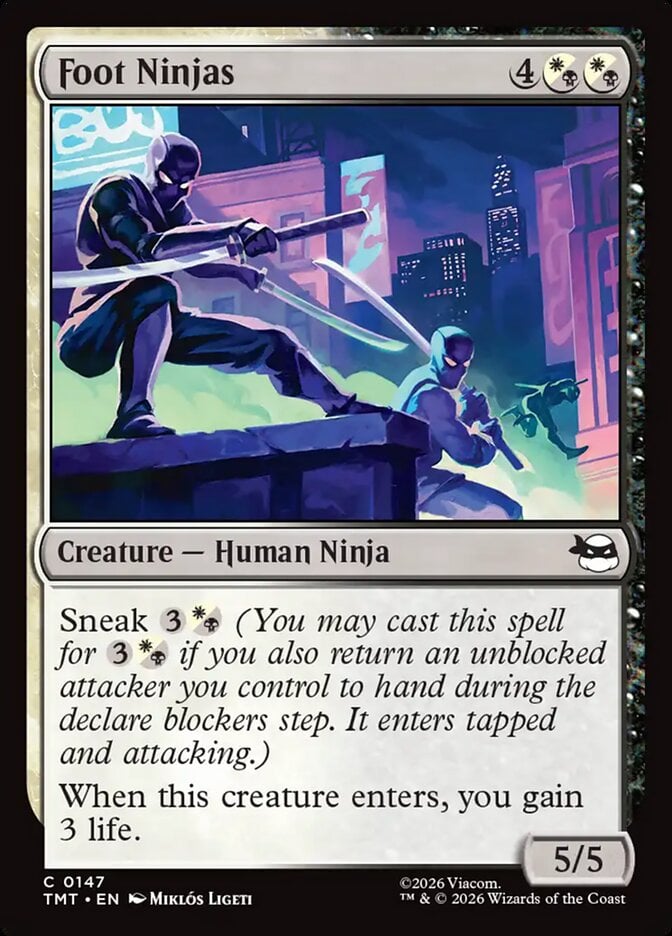
Rating: 3/10
While a little bit on the expensive side, Foot Ninjas is well worth the sneak cost. Hitting for 5 damage right away while gaining 3 life is a pretty huge life swing, which could be crucial if you’re trying to win a damage race.
Genghis Frog
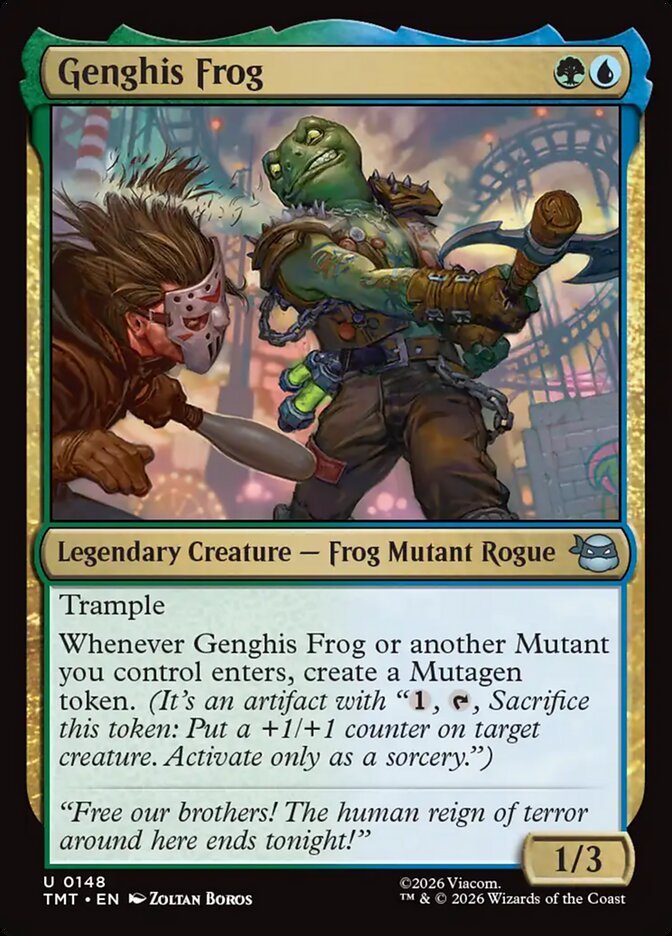
Rating: 6/10
Isn’t trample just a weird ability to see on a 1/3 creature? I get that you can load Genghis Frog up with your Mutagen tokens, but that’s still weird to see. Anyway, free Mutagen tokens for every mutant creature you play, many of which also give you Mutagens themselves. This should rack up a bunch of these tokens, and you can then choose where all your extra +1/+1 counters are going to go. This is a pretty good home for them, too!
Go Ninja Go
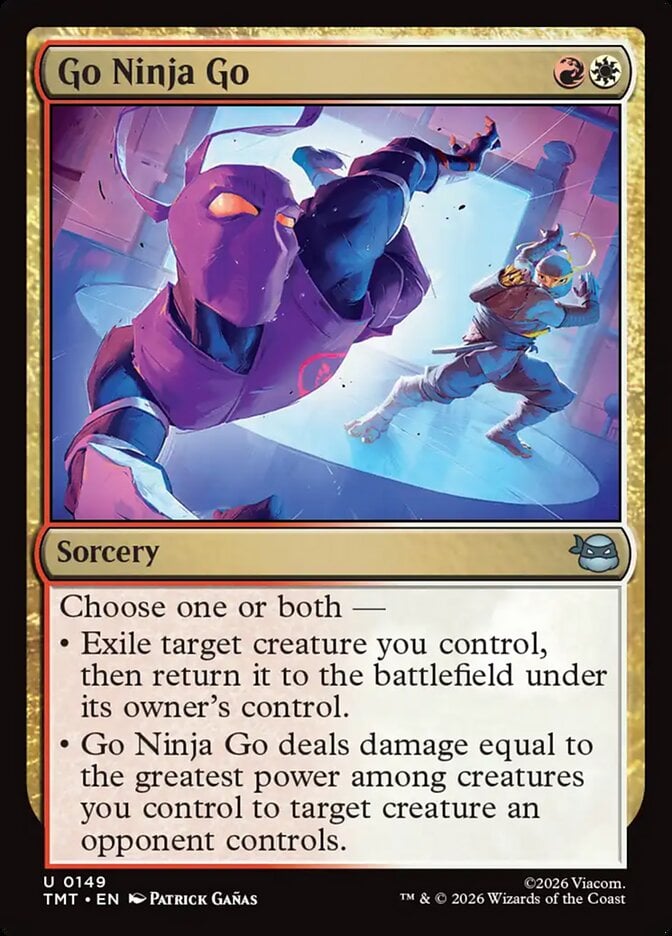
Rating: 6/10
Go Ninja Go is a perfectly serviceable removal spell, even though a bite spell is typically better suited to green decks. The flicker mode that you can add to this is a really nice touch; even without a good option for it, you can just flicker something random and trigger your alliance abilities in the process.
Ice Cream Kitty
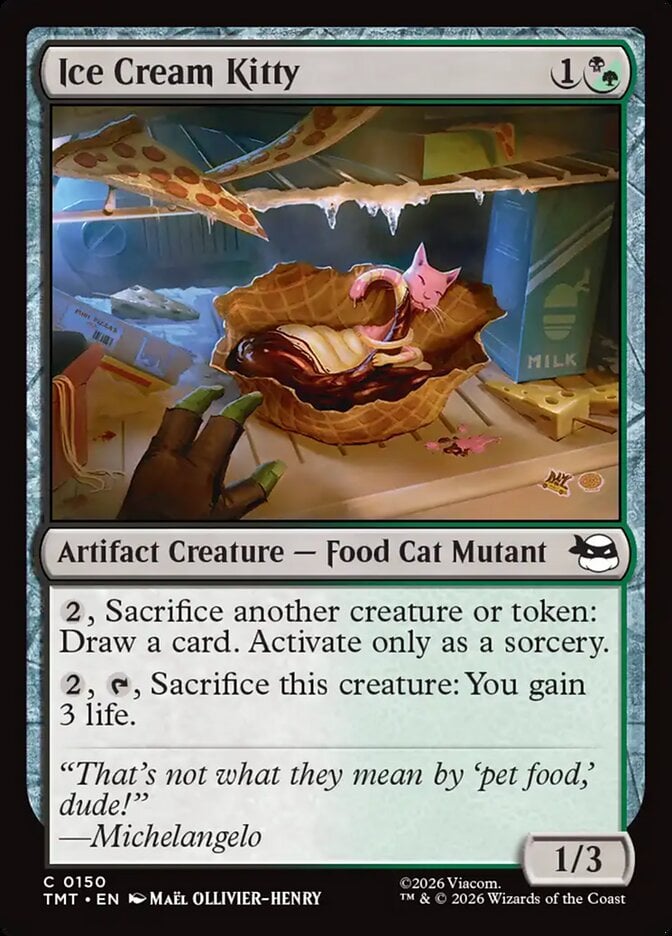
Rating: 4/10
This world really does have some bizarre creations in it…. Given the abundance of Mutagen tokens spread throughout this set, using Ice Cream Kitty to turn them into extra cards sounds pretty good to me. What stands out to me about this card is just how cheap it is. We’ve seen cards like this in several sets in the past, but they usually cost about 3 or 4 mana, and the ability costs a little more, too. At 2 to cast and 2 to activate, this looks like a really good common for the TMT Limited format.
Karai, Future of the Foot
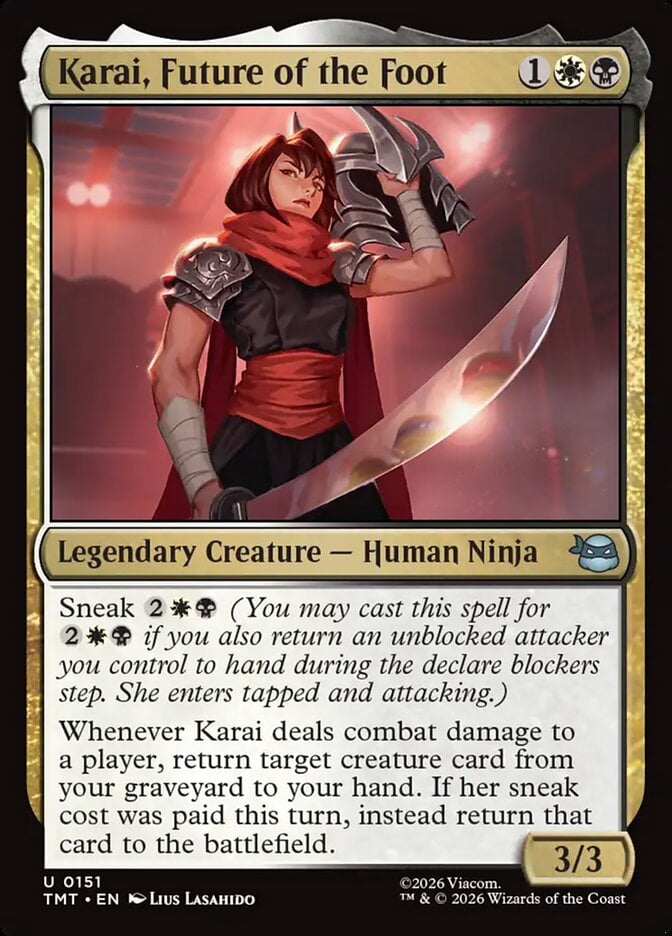
Rating: 7/10
We’ve seen so many ways to enable the ninjas deck so far, which of course tells me that Karai, Future of the Foot’s sneak cost is going to be very easy to enable. Reanimating just about any creature with its first hit is going to be a huge swing in both tempo and card advantage. Karai doesn’t even need to hit again, but the fact that it can keep going and give you a free Raise Dead every time you connect is just absurd. This is a great build-around for the deck, second perhaps only to…
Karai’s Technique
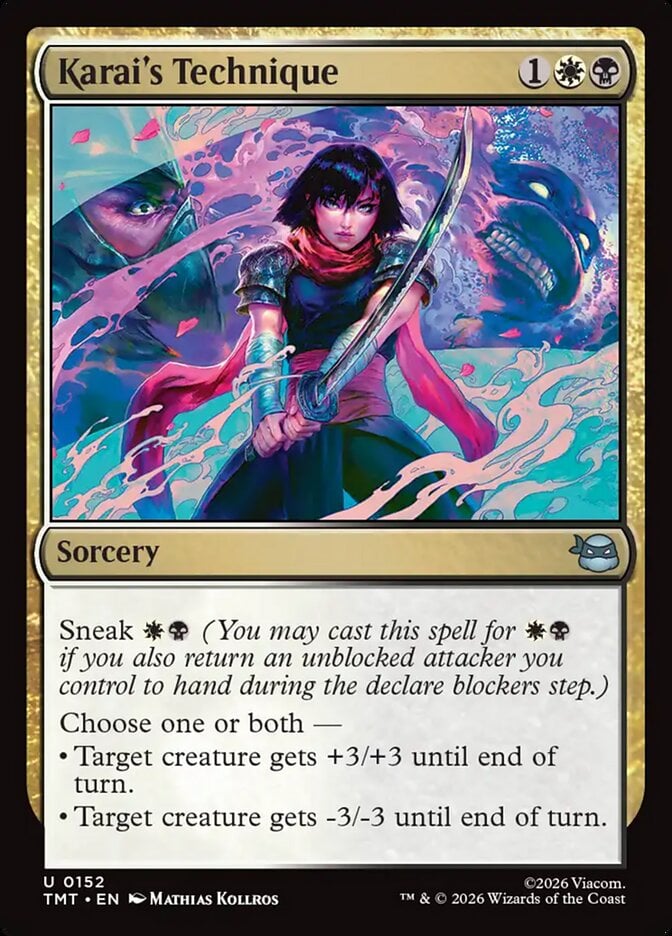
Rating: 8/10
One of the most brutal combat tricks ever created was Consume Strength from back in Apocalypse. Getting to kill one creature while also letting one of yours kill another in combat is absolutely huge. In fact, it’s so powerful that very few similar effects have ever been printed since. Granted, Karai's Technique is only an instant if you cast it for its sneak cost, but that’s well worth setting up given the tremendous upside that you get. Even if you can’t do that, -3/-3 at sorcery speed can kill a lot of creatures in a pinch. This all adds up to what looks like one of Teenage Mutant Ninja Turtles’ strongest nonrare cards.
Krang & Shredder
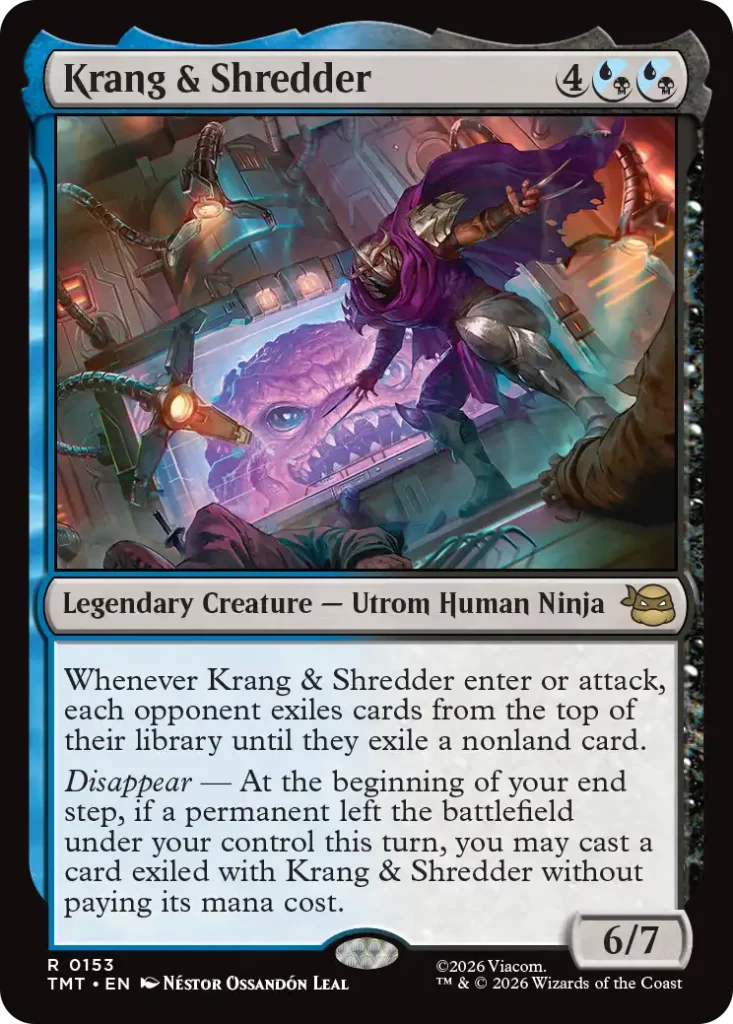
Rating: 9/10
If you have disappear enabled, Krang & Shredder immediately casts the top spell of your opponent’s deck for free. While the card you get is completely random, just about anything makes that worth it. After that, attacking and enabling disappear in the same turn sounds kind of hard to do, but you don’t need this duo to do much beyond that first turn to be great. Anything else you get is just a bonus.
The Last Ronin

Rating: 10/10
The Last Ronin is a highly acclaimed comic series from just a few years ago where Michelangelo is the last surviving turtle in an alternative future, seeking revenge for his fallen brothers. This card is also no joke. Board wipes are already good in Limited, but this one guarantees you a follow-up play on the next turn, followed by a huge lifelink swing on the one after that. This is very reminiscent of The Rise of Sozin, one of the best cards in Avatar’s Draft format, and this might even be better.
Lessons from Life
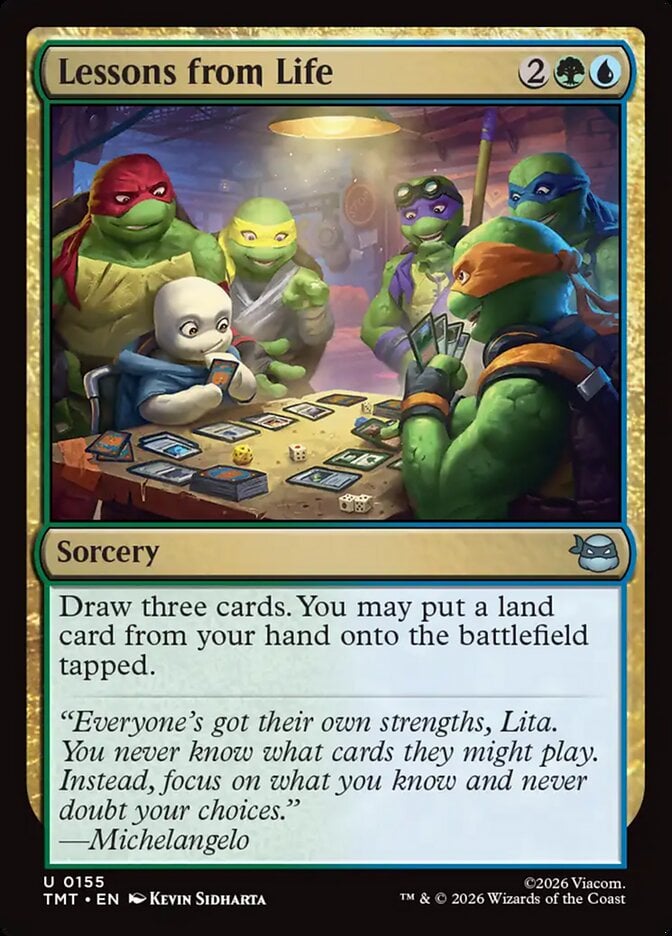
Rating: 6/10
This is yet another Magic precedent. To my knowledge, Lessons from Life is the first card artwork outside of an Un-set or a special promo to feature actual Magic cards in it. I know that’ll annoy some people, but I came from a Yu-Gi-Oh! background, and this was a common feature in that game. Anyway, this card is great. Concentrate plus an extra land drop is awesome.
Mechanized Ninja Cavalry
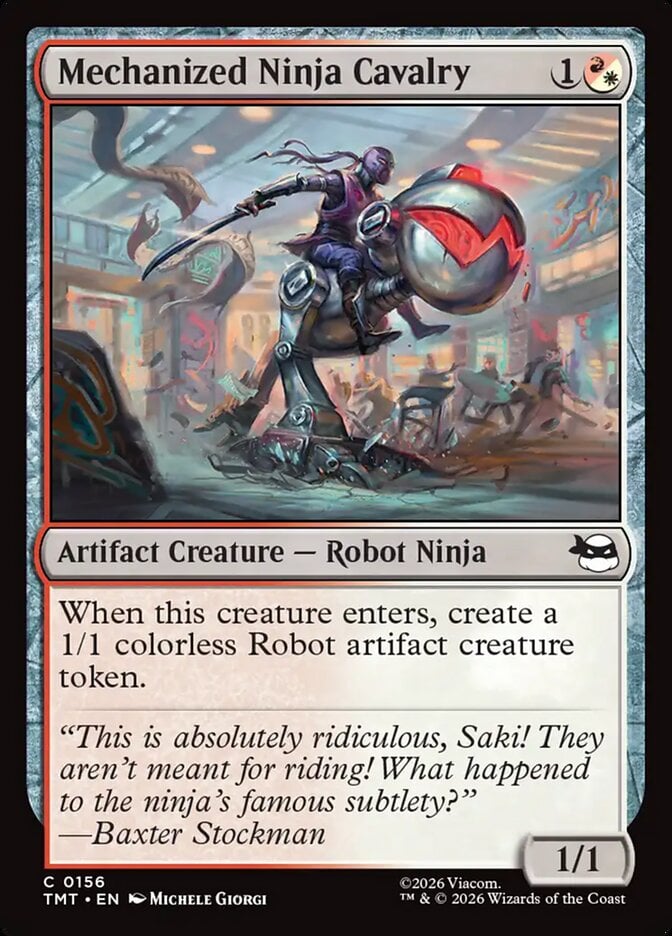
Rating: 5/10
Time and time again, we’ve seen that two 1/1s for 2 mana is a great deal. Mechanized Ninja Cavalry ups the ante: Both of its creatures are artifacts, it’s a good creature to return for sneak costs, it has a flexible mana cost, and it’s also good for alliance triggers. All nice upsides that make me think this’ll be a premium common.
Mikey & Don, Party Planners
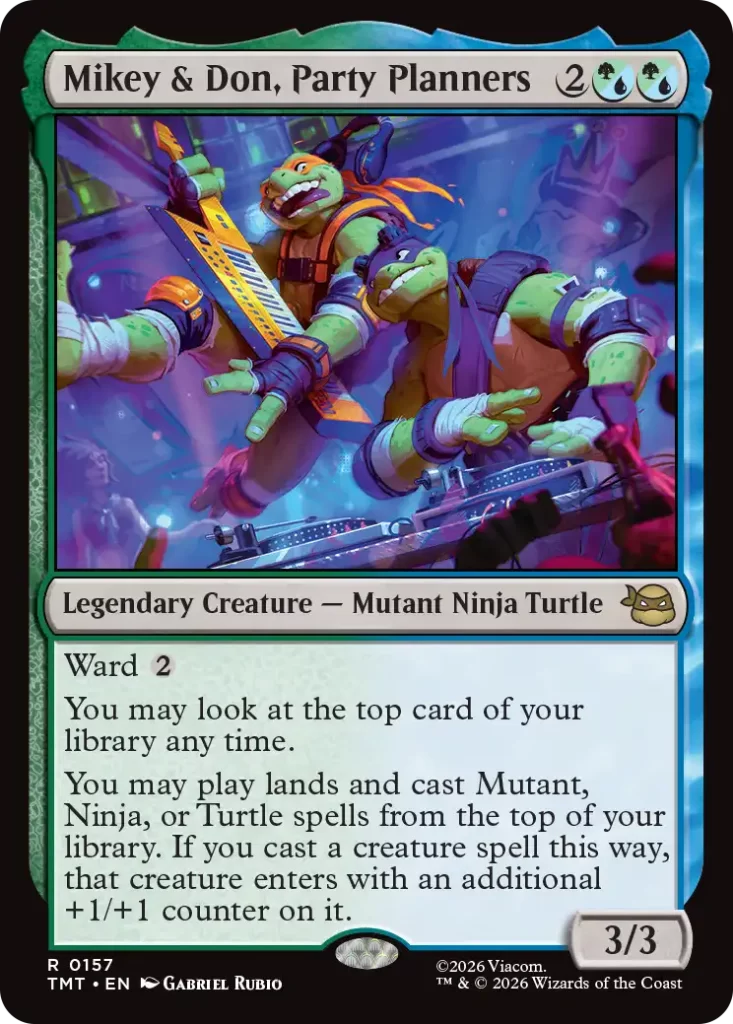
Rating: 5/10
You only need to cast one free spell off Mikey & Don, Party Planners to have made casting it worthwhile. About 61% of TMT’s creatures are mutants, ninjas, and/or turtles, so the right deck should have plenty of good hits in it. The main issue I see here is that a 4-mana 3/3 with ward 2 is pretty weak, so sometimes you’ll play Mikey & Don and it just won’t do anything relevant in the game.
Mikey & Leo, Chaos & Order
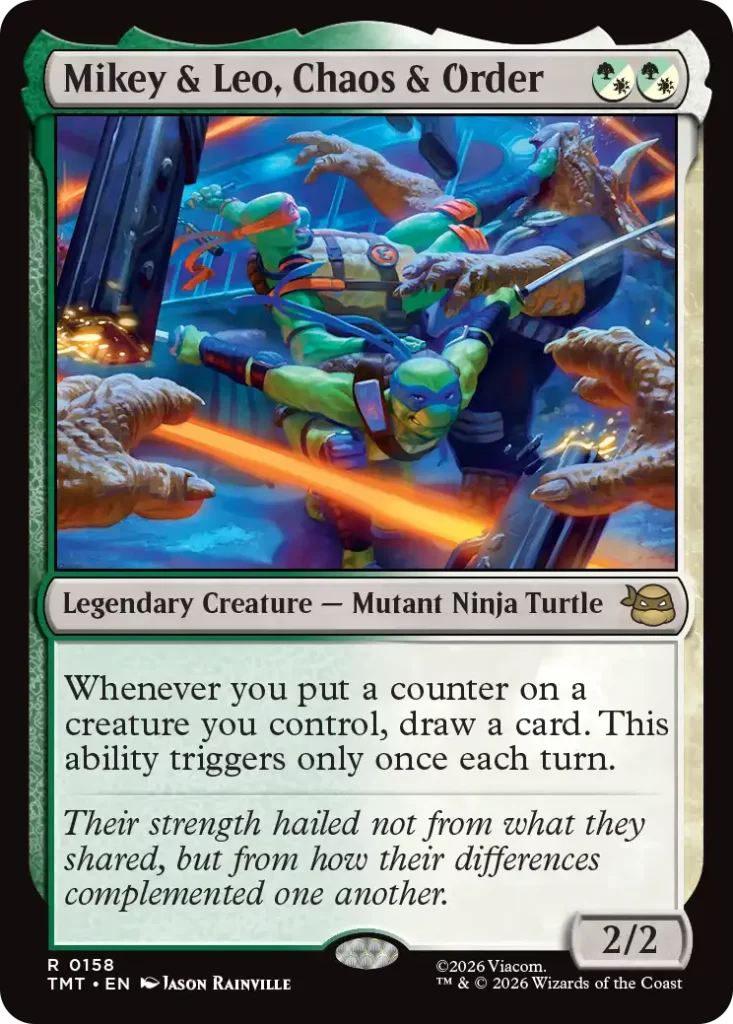
Rating: 7/10
With Mutagen tokens scattered throughout the set, Mikey & Leo, Chaos & Order has a ton of opportunities to trigger. Turning each Mutagen token into not just a counter but a free card is a great ability, and it’s even better that the ability appears on a 2-drop.
Mouser Mark III
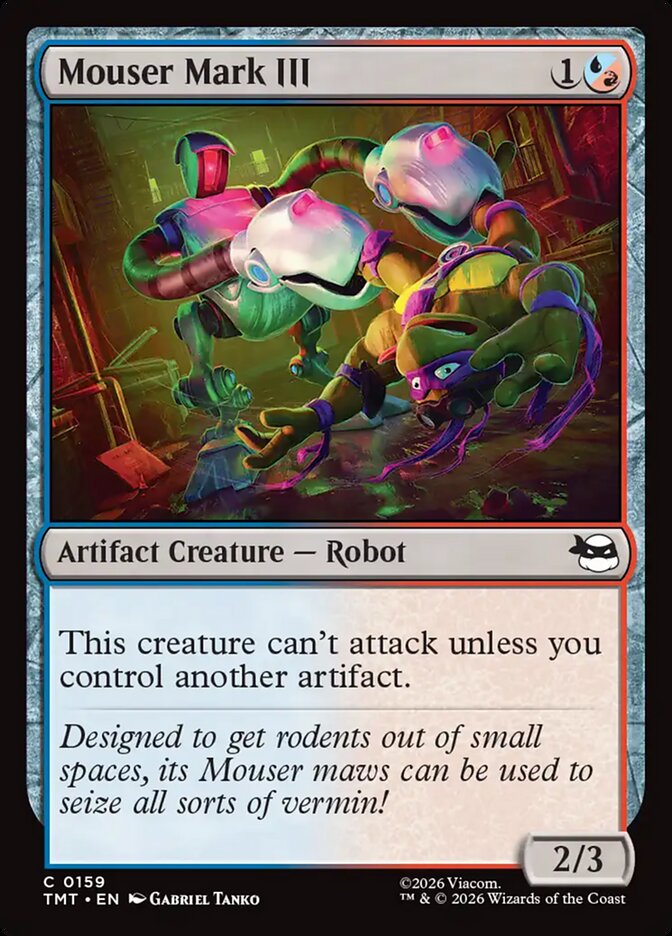
Rating: 3/10
If you’re in blue/red, I’d say the odds that you control another artifact are pretty high. In other color combinations, there are Mutagen tokens and other such cards that make it so that Mouser Mark III’s pesky downside shouldn’t get in your way very often. If that’s the case, this is a pretty solid 2-drop.
The Neutrinos
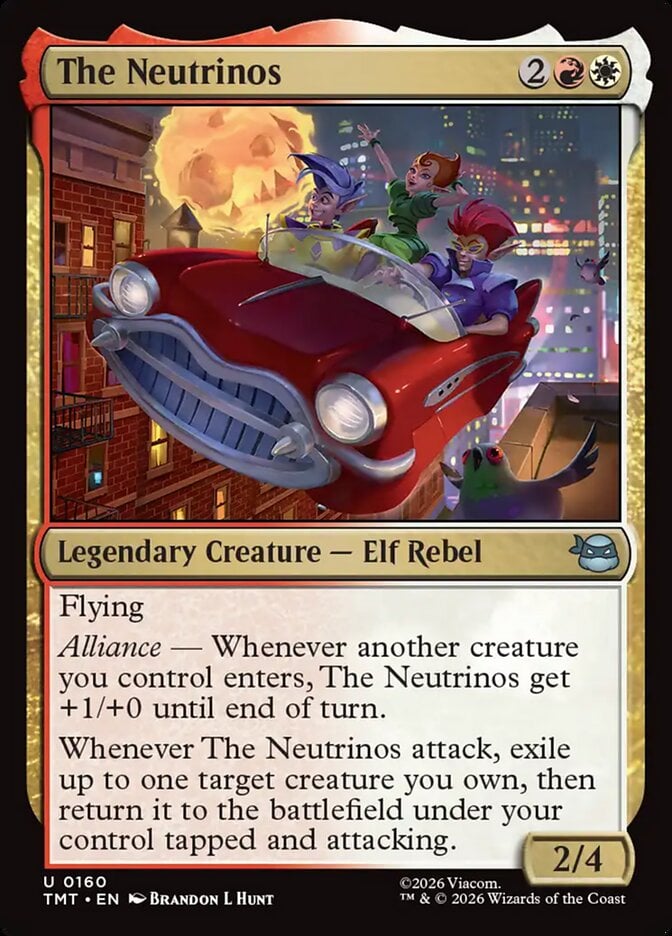
Rating: 7/10
This is a very weird and unique ability. Thanks to flickering a creature on attack, The Neutrinos should usually be at least a 3/4 flier, but it’ll often be quite a bit bigger than that. The funny thing you can do with this is to flicker a creature that you just played, effectively giving it haste. There are a lot of great targets for an ability like this, and when it comes with an oversized flier attached, I’m all in for it.
Nobody
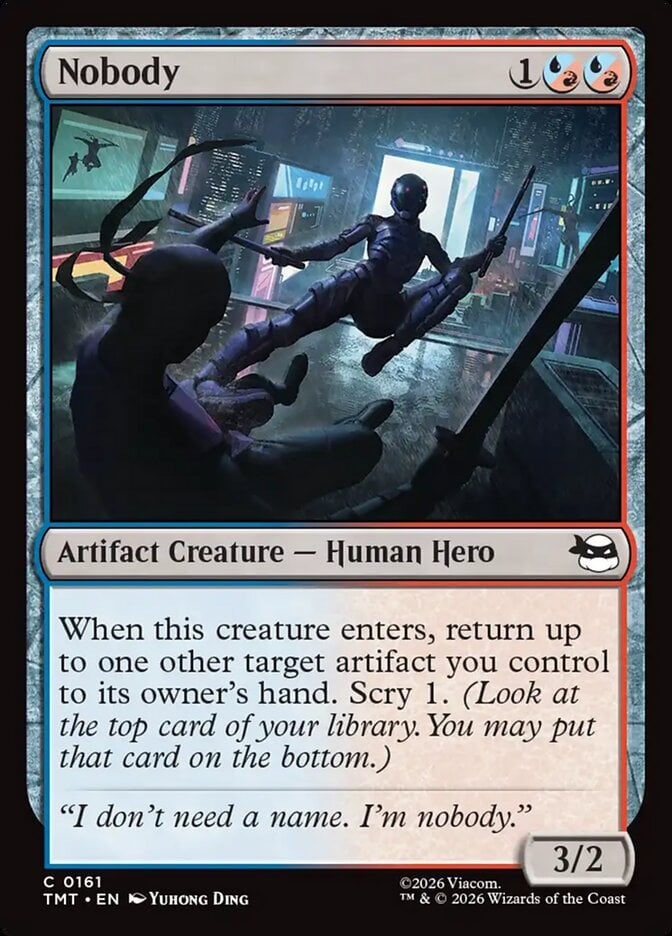
Rating: 3/10
This is such a weird ability. The bare minimum is that this is a 3/2 plus a scry 1 for 3 mana, which isn’t bad by any means. But you can also return an artifact you control to your hand? This isn’t much of an upside. While you get to reuse that card’s enters the battlefield ability, you still have to pay its cost again, which often you just won’t want to do. Nobody isn’t even oversized for your trouble. This is fine, but it’s a very weird design.
North Wind Avatar
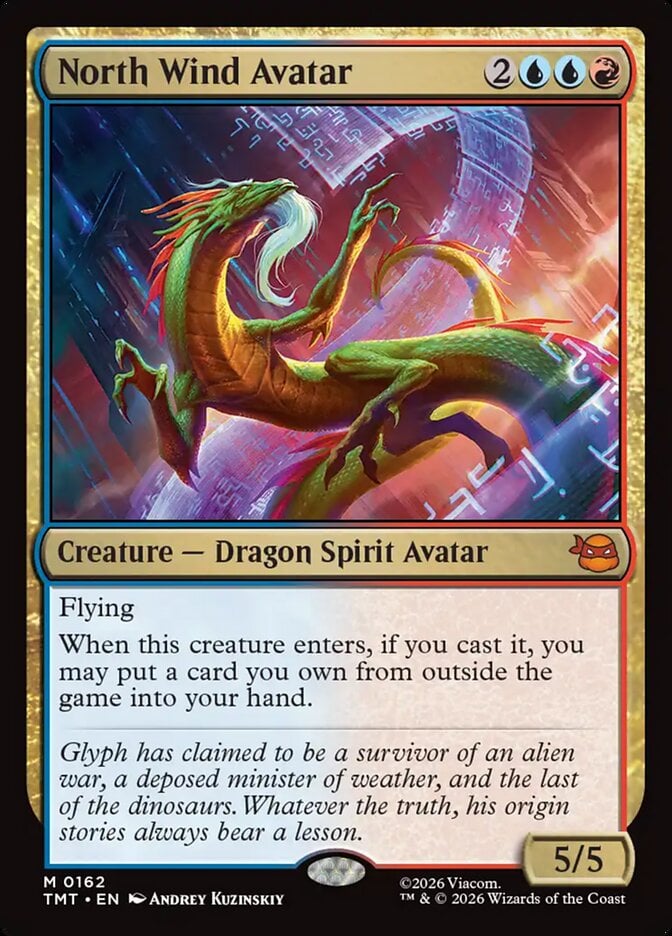
Rating: 9/10
In case you’re unaware, “a card you own from outside the game” means a card that’s in your sideboard. In Limited, that’s anything in your card pool that’s not in your main deck. So, is this any good? After all, is getting a card that wasn’t good enough to make the cut in your main deck even worth it? In this day and age, it definitely is. Your sideboard is likely to have all sorts of powerful cards that are simply too expensive or situational to include in your main, but grabbing them at will is going to be very useful. Besides, North Wind Avatar is still a huge 5/5 flier, and it draws you a spell when you play it, which is a great deal no matter what you get.
Pizza Face, Gastromancer
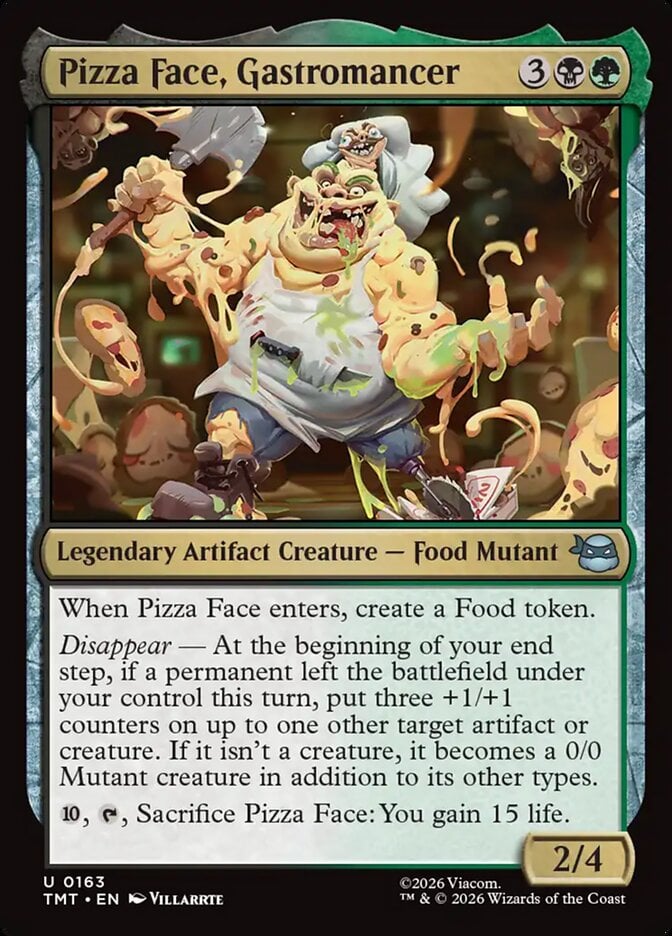
Rating: 7/10
This card is pretty funny, I really like it. I’ve said this a lot, but if you’ve been able to enable disappear before you play it, Pizza Face, Gastromancer immediately gives you a 2/4 plus a 3/3 for just 5 mana, which is excellent. The black/green deck in particular should be pretty good at enabling this turn after turn, and you just get to keep cranking out the +1/+1 counters. The 10-mana ability at the end is funny, essentially saying that this is the equivalent of five foods, but it’s basically never going to happen.
Punk Frogs
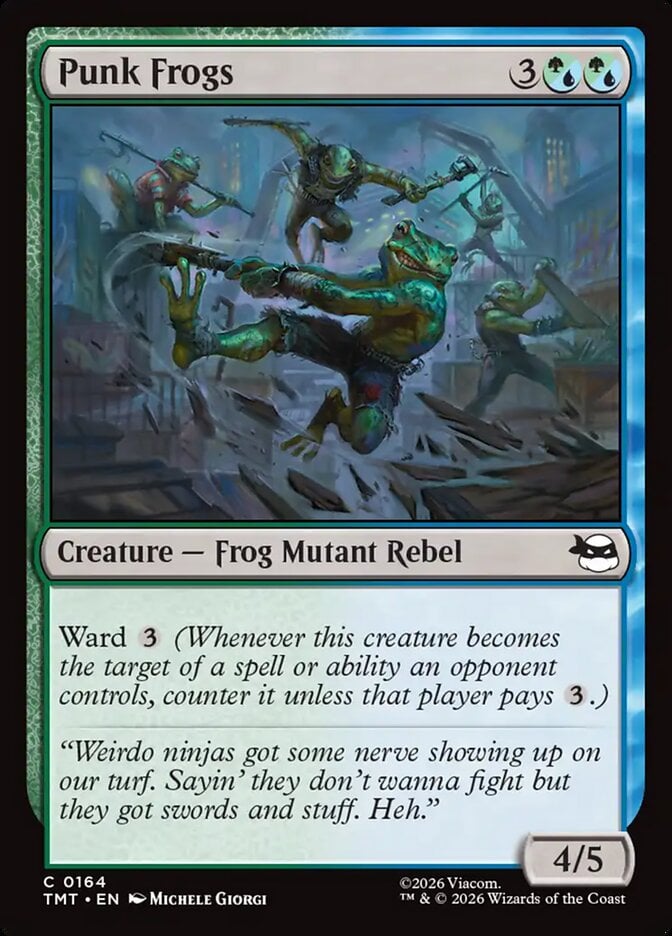
Rating: 1/10
This looks like a quintessential unplayable to me. Ward 3 is quite good, but Punk Frogs is a somewhat undersized vanilla creature otherwise. I think you’ll choose not to run this most of the time.
Putrid Pals
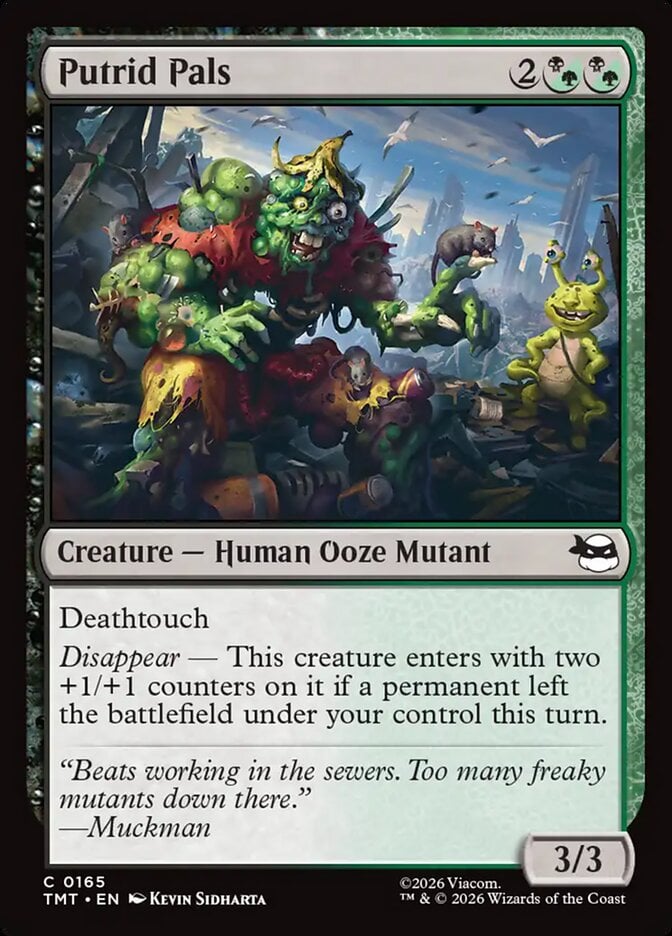
Rating: 3/10
Given that Putrid Pals has deathtouch, you don’t even need to have enabled disappear for it to have an impact on the board, though it’s obviously preferable. This is just a big vanilla creature at the end of the day, but a 5/5 deathtoucher is annoyingly hard to kill in combat because it trades with everything in a double or triple block scenario.
Raph & Leo, Sibling Rivals
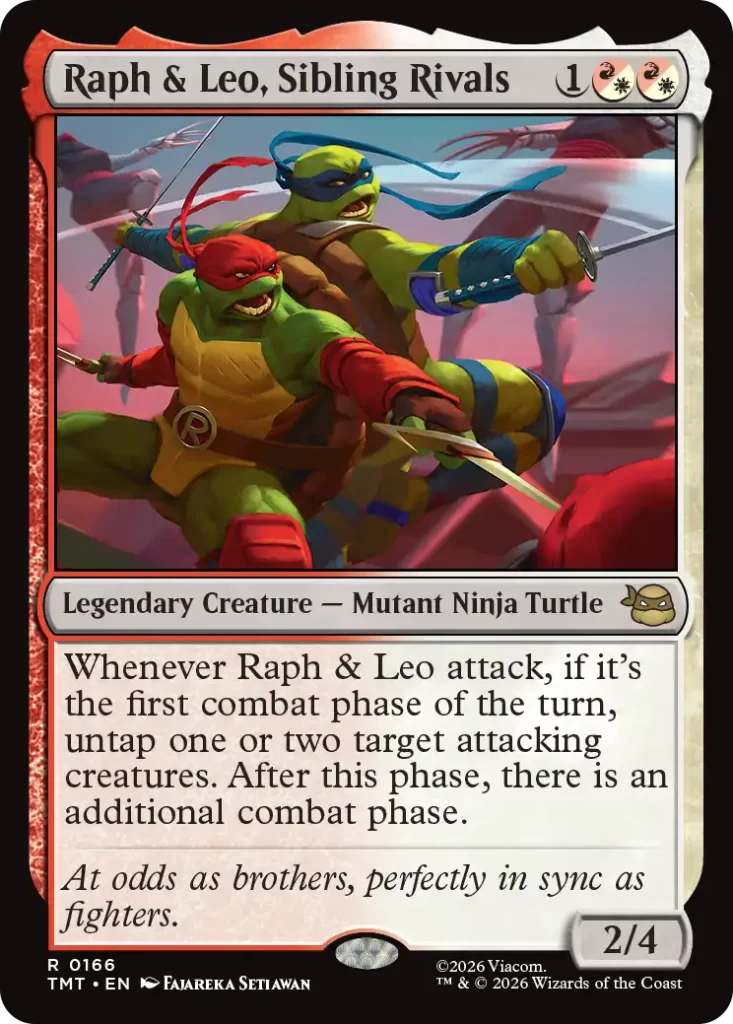
Rating: 7/10
Most additional combat effects are expensive, clunky, or far too situational for your average game of Limited. Raph & Leo, Sibling Rivals is none of that, which makes me wonder if this is finally the card that’ll make it worthwhile. We’ve seen Fear of Missing Out do some good work in the Duskmourn Limited format, so I imagine Raph & Leo will do so too.
Raph & Mikey, Troublemakers
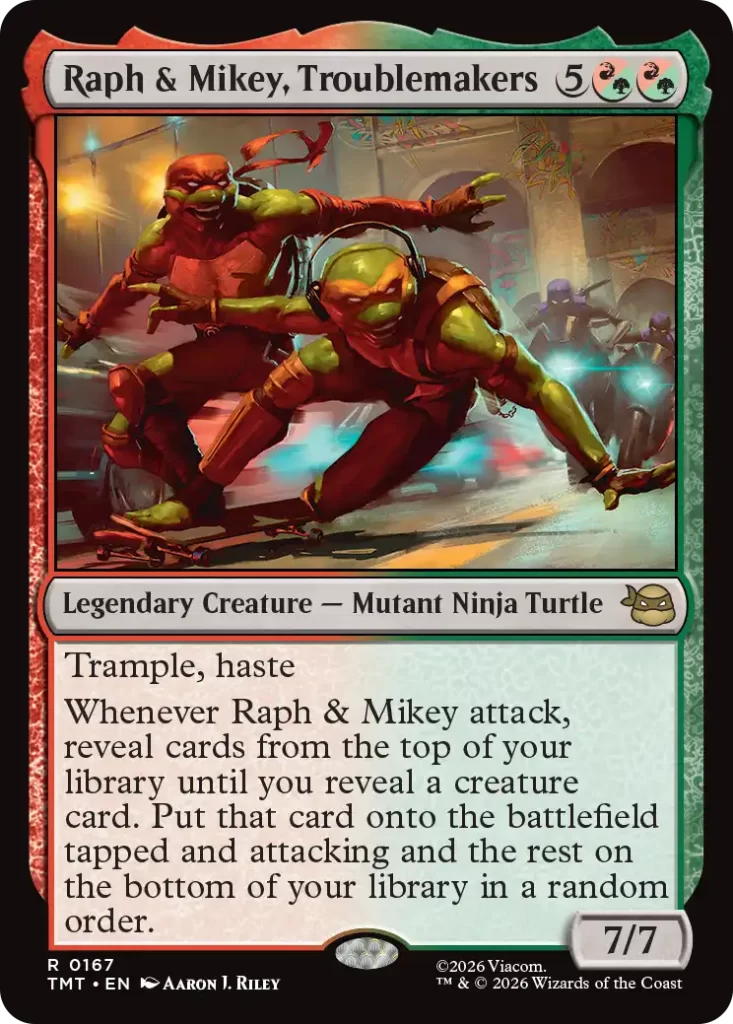
Rating: 9/10
I think I’ve found my next commander to build around. In Limited, Raph & Mikey, Troublemakers is already problematic as a 7/7 with haste and trample. It hits hard and fast, and it tops your curve incredibly well. The free creature you get when it attacks is completely random, so you don’t know if it’ll matter or not, but anything for free is a good thing. If you happen to hit something expensive, you’re absolutely set.
Slithering Cryptid
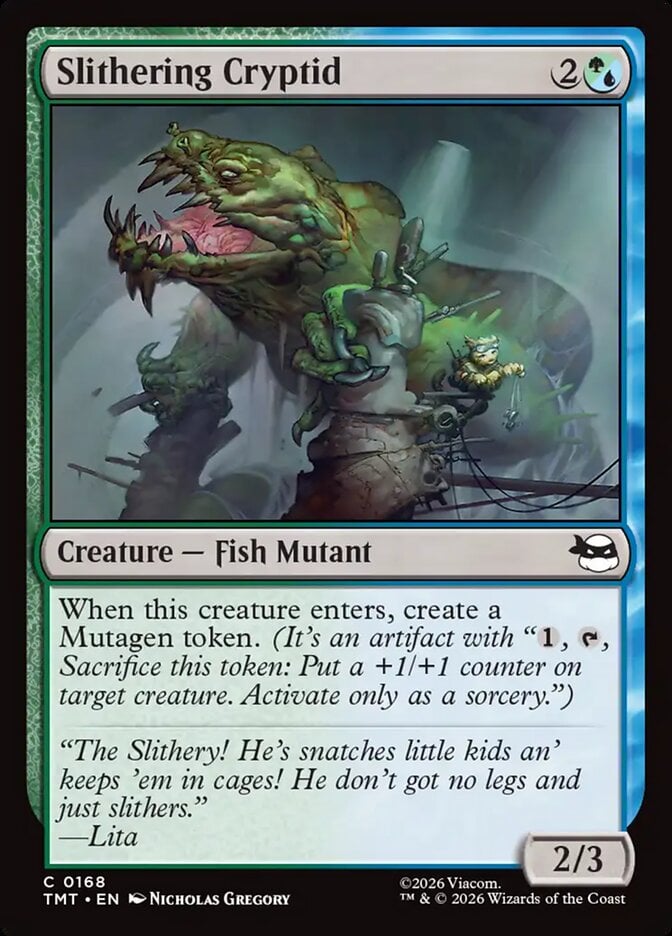
Rating: 3/10
A 2/3 plus a Mutagen token for 3 mana is very similar to a 3/4 for 4, but it should be so much better than that. The Mutagen tokens look quite valuable, so I’m sure Slithering Cryptid will be a decent common.
Splinter, Radical Rat
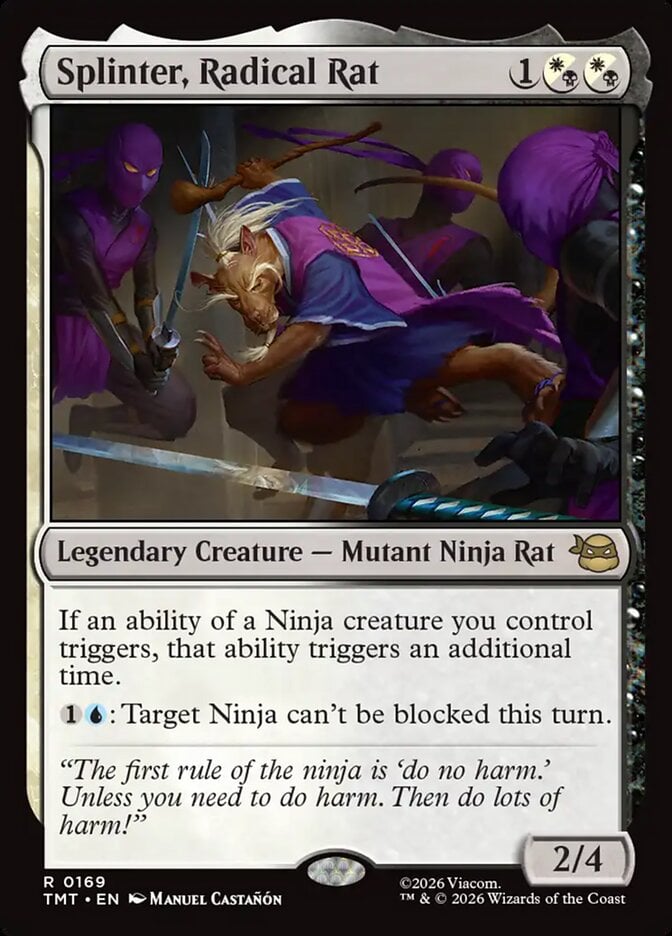
Rating: 6/10
Splinter, Radical Rat is clearly designed with Commander in mind as a 3-color commander that combines this set’s white/black ninjas with the traditionally blue (and black) ninjas from Kamigawa and other past sets. In Teenage Mutant Ninja Turtles, we’re unlikely to want blue mana in our ninja decks, so we should probably discount that ability entirely. Still, a 3-drop that doubles our ninjas’ triggered abilities sounds fine, especially as they basically all have triggered abilities of some kind.
Tainted Treats
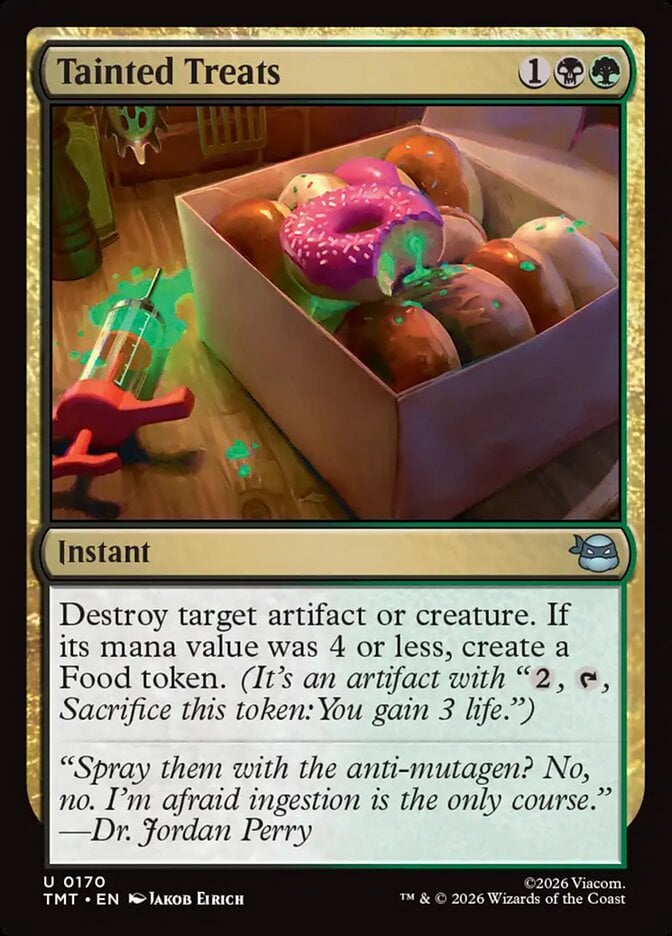
Rating: 7/10
I’m always happy with Putrefy in a Limited environment, so give me a functional reprint with a nice upside like Tainted Treats and we’re very much in business.
Tokka & Rahzar, Terrible Twos
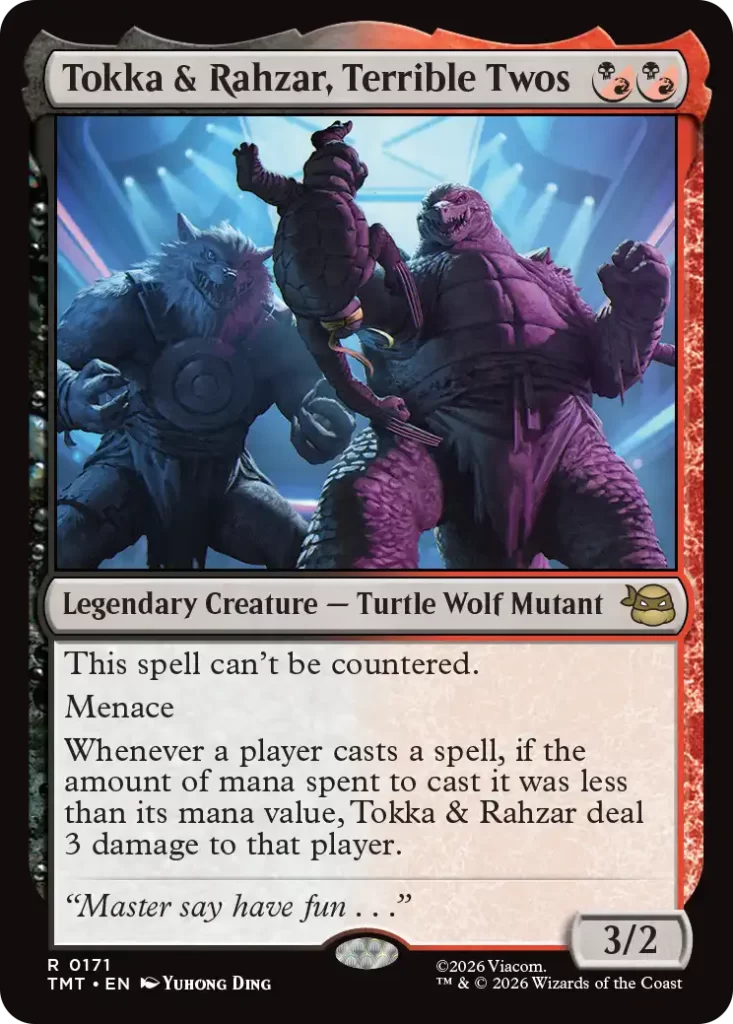
Rating: 4/10
A 2-drop 3/2 with menace isn’t too bad, but Tokka & Rahzar, Terrible Twos kind of stops there. The damage ability is mostly irrelevant in this format, but it does punish many of the sneak spells, which makes this card pretty strong against ninja decks. This turtle wolf mutant will however be rather lacking when you play against other decks.
Artifacts
Chrome Dome
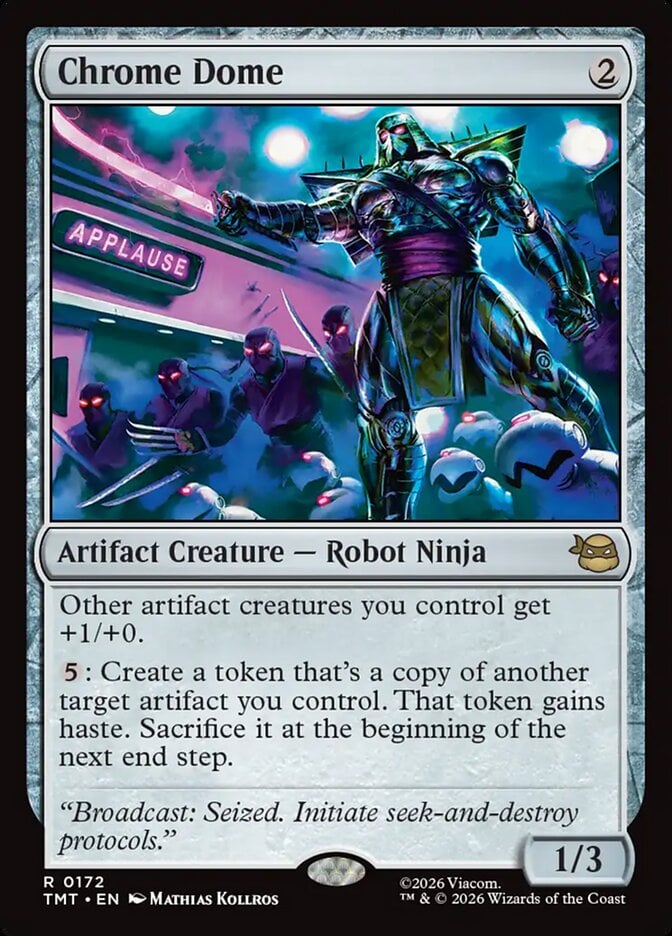
Rating: 4/10
I’m far more interested in Chrome Dome being a sort of typal lord for your artifact creatures than ever trying to activate its second ability. Five mana is a lot to spend to get a token that’s just going to die at the end of the turn, though at least it’s something you can sink your mana into when you reach the late game with nothing else to do.
Everything Pizza
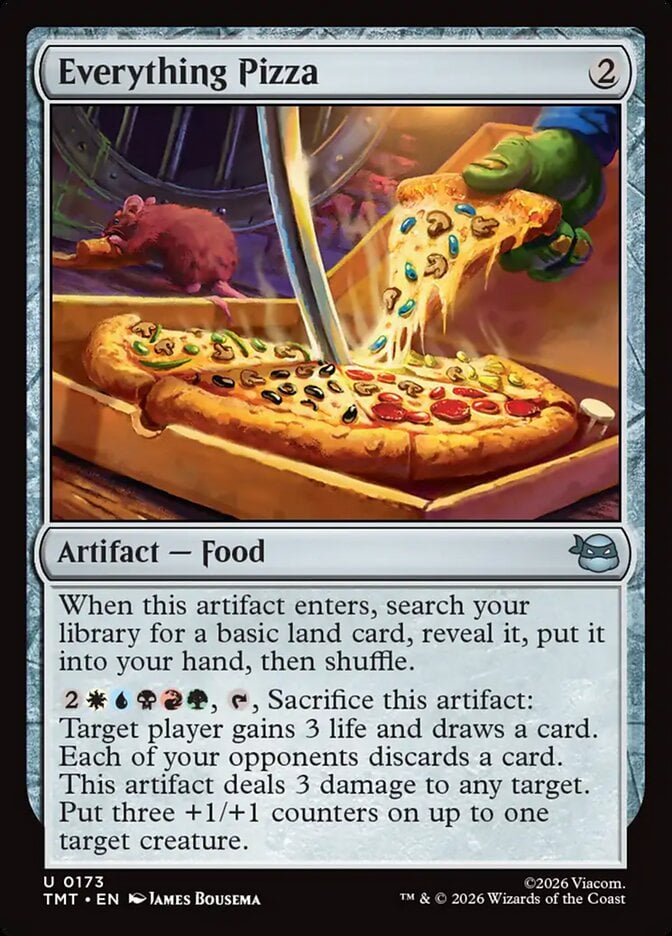
Rating: 3/10
I don’t see any real reason to build a 5-color deck in this format, but Everything Pizza makes me hope that it could happen at least once. You can use this to fix your mana in a pinch, and the black/green deck could certainly use more things to sacrifice, so this should be somewhat playable even without all the colors to win the game with.
Henchbots
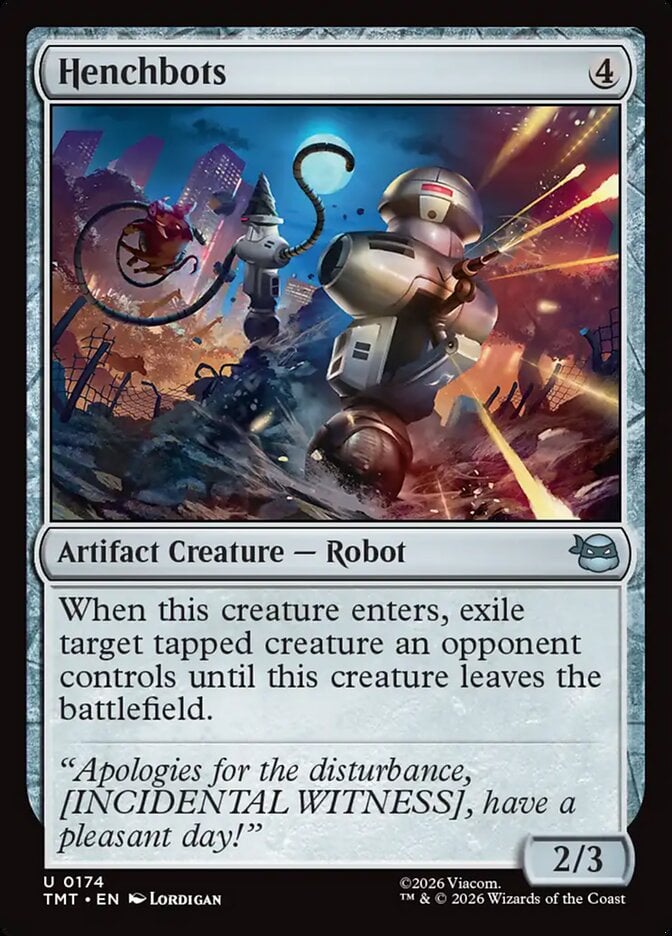
Rating: 6/10
Is that… a colorless Banisher Priest? Seriously? I mean sure, it costs 4 mana and can only target a tapped creature, but Henchbots is still an extremely powerful effect for any deck to have access to.
Krang, Utrom Warlord
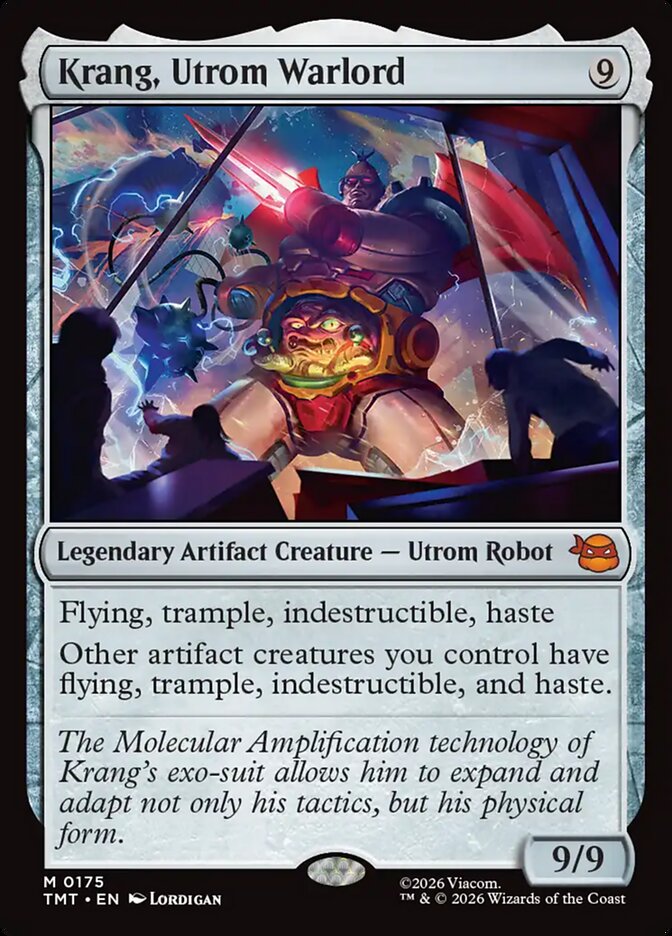
Rating: 1/10
Six or 7 mana is reasonable to expect to cast, and even 8 is possible if you put a bit of effort into it, or a format is slow enough. Nine feels like a step too far. Krang, Utrom Warlord is obviously powerful if you can land it, but doing so looks like an insurmountable task to me.
Omni-Cheese Pizza
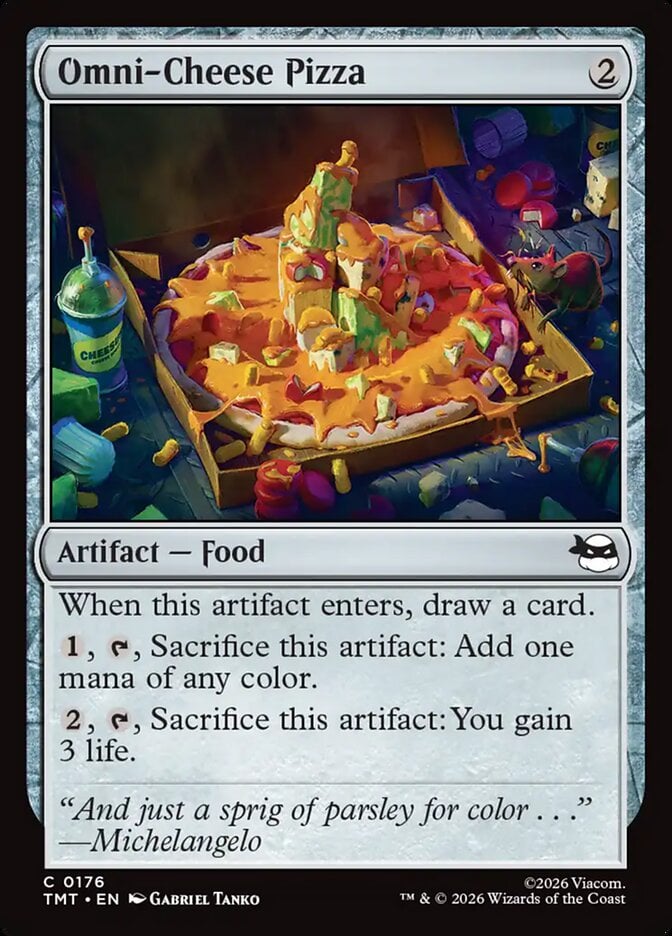
Rating: 3/10
If your deck likes having artifacts on the battlefield, you could certainly do worse than an Omni-Cheese Pizza or two. They immediately replace themselves with a fresh card and then help to fix your mana a little. They gain life as all foods do, or you can find some other way to use them depending on your deck.
The Ooze
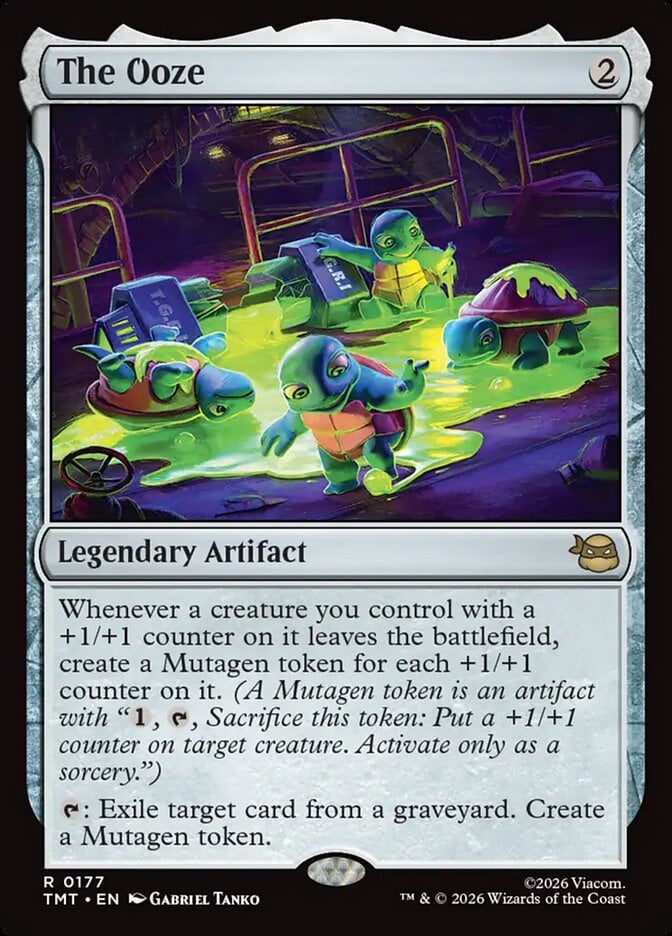
Rating: 7/10
Given that there are usually at least a few cards in the graveyards, The Ooze can create a Mutagen token nearly every turn cycle of the game, plus more when your creatures die. This enables you to pile all your counters onto one creature, then when it dies, you get a bunch of Mutagens and can pile them all onto something else. This card is pretty sweet, and there are a few decks in the TMT Limited format that will use it very well.
Skateboard
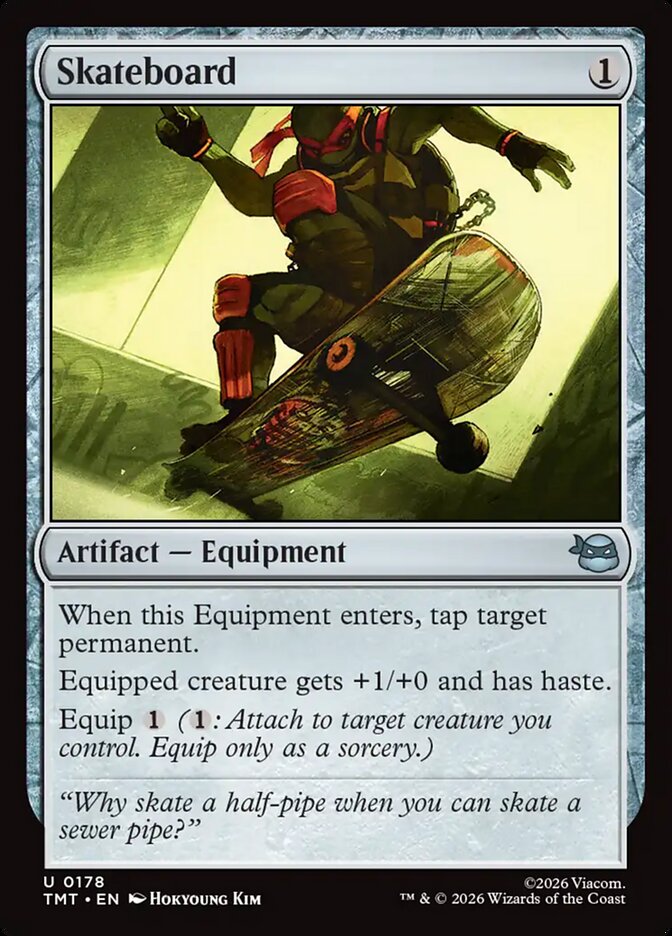
Rating: 1/10
I suppose they made this very generic so it can be reprinted in the inevitable future Universes Beyond set for The Simpsons. Well, I hope not, because Skateboard looks incredibly mediocre to me. Haste is a very powerful ability to grant for only 1 mana, but spending a whole card on this just isn’t going to be worth it most of the time.
Technodrome
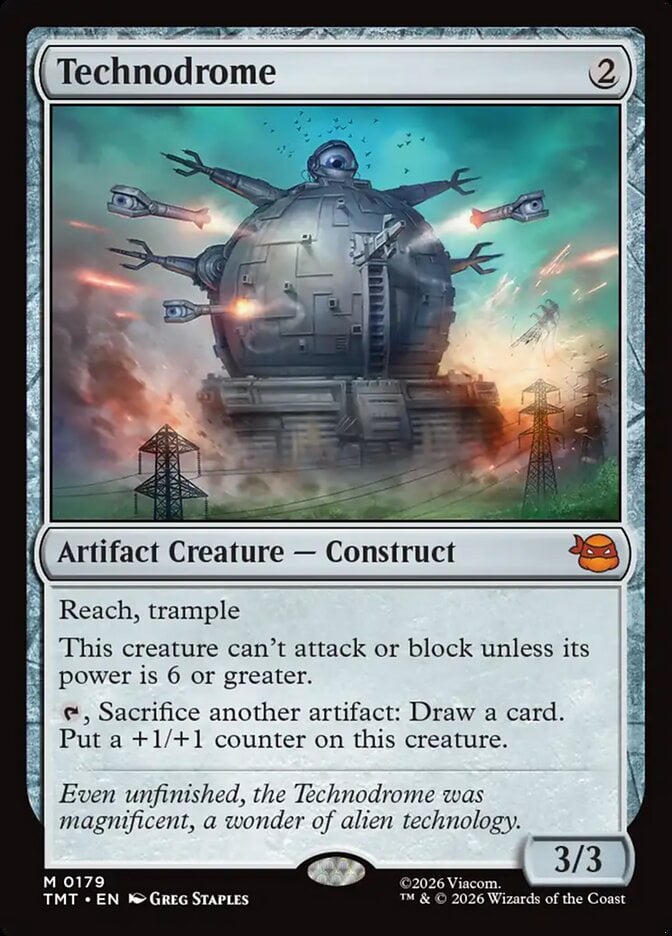
Rating: 6/10
Technodrome is an absolute house. Of course, you need to be a deck that can actually use it, since on its own it does literally nothing. More than likely it’ll be the green decks with an abundance of Food and Mutagen tokens that can use this the best, especially as the Mutagen tokens allow you to turbo this up to a 6/6 and start getting into combat. Even if you’re not attacking, getting to turn a token into an extra card each turn is quite a powerful ability, especially when it doesn’t cost any mana to use.
Turtle Blimp
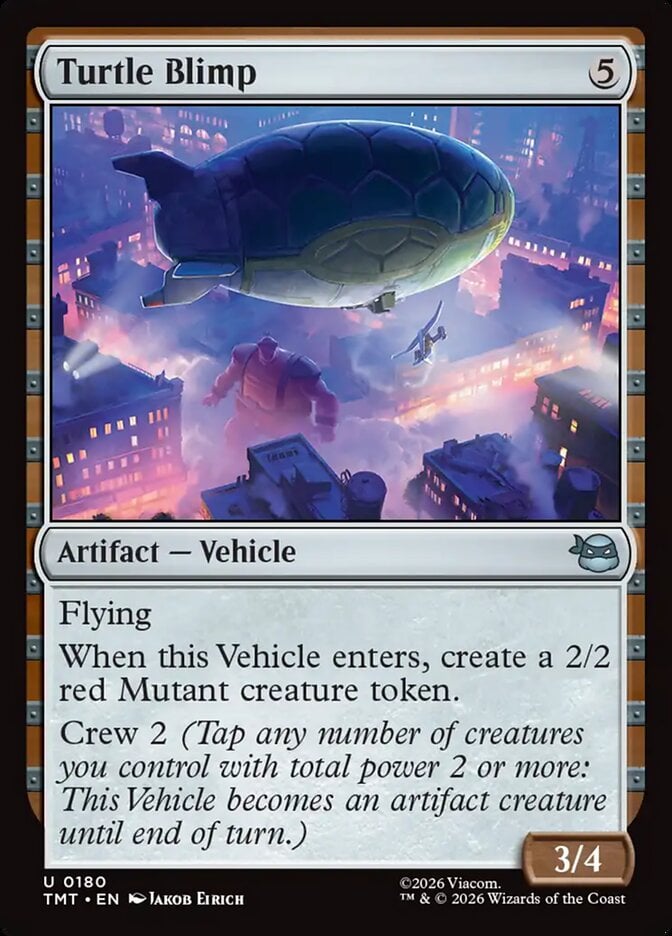
Rating: 5/10
“Oh my god! How can you afford these things!”
-Joe Swanson, Family Guy
Vehicles kind of suck, but Turtle Blimp giving you a 2/2 token that can then be used to crew it does make it worth playing. Besides, flying creatures are always valuable and crew 2 is a pretty accessible cost to enable it.
Turtle Van
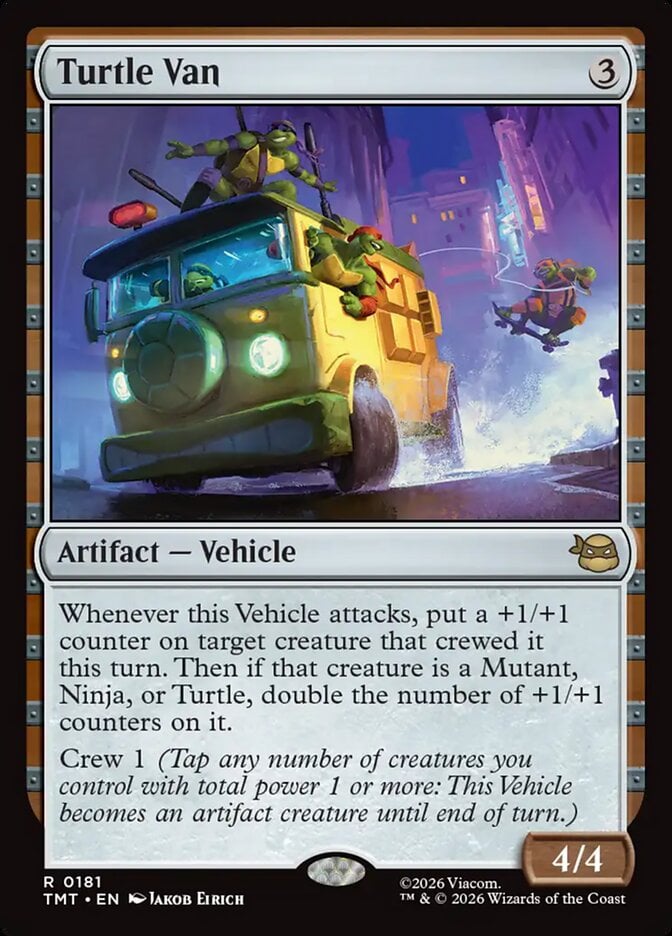
Rating: 7/10
A 4/4 vehicle with just crew 1 is a little above average these days, but vehicles need to do a lot more to be worth a slot in our decks. Turtle Van churns out a lot of +1/+1 counters if it gets to attack, though it’s somewhat easy to disrupt. Your opponent has a few opportunities available to deal with this before you get a trigger from it. That said, getting one, two, or even more counters with this ability is huge, which really incentivizes you to pick your moments and make sure it can’t be dealt with.
Weather Maker
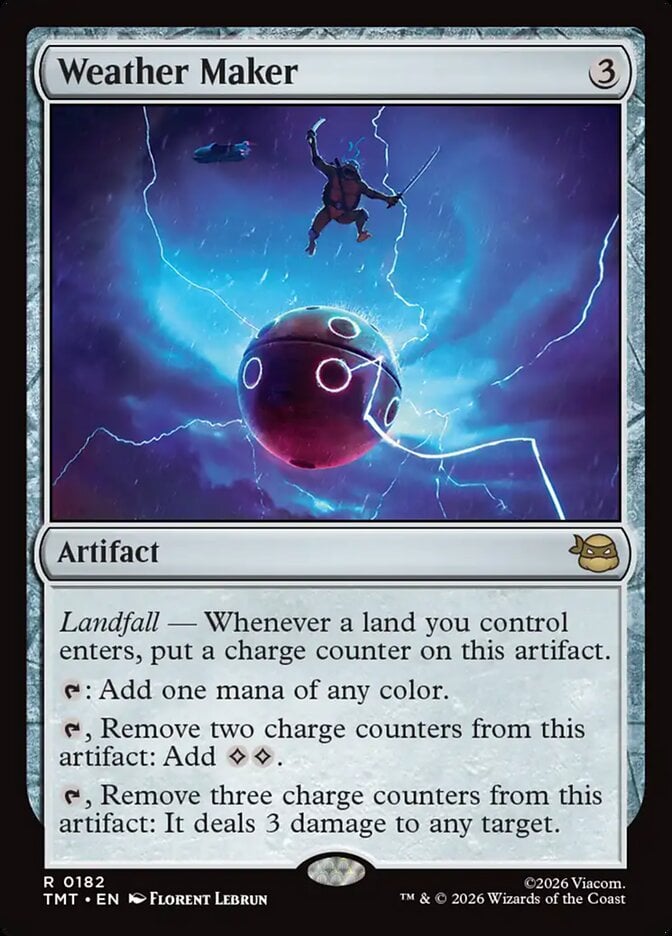
Rating: 4/10
Three-drop mana rocks range from unplayable to pretty good, all based on the extra abilities they may have. Weather Maker is pretty unique in that it can accelerate mana even further with its two counters ability, but notably also kill creatures with the last ability. Most mana rocks aren’t capable of also being removal, which I think makes this quite decent.
Lands
The Turtles Gain Lands
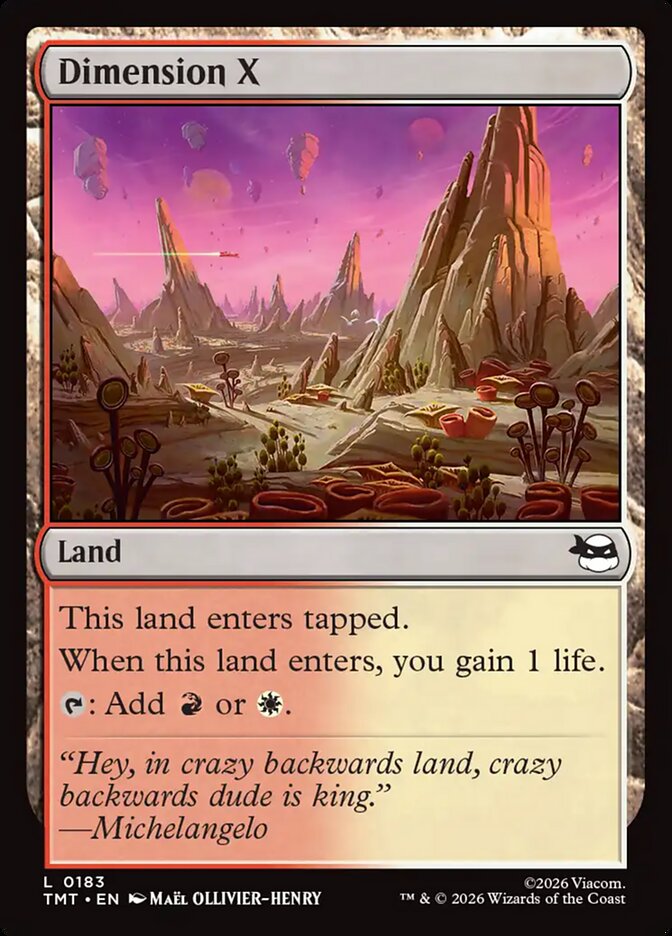
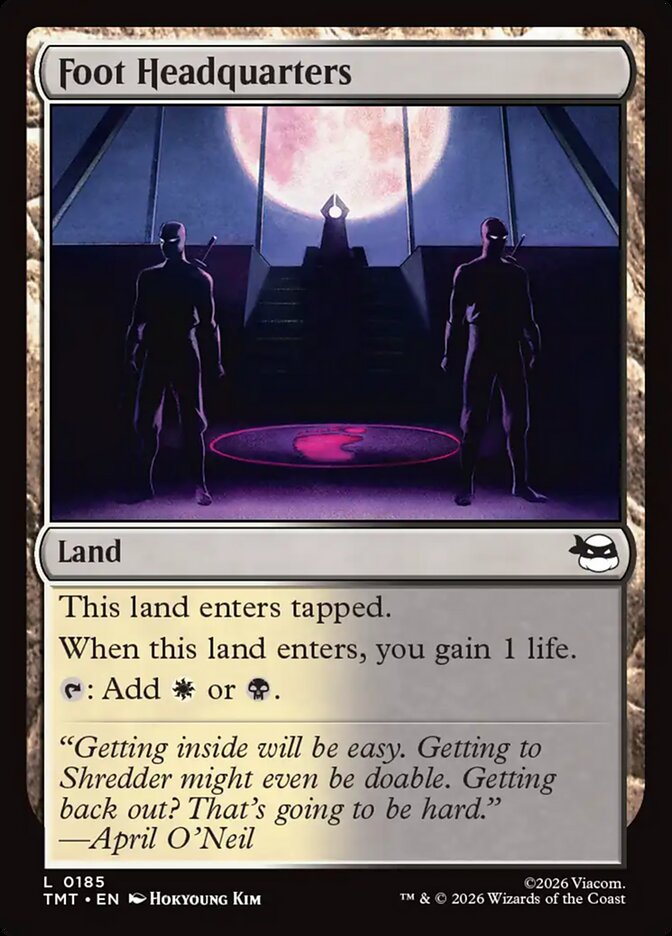
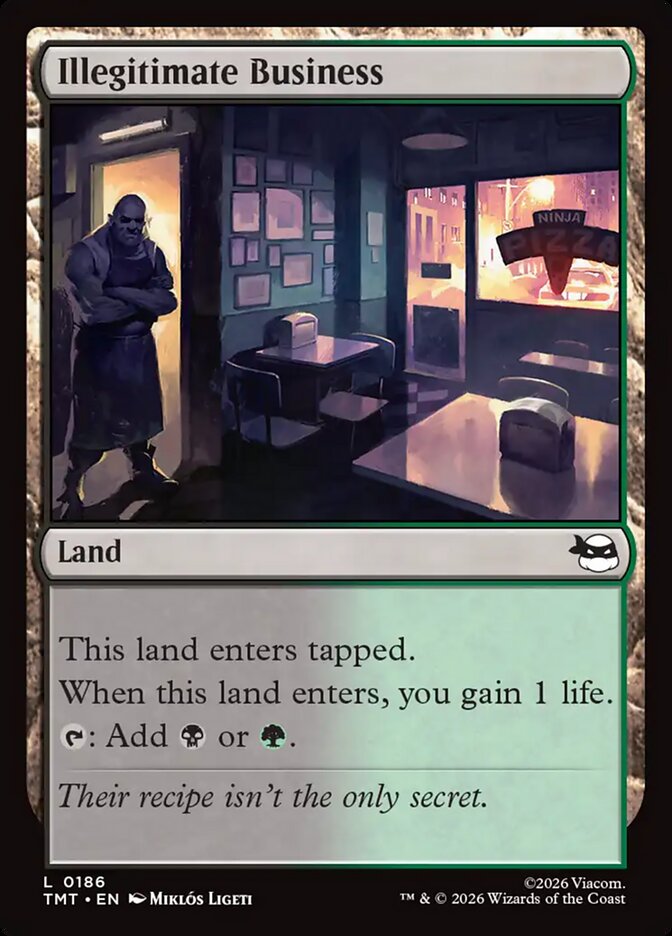
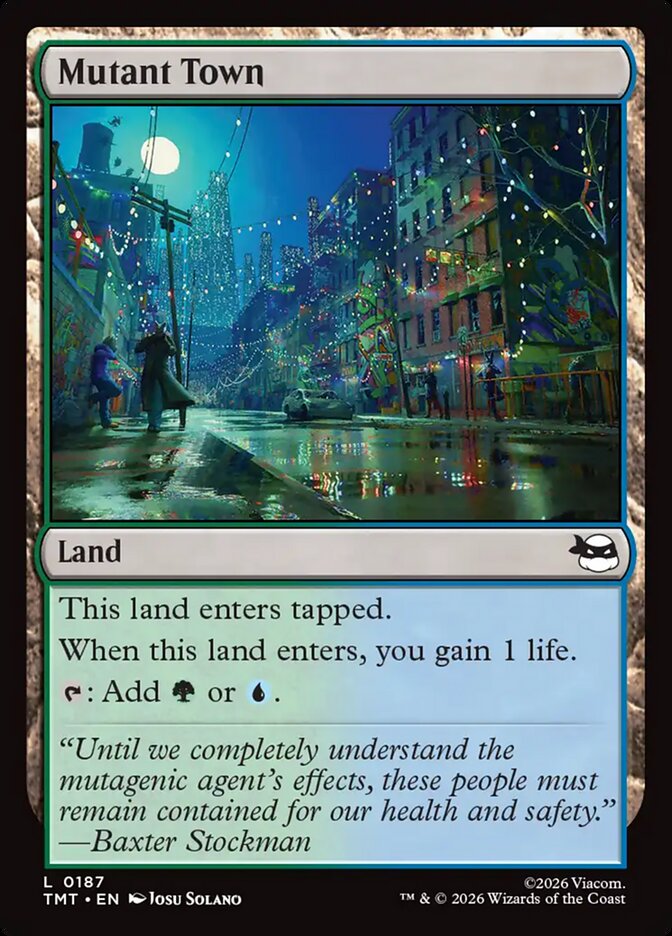
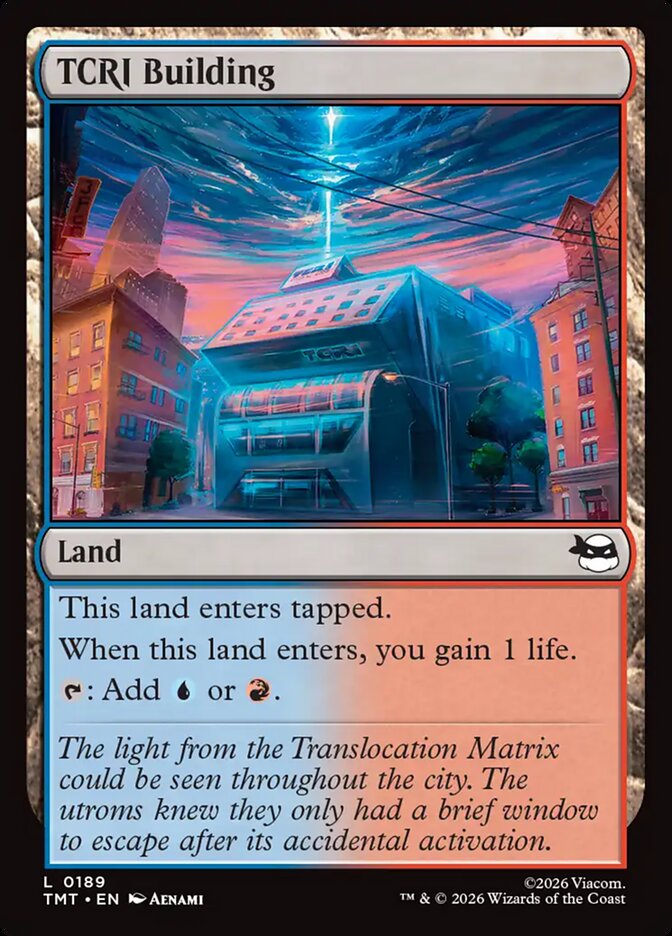
Rating: 4/10
Gain lands are fantastic to see in any set. Most of the decks we play in this format will be one of these combinations, so if you see a land for your deck, you should probably take it over most medium commons and shore up your mana base, but you also don’t need to prioritize them over very good cards.
Escape Tunnel
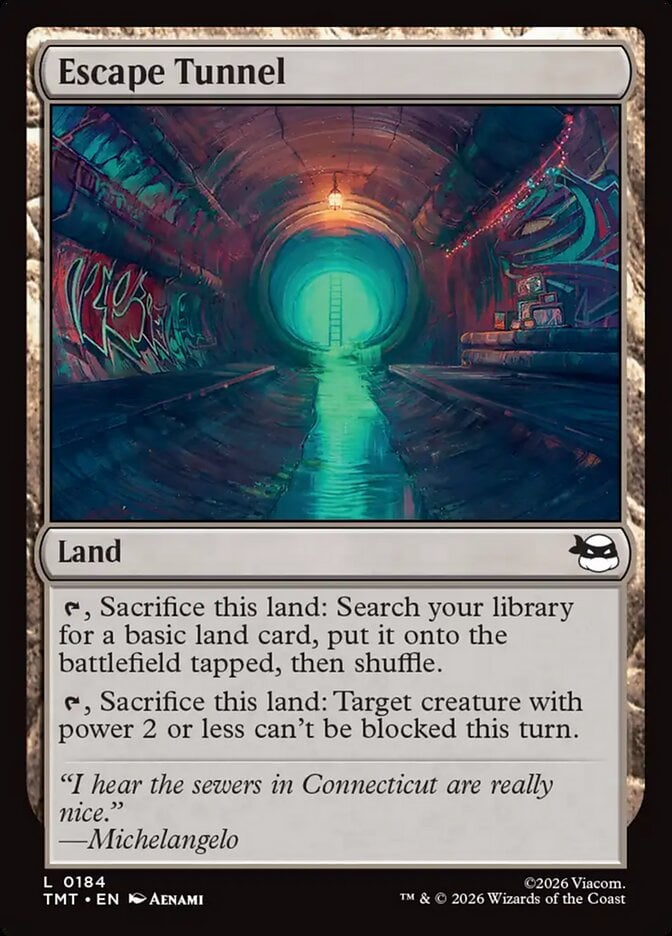
Rating: 4/10
Escape Tunnel is a cool reprint to see, too. It’s functionally the same as Evolving Wilds but with a little extra bonus, and you were already happy with Evolving Wilds in the first place. As with the gain lands, take it over medium commons, but don’t pass over better cards for it.
Northampton Farm
Rating: 1/10
This is very reminiscent of Endless Sands, a land which looked incredible at first, but proved to be virtually unplayable. Northampton Farm is a much better deal in terms of mana, but the cost of putting a colorless land into your deck likely far outweighs the niche potential that this card has.
Turtle Lair
Rating: 5/10
Rogue's Passage is a nasty little land that can win some board stalls here and there but is also a liability in your mana base since it’s a colorless land. Turtle Lair is quite a bit better than that, as it’ll sometimes tap for colored mana and help to cast your spells on time, then later make it so that you can close out a game. It’s not broken or anything, but it’s a very nice addition to the right decks.
Source Material Bonus Sheet
Teenage Mutant Ninja Turtles has a source material bonus sheet (PZA), very similar to the one we saw in the Spider-Man set (MAR). This one is rather small though: There’s only 20 cards this time. These cards aren’t relevant to the majority of Limited games, as they only appear in roughly 1 out of every 28 packs. Still, it’s useful to talk about them briefly for the times when they do come up, so let’s get started.
The Unplayables
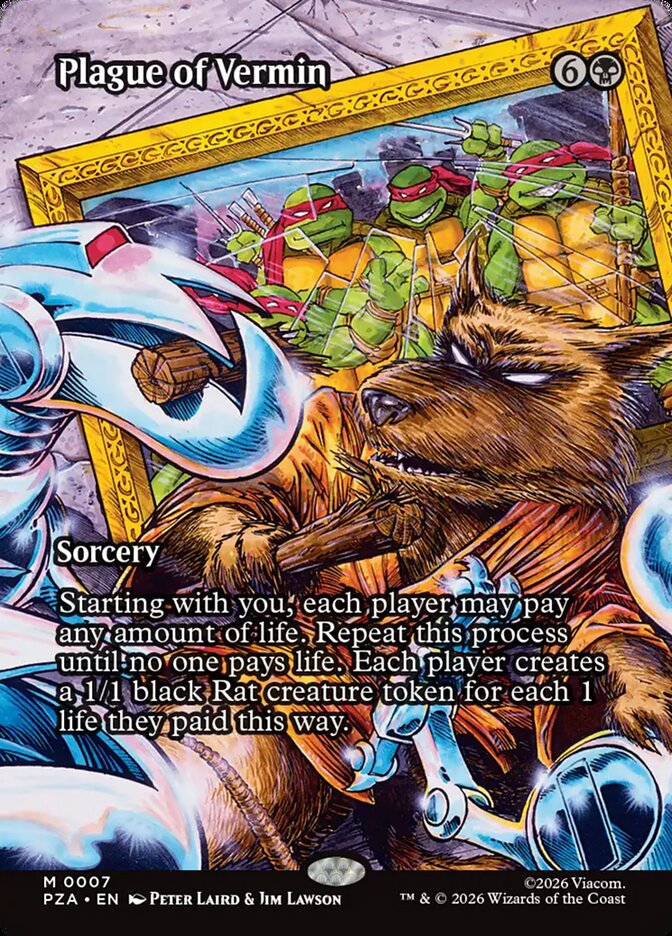
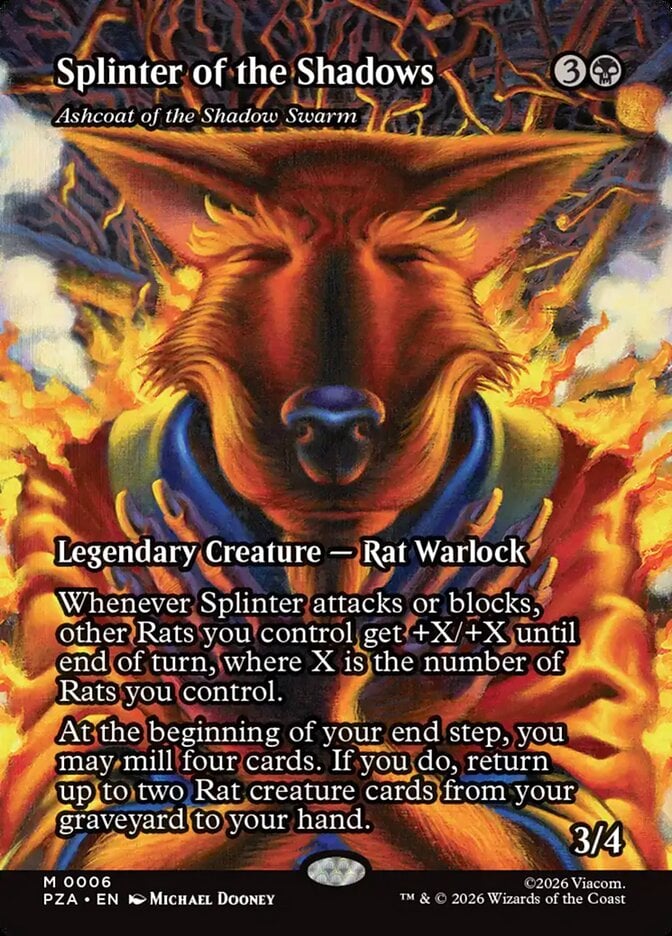
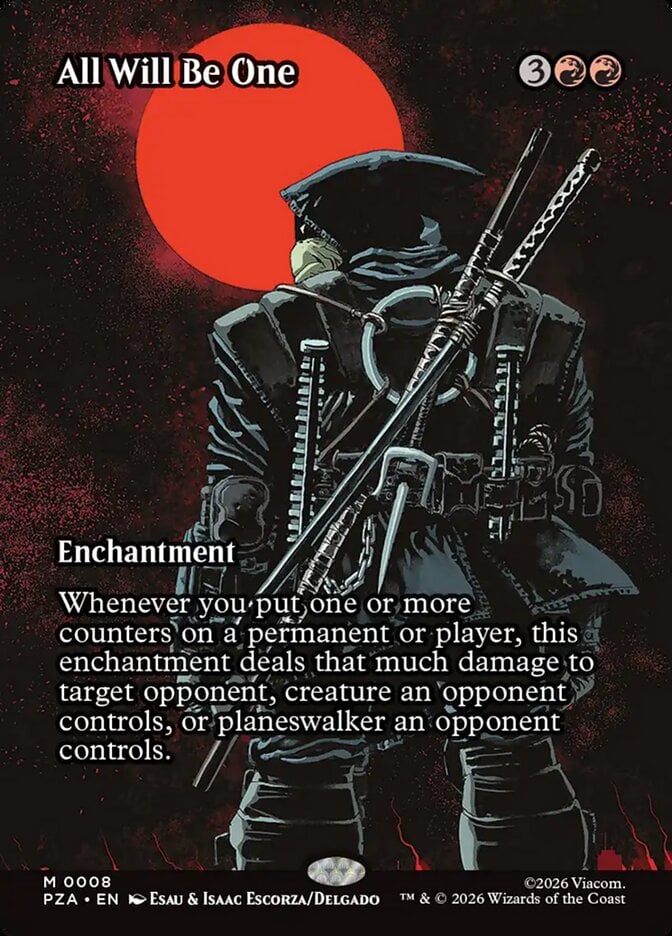
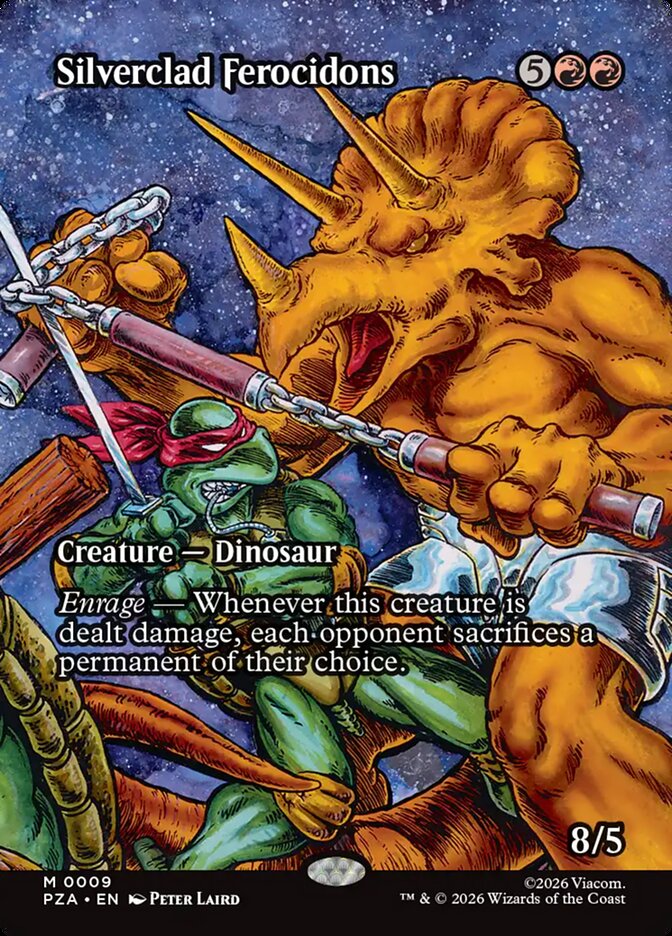

Rating: 0-2/10
I’ve done a few of these bonus sheets now, and I end up giving a ton of very low grades. Ultimately, there’s very little point in discussing any of these weak cards. They’re bad in Draft, and you shouldn’t concern yourself with them. Even if you can put together scenarios where they’re good, they’re ultimately far too expensive, niche, or just plain awful. Let’s talk about some good cards instead.
Path to Exile
Rating: 8/10
A lot of IPs feature stories where a protagonist ends up alone, exiled from their friends and/or family, and has to figure out how to overcome their troubles. As such, if WotC continues to do source material bonus sheets for Universes Beyond sets, we’ll keep seeing Path to Exile over and over. Not that I’m complaining, because it’s an excellent removal spell and you should always take it and play it.
Brainstorm
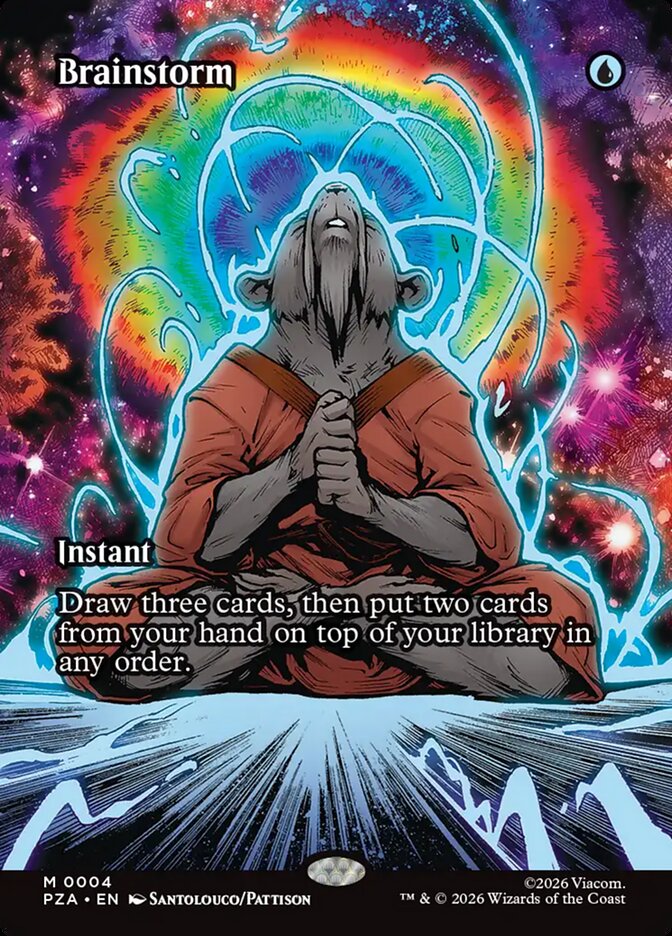
Rating: 3/10
Brainstorm might not be good enough to talk about, but it’s such a classic that I can’t help it. One-mana cantrips have a tendency to be bad unless you have a reason to cast lots of spells. Without a good reason in TMT, it’s possible that you’ll never play Brainstorm. Still, it’s very good when you can use a landcycler to shuffle your library, so maybe there’s something to consider there.
Cytoplast Manipulator
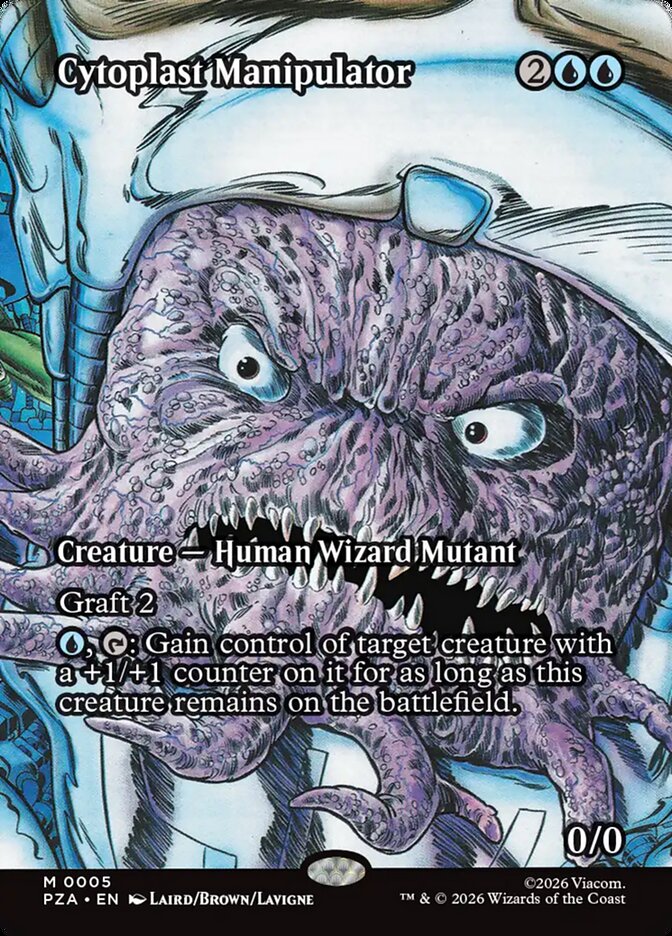
Rating: 7/10
We’ve seen just how many +1/+1 counters are scattered throughout this set, which potentially makes Cytoplast Manipulator the strongest creature on the board. You can steal just about anything and use its own graft ability to put a counter onto something that wouldn’t otherwise get one. The obvious downside is how vulnerable this is to removal, and you’ll give back the creatures you stole when it dies, but if you can protect it somehow then this’ll dominate a game.
Arcbound Ravager
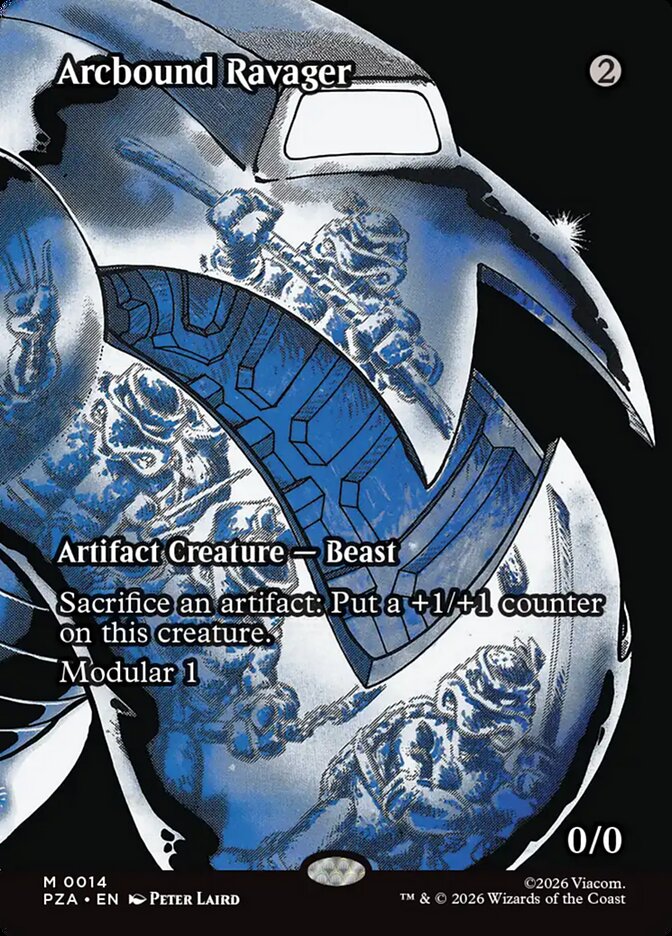
Rating: 7/10
Arcbound Ravager is quite an unassuming card, but an extremely powerful one. The ability to sacrifice any artifact for free and whenever you like shouldn’t be underestimated, and the modular ability lets you turn all of your artifacts into one very large creature, whether that’s the Ravager itself or something with some better abilities. This is a card that has been synonymous with the affinity archetype for decades, and it’s bound to have some kind of impact in Teenage Mutant Ninja Turtles.
Ronin’s Arsenal (Conqueror’s Flail)
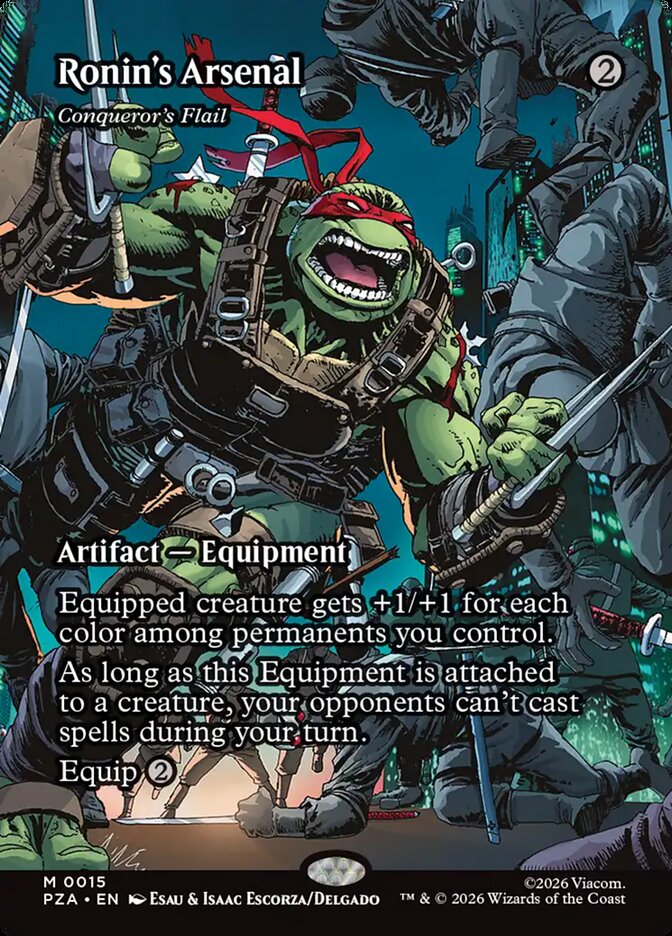
Rating: 5/10
The power and toughness boost you can get from Conqueror's Flail is usually capped at +2/+2, but thanks to the hybrid cards in this set, it’s not unreasonable to see that climb on certain boards. Similarly, it could also drop to just +1/+1. What’s really interesting is the Grand Abolisher-esque ability that allows you to attack without fear of running into a combat trick or removal spell. All of that is fine, though this is still an equipment, which typically needs to do a bit more to be considered good.
Metallic Mimic
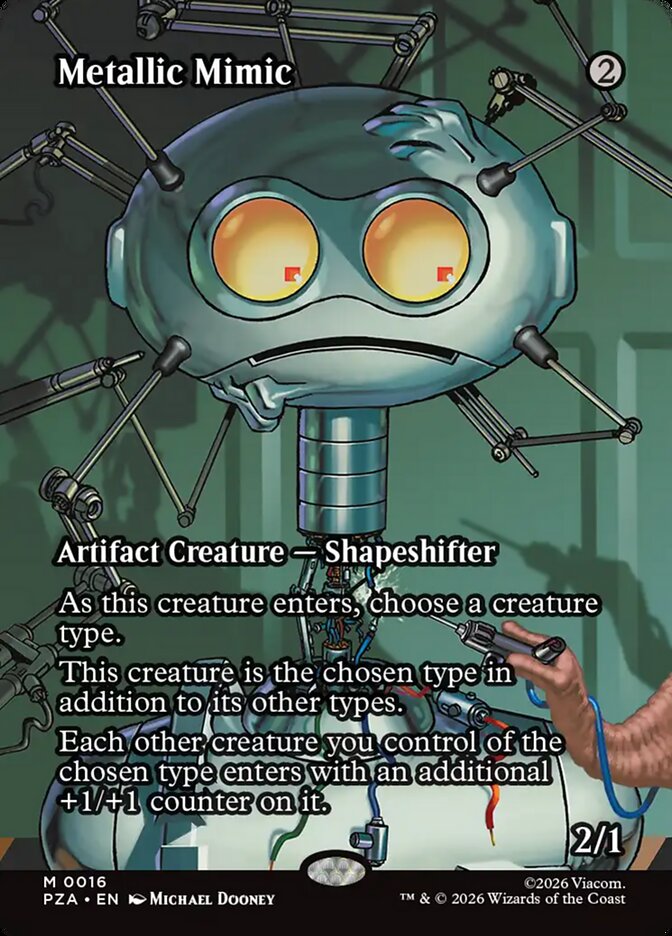
Rating: 6/10
If you have a lot of one creature type in your deck, which in TMT is likely to be either ninjas or mutants, then Metallic Mimic is going to slot right in. It’s awkward to draw this late, but the reverse scenario makes up for it: How powerful will it be if you get to play this on turn 2 and have most of your creatures be that much bigger for the trouble?
Donnie’s Bō (Shadowspear)
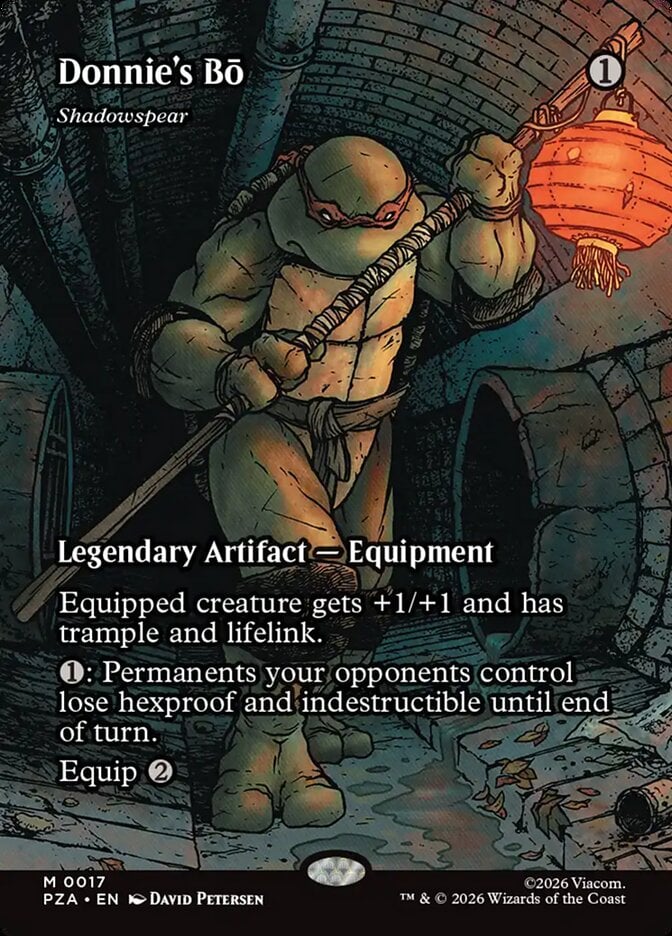
Rating: 7/10
The key to Shadowspear is the cheap cost for granting lifelink to any creature you play. Lifelink is one of the most powerful abilities in Limited, which makes this a very valuable equipment to have around. The +1/+1 and trample isn’t too bad, either.
Leo’s Katana (Sword of Sinew and Steel)
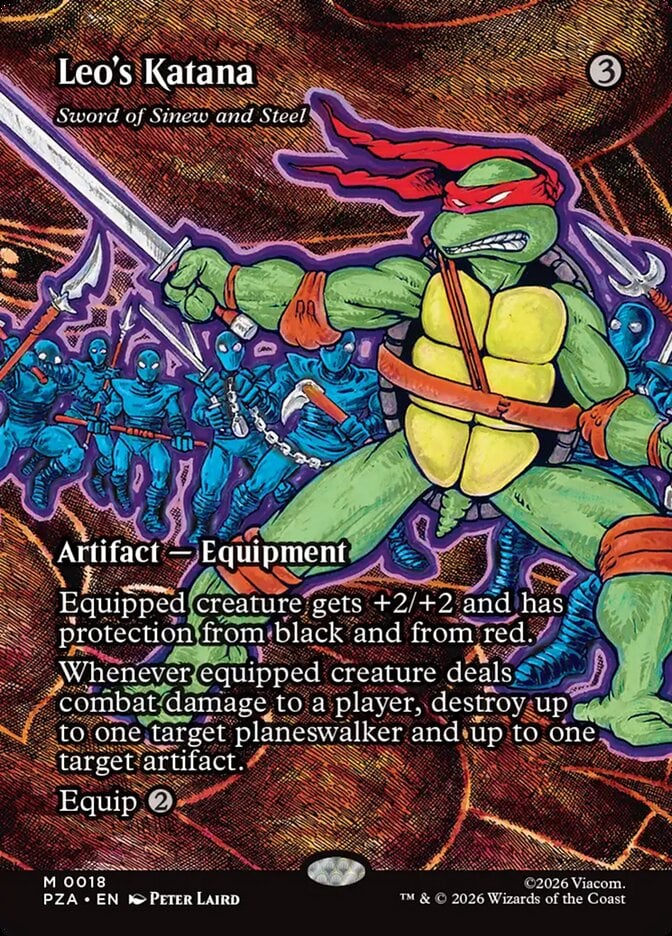
Rating: 7/10
It’s really quite funny to see this card here given that WotC have made functional reprints of existing cards just to remove references to planeswalkers, yet Sword of Sinew and Steel literally says “destroy target planeswalker”. The best part of this card is that it grants protection from red and black, the two strongest removal colors. Destroying an artifact is also a nice bonus, but we were already sold before we got to that.
Raph’s Jitte (Umezawa’s Jitte)
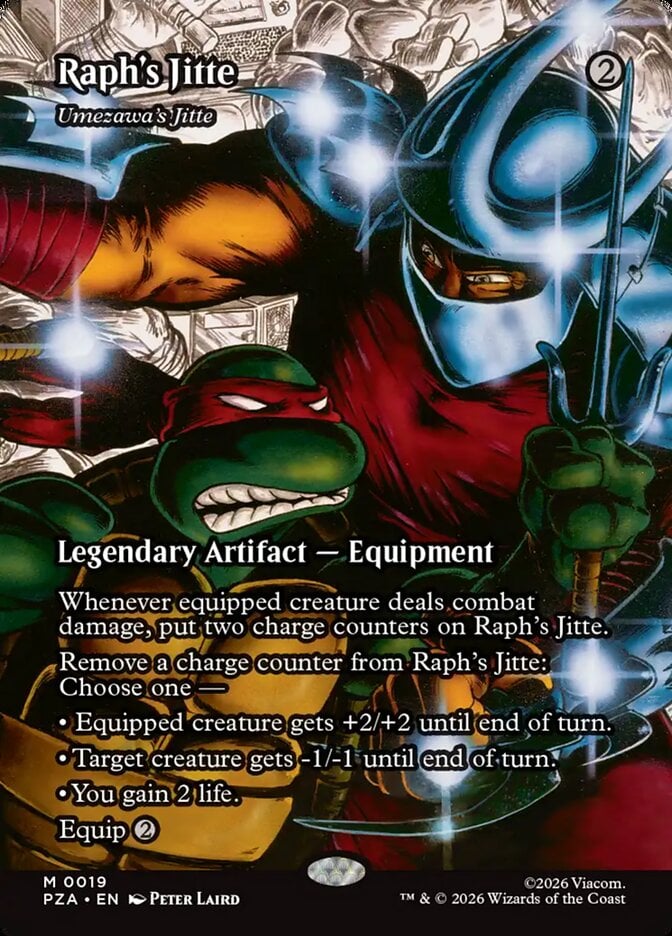
Rating: 11/10
Okay then, let’s talk about Umezawa's Jitte. This card is the single most broken Limited card in the history of this game. If you’ve never played with or against it, then it might be hard to appreciate just how powerful it is, but let me assure you that the rating I’ve given it is accurate.
First of all, it’s colorless, so it goes in literally every deck. It’s cheap to cast and to equip. It only requires the equipped creature to have dealt damage. Not damage to a player, just damage. Your opponent blocks? That’s fine, Jitte still charges itself. You can use those counters to make your creature too big to block effectively, at which point it would charge again, or just to kill creatures on the board. If your opponent can destroy it, you can just cash them in for some life.
Still unsure? I don’t blame you. When I first saw this card some 16 years ago, I smirked at it. Then I played it for myself and was gobsmacked at how powerful it was. Anyway, if you see this, take it, win your draft, thank me later.
Undercity Sewers
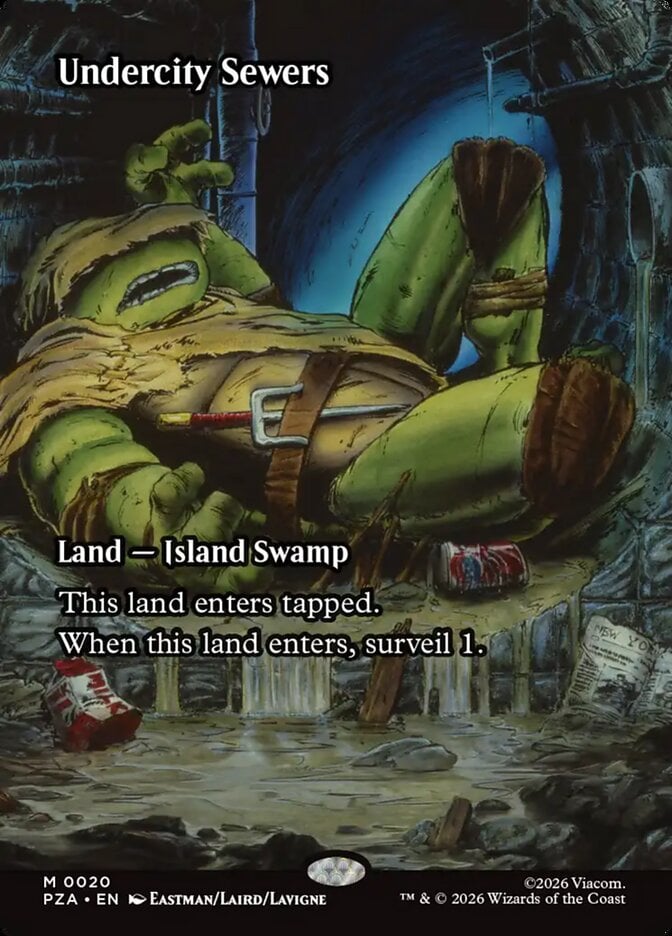
Rating: 4/10
Blue/black isn’t a supported color combination in this format, but Undercity Sewers can still be useful as a surveil land or to fix for a splash. Plus, it’s an expensive card, so you’ll probably take it for cash value.
Wrap Up
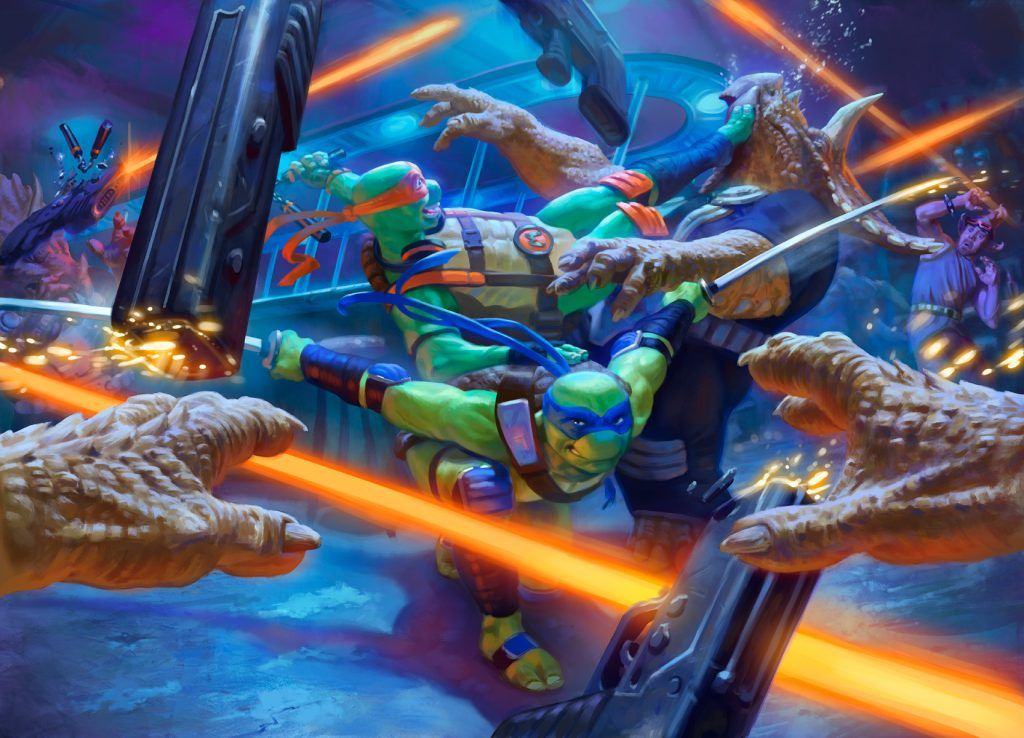
Mikey & Leo, Chaos & Order | Illustration by Jason Rainville
I’ve never been particularly interested in Teenage Mutant Ninja Turtles. This set however looks very good indeed. Despite being a small set, it hits a lot of the right notes for how a good Limited set should look, so I’m actually really excited to give it a go. I can’t wait for prerelease now!
If you liked this article, please follow us on X/Twitter @draftsim and join our Discord server, too. Share the article with your friends and help drive the conversation further.
Until next time, take care of yourselves!
Follow Draftsim for awesome articles and set updates:










7 Comments
Thanks for sharing, I love the MTG content of this page and the newsletter 🙂
Glad you enjoy it!
I think you might have missed an obvious synergy about Michelangelo, Improviser: Sneak naturally causes creatures to end up in your hand just in time for Michelangelo to trigger on combat damage and put them back onto the battlefield for free. This is especially true for his own Sneak — creature you return for it can come back right away.
Wow, did you miss the third ability of Leader’s Talent?
– Whenever you cast a spell, put a +1/+1 counter on each creature you control.
How is that “so minimal that you probably won’t want to prioritize them over other game actions”???
I do want to say – awesome review. THANK YOU!
I think the implication here is that you have to spend quite a bit of mana to get it to level 2 first, which doesn’t do much. Doubt the writer’s saying not to care about level 3, just to have that be something you work towards once you’re exhausted of other ways to spend your mana first, since levelling up to 2 is likely not worth it most turns.
But he also wrote: “you’re given the best ability on Leader’s Talent right away, so there’s barely any need to level it up”
I’d say the best ability is level 3 by far. So, that also makes me think he missed it. Yes, level 2 seems like a waste though.
Add Comment