HowtoHave
Difficult Conversations
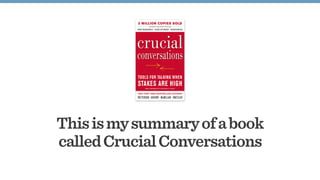
Thisismysummaryofabook
calledCrucialConversations
The single greatest problem in
communication is the illusion
that it had taken place.
“
– GEORGE BERNARD SHAW
Our lives begin to end the day
we become silent about things
that matter.
“
– MARTIN LUTHER KING JR.
A Crucial Conversation is:
• A discussion between two or more people where:
1. stakes are high
2. opinions vary, and
3. emotions run strong
• and the outcome greatly impacts their lives.
TheFool’sChoice:
Choosing between honesty and
keeping a friend
3 ways of handling crucial conversations:
• Avoid them
• Face them and handle them poorly
• Face them and handle them well
AskYourself:
How can I be 100% honest and
yet 100% respectful?
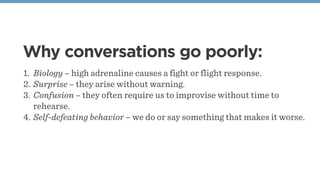
Why conversations go poorly:
1. Biology – high adrenaline causes a fight or flight response.
2. Surprise – they arise without warning.
3. Confusion – they often require us to improvise without time to
rehearse.
4. Self-defeating behavior – we do or say something that makes it worse.
Mastering Crucial Conversations:
ThePowerofDialogue
Dialogue: The free flow of meaning
between two people.
Pool of shared meaning (thoughts,
feelings, and experiences) needs to
grow
Successful dialogue results when
everyone feels safe to add their
meaning to the shared pool of
meaning
First principle of dialogue: start
with heart
Work on me first, us second
The problem is not that behavior
degenerates, it’s that motives do
Start with Heart:
HowtoStayFocusedon
WhatYouReallyWant
Start conversations with the right
motives, and stay focused. How?
1. Be smart when it comes to
knowing what you want. Don't
get distracted. 
2.Don't make fools choices. 
When feeling threatened, people
tend to create a new goal of
protecting themselves.
Protective behavior includes:
• Saving face
• Avoiding embarrassment
• Winning
• Being right
• Punishing others
Alternatively, we choose personal
safety (silence) over dialogue
Instead, focus on what you REALLY
want
Relax your body tension, take a
deep breath
"You know what? We need to talk
about this. I'm glad you asked the
question. Thank you for taking that
risk. I appreciate the trust that it
shows in me."
How can you move from anger to
gratitude when confronted during
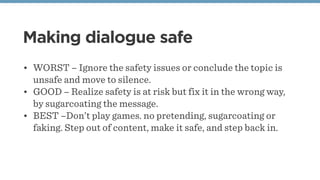
a conversation?
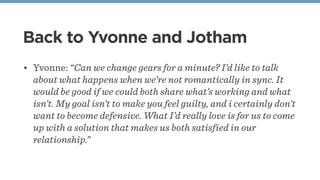
Here are the three steps to
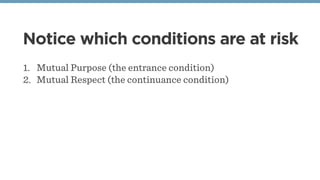
refocusing your brain
1. As you begin the discussion, start
by examining your motives. Ask
yourself what you really want. 
2. As the conversation moves
forward, pay attention to what's
happening to your objectives. Are
you starting to save face? Save
embarrassment? Win? Be right? Or
punish others?
Realize that our motives change
without us thinking about it. 
In order to move back to motives
that benefit dialogue, you MUST
step away from the conversation
and look at yourself like an
outsider.
Ask yourself: what am I doing? And
if I had to guess, what does it tell
me about my underlying motive?
3. Ask yourself:
- what do I really want for myself?
- what do I really want for others?
- what do I really want for my
relationship?
Then:
How would I behave if I really
wanted these results?
Why do this?
1. It reminds you of your goal
2. Asking yourself abstract, complex questions will literally pull
your body out of fight or flight mode
How to avoid the fools choice:
Turningeither/orintoand
1. Clarify what you really want
e.g. What I want is for my coworker to be more reliable. I'm
tired of being let down by them when they make
commitments that I depend on. 
2.Clarify what you really don't want
Think about what you're afraid will happen if you back
away from your current strategy of trying to win or stay
safe. What bad thing will happen?
e.g. To have a useless and heated conversation that creates
bad feelings and doesn't lead to change.
3.Present your brain with a more
complex problem
Combine the two into an and question.
e.g. How can I have a candid convo about #1 and avoid #2?
Learn to Look:
HowtoNoticeWhenSafety
IsaRisk
Watch for CONTENT (what) and
CONDITIONS (why) of the
conversation
The sooner you notice conditions
have changed, the sooner you can
change it
It takes knowledge and practice to
know what to look for, and then
actually see it
What do you look for?
1. The moment a conversation turns crucial
2. Signs that people don't feel safe: Silence or Violence
3. Your own style under stress
Spotting crucial conversations:
Notice physical signals
• Sweaty hands, dry mouth or eyes, loud heartbeat
Notice emotional signals
• Scared, hurt, angry
Notice behavioral signals
• Raising voice, pointing finger, getting quiet
Learn to look for safety problems
• Watch for signs that people are afraid
• Nothing kills the flow of meaning like fear
• Fear reduces your ability to see beyond yourself
• Pulling back from content and watching for fear opens your
ability to see
When it's safe, you can say
anything 
When you fear people aren't
buying into your ideas, you push
hard (fight)
When you fear harm, you become
silent (flight)
People feel unsafe because of the
conditions, not content, of a
conversation
There are TWO CONDITIONS
required for safety
People feel safe when they:
1. Believe the other person has their best interests at heart
(motives)
2. Respect the other person's opinion (ability)
Don't let safety problems lead
you astray:
• Others may attack you when their safety is at risk
• Recode silence and violence as signs that people are feeling
unsafe
SILENCE:
purposefully withholding
information from the dialogue
e.g.sarcasm,sugarcoating
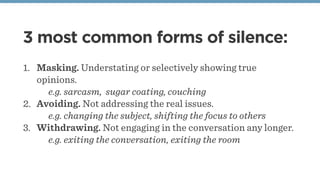
3 most common forms of silence:
1. Masking. Understating or selectively showing true
opinions.
e.g. sarcasm, sugar coating, couching
2. Avoiding. Not addressing the real issues.
e.g. changing the subject, shifting the focus to others
3. Withdrawing. Not engaging in the conversation any longer.
e.g. exiting the conversation, exiting the room
Masking. Understating or
selectively showing true opinions
e.g. sarcasm, sugar coating, couching
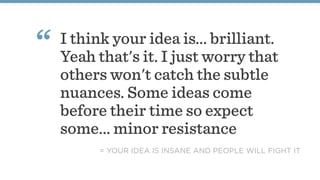
I think your idea is... brilliant.
Yeah that's it. I just worry that
others won't catch the subtle
nuances. Some ideas come
before their time so expect
some... minor resistance
“
= YOUR IDEA IS INSANE AND PEOPLE WILL FIGHT IT
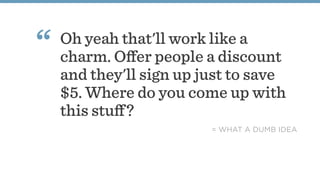
Oh yeah that'll work like a
charm. Offer people a discount
and they'll sign up just to save
$5. Where do you come up with
this stuff?
“
= WHAT A DUMB IDEA
Avoiding. Steering completely
away from sensitive subjects
e.g. changing the subject, shifting the focus to others
How was your blog post? Well,
you know, I thought it was
provocative.
“
= WHAT HAPPENED? DID YOU NOT DO ANY EDITING?
Speaking of ideas for cost
cutting, what if we bought less
office supplies? Or took people
out to lunch less?
“
= IF I OFFER TRIVIAL SUGGESTIONS, MAYBE WE CAN
AVOID SENSITIVE THINGS LIKE STAFF INEFFICIENCY 
Withdrawing. Pulling out of a
conversation altogether
e.g. exiting the conversation, exiting the room
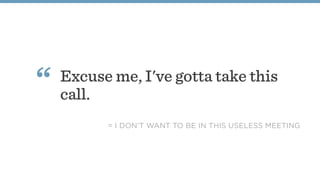
Excuse me, I've gotta take this
call.
“
= I DON'T WANT TO BE IN THIS USELESS MEETING
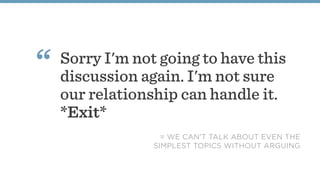
Sorry I'm not going to have this
discussion again. I'm not sure
our relationship can handle it.
*Exit*
“
= WE CAN'T TALK ABOUT EVEN THE
SIMPLEST TOPICS WITHOUT ARGUING
VIOLENCE:
convincing, controlling, or
compelling others to your
viewpoint
e.g.namecalling,monologuing,
makingthreats
3 most common forms of violence:
1. Controlling. Coercing others to your way of thinking.
e.g. cutting others off, overstating your facts, speaking in
absolutes, dominating the conversation
2. Labelling. Stereotyping or categorizing people.
e.g. name-calling, generalizing
3. Attacking. Making the other person suffer.
e.g. belittling, threatening
Controlling. Coercing others to
your way of thinking.
e.g. cutting others off, overstating your facts, speaking in
absolutes, dominating the conversation
There's not s person in the
world who haven't bought one
of these things. They're the
perfect gift.
“
= I CAN'T JUSTIFY SPENDING OUR HARD EARNED SAVINGS
ON THIS EXPENSIVE TOY, BUT I REALLY WANT IT
We tried their product, but it was
an absolute disaster. Everyone
knows they don’t really care
about the user and have the worst
customer service.
“
= I'M NOT CERTAIN OF THE REAL FACTS, SO I'LL USE
HYPERBOLE TO GET YOUR ATTENTION
Labelling. Stereotyping or
categorizing people.
e.g. name-calling, generalizing
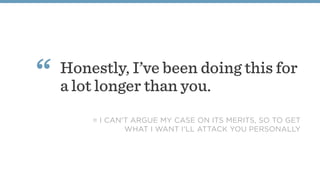
Honestly, I’ve been doing this for
a lot longer than you.
“
= I CAN'T ARGUE MY CASE ON ITS MERITS, SO TO GET
WHAT I WANT I'LL ATTACK YOU PERSONALLY
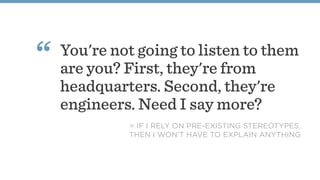
You're not going to listen to them
are you? First, they're from
headquarters. Second, they're
engineers. Need I say more?
“
= IF I RELY ON PRE-EXISTING STEREOTYPES,
THEN I WON’T HAVE TO EXPLAIN ANYTHING
Attacking. Making the other
person suffer.
e.g. belittling, threatening
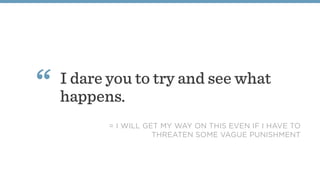
I dare you to try and see what
happens.
“
= I WILL GET MY WAY ON THIS EVEN IF I HAVE TO
THREATEN SOME VAGUE PUNISHMENT
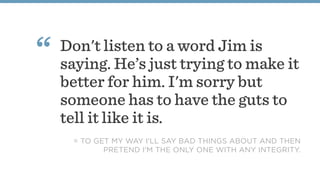
Don't listen to a word Jim is
saying. He’s just trying to make it
better for him. I'm sorry but
someone has to have the guts to
tell it like it is.
“
= TO GET MY WAY I'LL SAY BAD THINGS ABOUT AND THEN
PRETEND I'M THE ONLY ONE WITH ANY INTEGRITY. 
Look for your Style Under Stress
This is the hardest thing to
monitor during a conversation
What's your style under stress?
Take the survey:
www.vitalsmarts.com/styleunderstress
Make It Safe:
How to Make It Safe to Talk
About Almost Anything
Step out of the content of the
conversation, make it safe, then
step back in
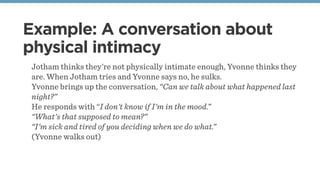
Example: A conversation about
physical intimacy
Jotham thinks they’re not physically intimate enough, Yvonne thinks they
are. When Jotham tries and Yvonne says no, he sulks.
Yvonne brings up the conversation, “Can we talk about what happened last
night?”
He responds with “I don't know if I'm in the mood.”
“What's that supposed to mean?”
“I'm sick and tired of you deciding when we do what.”
(Yvonne walks out)
Jotham thinks they’re not physically intimate enough, Yvonne thinks they
are. When Jotham tries and Yvonne says no, he sulks.
Yvonne brings up the conversation, “Can we talk about what happened last
night?”
He responds with “I don't know if I'm in the mood.”
“What's that supposed to mean?”
“I'm sick and tired of you deciding when we do what.”
(Yvonne walks out)
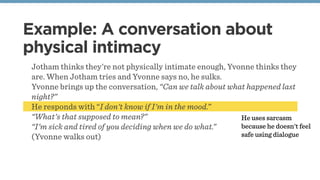
Example: A conversation about
physical intimacy
He uses sarcasm
because he doesn't feel
safe using dialogue
If you really want to have a healthy
conversation that may make or
break your relationship, then you
may have to set aside confronting
the sarcasm for a moment
Making dialogue safe
• WORST – Ignore the safety issues or conclude the topic is
unsafe and move to silence.
• GOOD – Realize safety is at risk but fix it in the wrong way,
by sugarcoating the message.
• BEST –Don’t play games. no pretending, sugarcoating or
faking. Step out of content, make it safe, and step back in.
Back to Yvonne and Jotham
• Yvonne: “Can we change gears for a minute? I’d like to talk
about what happens when we’re not romantically in sync. It
would be good if we could both share what’s working and what
isn’t. My goal isn’t to make you feel guilty, and i certainly don’t
want to become defensive. What I’d really love is for us to come
up with a solution that makes us both satisfied in our
relationship.”
Notice which conditions are at risk
1. Mutual Purpose (the entrance condition)
2. Mutual Respect (the continuance condition)
Mutual Purpose
(the entrance condition)
Crucial conversations often go
awry because the CONTENT
suggests a malicious INTENT
Mutual Purpose means:
• Others perceive that you’re working towards a common
outcome in a conversation.
• That you care about their goals, interests, and values (and
vice versa, you believe they care about yours).
Mutual purpose is the entry
condition of dialogue
Watch for signs that mutual
purpose is at risk:
• end up in debate
• defensiveness
• hidden agendas
• accusations
• circling back to the same topic
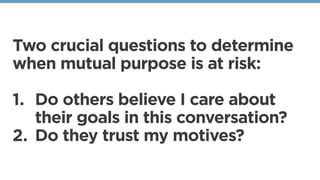
Two crucial questions to determine
when mutual purpose is at risk:
1. Do others believe I care about
their goals in this conversation?
2. Do they trust my motives?
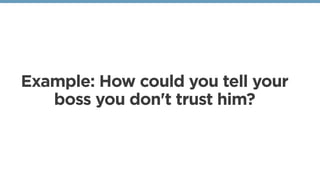
Example: How could you tell your
boss you don't trust him?
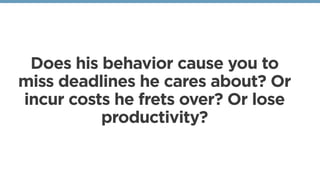
Does his behavior cause you to
miss deadlines he cares about? Or
incur costs he frets over? Or lose
productivity?
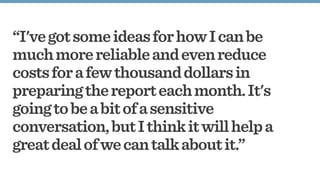
“I'vegotsomeideasforhowIcanbe
muchmorereliableandevenreduce
costsforafewthousanddollarsin
preparingthereporteachmonth.It's
goingtobeabitofasensitive
conversation,butIthinkitwillhelpa
greatdealofwecantalkaboutit.”
Mutual Respect
the continuance condition)
Will we be able to remain in
dialogue?
The instance people perceive
disrespect in a conversation, the
interaction is no longer about
mutual purpose. It's about dignity. 
To tell if respect has been
violated, watch for signs people
are defending their dignity:
• Highly charged emotions (fear to anger)
Ask yourself: Do others believe I
respect them?
How can I respect people I don't
respect?
• Different backgrounds
• Someone has let you down repeatedly
• Etc

How to Have Difficult Conversations

  • 1.
  • 2.
  • 3.
    The single greatestproblem in communication is the illusion that it had taken place. “ – GEORGE BERNARD SHAW
  • 4.
    Our lives beginto end the day we become silent about things that matter. “ – MARTIN LUTHER KING JR.
  • 5.
    A Crucial Conversationis: • A discussion between two or more people where: 1. stakes are high 2. opinions vary, and 3. emotions run strong • and the outcome greatly impacts their lives.
  • 6.
  • 7.
    3 ways ofhandling crucial conversations: • Avoid them • Face them and handle them poorly • Face them and handle them well
  • 8.
    AskYourself: How can Ibe 100% honest and yet 100% respectful?
  • 9.
    Why conversations gopoorly: 1. Biology – high adrenaline causes a fight or flight response. 2. Surprise – they arise without warning. 3. Confusion – they often require us to improvise without time to rehearse. 4. Self-defeating behavior – we do or say something that makes it worse.
  • 10.
  • 11.
    Dialogue: The freeflow of meaning between two people.
  • 12.
    Pool of sharedmeaning (thoughts, feelings, and experiences) needs to grow
  • 13.
    Successful dialogue resultswhen everyone feels safe to add their meaning to the shared pool of meaning
  • 14.
    First principle ofdialogue: start with heart Work on me first, us second
  • 15.
    The problem isnot that behavior degenerates, it’s that motives do
  • 16.
  • 17.
    Start conversations withthe right motives, and stay focused. How?
  • 18.
    1. Be smartwhen it comes to knowing what you want. Don't get distracted.  2.Don't make fools choices. 
  • 19.
    When feeling threatened,people tend to create a new goal of protecting themselves.
  • 20.
    Protective behavior includes: •Saving face • Avoiding embarrassment • Winning • Being right • Punishing others
  • 21.
    Alternatively, we choosepersonal safety (silence) over dialogue
  • 22.
    Instead, focus onwhat you REALLY want
  • 23.
    Relax your bodytension, take a deep breath
  • 24.
    "You know what?We need to talk about this. I'm glad you asked the question. Thank you for taking that risk. I appreciate the trust that it shows in me."
  • 25.
    How can youmove from anger to gratitude when confronted during a conversation?
  • 26.
    Here are thethree steps to refocusing your brain
  • 27.
    1. As youbegin the discussion, start by examining your motives. Ask yourself what you really want. 
  • 28.
    2. As theconversation moves forward, pay attention to what's happening to your objectives. Are you starting to save face? Save embarrassment? Win? Be right? Or punish others?
  • 29.
    Realize that ourmotives change without us thinking about it. 
  • 30.
    In order tomove back to motives that benefit dialogue, you MUST step away from the conversation and look at yourself like an outsider.
  • 31.
    Ask yourself: whatam I doing? And if I had to guess, what does it tell me about my underlying motive?
  • 32.
    3. Ask yourself: -what do I really want for myself? - what do I really want for others? - what do I really want for my relationship?
  • 33.
    Then: How would Ibehave if I really wanted these results?
  • 34.
    Why do this? 1.It reminds you of your goal 2. Asking yourself abstract, complex questions will literally pull your body out of fight or flight mode
  • 35.
    How to avoidthe fools choice: Turningeither/orintoand
  • 36.
    1. Clarify whatyou really want e.g. What I want is for my coworker to be more reliable. I'm tired of being let down by them when they make commitments that I depend on. 
  • 37.
    2.Clarify what youreally don't want Think about what you're afraid will happen if you back away from your current strategy of trying to win or stay safe. What bad thing will happen? e.g. To have a useless and heated conversation that creates bad feelings and doesn't lead to change.
  • 38.
    3.Present your brainwith a more complex problem Combine the two into an and question. e.g. How can I have a candid convo about #1 and avoid #2?
  • 39.
  • 40.
    Watch for CONTENT(what) and CONDITIONS (why) of the conversation
  • 41.
    The sooner younotice conditions have changed, the sooner you can change it
  • 42.
    It takes knowledgeand practice to know what to look for, and then actually see it
  • 43.
    What do youlook for? 1. The moment a conversation turns crucial 2. Signs that people don't feel safe: Silence or Violence 3. Your own style under stress
  • 44.
    Spotting crucial conversations: Noticephysical signals • Sweaty hands, dry mouth or eyes, loud heartbeat Notice emotional signals • Scared, hurt, angry Notice behavioral signals • Raising voice, pointing finger, getting quiet
  • 45.
    Learn to lookfor safety problems • Watch for signs that people are afraid • Nothing kills the flow of meaning like fear • Fear reduces your ability to see beyond yourself • Pulling back from content and watching for fear opens your ability to see
  • 46.
    When it's safe,you can say anything 
  • 47.
    When you fearpeople aren't buying into your ideas, you push hard (fight)
  • 48.
    When you fearharm, you become silent (flight)
  • 49.
    People feel unsafebecause of the conditions, not content, of a conversation
  • 50.
    There are TWOCONDITIONS required for safety
  • 51.
    People feel safewhen they: 1. Believe the other person has their best interests at heart (motives) 2. Respect the other person's opinion (ability)
  • 52.
    Don't let safetyproblems lead you astray: • Others may attack you when their safety is at risk • Recode silence and violence as signs that people are feeling unsafe
  • 53.
    SILENCE: purposefully withholding information fromthe dialogue e.g.sarcasm,sugarcoating
  • 54.
    3 most commonforms of silence: 1. Masking. Understating or selectively showing true opinions. e.g. sarcasm, sugar coating, couching 2. Avoiding. Not addressing the real issues. e.g. changing the subject, shifting the focus to others 3. Withdrawing. Not engaging in the conversation any longer. e.g. exiting the conversation, exiting the room
  • 55.
    Masking. Understating or selectivelyshowing true opinions e.g. sarcasm, sugar coating, couching
  • 56.
    I think youridea is... brilliant. Yeah that's it. I just worry that others won't catch the subtle nuances. Some ideas come before their time so expect some... minor resistance “ = YOUR IDEA IS INSANE AND PEOPLE WILL FIGHT IT
  • 57.
    Oh yeah that'llwork like a charm. Offer people a discount and they'll sign up just to save $5. Where do you come up with this stuff? “ = WHAT A DUMB IDEA
  • 58.
    Avoiding. Steering completely awayfrom sensitive subjects e.g. changing the subject, shifting the focus to others
  • 59.
    How was yourblog post? Well, you know, I thought it was provocative. “ = WHAT HAPPENED? DID YOU NOT DO ANY EDITING?
  • 60.
    Speaking of ideasfor cost cutting, what if we bought less office supplies? Or took people out to lunch less? “ = IF I OFFER TRIVIAL SUGGESTIONS, MAYBE WE CAN AVOID SENSITIVE THINGS LIKE STAFF INEFFICIENCY 
  • 61.
    Withdrawing. Pulling outof a conversation altogether e.g. exiting the conversation, exiting the room
  • 62.
    Excuse me, I'vegotta take this call. “ = I DON'T WANT TO BE IN THIS USELESS MEETING
  • 63.
    Sorry I'm notgoing to have this discussion again. I'm not sure our relationship can handle it. *Exit* “ = WE CAN'T TALK ABOUT EVEN THE SIMPLEST TOPICS WITHOUT ARGUING
  • 64.
    VIOLENCE: convincing, controlling, or compellingothers to your viewpoint e.g.namecalling,monologuing, makingthreats
  • 65.
    3 most commonforms of violence: 1. Controlling. Coercing others to your way of thinking. e.g. cutting others off, overstating your facts, speaking in absolutes, dominating the conversation 2. Labelling. Stereotyping or categorizing people. e.g. name-calling, generalizing 3. Attacking. Making the other person suffer. e.g. belittling, threatening
  • 66.
    Controlling. Coercing othersto your way of thinking. e.g. cutting others off, overstating your facts, speaking in absolutes, dominating the conversation
  • 67.
    There's not sperson in the world who haven't bought one of these things. They're the perfect gift. “ = I CAN'T JUSTIFY SPENDING OUR HARD EARNED SAVINGS ON THIS EXPENSIVE TOY, BUT I REALLY WANT IT
  • 68.
    We tried theirproduct, but it was an absolute disaster. Everyone knows they don’t really care about the user and have the worst customer service. “ = I'M NOT CERTAIN OF THE REAL FACTS, SO I'LL USE HYPERBOLE TO GET YOUR ATTENTION
  • 69.
    Labelling. Stereotyping or categorizingpeople. e.g. name-calling, generalizing
  • 70.
    Honestly, I’ve beendoing this for a lot longer than you. “ = I CAN'T ARGUE MY CASE ON ITS MERITS, SO TO GET WHAT I WANT I'LL ATTACK YOU PERSONALLY
  • 71.
    You're not goingto listen to them are you? First, they're from headquarters. Second, they're engineers. Need I say more? “ = IF I RELY ON PRE-EXISTING STEREOTYPES, THEN I WON’T HAVE TO EXPLAIN ANYTHING
  • 72.
    Attacking. Making theother person suffer. e.g. belittling, threatening
  • 73.
    I dare youto try and see what happens. “ = I WILL GET MY WAY ON THIS EVEN IF I HAVE TO THREATEN SOME VAGUE PUNISHMENT
  • 74.
    Don't listen toa word Jim is saying. He’s just trying to make it better for him. I'm sorry but someone has to have the guts to tell it like it is. “ = TO GET MY WAY I'LL SAY BAD THINGS ABOUT AND THEN PRETEND I'M THE ONLY ONE WITH ANY INTEGRITY. 
  • 75.
    Look for yourStyle Under Stress
  • 76.
    This is thehardest thing to monitor during a conversation
  • 77.
    What's your styleunder stress? Take the survey: www.vitalsmarts.com/styleunderstress
  • 78.
  • 79.
    Step out ofthe content of the conversation, make it safe, then step back in
  • 80.
    Example: A conversationabout physical intimacy Jotham thinks they’re not physically intimate enough, Yvonne thinks they are. When Jotham tries and Yvonne says no, he sulks. Yvonne brings up the conversation, “Can we talk about what happened last night?” He responds with “I don't know if I'm in the mood.” “What's that supposed to mean?” “I'm sick and tired of you deciding when we do what.” (Yvonne walks out)
  • 81.
    Jotham thinks they’renot physically intimate enough, Yvonne thinks they are. When Jotham tries and Yvonne says no, he sulks. Yvonne brings up the conversation, “Can we talk about what happened last night?” He responds with “I don't know if I'm in the mood.” “What's that supposed to mean?” “I'm sick and tired of you deciding when we do what.” (Yvonne walks out) Example: A conversation about physical intimacy He uses sarcasm because he doesn't feel safe using dialogue
  • 82.
    If you reallywant to have a healthy conversation that may make or break your relationship, then you may have to set aside confronting the sarcasm for a moment
  • 83.
    Making dialogue safe •WORST – Ignore the safety issues or conclude the topic is unsafe and move to silence. • GOOD – Realize safety is at risk but fix it in the wrong way, by sugarcoating the message. • BEST –Don’t play games. no pretending, sugarcoating or faking. Step out of content, make it safe, and step back in.
  • 84.
    Back to Yvonneand Jotham • Yvonne: “Can we change gears for a minute? I’d like to talk about what happens when we’re not romantically in sync. It would be good if we could both share what’s working and what isn’t. My goal isn’t to make you feel guilty, and i certainly don’t want to become defensive. What I’d really love is for us to come up with a solution that makes us both satisfied in our relationship.”
  • 85.
    Notice which conditionsare at risk 1. Mutual Purpose (the entrance condition) 2. Mutual Respect (the continuance condition)
  • 86.
  • 87.
    Crucial conversations oftengo awry because the CONTENT suggests a malicious INTENT
  • 88.
    Mutual Purpose means: •Others perceive that you’re working towards a common outcome in a conversation. • That you care about their goals, interests, and values (and vice versa, you believe they care about yours).
  • 89.
    Mutual purpose isthe entry condition of dialogue
  • 90.
    Watch for signsthat mutual purpose is at risk: • end up in debate • defensiveness • hidden agendas • accusations • circling back to the same topic
  • 91.
    Two crucial questionsto determine when mutual purpose is at risk: 1. Do others believe I care about their goals in this conversation? 2. Do they trust my motives?
  • 92.
    Example: How couldyou tell your boss you don't trust him?
  • 93.
    Does his behaviorcause you to miss deadlines he cares about? Or incur costs he frets over? Or lose productivity?
  • 94.
  • 95.
  • 96.
    Will we beable to remain in dialogue?
  • 97.
    The instance peopleperceive disrespect in a conversation, the interaction is no longer about mutual purpose. It's about dignity. 
  • 98.
    To tell ifrespect has been violated, watch for signs people are defending their dignity: • Highly charged emotions (fear to anger)
  • 99.
    Ask yourself: Doothers believe I respect them?
  • 100.
    How can Irespect people I don't respect? • Different backgrounds • Someone has let you down repeatedly • Etc