Showing posts with label Bill Graham. Show all posts

Friday, March 25, 2022

May 27, 1973 Ontario Motor Speedway, Ontario, CA: Allman Brothers Band/Grateful Dead/Waylon Jennings (What Might Have Been)

Image

May 27, 1973 Ontario Motor Speedway, Ontario, CA: Allman Brothers Band/Grateful Dead/Waylon Jennings/Jerry Jeff Walker (Sunday) Bill Graham Presents--canceled
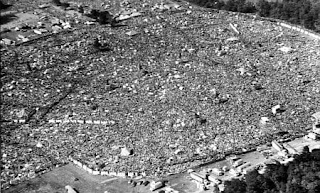
The biggest rock concert in American History was the "Summer Jam" at Watkins Glen Grand Prix Racecourse in Watkins Glen, NY, where 600,000 fans saw the Allman Brothers Band, the Grateful Dead and The Band perform on July 28, 1973. Three-quarters of those fans got in for free, however, as the crowd overwhelmed the fences. The highest paid attendance at any concert was the next Spring, at Ontario Motor Speedway in Ontario, CA, 35 miles East of Los Angeles on April 6, 1974. 200,000 or more fans fans, at least 168,000 of whom paid, saw Emerson, Lake and Palmer, Deep Purple and The Eagles headline over a slew of other popular bands.

Yet on Memorial Day weekend in 1973, on Sunday May 27, Bill Graham Presents had booked the Grateful Dead and the Allman Brothers at the Ontario Motor Speedway. It would have been the first show at the Speedway, and the first time the Dead and the Allmans had been booked together since the Fillmore East in 1970. The show was abruptly canceled, almost certainly due to tepid ticket sales. Yet the paired booking and the venue would prove to be the biggest winners in the history of rock. What happened? 

This post will review what we can determine about Bill Graham's grand plans for the Ontario Motor Speedway on May 27, 1973, and why he was too early.

Image
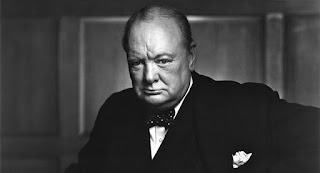
Winston Churchill ca. 1946

Winston Churchill was famously reputed to have said of his decisions in World War 2 that "History will be kind to me, as I intend to write it." It is largely forgotten now that the perpetually-broke Churchill made his living as a best-selling author of history books, so this was no casual assertion. [For the record, Churchill's actual quote was "For my part, I consider that it will be found much better by all Parties to leave the past to history, especially as I propose to write that history"]. Giant figures in rock music, notably Bill Graham, implicitly took Churchill's adage to heart. Graham is widely viewed as the greatest rock concert promoter in the 20th century, a view widely promulgated by Bill Graham. It isn't untrue, by the way--it's just that Bill made sure that the entire rock world heard his version of events first and loudest.

Bill Graham's modern twist on Churchill, however, was not as an author but as an interview subject. Graham gave more interviews than perhaps all rock promoters put together, always had a great story, told them well, and never told a provable lie. Sure, sometimes he favored his own interpretation of events. Every journalist and rock star biographer told Bill Graham's version of the story, and the very best of Graham's practices and innovations--and there were many, to be sure--took front and center, cementing Graham's legacy forever. Rock History was indeed kind to Bill Graham, but he was instrumental in the composition of that history.

In the Spring of 1973, Bill Graham took a big swing in the Southern California rock market, planning to put on the biggest concert in regional history. He struck out, massively. He never mentioned the event again, not in a meaningful way, and the story disappeared. In retrospect, Bill actually looks pretty good: he was absolutely right about everything, but he was just a little bit early. But that wasn't the story he wanted to tell, so he didn't tell it. Only the bare outlines remain.

Image

Rock Festivals and Major Rock Venues: Status Report early 1974

Rock Festivals were a product of the 1960s. Gina Arnold's excellent 2018 book Half A Million Strong (University of Iowa Press) tracks how "free shows in the park" evolved into "giant multi-day events in some farmer's muddy field" over the course of a few years (yes, she's my sister but you should still read it). By the time of the biggest festivals of 1969 and 1970, most famously Woodstock, hundreds of thousands of people would come to some outlying area and camp out for several days, while live rock music blasted 24/7. Legendary as these events were, most fans did not attend more than one giant event, and most communities that endured a huge rock festival did not tolerate a second one.

The live rock music business got bigger every year, and various efforts were tried to find a way to have "festival" events on a large scale. Multi-act events were appealing to promoters because they inherently hedged risk in a volatile music market. Since shows had to be planned many months in advance, it was hard to anticipate how one band might have a breakout hit, and how another may have become over the hill, or even broken up, in the few short months between booking the show and playing it. In early 1969, for example, Led Zeppelin found themselves playing tiny auditoriums, sometimes as the opening act, with their debut album roaring up the charts, while at the same time Vanilla Fudge found themselves no longer the draw they had been the year before. A rock festival, with dozens of acts over a few days, could more easily absorb the hits and misses. Promoters continued to search for a way to book multiple acts profitably.
Image
An aerial shot of the Watkins Glen Grand Prix Course on July 28, 1973, with some of the 600,000 fans in attendance at the Allman Brothers/Grateful Dead/Band rock concert

Rock Concerts at Auto Racing Tracks
The immediate and vast popularity of rock festivals posed a very specific land-use problem. Places like Indian Reservations and farms were not really viable for major, multi-day events, since too many things could go wrong. Equally importantly, despite or because of the increasing crowds, it was all but inevitable that rock festivals would become "free concerts." Liberating as this may have seemed at the time, it ensured that the events could not make enough money to provide a safe, repeatable event for bands, patrons and host communities. The financial opportunities of rock festivals were huge, however, and since nothing says "rock and roll" like "land use," over the years there was a concerted effort in the concert industry to find spaces that could successfully and profitably host occasional, loud outdoor events with giant crowds.

One of the intriguing solutions for hosting giant rock festivals was to use facilities designed for auto racing. Race tracks were usually somewhat removed from urban areas while still being near enough to civilization to attract a crowd. Auto races themselves were noisy, and major race events tended to occur just a few times a year and last an entire weekend, just like a rock festival. Since race tracks were permanent facilities, they generally had fences, bathrooms, water, power and parking, so in many ways they would seem like ideal venues for huge rock events. Indeed, some of the major rock events of the 1969 and the 1970s were held at race tracks. 

Image

Two of the most successful rock festivals were held at Dallas International Speedway and Atlanta International Raceway, both organized in 1969 by promoter Alex Cooley. Both tracks were giant NASCAR "super-speedway" ovals.  The Rolling Stones' debacle at tiny Altamont Speedway might not have happened had it been held at its original site, the newly-opened Sonoma Raceway, then a newly opened Road Course in rural Sonoma County, near the San Francisco Bay. 

I looked at some of the history and economic dynamics of Auto Racing tracks as Rock Concert sites in another post, although for purposes of scale I focused on the Grateful Dead. Generally speaking, while auto racing had been popular since the invention of the automobile, horse racing had been hugely popular in cities and county fairs throughout the United States, long before cars were invented. However, after WW2, when the GIs returned and economy boomed, America moved from its rural roots to a more urban and suburban universe, and the automobile became a more important part of everyone's life. A national boom in the popularity of auto racing corresponded with a slow decline in the popularity of horse racing. 

By the early 1960s, numerous custom-built facilities served the hugely popular auto racing industry, with oval tracks (for NASCAR and "Indianapolis" cars in the South and Midwest), road courses (for sports cars on both coasts) and dragstrips (nationwide). These facilities were actually ready-made for rock concerts, but there were some huge cultural divides. With a middle-class family audience for auto races, and their Dow Industrial sponsorship from major companies, racetrack promoters were neither tuned into nor inclined to sponsor long-haired outlaw rock concert events flaunting nudity and drugs. 
Image
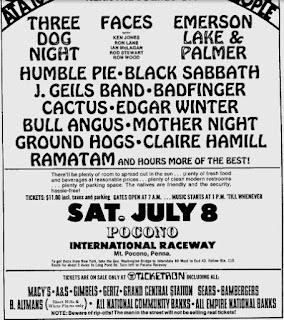
On July 8, 1972, Concert 10 presented a multi-act rock show at Pocono International Raceway in Long Pond, PA. Due to a huge rainstorm, the headliners did not appear until the dawn hours of July 9. The fine print says "the natives are friendly and the security, hassle-free"

Rock Concert Economics: 1973

In 1973, there was a huge audience for live rock music, but that audience was young, and without much ready cash. Also, since rock music stood for "rebellion," the most popular of rock music attractions were vulnerable to the complaint that they were charging "too much" for tickets. The inevitable result of these pressures was that popular rock bands put on concerts in larger and larger venues, instead of charging more at smaller places. By 1973, the most popular bands were selling out basketball arenas with capacities of 12,000 or more, even in so-called "secondary" markets. Ticket prices were reasonable, around 4 or 5 dollars usually, but the total number of tickets sold was larger than ever.

By the early 70s, multi-act "Festival" shows had mostly been financial debacles and public relations disaster, and it wasn't just Altamont: check out the saga of the "Erie Canal Soda Pop Festival" in Griffin, Indiana on Labor Day weekend of 1972. Smart promoters were looking for other workable venues, and race tracks re-appeared on the horizon. An interesting thing to consider about auto racing was that--because of the noise--they had to generally be well outside any populated areas, but still within driving distance of a lot of potential fans. At the same time, since fans had to drive a fair amount, a race track generally offered a whole slew of races during a weekend at the track, not just a headline race. These economics pretty much defined multi-act rock concerts, just for a different, younger fan base.

On July 8, 1972 there had been a huge multi-act rock festival at Pocono Raceway in Pennsylvania. Pocono Speedway, in rural Long Pond, was nonetheless in driving distance for a huge population of teenagers in greater Pennsylvania and parts of Northern New Jersey. Pocono Raceway was less than an hour from Scranton, Allentown and Nazareth, and about 90 minutes from the suburbs of Philadelphia and Newark. There was a huge population of suburban rock fans with access to their parent's cars. 120,000 fans showed up to see Emerson, Lake and Palmer, Faces, Humble Pie, Three Dog Night and and numerous other bands, completely overwhelming the facility. The interest was there.

The parallel development at this time was rock concerts at football or baseball stadiums, full-size major league ones. There had been experiments with stadiums going back to the Beatles, but they had been unsatisfactory. The live rock music audience had gotten bigger, however, and sound systems had improved as well. The first "modern" rock concerts at football stadiums were on May 4 and 5, 1973, when Concerts West hsd produced Led Zeppelin shows at Tampa Stadium and also at Fulton County Stadium in Atlanta. Upwards of 40,000 fans attended each concert. All fans bought tickets, too, setting paid attendance records at the time for such venues. Uniquely, Led Zeppelin were the only act for both shows, with no opening bands. 

The rock market was finding new mega-venues, and Bill Graham wasn't going to be left out. Graham was a self-promoter, yes, but he thought big--he was going to break in two mega-venues of his own, one at home in the Bay Area and the other down in Southern California.

Image

Bill Graham was the king of concert production in San Francisco, but he had only occasionally put on shows in Los Angeles. Southern California did not have a dominant promoter, however, so there was still room for Bill to operate. To do that, however, he needed to make a splash, and to make a splash he needed a place. It looked like that place was the Ontario Motor Speedway, an innovative and newly constructed auto racing track that had only opened for full-time racing in Summer 1970. 

The city of Ontario, CA, had been founded in 1891, and named by transplanted Canadians. Ontario is 35 miles East of Los Angeles, and 23 miles South of San Bernardino. Part of San Bernardino County, it is on the Western Edge of the proverbial Inland Empire. Ontario had been the site of a World War 2 Army Air Force Base, which remained an Air National Guard base after the war (and would remain so through 1995). The airport had also been established for civilian use in 1946 as Ontario International Airport. The Airport was joined to LAX in 1967, and jet flights had begun at the airport in 1968. Although Ontario only had a population of 64,118 in the 1970 census, as a result of the airport and the airbase it was at the nexus of a substantial freeway network. I-10 and I-15 met at Ontario Airport, so all of Southern California could get there easily.

Auto racing was booming in the 1960s, yet Los Angeles was underserved by facilities. Yes, there was the epic Riverside Raceway, another 25 miles East, but that made it even farther from LA proper. More importantly, Riverside was just a road racing facility--albeit a great one--and that limited the types of major events that could be held there. Ontario Motor Speedway was conceived as a full-service answer to every auto racing sector in the Los Angeles area, in a location near the city. The airport location was crucial, too, since major auto racing teams barnstormed around the country like touring rock bands, and drivers and even their race cars were often flying directly from track to track. 

Ontario Motor Speedway was custom built to provide first class facilities for all the major types of racing: an oval for NASCAR and Indianapolis cars, a road course (that included part of the oval) for road racing and a dragstrip. Besides advanced pit facilities, OMS also pioneered what we now call "clubhouses" and "luxury suites" for sponsors. It was a well-conceived endeavor. The plan was to have not only top level NASCAR and USAC (Indy Car) 500-mile races, but Formula 1 and NHRA Drag racing. The inaugural race was the (Indy Car) California 500 on September 6, 1970, with paid attendance of 178,000, a huge crowd even by auto racing standards. Jim McElreath beat out an All-Star field of drivers that included Mario Andretti, A. J. Foyt, Dan Gurney and the Unser brothers.
Image
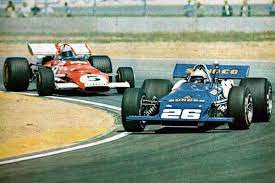
Mario Andretti (5) in a Ferrari 312B F1 car, about to lap Mark Donohue (26) in a Lola-T192 Chevy F5000 car. Andretti would win the Questor Grand Prix, the only F1 race at Ontario Motor Speedway, on March 28, 1971

After a hugely successful opening, however, Ontario Motor Speedway had a number of events in 1971 and '72 that did not live up to financial expectations. The racing was great--it was the early 70s--but after the September '70 opening, the Speedway didn't catch LA like it should. The big plan was that Ontario would host a 2nd United States Grand Prix, which hitherto had been the exclusive province of Watkins Glen in New York. As a prelude, Ontario Motor Speedway held a non-Championship Formula 1 race, the Questor Grand Prix, on March 28, 1971, won by Mario Andretti in a Ferrari 312B. The event was a financial bust, however, and Formula 1 cars never ran at Ontario again (ultimately Long Beach, CA, would get the second US Grand Prix). Although 1971 went alright, the 1972 Ontario attendance, despite great racing, were a financial letdown. Thus by 1973, Ontario Motor Speedway would have been open to the possibility of different promotions. 
Image
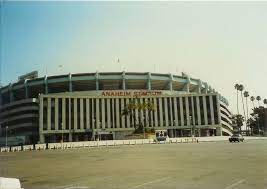
Anaheim Stadium, Anaheim, CA July 10, 1973

Southern California Stadiums
There were plenty of stadiums in Southern California, but none of them were particularly ripe for rock concert promoters. Dodger Stadium was under the full control of the Dodgers, and they didn't share it. The Los Angeles Coliseum was old (opened 1921) and in and was near "undesirable" (read: "too African-American") neighborhoods. The Rose Bowl, in Pasadena, had access and parking issues. That left Anaheim Stadium, in Orange County. But it was just across the road from Disneyland, and The Mouse would not want weekend parking disrupted by hordes of young rock fans. In fact, starting around 1976, Anaheim Stadium would become the primary home of stadium rock concerts in Southern California, with the full cooperation of Disneyland, but that was a few years away. In any case, Bill Graham was from out-of-town, not well-placed to talk local stadium operators into cooperating.

Ontario Motor Speedway was a different matter. It had been well-conceived and well-built, but after initial excitement, the attention had died down--same as it ever was for LA--and it was going to need additional sources of revenue. May 27, 1973 was the Sunday of Memorial Day weekend, and the biggest day for auto racing in America. Since all American race fans would be glued to their Televisions watching the 57th running of the Indianapolis 500, it was a perfect day for Ontario Motor Speedway to try something else. Bill Graham had figured out that he had a perfect venue in Southern California, and more importantly, a venue that needed him and his rock-concert expertise. 

What did the Ontario Motor Speedway offer as a rock concert venue?
  • Its location (35 miles E of LA, 23 miles Southwest of San Bernardino) put in close proximity to tens of thousands of potential rock fans.
  • The convergence of the I-10 and I-15 freeways meant that an even larger pool of rock fans could drive to the Speedway fairly easily, from either San Diego (on I-15) or nearer the Pacific Coast (I-10). Ontario was just outside of Central LA, so the majority of potential fans could circumnavigate the often brutal traffic jams that the region was infamous for.
  • In Southern California, it's always sunny and it never rains, so weather wasn't a consideration.
  • The racing facility had parking for 50,000 cars, and apparently there were satellite lots as well. No need to worry about cars abandoned by the side of the road on some farm road.
  • The grandstands featured 95,000 seats, with 40,000 "bleacher" seats in temporary grandstands, and a substantial crowd could fit on the infield. It was plausible to imagine 200,000 or more fans at an Ontario Speedway rock concert (178,000 had attended the inaugural California 500 race). This was double the capacity of even the enormous LA Coliseum.
  • Ontario Motor Speedway had debt to service and was looking for other sources of revenue, so they would be eager to work with a partner like Bill Graham.
  • Most importantly, the huge grandstands around the track, and hence around the facility, ensured that the facility was cordoned off. That meant it was plausible to ensure that only those with tickets would get into the show. At giant rock festivals, the economic issue was always gate-crashing, but that was usually in some giant, muddy field. The Speedway acted as fence, and entry was through controlled tunnels under the grandstands.
Image
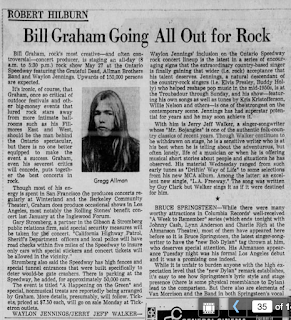
Robert Hilburn's column in the LA Times May 5, 1973

A feature in the Los Angeles Times mapped out the strategy I described above. Robert Hilburn was the Times' principal rock critic, and he had a "Saturday Roundup." On May 5, the Ontario Speedway concert was the primary topic, with a photo of Gregg Allman and quotes from a high-powered public relations executive (remember, in Los Angeles, PR equaled prestige).

Bill Graham Going All Out For Rock (Robert Hilburn, LA Times May 5 '73)
Bill Graham, rock's most creative--and often controversial--concert producer, is staging an all-day (8am to 5:30pm) rock show May 27 at the Ontario Speedway featuring the Grateful Dead, Allman Brothers Band and Waylon Jennings. Upwards of 150,000 persons are expected.

It's ironic, of course, that Graham, once so critical of outdoor festivals and other big-money events that lured rock stars away from more intimate ballrooms such as his Fillmores East and West, should be the man behind the Ontario spectacular, but there is no one better equipped to make the event a success. Graham, even his severest critics will conceded, puts together the best concerts in rock.

Though most of his energy is spent in San Francisco (he produces concerts regularly at Winterland and the Berkeley Community Theater), Graham does produce occasional shows in Los Angeles, most notably The Rolling Stones' benefit concert last January at the Inglewood Forum.

Gary Stromberg, a partner in the Gibson & Stromberg public relations firm, said special security measures will be taken for the concert. "California Highway Patrol, Sheriff's Department officers and local police will have road checks within five miles of the Speedway to insure that only cars with special stickers and concert tickets will be allowed in the vicinity."

Stromberg also said the Speedway has high fences and special tunnel entrances that were built specifically to deter would-be gate-crashers. There is parking at the Speedway, he added, for approximately 50,000 cars.

The event is titled "A Happening on the Green," and special non-musical treats are reportedly being arranged by Graham.


Image

This aerial shot of Kezar Stadium (exact date uncertain)


Meanwhile, Back In San Francisco

Whatever your modern-day view of Bill Graham might be, he didn't think small. In May 1973, Graham was planning to expand his empire with a dramatic entrance into the Southern California market. But he had big plans for Northern California as well. On May 4, information was quietly leaked (through the Hayward Daily Review rock column "KG") that the Grateful Dead would headline two concerts at the Cow Palace on Tuesday and Wednesday, May 21-22. Also on the bill would be Willie Nelson and the New Riders of The Purple Sage. This was a surprising booking on a number of levels.

The Grateful Dead had an extraordinarily loyal audience in San Francisco, but the band wasn't really that big. The Dead had headlined three weeknight concerts at the (officially) 5400-capacity Winterland back in December (Sunday-Tuesday December 10-12), followed by New Year's Eve. Those four shows had sold out without meaningful advertising. Yet the Cow Palace was a 16,000-capacity barn in Daly City, on the outskirts of San Francisco. Were there really enough Dead fans to fill it up for two weeknights? Willie Nelson was a rising star at this time, but he was no proven commodity in the Bay Area. Tickets went on sale, but it almost seemed to be a stealth show.

Image
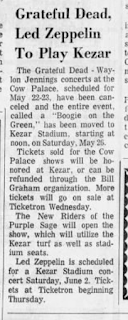
The San Francisco Examiner, May 14, 1973

On Monday, May 14, Graham showed his hand. The two Cow Palace Grateful Dead concerts were rescheduled for Saturday, May 26 at Kezar Stadium in Golden Gate Park. Kezar Stadium, opened in 1925, had been the home of the San Francisco 49ers until the 1971 NFL season. Kezar was now largely unused, but it was in the center of the city and relatively easy to get to by freeway from surrounding counties. On top of that, most Bay Area residents knew how to get to Golden Gate Park, so it was a workable destination. Kezar was small for an NFL stadium (about 60,000), but huge for a concert facility. With no competing sports dates, Kezar would be easier to schedule than an active stadium.

Image
More importantly, the weekend after the Grateful Dead, Graham announced that Led Zeppelin was going to headline Kezar Stadium. As noted, Zeppelin had begun their tour by headlining stadiums in Tampa and Atlanta. Now Graham was going to book Zep's biggest concert on the West Coast. Over the course of just eight days, Graham was planning to put on the Grateful Dead at Kezar (Saturday May 26, with Waylon replacing Willie), the Allman Brothers and the Dead at Ontario (Sunday May 27) and Led Zeppelin back at Kezar (Saturday June 2).

Grateful Dead, Led Zeppelin To Play Kezar (SF Examiner, May 14 '73)
The Grateful Dead-Waylon Jennings concerts scheduled for May 22-23, have been canceled and the entire event, called a "Boogie on the Green," has been moved to Kezar Stadium, starting at noon, on Saturday, May 26.

Tickets sold for the Cow Palace shows will be honored at Kezar, or can be refunded through the Bill Graham organization. More tickets will go on sale at Ticketron Wednesday.

The New Riders of the Purple Sage will open the show, which will utilize the Kezar turf as well as stadium seats.

Led Zeppelin is scheduled for a Kezar Stadium concert Saturday, June 2. Tickets at Ticketron beginning Thursday.
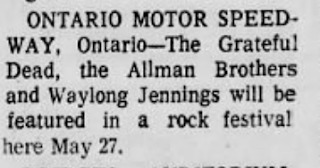
The Grateful Dead/Waylon Jennings show at Kezar drew about 30,000 fans, and was a huge success. The Led Zeppelin show on the next weekend was sold out, drawing twice as many fans. The noise bothered the local neighborhood--the sound system was in a different location than it had been for the Dead--, and Led Zeppelin's fans were not as welcome in the Haight-Ashbury as Deadheads. Bill Graham had proof-of-concept for his "Day On The Green" all-day stadium concerts, but he moved them to the more accessible Oakland Coliseum. They would thrive there for many decades.


Image
May 12, 1973 Pomona Progress-Bulletin listing

 May 1973 Status Report: Allman Brothers, Grateful Dead, Waylon Jennings, New Riders
The Allman Brothers Band would be the premier attraction at the Watkins Glen Summer Jam concert on July 28, 1973, attracting around 600,000 fans. 150,000 of them even paid. From the Summer of 1973 through the Fall of 1975 the Allman Brothers were one of the premier concert attractions in the country. You can make a good case that Led Zeppelin and Emerson, Lake & Palmer were equally as popular as the Allmans, but they weren't bigger. Now, granted, the Rolling Stones didn't tour and Bob Dylan only played indoor arenas, but the Allmans were a massive outdoor draw all over the country. Watkins Glen was the biggest, by far, but it wasn't a fluke.

Most rock fans from the era recall that Summer '73 was when the Allmans broke through with their mega-hit "Ramblin' Man," a catchy country tune that was not particularly typical of the bluesy jamming on which the Brothers had made their bones. "Ramblin' Man" was reminiscent of "Blue Sky," sure, and maybe "Revival," both of them Dickey Betts songs as well, but it wasn't at all like "Statesboro Blues" or "Whipping Post." So the idea that the Allmans began to dominate the US concert market when they got their big hit single is compelling. But it's wrong. 

The Allman Brothers had a massive successful US tour in the Summer of 1973. The first highlight was an epic double-bill with the Grateful Dead at Washington, DC's RFK Stadium, on the weekend of June 9-10. Yet that event was eclipsed by the triple-bill at Watkins Glen on July 28. Nonetheless, the Allmans' follow-up release to Eat A Peach, which had come out back in February '72, would not even be released until August of '73, after the Watkins Glen show. "Ramblin' Man" was the first single, released at the same time, and it would go on to reach #2 on the Billboard charts. Now, sure, advance copies of Brothers And Sisters and the "Ramblin' Man" 45 were probably on FM radio (or even AM) in late July, but the huge successes of RFK and Watkins Glen were before the album and single had even been released. The Allman Brothers Band were huge because they were huge. FM radio listeners had caught up to them, and FM radio played them constantly throughout 1972 and '73.

The Allman Brothers Band's third album At Fillmore East had been released in July 1971. As America was slowly catching up to their stunning sound, Duane Allman was killed in a motorcycle accident on October 29, 1971. As a result, the band's followup, Eat A Peach, a double-lp that was half studio and half live, received extraordinary (if well-deserved) attention. And if that wasn't enough, Derek And The Dominos had a hit in Summer '72 with the by-now18 month-old "Layla," and Duane's interplay with Eric Clapton drew even more attention to him. The Allmans were in the process of recording the sequel when bassist Berry Oakley died in a motorcycle accident almost exactly a year after Duane (on November 11, 1972). Interest in the Allmans inevitably redoubled. In 1973, Capricorn Records released a double album of their first two records (Allman Brothers Band and Idlewild South) as Beginnings, so the Allmans were all over the radio throughout the Summer, even though they did not yet have a new album. 

The Grateful Dead, meanwhile, had risen above the level of cult status, even if they were only somewhat of a "major attraction." The band had released four gold albums in a row (Workingman's Dead, American Beauty, Grateful Dead ['Skull & Roses'] and Europe '72), and they, too, got their share of play on FM radio. In the case of the Dead, the songs played on FM were likely the more rocking songs in their repertoire (like "Bertha" or "Sugar Magnolia"), rather than big jams like "Dark Star," but they were Dead songs nonetheless. The Dead would leave Warner Brothers to go independent at the end of 72, but they would not release their final record on the label (Bear's Choice) until July of '73.

The New Riders of The Purple Sage no longer featured any members of the Grateful Dead, but they still shared booking and other services with them. By May 1973, the Riders had released three albums on Columbia. The Dead tried to book the Riders as openers when it fit. Clearly, they fit in at Kezar but not Ontario.

Waylon Jennings (1937-2002) was an established country singer, but he had roots in rock and roll. Jennings had been the bass player for Buddy Holly and The Crickets, and had graciously offered to give up his seat on the airplane to The Big Bopper, on the fateful flight on February 3, 1959 that crashed, killing Holly, the Bopper, and Ritchie Valens. Jennings had gone on to success as a Nashville singer, but he had never been happy with how his records were made. By '73, country rock was starting to become a commercially viable enterprise, with the Eagles as the most prominent band, along with a slew of other groups like Poco, the New Riders and Pure Prarie League. The unhappy Jennings, however, tapped into something much more potent than hippies playing rock and roll with a twang.

The more potent and lasting merger of country music and the 60s would be the music coming out of Austin, TX. Genuine country musicians, with proper Nashville pedigrees, would move to Austin, grow their hair, light one up and pretty much play the same music they had been playing before. OK--maybe there was a bit more attitude, but that wasn't incompatible with older roughneck country, anyway. One of the earliest converts was Jennings. 

In 1972, Jennings had had a pretty good hit with the song "Ladies Love Outlaws," and RCA still wanted him to be a typical Nashville artist. By 1973, however, Jennings had moved to Austin, TX, to join fellow outcast Willie Nelson, and RCA finally saw the light. Jennings kept the beard he had grown, and "Outlaw Country" followed, with Willie and Waylon in the forefront. Sharing bills with the Grateful Dead and the Allman Brothers in California was a huge break from country practice. Jennings was consciously and enthusiastically aligning his music with long hair, weed and loud, loud music.

Image
What Happened: Ontario Motor Speedway
On Monday, May 22, Robert Hilburn explained in the Los Angeles Times that the Dead/Allmans/Waylon concert would be canceled. The reason given was that the police were going to insist that the concert end by nightfall, because of some incident at a concert in Stockton.

Ontario Rock Concert Canceled by Graham (Hilburn LA Times May 22 '73)
The all-day Grateful Dead-Allman Brothers-Waylon Jennings rock concert Sunday at the Ontario Motor Speedway--which had been expected to draw upwards of 150,000 persons--has been canceled, producer Bill Graham has announced.

"Trouble with several youngsters at an April 29 outdoor concert in Stockton caused Ontario civic official to take a hard, long look at the May date," Graham, who was not involved in the Stockton event, said. Specifically, police said the concert--the first of its kind at the huge speedway--would have to end three hours before dark, or approximately 5:54pm, he added.

Since the Allmans and the Grateful Dead were scheduled to play several hours each, Graham said he doubted he could honestly end the show by that time." He pointed out the Dead played six hours recently at an outdoor concert in Des Moines, Iowa. Though normally outspoken, Graham made it clear he was not blaming anyone. "All the Ontario officials and police were extremely cooperative. Under the time limits imposed however, I didn't feel we could have given the kids the show we promised.

Graham said he is proceeding with plans to present Leon Russell Aug. 5 at the Ontario facility. Ticket sales for the Sunday event were described as "healthy" by a spokesman for the San Francisco-based producer. 

You can buy this story if you like. Maybe there were some elements of truth to it, I don't know. Here's what I think--the concert didn't sell enough advance tickets, and it no longer made economic sense. Remember, Graham's team would have had to construct a huge stage and a ginormous sound system, and fly the Allman Brothers, the Dead and Waylon Jennings in from out of town.  The Times article says that the concert was "expected to draw upwards of 150,000 patrons." If Graham had those kind of ticket sales, he would have found a way around any police objections (if those objections were real), by paying for better lighting, more security or whatever it took. But I don't think the ticket sales were there. Given that we know that the Allmans and the Dead would pack Watkins Glen just two months later, why could that have been?
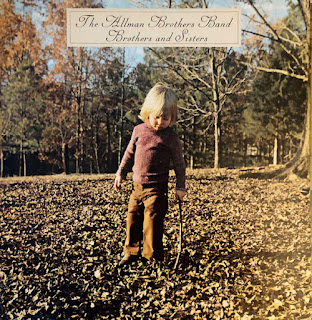
Image
Although this fine album was a massive hit, it doesn't shout "Los Angeles Summer of '73" to me

The West and The East

The West Coast and the the East Coast were very different concert markets in the 1970s. The Midwest and the South probably were different, too, but I have done less research into them, so I won't generalize. A characteristic of East Coast events from 1969 onwards was the willingness of large numbers of young people to get in their cars and travel for rock concerts. An event like Woodstock drew not just from New York state but all of New England, Pennsylvania and New Jersey. Population was much more distributed in the East. There were a lot of medium-sized cities full of young people anxious to see major rock bands, and they would travel. The phenomenon of Deadheads driving hundreds of miles to every show originated as an East Coast phenomenon. 

The West, even in California, was considerably less populated in the 1970s. The vast suburbs of Los Angeles, the Bay Area, Fresno and Vegas were far smaller then. It wasn't that young people didn't love rock and roll as much, they surely did, but once you got outside the major metro suburbs, there just weren't that many people. Fresno, to name just one outlying city, had 165,655 residents in the 1970 census, while it would have 542,107 in 2020. There were just fewer young people ready to hop in their parents' cars and see a big rock show. Few Deadheads from San Francisco would have been planning to travel down to Ontario, since the Dead were playing the afternoon before. As for LA, the Dead had already booked three shows at the Universal Amphitheatre on June 29-July 1, so it's not like Deadheads would lose out.
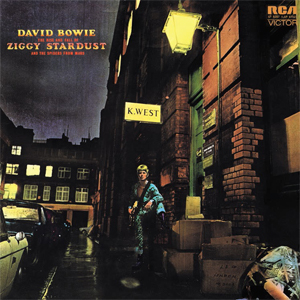
Image
Los Angeles and San Francisco aren't the same, which is what makes California great

Also, while both the Grateful Dead and the Allman Brothers were popular bands, I don't think they were particularly popular in 1973 Los Angeles. Now, sure, there were plenty of fans who liked each band, or both bands. But LA was huge, so any band could sell tickets--Jethro Tull, Black Oak Arkansas, The Yes, you name it. But the Allmans and the Dead were hippie guitar hero bands--was that what was happening and what was going to impress everybody in LA on Monday morning when you got back to school? I don't think so.

Did the Allmans or the Dead have a hit single on the radio? Definitely not. Did this matter in Los Angeles? Well, you decide, but it was the biggest record industry town in the history of the record industry, so I think you had to be super-cool or on the charts, and the Dead and the Allmans were neither. I think ticket sales were tepid, and Graham canceled the show. 

Some months later, in the East it was different. The tens of thousands who bought tickets for Watkins Glen weren't downtown Greenwich Village hipsters, they were kids in Syracuse or Allentown or Parsippany who wanted to see some big time rock bands. None of those bands were coming to their town, and their parents weren't necessarily OK with them driving to Manhattan, but some racetrack out in the countryside? Yeah, why not? The kids could have got permission to go the US Grand Prix, so why not a concert?

Graham's assessment of the Allman Brothers and the Dead as a booking pair was correct, but his location was off by 3000 miles. He was also right about the Ontario Motor Speedway, although he picked the wrong bands. The following Spring, Ontario Motor Speedway would hold the "California Jam" on April 6, 1974, an all-day affair headlined by Emerson, Lake & Palmer, Deep Purple and the Eagles. Actual attendance was well North of 200,000, but more importantly paid attendance was around 168,000, breaking every record known for a paying concert. That record would hold until "Cal Jam 2," also at Ontario Motor Speedway, on March 18, 1978. Cal Jam 2 had at least 175,000 paid.

So the planned May 27, 1973 concert at Ontario Motor Speedway had all the right pieces for an epic success of unimagined proportions, but in the wrong combination. We are left with only a poster.

Image
 
 
Postscripts
  • The August 5 Leon Russell concert booked for Ontario alluded to above seems to have been moved by Bill Graham to Oakland Coliseum, the first in what was a decades-long success in outdoor stadium concerts at that venue.  The Grateful Dead show at Kezar (on May 26) was a huge success, but the sold-out Led Zeppelin show did not go over well with the neighborhood, leading to the shift to Oakland Coliseum.
    Image

  • update 20240201: it turns out the Leon Russell concert was indeed held at Ontario Motor Speedway, on Sunday, July 29, 1973. This was the first rock concert at the Speedway. Leon had just released his monster hit triple album Leon Live. Per the July 31 Times, around 30,000 showed up, but Bill Graham was expecting 80,000. In a strange bit of symmetry, this was the same weekend as the Dead/Allmans blowout at the Glen, and Leon had originally been booked there. The Dead and the Allmans had preferred The Band, and Leon was bought out of the gig.
  • The first second concert at Ontario Motor Speedway has been entirely forgotten. On November 24, 1973, Three Dog Night and the Guess Who headlined a rainy Saturday at the Speedway. There were several opening acts, something like 25,000 people and per a Dennis Hunt Times review, a miserable time was had by all. It must have served as proof of concept, however, since Cal Jam was held five months later.
  • Bill Graham and the promoters of the Watkins Glen attempted another event at Ontario on August 3,1974, headlined by Crosby, Stills, Nash & Young. Tickets were even sold, but the event was canceled.
  • Ontario Motor Speedway was a well-designed and forward looking auto racing facility, but it did not succeed financially. The Speedway was open from August 1970 to December 17, 1980. Per Wikipedia, by 1980, the Ontario Motor Speedway bonds were selling at approximately $0.30 on the dollar. Generally unknown and unrealized by the bond-holding public, the 800 acres (3.2 km2) of land originally purchased at an average price of $7,500 per acre, had now risen to a value of $150,000 per acre. Chevron Land Company, a division of Chevron Corporation recognized the opportunity to acquire the bonds and effectively foreclosed on the real estate. For approximately $10 million, Chevron acquired land which had a commercial real estate development value of $120 million, without regard to the historic significance or future potential of the speedway.
  • From above, you can still see traces of Turn 3.


Appendix: Where Was Ontario Motor Speedway?

The speedway was bordered on the north by 4th Avenue (then referred to as San Bernardino Avenue), on the south by Interstate 10, the west by Haven Avenue, and the east by Milliken Avenue, which still has the eastward curve needed to make room for turn 1 and turn 2 of the racetrack.   Milliken Avenue is one of (maybe the only) street with curves like this in the entire city. 

Contrary to those news reports about the Ontario Mills Mall being built inside the old racetrack, this is not the case.  Ontario Mills Mall lies across the street, due-east of what was the racetrack, on the east side of Milliken Avenue.  When the Speedway was still in existence, the future home of Ontario Mills Mall was either empty fields, or parking areas, depending on the year. 

Even though virtually nothing remains of the race track, other than some of the raised-berms that made turn number 3 at the corner of 4th and Haven Avenues, The City Of Ontario has retained some of the history and heritage of the racetrack by building Ontario Motor Speedway Park a few blocks west of the racetrack site and by using auto racing inspired street names in and around the old speedway.  Let’s give Ontario some credit for these street names! (Jaguar Way, Corvette Dr, etc)

Appendix 2: Population of Ontario, CA
1960    46,617        103.8%
1970    64,118        37.5%
1980    88,820        38.5%
1990    133,179        49.9%
2000    158,007        18.6%


Thursday, March 6, 2014

April 17, 1971, Dillon Gym, Princeton University, Princeton, NJ


Image
The ad for the Dillon Gym show, in The Princetonian student newspaper of February 22, 1971. This appears to have been the only publicity for the show, which seems to have sold out instantly.
On Saturday, April 17, 1971, the Grateful Dead played a show in Dillon Gym at Princeton University. Beyond the enjoyment of the packed house, the show has become legendary in Grateful Dead circles because, for whatever reasons, a crisp board tape circulated as far back as the early 1980s. Although the band had had some rocky moments when Mickey Hart left the band in February, by April the Dead were firing on all cylinders. For listeners a decade later, the Princeton show was an expansion of the "Skull & Roses" album, with the Dead playing a striking cross section of American music along with their own original material. Dead fans have been enjoying the Princeton tape ever since, complete with epic Pigpen raps in a 27-minute "Good Lovin'" and a 16-minute "Turn On Your Lovelight." The Princeton show was celebrated at great length in the Tapers Compendium, and it may be one of the best-known Dead tapes ever.

Yet for all of the high profile of the Princeton tape, the context of the show at Dillon Gym has become obscured. 1971 was a different universe, and the micro-universe of Princeton University itself was an even more distant land. Part of what made the Princeton show so special was the insulated nature of the show, a show financed by the University exclusively for its own students, a financial arrangement that would be unheard of today. At the same time, the students chose a happening Fillmore East headliner from the opposite side of the country, an opportunity only made possible by the fact that the rock concert market in New Jersey was not fully formed yet. This post will take a look at the Grateful Dead concert at Dillon Gym on April 17, 1971, and focus on what made the concert a unique event that could not be duplicated.

Image
An announcement from the Friday, April 16, 1971 Princetonian, promoting the Princeton FREE Weekend. The fine print notes that the Grateful Dead show is, in fact, not free
Princeton University
Princeton University was founded in 1746 as the College of New Jersey, and it has been located in Princeton itself since 1756. It was just the fourth Chartered Institution of Higher Education in the American colonies. The University took the name Princeton University in 1896, and it is rightly regarded as one of America's finest undergraduate and graduate institutions. As an Ivy League school, Princeton students are always top-of-the-line. Of course, smart and accomplished as most Princeton students have always been, at least some of the undergraduates have always been at the school because of the wealth and prestige of their families, but that has always been a part of the Ivy League. Princeton, as the southernmost of the Ivies, has always had an historic connection to the South, so the school had a 20th century reputation as somewhat conservative.

The Borough of Princeton had been built up around Princeton University. Nassau Street was the main street of the Borough (now city) of Princeton as well as the front entrance to Princeton University. While in one sense Princeton is a college town, in another way it has a relaxed, wealthy feel that is quite different than your typical State University main strip. At the same time, Princeton is far more interesting than the usual moneyed enclave. Over the last few decades, and perhaps longer, former or current residents of Palo Alto have found Princeton eerily familiar, even if they have never set foot in the town before. The peculiar ways in which Palo Alto seems to be a younger, Western doppleganger for Princeton are too arcane to go into here, but suffice to say it is not a surprise to this former Palo Altan that the Grateful Dead's one show in Princeton was a stunning success.

The 1971 College Student
Undergraduates in 1971 would generally have been born between1949 and 1953. They would mostly have been in junior high when Beatlemania hit, so they mostly loved rock music. However, for the first explosion of live psychedelic rock, from 1967 onwards, they mostly would have had to wish and wonder. The original Fillmore scene, and similar scenes in places like Boston and Manhattan, were small and underground, and confined to bohemian enclaves in inner cities. Not many high school students were near enough to a Fillmore or a Boston Tea Party, and fewer still had a way to get there, with or without the permission of their parents.

However, when those 60s teenagers got to college, they were ready, ready, ready to rock and roll. They had read about all night debauchery and ear-splitting music--what was college if not a chance to experience that? In the 1960s, colleges still had entertainment budgets to provide extracurricular fun for their resident students. Sometimes this had comical results, like the time Jose Feliciano headlined the Ohio University Junior Prom, along with opener Led Zeppelin (yes, this really happened--May 19, 1969). By the time 1970 rolled around, however, the "entertainment committee" at most colleges had some serious rockers on it who tried to make sure that the best available bands came through. Booking agents caught on to this dynamic, too, and the Fillmore bands who were still together started playing more shows at colleges.

The Grateful Dead had been playing college bookings pretty steadily since 1969. To your typical college student, circa 1971, the Grateful Dead were the Real Deal. The Dead had been infamous since the Fillmore days, and were well-known to have "played all night" many a time. With two recent albums that featured hummable tunes, and getting airplay on FM stations, it wouldn't be hard for the long-hairs on the entertainment committee to to get the middle-of-the-roaders onboard. Since most colleges had entertainment budgets, a school like Princeton could afford the Grateful Dead's fee (around $10,000), because they weren't exclusively dependent on ticket sales. So for the students at Princeton, all future leaders of government and industry, a visit by one of the most infamous bands from the 1960s had to be very desirable indeed.

Princeton, conservative as it was, had been forcibly inducted into the 60s. Apparently, the first African-American students had been admitted to Princeton only in 1964. More dramatically, a court case in 1967 had forced Princeton to admit women. The very first women admitted as permanent students at Princeton were freshman in 1969, although apparently many of the first women at Princeton were actually transfers. Note that the show as advertised above was presented "in cooperation with the Classes of 1972, 1973 and 1974." Those three classes, who would have been Juniors, Sophomores and Freshmen in the Spring of 1971, were the first Princeton classes to have admitted women. Pigpen's admonitions during his legendary "Lovelight" rap may have been valuable advice for some of the more sheltered Princeton undergraduates.

Image
The Flying Burrito Brothers (with Rick Roberts having replaced Gram Parsons) were playing Alexander Hall on April 22, the Thursday night after the Dead show.
The Northern New Jersey Rock Market, 1971 (ca. 01 BSE: Before Scher Era)
Up until the middle of 1971, the most important figure in the New Jersey rock concert market was Bill Graham, even though he had never promoted a concert in New Jersey. Once Graham introduced the Fillmore East, on March 8, 1968, he became a central figure in the East Coast rock market. Playing the Fillmore East could make or break a known or unknown band, so playing there was not only profitable but a mark of prestige, as well. The Friday night early show at Fillmore East was almost always reviewed in the Village Voice, Billboard, Cashbox and other periodicals, so a good showing had significant consequences.

Bands contracted to play the Fillmore East had a standard clause where they could not play an advertised show within 20 days and 50 miles of the Fillmore East date. Some of the details may have varied, and it may have been applied differently to opening acts, but headline acts had to fear the very-real wrath of Bill Graham. Graham, naturally, was hip to the idea that a band could play a free concert or unannounced club show in Manhattan, and create some very good buzz for a Fillmore East show, but he was not going to let another promoter take away the Fillmore East's hold on the hippest touring rock bands. Much of the teenage population of New Jersey was in the North, less than 50 miles from Fillmore East, and as a result, the most populous part of New Jersey in the late 60s and early 70s was a no-fly zone for headline rock acts. Jersey rock fans had to go to either Manhattan or Philadelphia for their rock fix.

The actual members of the bands may have only been vaguely aware of the restrictions of their contracts, if at all. However, their management, booking agents and record companies were acutely aware of it. The band members of the Grateful Dead might have thought it was funny to poke Bill Graham in the eye, but it would not have been funny to Warner Brothers or their booking agent. Graham's ability to enforce his contract did not rest on his legal standing--although I'm sure Bill had a sharp attorney--but on the very real threat that anyone who crossed him would find that their other bands were not booked at the Fillmore East.

An effective exception to the Fillmore East rule (which was probably shared by every other major promoter in Philadelphia, Boston, Chicago and elsewhere) were student concerts at colleges. Even community colleges had entertainment budgets in those days, so bands like the Grateful Dead could play paying gigs at what were effectively student dances without violating any contracts. For example, I have confirmed that they played a Sunday night dance at the Edison County Community College in Edison, NJ, on Sunday November 22, 1970. The only "advertising" was a few mimeographed flyers (none yet recovered) posted around the school. So the Grateful Dead and other bands played a fair number of shows at New Jersey colleges, but those events were hardly known outside their schools. When the Fillmore East closed, the door in New Jersey opened for John Scher and others to promote shows, but up until the middle of 1971, live rock bands in New Jersey seemed largely to have been confined to colleges.

Rock At Princeton, 1970-71
Princeton was no junior college, so there was plenty of student entertainment. There was a professional theater company housed on campus, called McCarter Theater. McCarter Theater also acted as promoter for rock concerts on campus, whether or not the events were presented at the McCarter Theater itself. Reviewing The Princetonian newspaper for the 70-71 Academic year, I found quite a few campus rock shows:
October 3, 1970, McCarter Theater: Van Morrison
October 17, 1970, Dillon Gym: James Taylor (moved from Alexander Hall)
November 14, 1970, Alexander Hall: Miles Davis
November 21, 1970, Alexander Hall: Delaney & Bonnie & Friends
February 20, 1971, McCarter Theater: Tom Rush
March 12, 1971, Alexander Hall: Delaney & Bonnie & Friends (rescheduled from Nov 21 '70)
April 16-18, 1971: Princeton FREE Weekend
April 16: Palmer [Football] Stadium: Free Admission, Free Beer, Free Music
April 17: Dillon Gym: Grateful Dead/New Riders Of The Purple Sage
April 18: The Old New Quad: Mini Motherball Festival, Free Music
April 22, 1971 Alexander Hall: Flying Burrito Brothers
April 26, 1971 Alexander Hall: Cat Stevens
May 1, 1971 Alexander Hall: Kate Taylor
May 15, 1971 McCarter Theater: Incredible String Band
The McCarter Theater seated several hundred, and Alexander Hall seated about 1,100. Dillon Gym was the old gym, built in 1949, with a concert capacity of about 3,200. Bill Bradley, Princeton's best player ever, had played in Dillon, but in 1969 the University had opened the 5,000-capacity Jadwin Gym, so Dillon was relegated to campus uses. Dillon was used for bigger acts, like James Taylor, and particularly for acts that were perhaps too robust for venerable Alexander, built in 1892. However, Dillon  Gym still used folding chairs on the floor, rather than open seating.

There had been a surprisingly robust tradition of cool music at Princeton (as documented in the Princeton Alumni Weekly).  Generally, folk acts usually played McCarter Theater, and rock acts or larger folk acts played Alexander, but bands like the Dead played Dillon Gym. Relatively few acts played Dillon: James Taylor was so popular in 1971 that he was uprgraded to Dillon, and Poco played there in 1972. There was an apparently unique two night stand by Frank Zappa And The Mothers Of Invention on April 27-28, 1973 (what nights those must have been--RIP, George Duke), which somewhat confirms my suspicion that Dillon Gym was considered a more suitable venue for bands with members named things like "Pigpen" and "Motorhead." According to the Alumni Weekly, acts like Bruce Springsteen, The Yes and Genesis also played Princeton in the early 70s.


Image
Life in Princeton, ca '71. Want ads from the April 16 Princetonian have everything you need: stable your horse, buy an MGB-GT, get Dead tickets from Bob, a water bed, give Kevin a ride to Bennington, a tuxedo and a turntable. Which of these would you remember today?
April 17. 1971, Dillon Gym, Princeton University, Princeton, NJ: The Grateful Dead
Let's set the scene. It's Saturday night, April 17, 1971, at Princeton University. It's Spring, now, and about 20% of the student body are real, live women. There's a weekend event with free beer--my college never had free beer--and local bands, and a Fillmore East headline act is playing on campus. No need to take the Dinky train to Penn Station, because the real deal is coming to the little gym next to your dorm.

The old Tapers Compendium has a detailed description of the event from the campus point of view, thoroughly researched by Nicholas Meriwether. Princeton undergraduates have a strange tradition of "eating clubs," kind of like fraternities, only, apparently, not, but suffice to say every Eating Club was revved up for this Saturday night. Somewhat buttoned down Princeton was jumping on to a rocket ship to the end of the 20th century, and all the future leaders of industry and government were hopping on board. Everyone whose parents wouldn't let them to go to Fillmore East, or who couldn't sneak out of Prep School? No matter--the Grateful Dead were coming to Princeton.

Some Deadheads don't find the 1971 Grateful Dead to be as memorable as either the primal 69-70 music that preceded it, or the ethereal 72-74 configuration that followed, and generally I am inclined to agree. However, for converting 1971 college students, the 1971 model of the Grateful Dead couldn't have been better. With some known songs from Workingman's Dead and American Beauty, and some crispy soul, rock and country covers, the Dead were accessible to the average rock fan. With only four real players--Pigpen's organ only joined in occasionally--even the serious space was somewhat more comprehensible to the uninitiated. With a dose of professionalism and some Pigpen charisma, the 1971 college tour made Deadheads for life. People went to college to discover the wide world, and when the Grateful Dead brought the wide world to them--at Franklin and Marshall, or Bucknell, or Allegheny College, or Princeton or SUNY Cortland--people jumped on the bus with both feet.

The Princeton Alumni Weekly has a special memory of the Dead's show
The Grateful Dead’s invasion of Dillon on April 17, 1971 — Hell’s Angels motorcycle gang in tow — is famous among devotees for a quintessential performance of “Good Lovin’ ” by band member Ron “Pigpen” McKernan, then suffering from what would be fatal cirrhosis. “The concert was expensive, $10,000,” says [McCarter Director Bill] Lockwood, a faithful Deadhead who treasures a cassette recording he made that night.
The band played until “well past midnight,” Lock­wood recalls, and “a substantial part of the audience, which was all students, was stoned out of their minds.” Concertgoers passed ­marijuana joints down the rows of seats, he says. According to legend, when a Princeton proctor demanded that ­shaggy singer Jerry Garcia extinguish his joint, Garcia snarled, “I’ll never play here again.” He never did.
The story about Garcia and the Proctor (essentially a campus cop) always gets repeated. The truth of the matter is that the Grateful Dead would never again be small enough to play a 3200 seat gym  in Northern New Jersey. Ironically, once the Fillmore East closed, New Jersey became open territory. John Scher started promoting very successful Grateful Dead concerts at Roosevelt Stadium in Jersey City, and the Dead played no more campus concerts in the state, for the very reason that New Jersey became one of the largest and most fervent Deadhead strongholds in the country, and any campus gym would have been overrun.

Image
A clip from the Newsday article of April 8. 1971, announcing the cancellation of the scheduled Grateful Dead show at Hofstra University in Long Island on April 19, 1971, when 4500 out of 5000 tickets had been sold
The "Lost" Hofstra Concert, Monday, April 19, 1971
The uninitiated may wonder whether my fixation on advertising restrictions from the Fillmore East affected concerts in New Jersey. However, a fellow researcher sent me an article from the Long Island paper Newsday, on April 8, 1971 (clipped above), explaining how a scheduled Grateful Dead concert at the Hofstra Gym on Monday April 19, was abruptly canceled. The article begins
Since last Thursday was April 1, nobody at the Hofstra University Student Center took it seriously when someone called to say that The Grateful Dead was cancelling out of a scheduled April 19 concert at the school. "It was April Fool's Day," David Gould, student center director said yesterday. "At first we thought it was a joke."
Some joke.
Among the less humorous aspects were about 4,500 tickets that had already been sold at $4 and $5 for the concert, which was to be held in the 5,000 seat Physical Fitness Gymnasium because the Grateful Dead is a very popular rock group. 
At Hofstra, The Grateful Dead has lost much of its popularity in a very short time. A telegram followed the call, and since it was not April Fool's Day when the telegram arrived, reality dawned. Despite confirmation of the concert date on March 3, The Grateful Dead would not show up. The inevitable hectic scene of students lining up for refunds was the immediate result at the Hempstead campus yesterday.
The rest of the article, along with some background information about the band and comments from students, has some surprisingly vague quotes from Grateful Dead representatives.
Ron Rainey, who books the Grateful Dead for the International Famous Agency in New York, didn't help settle anybody's stomach with his explanation of the cancellation. "I don't really want to go into it in great detail," he said. But he did indicate the rock group "didn't want to be overexpose itself in the New York area." As for the group, Rainey said they were en route to Boston and he did not know how to reach them.
Then again, maybe it wasn't so much overexposure as overbooking that caused the washout. So opted Rock Scully, co-manager of the rock group, who was found at Fillmore East. Said Scully, "we get our contracts from both coasts and they don't catch up to us for an okay in time, sometimes. Our agent is often overenthusiastic in making bookings." He added, "it looked like a way-too-crowded itinerary."
As the blank tone of the Newsday writer suggests, neither Rainey nor Scully had convincing explanations, and indeed I believe they were merely intended to save face. According to Google Maps, Hofstra University is 28.5 miles from the Fillmore East. Regardless of what the exact contractual restriction of the Fillmore East, there was no way that Bill Graham was letting that stand. Long Island was a big market for the Fillmore East, since the Long Island Railroad and the Subway could take teenagers straight into the Fillmore East (the N, R, 6 and L were nearest). If Hofstra had sold out immediately, that might have been one thing, but since there were available tickets, Hostra could cut into the Fillmore East's box office.

Now, Graham was no naif, and probably knew perfectly well that the same people who bought the final tickets at Hofstra were probably going to most of the nights at Fillmore East anyway. Nonetheless, even though Graham was privately already planning to close the Fillmores, he had months more of shows to get through, and he wasn't going to let other promoters think they could horn in on his territory. Shutting down a nearly sold-out Grateful Dead concert was a clear warning blast to other promoters--cross Bill at your peril. Rock Scully and the booking agent were forced to make some token explanation that no one believed, but both needed Graham as much as anyone, and certainly the Dead had signed the original contract with Fillmore East.

Really, it's too bad. The Grateful Dead were rocking hard in the Spring of '71, and they were young and strong. What else were they doing on that Monday night? The night after Princeton, the Dead had played SUNY Cortland, 216 miles to the North of Fillmore East. What do you think they did next? I think they came back to Manhattan and hung out, and Garcia probably just practiced guitar all night. They would have had way more fun in front of 5000 rockin' Long Islanders, and who knows what Pigpen would have come up with. But business was business, and the Dead's contract with Graham mandated no Hofstra show two nights before a lengthy Fillmore East run.

Coda: Princeton Rocked (In It's Day)
Dillon Gym was just about exactly 50 miles from the Fillmore East, and with only one ad in the student paper and an instant sellout, Bill Graham had no reason to interfere with the Dead concert. This geographic constraint must surely have helped Princeton throughout the 70s, because even though Graham retreated to the West Coast, every other promoter must have had similar restrictions for their headline bookings. But Princeton seems to have been safely isolated from both Manhattan and Philadelphia, so the McCarter Theater was free to book shows. A search of the Princetonian reveals a lot of good shows in the early 70s. Just look at the Spring of '72
  • March 4 McCarter Theater: J Geils Band/Billy Joel (Peter Wolf must have melted the joint)
  • April 1 McCarter Theater: Mahavishnu Orchestra/John Prine (there's a double bill)
  • April 15 Alexander Hall: Curtis Mayfield (people, get ready)
  • April 24 Alexander Hall: New Riders Of The Purple Sage (I'll bet they smoked joints)
  • April 29 Alexander Hall: Mark Almond (these guys were great, if now largely forgotten)
  • May 5 Dillon Gym: Poco (another great live band)
  • May 14 McCarter Theater: Dave Mason (only you know and I know)
The fine shows continued throughout the first half of the early 70s. Since rock was expanding, there were a lot of touring bands, so a Princeton show was welcome on an off-night, even if the gigs were tiny. Frank Zappa did two shows at Dillon (April 27-28 '73), and Bruce Springsteen played an early and a late show at Alexander Hall (December 10, 1974).

By the late 70s, however, the rock market was just too big for tiny Princeton. For one thing, John Scher was booking a lot of shows at the Capitol Theater in relatively nearby Passaic, and he had a lot of clout, insuring that he kept the best bands. On top of that, the sort of acts that would have played McCarter or Alexander in the past were now commanding fees that required them to play Jadwin Gym. The Talking Heads and Bruce Springsteen played Jadwin Gym in the same week in 1978, and Bruce, of course, rocked the joint--whatever others may say, Mercer County is still part of New Jersey--but Jadwin paid a price. The whole crowd danced to Bruce while standing on folding chairs in the gym, and it created a $15000 repair bill. Although there were a few more concerts over the years, with The Kinks and 10,000 Maniacs and a few others, Princeton was priced out of the rock market. Bands still came to Princeton on occasion, but it was no longer a regular tour stop.

I'm sure that 70s graduates of Princeton all have their memorable rock moments, but it's hard not to see the Grateful Dead show as the day when uptight Princeton got down, whether anybody was ready for it or not. The Grateful Dead never came back, not because a Proctor made Jerry put out his joint--the Riders would not have turned up the next year if that were the case--but because the world where the Dead could play a sleepy little gym was just about to disappear, and the Princetonians who went were lucky enough to catch the bus before it got on the superhighway.


Thursday, October 4, 2012

March 23, 1975: Kezar Stadium, San Francisco, CA: The SNACK Concert with Jerry Garcia And Friends (FM VIII)

Image
The Grateful Dead had officially retired from performing after their five-night stand at Winterland in October, 1974, so it was quite a surprise when they appeared in concert and on the radio at Kezar Stadium on March 23, 1975. The band played entirely unheard new material, joined by guest keyboardists Merl Saunders and Ned Lagin, suggesting that rumors that they had not in fact broken up were actually true. The day's performance was actually billed as "Jerry Garcia And Friends," but it was generally perceived as a Grateful Dead show, and indeed, as most of it was released as a Grateful Dead bonus disc some time ago, it's fair to call it a Grateful Dead performance. However, the events and circumstances surrounding the event, including the radio broadcast, seem to have largely been overlooked. This post will consider the performance and broadcast of the Jerry Garcia And Friends set within the context of the SNACK Benefit concert on March 23, 1975, at Kezar Stadium in Golden Gate Park.

SF SNACK: San Francisco Students Need Athletics, Culture and Kicks
In early 1975, the San Francisco school district announced that due to an unexpected budget shortfall, programs for the 1975/76 school year would have to be drastically cut throughout the city. The School Board released a plan that pretty much cut all arts and sports in every school. In today's environment, where Public School Teacher's unions are demonized in order to lower taxes for billionaires, it may seem strange that there was public outrage at this turn of events, but such a world existed then. Amidst all the outrage, Bill Graham decided to organize a benefit concert to provide funds to help the San Francisco Public Schools to provide extracurricular activities for its students. Hence the name: SF SNACK--San Francisco Students Need Athletics, Culture and Kicks.

Bill Graham, ahead of his time as always, grasped that large rock concerts were a dramatic instrument for calling attention to problems, and a dramatic instrument that was not only self-funding but could in turn raise meaningful amounts of money. He also recognized that the management of major bands in the area would benefit professionally from the publicity and exposure, and would for their part work for little more than expenses. In that sense, SNACK was very much the forerunner of international fundraisers like Live/Aid and Farm-Aid.

As it happened, while there was an intense glare of publicity about the School District's plight, magnified by the publicity for the concert, the benefit was conceived and directed by Bill Graham, rather than with the direct cooperation of the city or the district. The School District did not appreciate being made to look like chumps--which they pretty much did--and more rational voices pointed out that the six-figure sum that would likely be raised by SNACK was just a fraction of the several million dollars that the schools would have needed. There was some distinct grumbling that the benefit concert was really a publicity grab by Graham and the bands, who were using the crisis as a promotional tool.

In the end, shortly before the SNACK concert took place, the San Francisco School District announced that they did not, in fact, have a budget shortfall. There had essentially been an accounting error, and the projected funds available for the forthcoming year had thus been off by several million dollars. There was no crisis; arts and sports would not be cut. Thus the raison d'etre for the SNACK concert was neutralized about a week before the show. The city was probably pretty relieved, and if I recall the School District pretty much washed their hands of SNACK, at least according to the San Francisco Chronicle. It was too late to turn back, however, so the show went on as scheduled. By that time, it was just a rock promotion, albeit a very successful one. The proceeds of the concert, apparently about $200,000, were apparently donated to unnamed charities. Thus, on Sunday, March 23, 1975, some of the Bay Area's biggest working rock acts--plus a few out-of-town friends--gathered to play at Kezar Stadium in Golden Gate Park in San Francisco.

Image
The poster for the canceled Wild West Festival at Kezar Stadium in Golden Gate Park, scheduled for August 22-24, 1969. The Grateful Dead were booked for Friday, August 22
Kezar Stadium, Golden Gate Park, San Francisco
Kezar Stadium had been built in Golden Gate Park in 1925. The stadium is located on the Eastern edge of the Park, on Stanyan and Frederick, a short walk from the Haight Ashbury district. In the 1920s, the area around Golden Gate Park was less populated, so building a stadium there was the equivalent of building one today on the outskirts of town. The stadium had a capacity of 59,000, so it was San Francisco's primary venue for events. All sorts of major sports attractions were held there in the 1930s and 40s.

The principal attraction at Kezar was football. High School and college football championships were held there from the 1920s onward, and Kezar was the home park for various local colleges, back when they all had football. The most famous tenant of Kezar, however, was the San Francisco 49ers, who used Kezar as their home field from 1946 through 1970. After the 49ers moved to Candlestick Park in 1971, many old time San Franciscans sniffily refused to attend 49ers games, at least until Joe Montana showed up. However, Kezar was an old-style stadium, with wooden benches, few amenities and an increasingly terrible parking situation, so it was no longer viable as a major sports venue.

There were a few efforts to turn Kezar Stadium into a rock concert venue. The stadium had been used for a few political rallies and the like, which sometimes included music (Yellow Shark has a great precis of Country Joe And The Fish's contribution to a Kezar Rally on April 15, 1967), but the increasingly crowded neighborhoods surrounding the park offered nothing in the way of parking, and there were no nearby garages, either. In August, 1969, San Francisco nearly had its own Woodstock, the Wild West Festival, based at Kezar Stadium, but that poorly organized affair fell apart at the last second.

In 1973, Bill Graham Presents started presenting rock concerts at Kezar, correctly anticipating that rock music had grown beyond the confines of even the largest indoor arenas. The first such event, dubbed "A Day On The Green," was held at Kezar Stadium on May 26, 1973, and featured the Grateful Dead, Waylon Jennings and The New Riders of The Purple Sage. The show was well attended, but not sold out, and the atmosphere around the neighborhood was nice. In 1973, Kezar was still Home Field territory for the Grateful Dead.

Seven days later, Bill Graham Presents held the second and seemingly last rock concert at Kezar, with headliners Led Zeppelin (and among the opening acts was unsigned local band The Tubes, featuring Vince Welnick on keyboards). The June 2, 1973 show was packed to the rafters, and the sound system was pointed differently than it had been for the Dead, so the sound was audible all over the area, much to the dismay of the neighborhood. The sound issue was used by the city to pass an ordnance that effectively prevented any future rock concerts at Kezar. I suspect also that the sold out show caused a parking nightmare, and that amped up Led Zeppelin fans were less appealing to the locals than mellow Deadheads. Thus there was a permanent injunction against any future shows at Kezar.

I have written at some length about how Graham moved his Day On The Green shows to the larger and more accessible Oakland Coliseum Stadium, an arrangement that continued successfully throughout the balance of the century. When Graham proposed the SNACK concert, however, he needed a San Francisco site, so he persuaded the powers-that-be to make an exception to the rule and allow the concert to be held at Kezar. Graham was great at working the press, so the Mayor and the City Council had little choice, but the neighborhood would have been very much against the event, and it had to have been a tricky political situation. Once it turned out that the entire basis for SNACK was an accounting error, no political good will would be coming back to the City, so the chances of there ever being another major rock event at Kezar approached zero. SNACK was the last rock event at Kezar Stadium.

The Billing
The poster lists both the rock acts and the various celebrities that would be at the show. This too prefigures the Live/Aid concert, which, if you will recall, had a heavy Graham presence. Graham's basic idea was that between each set, some sort of luminary would come out and praise the need for arts or athletics in the schools.

The Celebrities:
Frankie Albert, John Brodie, Rosie Casals, Werner Erhard, Cedric Hardman, Willie Mays, Jesse Owens, Gene Washington, the Rev. A. Cecil Williams
Most of the celebrities were San Francisco athletes, with an emphasis on 49ers who had played at Kezar (Frankie Albert, John Brodie, Cedric Hardman, Gene Washington). Willie Mays was, of course, Willie Mays, and the recently-retired star of the San Francisco Giants. The Giants had never played in Kezar (they had played in Seals Stadium, over on 16th and Potrero, in 1958-59), but he was a San Francisco icon (according to Dead.net, Mays got the biggest cheer of the day). Jesse Owens was a worldwide icon, but somehow Graham had persuaded him to appear, no doubt because Owens career was owed to sports programs in the public schools (in his case, in Ohio).

Rosie Casals (b. 1948) was a women's tennis champion who had learned to play on public courts in San Francisco. The Reverend Cecil Williams was the pastor of Glide Memorial Church in the City, and a well known person who lent credibility to anything he was associated with. As for that other name, Werner Erhard? The founder of Erhard Seminar Training (est)? Let's just say as little as possible.

There were also a few unbilled guests between sets as well. As I recall, the most famous of these was none other than Marlon Brando, who came out and made some remarks prior to Neil Young's set. Brando was perhaps the biggest active movie star in the world at the time, so in that sense it was a real coup by Graham to have him onstage. I do not know what, if any connection Brando had to San Francisco, Bill Graham or any of the causes, so I don't know how Graham persuaded Brando to appear--I will allow you to insert your own favorite variation on the obvious joke here.

The Music:
Doobie Brothers/Graham Central Station/Mimi Farina/Jefferson Starship/Jerry Garcia And Friends/ The Miracles/Joan Baez/Santana/Tower of Power/Neil Young
All of the billed performers had a significant Bay Area connection save for The Miracles. In the context of the benefit, it was important that acts with a largely African-American fan base, namely Graham Central Station, Tower Of Power and The Miracles, were a part of the SNACK show. If only white hippie rock acts had played the show, it would have struck a wrong note with the rather diverse San Francisco school district. In the perception of the time, I think Santana would have "counted" for a Hispanic act. 

Whether teenage African Americans and Hispanics were really listening to The Miracles and Santana is unknown to me, and beside the point. Since Graham had arranged the concert to support the school district, he had to have a diverse bill. At the time, Tower Of Power was perceived as a "soul" act in the Bay Area--a sort of code word for "appealing to non-white people"--even though the band had come up through the rock circuit and had many white members. With Tower, Graham Central Station, a popular R&B band that was led by ex-Sly And The Family Stone bassist Larry Graham, and Motown act The Miracles (who no longer featured Smokey Robinson) the R&B side of the equation was spoken for.

Joan Baez and her sister Mimi Farina were usually billed at major Bay Area benefits, and, similar to Rev. Cecil Williams, they lent an air of social credibility that was separate from their then-waning status as folk stars. At the time, Baez's best days seemed long behind her. Of course, just a month later, she would release her album Diamonds And Rust, which put her back on the charts, but no one knew that at the time. Neil Young, meanwhile, had moved to a ranch in the Santa Cruz mountains a few years prior, which was generally known, but SNACK was the first time he had appeared at one of these "only-in-San-Francisco" benefits that Bill Graham had made into part of rock history. It is worth noting that Neil Young's own legendary Bridge Concerts are to some extent built on the SNACK model pioneered by Graham, even if Neil has played so many gigs by now that he has probably sort of forgotten it himself. 

SNACK: Sunday, March 23, 1975
The SNACK Concert was heavily publicized in the days leading up to the concert. Much of the publicity, however, had to do with the politics surrounding the school board, leading up to the announcement that the entire crisis was simply a result of an accounting error. Bill Graham was regularly quoted, directly and indirectly, that all sorts of special guests were scheduled to appear. It was uncertain at the time whether those guests would be musicians or just 'celebrities.' There was no mention of the Grateful Dead playing. Everybody, including myself, assumed that 'Jerry Garcia And Friends' would be Jerry Garcia and Merl Saunders.

As for me, I was a lowly High School student in the suburbs, lacking a car. My access to concerts depended on persuading friends with vehicles, or my cousin, to take me to something. In fact, I was pretty persuasive, so persuasive in fact that I went to concerts at Winterland both on the Friday before and the Sunday after the SNACK concert, but that obviated any chance of making a pitch to my friends for SNACK. Overall, however, I was not bothered, other than the general thing that I wanted to go to every single concert in the Bay Area regardless of who was playing. The only acts on the SNACK bill who appealed to me were Garcia and Neil Young. I correctly figured out that both would only have been playing about 45 minutes at most, and I didn't have a big Jones to deal with a stadium concert just to see short sets by Garcia/Saunders and a probably solo Neil. Well,--summing up High School in a nutshell--I was smart, but I was wrong.


In the Winter of 1975, there was almost no coverage of Jerry Garcia or the Grateful Dead. SF Chronicle rock critic Joel Selvin had a weekly column called "The Lively Arts" in the Sunday paper, and he sometimes mentioned the Dead, but it was a passing thing, just a sentence or two. Selvin had mentioned that the Dead were recording, but I for one wasn't convinced. Rolling Stone reported annually that Crosby, Stills, Nash and Young were recording a new album, and I still hadn't seen one. I didn't doubt Selvin's assertion that the Dead were doing something, but I had just assumed that it would be a long time, if ever, that we would ever see the Dead in concert again. Up until SNACK, there had never been a show billed as Jerry Garcia And Friends, so everyone made the logical assumption that this was just another name for Garcia/Saunders, perhaps with an extra guest of some kind. 


Shortly before the SNACK concert, it was announced that the show would be broadcast live on KIOI-fm (known as K101 for its place on the dial). KIOI was a sort of commercial rock station, well down the hipness scale from the mighty KSAN. This seemed appropriate, as most of the acts were pretty 'popular,' a somewhat loaded term in those days. I had a vague idea that I would tune into the radio broadcast some time during the day, to see what was up (this was before I had a tape deck, so that wasn't a factor). The SNACK show started at about 9:00am, very early for a rock show. I got up late in those days, so I was sitting around drinking coffee at about noon when a friend called (thank you Paul A) and said "the Grateful Dead are on the radio, you should probably turn it on."


I rapidly turned on my little FM radio, moving the dial from 94.9 to 101.1, and heard the distinct sound of the Grateful Dead playing some very strange music. They played nothing I remotely recognized, nor anything that sounded like any previous Dead recording. I even had a vinyl bootleg or two by that time, and the music on K101 didn't sound anything like them, either. But I could hear Garcia's guitar, and I knew it was them. As I had predicted, the band only played about 40 minutes, but only the encore of "Johnny B. Goode" was familiar--the rest was completely strange.


What Were The Grateful Dead Thinking?

The Grateful Dead's appearance on the SNACK FM radio broadcast, in retrospect, stands as one of the most bizarre and in turn brilliant steps by the group. Of course, the band's choices were probably driven by no forethought whatsoever. Graham seems to have used his legendary persuasive powers to get the band to appear, and their compromise seems to have been that they had to billed as Jerry Garcia And Friends, rather than as the Dead. Since the show sold out anyway, the billing didn't matter, and Graham got to take credit for "getting the Dead back together," which wasn't really true, but it was how it seemed at the time. 

Knowing what we know now, it's plain the Dead were busy recording Blues For Allah, and played the material since it was all they really knew. Of course, they could have done "Not Fade Away">"Goin Down The Road" without effort or rehearsal, but one advantage to having billed themselves as Jerry Garcia and Friends was that there were no expectations and no obligations to play traditional crowd pleasers. In another sense, by appearing unexpectedly in concert and playing strange, challenging new music, the Grateful Dead not only confirmed the story that they had been playing together, but in distinct contrast to the likes of CSNY, showed that they had really been doing something while they were away. 


Of course, the Dead's appearance couldn't have happened if the Dead had not been independent of any record company. It would be incomprehensible to a record company like Warners or Columbia that one of their bands would appear on an FM broadcast at a major regional concert without using their own name--RCA, for example, would have flipped out if Jefferson Starship had been billed as "Paul Kantner And Friends." What would be the point of playing a largely unpaid gig otherwise?  As for the music itself, well, no record company would have really wanted the Dead to be working on "Blues For Allah" when they were hoping for the next "Uncle John's Band." 


Still, the idea that a major band would play parts of an unfinished album live on the radio would have made a 1975 record company apoplectic. Clinton Heylin's fascinating book Bootleg looks at the history of the vinyl bootleg industry, and record companies were frantically concerned with artist's new material being made available outside of official channels. Of course, the actual dollars and cents involved were miniscule, but the record companies were very alert to the threat of disintermediation, and managed to throttle the bootleg industry until the rise of Napster in the early 20th century. Rule #1, according to the record companies own agendas, was never to let anything new out before it could receive the full corporate marketing treatment, with accompanying profits.


The Grateful Dead defied all these rules by performing an instrumental version of "Blues For Allah" at SNACK. Of course, the lack of vocals and the strangeness of the material insured that it was not ripe fodder for bootleggers--I'm not aware of a vinyl boot of the broadcast, in any case. In a larger sense, the Dead's strange choice of material indicated to their fans that they were not only recording, they were still busily carving a unique path that no one expected. After the SNACK show and broadcast, strange as it was, Deadheads knew that the Grateful Dead were still in the game, even if the rules of that game were not yet known. When Jerry Garcia And Friends headlined a Winterland concert on June 17, 1975, everybody knew what it meant: it was just a matter of time.


The SNACK Concert

The SNACK Concert sold out, so obviously a lot of people attended the show, probably somewhere in the range of 50,000. However, I have never spoken to anyone who went. SNACK was a sort of "rock event," but not particularly a Grateful Dead event, since almost no one really knew the Dead would play. Reading the comments about the show on Dead.net, it seems that many who attended were local high school kids, seeing bands that were probably generally popular. A number of people have commented there that SNACK was their first Dead show. Correspondingly, there are not many photos from the show, nor audience tapes, ticket stubs and the usual memorabilia. In that respect, SNACK only became important to Grateful Dead history after the fact. 

The rest of the SNACK concert and broadcast was pretty conventional, save for the very last act. After the Dead played, I listened to the broadcast all afternoon. DJs were hinting at a big event to end the show. When Marlon Brando said a few words just before Neil Young's set, I assumed that was it. Nonetheless, while I had assumed that Neil Young would play solo or with Crazy Horse, I was profoundly mistaken. I was pretty excited when Bill Graham announced that Garth Hudson, Rick Danko and Levon Helm were playing with Neil Young, because I was a huge fan of The Band. However, after announcing Danko, a hoarse Graham said "on guitar, piano and vocals, Mr. Bob Dylan" I went nuts in my very own bedroom, along with the entire crowd at Kezar.


Bob Dylan's appearance with Neil Young at SNACK was Dylan's first appearance on a live FM radio broadcast, and one of the very few he would do in his career. At the time, it was electrifying. Of course, the set was brief and very strange. After songs by Neil Young, Levon Helm and Rick Danko, Bob stepped up for his very first ever live performance of "I Want You." However, Bob's vocal mic failed, and his voice was only faintly audible only through (I assume) the drum mics. It was very frustrating. A friend of mine had a scar on his knee for years, from where he kicked his kitchen table when he realized what was happening.


The informal band played another round of songs by Neil, and Rick and Levon (sharing vocals on "The Weight"), and eventually they played "Knocking On Heaven's Door." Dylan, mysteriously, changed the lyrics to something like "Knocking On The Dragon's Door," among other incomprehensible vocals. Finally, the ensemble ended the 40-minute set by doing "Will The Circle Be Unbroken," with lead vocals by Dylan and Danko. The electric presence of Bob Dylan, then a true figure of mystery and delight, overwhelmed all coverage of SNACK. Dylan had appeared several hours after the Grateful Dead, so the possible implications of the Grateful Dead's return to performing were only remarked upon as an afterthought in ensuing coverage.


SNACK: Aftermath

  • There was never another concert in Kezar Stadium. The old stadium was torn down in 1989, replaced by a modern facility that was one-sixth the size.
  • 1975 was the year that turned San Francisco against events in Golden Gate Park. After SNACK, there was a stealthy free concert by Jefferson Starship (May 16 '75) and a less stealthy one by the Dead (Sep 28 '75), but after that year the neighborhood  and the City were dead set against any Dead sets. Bill Graham's death, ironically, broke the logjam.
  • There was a bad feeling about SNACK, because it was based on an accounting error. It was only many years later that fans and journalists started to appreciate the scope of the event. It didn't hurt that the Grateful Dead, Neil Young and Marlon Brando had only become bigger than ever in the ensuing decades.
  • SNACK was Bill Graham's blueprint for Live/Aid, Farm-Aid and the 1989 Earthquake Benefit, which in turn were the blueprints for Neil Young's Bridge Concerts at Shoreline Amphitheater. Modern technology and a greater appreciation for the promotional value of appearing in benefit concerts made all of those events more effective than SNACK, but SNACK was the first of its breed.
  • The Grateful Dead completed and released Blues For Allah later in 1975. No other major rock band ever played such strange, unrecorded music on a regional FM broadcast, but it did the band no lasting harm.
Appendix: Set Details, SF SNACK Concert, Kezar Stadium, San Francisco, CA March 23, 1975
Jerry Garcia And Friends
Jerry Garcia-lead guitar
Bob Weir-guitar, vocals
Merl Saunders-organ
Ned Lagin-electric piano
Keith Godchaux-piano
Phil Lesh-bass
Bill Kreutzmann-drums
Mickey Hart-drums
Donna Godchaux-vocals
Blues For Allah>
  Stronger Than Dirt>
  drums>
  Stronger Than Dirt>
  Blues For Allah
Johnny B. Goode

The entire set was broadcast on KIOI-fm (101.1), and later released as a bonus disc that was only available as a premium for those who pre-ordered the Beyond Description box. David Crosby had rehearsed with the Dead, and was supposed to perform with them, but was called away at the last minute for a personal emergency. Bill Graham announced each player by name and instrument, although he inadvertently overlooked Ned Lagin, and then said "The Grateful Dead And Their Friends." Graham apologized to Lagin afterwards for skipping him.

Neil Young
Neil Young-guitar, piano, harmonica, vocals
Bob Dylan-guitar, piano, harmonica, vocals 
Tim Drummond-guitar
Ben Keith-pedal steel guitar
Garth Hudson-organ, piano
Rick Danko-bass, vocals
Levon Helm-drums
Are You Ready For The Country?  [lead vocal-Neil]
Ain't That A Lot Of Love [Levon]
Looking For A Love [Neil]
Lovin' You (Has Made My Life Sweeter Than Ever) [Rick]
I Want You [Bob]
The Weight [Levon and Rick]
Helpless> [Neil]
  Knockin' On Heaven's Door [Bob]
Will The Circle Be Unbroken [Bob and Rick]

K101 djs make various comments throughout the tapes. Old time Bay Area residents may be amused to realize that one of them was James Gabbert, later famous as the owner and host of KOFY-TV (Channel 20). The Neil Young set can be heard at Wolfgang's Vault.