Showing posts with label auto racing. Show all posts

Friday, March 25, 2022

May 27, 1973 Ontario Motor Speedway, Ontario, CA: Allman Brothers Band/Grateful Dead/Waylon Jennings (What Might Have Been)

Image

May 27, 1973 Ontario Motor Speedway, Ontario, CA: Allman Brothers Band/Grateful Dead/Waylon Jennings/Jerry Jeff Walker (Sunday) Bill Graham Presents--canceled
The biggest rock concert in American History was the "Summer Jam" at Watkins Glen Grand Prix Racecourse in Watkins Glen, NY, where 600,000 fans saw the Allman Brothers Band, the Grateful Dead and The Band perform on July 28, 1973. Three-quarters of those fans got in for free, however, as the crowd overwhelmed the fences. The highest paid attendance at any concert was the next Spring, at Ontario Motor Speedway in Ontario, CA, 35 miles East of Los Angeles on April 6, 1974. 200,000 or more fans fans, at least 168,000 of whom paid, saw Emerson, Lake and Palmer, Deep Purple and The Eagles headline over a slew of other popular bands.

Yet on Memorial Day weekend in 1973, on Sunday May 27, Bill Graham Presents had booked the Grateful Dead and the Allman Brothers at the Ontario Motor Speedway. It would have been the first show at the Speedway, and the first time the Dead and the Allmans had been booked together since the Fillmore East in 1970. The show was abruptly canceled, almost certainly due to tepid ticket sales. Yet the paired booking and the venue would prove to be the biggest winners in the history of rock. What happened? 

This post will review what we can determine about Bill Graham's grand plans for the Ontario Motor Speedway on May 27, 1973, and why he was too early.

Image
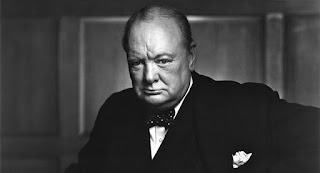
Winston Churchill ca. 1946

Winston Churchill was famously reputed to have said of his decisions in World War 2 that "History will be kind to me, as I intend to write it." It is largely forgotten now that the perpetually-broke Churchill made his living as a best-selling author of history books, so this was no casual assertion. [For the record, Churchill's actual quote was "For my part, I consider that it will be found much better by all Parties to leave the past to history, especially as I propose to write that history"]. Giant figures in rock music, notably Bill Graham, implicitly took Churchill's adage to heart. Graham is widely viewed as the greatest rock concert promoter in the 20th century, a view widely promulgated by Bill Graham. It isn't untrue, by the way--it's just that Bill made sure that the entire rock world heard his version of events first and loudest.

Bill Graham's modern twist on Churchill, however, was not as an author but as an interview subject. Graham gave more interviews than perhaps all rock promoters put together, always had a great story, told them well, and never told a provable lie. Sure, sometimes he favored his own interpretation of events. Every journalist and rock star biographer told Bill Graham's version of the story, and the very best of Graham's practices and innovations--and there were many, to be sure--took front and center, cementing Graham's legacy forever. Rock History was indeed kind to Bill Graham, but he was instrumental in the composition of that history.

In the Spring of 1973, Bill Graham took a big swing in the Southern California rock market, planning to put on the biggest concert in regional history. He struck out, massively. He never mentioned the event again, not in a meaningful way, and the story disappeared. In retrospect, Bill actually looks pretty good: he was absolutely right about everything, but he was just a little bit early. But that wasn't the story he wanted to tell, so he didn't tell it. Only the bare outlines remain.

Image

Rock Festivals and Major Rock Venues: Status Report early 1974

Rock Festivals were a product of the 1960s. Gina Arnold's excellent 2018 book Half A Million Strong (University of Iowa Press) tracks how "free shows in the park" evolved into "giant multi-day events in some farmer's muddy field" over the course of a few years (yes, she's my sister but you should still read it). By the time of the biggest festivals of 1969 and 1970, most famously Woodstock, hundreds of thousands of people would come to some outlying area and camp out for several days, while live rock music blasted 24/7. Legendary as these events were, most fans did not attend more than one giant event, and most communities that endured a huge rock festival did not tolerate a second one.

The live rock music business got bigger every year, and various efforts were tried to find a way to have "festival" events on a large scale. Multi-act events were appealing to promoters because they inherently hedged risk in a volatile music market. Since shows had to be planned many months in advance, it was hard to anticipate how one band might have a breakout hit, and how another may have become over the hill, or even broken up, in the few short months between booking the show and playing it. In early 1969, for example, Led Zeppelin found themselves playing tiny auditoriums, sometimes as the opening act, with their debut album roaring up the charts, while at the same time Vanilla Fudge found themselves no longer the draw they had been the year before. A rock festival, with dozens of acts over a few days, could more easily absorb the hits and misses. Promoters continued to search for a way to book multiple acts profitably.
Image
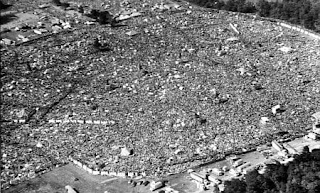
An aerial shot of the Watkins Glen Grand Prix Course on July 28, 1973, with some of the 600,000 fans in attendance at the Allman Brothers/Grateful Dead/Band rock concert

Rock Concerts at Auto Racing Tracks
The immediate and vast popularity of rock festivals posed a very specific land-use problem. Places like Indian Reservations and farms were not really viable for major, multi-day events, since too many things could go wrong. Equally importantly, despite or because of the increasing crowds, it was all but inevitable that rock festivals would become "free concerts." Liberating as this may have seemed at the time, it ensured that the events could not make enough money to provide a safe, repeatable event for bands, patrons and host communities. The financial opportunities of rock festivals were huge, however, and since nothing says "rock and roll" like "land use," over the years there was a concerted effort in the concert industry to find spaces that could successfully and profitably host occasional, loud outdoor events with giant crowds.

One of the intriguing solutions for hosting giant rock festivals was to use facilities designed for auto racing. Race tracks were usually somewhat removed from urban areas while still being near enough to civilization to attract a crowd. Auto races themselves were noisy, and major race events tended to occur just a few times a year and last an entire weekend, just like a rock festival. Since race tracks were permanent facilities, they generally had fences, bathrooms, water, power and parking, so in many ways they would seem like ideal venues for huge rock events. Indeed, some of the major rock events of the 1969 and the 1970s were held at race tracks. 

Image

Two of the most successful rock festivals were held at Dallas International Speedway and Atlanta International Raceway, both organized in 1969 by promoter Alex Cooley. Both tracks were giant NASCAR "super-speedway" ovals.  The Rolling Stones' debacle at tiny Altamont Speedway might not have happened had it been held at its original site, the newly-opened Sonoma Raceway, then a newly opened Road Course in rural Sonoma County, near the San Francisco Bay. 

I looked at some of the history and economic dynamics of Auto Racing tracks as Rock Concert sites in another post, although for purposes of scale I focused on the Grateful Dead. Generally speaking, while auto racing had been popular since the invention of the automobile, horse racing had been hugely popular in cities and county fairs throughout the United States, long before cars were invented. However, after WW2, when the GIs returned and economy boomed, America moved from its rural roots to a more urban and suburban universe, and the automobile became a more important part of everyone's life. A national boom in the popularity of auto racing corresponded with a slow decline in the popularity of horse racing. 

By the early 1960s, numerous custom-built facilities served the hugely popular auto racing industry, with oval tracks (for NASCAR and "Indianapolis" cars in the South and Midwest), road courses (for sports cars on both coasts) and dragstrips (nationwide). These facilities were actually ready-made for rock concerts, but there were some huge cultural divides. With a middle-class family audience for auto races, and their Dow Industrial sponsorship from major companies, racetrack promoters were neither tuned into nor inclined to sponsor long-haired outlaw rock concert events flaunting nudity and drugs. 
Image
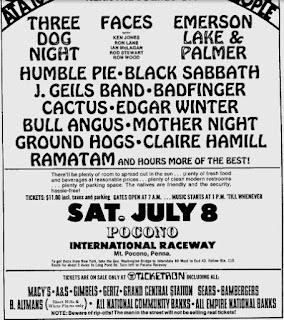
On July 8, 1972, Concert 10 presented a multi-act rock show at Pocono International Raceway in Long Pond, PA. Due to a huge rainstorm, the headliners did not appear until the dawn hours of July 9. The fine print says "the natives are friendly and the security, hassle-free"

Rock Concert Economics: 1973

In 1973, there was a huge audience for live rock music, but that audience was young, and without much ready cash. Also, since rock music stood for "rebellion," the most popular of rock music attractions were vulnerable to the complaint that they were charging "too much" for tickets. The inevitable result of these pressures was that popular rock bands put on concerts in larger and larger venues, instead of charging more at smaller places. By 1973, the most popular bands were selling out basketball arenas with capacities of 12,000 or more, even in so-called "secondary" markets. Ticket prices were reasonable, around 4 or 5 dollars usually, but the total number of tickets sold was larger than ever.

By the early 70s, multi-act "Festival" shows had mostly been financial debacles and public relations disaster, and it wasn't just Altamont: check out the saga of the "Erie Canal Soda Pop Festival" in Griffin, Indiana on Labor Day weekend of 1972. Smart promoters were looking for other workable venues, and race tracks re-appeared on the horizon. An interesting thing to consider about auto racing was that--because of the noise--they had to generally be well outside any populated areas, but still within driving distance of a lot of potential fans. At the same time, since fans had to drive a fair amount, a race track generally offered a whole slew of races during a weekend at the track, not just a headline race. These economics pretty much defined multi-act rock concerts, just for a different, younger fan base.

On July 8, 1972 there had been a huge multi-act rock festival at Pocono Raceway in Pennsylvania. Pocono Speedway, in rural Long Pond, was nonetheless in driving distance for a huge population of teenagers in greater Pennsylvania and parts of Northern New Jersey. Pocono Raceway was less than an hour from Scranton, Allentown and Nazareth, and about 90 minutes from the suburbs of Philadelphia and Newark. There was a huge population of suburban rock fans with access to their parent's cars. 120,000 fans showed up to see Emerson, Lake and Palmer, Faces, Humble Pie, Three Dog Night and and numerous other bands, completely overwhelming the facility. The interest was there.

The parallel development at this time was rock concerts at football or baseball stadiums, full-size major league ones. There had been experiments with stadiums going back to the Beatles, but they had been unsatisfactory. The live rock music audience had gotten bigger, however, and sound systems had improved as well. The first "modern" rock concerts at football stadiums were on May 4 and 5, 1973, when Concerts West hsd produced Led Zeppelin shows at Tampa Stadium and also at Fulton County Stadium in Atlanta. Upwards of 40,000 fans attended each concert. All fans bought tickets, too, setting paid attendance records at the time for such venues. Uniquely, Led Zeppelin were the only act for both shows, with no opening bands. 

The rock market was finding new mega-venues, and Bill Graham wasn't going to be left out. Graham was a self-promoter, yes, but he thought big--he was going to break in two mega-venues of his own, one at home in the Bay Area and the other down in Southern California.

Image

Bill Graham was the king of concert production in San Francisco, but he had only occasionally put on shows in Los Angeles. Southern California did not have a dominant promoter, however, so there was still room for Bill to operate. To do that, however, he needed to make a splash, and to make a splash he needed a place. It looked like that place was the Ontario Motor Speedway, an innovative and newly constructed auto racing track that had only opened for full-time racing in Summer 1970. 

The city of Ontario, CA, had been founded in 1891, and named by transplanted Canadians. Ontario is 35 miles East of Los Angeles, and 23 miles South of San Bernardino. Part of San Bernardino County, it is on the Western Edge of the proverbial Inland Empire. Ontario had been the site of a World War 2 Army Air Force Base, which remained an Air National Guard base after the war (and would remain so through 1995). The airport had also been established for civilian use in 1946 as Ontario International Airport. The Airport was joined to LAX in 1967, and jet flights had begun at the airport in 1968. Although Ontario only had a population of 64,118 in the 1970 census, as a result of the airport and the airbase it was at the nexus of a substantial freeway network. I-10 and I-15 met at Ontario Airport, so all of Southern California could get there easily.

Auto racing was booming in the 1960s, yet Los Angeles was underserved by facilities. Yes, there was the epic Riverside Raceway, another 25 miles East, but that made it even farther from LA proper. More importantly, Riverside was just a road racing facility--albeit a great one--and that limited the types of major events that could be held there. Ontario Motor Speedway was conceived as a full-service answer to every auto racing sector in the Los Angeles area, in a location near the city. The airport location was crucial, too, since major auto racing teams barnstormed around the country like touring rock bands, and drivers and even their race cars were often flying directly from track to track. 

Ontario Motor Speedway was custom built to provide first class facilities for all the major types of racing: an oval for NASCAR and Indianapolis cars, a road course (that included part of the oval) for road racing and a dragstrip. Besides advanced pit facilities, OMS also pioneered what we now call "clubhouses" and "luxury suites" for sponsors. It was a well-conceived endeavor. The plan was to have not only top level NASCAR and USAC (Indy Car) 500-mile races, but Formula 1 and NHRA Drag racing. The inaugural race was the (Indy Car) California 500 on September 6, 1970, with paid attendance of 178,000, a huge crowd even by auto racing standards. Jim McElreath beat out an All-Star field of drivers that included Mario Andretti, A. J. Foyt, Dan Gurney and the Unser brothers.
Image
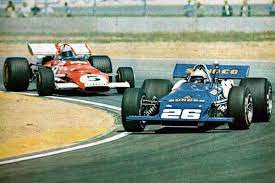
Mario Andretti (5) in a Ferrari 312B F1 car, about to lap Mark Donohue (26) in a Lola-T192 Chevy F5000 car. Andretti would win the Questor Grand Prix, the only F1 race at Ontario Motor Speedway, on March 28, 1971

After a hugely successful opening, however, Ontario Motor Speedway had a number of events in 1971 and '72 that did not live up to financial expectations. The racing was great--it was the early 70s--but after the September '70 opening, the Speedway didn't catch LA like it should. The big plan was that Ontario would host a 2nd United States Grand Prix, which hitherto had been the exclusive province of Watkins Glen in New York. As a prelude, Ontario Motor Speedway held a non-Championship Formula 1 race, the Questor Grand Prix, on March 28, 1971, won by Mario Andretti in a Ferrari 312B. The event was a financial bust, however, and Formula 1 cars never ran at Ontario again (ultimately Long Beach, CA, would get the second US Grand Prix). Although 1971 went alright, the 1972 Ontario attendance, despite great racing, were a financial letdown. Thus by 1973, Ontario Motor Speedway would have been open to the possibility of different promotions. 
Image
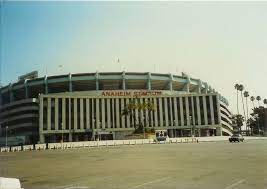
Anaheim Stadium, Anaheim, CA July 10, 1973

Southern California Stadiums
There were plenty of stadiums in Southern California, but none of them were particularly ripe for rock concert promoters. Dodger Stadium was under the full control of the Dodgers, and they didn't share it. The Los Angeles Coliseum was old (opened 1921) and in and was near "undesirable" (read: "too African-American") neighborhoods. The Rose Bowl, in Pasadena, had access and parking issues. That left Anaheim Stadium, in Orange County. But it was just across the road from Disneyland, and The Mouse would not want weekend parking disrupted by hordes of young rock fans. In fact, starting around 1976, Anaheim Stadium would become the primary home of stadium rock concerts in Southern California, with the full cooperation of Disneyland, but that was a few years away. In any case, Bill Graham was from out-of-town, not well-placed to talk local stadium operators into cooperating.

Ontario Motor Speedway was a different matter. It had been well-conceived and well-built, but after initial excitement, the attention had died down--same as it ever was for LA--and it was going to need additional sources of revenue. May 27, 1973 was the Sunday of Memorial Day weekend, and the biggest day for auto racing in America. Since all American race fans would be glued to their Televisions watching the 57th running of the Indianapolis 500, it was a perfect day for Ontario Motor Speedway to try something else. Bill Graham had figured out that he had a perfect venue in Southern California, and more importantly, a venue that needed him and his rock-concert expertise. 

What did the Ontario Motor Speedway offer as a rock concert venue?
  • Its location (35 miles E of LA, 23 miles Southwest of San Bernardino) put in close proximity to tens of thousands of potential rock fans.
  • The convergence of the I-10 and I-15 freeways meant that an even larger pool of rock fans could drive to the Speedway fairly easily, from either San Diego (on I-15) or nearer the Pacific Coast (I-10). Ontario was just outside of Central LA, so the majority of potential fans could circumnavigate the often brutal traffic jams that the region was infamous for.
  • In Southern California, it's always sunny and it never rains, so weather wasn't a consideration.
  • The racing facility had parking for 50,000 cars, and apparently there were satellite lots as well. No need to worry about cars abandoned by the side of the road on some farm road.
  • The grandstands featured 95,000 seats, with 40,000 "bleacher" seats in temporary grandstands, and a substantial crowd could fit on the infield. It was plausible to imagine 200,000 or more fans at an Ontario Speedway rock concert (178,000 had attended the inaugural California 500 race). This was double the capacity of even the enormous LA Coliseum.
  • Ontario Motor Speedway had debt to service and was looking for other sources of revenue, so they would be eager to work with a partner like Bill Graham.
  • Most importantly, the huge grandstands around the track, and hence around the facility, ensured that the facility was cordoned off. That meant it was plausible to ensure that only those with tickets would get into the show. At giant rock festivals, the economic issue was always gate-crashing, but that was usually in some giant, muddy field. The Speedway acted as fence, and entry was through controlled tunnels under the grandstands.
Image
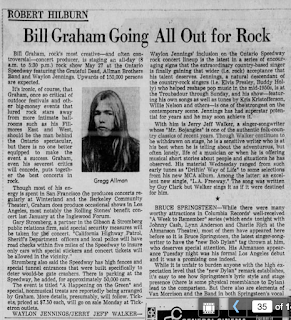
Robert Hilburn's column in the LA Times May 5, 1973

A feature in the Los Angeles Times mapped out the strategy I described above. Robert Hilburn was the Times' principal rock critic, and he had a "Saturday Roundup." On May 5, the Ontario Speedway concert was the primary topic, with a photo of Gregg Allman and quotes from a high-powered public relations executive (remember, in Los Angeles, PR equaled prestige).

Bill Graham Going All Out For Rock (Robert Hilburn, LA Times May 5 '73)
Bill Graham, rock's most creative--and often controversial--concert producer, is staging an all-day (8am to 5:30pm) rock show May 27 at the Ontario Speedway featuring the Grateful Dead, Allman Brothers Band and Waylon Jennings. Upwards of 150,000 persons are expected.

It's ironic, of course, that Graham, once so critical of outdoor festivals and other big-money events that lured rock stars away from more intimate ballrooms such as his Fillmores East and West, should be the man behind the Ontario spectacular, but there is no one better equipped to make the event a success. Graham, even his severest critics will conceded, puts together the best concerts in rock.

Though most of his energy is spent in San Francisco (he produces concerts regularly at Winterland and the Berkeley Community Theater), Graham does produce occasional shows in Los Angeles, most notably The Rolling Stones' benefit concert last January at the Inglewood Forum.

Gary Stromberg, a partner in the Gibson & Stromberg public relations firm, said special security measures will be taken for the concert. "California Highway Patrol, Sheriff's Department officers and local police will have road checks within five miles of the Speedway to insure that only cars with special stickers and concert tickets will be allowed in the vicinity."

Stromberg also said the Speedway has high fences and special tunnel entrances that were built specifically to deter would-be gate-crashers. There is parking at the Speedway, he added, for approximately 50,000 cars.

The event is titled "A Happening on the Green," and special non-musical treats are reportedly being arranged by Graham.


Image

This aerial shot of Kezar Stadium (exact date uncertain)


Meanwhile, Back In San Francisco

Whatever your modern-day view of Bill Graham might be, he didn't think small. In May 1973, Graham was planning to expand his empire with a dramatic entrance into the Southern California market. But he had big plans for Northern California as well. On May 4, information was quietly leaked (through the Hayward Daily Review rock column "KG") that the Grateful Dead would headline two concerts at the Cow Palace on Tuesday and Wednesday, May 21-22. Also on the bill would be Willie Nelson and the New Riders of The Purple Sage. This was a surprising booking on a number of levels.

The Grateful Dead had an extraordinarily loyal audience in San Francisco, but the band wasn't really that big. The Dead had headlined three weeknight concerts at the (officially) 5400-capacity Winterland back in December (Sunday-Tuesday December 10-12), followed by New Year's Eve. Those four shows had sold out without meaningful advertising. Yet the Cow Palace was a 16,000-capacity barn in Daly City, on the outskirts of San Francisco. Were there really enough Dead fans to fill it up for two weeknights? Willie Nelson was a rising star at this time, but he was no proven commodity in the Bay Area. Tickets went on sale, but it almost seemed to be a stealth show.

Image
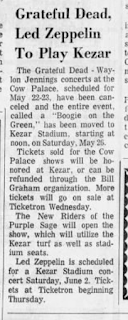
The San Francisco Examiner, May 14, 1973

On Monday, May 14, Graham showed his hand. The two Cow Palace Grateful Dead concerts were rescheduled for Saturday, May 26 at Kezar Stadium in Golden Gate Park. Kezar Stadium, opened in 1925, had been the home of the San Francisco 49ers until the 1971 NFL season. Kezar was now largely unused, but it was in the center of the city and relatively easy to get to by freeway from surrounding counties. On top of that, most Bay Area residents knew how to get to Golden Gate Park, so it was a workable destination. Kezar was small for an NFL stadium (about 60,000), but huge for a concert facility. With no competing sports dates, Kezar would be easier to schedule than an active stadium.

Image
More importantly, the weekend after the Grateful Dead, Graham announced that Led Zeppelin was going to headline Kezar Stadium. As noted, Zeppelin had begun their tour by headlining stadiums in Tampa and Atlanta. Now Graham was going to book Zep's biggest concert on the West Coast. Over the course of just eight days, Graham was planning to put on the Grateful Dead at Kezar (Saturday May 26, with Waylon replacing Willie), the Allman Brothers and the Dead at Ontario (Sunday May 27) and Led Zeppelin back at Kezar (Saturday June 2).

Grateful Dead, Led Zeppelin To Play Kezar (SF Examiner, May 14 '73)
The Grateful Dead-Waylon Jennings concerts scheduled for May 22-23, have been canceled and the entire event, called a "Boogie on the Green," has been moved to Kezar Stadium, starting at noon, on Saturday, May 26.

Tickets sold for the Cow Palace shows will be honored at Kezar, or can be refunded through the Bill Graham organization. More tickets will go on sale at Ticketron Wednesday.

The New Riders of the Purple Sage will open the show, which will utilize the Kezar turf as well as stadium seats.

Led Zeppelin is scheduled for a Kezar Stadium concert Saturday, June 2. Tickets at Ticketron beginning Thursday.
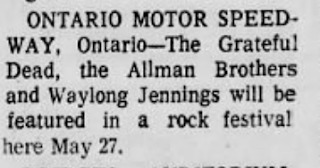
The Grateful Dead/Waylon Jennings show at Kezar drew about 30,000 fans, and was a huge success. The Led Zeppelin show on the next weekend was sold out, drawing twice as many fans. The noise bothered the local neighborhood--the sound system was in a different location than it had been for the Dead--, and Led Zeppelin's fans were not as welcome in the Haight-Ashbury as Deadheads. Bill Graham had proof-of-concept for his "Day On The Green" all-day stadium concerts, but he moved them to the more accessible Oakland Coliseum. They would thrive there for many decades.


Image
May 12, 1973 Pomona Progress-Bulletin listing

 May 1973 Status Report: Allman Brothers, Grateful Dead, Waylon Jennings, New Riders
The Allman Brothers Band would be the premier attraction at the Watkins Glen Summer Jam concert on July 28, 1973, attracting around 600,000 fans. 150,000 of them even paid. From the Summer of 1973 through the Fall of 1975 the Allman Brothers were one of the premier concert attractions in the country. You can make a good case that Led Zeppelin and Emerson, Lake & Palmer were equally as popular as the Allmans, but they weren't bigger. Now, granted, the Rolling Stones didn't tour and Bob Dylan only played indoor arenas, but the Allmans were a massive outdoor draw all over the country. Watkins Glen was the biggest, by far, but it wasn't a fluke.

Most rock fans from the era recall that Summer '73 was when the Allmans broke through with their mega-hit "Ramblin' Man," a catchy country tune that was not particularly typical of the bluesy jamming on which the Brothers had made their bones. "Ramblin' Man" was reminiscent of "Blue Sky," sure, and maybe "Revival," both of them Dickey Betts songs as well, but it wasn't at all like "Statesboro Blues" or "Whipping Post." So the idea that the Allmans began to dominate the US concert market when they got their big hit single is compelling. But it's wrong. 

The Allman Brothers had a massive successful US tour in the Summer of 1973. The first highlight was an epic double-bill with the Grateful Dead at Washington, DC's RFK Stadium, on the weekend of June 9-10. Yet that event was eclipsed by the triple-bill at Watkins Glen on July 28. Nonetheless, the Allmans' follow-up release to Eat A Peach, which had come out back in February '72, would not even be released until August of '73, after the Watkins Glen show. "Ramblin' Man" was the first single, released at the same time, and it would go on to reach #2 on the Billboard charts. Now, sure, advance copies of Brothers And Sisters and the "Ramblin' Man" 45 were probably on FM radio (or even AM) in late July, but the huge successes of RFK and Watkins Glen were before the album and single had even been released. The Allman Brothers Band were huge because they were huge. FM radio listeners had caught up to them, and FM radio played them constantly throughout 1972 and '73.

The Allman Brothers Band's third album At Fillmore East had been released in July 1971. As America was slowly catching up to their stunning sound, Duane Allman was killed in a motorcycle accident on October 29, 1971. As a result, the band's followup, Eat A Peach, a double-lp that was half studio and half live, received extraordinary (if well-deserved) attention. And if that wasn't enough, Derek And The Dominos had a hit in Summer '72 with the by-now18 month-old "Layla," and Duane's interplay with Eric Clapton drew even more attention to him. The Allmans were in the process of recording the sequel when bassist Berry Oakley died in a motorcycle accident almost exactly a year after Duane (on November 11, 1972). Interest in the Allmans inevitably redoubled. In 1973, Capricorn Records released a double album of their first two records (Allman Brothers Band and Idlewild South) as Beginnings, so the Allmans were all over the radio throughout the Summer, even though they did not yet have a new album. 

The Grateful Dead, meanwhile, had risen above the level of cult status, even if they were only somewhat of a "major attraction." The band had released four gold albums in a row (Workingman's Dead, American Beauty, Grateful Dead ['Skull & Roses'] and Europe '72), and they, too, got their share of play on FM radio. In the case of the Dead, the songs played on FM were likely the more rocking songs in their repertoire (like "Bertha" or "Sugar Magnolia"), rather than big jams like "Dark Star," but they were Dead songs nonetheless. The Dead would leave Warner Brothers to go independent at the end of 72, but they would not release their final record on the label (Bear's Choice) until July of '73.

The New Riders of The Purple Sage no longer featured any members of the Grateful Dead, but they still shared booking and other services with them. By May 1973, the Riders had released three albums on Columbia. The Dead tried to book the Riders as openers when it fit. Clearly, they fit in at Kezar but not Ontario.

Waylon Jennings (1937-2002) was an established country singer, but he had roots in rock and roll. Jennings had been the bass player for Buddy Holly and The Crickets, and had graciously offered to give up his seat on the airplane to The Big Bopper, on the fateful flight on February 3, 1959 that crashed, killing Holly, the Bopper, and Ritchie Valens. Jennings had gone on to success as a Nashville singer, but he had never been happy with how his records were made. By '73, country rock was starting to become a commercially viable enterprise, with the Eagles as the most prominent band, along with a slew of other groups like Poco, the New Riders and Pure Prarie League. The unhappy Jennings, however, tapped into something much more potent than hippies playing rock and roll with a twang.

The more potent and lasting merger of country music and the 60s would be the music coming out of Austin, TX. Genuine country musicians, with proper Nashville pedigrees, would move to Austin, grow their hair, light one up and pretty much play the same music they had been playing before. OK--maybe there was a bit more attitude, but that wasn't incompatible with older roughneck country, anyway. One of the earliest converts was Jennings. 

In 1972, Jennings had had a pretty good hit with the song "Ladies Love Outlaws," and RCA still wanted him to be a typical Nashville artist. By 1973, however, Jennings had moved to Austin, TX, to join fellow outcast Willie Nelson, and RCA finally saw the light. Jennings kept the beard he had grown, and "Outlaw Country" followed, with Willie and Waylon in the forefront. Sharing bills with the Grateful Dead and the Allman Brothers in California was a huge break from country practice. Jennings was consciously and enthusiastically aligning his music with long hair, weed and loud, loud music.

Image
What Happened: Ontario Motor Speedway
On Monday, May 22, Robert Hilburn explained in the Los Angeles Times that the Dead/Allmans/Waylon concert would be canceled. The reason given was that the police were going to insist that the concert end by nightfall, because of some incident at a concert in Stockton.

Ontario Rock Concert Canceled by Graham (Hilburn LA Times May 22 '73)
The all-day Grateful Dead-Allman Brothers-Waylon Jennings rock concert Sunday at the Ontario Motor Speedway--which had been expected to draw upwards of 150,000 persons--has been canceled, producer Bill Graham has announced.

"Trouble with several youngsters at an April 29 outdoor concert in Stockton caused Ontario civic official to take a hard, long look at the May date," Graham, who was not involved in the Stockton event, said. Specifically, police said the concert--the first of its kind at the huge speedway--would have to end three hours before dark, or approximately 5:54pm, he added.

Since the Allmans and the Grateful Dead were scheduled to play several hours each, Graham said he doubted he could honestly end the show by that time." He pointed out the Dead played six hours recently at an outdoor concert in Des Moines, Iowa. Though normally outspoken, Graham made it clear he was not blaming anyone. "All the Ontario officials and police were extremely cooperative. Under the time limits imposed however, I didn't feel we could have given the kids the show we promised.

Graham said he is proceeding with plans to present Leon Russell Aug. 5 at the Ontario facility. Ticket sales for the Sunday event were described as "healthy" by a spokesman for the San Francisco-based producer. 

You can buy this story if you like. Maybe there were some elements of truth to it, I don't know. Here's what I think--the concert didn't sell enough advance tickets, and it no longer made economic sense. Remember, Graham's team would have had to construct a huge stage and a ginormous sound system, and fly the Allman Brothers, the Dead and Waylon Jennings in from out of town.  The Times article says that the concert was "expected to draw upwards of 150,000 patrons." If Graham had those kind of ticket sales, he would have found a way around any police objections (if those objections were real), by paying for better lighting, more security or whatever it took. But I don't think the ticket sales were there. Given that we know that the Allmans and the Dead would pack Watkins Glen just two months later, why could that have been?
Image
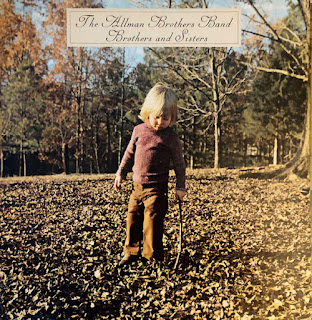
Although this fine album was a massive hit, it doesn't shout "Los Angeles Summer of '73" to me

The West and The East

The West Coast and the the East Coast were very different concert markets in the 1970s. The Midwest and the South probably were different, too, but I have done less research into them, so I won't generalize. A characteristic of East Coast events from 1969 onwards was the willingness of large numbers of young people to get in their cars and travel for rock concerts. An event like Woodstock drew not just from New York state but all of New England, Pennsylvania and New Jersey. Population was much more distributed in the East. There were a lot of medium-sized cities full of young people anxious to see major rock bands, and they would travel. The phenomenon of Deadheads driving hundreds of miles to every show originated as an East Coast phenomenon. 

The West, even in California, was considerably less populated in the 1970s. The vast suburbs of Los Angeles, the Bay Area, Fresno and Vegas were far smaller then. It wasn't that young people didn't love rock and roll as much, they surely did, but once you got outside the major metro suburbs, there just weren't that many people. Fresno, to name just one outlying city, had 165,655 residents in the 1970 census, while it would have 542,107 in 2020. There were just fewer young people ready to hop in their parents' cars and see a big rock show. Few Deadheads from San Francisco would have been planning to travel down to Ontario, since the Dead were playing the afternoon before. As for LA, the Dead had already booked three shows at the Universal Amphitheatre on June 29-July 1, so it's not like Deadheads would lose out.
Image
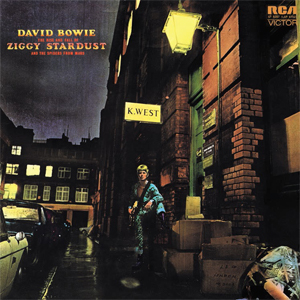
Los Angeles and San Francisco aren't the same, which is what makes California great

Also, while both the Grateful Dead and the Allman Brothers were popular bands, I don't think they were particularly popular in 1973 Los Angeles. Now, sure, there were plenty of fans who liked each band, or both bands. But LA was huge, so any band could sell tickets--Jethro Tull, Black Oak Arkansas, The Yes, you name it. But the Allmans and the Dead were hippie guitar hero bands--was that what was happening and what was going to impress everybody in LA on Monday morning when you got back to school? I don't think so.

Did the Allmans or the Dead have a hit single on the radio? Definitely not. Did this matter in Los Angeles? Well, you decide, but it was the biggest record industry town in the history of the record industry, so I think you had to be super-cool or on the charts, and the Dead and the Allmans were neither. I think ticket sales were tepid, and Graham canceled the show. 

Some months later, in the East it was different. The tens of thousands who bought tickets for Watkins Glen weren't downtown Greenwich Village hipsters, they were kids in Syracuse or Allentown or Parsippany who wanted to see some big time rock bands. None of those bands were coming to their town, and their parents weren't necessarily OK with them driving to Manhattan, but some racetrack out in the countryside? Yeah, why not? The kids could have got permission to go the US Grand Prix, so why not a concert?

Graham's assessment of the Allman Brothers and the Dead as a booking pair was correct, but his location was off by 3000 miles. He was also right about the Ontario Motor Speedway, although he picked the wrong bands. The following Spring, Ontario Motor Speedway would hold the "California Jam" on April 6, 1974, an all-day affair headlined by Emerson, Lake & Palmer, Deep Purple and the Eagles. Actual attendance was well North of 200,000, but more importantly paid attendance was around 168,000, breaking every record known for a paying concert. That record would hold until "Cal Jam 2," also at Ontario Motor Speedway, on March 18, 1978. Cal Jam 2 had at least 175,000 paid.

So the planned May 27, 1973 concert at Ontario Motor Speedway had all the right pieces for an epic success of unimagined proportions, but in the wrong combination. We are left with only a poster.

Image
 
 
Postscripts
  • The August 5 Leon Russell concert booked for Ontario alluded to above seems to have been moved by Bill Graham to Oakland Coliseum, the first in what was a decades-long success in outdoor stadium concerts at that venue.  The Grateful Dead show at Kezar (on May 26) was a huge success, but the sold-out Led Zeppelin show did not go over well with the neighborhood, leading to the shift to Oakland Coliseum.
    Image

  • update 20240201: it turns out the Leon Russell concert was indeed held at Ontario Motor Speedway, on Sunday, July 29, 1973. This was the first rock concert at the Speedway. Leon had just released his monster hit triple album Leon Live. Per the July 31 Times, around 30,000 showed up, but Bill Graham was expecting 80,000. In a strange bit of symmetry, this was the same weekend as the Dead/Allmans blowout at the Glen, and Leon had originally been booked there. The Dead and the Allmans had preferred The Band, and Leon was bought out of the gig.
  • The first second concert at Ontario Motor Speedway has been entirely forgotten. On November 24, 1973, Three Dog Night and the Guess Who headlined a rainy Saturday at the Speedway. There were several opening acts, something like 25,000 people and per a Dennis Hunt Times review, a miserable time was had by all. It must have served as proof of concept, however, since Cal Jam was held five months later.
  • Bill Graham and the promoters of the Watkins Glen attempted another event at Ontario on August 3,1974, headlined by Crosby, Stills, Nash & Young. Tickets were even sold, but the event was canceled.
  • Ontario Motor Speedway was a well-designed and forward looking auto racing facility, but it did not succeed financially. The Speedway was open from August 1970 to December 17, 1980. Per Wikipedia, by 1980, the Ontario Motor Speedway bonds were selling at approximately $0.30 on the dollar. Generally unknown and unrealized by the bond-holding public, the 800 acres (3.2 km2) of land originally purchased at an average price of $7,500 per acre, had now risen to a value of $150,000 per acre. Chevron Land Company, a division of Chevron Corporation recognized the opportunity to acquire the bonds and effectively foreclosed on the real estate. For approximately $10 million, Chevron acquired land which had a commercial real estate development value of $120 million, without regard to the historic significance or future potential of the speedway.
  • From above, you can still see traces of Turn 3.


Appendix: Where Was Ontario Motor Speedway?

The speedway was bordered on the north by 4th Avenue (then referred to as San Bernardino Avenue), on the south by Interstate 10, the west by Haven Avenue, and the east by Milliken Avenue, which still has the eastward curve needed to make room for turn 1 and turn 2 of the racetrack.   Milliken Avenue is one of (maybe the only) street with curves like this in the entire city. 

Contrary to those news reports about the Ontario Mills Mall being built inside the old racetrack, this is not the case.  Ontario Mills Mall lies across the street, due-east of what was the racetrack, on the east side of Milliken Avenue.  When the Speedway was still in existence, the future home of Ontario Mills Mall was either empty fields, or parking areas, depending on the year. 

Even though virtually nothing remains of the race track, other than some of the raised-berms that made turn number 3 at the corner of 4th and Haven Avenues, The City Of Ontario has retained some of the history and heritage of the racetrack by building Ontario Motor Speedway Park a few blocks west of the racetrack site and by using auto racing inspired street names in and around the old speedway.  Let’s give Ontario some credit for these street names! (Jaguar Way, Corvette Dr, etc)

Appendix 2: Population of Ontario, CA
1960    46,617        103.8%
1970    64,118        37.5%
1980    88,820        38.5%
1990    133,179        49.9%
2000    158,007        18.6%


Thursday, July 4, 2013

Grateful Dead Performances At Race Tracks 1969-88


Image
The poster for the New Orleans Pop Festival, on August 31-September 1 1969, held at the Baton Rouge Speedway in Prairieville, LA
The Grateful Dead were pioneers in moving rock concerts into new spaces. Rock concerts in the 1960s moved beyond buildings formally designated for performance into wide-open spaces. The Grateful Dead were at the forefront, as the first of the major Fillmore bands to start playing regularly for free in public parks in order to promote their music. When multi-act, multi-day rock shows moved beyond County Fairgrounds to empty farms, the Grateful Dead were at the major early events.

However, the immediate and vast popularity of rock festivals posed a very specific land-use problem. Places like Indian Reservations and farms were not really viable for major, multi-day events, since too many things could go wrong. Equally importantly, despite or because of the increasing crowds, it was all but inevitable that rock festivals would become "free concerts." Liberating as this may have seemed at the time, it insured that the events could not make enough money to provide a safe, repeatable event for bands, patrons and host communities. The financial opportunities of rock festivals were huge, however, and since nothing says "rock and roll" like "land use," over the years there was a concerted effort in the concert industry to find spaces that could successfully and profitably host occasional, loud outdoor events with giant crowds.

One of the intriguing solutions for hosting giant rock festivals was to use facilities designed for auto racing. Race tracks were usually somewhat removed from urban areas while still being near enough to civilization to attract a crowd. Auto races themselves were noisy, and major race events tended to occur just a few times a year and last an entire weekend, just like a rock festival. Since race tracks were permanent facilities, they generally had fences, bathrooms, water, power and parking, so in many ways they would seem like ideal venues for huge rock events. Indeed, some of the major rock events of the 1970s were held at race tracks, and the Grateful Dead's performances at race tracks from 1969 to 1988 offer a useful snapshot of the evolving rock concert market.

This post will review all of the Grateful Dead's scheduled performances at permanent facilities designed for auto racing. The most notorious of these events, the December 6, 1969 show at Altamont Speedway in Livermore, CA, was probably instrumental in insuring that race track operators were leery of rock concerts. Ironically enough, the concert at Watkins Glen Grand Prix Course in New York on July 28, 1973, showed how well race tracks could work. However, the economic evolution of the rock concert and auto racing industries veered in opposite directions, and the possibilities of rock concerts at race tracks was replaced by baseball stadiums and then custom built facilities like Shoreline Amphitheatre.

Image
Jim Hall's legendary 1970 Chaparral 2J, the "Sucker Car," driven by English rallying legend Vic ("Quick Vic") Elford
A Thumbnail History Of American Auto Racing After World War 2
In order to properly frame the different facilities that the Grateful Dead played, I will provide a brief history of the different types of Postwar auto racing. Automotively knowledgeable readers will have to forgive my simplistic categories. Generally speaking, while auto racing had been popular since the invention of the automobile, horse racing had been hugely popular in cities and county fairs throughout the United States, long before cars were invented. However, after WW2, when the GIs returned and economy boomed, America moved from its rural roots to a more urban and suburban universe, and the automobile became a more important part of everyone's life. A national boom in the popularity of auto racing corresponded with a slow decline in the popularity of horse racing.

There were three major forms of auto racing in the United States. One was sports car racing, which emphasized European or European-inspired cars driving on something resembling real roads. Initially sports car races were held on closed public roads, but by the mid-50s the cars had become too fast, and sports car races tended to move to custom-built road racing facilities. Sports car racing was most popular on the East and West coasts. California and the New York region led the way, with famous tracks like Riverside (in Southern California) and Bridgehampton (in Long Island).

A second popular form was drag racing. Drag racing tended to be more urban and suburban, since the facilities were smaller and fit more easily into the landscape. Needless to say, drag racing evolved from illicit automotive fun, usually at night on empty roads, into a serious competitive sport. Drag racing was hugely popular nationwide, and was culturally influential, but the tracks and events tended to more local or regional. The best known drag racers barnstormed across the country in local meets, with some sorts of similarities to touring rock bands. As a more urban phenomenon, drag racing had both a more working-class audience and was less exclusively white.

The third popular form of auto racing was oval track racing. Initially these speedways, as they were called, were less than a mile long--sometimes only a 1/4 mile--and often not even paved. The hard clay of the Midwest and the South was particularly conducive to this kind of auto racing. Speedways proliferated throughout the country, but oval tack racing was biggest in the Midwest and South. In the Midwest, with the inspiration of the Indianapolis Motor Speedway, emphasized custom-built specials. The South, with its tradition of moonshining and bootlegging, emphasized modified versions of production cars. NASCAR (The National Association of Stock Car Auto Racing) was financed in 1947 by many local bootleggers, and some of the principal early drivers had been well-schooled in building and driving "stock" looking cars that were anything but.

To some extent, all types of auto racing were prevalent all over the country, particularly in heavily populated regions like California and the industrial Midwest. However, the basic distinction of the three types of auto racing had some association with their different regions. Sports Car racing was the province of the coasts, drag racing was an urban and suburban pastime, and oval track racing was king in the Midwest and South, particularly in more rural counties. Just as the 1960s were a time in music when legends were born and everything seemed possible, the 60s was just as much a time of excitement and wonder in all forms of auto racing as well.

The increasing popularity of auto racing in America, in all of its forms, meant that from the end of the World War 2 to the birth of the Grateful Dead, numerous race tracks had been built up around America. When rock concerts got too large for indoor arenas, race tracks seemed to provide an answer. Rock concerts were loud, not always popular with the community, and the bands roamed from place to place. In that respect, race tracks seemed to provide pre-existing spaces that could be used for large scale concerts. It was no surprise that the rock festival industry came to that conclusion, too.

Image
Lots of great bands played the Labor Day New Orleans Pop Festival, and there was a Custom Bike show and a "Heavy Fireworks Display."
September 1, 1969 Baton Rouge Speedway, Prairieville, LA New Orleans Pop Festival
The Summer of 1969 was the Summer of rock festivals. Woodstock is the most famous, of course, but from May to December, there were huge outdoor festivals all over the United States and Canada. Many if not most North American rock fans were in range of a major outdoor festival sometime that year, even if their parents would not let them go to it. To name just a few events, these included The Big Rock Pow-Wow in Florida (May 23-25), Sky River 2 Festival (outside of Seattle, July 25-27), The Atlantic City Pop Festival (August 1-3) and of course Woodstock itself (August 15-17). All of these events featured a slew of major bands. All of them had various successes and failures, but in general they all struggled with accommodating giant crowds in a comfortable manner while still retaining economic viability. Woodstock, for example, was a financial disaster, only rescued by the extraordinarily popular film.

The festival promoters were learning as they went, however. Some of the most successful rock festivals occurred at the end of the summer. The Atlanta International Pop Festival was held on the weekend of July 4 (July 4-6), at the Atlanta International Speedway. Promoter Alex Cooley held a similar event two months later in Texas, on Labor Day weekend (August 30-September 1). The Texas event was held in Lewisville, TX, outside of Dallas, at the Dallas Motor Speedway. The Atlanta International Speedway, in Hampton, GA was built in 1960 as a 1.5 mile Superspeedway and remains an active NASCAR track today. The Dallas Motor Speedway was mainly a dragstrip, but it had a 1/2 mile oval and a 2.5 mile road course as well. The Texas facility ran into financial trouble immediately and closed in 1973.

The 1969 Texas and Atlanta events both had crowds of 100,000+, and both ran safely and on schedule. Other than the melting Southern heat, there were no real problems, and the events are fondly remembered by fans. The Atlanta event was profitable, and the indications are that the Texas event was too, or at least could have been. These two events seemed to be the first major rock events that suggested that auto racing tracks were a good place to hold a big rock concert. One of the biggest problems at both events, however, was that the surrounding communities were not comfortable with the "hippie invasion," even if every convenience store, motel and gas station were sold out for miles around. The cultural gap between hippie rock fans and the rural South was still very large in 1969.

That same Labor Day weekend of 1969, the Grateful Dead played their first rock festival at a racetrack. The New Orleans rock festival was held at a tiny oval track outside of Baton Rouge. Prairieville, LA is actually 60 miles West of New Orleans, most of the way to Baton Rouge (which is another 26 miles to the Northwest of Prairieville). Besides lots of great bands, like Santana, Janis Joplin and Canned Heat, the poster advertised a "Custom Bike Show," a whiff of the motorsports aura. The festival was fairly successful, but the tiny facility was no superspeedway. It had only been built around 1966, under dubious circumstances perhaps unique to Louisiana.

Image
This 1971 aerial photo of the Baton Rouge Speedway in Prairieville, LA, seems to be the only photograph of the site
A forum on old racing cars and tracks has uncovered what little information there is about the Baton Rouge Speedway in Prairieville (as opposed to the current Baton Rouge Speedway, in a different location):
There is very little info on this track out there, same with pictures.
It was known as Baton Rouge Int'l Speedway, and also Pelican Int'l Speedway.
You picture of the track is taken looking south; the track ran east/west, and the pit area was on the south side. The track was advertised as a 5/8ths mile, but in reality was almost 3/4 mile through the racing groove.

The track has a very checkered history; it was originally built by a man named Ed Grady; he was a teamsters boss. The track is rumored to have been built by the Louisiana Highway Department using taxpayer-bought material, under orders of the LA governor at that time. Not saying it happened that way, but it was never denied...
The governor had a kid who wanted to race, and they had the track built to give him a place to race. The kid was sponsored in part by the LA Tourism Bureau. Funny that, he hardly ever left LA to race, spent the tourism dollars in his his home state. And he could'nt drive a tricycle down a sidewalk, thankfully, he didn't last long.The governor, whose name I can't recall, and the kid both later did time; nothing unusual down there.
The track initially ran friday nights so as not to compete with Houston, Jackson and Mobile, all half mile tracks within 3-4 hours. The friday was an issue, as the traffic from the east around slidell hampered getting to the place. Track promotion was itself it's own nightmare story. I only got there once, in 1979; last time it ran.
It was originally built about 1966, and was off and on until 1978. The 79 race was the only event that year, twin 50 lap races won by Georgia Hotshoe Ronnie Sanders. The first event raced at the track was won by David Pearson.
The location is long gone, replaced by housing. If you go on Bing Maps, the location is easy to find. If you follow Hwy 73, aka Old Jefferson Highway southeast out of Baton Rouge, look for where it intersects Hwy 42, just North of Prarieville. You will actually be in Oak Grove. Just south of the intersection of 42/73, you will find Charleston Road running east. That was the track entrance. On your original pic, the road that makes a curve south of the track is the now Charleston road. Just North of Charleston is a road called Race Track road; that runs through the middle of the track footprint. 
As Labor Day weekend ended in 1969, however, it did seem like racetracks made pretty good facilities for rock festivals. Atlanta had been a big success, Texas had worked and New Orleans hadn't failed. Most people perceived Woodstock as a sort of lucky break--the festival got completely out of hand, but it all worked out anyway. The next to last rock festival of 1969 was a three day event in Palm Beach, Florida, at a sports car track and dragstrip (now the Palm Beach International Raceway). The November 28-30, 1969 Palm Beach International Pop Festival was headlined by no less than the Rolling Stones. So since the Rolling Stones were planning to headline a huge, free outdoor concert in San Francisco the very next week, doing it at a racetrack seemed like a pretty good idea.

December 6, 1969 Sears Point International Raceway, Sonoma, CA Rolling Stones/Grateful Dead/others (canceled)
Image
The restored Penske Racing Chevy Camaro with which Mark Donohue won the inaugural race at Sears Point, a round of the Trans-Am championship on September 21, 1969 (photo: Meccas Of Speed)
Sports car racing was hugely popular worldwide in the 1960s, and Northern California was prime sports car country. Road racing was hugely popular as well, and by a peculiar accident the best road track in Northern California was rarely available. Laguna Seca Raceway in Monterey was a beautiful, exciting track in a resort area, but unfortunately it was located on the grounds of Fort Ord, a U.S. Army base. Thus Laguna Seca was only available for a limited number of events. The Sports Car Club Of America's SF Region had given up on using temporary facilities--I saw the last race in the Candlestick Park parking lot in 1965, when the cars were simply too fast and two drivers died--so they looked to create their own custom built race track.

Sears Point International Raceway in Sonoma was in a nature preserve, far from any housing, yet it was still only an hour from San Francisco and the East Bay. The exciting, twisty course had 11 turns and many elevation changes, and it first opened in late 1968. The track had some financial problems, and by mid-1969 it was owned by Filmways, a movie studio. Although the race track was finished, the facility had not been fully built out by 1969. Nonetheless, the first major professional race was held there on September 21, 1969. At the time, the SCCA Trans-Am series had a half-dozen factory teams and numerous famous drivers, like Parnelli Jones, Dan Gurney and race winner Mark Donohue. I attended the race, and even I could tell that the facility was unfinished, but it was a beautiful setting with great sightlines.

Image
Although this photo is from a motorcycle race in 1985, it gives a pretty good idea of the panoramic vistas of Sears Point that made it appealing to Sam Cutler as a concert site. The "natural bowl" that Cutler refers to was probably off to the right of the photo (I think this is above Turn 6), but you can still get a feel for the site
Sam Cutler was no race fan, particularly, but he had been intimately involved in the Rolling Stones' search for a site for their promised free concert in the Bay Area on December 6. In his book You Can't Always Get What You Want (ECW Press, 2010), Cutler describes turning down various unacceptable sites offered by people who did not fathom the practical matters of over 100,000 people crammed into one space. Yet Cutler was suitably impressed with Sears Point as a prospective concert venue. He said (p.127)
[We] borrowed a car and [went] to see the site at Sears Point. We drove North [from Marin] for about half an hour, through rolling hills, and arrived at an isolated site. It seemed ideal. It had good access to the main north-south highway [CA37] and enough parking spaces for 100,000 cars. To one side of the racetrack there was a huge natural amphitheater. I walked around its perimeter to a point on its ridge where a stage could be erected. 
I could see for half a mile, in an arc of 180 degrees. It was a perfect spot for a concert
Concert preparations got underway at Sears Point, a stage was constructed and a giant sound system was put together. As we all know, however, negotiations stalled at the last minute and the concert was moved to the tiny Altamont Speedway. The name "Altamont" has been synonymous with everything wrong with outdoor rock festivals ever since. Its worth thinking, however, how a successful concert at Sears Point might have changed not only the rock concert landscape but the auto racing business as well.

What kept the Rolling Stones from playing Sears Point was the film rights. Sears Point Raceway was owned by Filmways, probably as a tax shelter, and while they could have cared less about racing,  film rights to an historic rock concert was something the corporation understood. They pushed too hard, however, and the stage and sound system were moved to Altamont in about 24 hours. Yet what if the concert had come off? Sears Point Raceway could handle the cars, and the sightlines were great. If people had had a relatively good time, Sears Point could have remade itself as a concert venue. Cutler was right--it was a perfect concert venue, and perfectly located. Even today, the same people who still see the Rolling Stones in California would be very happy to do it in Sonoma.

Yet Altamont was a disaster. The auto racing industry, which had to have quietly noticed the successes at Atlanta and Dallas, would have wanted nothing to do with rock after Altamont. Compared to the South, the Bay Area was a lot more hippie friendly, and Sears Point could have been Shoreline Amphitheater twenty years before its time. Nor would it have interfered with Sears Point's history and potential as a race track. It could still be holding the annual NASCAR road race and all its other events, while sparing a few weekends for some big outdoor rock shows.

Filmways Corporation ran into serious financial difficulties in 1970, and Sears Point Raceway remained closed until 1973. There were not even any road races at Sears Point, much less rock concerts, until then. In any case, thanks to Altamont, outdoor rock concerts at a race track would be haunted by the specter of Altamont until the 1980s. Everyone was the worse for it. I saw a great Trans-Am race on a glorious day at Sears Point in 1981 (George Follmer spun out in the opening lap, and came from last to third by the end). If only the Grateful Dead had played when the race was over...but a failed negotiation over film rights erased that possibility.

December 6, 1969 Altamont Speedway, Livermore, CA Rolling Stones/Grateful Dead/others (Grateful Dead did not play)
Image
Donnie Epperson and Gary Allbritian racing at Altamont Speedway sometime in the 1970s

The unfortunate story of the Rolling Stones concert at Altamont Speedway on December 6, 1969, has been told so many times, I won't re-tell it here. Suffice to say, the Altamont pass was a windy, desolate area in a mountain range at the Eastern edge of Alameda County. The little speedway had no neighbors to bother, with the nearest residents in the then-tiny town of Tracy, but the truth was the tiny oval had never been a success. The track had opened in 1966, but it was really too far for fans and drivers who wanted to enjoy the kind of casual, fun minor league racing that thrived on tiny half-mile ovals.

The owner of Altamont Speedway offered up the track in the hopes of providing some publicity for the struggling little track. He got the publicity all right, but the wrong kind. After the December concert, Altamont Speedway remained closed until 1973. It re-opened various times and was mostly operative, but never successful, and it finally closed for good in 2008. Tiny Altamont, which should never have hosted a major rock concert in the first place, much less a giant free event by the Rolling Stones, must have made race track operators shudder at the thought of a rock concert. If the Stones had played Sears Point, things might have been very different.

[update 20230613]: Thanks to Episode 7, Series 7 of the "Good Ol' Grateful Deadcast", produced by the stellar team of Jesse Jarnow and Rich Mahan, we know that the Iowa State Fair Grandstand was a racetrack as well as a concert venue. The Grateful Dead played the Grandstand on May 13, 1973 and June 16, 1974. The half-mile dirt track had first hosted auto races as early as 1907. While the racing was regional, big stars such as Bobby Allison had raced there. There were regular country concerts, and later rock concerts, every July, starting in 1970.

The Grateful Dead sound system was far more advanced than anything used for the country events, and the Dead crowds were much bigger than any of the previous country shows, so the Dead were definitely expanding the venue horizons. Per the Deadcast, while the Grateful Dead played Sunday, May 13, 1973, the stage could not be constructed until the stock car races were completed Saturday night. The entire Grateful Dead and crew apparently enjoyed the races from the stands.

July 28, 1973 Watkins Glen Grand Prix Racecourse, Watkins Glen, NY Allman Brothers Band/Grateful Dead/The Band

Image
The great Ronnie Peterson in the pits at Watkins Glen at the US Grand Prix on October 7, 1973. Peterson would go on to win the race in his Lotus 72-Cosworth, just edging out James Hunt (photo source: Sports Car Digest)
The Allman Brothers/Grateful Dead/Band concert at Watkins Glen Grand Prix Racecourse in upstate New York on July 28, 1973 was the largest single day rock concert up until that time. The crowd was estimated at 600,000. It is generally believed to be the largest rock concert ever, although I don't know exactly how that would be calculated. In any case, it was a major event, fondly remembered by everybody who went, profitable enough for the promoters and the bands and generally went off without serious incident.

Indeed, the only problem was that the show was so well attended that the huge crowd overwhelmed the roads and made everyone nervous about what would have happened if something had gone wrong, so once again any plans for future rock concerts at the Glen or similar facilities were shot down.  Yet the logistical success of the Watkins Glen show was one of the key reasons that I think a 1969 Rolling Stones concert at Sears Point might have come off fairly well. Although the Glen was somewhat larger than Sears Point, with a longer 3.2 mile layout rather than the tighter configuration at Sears Point, the basic idea of the tracks were the same. The tracks follow the elevation changes of the sites, and so there were natural sight lines for a large number of people, along with access, water, power and parking.

Watkins Glen, NY, about five hours Northwest of Manhattan, had been one of the centers of postwar East Coast road racing. There had been races as early as 1948 using closed public roads, but increasing speeds made this unsafe. The permanent course was built in 1956. From 1961 to 1980, "The Glen" was home to the Formula One United States Grand Prix, the most prestigious road racing event on the US racing calendar. The Glen also hosted a famous international sports car event, the Six Hours Of Watkins Glen, and races in all the important series, such as Can-Am, Trans-Am and so on.

Ironically enough, if the Grateful Dead had just played Watkins Glen by themselves, or with the New Riders and the Sons instead of the Allmans and The Band, they would have drawn about 50,000 people. That sounds like a lot, but Watkins Glen could have absorbed that crowd easily, and then it could have been an annual event. Yet the spectacular success of the Watkins Glen Grand Prix course insured that it would not be used as a concert venue again. Once again, race track operators must have taken note and decided that they did not want several hundred thousand people at their facilities, even if things went well. The Glen proved Sam Cutler right, more or less, but it still didn't start a trend. Watkins Glen has continued to thrive as a track, particularly for its annual NASCAR race, but save for a single 2011 Phish concert, rock bands have not been seen there.

August 24, 1975 Trenton Speedway, Hamilton, NJ Aerosmith/Poco/Kingfish/Slade/others
Image
Bobby Unser takes the checkered flag at an Indycar race at Trenton Speedway in 1966
Just an hour or so from Manhattan was the Trenton Speedway, actually located in Hamilton, NJ, just outside of Trenton. The 1-mile oval was part of the New Jersey State Fairgrounds. There had been racing at the Fairgrounds from 1912-1941, and a new one mile dirt oval was built in 1946. The track was paved in 1957. In 1968, the track was expanded to a 1.5 mile "Kidney Bean" oval. The race track was active until 1979. Although an old, unassuming facility, it was the biggest oval track near New York city, so Trenton Speedway hosted major races on the Indy Car and NASCAR circuits for much of its postwar history. Richard Petty won The Northern 300 three times there (in 1967, 70 and 71), and AJ Foyt won Indy Car races twelve times at Trenton, racing against Mario Andretti, the Unser brothers and all the other great Indy car racers of the era.

There were a few rock concerts held at the Trenton Speedway in the early 70s. A show headlined by the Allman Brothers in 1973 was overwhelmed by people trying to get in for free, and the Fairgounds had been very uneasy about a repeat episode. Kingfish's first Eastern appearance was at the next attempt at a show at Trenton Speedway, on August 24, 1975 as they opened for Aerosmith. Things went OK, apparently, but not so OK that I am aware of another concert there.

The fate of Trenton Speedway was the fate of many popular post war racetracks. While many racetracks became too unsafe as cars continued to get faster, even the fast, successful tracks were no match for suburbanization. Hamilton, NJ was once fairly far out in "the sticks," but no more. Now Hamilton is considered well with commuting range of Manhattan and Philadelphia, and it is a well-to-do community.

Racetracks are noisy, and they are never popular when they are encroached on by new housing. The New Jersey State Fairgounds, and Trenton Speedway, are now a UPS Shipping Facility, a housing development called Hamilton Lakes, and a museum called Grounds For Sculpture. Grounds For Sculpture is a custom designed outdoor facility for housing sculptures, financed by the Johnson And Johnson pharmaceutical fortune. The evolution from noisy racecars to a quiet museum epitomizes the transition of postwar suburban communities throughout America.

Image
Pictures from the 1977 drag racing season at Raceway Park in Englishtown, with highly modified "Funny Cars"
September 3, 1977 Raceway Park, Englishtown, NJ Grateful Dead/Marshal Tucker Band/NRPS
The Grateful Dead's concert at Raceway Park in Englishtown, NJ on September 3, 1977, was one of their most legendary events. It was a form of coming out party on the East Coast, the first large East Coast concert for the band after Terrapin Station was released. It was labor day weekend, and every Deadhead on the Eastern Seaboard seems to have not only gone to the show, but brought their brother, their girlfriend and their roommate, too. The crowd was estimated at well over 100,000, so the show was a huge success for promoter John Scher, cementing his solid reputation with the band.

Raceway Park had been founded in 1965, and it was primarily a dragstrip. New Jersey had been a manufacturing area for much of the first half of the 20th century, since it was near to seaports, New York and Philadelphia. As such, there had been various auto factories in New Jersey over the years, so there was a strong gearhead tradition throughout the state. In order for drag racing to succeed, it needed a local fanbase who likes popping the hood and tinkering with the engine, and New Jersey had a huge number of those people. When Bruce Springsteen wrote, "some guys get home from work and wash up/And go racing in the streets," he wasn't imagining it, as any late night trip on US9 will tell you.

Unlike many dragstrips, however, due to its proximity to New York and Philadelphia, Raceway Park was equipped for a much larger crowd than a local place. In its current configuration, Raceway Park can hold 85,000 people in the stands. I don't know if that was the configuration for the Grateful Dead concert, but at least its an indicator of the size of the venue. Originally built on 330 acres, by now it has expanded to over 500 acres, so there was plenty of room both to park all the cars and absorb all the people.

Despite the success of the Englishtown show, however, the Grateful Dead never returned, nor am I aware of another major concert at Raceway Park. Many racetracks, closed in the mid-70s, either victims of the recession or unable to afford safety improvements for ever-faster cars, but Englishtown has continued to thrive and expand ever since, and it is still thriving today. 

However, for those racetracks that made it through the late 70s, one result has been that they are often in use for every weekend, much of the year. Since there are fewer racetracks, and almost no temporary facilities (like old Air Force bases), those that remain are heavily used. New Jersey itself has become considerably more prosperous, so a track like Englishtown is appeals not only to race fans but to well-to-do hobbyists who need to a place to exercise their expensive toys or let their kids race go-karts. I doubt Englishtown has had a free Labor Day since 1977, even if the Grateful Dead or anyone else had been available. Rock concerts never became a regular part of racetrack scheduling, so there was never really any room for them.

Image
Part of the 300,00+ PAID attendance at Cal Jam II, Ontario Motor Speedway, March 18, 1978
California Jam and Cal Jam II at the Ontario Motor Speedway, Ontario, CA  
California Jam
April 6, 1974 Ontario Motor Speedway, Ontario, CA Emerson, Lake & Palmer/Deep Purple/Black Sabbath/Black Oak Arkansas/Seals & Crofts/The Eagles/Earth, Wind & Fire/Rare Earth
Cal Jam II
March 18, 1978 Ontario Motor Speedway, Ontario, CA Aerosmith/Foreigner/Santana/Dave Mason/Ted Nugent/Heart/Bob Welch with Stevie Nicks/Mahogany Rush/Rubicon
The Grateful Dead played at neither of the two rock concerts held at the Ontario Motor Speedway, 40 miles East of Los Angeles. While both shows featured the typical 70s touring bands that played baseball stadiums during that era, the two Ontario Speedway shows stand out not for the 300,000 plus who attended both events. Rather, they stand out for having the highest paid attendance of any rock concerts ever, numbers of great interests to promoters and band managers. The two Cal Jam events prove that the unique architecture of race tracks could easily be repurposed to high capacity rock concerts.

[update: Commenter runonguinness points out that a Grateful Dead/Allman Brothers show was scheduled for Ontario Motor Speedway on May 27, 1973:
The Dead almost played Ontario Motor Speedway on 1973-05-27 with the Allmans and Waylon Jennings. Randy Tuten produced a poster for Bill Graham based on David Byrd's Nassau "He's Truckin' She's Posin'", it's on his website rtuten.com

http://preview.tinyurl.com/oycdn6y

It was also advertised in Deadhead's newsletter 9 for April 1973 but as the next day, 1973-05-28 with Waylon and NRPS.
So the Grateful Dead could have had Watkins Glen at Ontario, but it was yet another woulda-coulda in this counter-history]

A Correspondent sends the long lost handbill of what might have been
Image
A long lost handbill for an almost-happened Dead/Allmans show at Ontario Motor Speedway, East of Los Angeles proper. This would have been two months prior to Watkins Glen, and everyone would have paid...


and for those of you who have forgotten your long ago LA geography

Image
Here's the back of the Ontario May 27 '73 handbill


At the same time, the increasing suburbanization of America meant that land that had once been far enough from any city for a noisy racetrack was now extremely valuable to real estate developers. The Ontario Motor Speedway, in Southern California, had opened in 1970 in Ontario , as a facility for Indy Cars, NASCAR and road racing. It was fairly successful as a racing venue, though not spectacularly so. Yet the land underneath the track was too valuable, and the bonds were foreclosed on by the Chevron Land Corporation. The track was torn down in 1980, and to be replaced by a Hilton Hotel and a shopping mall (you can still see traces of Turn 3, however). Ontario Speedway could have been a prime venue for major rock concerts in Southern California, but instead it is now a mall  an office park and a hockey arena.

Jun 30, 1979 Portland International Raceway, Portland, OR Grateful Dead/McGuinn, Clark and Hillman/David Bromberg Band

Image
Gianpiero Moretti's Porsche 935 Turbo at the Portland 100 IMSA GT race on May 8, 1979 (photo: Brent Martin from RacingSportsCars)
Automobiles represent prosperity, and auto racing rarely thrives when the economy is weak. Thus racing in the United States was in a holding pattern for much of the late 70s and early 80s. From the point of view of land-use, however, road racing was hit particularly hard. For various reasons, sports car racing had been extremely popular throughout the world in the 1960s, heavily supported by manufacturers in a variety of series. In the 1970s, that interest shifted somewhat to Formula One, which was not popular in the United States, and to Indianapolis-style cars ("Indy Cars") and NASCAR, both of which favored oval tracks. Road racing venues suffered as a result.

Many fine road racing venues faded away in the 70s and 80s, often swallowed up by eager housing developers. Those tracks that survived often had some peculiar reason that they were preserved and could not be developed. One such track was Portland International Raceway, on the outskirts of Portland, OR. The history of Portland International Raceway was even intimately tied up with the history of the Grateful Dead.

During World War 2, Kaiser Industries had huge shipyards on both sides of the Columbia River, in Portland, OR and Vancouver, WA. In 1943 they constructed the housing development of Vanport City for the workers, which ultimately had a population of 40,000 by war's end. 40% of the population was African-American. After the war, the shipbuilding jobs ended, and the population dropped, but Vanport City had became a home for many returning veterans. One of those veterans was Robert Hunter's father, and Hunter ended up in Vanport in 1948, when he was 7 years old. By that time, the town had a population of just 18,500, and it was not a well-off community.

Vanport City was built on land that had been reclaimed from the banks of the Columbia River, and thus was very vulnerable to flooding. There was a system of dikes in place, but there were a series of heavy rains throughout May of 1948. At 4:17 p.m on May 30, 1948--Memorial Day--the dike burst, and a 10-foot wall of water rushed through the town. It took half an hour to reach the houses, giving many a chance to get away. Many more were saved because they were at Memorial Day celebrations. Fortunately, only 15 died, but Vanport City was lost, and the people who lived there lost everything. After weeks of rain, the sun finally came out, and Hunter has said that the lyrics to "Here Comes Sunshine" recall his relief at the sunshine after the Vanport flood.

The land for Vanport City could not be used for housing or industry, so it became a protected city park in Portland. In 1961, as part of the Portland Rose Festival, some sports car enthusiasts organized some races through the paved streets of the deserted Vanport City. Over time, the dangerous street track was converted to a formally constructed road racing course in 1970. Since the racetrack is part of a city park that cannot be developed for other uses, Portland International Raceway is never in danger of being swallowed up by hungry real estate interests. PIR does not hold as many events as other full time facilities, but as a result it could be used for the occasional rock concert. The Grateful Dead have only been extraordinarily popular in Oregon, on a per-population basis, so PIR made a good facility for them. However, the weather in Oregon is always iffy, so an outdoor venue always carry some risk. In later years, the band played the football stadium in Eugene (an hour South), so the Dead never played PIR again.

May 9-10, 1987 Laguna Seca International Raceway, Monterey, CA Grateful Dead/Bruce Hornsby/Ry Cooder
Image
The Group 44 Jaguar XJR7 at Laguna Seca on March 5, 1987, driven by Hurley Haywood and John Morton, which finished 4th in the IMSA GT race (photo by Kenneth Barton, from RacingSportsCars)
By the mid-1980, rock concerts were  big business. Nobody benefited more from that than the Grateful Dead, and rightly so, since the Dead had done so much back in the 60s to carve out the circuit in the first place. More and more basketball arenas were designed as multi-use concert facilities, so there were more venues than ever before. Yet the big movement in concert venues was towards what were known as "Sheds" in the industry, like Shoreline Amphitheatre. Modeled on classical musical venues, with a covered stage and premium seats, surrounded by a grassy bowl, the custom built shed has grown to dominate the concert industry.

However, in the mid-80s, there still weren't that many sheds nationwide. Thus, forward looking promoters like Bill Graham and John Scher were still looking for venues that could be repurposed for larger concerts. Although auto racing was booming, too, and most race tracks were also custom built facilities that did not have a place for non-automotive events, a few old racetracks got a look before America was fully shedded up.

Laguna Seca Raceway, between Monterey and Salinas, was constructed in 1957. There had been a series of popular sports car races that had moved from Golden Gate Park--I kid you not--to the streets of wealthy Pebble Beach, but by the mid-50s sports cars had simply become too fast to race safely on public roads, even closed ones. The land for Laguna Seca originally belonged to Fort Ord, the local army base. in 1974, with the Army downsizing, the land for Laguna Seca was deeded over to the Monterey Parks Department. As a paradoxical compromise, the land handed over by Fort Ord was marked as a Nature Preserve, so there can be no development around Laguna Seca. The track is popular with racers and fans, and famously picturesque. It is familiar from many commercials, and apparently it is quite popular as a backdrop for video games.

Laguna Seca Raceway could not have been used as a concert site in the 60s, or up until 1974, since it was still on an Army base. Military police used to direct the traffic out of the track--I doubt that would have been comfortable with a Grateful Dead crowd. After 1974, the juju of Sears Point and Altamont must have hung over any thoughts of collaboration, and in any case there was no meaningful intersection between the auto racing and rock and roll communities, so I assume the idea never really came up.

By 1987, however, a two-day Grateful Dead concert at Laguna Seca seemed like a great idea. The track could absorb a huge crowd, it had power, water and bathrooms, and it already allowed camping. At one time, seeing a Grateful Dead concert at Laguna Seca would have been the perfect merger between my childhood and adolescence, and to see Jerry Garcia and Phil Lesh where I had seen Jim Hall and John Surtees would have been a perfect convergence. By 1987, however, for a variety of reasons having to do with work, attending the Laguna Seca Dead shows was extraordinarily difficult for me and I did not do so. Every account I have ever heard about it, however, was fulsome in praise, and I am not surprised. Even if the moment had passed, a road racing track like Laguna Seca was perfect for the Grateful Dead, and at the end of the line it was finally proven.

July 2-3, 1988 Oxford Plains Speedway, Oxford, ME Grateful Dead/Little Feat

Image
The layout of the Oxford Plains Speedway in Oxford, ME

Auto racing venues shift in importance for a variety of reasons, some related to the local area and some related to promoters and racing organizations. The Oxford Plains Speedway, in Oxford, ME, was established in 1950. Originally a half-mile oval, it was shortened to a 3/8 mile track at some point. Over the decades, it had been a regular stop for the second-tier NASCAR races, such as the Nationwide Series (and such predecessors as the Busch Grand National or Late Model Sportsman series). The seated capacity of the track is apparently, 14,000, which is large for a small oval.

In 1988, with the Grateful Dead looking for larger venues throughout the country, and without a shed in every region, they put on a weekend of shows at Oxford Plains Speedway. The speedway had put on a Monsters Of Rock heavy metal show earlier that summer (June 24, 1988), but I do not know whether the track was used as a concert venue much at any other time. From what I know of reading about the show in old editions of Deadbase, the site and shows were fondly remembered by New Englanders. In terms of physical layout, Oxford Plains was similar to Altamont, so a little oval could work fine for a Dead concert, as long as no one invited the Rolling Stones and made it a free concert.

However, whatever exactly happened, by 1988 the Grateful Dead were growing out of such venues, and into the bigger sheds in major venues. They never returned to Oxford Speedway. Oxford Speedway ultimately lost its Nationwide race--I won't bore you with the NASCAR politics associated with this--but the track continues to host smaller races every Summer.

July 29-30, 1988 Laguna Seca International Raceway, Monterey, CA Grateful Dead/Los Lobos/David Lindley and El-Rayo X

Image
The crowd at the Grateful Dead show at Laguna Seca in 1988. It appears that the stage is just in front of Turn 5, which used to be Turn 3 (before the track was lengthened)
The Grateful Dead returned to Laguna Seca for another weekend in 1988. Once again, by all accounts, it was a fun, profitable, mellow event. By this time, auto racing was a big, specialized business, just like rock concerts, and there was little room for collaboration. The Grateful Dead had an interesting role in the history of rock concerts, in that they often tried out things before other bands. The Dead were adventurous, their fans were easygoing, and Deadheads were going to come to the concert anyway, so promoters could take a chance with a new venue or a new setup.

Yet the Dead's high profile opportunities at race tracks had been scuttled by other events. A potentially glorious event at Sears Point in 1969 had turned into a nightmare at tiny Altamont. The Watkins Glen event was so large that its very success must have frightened race track operators and local communities. Throughout the country, many classic race tracks closed, so there was no chance to demonstrate how good it could have been. Finally, at the very end, with two weekends at Laguna Seca and one at Maine, they Dead showed how well racetracks could work for as an outdoor venue, before they too traveled on up the ladder.

Appendix: Other Venues
Image
Although large outdoor rock concerts are now annual events in Golden Gate Park, I do not believe we will ever see high speed sports car races though the park ever again. This track map is from the 1952-54 races. The race moved to the streets of Pebble Beach from 1955-57, and finally to a permanent site at Laguna Seca Raceway.

This post was written from the perspective of the concert history of the Grateful Dead. I'm aware that I dramatically simplified some aspects of the history of auto racing after World War 2, but I had to draw the line somewhere. My goal here was to write about land use, and my specific interest was in Grateful Dead concerts at facilities custom-built for auto racing. I'm aware of some places the band played where auto races were held, but they didn't fit my paradigm. However, for completeness, let me list them here:
  • Sports Car races were held on the paved roads of Golden Gate Park from 1952-54 (they were later moved to Pebble Beach, and then to Laguna Seca)
  • Midget auto races were held at Soldier Field in the 1950s (the Grateful Dead played there in the 1990s)
  • On September 22, 1968, the Grateful Dead played at an ostrich racing track (yes) in Del Mar, CA, that was later turned into a race track (Del Mar Raceway). However, from a land use point of view, it wasn't a race track at the time the Dead played there
  • The Grateful Dead played a number of county fairgrounds sites where auto races were held, but the band did not play on the race tracks themselves, to my knowledge. To name one example, the Dead played the Watsonville County Fairgrounds in 1983, but they played at main arena (probably the old horse race track), not the speedway.
  • I'm also aware that sometime around the 1990s, a promoter tried to tie in Trans-Am races with rock concerts, but I don't know such events were actually held. In the 1970s or 80s, that would have been unforgettable for me, though of course it would never have happened, but by the 1990s it was not a viable concept.
If any Deadhead racing fans see something I missed, please Comment or email me, and I will include it in the post.