Showing posts with label Heptapteridae. Show all posts

Tuesday, June 2, 2026

[Ichthyology • 2026] Leptorhamdia kamilai • Phylogenetic Placement and Description of A New Species of Leptorhamdia (Siluriformes: Heptapteridae) from the Amazon Basin


Image
Leptorhamdia kamilai
Silva, Reia, Souza, Ywamoto & Oliveira, 2026
 
 
Abstract
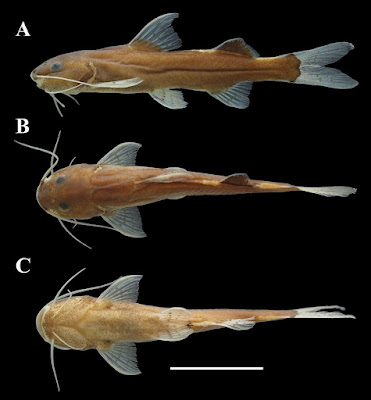
Brachyglaniini is a recently described tribe of Heptapterinae, composed of four genera: Brachyglanis, Gladioglanis, Leptorhamdia, and Myoglanis. Expeditions to the Aripuanã and Tapajós River basins revealed an undescribed species of Brachyglaniini, characterized by a conspicuous light-colored band posterior to the head. Our phylogenetic results provide strong evidence that this new Brachyglaniini species belongs to the genus Leptorhamdia and is closely related to L. marmorata and L. aspredinoides. In addition to the color pattern, the new species can be distinguished from its congeners by having 19-22 anal-fin rays and 47 vertebrae.

Keywords: Brazilian shield; Catfish; Integrative taxonomy; Systematics

Image
 Leptorhamdia kamilai
Left column: holotype, DZSJRP 16293, 92.4 mm SL.
Right column: paratypes, LBP 30639, from top to bottom: 66.3 mm SL; 47.8 mm SL; 31.4 mm SL.

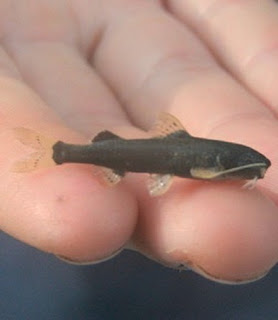
Image
Live specimens of Leptorhamdia kamilai, paratype, LBP 30639, 66.3 mm SL. Photographed by Eric V. Ywamoto. 
 Habitat: rio dos Patos, tributary of the upper Arinos River in Tapajós River basin.

Leptorhamdia kamilai, new species

 Diagnosis. Leptorhamdia kamilai can be readily distinguished among its congeners by having a conspicuous light collar-band, yellowish in live specimens, posterior to the head (vs. coloration uniformly throughout body and head, lacking any distinctive bar). Additionally, L. kamilai differs from its congeners by having 19-22 anal-fin rays (vs. 17 in L. essequibensis; 15 in L. marmorata; 32-35 in L. aspredinoides; 12 in L. nocturna, 15-16 in L. schultzi) and by having 46-47 vertebrae (vs. 45 in L. essequibensis; 43 in L.marmorata; 38 in L. nocturna; 56-57 vertebrae in L. aspredinoides and 43 vertebrae in L. schultzi).

Etymology. The specific name, kamilai, honors our dear friend Dr. Kamila Mayumi Duarte Kuabara, an entomologist and lab manager of the Ornithology Department at The Academy of Natural Sciences of Drexel University. A noun in a genitive case.


Gabriel de S. C. Silva, Lais Reia, Camila S. Souza, Eric V. Ywamoto and Claudio Oliveira. 2026. Phylogenetic Placement and Description of A New Species of Leptorhamdia (Siluriformes: Heptapteridae) from the Amazon Basin. Neotrop. ichthyol. 24 (01); DOI: doi.org/10.1590/1982-0224-2025-0037  

Tuesday, December 2, 2025

[Ichthyology • 2025] Cetopsorhamdia ramirezi • Phylogenetic Relationships and Historical Biogeography of Cetopsorhamdia (Siluriformes: Heptapteridae), with Description of a New Species from the Orinoco Basin, Colombia


Image
(A) Cetopsorhamdia ramirezi Cortés-Hernández & DoNascimiento, ,
Holotype, IAvH-P 9723, 87.9 mm SL, Colombia, Casanare, Aguazul, río Únete;
(B) C. boquillae, IAvH-P 13552, 62.0 mm SL, Colombia, Quindío, Finlandia, El Membrillal; (C) C. cf. insidiosa, MHNU-I 1159, 59.5 mm SL, Colombia, Meta, Villavicencio, río Ocoa; (D) C. nasus, CIUA 7809, 68.4 mm SL, Colombia, Valle del Cauca, Ansermanuevo, quebrada el Chanco (photo by José Luis Londoño-López); 

in Cortés-Hernández, Márquez et DoNascimiento, 2025. 
 
Abstract
Cetopsorhamdia as currently classified is corroborated as non-monophyletic, based on a comprehensive multilocus phylogenetic analysis, with complete taxonomic representation from northern South America, and including its type species. However, a subgroup of species that agrees with a previous phylogenetic definition of the genus, based on morphology, is recovered as monophyletic and is designated herein as Cetopsorhamdia sensu stricto. A new species from piedmont tributaries of the Meta and Guaviare Rivers, Orinoco basin in Colombia, was recovered as sister to remaining cis-Andean species of the sensu stricto concept of the genus and is described here. The new species is distinguished from all sensu stricto congeners by a unique combination of characters: distal end of pectoral fin surpassing dorsal-fin origin, adipose-fin base short (12.9–15.9% of SL), lower lobe of caudal fin longer than upper lobe (31.7–37.3% of SL), body homogeneously brown, and 35–36 total vertebrae. A clear vicariant cis- and trans-Andean pattern is obtained for species of Cetopsorhamdia sensu stricto, predating isolation of present Magdalena and Lake Maracaibo basins by orogenesis of the Eastern Cordillera and Mérida Andes, respectively.

Image
Left lateral view of (A) Cetopsorhamdia ramirezi, holotype, IAvH-P 9723, 87.9 mm SL, Colombia, Casanare, Aguazul, río Únete;
(B) C. boquillae, IAvH-P 13552, 62.0 mm SL, Colombia, Quindío, Finlandia, El Membrillal; (C) C. cf. insidiosa, MHNU-I 1159, 59.5 mm SL, Colombia, Meta, Villavicencio, río Ocoa;
 (D) C. nasus, CIUA 7809, 68.4 mm SL, Colombia, Valle del Cauca, Ansermanuevo, quebrada el Chanco (photo by José Luis Londoño-López); (E) C. picklei, IAvH-P 11805, 125.5 mm SL, Colombia, Norte de Santander, río Zulia. Scale bar 5 mm.

Cetopsorhamdia ramirezi Cortés-Hernández and DoNascimiento, new species 

Etymology.—The specific epithet honors Hernando Ramírez Gil, for his invaluable contribution to the knowledge and conservation of ornamental and food fishes in Colombia


Miguel Ángel Cortés-Hernández, Edna J. Márquez, and Carlos DoNascimiento. 2025. Phylogenetic Relationships and Historical Biogeography of Cetopsorhamdia (Siluriformes: Heptapteridae), with Description of a New Species from the Orinoco Basin, Colombia. Ichthyology & Herpetology. 113(4), 667-681. DOI: doi.org/10.1643/i2025051 (28 November 2025). 

Cetopsorhamdia como es actualmente clasificado es corroborado como no monofilético, con base en un análisis filogenético multilocus exhaustivo, con representación taxonómica completa del norte de Sudamérica, e incluyendo su especie tipo. Sin embargo, un subgrupo de especies que concuerda con una definición filogenética previa del género, con base en morfología, es recuperado como monofilético y es designado aquí como Cetopsorhamdia sensu stricto. Una especie nueva de tributarios de piedemonte de los ríos Meta y Guaviare, cuenca del Orinoco en Colombia, fue recuperada como hermana de las especies cisandinas del concepto sensu stricto del género y es descrita aquí. La especie nueva se distingue de todos sus cóngeneres sensu stricto por una combinación única de caracteres: extremo distal de la aleta pectoral sobrepasando el origen de la aleta dorsal, base de la aleta adiposa corta (12,9–15,9% de LE); lóbulo inferior de la aleta caudal más largo que el lóbulo superior (31,7–37,3% de LE), cuerpo homogéneamente marrón y 35–36 vértebras totales. Un claro patrón vicariante cis y transandino es obtenido para las especies de Cetopsorhamdia sensu stricto, antecediendo el aislamiento de las actuales cuencas del Magdalena y del lago de Maracaibo, por la orogénesis de la cordillera oriental y de los Andes de Mérida, respectivamente.

Thursday, July 10, 2025

[Ichthyology • 2025] Magdalenichthys lundbergi, M. poira, ... • An unexpectedly diverse New Genus of Catfishes (Siluriformes: Heptapteridae) endemic to the Magdalena River Basin, Colombia


Image
Magdalenichthys DoNascimiento, Conde-Saldaña, Albornoz-Garzón & Villa-Navarro gen. nov.

Magdalenichthys lundbergi 
DoNascimiento, Villa-Navarro, Ortega-Lara, Albornoz-Garzón, Méndez-López & Conde-Saldaña,
M. mompox DoNascimiento, Villa-Navarro, Albornoz-Garzón, Méndez-López & Conde-Saldaña,
M. poira Villa-Navarro, DoNascimiento, Albornoz-Garzón, Méndez-López & Conde-Saldaña,
M. yariguies DoNascimiento, Albornoz-Garzón, Méndez-López, Villa-Navarro & Conde-Saldaña 

in DoNascimiento, Villa-Navarro, Albornoz-Garzón, Conde-Saldaña, Silva, Méndez-López, Roxo, Ortega-Lara et Oliveira, 2025. 

Abstract
A new genus of heptapterid catfish, Magdalenichthys gen. nov., largely ignored for the past two decades is herein described. Comprehensive examination of specimens in Colombian ichthyological collections and additional samplings in the Magdalena basin were the base for an integral analysis using morphological characters, DNA barcode delimitation, and molecular phylogenetic analyses to assess monophyly and relationships of the new genus, and to delimit and diagnose four new species, Magdalenichthys lundbergi sp. nov., Magdalenichthys mompox sp. nov., Magdalenichthys poira sp. nov., and Magdalenichthys yariguies sp. nov., endemic to the Magdalena basin. The new genus is phylogenetically diagnosed. Maximum likelihood, Bayesian inference, and coalescent-based analyses with ultraconserved elements (UCEs) data, place the new genus as sister to Phenacorhamdia, within a clade also containing Cetopsorhamdia and Pariolius, consistent with the finding of two apomorphic characters shared by the new genus and Phenacorhamdia. The biogeographic pattern of the new genus (restricted to the Magdalena basin) is also discussed.

Andes, DNA barcode, freshwater fishes, iterative taxonomy, phylogenomics, South America, species delimitation, systematics, trans-Andean, ultraconserved elements

Image

Magdalenichthys DoNascimiento, Conde-Saldaña, Albornoz-Garzón & Villa-Navarro gen. nov.
 
Type species: Magdalenichthys lundbergi DoNascimiento, Villa-Navarro, Ortega-Lara, Albornoz-Garzón, Méndez-López & Conde-Saldaña sp. nov.

Diagnosis: A member of the tribe Heptapterini as defined by Silva et al. (2021). Magdalenichthys is distinguished from all other heptapterids by a single autapomorphy: posterolateral corner of lateral ethmoid with pointed posterior process, extending parallel and adjacent to the lateral margin of neurocranium, contacting the lateral margin of frontal, at level of anterior region of orbitosphenoid (vs. posterolateral region of lateral ethmoid devoid of any process, ending at posterior articulation with orbitosphenoid) (Fig. 1). Additionally, Magdalenichthys can be recognized from all members of Heptapterini (except Phenacorhamdia Dahl, 1961) by having a prognathous mouth (vs. terminal, subterminal, or ventral). Magdalenichthys differs from Phenacorhamdia by having an upper caudal-fin lobe longer than the lower lobe (vs. lower caudal-fin lobe longer) and hemal spines of vertebrae dorsal to insertion of anal fin simple (vs. bifid). Another character useful for its recognition among Heptapterini species from the Magdalena basin (except Imparfinis timana Ortega-Lara, Milani, DoNascimiento, Villa-Navarro & Maldonado-Ocampo, 2011) is the adipose-fin shape roughly rectangular [vs. rounded in Cetopsorhamdia boquillae Eigenmann, 1922 or triangular in Cetopsorhamdia molinae Miles, 1943, Cetopsorhamdia nasus, Imparfinis nemacheir (Eigenmann & Fisher, 1916), and Imparfinis usmai Ortega-Lara, Milani, DoNascimiento, Villa-Navarro & Maldonado-Ocampo, 2011], being further and easily recognized from I. timana by its shorter maxillary barbel, never surpassing the distal edge of the pectoral fin (vs. extending at least to the pelvic-fin base), and pelvic-fin origin at vertical though dorsal-fin origin or slightly posterior (vs. inserted at or slightly posterior to middle of dorsal-fin base).

Included species: Magdalenichthys lundbergi sp. nov., Magdalenichthys mompox sp. nov., Magdalenichthys poira sp. nov., Magdalenichthys yariguies sp. nov.

Etymology: In allusion to the Magdalena River basin, remarking on the restricted geographic distribution of this heptapterid genus to the Cauca and Magdalena rivers, which together form the main hydrographic basin of the trans-Andean region of Colombia, framed by the Western, Central, and Eastern cordilleras, the most salient feature of the Colombian geomorphology. Gender masculine.


Magdalenichthys lundbergi DoNascimiento, Villa-Navarro, Ortega-Lara, Albornoz-Garzón, Méndez-López & Conde-Saldaña sp. nov.

Etymology: The species name is dedicated to John G. Lundberg, in recognition of its seminal contributions to the systematics of pimelodoid and heptapterid catfishes, and for being an inspiring milestone in the first author’s career.

Magdalenichthys mompox DoNascimiento, Villa-Navarro, Albornoz-Garzón, Méndez-López & Conde-Saldaña sp. nov.

Etymology: The species name refers to the Cacique Mompoj of the Malibú tribe that once inhabited the region today corresponding to the municipality of Santa Cruz de Mompox, within the so-called Momposina Depression. This indigenous group was exterminated by the Spanish armies of Gerónimo Lebrón and Alonso Martín, during the Cesar massacre of 1540. Used as a noun in apposition.


Magdalenichthys poira Villa-Navarro, DoNascimiento, Albornoz-Garzón, Méndez-López & Conde-Saldaña sp. nov.

Etymology: The name poira is the most important indigenous mythological figure of the Tolima department and refers to the mischievous and libertine Mohán, who is a human-like being (when it appears in the form of a child or adolescent), with a face tanned by the sun, and penetrating and rougish eyes. The poira enchants and attracts young women, who often go to wash clothes on the banks of the river. Used as a noun in apposition.

Magdalenichthys yariguies DoNascimiento, Albornoz-Garzón, Méndez-López, Villa-Navarro & Conde-Saldaña sp. nov.

Etymology: The name yariguies honours the exterminated indigenous group that inhabited the río Cascajales drainage. Used as a noun in apposition.

 
Carlos DoNascimiento, Francisco Antonio Villa-Navarro, Juan G Albornoz-Garzón, Cristhian C Conde-Saldaña, Gabriel S C Silva, Alejandro Méndez-López, Fábio F Roxo, Armando Ortega-Lara and Claudio Oliveira. 2025. An unexpectedly diverse New Genus of Catfishes (Siluriformes, Heptapteridae) endemic to the Magdalena River Basin, Colombia. Zoological Journal of the Linnean Society. 204(3); zlaf048. DOI: doi.org/10.1093/zoolinnean/zlaf048 [08 July 2025]

Sunday, April 27, 2025

[Ichthyology • 2025] Imparfinis arceae • Integrative Taxonomy Reveals a New Species of Imparfinis (Siluriformes: Heptapteridae) from the Upper Xingu River Basin


Image
Imparfinis arceae
 Silva, Sabaj, Carvalho & Oliveira, 2025 


Abstract  
Imparfinis is a genus of small catfishes with 21 valid species broadly distributed throughout the main river basins of the Neotropical region. Here, a new species of Imparfinis is described from the headwaters of the Rio Xingu. The new species is distinguished from its congeners by the presence of a wide dark stripe from snout tip to caudal peduncle sharply contrasting pale underside and aligned with dark stripe centered on dorsal portion of lower caudal-fin lobe, 11–12 gill rakers on the first ceratobranchial, 39 vertebrae, maxillary barbel surpassing vertical through dorsal-fin origin, and absence of short, flexible extension of the anteriormost pectoral, dorsal, and upper caudal-fin rays. In addition, assemble species by automatic partitioning (ASAP) and the Poisson tree processes model (bPTP) analyses support the validity of this new species. Our molecular phylogeny based on the cytochrome c oxidase subunit 1 mitochondrial gene (COI) corroborates the placement of the new species in Imparfinis and its close relationship with I. guttatus. Species delimitation in Imparfinis is discussed.

Image
Imparfinis arceae
Left column: holotype, MCP 55325, 47.9 mm SL.
Right column: ANSP 187252, from top to bottom: 50.5 mm SL; 43.9 mm SL; 40.6 mm SL; 36.9 mm SL.

Image

Imparfinis arceae, new species 

Etymology.—The specific name, arceae, honors Dr. Mariangeles Arce Hernández, Executive Director of the Center for Systematic Biology and Evolution at The Academy of Natural Sciences of Drexel University, for her valuable contributions to studies of the systematics and evolution of catfishes. A genitive noun.
 

Gabriel de Souza da Costa e Silva, Mark Henry Sabaj, Kaylane Rodrigues de Carvalho and Claudio Oliveira. 2025. Integrative Taxonomy Reveals a New Species of Imparfinis (Siluriformes: Heptapteridae) from the Upper Xingu River Basin. Ichthyology & Herpetology. 113(1); 143-153. DOI: doi.org/10.1643/i2023097 (3 April 2025) 

Monday, April 22, 2024

[Ichthyology • 2024] Pimelodella guato • A New Species of Pimelodella (Siluriformes: Heptapteridae) from the Paraguai Basin, Brazil, with a discussion regarding its distribution


Image
 Pimelodella guato
Pierre & Slobodian, 2024


Abstract​ 
A new species of Pimelodella is described from the rio Paraguai basin in Mato Grosso do Sul and Mato Grosso States, Brazil. The new species distinguishes from all other members of the genus based on a unique combination of characteristics, which include: dorsal profile straight from snout to dorsal-fin, maxillary barbel reaching at least the anal-fin terminus when parallel to main body axis, robust dorsal-fin spine bearing small spinules along three-fourths of its posterior margin, 41–42 total vertebrae (rarely 43 or 44), 13–23 large and retrorse blades at the posterior margin of the pectoral-fin spine, and dorsolateral region of body slightly darkened. This study also discusses the ichthyofaunal similarities between the Paraguai and Amazon basins, shedding light on their biogeographic history. Additionally, the research includes considerations about the sexual dimorphism of Pimelodella and provides an identification key for the Pimelodella species found in the Paraguai basin.

Keywords: Biogeography, Catfishes, Identification key, Sexual dimorphism, Taxonomy.

Image
 Pimelodella guato, holotype, ZUFMS-PIS 8515, 78.5 mm SL, Brazil, Mato Grosso do Sul, Corumbá municipality, rio Paraguai basin, rio Miranda, sandy beaches at Passo do Lontra region, ...
 A. Dorsal; B. Left lateral; and C. Ventral views. Scale bar = 1 cm.

Pimelodella guato, new species

Diagnosis. Pimelodella guato differs from all Pimelodella species except P. boliviana, P. chaparae, P. cristata, P. cruxenti, P. dorseyi, P. geryi, P. gracilis, P. howesi, P. humeralis, P. laurenti, P. longibarbata, P. longipinnis, P. martinezi, P. megalops, P. mucosa, P. notomelas, P. odynea, P. ophthalmica, P. parnahybae, P. serrata, P. steindachneri, P. taeniophora, P. tapatapae, P. wesselii, and P. witmeri by the long maxillary barbel, reaching at least the anal-fin terminus when parallel to main body axis (vs. reaching at best posterior limit of anal-fin base). It differs from P. longipinnis and P. tapatapae by having the supraoccipital process reaching the anterior nuchal plate (vs. not reaching, gap between distal terminus of supraoccipital process and anterior nuchal plate ca. 20–25% of supraoccipital process length). It differs from P. boliviana, P. cruxenti, P. geryi, P. laurenti, P. martinezi, P. megalops, P. notomelas, P. odynea, and P. taeniophora by having a robust dorsal-fin spine, bearing small, straight spinules along three-fourths of its posterior margin (vs. dorsal-fin spine not particularly robust, with posterior margin spinules inconspicuous or absent). It differs from P. cristata, P. dorseyi, P. gracilis, P. howesi, P. humeralis, P. ophthalmica, P. parnahybae, P. steindachneri, P. wesselii,and P. witmeri by usually having 41–42 (rarely 43 or 44) total vertebrae (vs. always 43–44 in P. howesi; 46 or more in the remaining species). It further differs from P. howesi by having the dorsolateral region of body slightly darkened (vs. not darkened), dorsal fin with light brown stripe near its origin, followed by a hyaline stripe, and distal half dark (vs. basal half of dorsal fin hyaline, and distal half dark), and by the dorsal lamina of the Weberian apparatus reaching the ventral margin of the supraoccipital process only at its first third (vs. dorsal lamina reaching the supraoccipital process along all its extension). It differs from P. mucosa and P. longibarbata by the preoperculomandibular laterosensory canal openings at dentary not particularly large (vs. large openings). It differs from P. chaparae, P. longibarbata, and P. serrata by the wide midlateral stripe (vs. narrow) and by the dorsal lamina of the Weberian apparatus reaching the ventral margin of the supraoccipital process only at its first third (vs. first half in P. longibarbata; and almost its entire extension in P. chaparae and P. serrata) (Figs. 2A, D).

Etymology. The species name guato is in honor of the indigenous Guató people, who are affectionately known as “people of the Pantanal waters” due to their primary mode of transportation, canoes. Historically, the Guató people inhabited an extensive area along the rio Paraguai (Schmidt, 1942). However, in the 1940s, they began to lose their territory due to cattle ranching, and many relocated to cities such as Cáceres and Corumbá. This dispersal led to a reduction in the Guató population, and since then, they have been fighting for recognition of their ethnicity and the demarcation of their lands (Costa, 2015). The choice of guato is a homage to the resilience and cultural significance of these people who inhabit the same region where the new species is found. It also recognizes the ongoing struggles with land delimitation that indigenous communities continue to face, particularly in Brazil. A noun in apposition.


Veida Pierre and Veronica Slobodian. 2024. A New Species of Pimelodella (Siluriformes: Heptapteridae) from the Paraguai Basin, Brazil, with a discussion regarding its distribution. Neotrop Ichthyol. 22(1): e230110. DOI: 10.1590/1982-0224-2023-0110

Friday, September 9, 2022

[Ichthyology • 2022] Redefinition of Heptapterus (Heptapteridae) and Description of Heptapterus carmelitanorum, A New Species from the upper Paraná River Basin in Brazil


Image
Heptapterus carmelitanorum
Azevedo-Santos, Deprá, Aguilera, Faustino-Fuster & Katz, 

in Deprá, Aguilera, Faustino-Fuster, Katz & Azevedo-Santos, 2022. 

Abstract
A new diagnosis and a new classification of Heptapterus are provided and a new species, H. carmelitanorum, is described. Heptapterus is diagnosed by the following character combination: adipose fin confluent with the caudal fin; non-bifurcate caudal fin; anal-fin insertion posterior to vertical through adipose-fin insertion; 10–23 anal-fin rays; anal fin not confluent with caudal fin; and extremely elongate body, with a head length of 16.1–24.9%SL. Species included in Heptapterus are H. borodini, H. carmelitanorum, H. carnatus, H. exilis, H. hollandi, H. mandimbusu, H. mbya, H. mustelinus, H. ornaticeps, and H. qenqo. Some of the character states diagnosing H. carmelitanorum among its congeners are the anal-fin insertion less than one eye diameter posterior to a vertical through the adipose-fin insertion (vs. more than one eye diameter in all congeners); the isognathous mouth (vs. slightly to moderately retrognathous, except H. borodini); and the keel formed by ventral procurrent caudal-fin rays shallow, far from reaching anal-fin base (vs. keel formed by ventral procurrent caudal-fin rays deep, continuing almost to the anal-fin base, except in H. borodini and H. hollandi).

Key Words: ‘Chasmocranus’ brachynema, Grande River basin, Heptapterus mustelinus, Imparfinis borodini, Imparfinis hollandi, Minas Gerais, Pariolius, Sapucaí River basin, Siluriformes

Image
Heptapterus carmelitanorum, new species, holotype, coloration in life.

Image
Heptapterus carmelitanorum, new species, holotype, MNRJ 53174, 144.3 mm SL;
a. Dorsal view; b. Lateral view; c. Ventral view.

Heptapterus carmelitanorum sp. nov., Azevedo-Santos, Deprá, Aguilera, Faustino-Fuster & Katz
 
‘Heptapterus’ sp.: - Azevedo-Santos et al. (2019) (listed in a survey).
 
Diagnosis: Heptapterus carmelitanorum differs from all congeners by possessing the anal-fin insertion less than one eye diameter posterior to a vertical through the adipose-fin insertion (vs. more than one eye diameter posterior). From all congeners, except H. borodini, by an isognathous mouth (vs. slightly to moderately retrognathous). It differs from all other congeners except H. borodini and H. hollandi, by the keel formed by ventral procurrent caudal-fin rays shallow, far from reaching anal-fin base (vs. keel formed by ventral procurrent caudal-fin rays deep, continuing almost to the anal-fin base, even though its anterior portion is devoid of fin rays) (Fig. 5). It differs from both H. borodini and H. hollandi by having an almost elliptical caudal fin (vs. lanceolate in H. borodini, obliquely truncate to falcate in H. hollandi; Fig. 6), the length of its dorsal lobe 18.3–19.3% SL (vs. 24.4–43.3% SL in H. borodini). Additionally, H. carmelitanorum differs from all other congeners, except H. carnatus, H. mbya, H. qenqo, and some specimens of H. hollandi, by having inconspicuous dorsal bars (vs. conspicuous). From H. borodini, H. carnatus, H. exilis, H. hollandi, H. mustelinus, and H. ornaticeps, by having 14–15 anal-fin rays (vs. 10–12 in H. borodini and H. hollandi; 18–21 in H. carnatus; 16–19 in H. exilis; 18–23 in H. mustelinus; and 19 in H. ornaticeps). Differs from H. exilis by the complete lateral line (in adults), continuous to base of hypural plate (vs. incomplete, not reaching dorsal-fin insertion). Heptapterus carmelitanorum further differs from H. hollandi by having i,6 dorsal-fin rays (vs. i,7).

Image
Partial view (i.e., stretch) of the stream where the type specimens of Heptapterus carmelitanorum were sampled.

Etymology: The specific name is a noun in apposition derived from Carmelitanos (in Portuguese), the local appellation of people born or living in Carmo do Rio Claro (Minas Gerais, Brazil), the city where the species was discovered. The name is in honor of Carmelitanos, especially Ana Maria Vilela Soares, José Cândido de Mello Carvalho, Moara Lemos, and Carlos Roberto Bueno Júnior, for their contributions to biological science.

Image

 Gabriel de Carvalho Deprá, Gastón Aguilera, Dario R. Faustino-Fuster, Axel M. Katz and Valter M. Azevedo-Santos. 2022. Redefinition of Heptapterus (Heptapteridae) and Description of Heptapterus carmelitanorum, A New Species from the upper Paraná River Basin in Brazil. Zoosystematics and Evolution. 98(2): 327-343.  DOI: 10.3897/zse.98.89413
 
Image

Thursday, May 19, 2022

[Ichthyology • 2022] Phenacorhamdia suia • A New Species of Phenacorhamdia (Siluriformes: Heptapteridae) from the Xingu River Basin


Image
Phenacorhamdia suia 
 Silva, Ochoa & Castro, 2022

Photographed by Dario Faustino-Fuster.

Heptapteridae is a diverse group of catfishes composed of 231 valid species endemic to the Neotropical region, recognized in two subfamilies: Rhamdiinae and Heptapterinae. Phenacorhamdia is a Heptapterinae member and currently has 13 valid species broadly distributed throughout the main river basins of South America. Here we described a new species of Phenacorhamdia from the Xingu River basin. Morphological data were obtained from 30 specimens under 23 morphometric measures and 6 meristic counts. The new species differs from congeners based on the exclusive combination of the following diagnostic characters: atypical mottled colored body and all fins with interradial membranes mottled pigmented; multicuspid teeth; maxillary barbel reaching pectoral-fin origin; lacking a short extension of the first pectoral-fin ray; caudal fin lobes extremely elongated and pointed; and 43−45 total vertebrae.

Keywords: Amazon River basin, Brazilian Shield, Catfishes, Taxonomy.


Image
Phenacorhamdia suia, MNRJ 24850, holotype, 81.8 mm SL,
Brazil, Mato Grosso State, São Félix do Araguaia, upper Xingu River basin.
Photographed by Dario Faustino-Fuster.

Phenacorhamdia suia, new species

Diagnosis. Phenacorhamdia suia differs from all congeners by having an atypical mottled colored body (Figs. 1−2) (vs. uniformly counter-shaded, without mottled pattern; with a longitudinal dark brown stripe along the dorsal half of the body in P. unifasciata), and by having all fins with interradial membranes pigmented and mottled (vs. fins with interradial membranes hyaline). Additionally, P. suia differs from all congeners, except P. taphorni by having multicuspid teeth (vs. conical teeth) (Fig. 3). The new species differs from some of its congeners by maxillary barbel reaching pectoral-fin origin (vs. maxillary barbel reaching the end of adpressed pectoral fin in P. anisura, P. boliviana, P. nigrolineata, and P. tenebrosa; reaching half the length of pectoral fin in P. tenuis; surpassing pectoral fin in P. provenzanoi and P. taphorni; reachingpelvic-fin origin in P. macarenensis); lacking a short extension of the first pectoral-fin ray (vs. present in P. anisura, P. macarenensis, P. nigrolineata, P. provenzanoi, and P. taphorni), by caudal fin deeply forked with extremely elogated and pointed lobes (vs. moderately pointed in P. hoehnei; rounded in P. somnians); and by having 43−45 total vertebrae (vs. 39 in P. taphorni; 41 in P. hoehnei; 41−42 in P. tenebrosa;46−47 P. unifasciata; 47−48 in P. provenzanoi; 53−55 in P. tenuis). 

Etymology. The specific name “suia” refers to the Suias indigenous people who, since the 90’s, have stood out in the fight to protect the Suiá-Missu River environment and for recovery of their traditional lands outside the limits of Xingu park. A noun in apposition.


 Gabriel S. C. Silva, Luz E. Ochoa and  Íthalo S. Castro. 2022. New Species of Phenacorhamdia (Siluriformes: Heptapteridae) from the Xingu River Basin. Neotrop Ichthyol. 20(2); e210143.  DOI: 10.1590/1982-0224-2021-0143

Image

Resumo: Heptapteridae é um grupo diverso de bagres neotropicais composto por 231 espécies válidas, endêmicas da região Neotropical, divididas em duas subfamílias: Rhamdiinae e Heptapterinae. Phenacorhamdia é um membro de Heptapterinae e atualmente possui 13 espécies válidas amplamente distribuídas pelos principais rios da América do Sul. Aqui nós descrevemos uma nova espécie de Phenacorhamdia da bacia do rio Xingu. Dados morfológicos foram obtidos de 30 espécimes, 23 medidas morfométricas e seis contagens merísticas. A nova espécie é diferenciada de suas congêneres com base na seguinte combinação de características: um atípico corpo manchado com as membranas interradiais de todas as nadadeiras manchadas; dentes multicuspidados; barbilhão maxilar atingindo a origem da nadadeira peitoral; ausência de uma curta extensão do primeiro raio da nadadeira peitoral; lóbulos da nadadeira caudal extremamente alongados e pontiagudos, e 43−45 vértebras.
Palavras-chave: Bacia do rio Amazonas; Bagres; Escudo Brasileiro; Taxonomia

Friday, October 29, 2021

[Ichthyology • 2021] Cetopsorhamdia hidalgoi • A New Species of Cetopsorhamdia (Siluriformes: Heptapteridae) from the Upper Amazon River Basin


Image
Cetopsorhamdia hidalgoi
Faustino-Fuster & de Souza, 2021

 
Abstract
A new species of Cetopsorhamdia is described from material collected on rapid inventories and ichthyological expeditions in the Amazon region of Peru, Ecuador and Colombia. The new species can be differentiated from all other species of Cetopsorhamdia by the colouration pattern on fins, number of vertebrae, number of ribs, level insertion of dorsal fin, number of rays on dorsal and pectoral fin, osteological characters and several other morphometric characters. The new species is distributed along tributaries of the upper Amazon River basin in Peru, Colombia and Ecuador.

Keywords: fresh water, Neotropical, taxonomy, three-barbel catfish

Image
Cetopsorhamdia hidalgoi. MUSM 69550, holotype, 30.7 mm LS, Peru, Loreto, Requena, Tapiche River tributary to Ucayali River basin.
 (a) Lateral view, (b) dorsal view and (c) ventral view. Black arrow indicates the urogenital papillae.
Scale bar = 1 cm

Cetopsorhamdia hidalgoi new species


Etymology: Named in honour of the authors’ colleague and friend Max Hidalgo, professor, and curator of the Ichthyology Department at the Museo de Historia Natural in the Universidad Nacional Mayor de San Marcos (MUSM) for his devotion and dedication to Peru Ichthyology. Hidalgo collected the holotype, in addition to many specimens of the type series on expeditions including several rapid inventories in Peru that have led to the creation of multiple conservation areas.

 Geographic distribution: C. hidalgoi is known from the Ucayali, Marañón, Napo and Orteguaza rivers tributaries of the Upper Amazon River in Peru, Ecuador and Colombia and from the Madre de Dios River tributary of the Madeira River basin in Peru (Figure 6).

 Ecology: Found in clearwater streams with modest flow, substrate often with submerged leaves and sand.

Image


Dario R. Faustino-Fuster and Lesley S. de Souza. 2021. A New  Species of Cetopsorhamdia (Siluriformes: Heptapteridae) from the Upper Amazon River basin. Journal of Fish Biology. DOI: 10.1111/jfb.14914

Sunday, December 13, 2020

[Ichthyology • 2020] Phenacorhamdia roxoi • A New Species of Phenacorhamdia Dahl 1961 (Siluriformes: Heptapteridae) from the Paranapanema River Basin, southeastern Brazil


Image
Phenacorhamdia roxoi
Silva, 2020


Abstract

A new species of Phenacorhamdia is described from Paranapanema River, Upper Paraná River basin, southeastern Brazil. The new species is distinguished from congeners by the combination of following characters 45−46 vertebrae; an entirely dark-brown body; nine pleural ribs; eight branched rays in upper lobe of caudal fin; seven branched rays in pectoral fin; 13 anal-fin rays with 9−10 branched; first basal radial inserted at the 13th vertebrae and eight branchiostegal rays.

Keywords: Siluriformes, Catfishes, Neotropical freshwaters fishes, Taxonomy, Upper Paraná River basin


Image


Gabriel S. C. Silva. 2020. A New Species of Phenacorhamdia Dahl 1961 (Siluriformes: Heptapteridae) from the Paranapanema River Basin, southeastern Brazil. Zootaxa. 4890(2); 275–282. DOI: 10.11646/zootaxa.4890.2.8

Wednesday, December 4, 2019

[Ichthyology • 2019] Imparfinis munduruku • A New Species of Imparfinis Eigenmann & Norris, 1900 (Siluriformes: Heptapteridae) from the Tapajós Basin, Brazil


Image
Imparfinis munduruku
Castro & Wosiacki, 2019


Abstract
Imparfinis comprises 20 valid species in the Heptapteridae, being the most diverse taxonomic group of catfishes of the Nemuroglanis subclade. The genus has one of the widest geographical distributions in the neotropical region, found on both sides of the Andes, from Costa Rica to the Paraná and Uruguay river basins in Argentina. A new species of Imparfinis is described from streams of the upper Rio Tapajós and its tributary Teles Pires in northern Brazil. The new species is diagnosed from all congeners by the presence of a vertical dark brown band W-shaped at the base of the caudal-fin rays, a thick dark brown lateral stripe from the snout to the end of the caudal peduncle, dark brown head, long maxillary barbel surpassing the distal margin of the pectoral fin, and presence of 39 or 40 total vertebrae.

Keywords: Pisces, Color pattern, freshwater, Neotropical region, taxonomy

Image


Íthalo Da Silva Castro and Wolmar Benjamin Wosiacki. 2019. A New Species of Imparfinis Eigenmann & Norris, 1900 (Siluriformes: Heptapteridae) from the Tapajós Basin, Brazil. Zootaxa. 4701(5); 461–472. DOI: 10.11646/zootaxa.4701.5.6